Introduction
A number (c. 15) of hairy Leptogium species [in the so-called sect.Mallotium (Ach.) Vain.] is known from the Himalayas and adjacent mountain chains (Jørgensen Reference Jørgensen1997), so it came as a surprise to find an additional, new species among recently collected lichen material from Nepal. This new species, described below, increases the number of hairy Leptogium species known from Nepal (Awasthi Reference Awasthi1988) to ten.
The Species
Leptogium sphaerosporum P. M. Jørg. & L. Olley sp. nov
Leptogio burnetiae similis sed thallo subtili, phyllidiato et ascosporis sphaericis.
Typus: Nepal, Langtang, track from Thulo Syabru to Bamboo, c. 1970 m, 16 September 2007, L. R. Sharma, L. Olley & A. Cross AC 7.1 (E—holotypus).
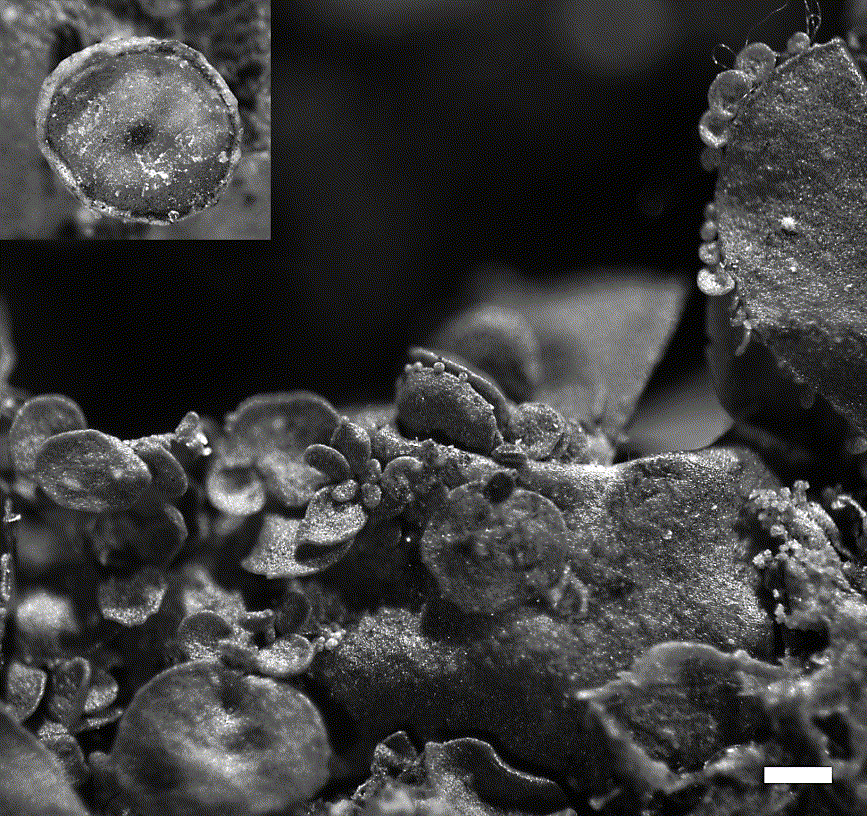
Leptogium sphaerosporum, habitus; inset, an apothecium (E—holotype). Scale = 1 mm.

Thallus foliaceus, bluish grey, to 5 cm wide with orbicular marginal, smooth, non-swelling lobes, 0·5 cm broad, to 150 μm thick Lower surface paler with a dense covering of long-celled, 6–10 × 4 μm, white hairs, to 1mm long.
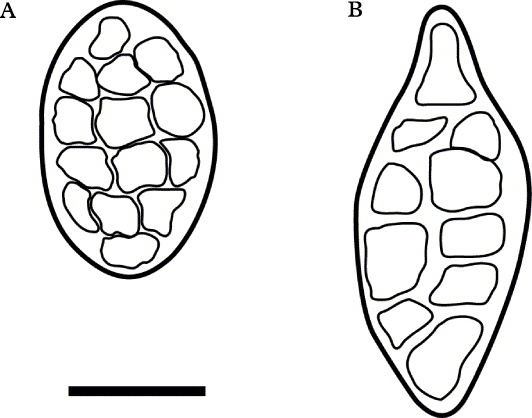
Apothecia scattered, subpedicillate, to 1·5 mm diam. with flat brown disc and pale bluish thalline margin, dentate to phyllidiate, obscuring the proper exciple of periclinal hyphae, 100–150 μm wide. Ascospores colourless, thick-walled, muriform, spheroid, (19–) 20 (–27) × (14–)15(–19) μm with rounded apices.
Conidiomata not observed.
Chemistry. All spot reactions negative, no substances detected by TLC.
Notes. This new species is undoubtedly closely related to Leptogium burnetiae Dodge which occasionally produces some phyllidia, but always has clustered coralloid laminal isidia. It is also close to the non-isidiate, usually fertile Leptogium pedicellatum P. M. Jørg. which likewise may produce phyllidia, but has quite different, ellipsoid ascospores, 25–30 × 10–15 μm with pointed apices (Fig. 2). Both of these species occur in the same region, though at higher altitudes, and there is no overlap in spore-sizes or form. Leptogium sphaerosporum also has a more delicate appearance than these two species, and may easily be overlooked as an underdeveloped (shade) form of them, but the ascospores prove otherwise.
Leptogium sphaerosporum may be included in the world-key to the hairy Leptogium species (Jørgensen Reference Jørgensen1997) in the following way (new numbering in italics):
34 Apothecia distinctly stalked ... 35
Apothecia sessile or shortly stalked ... 36
35 Thallus always phyllidiate; ascospores spheroid, 20–30 × 15–19 μm ... ... L. sphaerosporum
Thallus occasionally phyllidiate; ascospores ellipsoid and acuminate, 25–35 × 10–15 μm ... L. pedicellatum
Habitat and distribution. The type is corticolous and was collected on Alnus nepalensis in an undisturbed, mixed broad-leaved forest (including oak and maple) in the lower temperate zone, at nearly 2000m, a rather shady and humid forest with Castanopsis, Eugenia jambulans, Ficus, Machillus and Rhododendron. Bryophytes dominated the larger trunks and few lichens were found there. Leptogium sphaerosporum may be a local taxon since it was not found among other collections from Nepal. Only one other species of hairy Leptogium species is found at lower altitudes, the subtropical Leptogium trichophorum Müll. Arg., though the little known, but widespread L. askotense Awasthi appears nearly at the same altitude as L. sphaerosporum.
Leptogium species, ascospores. A, L. sphaerosporum; B, L. pedicellatum. Scale = 10 μm.