1. Introduction
The Hellenides in Greece are an integral part of the Alpine–Himalayan orogenic system and have traditionally been subdivided into the internal and the external Hellenides. The internal Hellenides comprise, from SW to NE, the Pelagonian Zone (including the Attic–Cycladic Massif), the Vardar Zone, the Serbo-Macedonian Massif and the Rhodope Massif (e.g. Jacobshagen, Reference Jacobshagen1986). All these units consist predominantly of Palaeozoic (but also Neoproterozoic and Mesozoic) basement rocks (e.g. Engel & Reischmann, Reference Engel and Reischmann1998; Vavassis et al. Reference Vavassis, De Bono, Stampfli, Giorgis, Valloton and Amelin2000; Anders et al. Reference Anders, Reischmann, Poller and Kostopoulos2005, Reference Anders, Reischmann, Kostopoulos and Poller2006; Anders, Reischmann & Kostopoulos, Reference Anders, Reischmann and Kostopoulos2007; Himmerkus, Reischmann & Kostopoulos, Reference Himmerkus, Reischmann, Kostopoulos, Robertson and Mountrakis2006; Turpaud, Reference Turpaud2006; Cornelius et al. Reference Cornelius, Reischmann, Frei and Kostopoulos2007; Himmerkus et al. Reference Himmerkus, Anders, Reischmann, Kostopoulos, Hatcher, Jr, Carlson, McBride and Martínez Catalán2007) overlain by or intercalated with sedimentary successions. They experienced quite complex Mesozoic to Cenozoic tectonism, which gave rise to equivocal palinspastic models and interpretations. Late Palaeozoic and Mesozoic palaeotectonic reconstructions show the existence of two major oceanic realms in the Eastern Mediterranean, namely the Palaeotethys and the Neotethys (e.g. Stampfli & Borel, Reference Stampfli and Borel2002, and references therein). Following Stampfli & Borel (Reference Stampfli and Borel2002) the term Palaeotethys is used here to denote a seaway that separated Gondwana from its detached fragments between the Silurian and early Late Triassic, during which time the same fragments drifted northward and accreted to Laurussia in a stepwise fashion. The Palaeotethys was closed by the northward drift of the Cimmerian terranes in response to the opening of Neotethys in the south. In the eastern Aegean Sea, Chios Island (Fig. 1a) seems to be a key area for understanding the closure of the Palaeotethys Ocean because it is one of the rare localities where very-low-grade to virtually unmetamorphosed fossil-bearing Palaeozoic to Mesozoic sequences are preserved (e.g. Besenecker et al. Reference Besenecker, Dürr, Herget, Jacobshagen, Kauffmann, Lüdtke, Roth and Tietze1968; Meinhold et al. Reference Meinhold, Reischmann, Kostopoulos, Lehnert, Matukov and Sergeev2008). Chios is generally assigned to the easternmost part of the Pelagonian Zone (e.g. Jacobshagen, Reference Jacobshagen1986; see Meinhold, Kostopoulos & Reischmann, Reference Meinhold, Kostopoulos and Reischmann2007, for discussion) and may form an important link to the Sakarya–Anatolide–Tauride units in Turkey since detrital zircon ages indicate that basement rocks from the Sakarya basement supplied detritus to the Permian–Triassic clastic sediments of Chios (Meinhold et al. Reference Meinhold, Reischmann, Kostopoulos, Lehnert, Matukov and Sergeev2008). Unlike Chios, the affiliation and the stratigraphic age of metasedimentary successions from the neighbouring islands of Inousses and Psara are still speculative because of the monotonous character of their sedimentary successions, the lack of fossils and radiometric data and the greenschist-facies metamorphic overprint. Therefore, the islands of Inousses and Psara are the focus of this study.
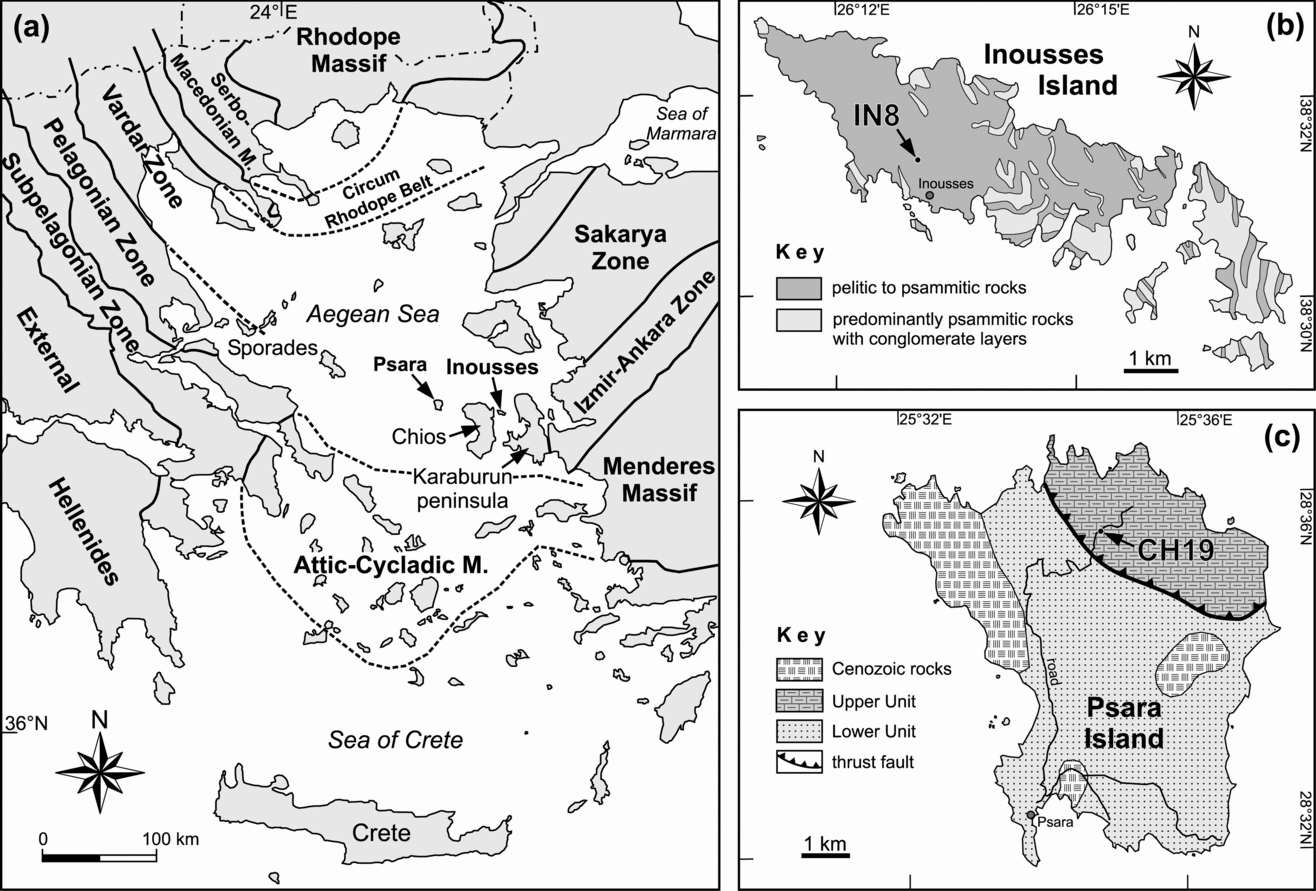
(a) Map of Greece and western Turkey showing the main geotectonic units (after Jacobshagen, Reference Jacobshagen1986; Okay, Satır & Siebel, Reference Okay, Satir, Siebel, Gee and Stephenson2006). The islands of investigation are indicated by black arrows. (b, c) Simplified geological maps of the island of Inousses and Psara (modified from Meinhold et al. Reference Meinhold, Kostopoulos and Reischmann2007). The localities of samples used for zircon dating are indicated by black arrows.

Here, we present for the first time high-spatial-resolution U–Pb dating by laser ablation sector-field inductively-coupled plasma mass spectrometry (LA–SF–ICP–MS) of detrital zircons from two metasedimentary samples of Inousses and Psara to evaluate potential source regions and ancient major magmatic events. Provenance data are of specific interest for palaeotectonic reconstructions of the Tethyan realm. Furthermore, in the absence of fossil and other stratigraphic data, the youngest grain (e.g. zircon) in a sedimentary rock can indicate a maximum limit for the age of deposition (e.g. Fedo, Sircombe & Rainbird, Reference Fedo, Sircombe, Rainbird, Hanchar and Hoskin2003).
2. Geological setting
Inousses (Fig. 1) and its adjacent islets are located east of Chios and west of the Karaburun peninsula of the Turkish mainland to the east. Inousses itself consists of a flysch-like sequence (Kilias, Reference Kilias1987) which can be lithostratigraphically subdivided into a lower and an upper part (see Meinhold, Kostopoulos & Reischmann, Reference Meinhold, Kostopoulos and Reischmann2007). The lower part is exposed in the south of the island and adjacent islets to the east. It comprises medium- to coarse-grained metasediments including light grey metasandstones and metagreywackes with intercalations of light grey to greenish-grey conglomerate layers. The latter pass upwards into medium- to very-fine-grained metasedimentary rocks including argillaceous metagreywackes and dark grey to black metapelites (phyllites). This lithostratigraphically upper part crops out mainly in the N and NW part of the island. The main structural feature on Inousses is multiple folding with two axial trends (e.g. Kilias, Reference Kilias1987). The major foliation is folded with gently NNW-dipping fold axes. Besenecker et al. (Reference Besenecker, Dürr, Herget, Jacobshagen, Kauffmann, Lüdtke, Roth and Tietze1968) assumed that the epimetamorphic flysch sequence of Inousses is older than the Palaeozoic of the autochthonous Lower Unit of Chios and thus forms its metamorphic basement. Mountrakis et al. (Reference Mountrakis, Sapountzis, Kilias, Eleftheriadis and Christofides1983) correlated the Inousses metamorphic rocks with the Permian–Lower Triassic metasedimentary rocks of the western margin of the Pelagonian Zone of continental Greece and the Sporades Islands. Kilias (Reference Kilias1987) also assumed an affiliation of the Inousses metamorphic rocks to the Pelagonian nappes. All this contradicts the interpretation of Kozur (Reference Kozur and Szaniawski1998) who compared the metasedimentary succession of Inousses with the monotonous siliciclastic Küçükbahçe Formation of the Karaburun peninsula of probable Ordovician (or Cambrian–Ordovician) age (Kozur, Reference Kozur and Szaniawski1998). Based on a chemostratigraphic approach, Meinhold, Kostopoulos & Reischmann (Reference Meinhold, Kostopoulos and Reischmann2007) recently suggested that the protoliths of the metasedimentary succession of Inousses originated from acidic magmatic and sedimentary sources and were deposited in a continental island-arc setting probably in Late Palaeozoic or Triassic times. The succession has been assigned to the Pelagonian nappes of mainland Greece.
Psara is located c. 20 km west of Chios Island in the Aegean Sea (Fig. 1) and consists of two tectonostratigraphic units (see Meinhold, Kostopoulos & Reischmann, Reference Meinhold, Kostopoulos and Reischmann2007, for discussion). The Lower Unit predominantly consists of dark grey metapelites (phyllites), metasandstones and metagreywackes. The major foliation strikes approximately N–S and dips steeply either E or W. The Upper Unit mainly comprises mica schists (with garnets up to 0.8 cm in diameter) intercalated with calcschists and marble layers that pass up into pure marbles at the top. The quartz–muscovite–chlorite–garnet–biotite assemblage of the mica schists suggests mid-upper-greenschist-facies metamorphic conditions (Meinhold, Kostopoulos & Reischmann, Reference Meinhold, Kostopoulos and Reischmann2007). The predominant foliation dips mostly S and is folded with fold axes dipping gently E or W. Unfortunately, in both units neither fossils nor radiometric data are yet available, thus complicating their stratigraphic affiliation. Cenozoic volcanic rocks crop out in the northwestern and central part of Psara. The tectonostratigraphic affiliation of Psara to units in Greece is undecided. Mountrakis et al. (Reference Mountrakis, Sapountzis, Kilias, Eleftheriadis and Christofides1983) correlated both units of Psara with the Subpelagonian Zone of continental Greece, whereas Wallbrecher (in Dürr & Jacobshagen, Reference Dürr, Jacobshagen and Jacobshagen1986) favoured an affiliation to successions from the southern Pelion Peninsula and the northern Sporades of the Pelagonian Zone. Based on a chemostratigraphic approach, Meinhold, Kostopoulos & Reischmann (Reference Meinhold, Kostopoulos and Reischmann2007) recently suggested that the protoliths of the metasedimentary rocks from the Lower Unit and Upper Unit of Psara Island were deposited in a continental island-arc setting and mainly originated from acidic magmatic and sedimentary sources. The abundance of carbonate in the Upper Unit indicates a shallow marine environment. The very-low-grade metasedimentary rocks of the Lower Unit are correlated with the Skiathos Unit, whereas the more carbonate-dominated Upper Unit is assigned to the Pelagonian marble nappe of the northern Sporades Islands and the nearby Pelion Peninsula.
3. Analytical method
For U–Pb geochronology, zircons were separated from the bulk samples using standard techniques (hydraulic press, rotary mill, Wilfley table, Frantz isodynamic magnetic separator and heavy liquids (methylene iodide)). Final purification was carried out by hand-picking under a binocular microscope. Zircon grains were set in epoxy resin mounts, sectioned and polished to approximately half their original thickness. Prior to the analyses, cathodoluminescence (CL) images were obtained for all grains to study their internal structure and to target specific areas within them, e.g. growth structures and inherited cores. The U–Pb isotopic analyses of individual zircon grains were performed using a Thermo-Finnigan Element II sector-field ICP–MS system coupled to a Merchantek/NewWave 213 nm Nd-YAG laser system at the Geological Survey of Denmark and Greenland, Copenhagen, Denmark. The method applied followed that described by Gerdes & Zeh (Reference Gerdes and Zeh2006) and Frei et al. (Reference Frei, Hollis, Gerdes, Harlov, Karlsson, Vasquez, Franz, Johansson and Knudsen2006). For the interpretation of the zircon data, analyses with 95–105% concordance (calculated from 100(206Pb–238U age)/(207Pb–235U age)) are considered to be concordant. Analyses with a discordance >10% were rejected and consequently not considered for data interpretation. Unless stated otherwise, 206Pb–238U ages are used for zircon grains <1.2 Ga whereas older grains are quoted using their 207Pb–206Pb ages. This is because the 207Pb–206Pb ages become increasingly imprecise below 1.2 Ga due to small amounts of 207Pb. The 207Pb–206Pb ages are generally considered as minimum ages due to the effect of possible Pb loss. Concordia diagrams and probability density distribution and histogram plots were produced using the programs Isoplot/Ex (Ludwig, Reference Ludwig2003) and AgeDisplay (Sircombe, Reference Sircombe2004) respectively. Unless stated otherwise, ages reported in the text are given at the 2-sigma level. The Geological Time Scale (GTS) of Gradstein, Ogg & Smith (Reference Gradstein, Ogg and Smith2004) was used as stratigraphic reference for data interpretation. Isotopic data referred to in this paper are given in Appendix Tables A1 and A2, available as supplementary material online at http://multimediafluids.uam.elogim.com/journals/geo. Here, the reader is informed that it is likely statistically that a zircon population remains unrecognized because of the small number of analysed zircons (see Vermeesch, Reference Vermeesch2004), although we consider the zircon populations of both samples to be representative.
4. Geochronological results
4.a. Inousses
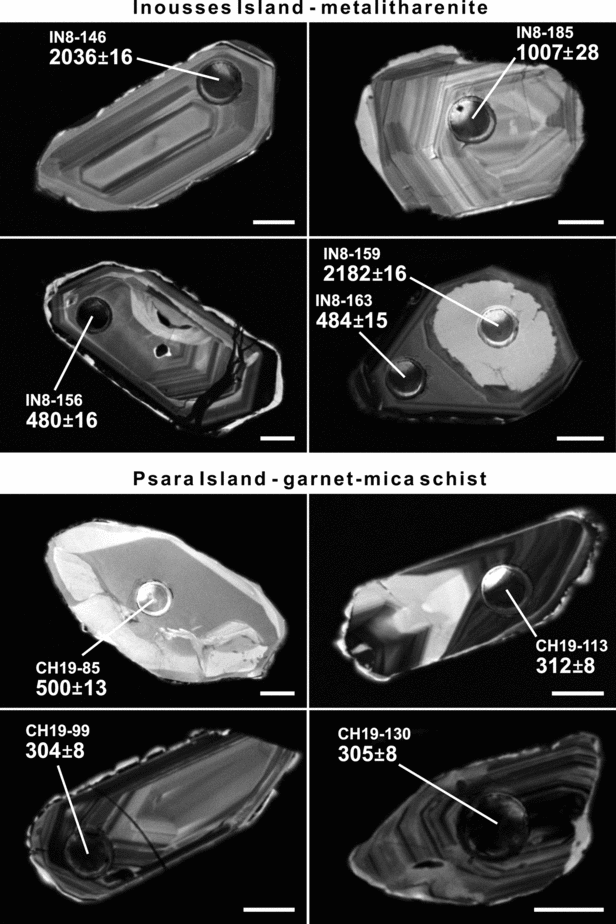
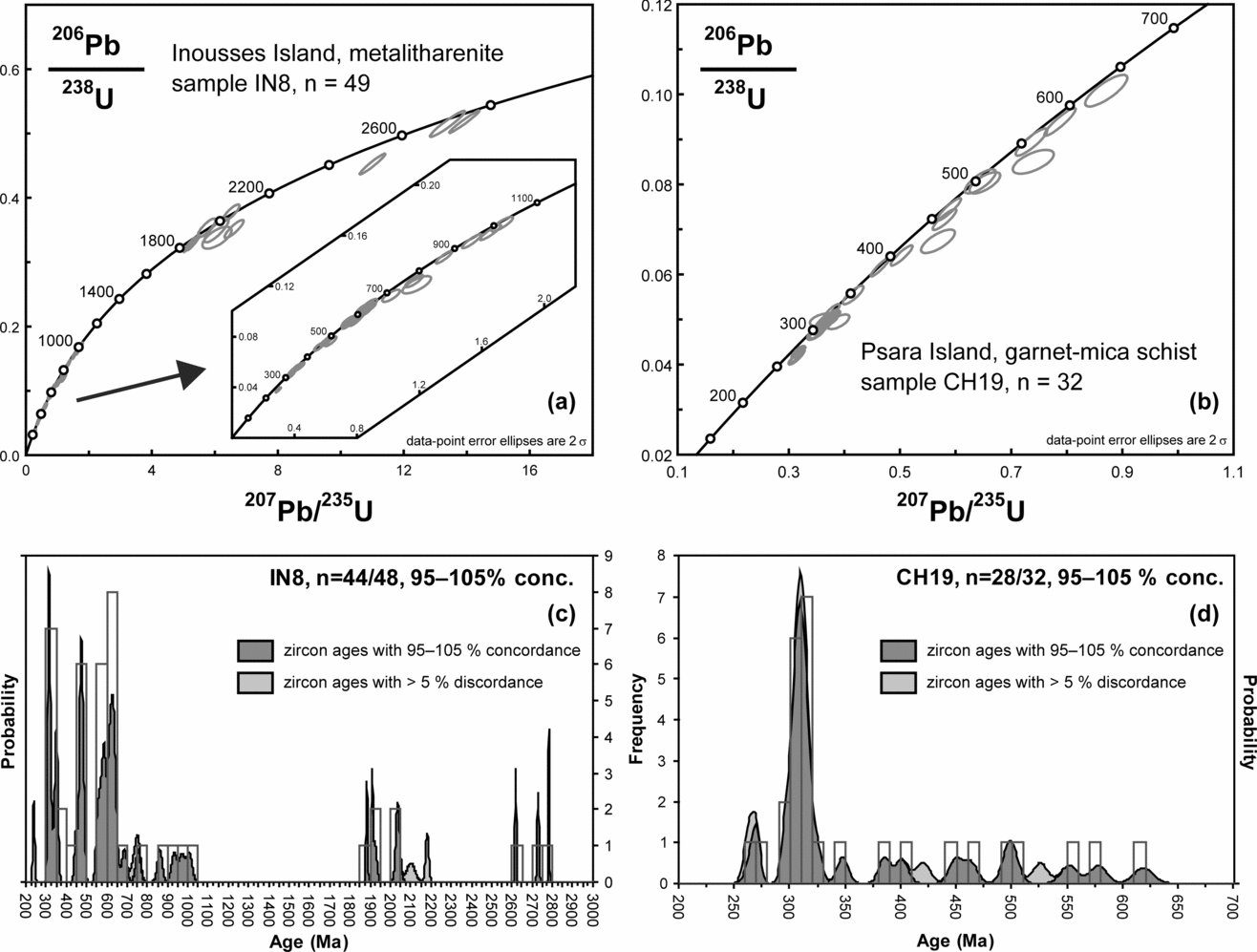
Sample IN8 was collected from a metalitharenite succession cropping out north of Inousses village (38° 31′ 17.2′ N, 26° 12′ 59.6″ E; Fig. 1b). The sample predominantly consists of monocrystalline and polycrystalline quartz, sedimentary and altered volcanic lithoclasts, minor muscovite flakes, feldspar and strongly altered detrital biotite. Accessory minerals include sericite and heavy minerals such as zircon, tourmaline, opaque minerals and epidote. The zircons have a subhedral to well-rounded shape. They are clear to cloudy, colourless to slightly pinkish. The length of single zircon crystals varies between 60 and 200 μm. Most analysed zircons have clear oscillatory zonation patterns in CL images and appear to be magmatic in origin; few exhibit no zoning or patchy zoning (Fig. 2). Inherited cores are present to a minor degree. The concordance-filtered zircon ages show a polymodal age distribution with major groups of 310–350, 450–500, 550–700, 900–1050 and 1880–2040 Ma, and also few ages between 2600 and 2800 Ma (Fig. 3). Zircon ages between 1050 and 1880 Ma are totally absent. The youngest concordant zircon grains are slightly rounded and have 206Pb–238U ages of 310 ± 9 to 330 ± 18 Ma, which indicates the maximum age of deposition to be Late Carboniferous.
CL images of representative zircon grains from analysed samples with location of the LA–SF–ICP–MS analysis spot and corresponding 206Pb–238U age (±2σ) for grains <1.2 Ga and 207Pb–206Pb age (±2σ) for grains >1.2 Ga, respectively. Letter–number code above the ages: sample-spot. The scale bar represents 30 μm in all images.

(a, b) Concordia diagrams and (c, d) probability density distribution and histogram plots for the set of U–Pb analytical zircon data from samples of Inousses and Psara. Because of illustration purposes one highly discordant grain of sample CH19 with a 207Pb–206Pb age of 2116 Ma is not shown in the concordia plot. A 1.2 Ga limit is used to switch between 206Pb–238U and 207Pb–206Pb ages for the probability plots. n=number of analyses.

4.b. Psara
Sample CH19 was collected from a garnet–mica schist succession of the Upper Unit of Psara (38° 35′ 36.4″ N, 25° 35′ 00.3″ E; Fig. 1c). The sample predominantly consists of quartz, muscovite, biotite, garnet and chlorite. Zircon, tourmaline and ilmenite are accessory minerals. The zircons have a subhedral to rounded shape. They are clear and colourless; some have many inclusions. The length of single zircon crystals varies between 70 and 190 μm. Most analysed zircons have clear oscillatory zonation patterns in CL images and appear to be magmatic in origin; only very few exhibit no zoning or patchy zoning (Fig. 2). Inherited cores are present to a minor degree. The concordance-filtered zircon ages show a polymodal age distribution with a major group of 295–325 Ma, a minor peak at 270 Ma and a spread of single ages between 325 and 650 Ma (Fig. 3). The youngest concordant zircon grains are slightly rounded to rounded and have 206Pb–238U ages of around 270 Ma, which indicates the maximum age of deposition to be Late Permian.
5. Discussion and conclusions
Detrital zircon age spectra from samples of Inousses and Psara differ but both show a prominent age cluster between c. 300 and 330 Ma that indicates denudation of Carboniferous and Lower Permian basement rocks. These could have been rocks of the Pelagonian Zone (including the Attic–Cycladic Massif), from Sakarya or the Thracia Terrane of the Rhodope Massif, since Carboniferous and Early Permian ages of that range are documented for magmatic rocks from these areas (e.g. Engel & Reischmann, Reference Engel and Reischmann1998; Özmen & Reischmann, Reference Özmen and Reischmann1999; Vavassis et al. Reference Vavassis, De Bono, Stampfli, Giorgis, Valloton and Amelin2000; Reischmann et al. Reference Reischmann, Kostopoulos, Loos, Anders, Avgerinas and Sklavounos2001; Anders, Reischmann & Kostopoulos, Reference Anders, Reischmann and Kostopoulos2007; Okay, Satır & Siebel, Reference Okay, Satir, Siebel, Gee and Stephenson2006; Turpaud, Reference Turpaud2006; Cornelius et al. Reference Cornelius, Reischmann, Frei and Kostopoulos2007). They are assigned to a major igneous event in the Aegean and the surrounding area belonging to a volcanic-arc or active-continental-margin setting (e.g. Reischmann et al. Reference Reischmann, Kostopoulos, Loos, Anders, Avgerinas and Sklavounos2001) due to northward subduction of (a branch of) Palaeotethys beneath Pelagonia and Sakarya (e.g. Vavassis et al. Reference Vavassis, De Bono, Stampfli, Giorgis, Valloton and Amelin2000).
Furthermore, both samples show age clustering between c. 350 and 650 Ma, although in varying amount, that indicates denudation of Lower Palaeozoic and Upper Neoproterozoic basement rocks. Sample IN8 from Inousses especially contains a significant amount of 550–690 and 450–485 Ma grains (Fig. 3). The former age group can be assigned to Pan-African basement rocks, which are widespread in the Eastern Mediterranean (e.g. Meinhold et al. Reference Meinhold, Reischmann, Kostopoulos, Lehnert, Matukov and Sergeev2008, fig. 10). The Middle–Late Ordovician ages are good constraints for palaeotectonic reconstructions in the Eastern Mediterranean since these ages are restricted to few terranes only. They have been reported from basement rocks of the Sakarya Terrane in western Turkey (Özmen & Reischmann, Reference Özmen and Reischmann1999) and of the Serbo-Macedonian Massif in northern Greece and Bulgaria (e.g. Titorenkova et al. Reference Titorenkova, Macheva, Zidarov, von Quadt and Peytcheva2003; Himmerkus et al. Reference Himmerkus, Anders, Reischmann, Kostopoulos, Hatcher, Jr, Carlson, McBride and Martínez Catalán2007; Meinhold, Reference Meinhold2007). In general, the lack of zircon ages between 1.1 and 1.8 Ga, coupled with the occurrence of c. 2-Ga-old zircons in the sample of Inousses, imply a northern Gondwana-derived source.
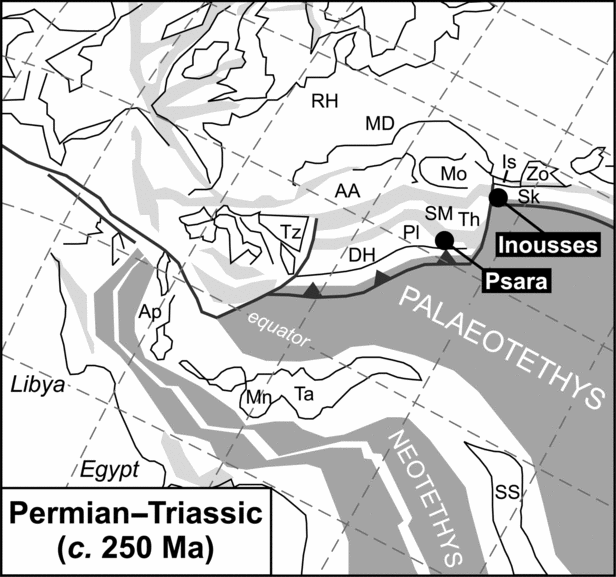
The maximum depositional age of the studied metasedimentary rocks can be constrained by the youngest detrital zircons: c. 310–330 Ma for sample IN8 from Inousses and c. 270 Ma for sample CH19 from Psara. The zircon age data clearly show that the metasedimentary successions of Inousses cannot be older than Late Carboniferous. This contradicts the interpretation of Kozur (Reference Kozur and Szaniawski1998) who compared the metasedimentary rocks of Inousses with the monotonous siliciclastic Küçükbahçe Formation of the Karaburun peninsula for which he suggested an Ordovician (or Cambrian–Ordovician) age. Here, we suggest that the metasedimentary rocks of Inousses and Psara were deposited far apart, but close to the southern margin of Laurussia in Permian–Triassic time (Fig. 4).
Palaeotectonic map for the Permian–Triassic (modified from Stampfli & Borel, Reference Stampfli and Borel2002). The light grey areas are initial rift basin systems; the black dots show the presumed position of Inousses Island and the Upper Unit of Psara Island. AA: Austro-Alpine; Ap: Apulia; DH: Dinarides–Hellenides; Is: Istanbul; MD: Moldanubian; Mn: Menderes; Mo: Moesia; Pl: Pelagonian; RH: Rheno-Hercynian; Sk: Sakarya; SM: Serbo-Macedonian; SS: Sanandaj–Sirjan; Ta: Taurus; Th: Thracia; Tz: Tizia; Zo: Zonguldak.

To summarize, the Early Palaeozoic ages in the studied sedimentary successions in conjunction with the Carboniferous–Early Permian ages support a source from terranes at the southern margin of Laurussia during the Late Palaeozoic and hence clarify the palaeotectonic position of the metasedimentary units of Inousses and Psara within the Palaeotethyan realm.
Acknowledgements
Early parts of this work were carried out while GM was holding a Ph.D. scholarship from the German Research Foundation (DFG) and the state of Rhineland–Palatinate through the Graduiertenkolleg 392 ‘Composition and Evolution of Crust and Mantle’. Laboratory facilities at the Max-Planck-Institute for Chemistry, at the Institute of Geosciences in Mainz and at the Geological Survey of Denmark and Greenland in Copenhagen are gratefully acknowledged. GM thanks D. Kostopoulos and T. Reischmann for stimulating discussions about the geology of Greece. This manuscript has benefited from careful reviews and helpful comments of V. Pease and an anonymous referee. This paper is published with the permission of the Geological Survey of Denmark and Greenland.