





Contemporary Indigenous cultural practices and knowledge
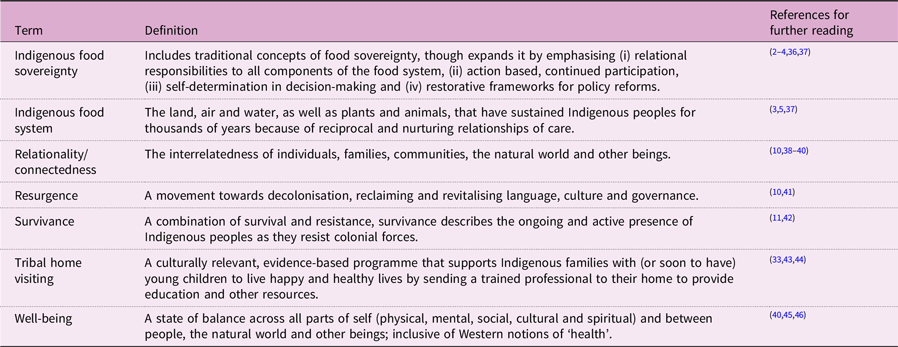
American Indian and Alaska Native peoples comprise communities rich in traditional heritage, cultural lifeways and kinship connections that have promoted health for generations. Despite this survivance, settler colonialism has led to adverse social, health and academic outcomes for American Indian and Alaska Native people (for details on terminology used in this paper, see Table 1). Specifically, diet-related diseases and health outcomes borne of food insecurity have increased among Indigenous youth at alarming rates, including diabetes, obesity and cancer, while also impacting cognitive and behavioural development, the cycle of poverty, poor mental health and associated risks of suicidality and substance misuse(Reference Banerji, Pelletier and Haring1). While policies such as the American Indian Religious Freedom Act of 1978 have helped protect the rights of American Indian and Alaska Native peoples to practice traditional cultural ways, more can be done to systematically and institutionally foster the well-being of American Indian and Alaska Native children, families and communities. Notably, terms such as American Indian, Native American, Alaska Native, Indigenous peoples and First Nations have distinct histories and interpretations. While American Indian and Alaska Native are commonly used in federal contexts, some scholars, including Dr. Michael Yellow Bird, critique both American Indian and Native American as ‘oppressive’ and advocate for Indigenous peoples or First Nations instead. Usage can also vary based on federal recognition status.
Defined key terms used throughout the manuscript

Table 1. Long description
A table with two columns and eight rows. The first column is labeled Term and the second column is labeled Definition. The table defines key terms related to Indigenous food sovereignty, food systems, and well-being. Row 1: Term, Indigenous food sovereignty; Definition, Includes traditional concepts of food sovereignty, though expands it by emphasising (i) relational responsibilities to all components of the food system, (ii) action based, continued participation, (iii) self-determination in decision-making and (iv) restorative frameworks for policy reforms. Row 2: Term, Indigenous food system; Definition, The land, air and water, as well as plants and animals, that have sustained Indigenous peoples for thousands of years because of reciprocal and nurturing relationships of care. Row 3: Term, Relationality/connectedness; Definition, The interrelatedness of individuals, families, communities, the natural world and other beings. Row 4: Term, Resurgence; Definition, A movement towards decolonisation, reclaiming and revitalising language, culture and governance. Row 5: Term, Survivance; Definition, A combination of survival and resistance, survivance describes the ongoing and active presence of Indigenous peoples as they resist colonial forces. Row 6: Term, Tribal home visiting; Definition, A culturally relevant, evidence-based programme that supports Indigenous families with (or soon to have) young children to live happy and health lives by sending a trained professional to their home to provide education and other resources. Row 7: Term, Well-being; Definition, A state of balance across all parts of self (physical, mental, social, cultural and spiritual) and between people, the natural world and other beings; inclusive of Western notions of health.
Currently, the USA acknowledges 574 federally recognised tribes, each with distinct histories, languages and cultures that promote health and healing. These tribes are sovereign nations, maintaining government-to-government relationships with the US federal government. Tribal sovereignty is the inherent right of Indigenous nations to self-governance, self-determination and self-education and is the cornerstone of Indigenous nations’ ability to promote their own economic, judicial, social, political and cultural lifeways. Indigenous food sovereignty is a key aspect of this self-determination, encompassing the right of Indigenous communities to define their own food systems, restore traditional food practices and maintain access to culturally significant, locally sourced and sustainable foods that support community health and well-being(Reference Jernigan, Nguyen and Maudrie2–Reference Abdul, Ingabire and Lam6).
Central to Indigenous food sovereignty is the understanding that food is more than sustenance – it is deeply tied to relationships, cultural continuity, and reciprocal care. Though Indigenous communities are diverse, they share cultural elements and values including connectedness, or ‘the interrelated welfare of the individual, one’s family, one’s community, and the natural environment’(Reference Mohatt, Fok and Burket7). A key component of connectedness is the relationship with all beings, including land and food. Maudrie et al. (Reference Maudrie, Nguyen and Wilbur4) highlight the key components of Indigenous food sovereignty: relationships, relationality and reciprocity. Importantly, ‘Indigenous peoples have always been in relationships with and relied upon one another and our more than human relatives to be nourished’(Reference Maudrie, Nguyen and Wilbur4). The importance of Indigenous food sovereignty extends into early childhood given that children are considered sacred, and children’s development has always been supported through nourishing relationships of reciprocal respect (e.g. (Reference Hodge, Limb and Cross8)). Furthermore, maintaining relationships with all beings has always been the key to community health and balance, and supporting a resurgence of traditional foods in early childhood can be key to restoring and protecting community traditions and survivance(Reference Hodge, Limb and Cross8).
Our work is grounded in the traditional and contemporary homelands of the Anishinaabeg Peoples of the Three Fires Confederacy. As detailed in the Anishinaabe origin story of a great migration from the east coast of Turtle Island (also known as North America as described by many North American Indigenous peoples), along the St. Lawrence seaway and the larger Great Lakes region, ‘where the food grows on the water’ referencing manoomin (‘wild rice’ or ‘the good berry’ in Anishinaabemowin, the language of the Anishinaabe peoples), this land was prophesied as ‘their chosen ground, a land in the west to which they must move their families’(Reference Benton-Banai9). In this way, food comes from the land, is a relative and is mashkiki (medicine in Anishinaabemowin). Cultivating and eating food from the land reminds us of who we are, where we come from and our responsibilities, as this relational understanding is essential to the practices of everyday living(Reference Simpson10). Wiingaashk (sweetgrass in Anishinaabemowin) is a sacred gift from the Creator. It is often woven together into braids, a symbolic gesture that demonstrates our love and gratitude for Mother Earth. Braids of sweetgrass also represent continuation and survivance(Reference Wilbur and Gone11). We inhabit and care for this land, ‘…living as if your children’s future mattered…’(Reference Kimmerer12). Also foundational to our research is a recognition of our responsibility to uphold the original treaties between the Anishinaabeg and our animal relatives. These first treaties outline the mutual respect and caretaking that Anishinaabeg have for our animal relatives and that they have for us. As Indigenous people, it is important to reflect on this history as acknowledgment, visibility and honoring ways of life, and as non-Indigenous people, it is important to learn and comprehend the past and current trauma that shapes lived experiences today. Holding this knowledge in conversation is critical for interpreting and understanding the findings of this research.
Survivance of Indigenous communities
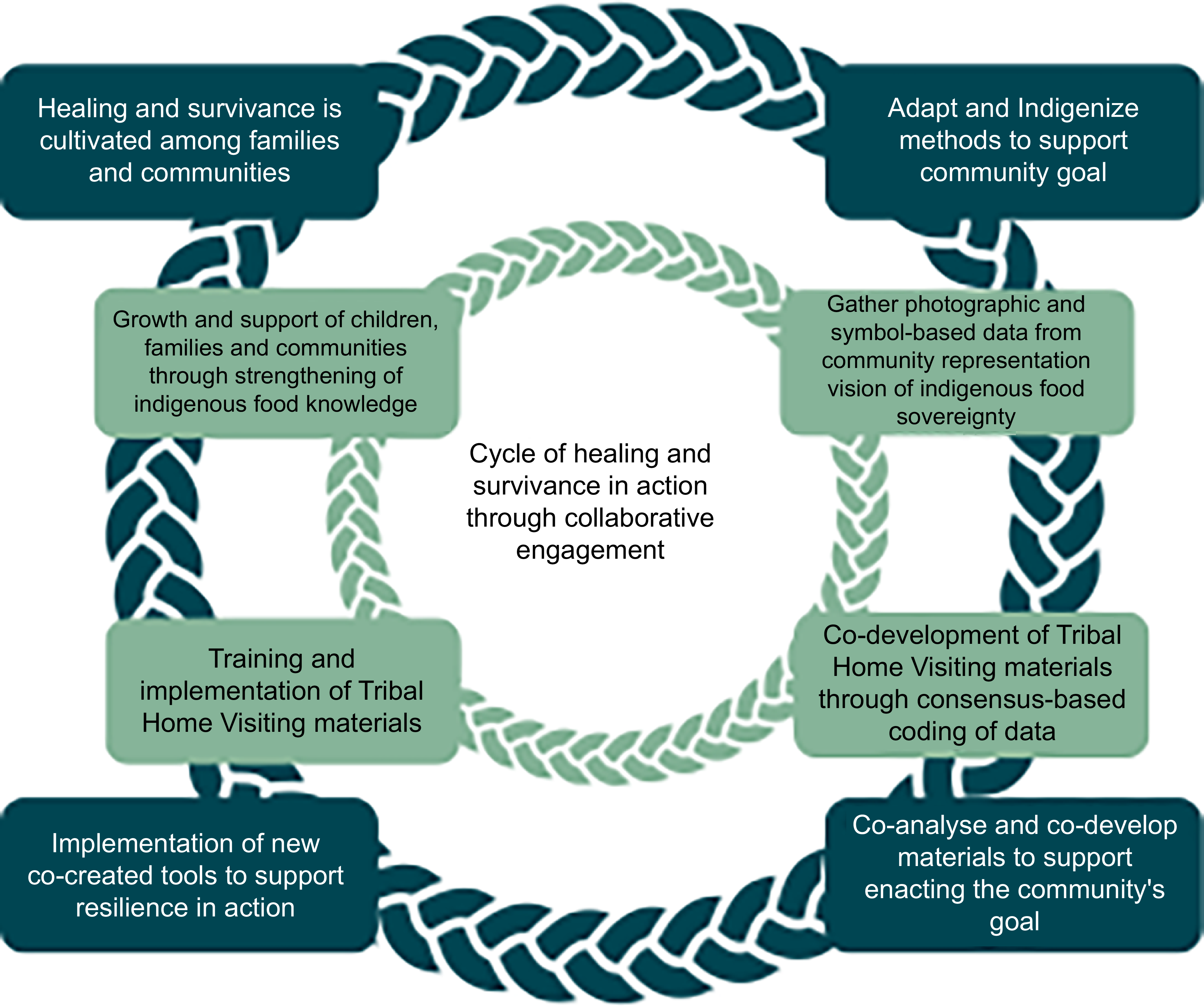
As we worked together, we gained a clearer understanding of our research as a reflection of community praxis oriented towards well-being – an interweaving and strengthening of the cycle of healing and survivance in action through collaborative engagement symbolised in braided sweetgrass. Much more than a metaphor or a convenient visual representation of interweaving, however, sweetgrass is ‘an intermediary between humans and the land, strengthening Indigenous cultural sovereignty and deepening human relationships by reminding people of their shared embodiment and their shared spiritual territorial connection… a profound conjoining of the earth and the human body, both submitted to the care of human hands,’ as Cariou(Reference Cariou13) summarises in his analysis of the image of sweetgrass across diverse Indigenous scholarship and literature. Figure 1 illustrates the interconnectedness necessary for mobilising family well-being through Indigenous food systems that both shaped our research and underscored its findings.
The cycle of healing and survivance in action through collaborative engagement.

Our work centres on fostering a cycle of healing and survivance in action through collaborative engagement. Figure 1 illustrates this, showing both a general depiction of the cycle (inner braid) and how we operationalised this in our project (outer braid). The cycle can be entered at any point, depending on context and needs.
Our work builds on three coequal components, each represented by one strand of the braids in Figure 1: (1) children, families and communities; (2) individuals and programmes, such as Tribal home visiting, connected to early childhood and (3) policymakers, tribal leaders and early childhood allies (each defined in Box 1). Each of these strands prioritises building relationships, culturally grounded educational activities and respectful policy actions to support the broader communities whose goals are intertwined. Like wiingaashk, these relationships embody how the three strands are mutually reinforcing when we create programmes that uplift families and communities in a good way(Reference Gordon and Around Him14). When braided together, the strands are stronger than when they stand alone, and as depicted in the circle, we emphasise that there is no hierarchy between the strands – each strand needs to support and strengthen the others.
Strands that form the foundation of our call to action
Strand 1: Children, Families and Communities
-
• Prioritising relationships that reclaim and promote Indigenous knowledge for well-being of family and community
Strand 2: Individuals and Programs Connected to Early Childhood
-
• Prioritizing intergenerational teaching and learning Indigenous language and traditions for child and family well-being
Strand 3: Policy Makers, Tribal Leaders, Researchers, Early Childhood Allies
-
• Prioritizing planning, funding and community-based initiatives to achieve outcomes that support Indigenous lifeways
To operationalise this cycle of healing for our community context and needs, we took four primary steps. First, community partners working within Wiba Anung shared their goal of promoting Indigenous food sovereignty for early childhood through Tribal Home Visiting programs, which shaped project development. We collaborated to indigenise Photovoice(Reference Wang and Burris15) and adapt Anishinaabe Symbol-Based Reflection (ASBR)(Reference Lavallée16) to support food sovereignty. ASBR was developed by Metís scholar Lynn Lavallée in 2005 and involves having participants engage physically, mentally, emotionally and spiritually by creating symbols that represent the concept or research question being explored. An important aspect of our integrated approach to Photovoice and ASBR is the discussion of symbols and photos through sharing circles. In this case, all our sharing circles occurred over Zoom, as participants engaged from locations across Michigan. Next, we analysed data collaboratively using the results to co-develop Tribal home visiting materials. Those materials were implemented following training and feedback cycles with Tribal home visiting staff and directors. The use of these materials strengthens Indigenous food knowledge in families with children under 5 years old, which then transfers to communities as materials and knowledge are shared. Because the three strands that form the foundation of this work remind us of the need to strengthen our human and more-than-human relationships and reflect Indigenous values, we can collectively build programmes’ shared knowledge and support for the cycle of healing and survivance. Other scholars may choose to enter this cycle at different points, but grounding work in these three strands and moving through this series of activities is the foundation for mobilising healing and survivance in action.
Objectives, partnership context and research questions
Our team, Wiba Anung, which translates to Early Star in Anishinaabemowin, is a partnership between Indigenous community leaders, the Inter-Tribal Council of Michigan and researchers at Michigan State University working to support food sovereignty, early childhood education and community well-being among all twelve federally recognised Tribes in Michigan. We aim to reclaim Indigenous cultural practices and promote food sovereignty and holistic well-being by co-developing resources for Indigenous families with young children. Our team includes the Inter-Tribal Council Head Start Director, leaders in Inter-Tribal Council of Michigan, community leaders, academic staff, faculty and students, all of whom have focused their careers on supporting the well-being of Indigenous families with young children. Our team works with the Tribal Early Research Center, and our experiences, expertise and community responsibilities uniquely position us to conduct this research in collaboration with our community partners. Our team and partnerships are built on longstanding relationships nurtured for more than 18 years. By prioritising our relational well-being, we share space and serve our communities in a good way. Our existing relationships with one another, and our communities are furthered through dreaming, planning, continuing and enacting together(Reference Simpson10).
Given that our collective work is in support of early childhood learning and well-being, we aimed to explore perceptions of the impact of colonisation on Indigenous food systems and to investigate how Michigan tribes can support a return to traditional foods. While community leaders and partners define our partnership’s goals, the research questions for this project emerged through collaborative conversations with participants themselves. We co-identified five research questions to guide our work: (1) What is the relationship between food and well-being? (2) How do food and our relationships around food influence our personal, family, or community relationships and well-being? (3) How does food support Indigenous language and cultural development in young children? (4) What food traditions do you think are important to preserve for the future? (5) What food traditions do you think are important to share with young children? While interconnected, here we focus on question 2: How does food, and our relationships with and around food, influence our personal, family or community relationships and well-being?
Methods
As part of a collaborative, co-created community engagement project, our methods are driven by what is best suited for our community partners and the research questions. As we have previously detailed, ‘The mixed methodological process developed from our relationships is both unique to regional Anishinaabe cultural contexts and innovative in its contributions to scientific rigor by highlighting specific mechanisms by which cultural practices support children’s development’(Reference Barnes-Najor, Stonefish and Wentworth17). Anishinaabe values are centred throughout the project reported here, which began in 2020, and this has been our practice since the inception of the nearly 20-year Wiba Anung partnership. We highlight the strengths of Michigan Indigenous communities, and our activities centre Anishinaabe values of reciprocity, honour, respect and trust. This engagement in the co-generation of knowledge is consistent with established scholarship with Indigenous communities(Reference Lavallée16,Reference Absolon18–Reference Thompson, Miller and Cameron24) . As a result, our findings have immediate applications in the lives of Indigenous children and their families through the creation and implementation of Tribal home visiting materials developed from this research. This also contributes to shifts in theories of early childhood development through grounded Indigenous community-based pedagogical practices.
In our co-creative approach, Photovoice(Reference Wanjohi, Pradeilles and Asiki25) works well as a participatory visual research method that helps to foster positive social change because it requires that there be space for all partners to share their stories through visuals and storytelling(Reference Wang and Burris26). Before generating and collecting data through this method, we thoughtfully considered the balance of power, experience and mentoring needs of those members of Wiba Anung who would work on this part of the research and laid a foundation for community members on our research team to fully engage with all aspects of analysis and authorship(Reference Barnes-Najor, Stonefish and Wentworth17). A modified approach to Photovoice best allowed participants to share their wisdom with us. We asked Anishinaabe and Anishinaabe-serving Michigan community members to take pictures and share stories that highlight food connections and early childhood. Participants were recruited via snowball sample(Reference Bernard27) based on recommendations from community members of our Wiba Anung research team. We also adapted the Photovoice method to centre Indigenous values, incorporating elements of ASBR. ASBR revolves around the holistic aspects of creating a symbol (such as a photo or a crafted item), relational engagement and reciprocal reflection. Creating a symbol answers a research question but also allows participants to be holistically engaged in the research process by making and sharing symbols. Participants may find sharing inspiring because they connect with and learn from other people who share similar experiences(Reference Lavallée16).
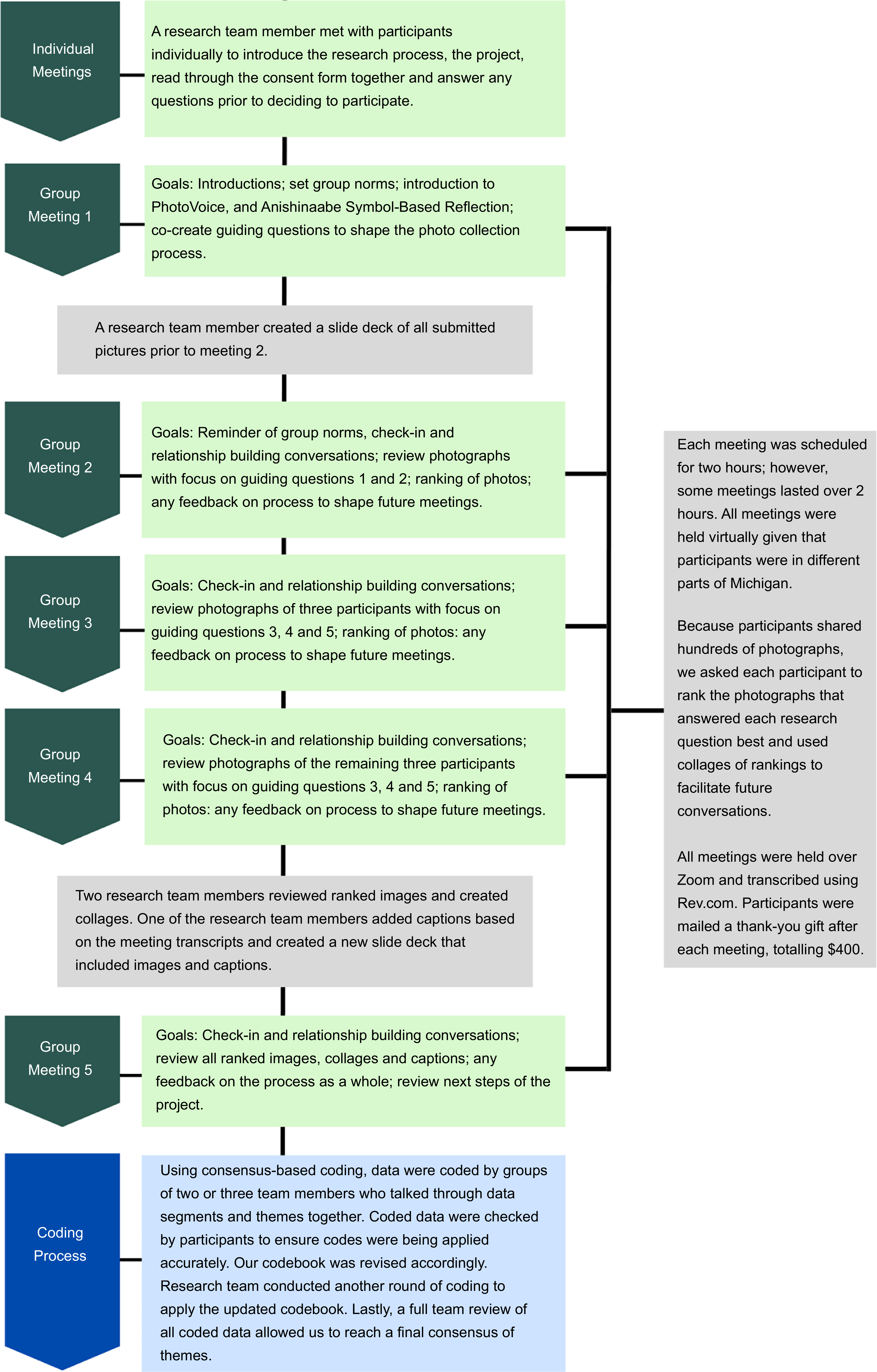
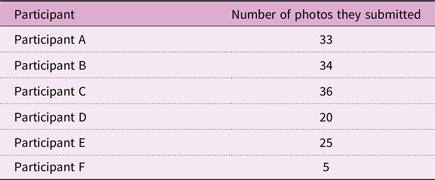
Our methodology began with team relationship- and trust-building through the establishment of group norms and facilitating a safe and productive space together to co-create the questions to guide the Photovoice process(Reference Leung, Huggins and Bonham28). Barnes-Najor et al. (2024) detail the methods for this work, which are summarised here. Our research questions, co-created by the research participants in the first group meeting, focused on the connections between food, relationships and well-being (see Figure 2 for a graphic outline of our full research process). Team members met with participants as a group and individually to ensure a shared understanding of the research process and informed consent and to provide an opportunity for iterative feedback. This process goes beyond the requirements of an IRB, though this research was approved by the MSU IRB STUDY00005844, and participants gave informed consent and signed photo release forms to participate. Participants received $400 honoraria for participating in the series of six meetings. Conducted over Zoom, all five meetings were recorded, then transcribed using Rev.com (Figure 2). This research was conducted remotely to ensure participants from Tribal communities across the state of Michigan could engage in this research. During the individual meetings, we asked participants whether they needed cameras to take photographs, and all chose to use their personal cell phones to take photos or used photos they took previously. Once participants were ready to share their photographs, a team member prepared a slide deck of all the photos for the participants to rank concerning our guiding questions. A participant list with the number of photos they contributed is provided in Table 2. This occurred over three group meetings, which were recorded and transcribed. When the ranking was complete, team members created collages and captions based on the meeting transcriptions, which served to review the ranking and interpretations made through the captions, and final revised collages were readied for analysis. A grounded and iterative review process with community partners then took place over another series of meetings, which were also recorded and transcribed. These meetings generated a set of themes that formed the basis of a codebook we used with ATLAS.ti, a qualitative data analysis software and our further inductive analysis(Reference Saldaña29).
Data collection procedures and coding process adapted from Barnes-Najor et al. (2024).

Figure 2. Long description
The flowchart details the steps and goals of individual and group meetings in a research study. It begins with individual meetings where participants are introduced to the research process and consent forms. Group Meeting 1 focuses on introductions, setting group norms, and co-creating guiding questions. Group Meeting 2 involves reviewing photographs, ranking them, and providing feedback. Group Meeting 3 and 4 continue with reviewing photographs, focusing on specific guiding questions, and ranking photos. Group Meeting 5 reviews all ranked images, collages, and captions, and discusses the next steps. The coding process involves consensus-based coding, where data is coded by groups of two or three team members, checked for accuracy, and reviewed to reach a final consensus.
List of participants and number of photos they contributed to this project

Table 2. Long description
A table titled ʼParticipant Number of photos they submittedʼ with two columns and six rows. The first column is labeled ʼParticipantʼ and the second column is labeled ʼNumber of photos they submittedʼ. Row 1: Participant A, 33. Row 2: Participant B, 34. Row 3: Participant C, 36. Row 4: Participant D, 20. Row 5: Participant E, 25. Row 6: Participant F, 5.
We used a consensus-based coding process grounded in community-engaged praxis, coding in pairs and discussing the photographs as a group(Reference Richards and Hemphill30). We co-developed narratives and cross-cutting themes, which were then reviewed, clarified and revised with community partners. Rather than the typical use of consensus-based coding that involves inter-rater reliability testing(Reference Cole31), we developed a collaborative process(Reference Barnes-Najor, Stonefish and Wentworth17). To remain consistent with our established collaborative process grounded in community-engaged values, data were coded by groups of two or three team members who talked through data segments and themes together for the first coding pass. This was followed by a full team review of all coded data to reach a final consensus. Coded data were checked by community members to ensure codes were being applied accurately(Reference Barnes-Najor, Stonefish and Wentworth17).
Results: relationship between food and well-being
Our results, presented below, intentionally blend participants’ qualitative contributions, cultural teachings and the research team’s contextual knowledge. This reflects our feminist community engaged epistemology(Reference Wentworth, Doberneck and Barnes-Najor32) and the co-creation of all stages of this project with community partners, including developing the aims, research questions and conducting the analysis. These findings represent our shared understandings grounded in lived experiences, cultural knowledge and the relational insight developed throughout the partnership. This approach aligns with Indigenous ways of knowing, where story, experience and meaning-making are interconnected rather than treated as separate domains(Reference Simpson10,Reference Moyer, Wesner and Sarche33,Reference Kovach34) .
Participants generated 147 images that were shared in a series of five group meetings, each lasting approximately 2 hours. Data included the images, captions and quotes from all these meetings to highlight experiences reflective of Indigenous families across Michigan. These data collectively helped us answer our research question: How does food and our relationships with and around food influence our personal, family or community relationships and well-being? The analysis of the data helped us consider two key themes: first, the ways that food is a connector between ancestors and descendants, and a connection to language learning and cultural knowledge; second, that food is foundational to family and community, achieving health and the education of children.
Theme 1: Food as a connector
‘The way we harvest and prepare food builds a bond between the spirit world, the physical world, and the earth itself. Mother Earth provides us with nutrients and gifts, and through these traditions, we honor that relationship’. – Participant B
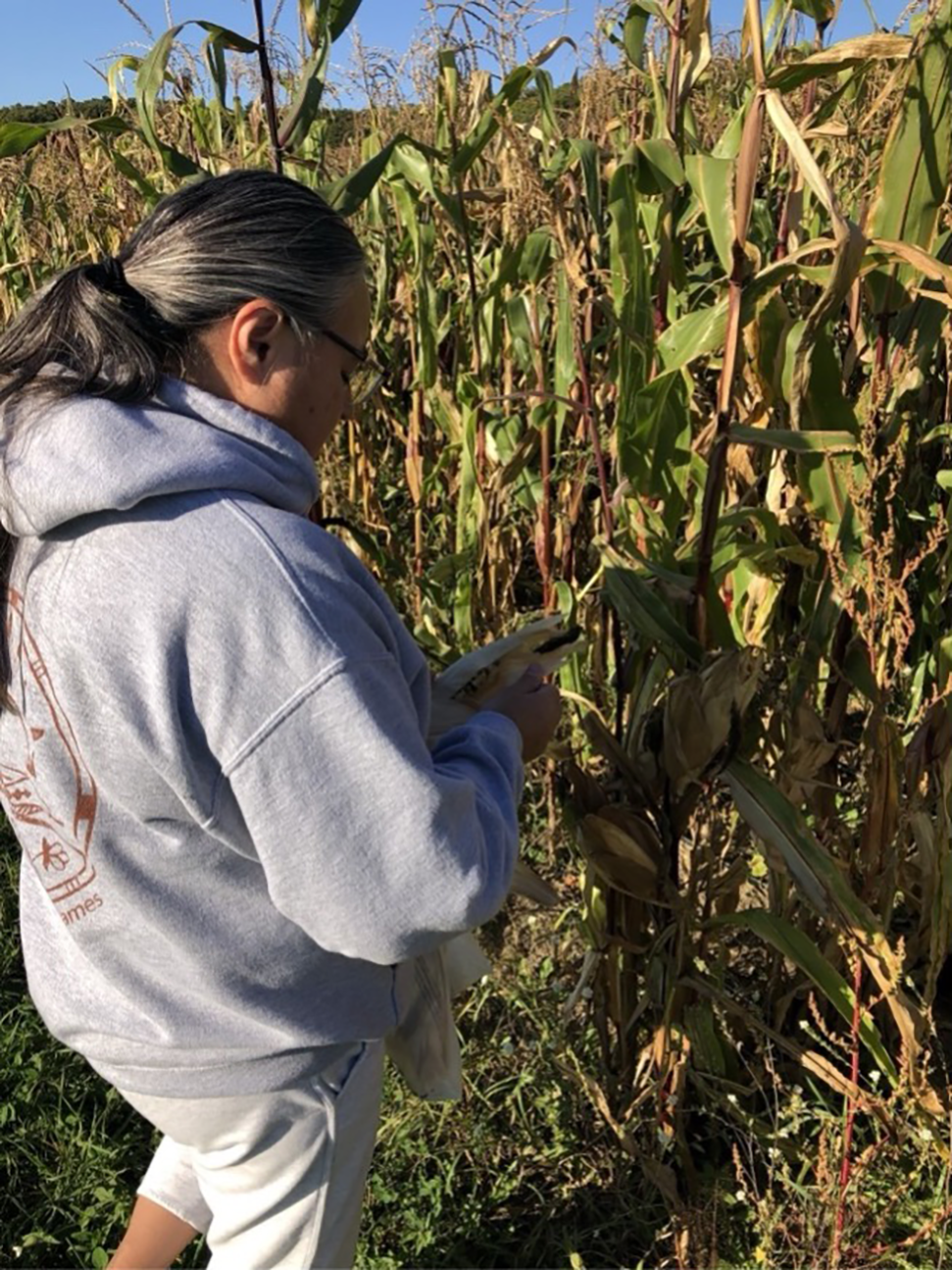
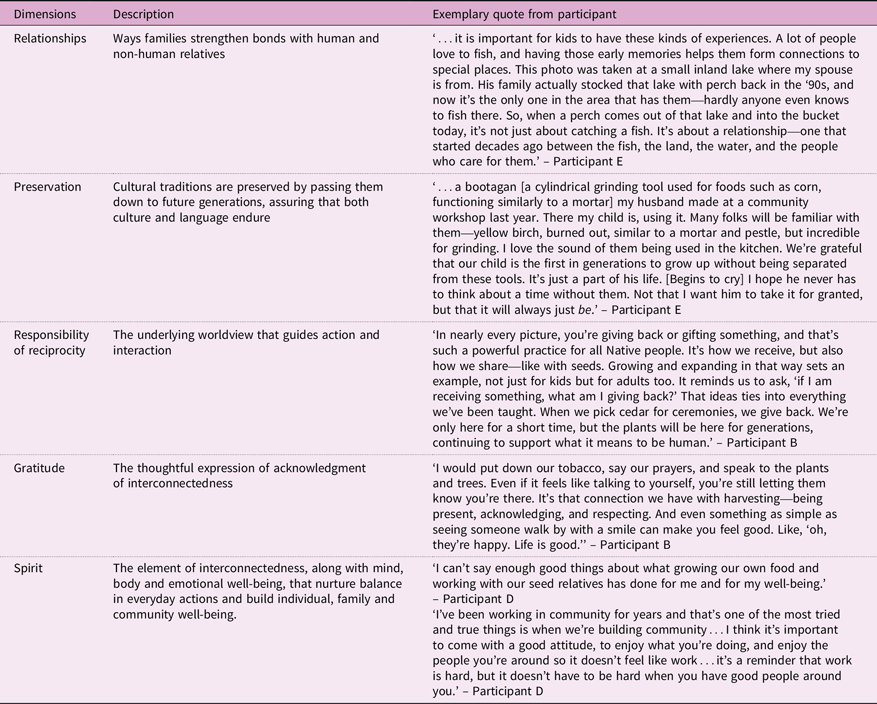
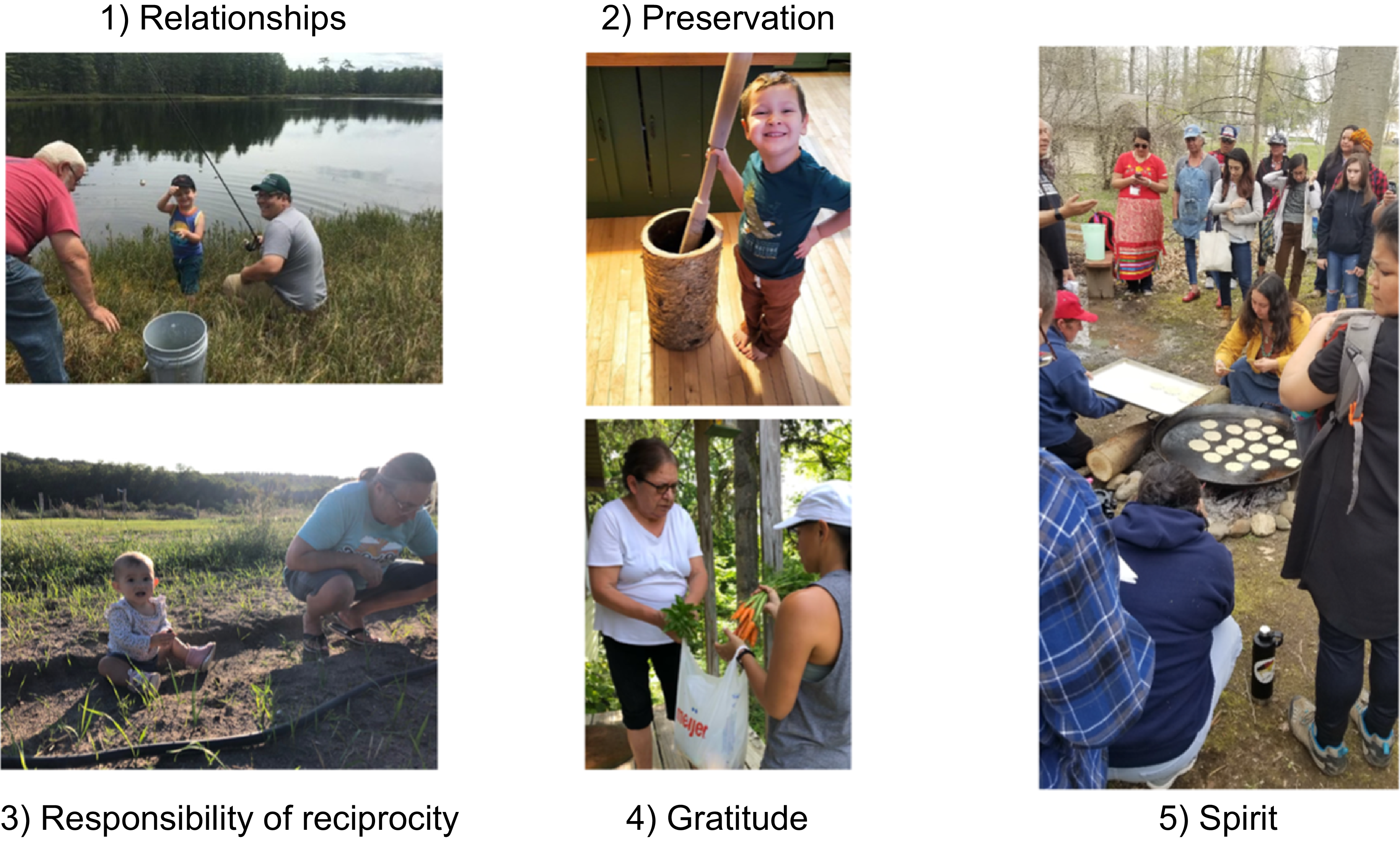
Food connects relatives across time and place, serving as a bridge between ancestors, descendants, culture and language (see Figure 3 for an example). This connection includes five key dimensions: (1) relationships, (2) preservation, (3) responsibility of reciprocity, (4) gratitude and (5) spirit (see Table 3). Additionally, each of these dimensions is illustrated with an exemplar image, numbered to correspond with the dimension (see Figure 4). Through caring, harvesting, preparing and sharing food, we strengthen bonds with our relatives – both human and non-human. Activities such as fishing, hunting and foraging help build relationships with all relatives – land, water and food itself. Food helps us preserve and transmit cultural traditions and memories, honoring those who came before us and those who will come after. With this comes the responsibility to uphold reciprocity, such as giving back to all beings who exist to provide with their best parts. We must care and honor all living things, as they will continue to sustain us and connect us across generations. Expressing gratitude for the nourishment that foods provide deepens our relationship with land, water and community, often communicated through offerings such as traditional tobacco and prayers. This connection also highlights the pride and spiritual nourishment that comes from serving the community through food. Working in community strengthens intergenerational bonds, reinforcing a sense of pride and deepening the spiritual connection individuals have with people and traditions. Through these shared experiences, food becomes more than sustenance – it becomes a powerful expression of identity, belonging and collective care.
Participant B shared how joyful and meaningful it was to work alongside their mother in a community garden, harvesting and delivering food with care and cultural pride. They created cards in their Indigenous language, Anishinaabemowin, for the deliveries, which community members appreciated. Including their mother in the story highlights the deep personal and emotional connection, emphasising her importance in the participant’s life.

Dimensions of theme 1

Table 3. Long description
A table with three columns: Dimensions, Description, and Exemplary quote from participant. The table has five rows, each describing a different dimension. Row 1: Relationships, Ways families strengthen bonds with human and non-human relatives, ‘…it is important for kids to have these kinds of experiences. A lot of people love to fish, and having those early memories helps them form connections to special places. This photo was taken at a small inland lake where my spouse is from. His family actually stocked that lake with perch back in the ‘90s, and now it’s the only one in the area that has them—hardly anyone even knows to fish there. So, when a perch comes out of that lake and into the bucket today, it’s not just about catching a fish. It’s about a relationship—one that started decades ago between the fish, the land, the water, and the people who care for them.’ – Participant E. Row 2: Preservation, Cultural traditions are preserved by passing them down to future generations, assuring that both culture and language endure, ‘…a bootagan [a cylindrical grinding tool used for foods such as corn, functioning similarly to a mortar] my husband made at a community workshop last year. There my child is, using it. Many folks will be familiar with them—yellow birch, burned out, similar to a mortar and pestle, but incredible for grinding. I love the sound of them being used in the kitchen. We’re grateful that our child is the first in generations to grow up without being separated from these tools. It’s just a part of his life. [Begins to cry] I hope he never has to think about a time without them. Not that I want him to take it for granted, but that it will always just be.’ – Participant E. Row 3: Responsibility of reciprocity, The underlying worldview that guides action and interaction, ‘In nearly every picture, you’re giving back or gifting something, and that’s such a powerful practice for all Native people. It’s how we receive, but also how we share—like with seeds. Growing and expanding in that way sets an example, not just for kids but for adults too. It reminds us to ask, ‘if I am receiving something, what am I giving back?’ That idea ties into everything we’ve been taught. When we pick cedar for ceremonies, we give back. We’re only here for a short time, but the plants will be here for generations, continuing to support what it means to be human.’ – Participant B. Row 4: Gratitude, The thoughtful expression of acknowledgment of interconnectedness, ‘I would put down our tobacco, say our prayers, and speak to the plants and trees. Even if it feels like talking to yourself, you’re still letting them know you’re there. It’s that connection we have with harvesting—being present, acknowledging, and respecting. And even something as simple as seeing someone walk by with a smile can make you feel good. Like, ‘oh, they’re happy. Life is good.’’ – Participant B. Row 5: Spirit, The element of interconnectedness, along with mind, body and emotional well-being, that nurture balance in everyday actions and build individual, family and community well-being, ‘I can’t say enough good things about what growing our own food and working with our seed relatives has done for me and for my well-being.’ ‘I’ve been working in community for years and that’s one of the most tried and true things is when we’re building community … I think it’s important to come with a good attitude, to enjoy what you’re doing, and enjoy the people you’re around so it doesn’t feel like work … it’s a reminder that work is hard, but it doesn’t have to be hard when you have good people around you.’ – Participant D.
This collage illustrates the dimensions of Theme 1: Food as a connector. The images represent five key dimensions: (1) relationships, (2) preservation, (3) responsibility of reciprocity, (4) gratitude and (5) spirit.

Figure 4. Long description
The collage consists of five separate photos. Panel 1: Relationships. A man and two children are fishing by a lake. Panel 2: Preservation. A child is standing in a barrel, and two women are holding vegetables. Panel 3: Responsibility of reciprocity. A woman is planting with a baby nearby. Panel 4: Gratitude. A group of people is gathered around a table with food. Panel 5: Spirit. A group of people is gathered outdoors, possibly discussing or sharing a meal.
Theme 2: Food is foundational to the health and education of our children, family and community
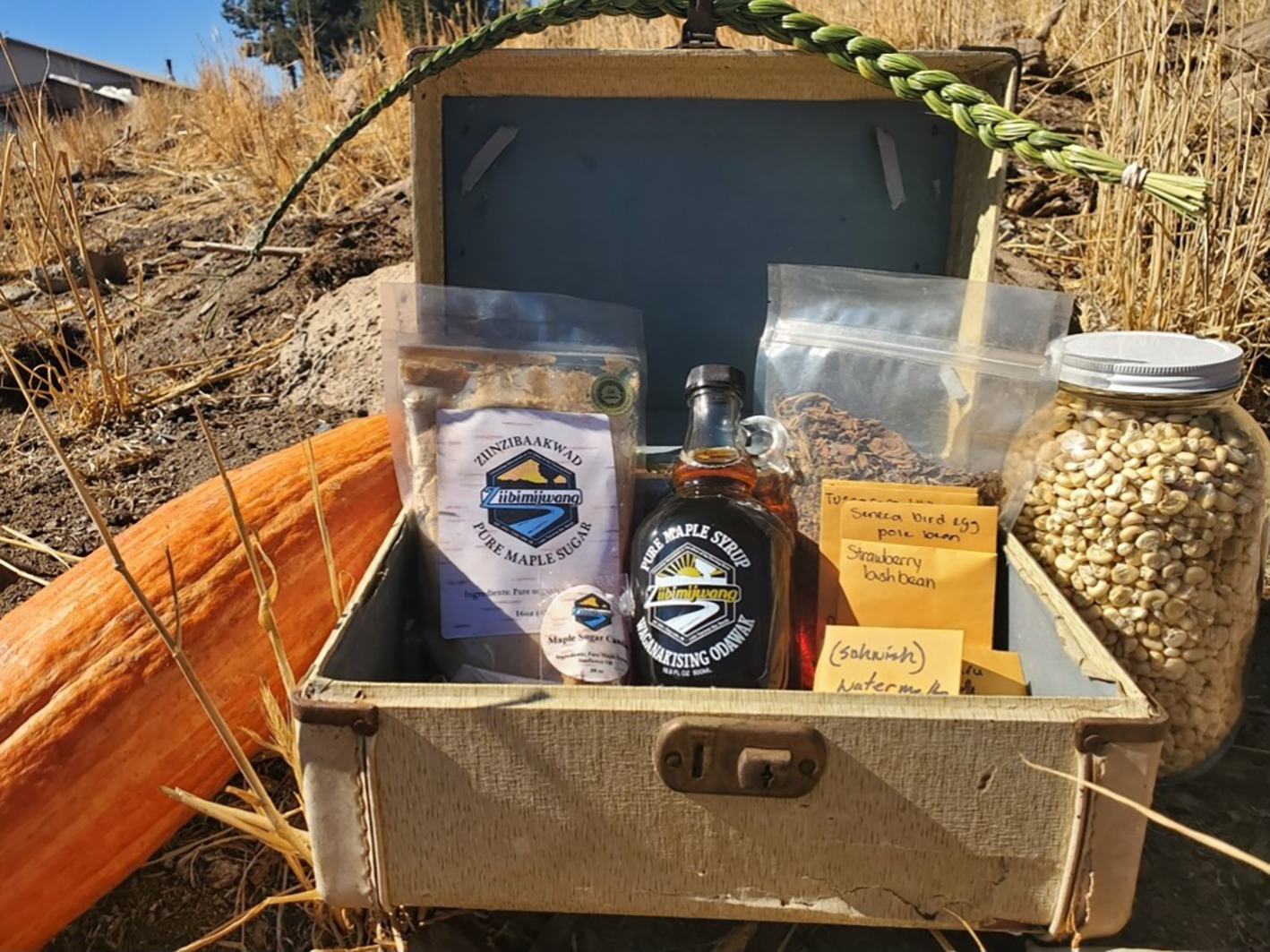
‘Family and community are intertwined throughout these photos, including those who are no longer with us. The suitcase makes me think about who gathered the seeds for the beans, sumac, and squash. Their presence and contribution are deeply intertwined into this story’. – Participant D
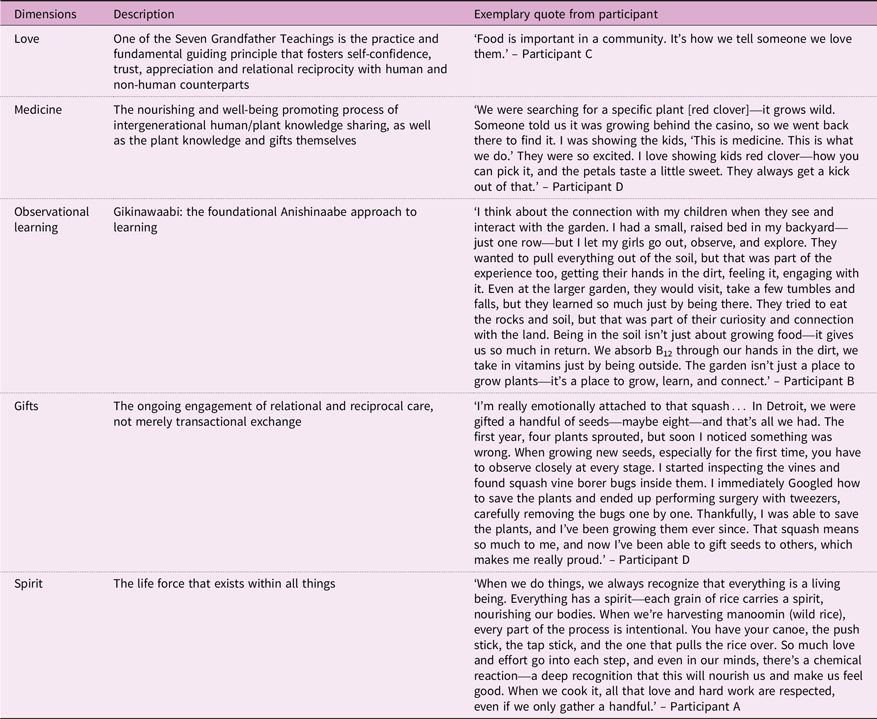
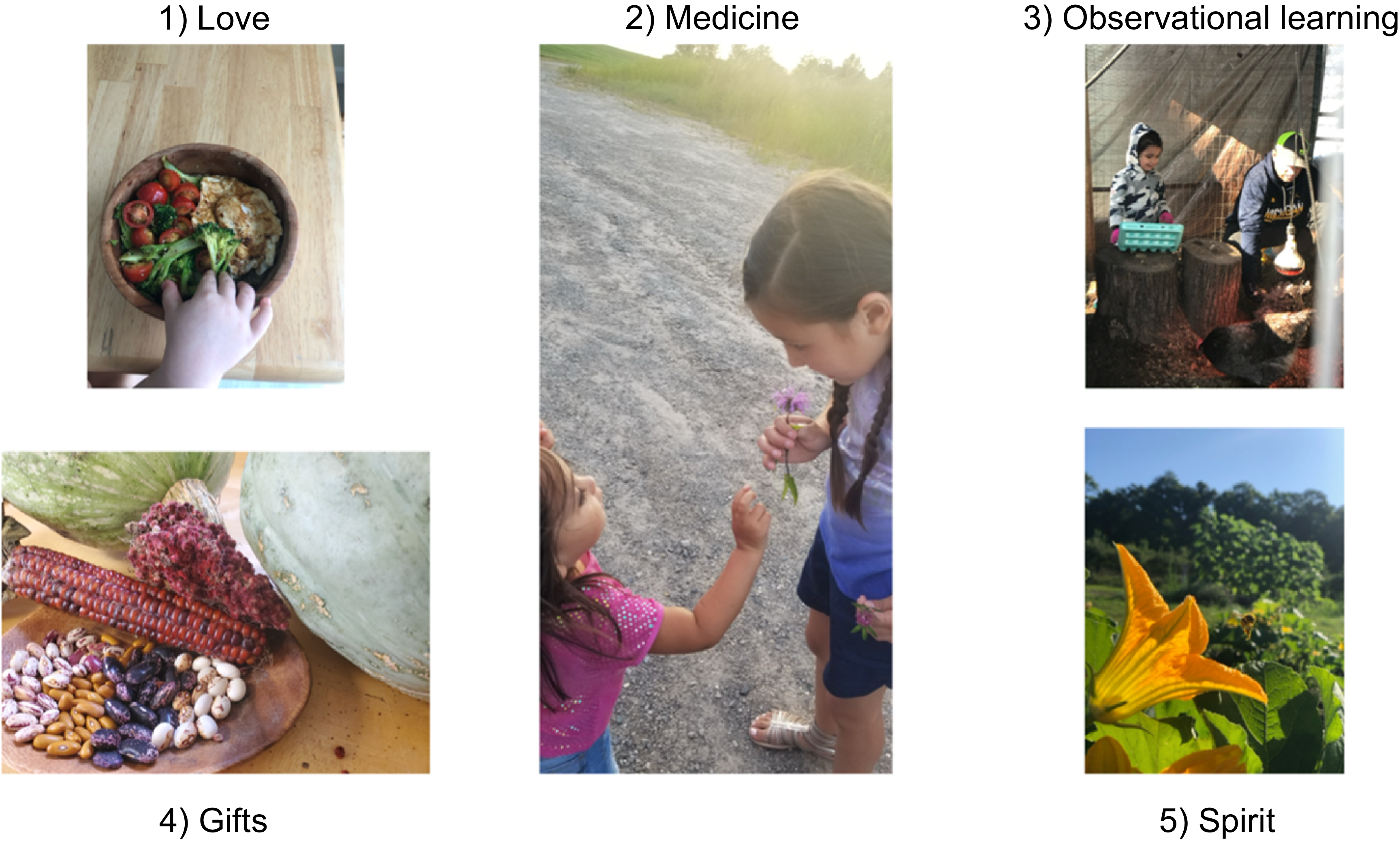
The health and education of children, families and communities are nurtured through food, which is embodied through five key dimensions: (1) love, (2) medicine, (3) observational learning, (4) gifts and (5) spirit (see Table 4). Ullrich (2019) reminds us that everything has spirit. Spirit is present in both themes one and two, as it is the life force that exists within all things. It can be observed and experienced through art, food, home structures, education, subsistence lifestyles, language and more. Additionally, each of these dimensions is illustrated with an exemplar image, numbered to correspond with the dimension (see Figure 6). Food is more than nourishment – it is an expression of love, whether through sharing and strengthening community relationships, reclaiming traditional practices or practicing survivance (see Figure 5). Food plays a vital role in well-being, serving as medicine that nourishes our body, mind and spirit. Beyond providing essential vitamins, minerals and energy, the act of preparing and sharing food strengthens relationships and supports mental and emotional well-being. Reclaiming Indigenous foods and striving for food sovereignty are essential steps in healing from colonial disruption and restoring cultural connections. To sustain these practices, it is crucial to establish food traditions within families, encouraging children to explore new experiences and engage in cultural and communal practices. Through observation, they learn from those around them, carrying forward knowledge that strengthens identity, community and connection for future generations. Learning cultivates gratitude for all living beings, recognising their role in sustaining and nourishing us. It also teaches us not to take these gifts for granted and to see their own gifts and abilities in growing, preparing and sharing food with families and communities. This perspective nurtures a sense of appreciation, responsibility and interconnectedness. Lastly, as highlighted in theme one, every being, including plants, carries a spirit that nourishes both body and soul. When food is intentionally cared for, gathered and prepared with love, its spirit strengthens our holistic well-being.
Dimensions of theme 2

Table 4. Long description
The table has five rows and three columns. The columns are labeled Dimensions, Description, and Exemplary quote from participant. Row 1: Dimensions: Love; Description: One of the Seven Grandfather Teachings is the practice and fundamental guiding principle that fosters self-confidence, trust, appreciation and relational reciprocity with human and non-human counterparts; Exemplary quote from participant: Food is important in a community. Itʼs how we tell someone we love them. Participant C. Row 2: Dimensions: Medicine; Description: The nourishing and well-being promoting process of intergenerational human/plant knowledge sharing, as well as the plant knowledge and gifts themselves; Exemplary quote from participant: We were searching for a specific plant [red clover]—it grows wild. Someone told us it was growing behind the casino, so we went back there to find it. I was showing the kids, This is what we do. They were so excited. I love showing kids red clover—how you can pick it, and the petals taste a little sweet. They always get a kick out of that. Participant D. Row 3: Dimensions: Observational learning; Description: Gikinaawaab: the foundational Anishinaabe approach to learning; Exemplary quote from participant: I think about the connection with my children when they see and interact with the garden. I had a small, raised bed in my backyard—just one row—but I let my girls go out, observe, and explore. They wanted to pull everything out of the soil, but that was part of the experience too, getting their hands in the dirt, feeling it, engaging with it. Even at the larger garden, they would visit, take a few tumbles and falls, but they learned so much just by being there. They tried to eat the rocks and soil, but that was part of their curiosity and connection with the land. Being in the soil isnʼt just about growing food—it gives us so much in return. We absorb B12 through our hands in the dirt, we take in vitamins just by being outside. The garden isnʼt just a place to grow plants—itʼs a place to grow, learn, and connect. Participant B. Row 4: Dimensions: Gifts; Description: The ongoing engagement of relational and reciprocal care, not merely transactional exchange; Exemplary quote from participant: Iʼm really emotionally attached to that squash ... In Detroit, we were gifted a handful of seeds—maybe eight—and thatʼs all we had. The first year, four plants sprouted, but soon I noticed something was wrong. When growing new seeds, especially for the first time, you have to observe closely at every stage. I started inspecting the vines and found squash vine borer bugs inside them. I immediately Googled how to save the plants and ended up performing surgery with tweezers, carefully removing the bugs one by one. Thankfully, I was able to save the plants, and Iʼve been growing them ever since. That squash means so much to me, and now Iʼve been able to gift seeds to others, which makes me really proud. Participant D. Row 5: Dimensions: Spirit; Description: The life force that exists within all things; Exemplary quote from participant: When we do things, we always recognize that everything is a living being. Everything has a spirit—each grain of rice carries a spirit, nourishing our bodies. When weʼre harvesting manoomin (wild rice), every part of the process is intentional. You have your canoe, the push stick, the tap stick, and the one that pulls the rice over. So much love and effort go into each step, and even in our minds, thereʼs a chemical reaction—a deep recognition that this will nourish us and make us feel good. When we cook it, all that love and hard work are respected, even if we only gather a handful. Participant A.
Participant D described a meaningful road trip they took from Michigan to Oregon, visiting Indigenous communities and trading seeds. Along the way, they collected and exchanged items, storing them in their grandmother’s old suitcase, which is now a special traveling container, pictured here. The journey was part of a broader effort to revive traditional trade routes and cultural exchange, emphasising the importance of food and meaningful items for overall well-being and community care.

This collage illustrates the dimensions of Theme 2: Food is foundational to the health and education of our children, family and community. The images represent five key dimensions: (1) love, (2) medicine, (3) observational learning, (4) gifts and (5) spirit.

Discussion
Our research question was, ‘How does food, and our relationships with and around food, influence our personal, family, or community relationships and well-being?’ We approached this question through the lens of early childhood development, intentionally focusing our conversations on children. Three key insights emerged from the results of our consensus-based coding process. First, food and nutrition are not isolated, independent or empty of meaning. While we nourish ourselves with food, food also represents a broader, embodied experience. Through food, our connections with stories, songs, culture and spirituality are strengthened.
Second, understanding relationships and well-being begins with supporting children. Both food and children play vital roles in nurturing life and the future. Involving children in foodways helps us bridge a connection to our ancestors, each other and generations to come, highlighting the importance of sustaining cultural lifeways and values for the future. Children are an essential part of connections to culture, our understanding of the future and the growth and resiliency of our communities. Food serves as a medium through which we teach, nourish and promote resiliency and survivance within our communities.
Third, we found that adapting the Photovoice methods with the principles of ASBR advances community-engaged research and praxis. Because ASBR is a culturally appropriate method, it supported deeper participant engagement, fostered a safe space for vulnerability and enabled us researchers to better understand the connections between food and children. These insights directly inform the development of other research products, primarily culturally grounded curricula and materials for Tribal Home Visiting and Head Start programs called the Gikinawaabi Child Well-being Curriculum. In these materials, organised around the Anishinaabe lunar calendar, we interweave Anishinaabe early childhood- and food-related knowledge and practices in curricula and activities for families that support children in growing, gathering, preparing and consuming healthy food, engaging in physical activity, learning Anishinaabe food stories, using Anishinaabemowin food and well-being vocabulary and meeting relevant developmental milestones.
Ultimately, our data illustrate how each of the three strands described in Box 1 is strengthened when braided together as depicted in Figure 1. We describe how our research results are reflected in the lives of those affiliated with each of the three strands.
Children, families and communities
This research highlights the importance of relationships, relationality and reciprocity with food and food systems in healing from the impact of colonisation. They are integral to reclaiming and promoting Indigenous knowledge and ways of life that support the well-being of the family and community (see also(Reference Kuhnlein35)). This can be achieved in various ways that centre on intergenerational and lateral relationships of reciprocity. Caregivers, teachers and other responsible adults in children’s lives can talk to and with children about food. Adults learn from children’s free expression of curiosity and share the teachings learned from family traditions. This includes learning together more about family and community traditions around food and food systems from elders and community members, spending time outdoors together to connect and learn from and with the land and increasing learning and putting into action Indigenous languages.
Individuals and programmes connected to early childhood
Our research focuses on how prioritising the intergenerational promotion of teaching and learning enables children and families to undertake this effort. This includes relationships with food, food systems and community traditions that strengthen connections to the well-being of the child, family and community. Some examples are the utilisation of child and caregiver educational tools created from this work, like Gikinawaabi, and the learning opportunities it generates beyond the service provider and classroom settings in which it may have been introduced. Child, teacher, caregiver and classroom materials facilitate broader learning opportunities integrated with the encouragement of elders and tribal programs to share knowledge about foods and food systems, children and families to spend time outdoors together and support Indigenous Language acquisition.
Policymakers, tribal leaders, researchers and early childhood allies
This research supports Tribal leaders, researchers and early childhood allies to prioritise planning, funding and documenting community-based outcomes of programmes and initiatives that centre relationships with food, food systems, connections to the environment, connections to Indigenous teachings and ways of life and efforts to revitalise Indigenous languages.
Conclusion: healing and survivance in action
By using this approach, the team fostered a space for deeper sharing and trust, which is essential for creating a place for healing and promoting survivance that puts into action the ways food traditions and stories are foundational to healthy relationships, cultural continuity and reciprocal care. Thus, the praxis of survivance is embedded in lifeways and stories, braiding together pathways of ongoing healing through heartfelt discussions of participant photos and captions and the revitalisation and reclaiming of Indigenous foodways. This process was an emotional experience for both participants and researchers on our team, as food is the heart of identity, family and relationships, nourishing the connectedness that fosters healing for our human and non-human relations. Food connections are integral to our relationships with Mother Earth, animals, ancestors and spirits.
By sharing this process and these stories, we integrate a broader audience into this healing process. Our research also illustrates the absence of Indigenous knowledge from early childhood developmental science and the capacity of Photovoice and Anishinaabe Symbol-Based Reflection principles to come to a holistic understanding of the significance and impact of food on early childhood development. This method can drive genuine social change by uplifting the voices of underserved and marginalised communities through their own lenses and words. Bringing this methodology into wider use supports the construction of co-creative collaborative research, expanding the implementation of community-engaged research to promote sustainable interventions. Together, this work will promote healing and survivance in action with our communities, and more broadly, across Turtle Island.
Acknowledgements
We extend our deepest gratitude to Kat Jacques and Elizabeth Leffler for their contributions to the formal analysis, investigation and validation of the data included in this manuscript. We respectfully acknowledge the traditional and contemporary custodians of the land on which this research took place – the Anishinaabe peoples, including the Ojibwe, Odawa and Potawatomi Nations.
Financial support
This research was funded by the Michigan Health Endowment Fund Community Health Impact Grant #R-2201-147895.
Competing interests
There are no conflicts of interest.
Authorship
C.W. – conceptualisation, formal analysis, funding acquisition, investigation, methodology, project administration, supervision, validation, visualisation, writing – original draft, writing – review & editing. J.S.S. – conceptualisation, data curation, formal analysis, investigation, methodology, project administration, validation, visualisation, writing – original draft, writing – review & editing. H.H.B. – conceptualisation, formal analysis, funding acquisition, methodology, supervision, writing – original draft, writing – review & editing. L.M.—conceptualisation, formal analysis, funding acquisition, supervision, writing – original draft, writing – review & editing. D.G. – conceptualisation, formal analysis, funding acquisition, project administration, supervision, validation, writing – original draft, writing – review & editing. B.S. – conceptualisation, data curation, formal analysis, investigation, methodology, validation, writing – original draft, writing – review & editing. R.B.S. – formal analysis, investigation, supervision, validation, writing – review & editing. M.L. – conceptualisation, formal analysis, supervision, validation, writing – review & editing. C.G. – formal analysis, investigation, validation, writing – review & editing. C.H. – formal analysis, investigation, validation, writing – review & editing. J.Mc. – formal analysis, investigation, validation, writing – review & editing. R.B. – formal analysis, writing – review & editing. J.B-N. – conceptualisation, formal analysis, funding acquisition, investigation, methodology, project administration, supervision, validation, writing – review & editing. A.C. – conceptualisation, formal analysis, supervision, validation, writing – review & editing.
Ethics of human subject participation
This study was conducted according to the guidelines laid down in the Declaration of Helsinki, and all procedures involving research study participants were approved by the Michigan State University Institutional Review Board (STUDY00005844). Written informed consent was obtained from all participants.

 Open access

