Ice cream is a very popular dairy food in Egypt and worldwide due to its refreshing, enjoyment effect, high palatability, nutritional and calorific value. However, it has low content of dietary fibre and natural antioxidants (Mansour et al., Reference Mansour, Ahmed, Elfaruk, Alsaleem, Hammam and El‐Derwy2021; Genovese et al., Reference Genovese, Balivo, Salvati and Sacchi2022). Therefore, several attempts were conducted to develop a functional ice cream to be more suitable for consumer's expectations and demands by the fortification with fruits and vegetables by-products which are considered significant and rich sources of health promoting bioactive components and can be utilized as nutraceuticals (Sikdar et al., Reference Sikdar, Nath, Bandyopadhyay and Mollick2020; Tlais et al., Reference Tlais, Fiorino, Polo, Filannino and Di Cagno2020). According to Jaouhari et al. (Reference Jaouhari, Travaglia, Giovannelli, Picco, Oz, Oz and Bordiga2023), approximately 38% of the wastes generated during the processing of fruits and vegetables make up 14.8% of the total food waste in the industrial sector.
Banana peel (BP), which is discarded as waste (114.08 million metric tons annually worldwide), contains a variety of bioactive components for management of insulin resistance and enhancing blood lipid profile that facilitate its incorporation in food processing and beverage industry (Bhavani et al., Reference Bhavani, Morya, Saxena and Awuchi2023).
Watermelon rind (WMR) accounts for almost 40% of the total fruit weight and is characterized by its high content of β-carotene, carbohydrates, minerals and vitamins. It also has a high capacity for water and oil absorption in the food matrix (Kataria and Kaur, Reference Kataria and Kaur2023). It possesses various biological activities and therapeutic effects (Dubey et al., Reference Dubey, Rajput and Batta2021). Also, WMR contains many polysaccharides which make it a good thickening agent for food formulations (Zia et al., Reference Zia, Khan, Shabbir and Aadil2021).
Apricot kernel (AK) constitutes 30.7–33.7% of apricot stone and is charaterised by unique nutritional value, comprisings multiple bioactive compounds (Akhone et al., Reference Akhone, Bains, Tosif, Chawla, Fogarasi and Fogarasi2022). It has a high percentage of oil, mostly unsaturated fatty acids, protein, and dietary fibre, in addition to various essential amino acids which account 32–34% of total amino acids (Pawar and Nema, Reference Pawar and Nema2023). AK can be exploited for production of functional foods and as a non-traditional source for nutritious ingredients (Kasapoğlu et al., Reference Kasapoğlu, Kahraman and Törnük2020).
Peach kernel (PK) has not been well-exploited so far although it represents a rich source of protein and unsaturated fatty acids with anti-inflammatory, antibacterial, antioxidant and antitumor bioactivities (Kumari et al., Reference Kumari, Kumar, Puri, Zhang, Rais, Pundir, Chandran, Raman, Dhumal, Dey, Senapathy, Kumar, Pokharel, Deshmukh, Damale, Thiyagarajan, Balamurgan, Sathish, Singh and Lorenzo2023). PK has shown high antioxidative capacity and ability to inhibit enzymes associated with type 2 diabetes, obesity and Alzheimer's disease. It can be used as value-added source of bioactive components to create new functional foods (Nowicka and Wojdyło, Reference Nowicka and Wojdyło2019).
The application of nanotechnology in dairy sector offers promising opportunities to enhance the quality, safety, and functionality of dairy products (Poonia, Reference Poonia, Pudake, Chauhan and Kole2019; Aliabbasi and Emam‐Djomeh, Reference Aliabbasi and Emam‐Djomeh2024). Thus, the objective of this study was to create an innovative functional ice cream by fortifying it with nano-powders of AK, PK, WMR, and BP and examine its impact on the functional and qualitative characteristics of the final product.
Materials and methods
Materials
Debittered apricot (Prunus sp.) kernel powder was obtained from Hebei Seven Fruit Trade Co., Ltd, China. Highly pure peeled peach (Prunus persica L. Batsch) kernel powder (Tao Ren powder) was obtained from Mountain Herbs Co., China.
Watermelon (Citrullus lanatus) was purchased from the local market (Giza, Egypt). The peels of fresh fruit were washed then the flesh and the peel were removed. After that, the rind was separated and cut into small pieces then sliced using high power slicer (Robot-Coupe, Model CL 50, France), before it was rinsed with tap water and dried using hot air oven (DRTH, Dreieich, Germany) at 50ºC for 24 h. The obtained dried rind was grounded with laboratory mill (KENWOOD BL480, China) to form a fine powder followed by sieving using 50 mesh screens as reported by Al-Sayed and Ahmed (Reference Al-Sayed and Ahmed2013).
Banana (Musa spp.) was purchased from the local market (Giza, Egypt). The fruit peels were removed, washed with tap water then soaked in 5% acetic acid solution for 10 min to minimize the enzymatic browning (Amini Khoozani et al., Reference Amini Khoozani, Birch and Aeda2019). After drainage of the soaking solution, the peels were dried using microwave oven (Sharp, model R-750MR) for 6 min at power 960 W with the continuous pleating of peels every 30 s to prevent their burning through drying as suggested by Vu et al. (Reference Vu, Scarlett and Vuong2017). The dried peels were ground, then sifted as described above.
To increase the efficiency and solubility of the previously obtained materials, they were reground by a ball milling apparatus (ph-BML911model, Photon Scientific Company, Egypt) as the powder was exposed to collision with high-energy, derived from the balls with size 5 mm, putting in 50 mL stainless-steel cup. The grinding was achieved for 9 days (5 h daily) at 25°C with a fixed speed of 500 rpm, and the balls weight to powder ratio was (20:1). The used milling apparatus was equipped with an air-cooling unit to reduce the excessed heating produced from it. The resultant nano-powders were analysed for their chemical composition and functional properties according to Taha et al. (Reference Taha, Elshaghabee and Ameen2024a). The particle sizes were ranged from 13.75 to 32.09 nm.
Fresh skimmed buffalo milk (0.4% fat) and fresh milk cream (68% fat) were purchased from the Dairy Technology Unit, Faculty of Agriculture, Cairo University. Spray dried skimmed milk powder (Yew Tree Dairy Co., United Kingdom, 95.47% MSNF and 0.25% fat), sugar and vanillin powder were obtained from the local market (Giza, Egypt). Lacta 9080 (stabilizer and emulsifier) was kindly gifted by Misr Food Additives (Mifad) Co. (Egypt).
Chemicals and reagents
Folin-Ciocalteu's reagent was obtained from Loba Chemie PVT. LTD. (India). 2,2-diphenyl-1-picrylhydrazyl (DPPH) was purchased from Sigma-Aldrich Co. (St. Louis, MO, USA). MacConkey agar medium was obtained from HiMedia Laboratories PVT. LTD. (India). Malt extract powder and yeast extract powder were purchased from Research-Lab Fine Chem Industries Co. (Mumbai, India). Analytical grade chemicals and solvents were utilized in all laboratory experiments.
Manufacture of ice cream
Ice cream samples were prepared in the Pilot Plant of Dairy Science Department, Faculty of Agriculture, Cairo University, Egypt. All ice cream mixes were standardized to contain 6% fat, 12% MSNF, 13% sugar, 0.5% mixture of stabilizer & emulsifier, and 0.02% vanilla. To choose the suitable concentration of the nano-powders of tested wastes, a preliminary study was performed as ice cream was manufactured using various concentrations of each nano-powder (0.5, 1, and 2%), and sensory evaluated by ten experienced panellists (staff members) of Dairy Science Department, Faculty of Agriculture, Cairo University. The panellists favoured and recommended 1% level for fortification of the product with the studied wastes.
For the production of ice cream samples, all ice cream ingredients were well mixed at 60°C. 1% of each fruit waste nano-powder was added to the mix and well mixed. All mixes were heat treated at 85ºC/15 s and cooled to 4 – 5ºC before aging at 4ºC for 24 h. The resultant mixes were whipped at – 2ºC for 10 min using an ice cream freezer with batch pattern (Model Starmatic V500, Promag, Bologna, Italy). The resultant ice cream was packed in 120 mL sterilized polystyrene cups, hardened at – 18ºC and kept deep frozen for 30 days.
Methods of analysis
Physicochemical properties of ice cream mixes and the resultant ice cream
The titratable acidity (%) of all ice cream mixes and the resultant ice cream, total solids, protein, fat and ash contents were measured according to AOAC (2012). pH values of ice cream mixes and product samples were determined using pH meter (Jenway 3520, UK). The specific gravity and freezing point were determined according to Goff and Hartel (Reference Goff and Hartel2013). The weight per gallon (Kg) was calculated by multiplying the specific gravity of ice cream mixes or product samples by a factor of 3.789. The ice cream samples’ overrun (%) was calculated using Arbuckle (Reference Arbuckle and Arbuckle1986) methodology. Apparent viscosity of all ice cream mixes (before and after aging) in centipoise (cP) was measured using a concentric cylinder Brookfield Programmable Viscometer (Model DV – II; Brookfield Engineering Laboratories, Middleboro, MA, USA) at speed of 40 rpm with a spindle No. 2. Before the measurement, the samples were allowed to temper at 25ºC for 10 min.
Air bubbles diameters measurement
Ice cream samples ( – 18ºC) were exposed to liquid nitrogen to completely harden the fat globules. A thin slice of ice cream samples was taken with a lab cutter then the sample was put carefully onto a microscopic slide. The ice cream became more fluid and partially melted as the temperature of sample gradually elevated ( – 6°C), which allowed with the following of the air bubbles formed in the sample. The air bubbles were observed using a light microscope (Model DM750, Leica, Germany) equipped with a camera (Model ICC50, Leica, Germany). Air bubbles diameters were measured by the Leica Application Suite (LAS V4.2) Microscope Camera Software (Caillet et al., Reference Caillet, Cogné, Andrieu, Laurent and Rivoire2003).
Total phenols content and antioxidant activity (%) of ice cream
10 g of each ice cream sample was added to 100 mL of 80% methanol (1:20), stirred on a magnetic stirrer at ambient temperature for 1 h., and the resultant extract was filtered by Whatman filter paper No.1 (Karaman et al., Reference Karaman, Ös, Yüksel, Çam, Kayacier and Dogan2014). For determination of total phenols content, 300 µL of each extract was mixed with 1.5 mL of Foiln-Ciocalteu reagent (diluted with ratio 1:10 v/v by distilled water) and 1.2 mL of sodium carbonate (7.5%). The obtained mixture was vortexed for 15 s then incubated for 30 min at room temperature. The absorbance was determined at 765 nm against a blank by visible spectrophotometer (Jenway 6300, UK). Standard curve of gallic acid was prepared with concentrations ranged between 20-200 µg/mL. The total phenols content was expressed as mg gallic acid/g of sample (Osman et al., Reference Osman, Noureldin, El-Gazzar and Salman2023). The antioxidant activity of ice cream samples was measured using DPPH assay as presented by Osman et al. (Reference Osman, Noureldin, El-Gazzar and Salman2023).
Determination of meltability
Ice cream meltability was measured according to Şanlidere Aloğlu et al. (Reference Şanlidere Aloğlu, Özcan, Karasu, Çetin and Sağdiç2018). 120 g of ice cream was put on a 1-mm stainless-steel screen held on a beaker at 30°C. The melting amount was measured by weighing the molten ice cream after 15, 30, 45, 60, 75 and 90 min.
Meltability (%) = (weight of molten ice cream/initial weight of frozen ice cream) × 100.
Microstructure of ice cream samples
The microstructure of ice cream was examined using a transmission electron microscope (TEM) (Model JSM-5200; JEOL, Japan) operated at 200 V. The preparation of samples was conducted according to Carroll et al. (Reference Carroll, Thompson and Nutting1968).
Sensory evaluation
All ice cream samples as fresh and during storage periods (15 and 30 days) at – 18°C, were sensory evaluated by ten well-trained panelists (staff members) of Dairy Science Department, Faculty of Agriculture, Cairo University using the following parameters: flavour (45 points), body and texture (30 points), melting quality (15 points), and colour (10 points), overall acceptability (100 points) according to Ismail et al. (Reference Ismail, Hameed, Refaey, Sayqal and Aly2020).
Statistical analysis
All the obtained data (as the average of three replications) were statistically examined through a randomized complete block design with two factors. The treatments means were compared by least significant difference (L.S.D.) test according to Snedecor and Cochran (Reference Snedecor and Cochran1994) using Assistat 7.6 beta program (Personal PC developer) as indicated by Silva and Azevedo (Reference Silva and Azevedo2009).
Results and discussion
Physicochemical properties of the ice cream mixes
Data in Table 1 show the effect of adding nano-powders of the studied fruit wastes to ice cream mix on its physicochemical properties. Control and AK samples had the lowest titratable acidity compared to PK, WMR and BP with significant differences (P < 0.05) between samples. In contrast to the titratable acidity, the pH values decreased in fortified samples, which is consistent with their increased acidity.
The physical characteristics of ice cream mixes fortified with nano-powder of some fruit wastes

Data are expressed as mean ± SD of three replicates per treatment.
C = Control; AK = ice cream with apricot kernel; PK = ice cream with peach kernel; WMR = ice cream with watermelon rind; BP = ice cream with banana peel
Means with different superscripts in the same row for each variable are significantly different at p ≤ 0.05.
Regarding the specific gravity (gm/cm3), all the added nano-wastes significantly (P < 0.05) increased its value compared to control specially WMR. As a result, the weight per gallon (Kg) values increased significantly (P < 0.05) compared to the control. These results are in accordance with Ismail et al. (Reference Ismail, Hameed, Refaey, Sayqal and Aly2020) who reported that the specific gravity value, which is directly associated with the weight per gallon, is elevated by addition of pomegranate peel powder (PPP).
Concerning the mix viscosity of ice cream (either before or after aging process), it is clear that all the added wastes significantly (P < 0.05) increased the viscosity compared to the control mix. Also, the aging process led to significant increase of viscosity. This trend is in accordance with Mahdian and Karazhian (Reference Mahdian and Karazhian2020) who found that more viscosity values were obtained for frozen yoghurt mix containing banana peel. Additionally, the addition of PPP to ice cream mix increased the viscosity values of samples due to its higher content of fibers, which are characterized by its high water-hydration and binding capacity (Ismail et al., Reference Ismail, Hameed, Refaey, Sayqal and Aly2020).
It is remarkable that PK, WMR and BP- fortified mixes had the highest values of viscosity before and after aging due to its high fibre contents (Taha et al., Reference Taha, Elshaghabee and Ameen2024a). Similar results were reported by Zayan et al. (Reference Zayan, El-Gharably and El-Bialy2010) when they utilized defatted apricot kernel powder (DAKP) as a substitute for the added skim milk powder in ice cream making by ratios from 10-50%.
The addition of the tested nano-wastes powders lowered the freezing point of ice cream mixes, compared to control. This depression can be explained by the high carbohydrate and dietary fibre content of the added nano-wastes, particularly WMR and BP (Table 1). These results are in accordance with Tawfek (Reference Tawfek2021).
Chemical composition, titratable acidity (%) and pH- value of the ice cream
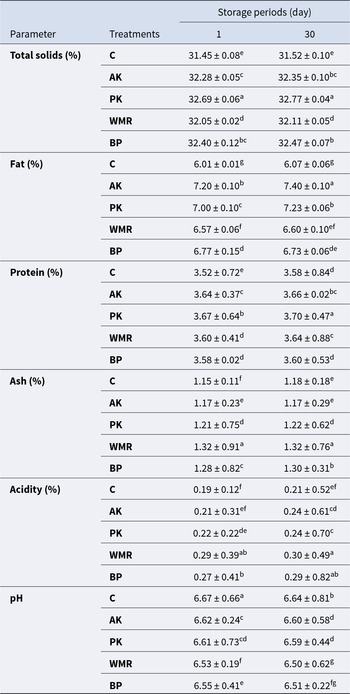
Data in Table 2 show the chemical composition of ice cream fortified with the nano-powders of fruit wastes. As for the total solids content (TS) of fresh ice cream, the addition of the tested wastes significantly (P < 0.05) increased the TS content compared to control samples (31.45%). At the end of storage, the TS content is slightly elevated in all treatments with significant differences (P < 0.05) between the control and other treatments. The same trend was observed for the fat content in which, fortification of ice cream with the nano-wastes significantly (P < 0.05) increased the fat content compared to the control. At the end of storage period, except for the BP-treated samples, the fat percent elevated with a little extent in the other treatments.
The chemical composition, acidity and pH of ice cream fortified with nano-powder of some fruit wastes during storage ( – 18 ± 2°C)

C = Control; AK = ice cream with apricot kernel; PK = ice cream with peach kernel;
WMR = ice cream with watermelon rind; BP = ice cream with banana peel
Data are expressed as mean ± SD of three replications per treatment.
Means with different superscripts in the same row and column for each parameter are significantly different at p ≤ 0.05.
Similarly for fat content, the tested nano-wastes significantly (P < 0.05) increased protein and ash contents as compared to the control. During the storage, these constituents slightly increased as the AK and PK -treated samples had the highest content of protein while the WMR and BP -treated samples had the highest content of ash either in the fresh or stored ice cream. These results are consistent with our previous findings showing that all the used additives are rich sources of fat, protein and carbohydrates (Taha et al., Reference Taha, Elshaghabee and Ameen2024a) and Ismail et al. (Reference Ismail, Hameed, Refaey, Sayqal and Aly2020) who reported that fortification of ice cream with 0.25 and 0.5% PPP significantly increased TS and fibre contents compared to the control. Furthermore, Ayar et al. (Reference Ayar, Siçramaz, Öztürk and Yilmaz S2018) found that fortification of probiotic ice cream with a dietary fibre-rich apricot pomace (0.5 and 2%) reduced its pH value due to its predominately significant content of citric and malic acids, and increased the TS, fat, ash, and overrun (%). The same authors also reported that this type of pomace is considered as a good source of pectins, which have favourable gelling properties that improve the overrun capacity.
As in ice cream mixes samples, fortification of ice cream mixes with the tested wastes significantly (P < 0.05) increased the titratable acidity and thus lowered the pH values in the ice cream products (Table 2). WMR and BP- fortified samples had the highest titratable acidity and the lowest values of pH either in the fresh or stored ice cream compared to the other treatments. This effect can be attributed to the lower pH of WMR and BP than AK and PK in their flours. According to the literature, both BP and WMR powders have an acidic pH values reach 5.31 to 5.90 based on the drying conditions (JP et al., Reference JP, MP, Román, Zhang, Baeyens, Rodriguez and Mazza2022; Saeed et al., Reference Saeed, Zahra, Saeed, Syed and Abidi2024), while some AK and PK powders have lower titratable acidity may be due to the technical treatments (boiling, peeling, water soaking, etc.) applied in the debittering process of kernels (Salık and Çakmakçı, Reference Salık and Çakmakçı2024).
A slight increase of acidity through the storage duration was found which corresponded with a significant decrease of pH during the same period which is in accordance with Ziarno et al. (Reference Ziarno, Cichońska, Kowalska and Zareba2024) who observed a similar tendency in probiotic-enriched ice cream that contained fermented homogenate of white kidney bean.
Physical properties of ice cream
As shown in Table 3, during the pre-freezing process and whipping of the ice cream mixes, air bubbles merging led to decrease their specific gravity, and so the resultant products have a specific gravity lower than their own mixes, which is compatible with that reported by Ismail et al. (Reference Ismail, Hameed, Refaey, Sayqal and Aly2020). Specific gravity values of fresh control and AK- fortified ice cream samples were the highest with non-significant differences (P < 0.05) between both, compared to PK, WMR and BP- fortified ice cream samples. The specific gravity of all treatments gradually and significantly (P < 0.05) increased during storage periods, which can be attributed to the reduction of size resulted from the instability or loss of air bubbles due to the effect of ice crystals formed during the deep freezing of samples. It is also noticeable that the weight per gallon (Kg) values behaved in a similar trend as the specific gravity of ice cream either when fresh or during storage. The weight per gallon of all treatments significantly (P < 0.05) increased during storage.
The physical characteristics of ice cream fortified with nano-powder of some fruit wastes during storage ( – 18 ± 2°C)

C = Control; AK = ice cream with apricot kernel; PK = ice cream with peach kernel
WMR = ice cream with watermelon rind and BP = ice cream with banana peel
Data are expressed as mean ± SD of three replications per treatment.
Means with different superscripts in the same row and column for each parameter are significantly different at p ≤ 0.05.
Also, data in Table 3 show that fresh fortified ice cream had considerably increased overrun %, compared to control. The overrun (%) gradually decreased in all samples till the end of storage. These findings are in line with those of Ziarno et al. (Reference Ziarno, Cichońska, Kowalska and Zareba2024), who observed a similar pattern in probiotic ice cream with fermented homogenate of white kidney bean.
The light microscopic examination showed that fortification of ice cream mixture with the tested wastes improved the whipping ability of samples that allowed with merging a higher amount of air bubbles, which was showed through their estimated diameters (Fig. 1). PK, WMR and BP-treated samples had the highest values of air bubbles diameters average within the duration of storage. This matches the overrun (%) determined in the same treatments. Under the conditions of freezing, the ice crystals are formed that make air bubbles gradually reduced and crashed, therefore these diameters significantly (P < 0.05) lowered by the time as presented in (Table 3). At the end of storage, the average of these diameters decreased in all treatments.
Light microscopic images of air bubbles in fresh control ice cream (A) compared to that fortified with nano-powders of apricot kernel (B), peach kernel (C), watermelon rind (D) and banana peel (E).

Positive correlations between viscosity, overrun (%) and air bubbles diameters were found in the ice cream mixes and their resultant ice cream. This relation was also reported by Abdel-Maqsoud et al. (Reference Abdel-Maqsoud, Elshaghabee, Metwally and Anis2021) when used nano-stabilizers in preparing ice cream as the mixes with higher viscosity had higher air bubbles size (µm) and overrun.
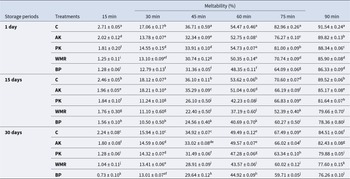
The meltability % of ice cream supplemented with nano-wastes is displayed in Table 4. It is evident that the fortification with the tested wastes significantly (P < 0.05) increased the melting resistance compared to the control either when fresh or during storage. PK, WMR and BP nano-powders increased the viscosity of ice cream mixture and thus the overrun by merging a higher amount of air bubbles which lowered the heat transfer during melting (Hartel et al., Reference Hartel, Muse, Sofjan, Goff and Tharp2004). As storage time increased the melting resistance elevated, which can be due to the increase in formed ice crystals size during storage.
Meltability of ice cream fortified with nano-powder of some fruit wastes during storage ( – 18 ± 2°C)

C = Control, AK = ice cream with apricot kernel, PK = ice cream with peach kernel
WMR = ice cream with watermelon rind and BP = ice cream with banana peel
Data are expressed as mean ± SD of three replications per treatment.
Means with different superscripts in the same column for each period are significantly different at p ≤ 0.05.
The meltability % significantly (P < 0.05) increased as the experiment time increased from 15 to 90 min. Both of BP followed by WMR- fortified ice cream samples had the significant and lowest meltability until the end of experiment time. This effect is due to their higher fibre content (Taha et al., Reference Taha, Elshaghabee and Ameen2024a). This tendency was noticed by Yangılar (Reference Yangılar2015) who added green banana peel and pulp flours at concentrations 1 and 2% for each into the ice cream mixture as a valuable source of dietary fibre. They found that the viscosity behaviour and melting properties of ice cream samples were improved.
In another study conducted by Yangılar (Reference Yangılar2016), similar results were achieved by adding peach pulp or peel fibre (1 and 2%) to ice cream samples with higher viscosity and longer first dripping time or full melting time as the fiber concentrate content of ice cream samples increased. Qayyum et al. (Reference Qayyum, Huma, Sameen, Siddiq and Munir2017) substituted milk fat and solids not fat with watermelon seed flour at levels of 5, 10 and 15%. The rates of meltdown were gradually reduced as the percentage of additional flour increased. Also, during storage until 60 days, melting resistance increased that was explained by increasing fat content as a result of the fortification with the added flour, which hindered the flow of serum phase during melting as well as the increase in ice crystals size caused by ice recrystallization.
Total phenols content (TPC) and antioxidant activity (%)
As shown in Fig. 2, all the added nano-wastes had a significant effect on TPC of ice cream compared to control either when fresh or during storage. The fresh control ice cream had the lowest TPC content. It is noticeable that ice cream containing WMR and BP nano-powders had superior content of phenolics. During storage periods, TPC significantly (P < 0.05) decreased in all treatments until the end of storage which is in accordance with Singh et al. (Reference Singh, Bajwa and Goraya2014) who indicated that the TPC decreased during storage period of ice cream samples.
Total phenolic content (A) and DPPH scavenging activity (B) of ice cream fortified with nano-powders of apricot kernel (AK), peach kernel (PK), watermelon rind (WMR) and banana peel (BP) as compared to control (C) during storage ( –18 ± 2°C).

Furthermore, these additives significantly (P < 0.05) improved the antioxidant activity of ice cream which behaved in a similar trend as TPC. Its values ranged from 15.14 ± 0.11 to 74.22 ± 0.10% in the fresh samples. Also, BP followed by WMR had significantly (P < 0.05) higher antioxidant activity compared to the other ice cream samples either when fresh or through storage periods. This effect is directly related with the higher phenols and flavonoids content of BP and WMR nano-powders as demonstrated in our preceding study (Taha et al., Reference Taha, Elshaghabee and Ameen2024a). During the storage period, the antioxidant activity (%) of all samples declined till the end of storage, which may be attributed to the degradation or accelerated oxidation of the bioactive phenolic compounds during storage time by oxygen, which causes the removal of the reactive oxygen species. Also, this decline may be as a result of the interaction of phenolic compounds with protein, which masked their antioxidant activity (Kebary et al., Reference Kebary, Hussein, Badawi, Hatem, Omar and Ghazi2024). The samples can be arranged in descending order as follows: BP > WMR > PK > AK > control ice cream.
These findings are in line with our previous study when the tested wastes were utilized in the fortification of stirred yoghurt (Taha et al., Reference Taha, Elshaghabee and Ameen2024b). Moreover, Patthamakanokporn et al. (Reference Patthamakanokporn, Puwastien, Nitithamyong and Sirichakwal2008) noticed significantly lower antioxidant activity in ice cream samples containing vanilla, chocolate, or guava pulp during storage at – 20ºC and continued to three months. Also, Shamshad et al. (Reference Shamshad, Ul-Haq, Butt, Nayik, Al Obaid, Ansari, Karabagias, Sarwar and Ramniwas2023) noticed a gradual decline in TPC during 60 days of ice cream storage, and suggested that the decline in TPC could possibly be attributed to the decrease in the contents of anthocyanin owed to the environmental factors.
Microstructure of ice cream
The microstructure of ice cream is associated with its viscoelastic behaviour, melting properties and hardness, which are substantial quality parameters (Liu et al., Reference Liu, Sala and Scholten2023). As shown in Fig. 3, fat globules and protein particles have appeared with a higher rate and density in the micrographs of fortified products especially with the addition of AK and PK in ice cream formulation. Also, the increment of liquid phase was evident with the addition of PK, WMR and BP compared to the control. This separation of serum can be attributed to whey proteins aggregation and interactions between casein micelles associated with the low pH of samples which accompanied the fortification with the tested wastes. At low pH (caused by the additives), some casein micelles have a net positive charge due to protonation of their basic side chains, which encourages the interactions with whey proteins that have a net negative charge, and so the aggregates are formed between both and the serum phase separates (Sakr et al., Reference Sakr, Mohamed, Ali, Ahmed, Algheshairy, Almujaydil, Al-Hassan, Barakat and Hassan2023).
Transmission electron micrographs of fresh control ice cream (A) compared to that fortified with nano-powders of apricot kernel (B), peach kernel (C), watermelon rind (D) and banana peel (E). fat globules (red arrow), protein clusters (blue arrow) and serum phase and water separation (white arrow).

Organoleptic properties of ice cream
Sensory evaluation testing of any food product is crucial since it expresses the extent of acceptance or rejection of the product by the consumer. Data presented in Table 5 show the sensory attributes of ice cream fortified with the nano-powders of the tested fruit wastes.
The sensory characteristics of ice cream fortified with nano-powder of some fruit wastes during storage ( – 18 ± 2°C)

C = Control, AK = ice cream with apricot kernel, PK = ice cream with peach kernel
WMR = ice cream with watermelon rind and BP = ice cream with banana peel
Data are expressed as mean ± SD of three replications per treatment.
Means with different superscripts in the same column for each parameter are significantly different at p ≤ 0.05.
The evaluation of the flavour included the detection of some off-flavours, icy mouthfeel, creamy mouthfeel, sweetness or bitterness and freshness. While the evaluation of body and texture included the occurrence of coarseness, sandiness, gumminess and consistency.
The flavour of all fresh ice cream samples was preferable with non-significant differences (P < 0.05) except for PK- fortified ice cream which showed a bitterness aftertaste. As the storage period increased, a gradual and non-significant reduction in flavour scores of all ice cream samples was observed. Ice cream samples containing BP had the lowest scores whereas WMR samples had the highest score after 30 days of storage.
Regarding the body and texture of ice cream, it is clear that the fresh control and PK- fortified ice cream samples received the lowest scores while AK and BP- fortified ice cream followed by WMR ice cream received the highest scores with non-significant differences (P < 0.05). This implies that the body and texture qualities were enhanced by the inclusion of the investigated nano-wastes. At the end of storage period, a progressive reduction was noticed for both of control and AK- treated ice cream samples with non-significant differences (P < 0.05) with an obvious sandy texture while WMR, PK and lastly BP- treated ice creams received the highest scores with non-significant differences (P < 0.05).
The melting resistance scores of fresh ice cream samples ranged from 12.0 to 14.0 with significant differences (P < 0.05) between both of control, AK- fortified ice cream and the rest of the other treatments. BP ice cream gained the highest melting resistance followed by WMR and lastly PK ice cream. This may be due to their higher fiber content (Taha et al., Reference Taha, Elshaghabee and Ameen2024a). During storage period, the melting resistance was gradually improved in all treatments till the end of storage with non-significant differences (P < 0.05). Also, BP followed by WMR gained the highest scores (Table 5).
As shown in Fig. 4, the colour of ice cream samples tended to be yellowish or brownish with the fortification with WMR and BP- nano powders that affected their color scores compared to control, AK and PK samples either when fresh or during storage. Therefore, WMR and BP-treated samples had the lowest scores. Otherwise, AK and PK -fortified samples were not a significantly different (P < 0.05) with the control over storage time. During storage, the colour scores were significantly (P < 0.05) decreased, and the rate of loss being more pronounced for BP and WMR ice cream which affected the acceptability of the product.
Color changes in ice cream fortified with nano-powders of apricot kernel (AK), peach kernel (PK), watermelon rind (WMR) and banana peel (BP) as compared to control (C).

All fresh ice cream samples were sensorily accepted with non-significant differences (P < 0.05). During storage period, the overall acceptability scores of all samples declined as the control and BP-fortified ice cream were less acceptable compared to the other treatments.
In conclusion, this research throws the light on the ability of using nano-powders of AK, PK, WMR and BP as functional additives in the production of novel ice cream. Fortification of ice cream with the tested nano-powders improved the chemical composition, whipping ability and microstructure giving a better merging of the air bubbles. WMR and BP significantly (P < 0.05) increased the total phenolic content and DPPH scavenging activity of ice cream as compared to AK and PK. The added tested nano-wastes elevated the melting resistance and gained the resultant ice cream more favourable body and texture. With the exception of BP ice cream during storage, the tested additives also had higher sensory scores and were deemed more acceptable than the control. Finally, our study suggests that AK, PK, WMR, and BP in nano-sized powder can be added to ice cream formulations as innovative value-added ingredients.
Acknowledgements
The authors are grateful to Faculty of Agriculture, Cairo University, for providing laboratory facilities.
Conflict of interest
The authors declare that they have no known competing financial interests or personal relationships that could have appeared to influence the work reported in this paper.
Funding declaration
The authors did not receive support from any organization for conducting this study.
Ethics approval
This study was granted exemption from the ethics approval by Cairo University Ethics Committee for the Care and Use of Experimental Animals in Education and Scientific Research, because this study doesn't involve any biological experiments on humans or animals.
Data availability information
The data that support the findings of this study are available from the corresponding author upon reasonable request.