Surgical gowns and drapes (SGDs) decrease the risk of surgical-site infection and protect healthcare workers from patient fluids. The reuse of SGDs made of cotton fabric is widespread in low-income countries, but methods to monitor fabric wear, microbial barrier efficacy, and the impact of steam sterilization are not available. 1 Simulated use and reprocessing indicate different numbers for the maximum sustainable uses, up to 65 times. Reference Burgatti, Possari and Moderno2,Reference Rodrigues, Levin, Sinto, Mendes, Barbosa and Graziano3
In response to the World Health Organization call for research about cotton fabric durability, 1 we prospectively collected SGDs in clinical use at a medium-sized hospital (ie, 67 beds) in the midwestern region of Brazil from February 2018 to May 2019. We tested their physical properties and their biological barrier performance.
For this study, all SGDs in use at the hospital were discharged and replaced by new ones made of 100% cotton fabric (Santista, Solasol, São Paulo, Brazil) (40 threads/cm2, 260 g/m2, and 3/1 twill weave 4 ). In total, 156 surgical drapes and 78 surgical gowns were replaced, plus 30% for replacing discarded or lost items. A matrix was printed on each item to track the number of uses, and all items were washed 3 times before their first use to remove starch. We selected 3 SGDs at random as samples for the control group. The remaining items were subjected to clinical use and reprocessing throughout the study (Supplementary Table A online).
After 3 months (group 1), 6 months (group 2), 9 months (group 3), 12 months (group 4), and 15 months (group 5) of clinical use, 3 surgical gowns and 3 surgical drapes having the highest record of uses were collected from each group. Overall, 18 surgical drapes and 18 surgical gowns samples were collected for the study and were subjected to the following tests, detailed in the Supplementary Material (online):
-
1) Size (using a 1-mm ruler), weight (in g/m2), thread count (using a 5× magnifying glass), and thread thickness in warp and weft directions, using a scanning electron microscope (SEM)
-
2) Linting, using fibers released on adhesive tape observed at SEM and quantified by image analysis
-
3) Water absorption, using 0.2 µS/cm 72.8 mN/m water, microbalance, and modified Washburn equation Reference Cieslak, Puchowicz and Schmidt5
-
4) Semiquantitative microbial penetration, using DIN 58.953 methodology 6
-
5) Quantitative microbial/blood penetration, using 100 µL S. aureus or human blood suspension dropped on the external surface of a double-layer fabric; microbial cells or erythrocytes were counted on the opposite side by SEM after 30 minutes.
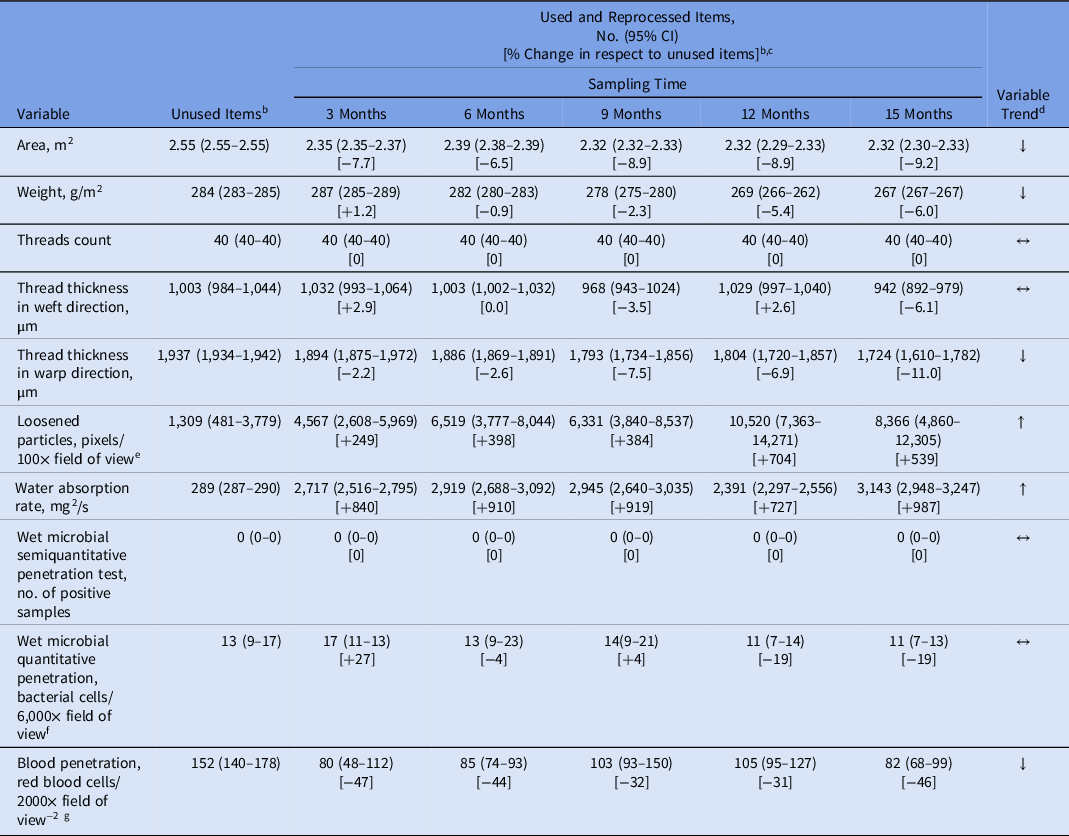
Table 1 presents the results summary and Figure 1 illustrates a selection of representative SEM images. The longer the time, the higher the number of uses, which reached a maximum of 87 for surgical drapes and 72 for gowns at 15 months. The longer the clinical use, the higher the number of unentangled and broken fibers (Fig. 1, first column). Additionally, SEM showed that clinical use and reprocessing induced a diffused fibrillation, with small filaments departing from the superficial fibers (Fig. 1, third and fourth columns). Fabric wear could be related to both mechanical stress during use, chemicals, and mechanical and physical stresses during reprocessing. Repeated reprocessing cycles can damage the fabric structure, promoting progressive degradation of the physical properties of the fabric over time.
Comparative Summary of the Results Obtained From the Characterization of Unused and Clinically Reused and Reprocessed Cotton surgical Drapes And Gowns a

a Data refer to a total of 8 surgical gowns and 18 surgical drapes samples, being 3 surgical gown and 3 surgical drapes collected at each study timepoint (control, months 3, 6, 9, 12, and 15). The number of tests performed for each garment sample is detailed in the supplementary material.
b Values are expressed as median (first quartile–third quartile) of the experimental values distribution.
c Values are reported in bold when significantly different from control group, P < .05.
d Qualitative comparison of variable values across the whole life cycle of the device: ↑ increase; ↔ no change; ↓ decrease.
e The 100× field of view corresponded to an area of 7.68 mm2.
f The 6,000× field of view corresponded to an area of 0.00213 mm2.
g The 2,000× field of view corresponded to an area of 0.0192 mm2.
Scanning electron microscopy images of fabric samples at 3 study points: before use (first row), after 6 months (second row) and after 15 months (third row) of clinical use and reprocessing. Low magnification images (first column, 100× original magnification) were collected for qualitatively evaluating the wearing of the fabric and to quantitatively measure thread size. Images of the adhesive tape surface obtained from the linting test (second column, 100× original magnification) show the increase of released fibers with time. Representative images for quantitative microbial penetration test (third column, 6,000× original magnification) and blood penetration test (fourth column, 100× original magnification) were used to enumerate coccoid cells and red blood cells, respectively. Fibrillation is also evident at 15 months of use.

A dimensional reduction of the surgical drapes was observed, with a marked reduction in the area at 3 months (−7%), mainly due to a size reduction in the warp direction, in agreement with the observed reduction of the microscopic thread thickness, showing a statistically significant decrease after 9 months (−7.5%), 12 months (−6.9%), and 15 months (−11%). No significant dimensional change was observed in the weft direction. Weight measurements showed significant decreases after 9 months (−2.3%), 12 months (−5.4%), and 15 months (−6.3%) of use, similarly to previously reported data. Reference Burgatti, Possari and Moderno2
No change in thread count was noted over time. In contrast, a significant increase with time in the number of loosened fibers was observed compared to controls: approximately +250%, +400%, +380%, +700%, and +540% at 3, 6, 9, 12, and 15 months, respectively. The increase over time in the number of loosened fibers concurred with the overall loss of mass and the increased fiber deconstruction observed by SEM. This degradation is a concern because standards recommend that SGDs be free of particles, lint, and fiber fragments, which may cause adverse events. Reference Shannon, Billbao, Marotta and Terbrugge7
The water absorption coefficient increased at 3 months (+840%), representing a significantly quicker water absorption rate. No further changes were noted at longer times. Possibly, the starch had not been fully removed by the triplicate washing of control samples.
Both semiquantitative and quantitative bacterial wet penetration tests showed no significant changes in cell penetration across fabric at any study point. Semiquantitative tests were passed by all samples in both single and double layers. A trend toward lower bacteria penetration with time was revealed by quantitative tests, but statistical significance was not reached. A similar trend was observed for the blood penetration test. A significant reduction in the number of red blood cells was observed after 6 months (−44%) and after 15 months (−46%).
Surprisingly, changes in the water absorption rate did not reflect detrimental performance in wet microbial and blood penetration, possibly due to the higher number of unraveled fibers and particularly to the higher cotton fabric fibrillation associated with use and reprocessing. The altered fabric microstructure had a clear impact on the water absorbance rate. However, it also generated a higher number of fibrils and a higher total fiber surface, which could act as a more effective trapping system, making penetration of bacterial and blood cells through the fabric more difficult. Similar results have been reported for face masks made of cotton fabric. Reference Sankhyan, Heinselman and Ciesielski8
Nondegradation of the wet bacterial filtration properties with time was also evidenced by results obtained with the DIN method. Some previous studies Reference Ward, Cooper, Lippert, Kablawi, Neiberg and Sherertz9,Reference Sahu, Panda, Jena, Hembram and Thakur10 have reported results for wet microbial penetration similar to this study but with variations among tested materials. Ward et al12 tested the performance of 100% cotton fabric in a single layer. Using a similar protocol, Sahu et al Reference Sahu, Panda, Jena, Hembram and Thakur10 used S. aureus as test microorganisms; however, the bacterial concentration of the testing solution was lower. Another study using the DIN method reported different results, Reference Cieslak, Puchowicz and Schmidt5 but tested samples were generated in a laboratory setting by applying repeated washing and sterilization.
This study had some limitations. We used originally developed tests instead of standardized methodologies. This approach allowed a finer comparison between test and control groups, whereas standard tests are more suitable to check conformity to prerequisites, often using a pass–fail approach. The results of this study cannot be directly extended to other fabric compositions, and further studies are needed to evaluate the effect of alternative methods and technologies to reprocess reusable fabric.
In conclusion, the properties of SGDs made of 100% cotton fabric change over their use cycle. Water absorption increased significantly, and a deconstruction of cotton fibers produced a significant increase of linting fibers. Given the progressive increase of linting fibers with time and the nondestructive nature of the linting test presented here, this parameter could be considered for monitoring the wearing status of the device along its use cycle. In contrast, our data showed that wet microbial and blood penetration were not impaired within the timeframe of this study.
Supplementary material
To view supplementary material for this article, please visit https://doi.org/10.1017/ice.2022.127
Acknowledgments
Financial support
This work was funded by the Fundação de Amparo à Pesquisa do Estado de Goiás (grant no. 19369), and Coordenação de Aperfeiçoamento de Pessoal de Nível Superior (grant no. 88882.306482/2018-01).
Conflicts of interest
All authors report no conflicts of interest relevant to this article.