Introduction
The emergence of molecular genetics has presented the animal breeding industry with new technologies that can be used in conjunction with traditional selection methods to enhance genetic progress. Recently, DNA-based tests have been developed to detect animals with a favorable genotype for economically desired traits (e.g. meat quality, growth rate, milk production). However, it is paramount to consider not only enhancement of genetic gain but also genetic defects that result in negative impacts on animal production.
Some genetic defects have so far been reported in Japanese cattle (Kunieda, Reference Kunieda2005). For example, the Chediak-Higashi syndrome is a recessive genetic defect with light coat color in a population of Japanese Black cattle (Ogawa et al., Reference Ogawa, Tu, Kagamizono, Soki, Inoue, Alatsuki, Nagata, Wada, Ikeya, Makimura, Uchida, Yamaguchi and Otsuka1997). This syndrome manifests itself in calves as increased bleeding tendency, abnormal granules in leukocytes, decreased number of dense granules in platelets and partial albinism (Tu et al., Reference Tu, Talahashi, Kaseda, Uchida, Yamaguchi, Suzuki, Ogawa and Otsuka1996). Claudin-16 deficiency is also a recessive genetic defect and is known to cause renal failure (Kobayashi et al., Reference Kobayashi, Hirano, Maruyama, Matsune, Mukoujima, Morimoto, Nakayama and Sugimoto2000; Sasaki et al., Reference Sasaki, Kitagawa, Kitou, Ohkura, Suzuki, Mizukoshi, Ohba and Masegi2002; Watanabe et al., Reference Watanabe, Ban, Takahashi, Ishikawa, Watababe, Yamanobe, Fujimori, Miyake, Okada, Otsuka, Oguro, Kawamura, Hirano, Sugimoto, Abe and Saito2002).
Most genetic defects are recessive, and heterozygotes cannot be phenotypically distinguished from normal homozygotes. Therefore, animal breeders often continue to use sires with a single copy of a deleterious allele, without due consideration of the effects in the herd. To make fully informed decision, it is important to be able to predict the monetary loss of using carrier sires of genetic defects.
The gene-flow method is thought of in terms of the proportion of genes in a group of animals originating from a base group of selected individuals and is useful for assessing the monetary benefits or losses of using genotypic information when making breeding decisions. This method accounts for the fact that monetary benefits or loss realized from genetic expressions in future years have lower effective value than those incurred currently. The objective of this study was to calculate cumulative discounted expressions (CDE) of aa animals with genetic defects when using sires carrying a single defective allele in the herd by applying a modified gene-flow method (Nishio et al., 2008) to investigate the expression pattern of homozygous recessive genotypes and to evaluate the monetary loss of using these sires.
Material and methods
The discounted gene-flow method (Hill, Reference Hill1974; McClintock and Cunningham, Reference McClintock and Cunningham1974; Van Vleck and Everett, Reference Van Vleck and Everett1976) has long been used to account for CDE of sire’s genes in his descendant. The discounted gene-flow principles of Van Vleck and Everett (Reference Van Vleck and Everett1976) were modified by Amer (Reference Amer1999) and Amer et al. (Reference Amer, Simm, Keane, Diskin and Wickham2001) and were applied to sheep and beef breeding programs, respectively. The work by Amer (Reference Amer1999) was extended to evaluate the value of using genetically superior animals for expression of a recessive single gene (Wood et al., Reference Wood, van der Werf and Parnell2004; Kearney et al., Reference Kearney, Amer and Villanueva2005) and to account for a situation where descendants of specific animals are mated to more than one breed (Berry et al., Reference Berry, Madalena, Cromie and Amer2006). Recently, Nishio et al. (2008) modified the conventional gene-flow method (Hill, Reference Hill1974) to calculate the CDE of all genotypes when using sires of a particular genotype in the herd. In this study, this modified gene-flow method was applied to calculate the CDE of homozygous recessive animals with genetic defect as a result of using carrier sires.
A single biallelic locus (alleles A and a) was considered with A representing the dominant allele and a representing the recessive allele. The frequency of allele A was denoted by p and that of allele a by q = 1 − p, assuming the Hardy-Weinberg equilibrium. It was assumed that all or some of the recessive animals (aa) die due to genetic defects. Therefore, gene frequency in the next generation depends on the fitness of the genotypes and on the gene frequency in the current generation. Fitness of a particular genotype was defined as the proportion of the genotypes that reproduce relative to others. If the probability of an animal dying due to genetic defects is w, the fitness of aa animal can be defined as 1 − w.
When calculating CDE of using sires of a particular genotype, the modified gene-flow method needs to be changed assuming the differential effect of genotypes on fitness. In this study, therefore, matrix P describes the flow of genotypes and the elements of that depend on parents’ genotypes and the gene frequencies in the herd. Assuming random mating, the proportion of progeny of genotype i at the time of birth t (oi ,t) can be calculated as

where n is the number of genotypes for gene of interest; Prob (oi ,t|Sj,Dk) is the conditional probability of a progeny of genotype i at time t, given sire of genotype Sj and dam of genotype Dk, and can be calculated from Mendelian rules; sj ,t − 1 and dk ,t − 1 are the proportions of sires of genotype j and dams of genotype k at time t − 1, respectively. For example, when using a sire of genotype aa, the probability that the genotype of its progeny will be genotype aa at the time t (Prob(oaa ,t|Saa)) can be calculated as

Because the proportion of sires of genotype aa is 1 and the fitness of genotype aa is 1 − w,

where  describes the proportion of allele a of females mated at time t − 1. In the same way, when using a dam of genotype aa, the probability that the genotype of its progeny will be genotype aa at time t (Prob(oaa ,t|Daa)) can be calculated as

Thus,
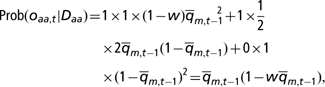
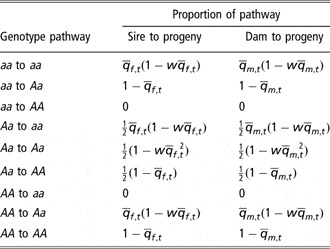
where  describes the proportion of allele a of males mated at time t − 1. The proportions of all genotype pathways are shown in Table 1.
Proportions of all genotype pathways at time t

The values of  and
 are calculated from weighted averages of genes in the herd. Let qm ,t and qf ,t be the vectors describing proportions of allele a in each age class of males and females at time t, respectively. Because
 and
 are the weighted averages of alleles a in mated males and females, they are calculated from

where m and f describe the vectors of proportions of offspring from each age class of sires and dams, respectively.
The frequency of each genotype in the age class 1 in year t + 1 was multiplied by its relative fitness, producing the ratio aa : Aa : AA= . Each value was standardized by dividing it by the sum of values for the three genotypes to ensure that the genotype proportions sum to 1. Therefore, the gene frequency of males and females in age class 1 in year t + 1 in the herd can be calculated as

The proportions in the other age classes in time t + 1 are as follows:

where m and f are the numbers of age classes of males and females, respectively.
Let mt be a vector describing the proportion of each genotype in the herd at time t. The genotype frequencies at any given time can be derived from genotypic frequencies in the previous year using matrix P:

In age class 1, w of aa animals die and 1 − w survive. Therefore, m(1) and m(3m + 1) corresponding to age class 1 of aa males and aa females are multiplied by (1 − w).
In this study, the objective was to evaluate the effect of using carrier sires (Aa). When only Aa sires are used in the first year, the starting value at time 0 is m0′=[00…0|10…0|00…0|00…0|00…0|00…0]. The blocks of m correspond to the proportions of genotypes aa, Aa and AA in males and females of each age class. Calculating the CDE of using normal sires (AA) is also important for comparison with those when using carrier sires. Therefore, this study also simulated a scenario assuming the use of AA sires and m0′=[00…0|00…0|10…0|00…0|00…0|00…0]. The blocks of m correspond to the proportions of genotypes aa, Aa and AA in males and females of each age class.
The CDE over planning horizon (k) when using sires of a particular genotype are given by

where d is a discount vector, h is an incidence vector and lag is a genetic lag that gives the delay from the time of birth to the expression of the trait. The CDE need to be discounted back to the time when the sires of a particular genotype were first used to account for later expression of traits in progeny. The discount vector is calculated from

where t = 1 to i and c is the discount rate per annum. The incidence vector accounts for the proportional number of animals within an age class, and the relative level of expression in an age class (Groen, Reference Groen1990). The elements h(i) of the incidence vector h at time t can be defined as follows:

and

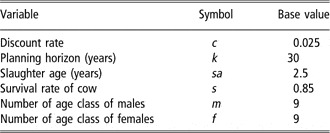
The value 0.5 represents the sex ratio. Because w of aa progeny will die, the CDE of aa progeny with genetic defect are calculated using the elements of vector h corresponding to aa progeny (i.e. h(1) and h(3m + 1)). Several parameters are required when calculating the CDE, i.e. survival probabilities of cow (s) from age group i − 1 to age group i, resulting in a fixed age distribution, the numbers of age classes of males and females (m, f), discount rate (c), planning horizon (k), age at slaughter of progeny (sa), and gene frequency of male and female in the herd at time t ( ). The base values of these parameters are shown in Table 2. The values represented a typical situation in a Japanese Black cattle herd. The replacement rate (r) can be calculated as follows (Nishio et al., 2008):
Base values for variables

The monetary loss of sires of a particular genotype was calculated as the product of the production value of calves and the CDE when using those sires. In this study, the monetary loss of using carrier sires was examined when the genetic defects had a lethal recessive condition because most genetic defects reported in livestock are considered as lethal recessive conditions. In this condition, breeders suffer loss through death of calves of genotype aa. The loss of using those sires is given by

The value 3645 is in US$ and corresponds to the production costs of a calf (MAFF, 2005). The monetary loss of using Aa and AA sires was calculated. In addition, the difference in the loss between using Aa and AA sires was calculated to assess the effect of using carrier sires.
Results
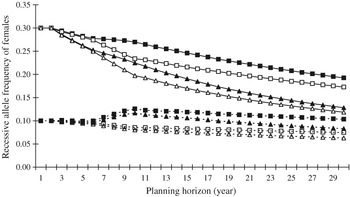
The changes in recessive allele frequency over planning horizon when Aa and AA sires are used at various initial recessive allele frequencies and fitness of homozygous recessive genotype are shown in Figure 1. When the initial allele frequency was 0.1, the recessive allele frequency slightly increased right after year 7. The rates of changes in recessive allele frequency depended on both initial allele frequency and fitness (1 − w) of genotype aa. Low fitness led to a decrease in the recessive allele frequency. This decrease was large at high initial allele frequency because more animals of genotype aa died in this case. These trends were also shown when using AA sires in the first year.
Change in recessive allele frequencies in the herd over the planning horizon when Aa sires (▪,▴) and AA sires (□,▵) are used at an initial recessive allele frequency of 0.1 (dotted line) and 0.3 (solid line), and fitness of homologous recessive genotype (1 − w) of 0 (▴,▵) and 0.5 (▪,□).

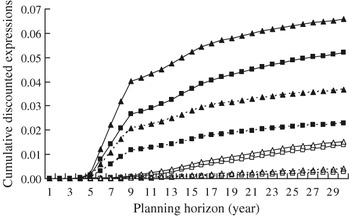
The CDE over planning horizon when Aa and AA sires are used at initial recessive frequencies of 0.1 and 0.3 and fitnesses of homozygous recessive genotype of 0 and 0.5 are shown in Figure 2. At both initial recessive frequencies, up to year 5, the CDE were almost equal to 0 because it took 5 years for the aa progeny to be born from first sires. When using Aa sires, the CDE increased dramatically from year 5 up to year 9. After year 9, the increase was gradual. The gradual increase in CDE was due to a decrease in recessive allele frequency in the herd. When using AA sires, the value of CDE was smaller than when Aa sires were used.
Cumulative discounted expressions over planning horizon when Aa sires (▪,▴) and AA sires (□,▵) are used at initial recessive allele frequency of 0.1 (dotted line) and 0.3 (solid line) and fitness of homologous recessive genotype (1 − w) of 0 (▴,▵) and 0.5 (▪,□).

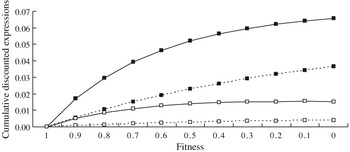
It is important to calculate the CDE to evaluate the monetary loss of using sires of a particular genotype. The difference in the CDE between sires of genotype Aa and AA was estimated to evaluate the disadvantage of using Aa sires. Figure 3 shows the CDE when either Aa or AA sires are at initial recessive allele frequencies of 0.1 and 0.3 and various fitness of homozygous recessive genotype. When the fitness was 1, the CDE were 0 in all four cases because all aa progeny survive. As expected, expressions increase with decreasing fitness in all four cases. The rates of increase in the CDE depended on the initial allele frequencies. When the initial allele frequency was 0.3, the rates of increase in the CDE were larger at higher fitness. When the initial allele frequency was 0.1, the rates of increase in the CDE increased linearly with decreasing fitness. The difference in the CDE between sires of genotype Aa and AA was larger at high fitness than at low fitness.
Number of cumulative discounted expressions when either Aa (▪) or AA (□) sires are used at initial recessive allele frequencies of 0.1 (dotted line) and 0.3 (solid line) at various fitness of homologous recessive genotype.

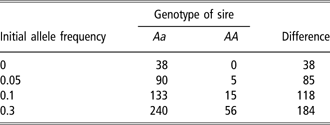
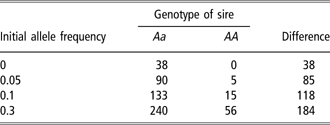
The monetary loss of using Aa and AA sires with different initial allele frequencies and fitness is shown in Table 3. Note that using AA sires causes the loss because AA sires produce the Aa progeny, which will also become the sires and dams. The loss of using Aa or AA sires was larger at higher initial allele frequencies. The difference was larger when initial allele frequency was higher than when initial allele frequency was low. For example, when initial allele frequency was 0.3, the difference in the monetary loss between Aa sires and AA sires was US$183. Considering a population size of 628 000 cows in Japan per year, the difference would be US$114 924 000.
Loss of using Aa and AA sires (US$)
Discussion
There are some studies on the effects of recessive genes for genetic defects on animal breeding programs (Van Vleck, Reference Van Vleck1966; Tanida and Hohenboken, Reference Tanida and Hohenboken1987; Thompson et al., Reference Thompson, Heesterbeek and van Arendonk2006). Kearney et al. (Reference Kearney, Amer and Villanueva2005) evaluated the use of sires for a lethal recessive genetic defect in dairy cattle. Using carrier sires involves a certain amount of financial risks, it is important for breeders to know the effect of using carrier sires. Therefore, this study demonstrated the economic implications of using sires that carry one copy of a deleterious allele in Japanese Black cattle.
The CDE were calculated under situations where the initial allele frequency in the herd and the fitness of homologous recessive genotype varied to investigate the expression pattern of homozygous recessive genotypes with genetic defects in the herd. The present result showed that when a genetic defect is highly lethal (low fitness of homozygous recessive genotypes), the CDE of using carrier sires were large. Moreover, the monetary loss of using carrier sires in lethal recessive conditions was greatly affected by initial allele frequency.
The method used in this study applied to defects reported in Japanese Black cattle. Claudin-16 deficiency is frequently seen in Japanese Black cattle and is known to cause hereditary renal failure. The recessive allele frequency of this defect is 0.1 (LIAJ, 2001). Because most cattle with this defect die, the fitness of homozygous recessive genotype is 0. In this case, the difference in the loss between using Aa and AA sires will be US$118. The Band-3 deficiency is an autosomal recessive defect. Affected calves suffer from hemolytic anemia, choloplania and splenic tumor, and most of them die. The recessive allele frequency of this defect is 0.04 (LIAJ, 2001), and the fitness of the homozygous recessive genotype is 0, leading to a difference in the loss between using Aa and AA sires of US$77.
This study assumed no selection and that the fitness of homozygous recessive genotypes was s and that of other genotype was 1 because most genetic defects are recessive. In practice, because majority of genetic defects are expressed early in life and animals having a visible defect will usually be culled even if not lethal, the fitness of the homozygous recessive genotype should be 0. On the other hand, some defects occur in some animals of genotype aa, e.g. the F11 deficiency in Japanese Black cattle. Kunieda et al. (Reference Kunieda, Tsuji, Abbasi, Khalaj, Ikeda, Miyadera, Ogawa and Kunieda2005) reported that Japanese Black cattle with F11 deficiency showed a marked reduction in F11 activity with prolonged bleeding time and abnormal plasma coagulation. However, not all animals with this deficiency die (i.e. w ≠ 1). Therefore, it is possible that some cattle with F11 deficiency are normal. Ghanem et al. (Reference Ghanem, Nishiobori, Nakao, Nakatani and Akita2005) reported that one Holstein cow with repeat breeding was found to have the F11 deficiency heterozygous genotype in Japan. However, no repeat breeding or abnormal bleeding at parturition has been reported in the F11 deficiency dams. Therefore, F11 deficiency might have little effect on the reproductive ability. In this case, the CDE can be calculated by defining a fitness value of genotype aa if greater than 0.
If carrier sires have high genetic merit for other economically important traits (i.e. BMS number), selection on important traits will increase the recessive allele. Conversely, culling of such carrier sires may lead to delay in genetic improvement. Larzul et al. (Reference Larzul, Manfredi and Elsen1997) and Pong-Wong and Woolliams (Reference Pong-Wong and Woolliams1998) described the methods of selection using gene information by applying the selection index theory. These methods can be used to select carrier sires with high genetic merit by including gene information on both genetic defects and economically important traits in the selection index.
Conclusions
In this study, although a single locus genotype with two alleles was assumed, extension to a large number of loci is straightforward. Therefore, it is possible to calculate the CDE and economic implications of using particular sires for both disease and economically important traits. The CDE of using AA and Aa sires were affected by initial allele frequency and fitness, stressing the importance of determining the initial allele frequency and fitness when using certain sires, especially Aa sires. In this study, the method was applied on genetic defects commonly found in the Japanese Black cattle. However, it should be noted that a similar approach could be applied to other genetic defects in different breeds and species.
Acknowledgment
This study was partly supported by Grant-in-Aid for scientific research (No.19658104) from the Japanese society for promotion of science (JSPS).