Introduction
Human strongyloidiasis, primarily caused by the nematode Strongyloides stercoralis (Bavay, 1876), is a widely recognised neglected tropical disease with substantial epidemiological impact. Although precise prevalence data from endemic regions remain limited, previous estimates suggested 30–100 million infections worldwide (Bethony et al. Reference Bethony, Brooker, Albonico, Geiger, Loukas, Diemert and Hotez2006), while more recent, less conservative analyses propose up to approximately 600 million cases (Buonfrate et al. Reference Buonfrate, Bisanzio, Giorli, Odermatt, Fürst, Greenaway, French, Reithinger, Gobbi, Montresor and Bisoffi2020).
Strongyloidiasis is particularly significant due to its potential to progress to severe clinical manifestations under specific conditions, such as prolonged corticosteroid administration. In these circumstances, the parasite population can increase dramatically, resulting in hyperinfection. Without prompt intervention, the disease may advance to complicated strongyloidiasis, in which parasites disseminate to multiple organs (disseminated infection syndrome). This disseminated form can be life-threatening and is associated with high mortality rates (Mati et al. Reference Mati, Raso and Melo2014; Rojas et al. Reference Rojas, Montoya, Villanueva-Lozano and Carrion-Alvarez2023; Vadlamudi et al. Reference Vadlamudi, Chi and Krishnaswamy2006).
Despite its significant medical and epidemiological importance, strongyloidiasis has been neglected, primarily due to the challenges associated with researching the parasite’s biology and the host’s pathophysiology. Key obstacles include the inability to maintain S. stercoralis of human origin in the laboratory and the almost complete absence of viable experimental models to study critical processes such as autoinfection, hyperinfection, and dissemination of this parasite (Mati Reference Mati2025; Mati et al. Reference Mati, Raso and Melo2014). Consequently, research on strongyloidiasis frequently relies on alternative Strongyloides spp. as parasitic models for the human nematode. Among the approximately 60 taxonomically valid species within the genus (Mati and Melo Reference Mati and Melo2014), Strongyloides venezuelensis Brumpt, 1934, which naturally infects rodents (Little Reference Little1966; Viney and Kikuchi Reference Viney and Kikuchi2017), has been extensively used in experimental studies employing various animal host models. These primarily include different strains of mice (Fernandes et al. Reference Fernandes, Pereira, Eschenazi, Schilter, Sousa, Teixeira and Negrão-Corrêa2008; Martins et al. Reference Martins, Melo, Nicoli, Carvalho, Lana, Vieira and Farias1999, Reference Martins, Melo, Nicoli, Cara, Carvalho, Lana, Vieira and Farias2000, 2009; Melo et al. Reference Melo, Vasconcelos and Gazzinelli2006; Rodrigues et al. Reference Rodrigues, Camelo, Rezende, Maggi, Silva, Rodrigues, Araújo, Martins-Filho and Negrão-Corrêa2021; Sato and Toma Reference Sato and Toma1990) and rats (Anjos-Ramos et al. Reference Anjos-Ramos, Gama, Mati, Corá, Fujiwara and Americo2016; Figueiredo et al. Reference Figueiredo, Resende, Mati and Anjos-Ramos2023; Islam et al. Reference Islam, Kim and Baek1999; Marra et al. Reference Marra, Chiuso-Minicucci, Machado, Zorzella-Pezavento, França, Ishikawa and Amarante2011; Tavore et al. Reference Tavore, Silva Bispo, Gama, Mati and Anjos-Ramos2021; Tobar et al. Reference Tobar, Ramos-Sarmiento, Tayupanta, Rodríguez and Aguilar2021), but also gerbils (Baek et al. Reference Baek, Islam, Kim, Choi and Lee2002; Horii et al. Reference Horii, Khan and Nawa1993; Khan et al. Reference Khan, Horii and Nawa1993; Tsuji et al. Reference Tsuji, Nakamura and Taira1993) and even nonhuman primates (Melo et al. Reference Melo, Mati and Martins2012).
Conducting these studies depends on maintaining the parasite in the laboratory, which requires successive passages through rodent models – a process that poses additional challenges for researchers. In this context, Mongolian gerbils (Meriones unguiculatus), also known as clawed jirds, have been employed with promising results. Their prolonged infection duration with S. venezuelensis makes them particularly valuable for investigating parasite–host interactions related to chronic infection and parasitological diagnosis. These rodents also serve as relatively safe and long-term sources of S. venezuelensis eggs, which are continuously shed in their faeces (Baek et al. Reference Baek, Islam, Kim, Choi and Lee2002; Tsuji et al. Reference Tsuji, Nakamura and Taira1993). Thus, faecal material from infected clawed jirds can be used to continuously recover large quantities of eggs for larval cultivation, making this animal model highly valuable for alternative experimental and innovative research lines. The possibility of studying larvae is crucial for analyses on the development of the nematode, covering areas from basic biology and morphology to molecular studies of Strongyloides spp. However, for these different approaches, including biochemical and immunological studies, it is essential to use highly purified preparations of nematode eggs and larvae that are free from faecal contamination (Martins et al. Reference Martins, Melo, Nicoli, Carvalho, Lana, Vieira and Farias1999, Reference Martins, Melo, Nicoli, Cara, Carvalho, Lana, Vieira and Farias2000; Tuo et al. Reference Tuo, Zarlenga, Hebert, Miramontes and Fetterer2015).
For a century, the principle of floating parasitic elements in high-density solutions has been used for diagnostic purposes. Willis (Reference Willis1921) and Sheater (Reference Sheather1923), in their pioneering studies, used saturated solutions of sodium chloride (NaCl) and sucrose, respectively, to detect and identify ‘light’ eggs and larvae of helminths, as well as cysts and oocysts of protozoa in faecal samples. Due to their lower density, these structures float on the solution’s surface and can be collected and observed with the aid of a light microscope. Subsequently, centrifugal flotation using zinc sulphate as a flotation solution (Faust et al. Reference Faust, D’Antoni, Odom, Miller, Peres, Sawitz, Thomen, Tobie and Walker1938) was developed, introducing a versatile, simple, and inexpensive technique that remains widely employed in routine parasitological testing in clinical laboratories.
Although flotation methodologies were originally developed primarily for diagnostic purposes, over time they have been adapted, particularly in veterinary medicine, to recover viable nematode eggs for a wider range of applications (Choi et al. Reference Choi, Park, Park, Kang, Lee, Song, Kim, Park, Kim and Yu2019; Cringoli et al. Reference Cringoli, Rinaldi, Maurelli and Utzinger2004; Tuo et al. Reference Tuo, Zarlenga, Hebert, Miramontes and Fetterer2015; Wassall and Denham Reference Wassall and Denha1969). However, in contrast to diagnostic studies, methodological research utilising the principle of flotation in saturated solutions for isolating parasitic elements, particularly involving nematode species relevant to human medicine, remains scarce. Indeed, no robust quantitative protocol has yet been established for recovering large quantities of Strongyloides eggs and/or larvae while ensuring the viability of distinct developmental stages for experimental applications. Some studies have reported the recovery of Strongyloides spp. eggs and mentioned procedures for handling nematode larvae for non-diagnostic purposes (Baek et al. Reference Baek, Islam and Kim1998a; Busari et al. Reference Busari, Elizondo-Luévano, Aiyelaagbe, Soetan, Babayemi, Gorgojo-Galindo and López-Abán2024; Martins et al. Reference Martins, Melo, Nicoli, Carvalho, Lana, Vieira and Farias1999, Reference Martins, Melo, Nicoli, Cara, Carvalho, Lana, Vieira and Farias2000; Moncol and Triantaphyllou Reference Moncol and Triantaphyllou1978; Yamada et al. Reference Yamada, Matsuda, Matsuda, Taira, Sato and Tada1991); however, these approaches have not sufficiently addressed the need for high-yield, viable preparations of both eggs and larvae. Notably, a sucrose gradient centrifugal-flotation technique has been proposed for obtaining S. venezuelensis eggs free of faecal debris from rats (Roldán et al. Reference Roldán, de Paula and Gryscheck2020). However, as that preliminary report did not quantify key variables and recovery yield aspects were not completely clarified, further methodological development remains warranted.
Therefore, we revisited the century-old principle of egg flotation using saturated solutions, a cornerstone of parasitological diagnosis, and refined the methodology to obtain large quantities of viable S. venezuelensis eggs for controlled biomedical research, integrating classical and contemporary experimental frameworks. An alternative, low-cost, and easily reproducible protocol is presented for the systematic and quantitative recovery of S. venezuelensis eggs, with potential applicability to other nematode species. The procedure’s efficacy is demonstrated through comprehensive analyses of larval development and viability following recovery using saturated NaCl and sucrose solutions. Furthermore, the current use of this historical principle in modern scientific contexts is discussed, emphasising its role in standardising the quantitative collection of S. venezuelensis eggs and subsequent larval cultivation to address current research demands. This study reflects on the broader epistemological implications of preserving and repurposing foundational scientific knowledge, bridging historical methodologies with cutting-edge biomedical innovation. Therefore, we highlight that such an integrative approach deserves greater attention, as it not only leverages past scientific efforts to generate substantial present-day benefits but also fosters efficiency, sustainability, and inspiration for future parasitological research by valuing and revitalising conventional methods.
Material and methods
Strongyloides venezuelensis strain
A strain of Strongyloides venezuelensis Brumpt, 1934, was isolated from rats in 1987 and maintained at the Laboratory of Taxonomy and Invertebrate Biology of the Department of Parasitology of the Institute of Biological Sciences, Federal University of Minas Gerais (ICB/UFMG), through successive passages in AKR/J mice during more than 25 years (Martins et al. Reference Martins, Melo, Nicoli, Cara, Carvalho, Lana, Vieira and Farias2000, Reference Martins, Nicoli, Farias, Carvalho, Cara and Melo2009; Melo et al. Reference Melo, Mati and Martins2012). Subsequently, the strain was also maintained in clawed jirds (M. unguiculatus), including at the Department of Medicine of the Federal University of Lavras (UFLA). Maintaining the strain in this rodent species offers two key advantages in the context of this study: (i) prolonged infection lasting months without frequent repassaging, substantially reducing workload, costs, and ethical concerns by minimising the number of animals required to maintain the strain; and (ii) consistent egg shedding suitable for large-scale recovery, with intermediate faecal pellet size between mice and rats.
Rodent infection and quantification of eggs in faeces
Male specimens of M. unguiculatus (n = 5) infected subcutaneously with 2,000 filariform larvae of S. venezuelensis were maintained in medium-sized cages lined with wood shavings and provided with water and a commercial rodent food ad libitum. For the collection of faeces, the rodents were housed individually in cages overnight (for approximately 10–12 hours). The cages were equipped with a metal screen that allowed the rodent faeces to fall onto a layer of damp absorbent paper at the bottom, and the following morning, their fresh faeces were collected. The samples were weighed on an analytical balance, macerated with a glass rod, and processed.
The number of eggs and/or larvae per gram of faeces (EPG) was determined as baseline reference using spontaneous sedimentation (Hoffman et al. Reference Hoffman, Pons and Janer1934; Lutz Reference Lutz1919). Approximately 5% of collected faeces (weighed on an analytical balance) were suspended in water and allowed to sediment spontaneously for 2 h. The supernatant was discarded, the sediment fixed in 10% formalin, and the entire sediment examined microscopically (40× magnification) for complete egg and/or larva enumeration. This enabled simple proportional calculation of the ‘true’ (or baseline) EPG in the faecal material.
The use of rodents was approved by the Committee on Ethics in the Use of Animals (CEUA) of the UFLA according to Protocol No. 095/18 of 10/19/2018.
Preparation of saturated solutions and faecal suspensions
Saturated NaCl and sucrose solutions were prepared using established proportions representing solubility limits at 20°C: 36 g NaCl and 203.9 g sucrose per 100 g deionised water (specific gravities: 1.20 g/mL for NaCl; 1.28–1.32 g/mL for sucrose). These exceed the specific gravity of most helminth eggs (typically 1.05–1.15 g/mL), ensuring effective flotation. Weight (grams) rather than volume was used for precision, as solution density varies with saturation and temperature, making gravimetric preparation more reproducible across laboratories. Excess solute was added until undissolved crystals remained, the mixtures were agitated until no further dissolution occurred, and supernatant was decanted to separate excess solute. Final densities were verified as 1.20 g/mL (NaCl) and 1.29 g/mL (sucrose) using a hydrometer, consistent with parasitological standards. These solutions served as references for comparative egg recovery tests and optimisation experiments evaluating faecal suspension volumes/concentrations.
Within this framework, after quantifying the number of eggs per gram of faeces (EPG) from the clawed jirds in the starting material, as already described, fresh faeces were used to produce aqueous faecal suspensions for the optimisation tests. The initial ratio in these suspensions was 100 ± 10 mg of faeces per 1 mL of deionised water. Samples in 15 mL polypropylene conical centrifuge tubes underwent three washes via centrifugation (1006–1260 g.min) until the supernatant cleared. Each cycle involved discarding the supernatant and refilling the tube with the faecal sediment using deionised water.
Lastly, according to the experimental design, aliquots of the stock-saturated solution or the initial aqueous faecal suspension (100 mg/mL) were serially diluted with deionised water to produce samples with decreasing dilution factors.
Experimental design
The experiments consisted of two phases: comparison and optimisation. In the comparison phase, two saturated solutions (NaCl and sucrose) were tested, followed by incubation of parasitic elements to assess their development and survival. The optimisation phase examined different volumes and concentrations of faecal suspensions, as well as varying solute concentrations of the saturated solution selected in the comparison phase, to determine the most effective combination for egg recovery.
Phase 1: Centrifugal flotation and comparison between saturated solutions of NaCl and sucrose
Faeces from rodents infected with S. venezuelensis were processed using a modified centrifugal flotation technique grounded in established diagnostic principles and techniques (Faust et al. Reference Faust, D’Antoni, Odom, Miller, Peres, Sawitz, Thomen, Tobie and Walker1938; Ritchie Reference Ritchie1948; Sheather Reference Sheather1923; Willis Reference Willis1921). Briefly, a baseline of eggs per gram (EPG) was first quantified in the original faecal samples after processing as described above. Subsequently, aliquots of faeces were transferred with the aid of a Pasteur pipette into 15 mL centrifuge tubes containing saturated NaCl or sucrose solutions, diluted also to a final concentration of approximately 100 ± 10 mg of faeces per mL of saturated solution. The resulting suspensions (15 mL) were centrifuged at 126 x g for 10 minutes (1260 g.min), and 2 mL of supernatant from each tube was collected using a 1,000 μL automatic pipette with the tip cut off to facilitate egg recovery among debris. The supernatant was transferred to another centrifuge tube and brought up to volume with deionised water, and the tube was subjected to a new centrifugation cycle for egg sedimentation. After centrifugation, the water was removed from the tubes with a Pasteur pipette until 2 mL remained, after which the mixture was again topped up with deionised water and centrifuged. The washing procedure was performed three times to remove excess solute from the saturated solutions. To quantify egg recovery yield, the number of eggs in three 25 μL aliquots from each replicate was counted. The average number of eggs was then estimated, and the recovery percentage was calculated relative to the baseline EPG.
To confirm recovered eggs remained viable post-recovery and washing, larval hatching and survival were assessed as a quality control step. Remaining tube contents were transferred to glass Petri dish lids (37 × 8 mm) for optimal microscopic visualisation. Lids were covered with perforated plastic film to ensure oxygenation while minimising evaporation. These biological systems were placed in a BOD incubator at 27°C for 96 hours. The development and survival of the larvae were then evaluated every 24 hours. For these evaluations, the lids were placed on a glass slide and shaken prior to direct counting under a microscope.
In this comparison using saturated NaCl and sucrose solutions in the modified centrifugal flotation method, four different experiments were conducted. Each experiment was performed in duplicate or triplicate, and in each case, aliquots were evaluated in triplicate.
Phase 2: Systematic optimisation using saturated NaCl solution
Following superior NaCl performance in Phase 1 (see Results), Phase 2 optimised the protocol for greater precision using smaller volumes of separation solution (5 mL vs 15 mL in Phase 1) and shorter centrifugation time, while maintaining the same methodological principles. Complementary tests systematically evaluated key variables to maximise recovery of viable S. venezuelensis eggs:
I. Effect of volume and concentration of the faecal suspension
Varying volumes (1, 2, 3, 4 mL) of faecal suspensions at concentrations 100, 50, 25, 12.5, 6.25, 3.125 mg/mL were processed with 5 mL saturated NaCl at 503 x g for 2 minutes (1006 g.min). Supernatant (2 mL) was discarded, and the pellet at the bottom of the conical centrifuge tube was collected with a pipette. The recovered nematode eggs were transferred to a fresh 15 mL centrifuge tube for reprocessing and/or fixed in 10% formalin for subsequent counting under a microscope.
II. Reprocessing of primary pellets
Remaining material from the centrifugal-flotation tests with 1–4 mL faecal suspensions (100 mg/mL) was reprocessed, as these primary pellets likely contained trapped eggs that could increase total yield. To maximise recovery yield, pellets were resuspended in water (1 mL), mixed with 5 mL fresh saturated NaCl solution, and re-centrifuged (1006 g.min). Second supernatants were collected, washed, and eggs fixed in 10% formalin for microscopic enumeration.
III. NaCl concentration gradient
Aliquots of 1 mL were removed from the faecal suspension (100 mg/mL), quantified, and added to 5 mL of NaCl solution at different concentrations, ranging from 1.0 (saturated solution, 100%) to 0.05 (5%). Subsequently, the eggs were centrifuged, collected, and transferred to microcentrifuge tubes, as previously described. The recovered eggs were fixed in 10% formalin and counted under a microscope. Two aliquots were processed for each concentration of the NaCl solution. Based on these results, a theoretical sigmoidal curve was fitted.
For each case, two or three different experiments were performed, each with at least two repetitions.
Statistical analysis
To assess differences in egg recovery between the two solutions, a “Student’s t-test” was performed. The percentage survival of eggs and larvae was evaluated using a “chi-squared test”. The effects of faecal suspension volume and concentration on egg recovery were analysed by multiple linear regression. Moreover, recovery data for different faecal suspension volumes during the first processing and a second reprocessing (second recovery) were subjected to “analysis of variance (ANOVA)”, with the “Tukey test” used for post-hoc comparisons. Lastly, the decrease in egg recovery resulting from dilution of the saturated sodium chloride solution was modelled using a sigmoidal curve fitted by non-linear regression.
Results
During the experiments and their repetitions, more than 15,000 eggs and/or larvae were directly observed and counted under the microscope. The results are presented according to the experimental design, organised into Phase 1 and Phase 2. At the end of the results section, additional observations are included in a dedicated topic.
Phase 1: Centrifugal flotation and comparison between saturated solutions of NaCl and sucrose with analysis of hatching and larval survival
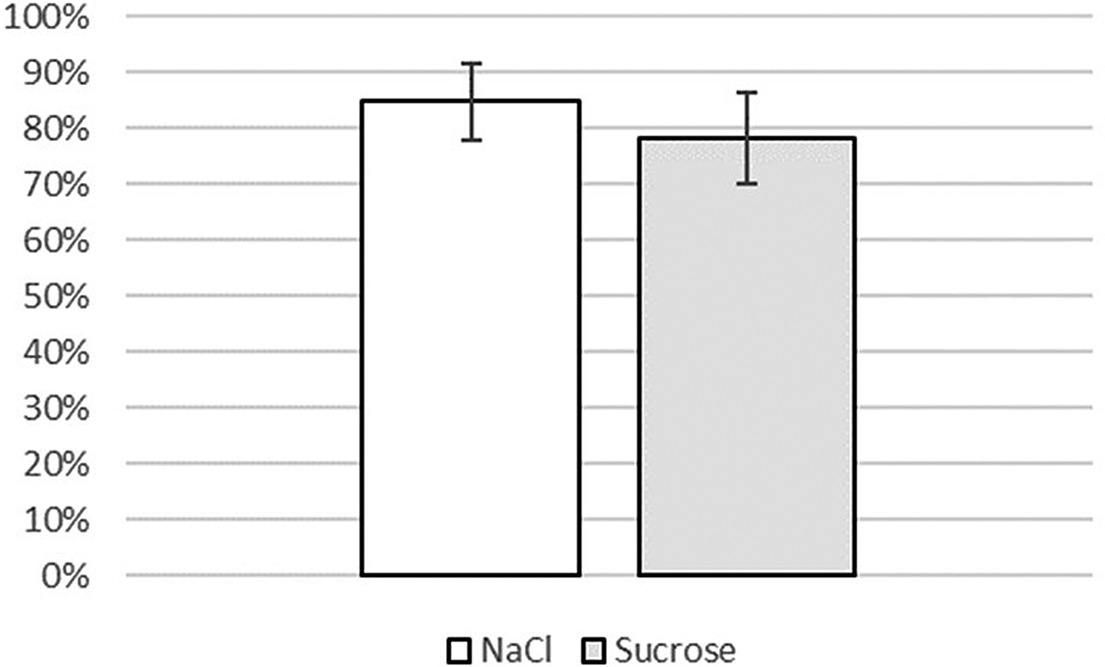
Centrifugal flotation with saturated solutions of sucrose or NaCl enabled the recovery of a large number of eggs and even some viable larvae (<2% of the total) of S. venezuelensis. Both solutions produced satisfactory egg recovery percentages from the faecal material analysed (4 ± 1.2 g of faeces per experiment). The maximum recovery yield was achieved with the saturated NaCl solution, reaching 94% of the total number of eggs present in a stool sample, as determined by initial quantitative examination. The mean percentage of eggs recovered from faeces was 84.8% ± 6.7% using the saturated NaCl solution and 78.3% ± 8.2% using the saturated sucrose solution (Figure 1), although the difference between the two solutions was not statistically significant (p = 0.169). However, the use of a saturated sucrose solution for centrifugal flotation resulted in a more viscous residual liquid, characterised by the presence of sediments and substrates, increased turbidity, and occasional growth of filamentous fungi. These combined factors hindered visualisation under light microscopy. In contrast, the visibility was substantially enhanced when saturated NaCl solution was used as the separation solution, particularly during the evaluation of developmental kinetics and the survival of the larvae in subsequent culture.
Percentage recovery of S. venezuelensis eggs by centrifugal flotation using saturated NaCl or sucrose solutions, calculated as the ratio of eggs recovered to the total egg count in the original faecal samples. No significant difference between the two solutions was observed (p = 0.169). Data from four experiments with a total of ten replicates.

The mean and standard deviation of S. venezuelensis larvae cultured for 96 hours in the residual liquid from the process of recovering eggs by centrifugal flotation in saturated solutions (NaCl or sucrose) are summarised in Table 1. The number of eggs incubated in the samples, estimated by counting three 25 μL aliquots, was 496 ± 45 in saturated saline solution and 480 ± 37 in saturated sucrose solution. From these values, the survival rate of the larvae during the culture period was calculated and is also presented (Table 1). After 24 hours of incubation, considering the sum of L1 and L2 larvae, the survival rate of hatched larvae observed in relation to the number of eggs incubated was 15.5% in the residual liquid from recovery in saturated saline solution and 11.2% in residual liquid from recovery in saturated sucrose solution. At this time, no third-stage filariform larvae (L3) were observed. As expected, the number of rhabditiform larvae decreased as the number of L3 increased over culture time. After 48 hours of incubation, there was greater survival of larvae in the residual liquid from the saturated saline solution than in the residual liquid from the saturated sucrose solution. In fact, the values of L3 observed in cultures using NaCl residual liquid were at least 2.5 times greater than the number of L3 observed in the sucrose residual liquid, and at 72 hours of culture the difference in the survival rate of L3 was highly significant (p < 0.001).
Means and standard deviations of S. venezuelensis larvae cultured for 96 hours in residual suspension from egg recovery by centrifugal flotation in saturated NaCl or sucrose. The percentages in relation to the initial number of eggs incubated are presented in parentheses.

NE: Not evaluated; * p < 0.05; ** p < 0.01
Phase 2: Optimisation of centrifugal flotation and complementary tests
I. Influence of volume and concentration of faecal suspension on nematode egg recovery
Statistical analysis demonstrated a significant effect of the faecal suspension concentration on the recovery of nematode eggs (and larvae) per gram of faeces (EPG) (p < 0.001), but no significant effect for suspension volume (p = 0.219). In fact, higher EPG mean counts were obtained from initial samples with 100 mg/mL concentration processed by the centrifuge-flotation method using saturated NaCl solution, while more diluted samples yielded significantly lower recovery ratios (Figure 2). The highest mean EPG (4731 ± 1919) was observed when processing 1 mL of 100 mg/mL suspension. Although not statistically significant, this value was, respectively, 15.2%, 11.1%, and 23.3% higher than the EPG means obtained using 2 mL (4106 ± 811), 3 mL (4258 ± 1102), and 4 mL (3837 ± 1232) of suspension at the same concentration (Table 2).
Quantity of S. venezuelensis eggs (and larvae) per gram of faeces (EPG) obtained according to the volume and concentration of the faecal suspension used in centrifugal flotation in saturated NaCl solution.

Quantity of S. venezuelensis eggs (and larvae) per gram of faeces (EPG) and recovery yield (%) obtained during initial processing and after reprocessing of samples with varying volumes of faecal suspension using centrifugal flotation in saturated NaCl solution.

* Ratio ‘recovery yield in reprocessing/total recovery yield’.
II. Reprocessing and maximisation of total recovery
While no statistically significant effect of faecal suspension volume was observed on EPG values during the first centrifugation, a significant volume-dependent effect emerged in the reprocessed pellet. Specifically, higher EPG values and percent recovery yields were associated with increased faecal suspension volumes used in the reprocessing experiment (Table 2). In fact, the reprocessing of samples (second recovery) of 3 mL (5.2%; 305 ± 70 EPG) and 4 mL (7.1%; 417 ± 99 EPG) using the centrifuge-flotation method on material remaining from a first processing showed a recovery yield significantly higher (p < 0.001) compared to the reprocessing of 1 mL and 2 mL faecal suspension samples. Consistently, the percentage of eggs collected in the reprocessing process in relation to the total eggs recovered was also significantly higher when 3 mL and 4 mL of faecal suspension were used (i.e., + 6.7% and + 9.8%, respectively)
III. The egg recovery according to the concentration gradient of the NaCl solution
The concentration of the NaCl solution used to obtain the eggs was related to the recovery yield, since a smaller number of S. venezuelensis eggs were recovered when the concentration of the saturated NaCl solution was higher than 50% (Figure 3). The 50% recovery yield was observed at a dilution point on the NaCl solution curve, slightly below 40% concentration and above 30% concentration (equivalent to a density of 1.08 g/L and 1.06 g/L, respectively, at 25°C). No eggs or larvae were recovered at concentrations below 30% of the saturated NaCl solution.
Means and standard deviations of the recovery yield (%) of S. venezuelensis eggs obtained from different dilutions of saturated sodium chloride (NaCl) solution. In order to provide a complementary analysis of the data, concentrations in m/m and densities at 25°C are also shown for different dilutions of NaCl solution.

Additional observations
Throughout the phases, repetitions, and preliminary tests of the study, some additional valuable observations merit recording. Notably, direct microscopic analysis revealed active movement of S. venezuelensis larvae inside eggs soaked in saturated NaCl solution over a one-hour period. During this time, all eggs maintained their morphological integrity, and the larvae within them remained actively motile. Additionally, maintaining the faeces in a moist state is crucial since recovery rates from dry faeces were exceptionally low – averaging 19.8% in saturated sugar solution (with a minimum value of 3.7%) and 18.4% in saline solution (with a minimum value of 5.1%). Importantly, all steps involved in obtaining the eggs, from collecting faecal material to performing the centrifugal-flotation method, should be executed without interruption, minimising processing time to preserve egg viability and prevent premature larval hatching, both of which reduce recovery efficiency. We also evaluated two methods for transferring faecal suspensions between tubes: pouring the contents and pipetting using either a Pasteur pipette or an automatic pipette fitted with an enlarged tip. Regardless of the pipette type, pipetting proved to be the most effective technique for minimising egg loss during transfer between containers.
Optimised egg collection protocol – summary
The protocol below synthesises the optimal parameters identified across Phases 1 and 2 for processing fresh faeces from S. venezuelensis-infected clawed jirds (M. unguiculatus) via centrifugal flotation with saturated NaCl, achieving high recovery rates with excellent purity and larval viability.
Materials required
-
• Fresh faeces from S. venezuelensis-infected experimental hosts as the source of nematode eggs.
-
• Saturated NaCl solution (density ~1.20 g/mL at 20°C; prepare with 36 g NaCl per 100 g deionised water, shake to saturation, and decant excess salt).
-
• 15 mL polypropylene conical centrifuge tubes.
-
• Deionised water.
-
• Pipettes: Pasteur pipettes and 1000 μL automatic pipettes with the tip cut to widen the orifice.
-
• Analytical balance for accurate weighing of faecal samples.
Step-by-step procedure
-
• Faecal suspension preparation: Weigh fresh faeces (up to approximately 1.5 g) and macerate thoroughly in deionised water, adjusting the volume to a maximum of 15 mL to maintain a concentration close to 100 mg/mL Centrifuge the suspension (1006–1260 g.min), discard the supernatant, and resuspend the sediment in deionised water; repeat this washing step three times until the supernatant becomes clear.
-
• Flotation: Transfer 1 mL of the faecal suspension at 100 mg/mL into a 15 mL tube containing 5 mL of saturated NaCl solution. Alternatively, up to 4 mL of faecal suspension may be used, provided that the final NaCl concentration in the mixture remains at least 50% of saturation (to preserve adequate density for flotation). Centrifuge (1006–1260 g.min) and gently collect approximately 2 mL of the upper supernatant, corresponding to the egg-rich interface.
-
• Washing: Dilute the collected supernatant to 15 mL with deionised water and centrifuge again. Carefully remove the supernatant, leaving ~2 mL above the pellet. Repeat this washing step two additional times (three washes in total) to remove residual NaCl and impurities.
-
• Quantification: Homogenise the final suspension and examine three 25 μL aliquots under a light microscope to count the number of eggs. Using a simple proportional calculation, estimate the total number of eggs recovered in the final volume of suspension.
-
• Optional reprocessing: For maximal yield, resuspend the pellet remaining after first flotation in deionised water and repeat flotation and washing steps. This can add up to ~10% final recovery, particularly when larger initial suspension volumes are used (3 or 4 mL).
Remarks
-
• To maximise helminth egg recovery, prevent sample drying and premature larval hatching; complete all procedural steps promptly without unnecessary interruptions or delays; always use fresh, moist faeces; employ pipettes for transfers instead of pouring to minimise egg loss.
-
• Eggs and early larval stages may be kept, at least for the first hours, in the residual liquid from the NaCl-based procedure, as viability is maintained and cultures typically reach around 7.5% L3 after 72 h of incubation at 27°C.
-
• To determine exact procedural yield when required, first establish baseline eggs per gram (EPG) from a separate weighed faecal subsample using spontaneous sedimentation, then calculate percentage of eggs recovered post-flotation.
Discussion
Optimised protocols for recovering viable nematode eggs from host faeces while preserving viability and ensuring embryo development are fundamental for providing sufficient and reliable biological material necessary for several experimental studies. Clawed jirds (M. unguiculatus) provide optimal practicality and productivity as egg source hosts, and our adapted centrifugal flotation method efficiently recovers substantial quantities of S. venezuelensis eggs (84.8 ± 6.7%, up to 94%), with saturated NaCl outperforming sucrose due to superior visualisation and reduced microbial contamination, enabling subsequent larval development. These purified eggs and/or larvae support diverse applications including morphophysiological, genetic, transcriptomic, and drug screening studies targeting Strongyloides spp. life cycle stage, including rhabditiform and filariform larvae, as well as free-living forms (Jaleta et al. Reference Jaleta and Lok2019; Marzano et al. Reference Marzano, Mancinelli, Bracaglia, Del Chierico, Vernocchi, Di Girolamo, Garrone, Kuekou, D’Argenio, Dallapiccola, Urbani and Putignani2017; Rooney et al. Reference Rooney, Northcote, Williams, Cortés, Cantacessi and Morphew2022). Although saturated NaCl recovery was numerically higher than sucrose (78.3 ± 8.2%), the difference was not statistically significant, yielding mean EPG losses of ~15% and ~22%, respectively. This aligns with both solutions’ densities (NaCl: 1.20 g/mL; sucrose: 1.29 g/mL) exceeding the estimated specific gravity of S. venezuelensis eggs (1.06–1.08 g/mL), comparable to those values reported for eggs of Ancylostoma and Toxocara species (David and Lindquist Reference David and Lindquist1982). Thus, the parameters used may be extrapolated to other nematodes presenting ‘light’ eggs, but not trematodes, whose eggs are denser, perhaps requiring higher-density separation solutions and/or greater ‘g.min’ during centrifugal flotation. Interestingly, despite higher density, saturated CaCl₂ (1.4 g/mL) achieved 20–30% lower recovery of S. venezuelensis eggs (data not shown), suggesting physicochemical properties beyond density – such as chemical composition or osmotic effects – adversely affect egg integrity during flotation.
These non-density effects of saturated suspensions likely extend to other flotation approaches, as tacitly revealed by Roldán et al. (Reference Roldán, de Paula and Gryscheck2020), who reported >100% recovery of S. venezuelensis eggs using sucrose gradient flotation from composite rat faeces. Besides lacking replicates for the same day post-infection and using McMaster chambers – from a standard method in veterinary parasitology surveys (Gordon and Whitlock, Reference Gordon and Whitlock1939) – for EPG estimation, they acknowledged this as an approximation, suggesting potential methodological limitations: ‘Perhaps more float time would be necessary before examining the plastic chamber slide’. However, contrary to their suggestion, our experience shows that longer flotation times in McMaster chambers actually reduce S. venezuelensis egg recovery. Thus, this method likely underestimates baseline EPG due to unexplained losses related to physicochemical aspects during flotation and/or counting, artificially inflating recovery rates. This inconsistency reinforces caution when using McMaster chambers for EPG determination in experimental strongyloidiasis, although a specific study on these aspects would be desirable. Accordingly, we adopted direct microscopic counting of subsamples from each replicate, which, though more laborious, provides a more accurate estimate of baseline EPG.
Saturated NaCl provided superior microscopic visibility over sucrose, despite previous reports highlighting minimal faecal detritus as a benefit of sucrose centrifugal flotation (Roldán et al., Reference Roldán, de Paula and Gryscheck2020). This enhanced clarity facilitated egg counting and larval monitoring in residual suspensions – originally intended only to verify nematode viability – confirming biological functionality for downstream applications (e.g., hatching studies, drug screening). Moreover, NaCl’s clearer medium yielded significantly higher larval development and survival after 72 hours of incubation (p < 0.001), likely due to reduced turbidity and microbial contamination in the residual medium, highlighting the practical benefits for both egg recovery and nematode viability. Conversely, sucrose’s turbid medium hindered visualisation, larval classification, and cultivation, resulting also in inferior larval development and survival. After incubation, greater larval motility was observed in this more turbid medium, which may be linked to alterations in the microenvironment caused by differences in the composition and abundance of bacteria and fungi constituting the microbiome of the system, especially considering that nematode larvae feed on microorganisms. Relationships involving competition for resources (for example, oxygen and nutrients) and even antagonism between nematodes and bacteria and fungi, including predation by filamentous fungi (Poveda et al. Reference Poveda, Abril-Urias and Escobar2020), are well documented. Certain stool components and species present in the microbiome can critically influence nematode feeding, physiological fitness, growth, reproductive success, and survival under both standard and stressful conditions (Anamnart et al. Reference Anamnart, Intapan, Pattanawongsa, Chamavit, Kaewsawat and Maleewong2015; Dirksen et al. Reference Dirksen, Marsh, Braker, Heitland, Wagner, Nakad, Mader, Petersen, Kowallik, Rosenstiel and Schulenburg2016; Zhang et al. Reference Zhang, Li, Li, Wang, Zhang and Xu2020). Further studies using axenic media, eggs, and larvae are needed to elucidate these mechanisms (Martins et al. Reference Martins, Melo, Nicoli, Carvalho, Lana, Vieira and Farias1999, Reference Martins, Melo, Nicoli, Cara, Carvalho, Lana, Vieira and Farias2000).
Previously, Baek et al. (Reference Baek, Islam and Kim1998a, Reference Baek, Islam and Kimb) cultured S. venezuelensis eggs to assess development to infective larvae, recovering eggs from rat faeces also using saline flotation but without EPG quantification, limiting direct yield comparisons. Unlike their qualitative approach focused on nutrient availability and temperature, our study quantified baseline EPG through systematic coproscopy before centrifugal flotation, as already mentioned, enabling precise recovery assessment. Rigorous controls – including deionised water, fresh weighed faeces avoiding desiccation, and no fixatives – preserved egg viability while systematically optimising variables of interest (see below). This is one of the strengths of the present protocol, prioritising biological functionality over mere detection, contrasting with some classical diagnostic methods like formalin-ether sedimentation (Ritchie Reference Ritchie1948).
Adaptations of egg flotation technique using saturated solutions have been applied in veterinary parasitology for parasite life cycle studies (Hansen et al. Reference Hansen, Buecher and Cryan1969; Moncol and Triantaphyllou Reference Moncol and Triantaphyllou1978; Yamada et al. Reference Yamada, Matsuda, Matsuda, Taira, Sato and Tada1991) but remain limited for human-relevant nematode models (Anamnart et al. Reference Anamnart, Pattanawongsa, Intapan and Maleewong2010; Roldán et al. Reference Roldán, de Paula and Gryscheck2020). In this context, our optimisation of saturated NaCl for S. venezuelensis egg recovery quantitatively evaluated key variables associated with both the faecal sample (volume and concentration of faecal suspension) and the NaCl solution (solute concentration gradient). Evaluation of faecal suspension volumes (ranging from 1 to 4 mL, 100 mg faeces/mL) revealed no significant recovery differences, indicating flexibility provided by dilution limits maintains adequate NaCl density. Accordingly, we investigated NaCl concentration reduction from larger volumes of faecal suspension. Fixed 1 mL aliquots (100 mg/mL) processed with progressively diluted separating solutions (NaCl) showed recovery declining as densities fell below S. venezuelensis egg specific gravity, underscoring the need to limit dilution to ≤50% saturation when adding faecal suspension or washing liquid to prevent loss of eggs at the washing interface. Furthermore, larger faecal suspension volumes may negatively impact egg and larvae recovery, as indicated by the observation of increased impurities during microscopic analysis. Reprocessing confirmed this: despite equivalent primary recovery, second-pass yields from 3 and 4 mL volumes were significantly higher (p < 0.001; +6.7 and +9.8% additional eggs) than 1 and 2 mL. This indicates more eggs remain trapped in initial pellets with higher volumes, likely due to increased impurities and/or greater handling losses during preparation. The final protocol recommendation, based on Phases 1 and 2 data (see specific subsection in Results), balances several key objectives: effective suspension cleaning for high egg recovery, clear visualisation of parasitic elements, minimal handling, and prevention of excessive dilution (both in separation solution and faecal suspension volumes) to avoid material losses. Although optimal values may vary by study objectives and experimental design, evidence suggests 1 mL faecal suspension (100 mg/mL) with 5 mL saturated NaCl provides ideal centrifugal flotation results under established conditions. Since the method targets egg recovery, maintaining proper initial faecal humidity and rapid execution time is critical – delays risk desiccation or premature larval hatching, both hindering success.
It may seem surprising, at first glance, to focus on refining laboratory aspects of a diagnostic method developed over a century ago (Sheather Reference Sheather1923; Willis Reference Willis1921). However, given the advances in biomedical sciences in recent decades, revisiting classic methodologies with new questions is both valuable and timely. From an epistemological perspective, the present findings invite reflection on the conservation of scientific knowledge, traditionally linked to theoretical frameworks, emphasising that established concepts should be preserved and used as a basis for future practical and methodological innovation. Frodeman (Reference Frodeman2011), based on Hegel, argues that part of the scientific community may be experiencing a kind of ‘bad infinity’, in which unchecked knowledge production leads to dilemmas about real need, sustainability, and the relationship between research outputs, applicability, and social impact. In this context, basic knowledge is sometimes overlooked or poorly applied in practice as disciplines such as parasitology and zoology advance (Pinto et al. Reference Pinto, Campos, Gomes, Costa, Marcello Junior and Mati2023), making a return to foundational approaches desirable. In helminthology this issue is particularly pertinent, as numerous studies have revisited and improved long-standing principles and procedures (e.g., Faust et al. Reference Faust, D’Antoni, Odom, Miller, Peres, Sawitz, Thomen, Tobie and Walker1938; Katz et al. 1973; Mati and Melo Reference Mati and Melo2013; Mati et al. Reference Mati, Bicalho and Melo2017). When well-established principles are refined, more precisely characterised, or strategically reintroduced into laboratory practice, they can drive the development of innovative protocols and research strategies, with substantial potential to advance the field, especially in diagnosis and clinical management of strongyloidiasis (Anamnart et al. Reference Anamnart, Pattanawongsa, Intapan and Maleewong2010; Fradejas et al. Reference Fradejas, Herrero-Martínez, Lizasoaín, Pérez-Jacoiste Asín and Pérez-Ayala2022; Kaewrat et al. Reference Kaewrat, Sengthong, Yingklang, Intuyod, Haonon, Onsurathum, Dangtakot, Saisud, Sangka, Anutrakulchai, Pinlaor, Cha’on and Pinlaor2020; Mati Reference Mati2025; Moraes Reference Moraes1948; Rodrigues et al. Reference Rodrigues, Miranda, Camelo, Rodrigues, Silva, Gouveia, Porto, Wanderley, Geiger and Negrão-Corrêa2024). Building on this foundation, the present study offers new methodological insights into the classic concept of egg flotation in saturated solutions – a technique widely used for diagnosing intestinal parasitic infections – now redirected towards research applications in experimental helminthology, particularly strongyloidiasis.
In conclusion, our optimised centrifugal flotation protocol using saturated NaCl efficiently recovers S. venezuelensis eggs from gerbil faeces while providing superior visualisation and larval viability compared to sucrose, likely due to reduced microbial competition. This quantitative standardisation – balancing suspension cleaning, minimal handling, and density control – delivers high-purity material for diverse applications: hatching studies, drug screening, and life cycle analyses across Strongyloides spp. and even related nematodes. Nevertheless, further standardisation of cultivation protocols – particularly regarding larval hatching and development into infective or free-living stages – remains necessary. Revitalising Willis (Reference Willis1921) and Sheather (Reference Sheather1923) flotation principles for experimental helminthology demonstrates that century-old methods, when quantitatively refined, yield immediate practical benefits and enduring epistemological value. Cost-effective, rapid, and scalable, this protocol bridges classical diagnostics with modern research needs – exemplifying how knowledge conservation catalyses innovation in experimental parasitology.
Competing interests
None.