

I. Introduction
At the heart of wine routes are several public, private, not for profit individual and institutional stakeholders required to collaborate in order to create value (Alonso and Bressan, Reference Alonso and Bressan2017; Brás, Costa, and Buhalis, Reference Brás, Costa and Buhalis2010; Del Chiappa, Bregoli, and Kim, Reference Del Chiappa, Bregoli and Kim2019). But establishing a productive collaborative process among oenotourim route stakeholders to fulfill this promise remains an important hurdle: “Wineries are aware of the need for collaboration and forming alliances, but the competitive nature of the market makes some entrepreneurs uneasy” (Villanueva and Moscovici, Reference Villanueva and Moscovici2016, p. 317). There is, however, a paucity of research on what actions could actually help route stakeholders alleviate or navigate this uneasiness and avert ensuing negative economic consequences. Hence, stakeholders must simultaneously balance organizational dimensions, that is, the “organizing,” and visitor experience offer, that is, the “selling” of the route.
Recent trend data show that the situation is similar regarding the Cider Route and Wine Route of the Montérégie region in Québec, because their attractiveness has plummeted on many fronts due to outdated mission, vision, strategy. There is lower: membership of cideries/wineries; attendance at stakeholder meetings; financing; visitors’ attention due to competing touring routes; and interest for agritourism among cidermakers/winemakers within respective associations (Cloutier et al., Reference Cloutier, Renard, Arcand and Laviolette2016). These issues weigh heavily on collaborative processes which have fallen short over the past years of creating opportunities for stakeholders to redefine their respective purpose. It is useful to highlight route stakeholders’ priorities regarding individual and collective actions stemming in the way to economic performance.
Hence, the research question: What are the stakeholders’ representations and perceptions of the economic actions underlying the definition of the vision, mission, and strategy of the routes? The research objective consists in uncovering stakeholders’ economic action articulations regarding their relative importance and feasibility of rejuvenating the Cider Route and the Wine Route of the Montérégie. Group concept mapping (GCM) is used to investigate empirically in this research the collective conceptualization and perception of economic actions by route stakeholders.
II. Background
Thematic touristic routes are conceptualized as complex dynamic systems comprising public and private stakeholders involved in a coordination process. Stakeholders aim to assemble resources and capabilities needed to produce an agritourism experience that meet visitors’ needs (Bregoli et al., Reference Bregoli, Hingley, Del Chiappa and Sodano2016; Back, Bufquin, and Park, Reference Back, Bufquin and Park2018). Economic results have established the positive effect of synergy and coherence of wine route stakeholders’ action (Brunori and Rossi, Reference Brunori and Rossi2000). When a wine route is successful, its economic impact on the vineyard is twofold: an increase in the profitability of existing activities and the discovery of new entrepreneurial opportunities in emerging wine regions (Franken, Gómez, and Ross, Reference Franken, Gómez and Ross2018). Thus, the greater the number of visitors, the greater the demand for wine and complementary products and services on the property. As the reputation of a region gets established, it becomes possible for route participants to increase the price of wine or to experience sales volume growth in specific markets.
Wine route stakeholders rely on each other to exchange information and resources to carry out activities (Perkins and Khoo-Lattimore, Reference Perkins and Khoo-Lattimore2019), and develop new skills. Vineyards and cideries do not necessarily possess resources and capabilities in tourism services to get started and rely instead on specialized organizations to access them (Bregoli et al., Reference Bregoli, Hingley, Del Chiappa and Sodano2016). This highlights that a systemic, coherent, and cohesive collaboration process among stakeholders is a key success factor for touring routes (Hardy, Reference Hardy2003).
III. Methods
GCM is a stepwise multivariate mixed-based approach used to conduct the empirical inquiry (Cloutier et al., Reference Cloutier, Arcand, Laviolette and Renard2017; Kane and Rosas, Reference Kane and Rosas2018). Step 1, Generating ideas, four group discussions (GDs) were held with 39 participants (winemakers, cidermakers, tourism professionals, visitors). Participants provided ideas to a focus prompt about actions to rejuvenate the mission, vision, and strategy of the Cider Route/Wine Route to be carried out by routes’ stakeholders.
Step 2 Structuring items, 170 ideas extracted from the GDs were formalized into a 94-item set of actions numbered from 1 to 94. The participants were instructed to complete three tasks. (1) To fill in a contextual/background questionnaire (N Q = 29). (2) To sort the numbered items printed on individual business cards based on the conceptual proximity of ideas expressed (N S = 19). The goal is to sort ideas into piles by themes based on conceptual proximity. (3) To rate each item for its “relative importance” and “relative feasibility” on a perceptual five-point Likert-type scale (N P = 29).
Step 3, Analyzing concept maps, structures the data for multivariate statistical treatment of participants’ qualitative ideas. Item sorts of individual participants (Step 2) form a square binary matrix (94 × 94). These matrices are summed horizontally to form the “total square similarity matrix.” This matrix is used to estimate X-Y coordinates of action items using multidimensional scaling analysis (MDS) (Kane and Rosas, Reference Kane and Rosas2018). The stress value of estimates is 0.28, that is, within the 95% confidence interval for statistical reliability (Rosas and Kane, Reference Rosas and Kane2012).
Step 4, Analyzing the concept map, aims to make sense of results with route stakeholders. The X-Y coordinates obtained from MDS estimates were used to perform an agglomerative hierarchical cluster analysis (HCA) (Kane and Rosas, Reference Kane and Rosas2018). HCA results generate the polygons delineated by the dots on the concept map. A GD with stakeholders to debrief results provided the rationale to determine the number of clusters on the map. Route stakeholders retained eight (8) non-overlapping clusters, on which the 94 action items were distributed, and named them based on item contents.
Step 5, Interpreting results, two GDs took place with route stakeholders. The bidimensional point map estimates are used to identify two latent constructs (based on MDS estimates) and interpret the results. Perception scale measures of relative importance and relative feasibility assist route stakeholders to determine priorities for action.
IV. Findings
The route stakeholders’ conceptualization is presented in Section A, and route stakeholders’ perception measures of clusters’ strategic action relative importance and feasibility are analyzed in Section B.
A. Cider and Wine Route Stakeholders’ Economic Conceptualization
The concept map (Figure 1) contains eight action clusters and is the overlay of: MDS point map estimates (Step 3); HCA-based cluster map (Step 4); and latent construct axes (dotted lines) (Step 5).
Group Concept Map Based on MDS and HCA

Stakeholder Collaboration is at the center of the system and shares a conceptual proximity with all other clusters on the map. The seven remaining clusters are spatially reflecting how route stakeholders conceptualize action items. The concept map reveals four “regions of meaning” (RM). The latent construct along the north-south axis is COMPETENCES and CAPABILITIES. At the north end, clusters relate to the ability of the stakeholders to develop competences to be part of a route organization in which actions to be carried out depend on individual initiative. At the south end, clusters are indicative of capabilities required by stakeholders to organize actions collectively. The west-east axis latent construct is the ROUTE ORGANIZATION, that is, the organizational dimensions that structure the routes, and the OFFER TO VISITORS, that is, the market dimensions that relate to visitors. The map reveals tensions among clusters given their spatial distribution across RM, and cluster distance versus proximity on the concept map (Kane and Rosas, Reference Kane and Rosas2018).
Table 1 presents the distribution of clusters in RM. In the RM bordered by ROUTE ORGANIZATION—COMPETENCES, the cluster Management Mode emphasizes information searches and management of visitors’ profiles; tastes; and behavior; and individual and collective benefits. In the ROUTE ORGANIZATION—CAPABILITIES RM, the Governance cluster is concerned with organizational and administrative structures; financing; and stakeholders’ roles and responsibilities. The cluster Mission, Vision, Strategy concerns actions related to market positioning for the Cider Route and the Wine Route as distinct entities, the scope of routes, the event organizers hiring, and whether to involve additional stakeholders (e.g., restaurants, hotel associations, visitors).
Clusters by Regions of Meaning (RM)

The OFFER TO VISITORS—COMPETENCES RM has two action clusters. Competence Development includes: agrotourism training, sharing experiences, and transferring knowledge among cidermakers and winemakers; implementing best practices; and continuing process improvement. The Visitors’ Experience Offer is about the nooks and crannies of visitors’ experience at the property: tasting room layout; tasting forms; uniformity of experience offer; complementary products; onsite experience staging; availability of information about activities on the property; and availability of maps and flyers. The OFFER TO VISITORS—CAPABILITIES RM has two clusters. The Promotion Actions cluster targets actions within reach and historically carried out by stakeholders: distributing flyers; using road signs; introducing a phone app; advertising year round; establishing a visitor's passport and proposing flexible itineraries based on profiles. The Marketing Strategy includes attracting visitors with traditional and social media; establishing an annual program; promoting complementary local and terroir products (e.g., craft cheese, bread, etc.); promoting routes with a marketing professional; and establishing closer relationships with tour operators.
B. Cider and Wine Route Stakeholders’ Perceptions of Strategic Actions
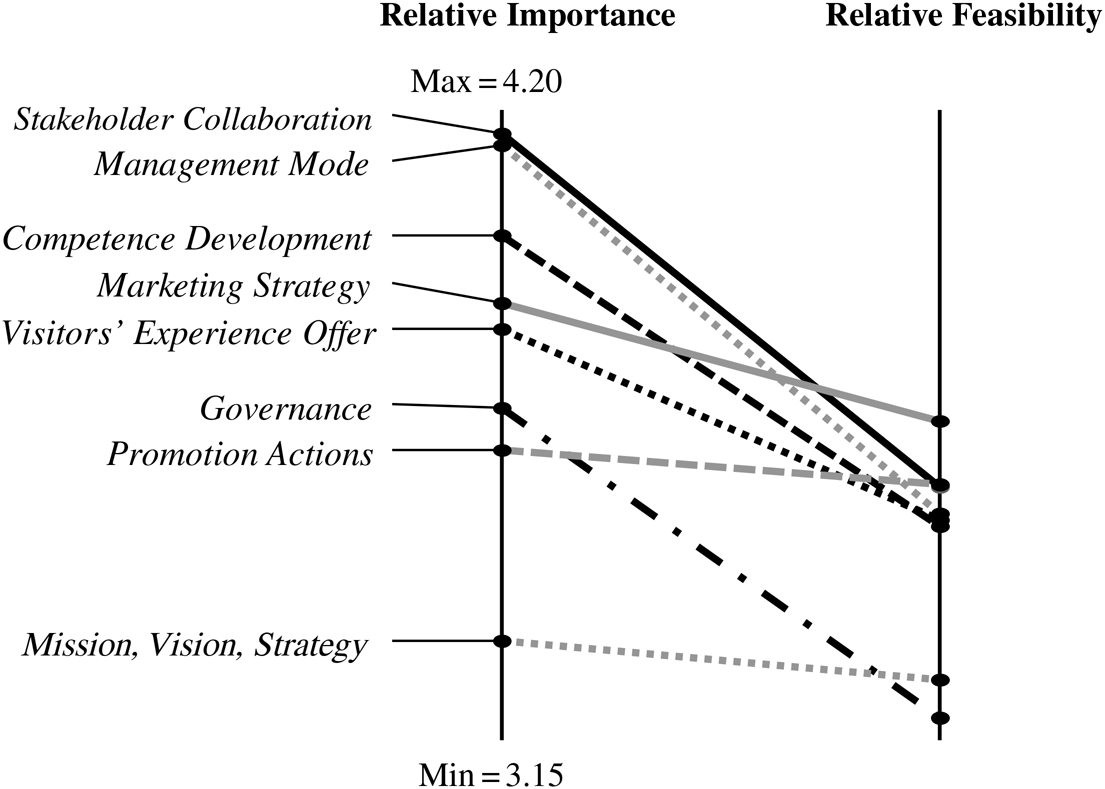
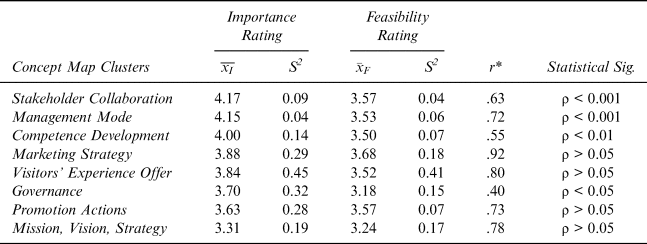
The perception of relative importance and feasibility of routes’ stakeholders about proposed actions are reported in the pattern matches scale results (Figure 2). The relative importance of clusters and feasibility rankings of scale ratings are compared using the Wilcoxon Rank-order non-parametric test and the differences are statistically significant (ρ-value < 0.01). Stakeholders do not perceive that the relative importance of strategic actions correspond to its relative feasibility: there are strong obstacles associated with overall action implementation (Table 2).
Pattern Matches: Relative Importance and Feasibility Ratings

Relative Importance and Relative Feasibility by Concept Map Clusters

* Correlation
Stakeholder Collaboration is rated the most important and its feasibility rating is ranked second (ρ-value < 0.001). The second cluster in relative importance, Management Mode, in the ROUTE ORGANIZATION—COMPETENCES RM, and the perceived feasibility in fourth rank, presents a challenging action set as it concerns the collective organization process among stakeholders (ρ-value < 0.001). Both clusters involve action initiatives aimed at advancing routes’ stakeholder objectives regarding the very existence of a route.
In the OFFER TO VISITORS—COMPETENCES RM, Competence Development ranks third in relative importance, while its feasibility is rated much lower in sixth place, and their mean values are statistically different (ρ-value < 0.01). The Visitors’ Experience Offer cluster ranks fifth in both relative importance and feasibility.
In the RM OFFER TO VISITORS—CAPABILITIES, the cluster Marketing Strategy ranks fourth in relative importance and first in relative feasibility (ρ-value > 0.05). The Promotion Actions cluster ranks seventh in relative importance and second in feasibility (ρ-value > 0.05). These action clusters could be considered easy wins for Cider Route and Wine Route stakeholders.
In the RM ROUTE ORGANIZATION—CAPABILITIES, the Governance action cluster ranks sixth for relative importance, but its feasibility is ranked last (ρ-value < 0.05). Questions about the roles and responsibilities of stakeholders and the ground rules for collaboration are neither prioritized nor perceived as a challenge. Finally, the Mission, Vision, Strategy action cluster ranks last with regards to relative importance and seventh in feasibility (ρ-value > 0.05). In terms of relative importance and feasibility, clusters within this RM are not perceived as key by stakeholders. This is surprising given the importance and feasibility rankings associated with Stakeholder Collaboration. There appears to be little appetite among stakeholders for deciding collectively on how to organize routes and their associated market positioning.
V. Discussion and Conclusion
The GCM has helped estimate the conceptualization of economic actions by Cider Route and Wine Route stakeholders of the Montérégie region. Both the “organization” among stakeholders as a collective economic unit, and the “selling” of visitors’ experience dimensions, are highlighted by action clusters on the concept map. The latent construct analysis helped uncover the conceptual economic articulation among route stakeholders.
The empirical results contribute a number of insights. Not surprisingly, importance of Stakeholder Collaboration is recognized, which acts as a pivot at the center of the map, and is perceived as the most important and feasible cluster. The emphasis on the collaborative process is related to actions individual stakeholders conduct about Management Mode and Competence Development. Action clusters that require organizational capabilities were generally not ranked as important and were considered more feasible; given stakeholders have more experience individually with Marketing Strategy and Promotion Actions. However, actions to be carried out collectively which depend on organizational capabilities were perceived as neither important nor feasible. Given the recent evolution of these routes, this result is not entirely surprising since limited resources have been invested to rejuvenate the routes’ Mission, Vision, Strategy and their Governance. The latter appears to be a missing piece of the puzzle. The collective economic conceptualization by route stakeholders shows that policy solution to the Cider Route and the Wine Route performance can be articulated by them: stakeholders own and can create their own solutions. Nevertheless, there appears to be little consideration given to the relevance of crafting collaborative organizational capability-oriented actions to better navigate “tough” economic issues that create uneasiness among some cidermakers and winemakers in a competitive environment, but could help ensure greater collective economic performance in this emerging cider and wine producing region.