Modern school choice, as defined by the existence of systematic alternatives to public education, is not a late twentieth-century phenomenon. Rather, it arose during the late nineteenth century as a consequence of surging Roman Catholic immigration into urban areas and the resulting mass attendance in parochial schools. By 1900, nearly one million American children were enrolled in Catholic parochial schools. In cities such as Cleveland, Milwaukee, Cincinnati, Buffalo, Boston, and Pittsburgh, approximately 40 percent or more of children attended Catholic institutions.Footnote 1 Catholic school systems represented the first large-scale alternative to public schooling, providing new educational choices for millions of Catholic parents. The existence of two distinct, competing urban education systems was impossible to miss.
With the rise of Catholic schools, educational choices proliferated, along with new, unanticipated problems. By the early twentieth century, tens of thousands of Catholic children in large American cities by and large attended neither public nor Catholic schools exclusively. Instead, pupils often transferred between them, creating unregulated and competing school systems in which two educational challenges, in particular, arose: first, that public officials were unable to track Catholic children’s attendance across the different systems, and second, that instructional standards between public and private schools were unaligned. As reformers witnessed millions of Catholic parents exercising monthly and annual choices over their children’s schooling, they sought ways to rationalize how parents chose schools and how children transferred between them.
Cities and states responded to growing numbers of parochial schools by regulating the increased educational choices that Catholic parents faced. By the 1920s, new regulations and urban administrative bureaus had arisen to govern otherwise dizzyingly chaotic, competing school systems. State legislators crafted new regulations forcing parochial schools to coordinate their attendance systems with local public schools. In addition, urban school boards constructed vast bureaus of attendance to manage transfers between school systems, tying together public and parochial school governance in ways unthinkable during the nineteenth century. School boards, meanwhile, began accrediting primary parochial schools, allowing students from these approved institutions to be admitted to public high schools without taking an entrance examination.
Far from hindering parental choice, these new regulations enhanced it by standardizing attendance procedures and curriculum standards across the dueling systems. Students moving between different school systems no longer could use their transfers to evade attendance requirements. Accreditation, meanwhile, ensured that public high schools would recognize graduates from private elementary schools. Over the first two decades of the twentieth century, Catholic parents and administrators willingly, even happily, complied with state laws that required them to report attendance information to public officials. By giving private choices the backing of public authority, regulation spurred educational marketization. School choice in the Progressive Era thrived precisely because of public regulation.
The relationship between public power and private markets has long been a theme in American historical writing. Historians now recognize that municipal and state governments actively regulated local markets in manifold ways throughout the nineteenth and early twentieth century.Footnote 2 Indeed, public regulations did not simply intervene in markets; they often constituted them. Daniel Carpenter has described how nineteenth-century public marketplaces were “literally made by state regulation and government rules.”Footnote 3 Because historians of education focus on public and private schooling in isolation from one another, and generally in isolation from the literature on American political economy, they only recently have begun to explore how states and municipalities managed and constituted education markets: how schools themselves competed with one another for students and resources, and how governments responded to that competition.Footnote 4 This article, in addition to exploring the origins of modern school choice policies in the Progressive Era, describes how education markets, much like other areas of private enterprise in American history, have been structured by public policies.
I
Mass Catholic schooling in the United States originated as a response to the rise of public education in the mid-nineteenth century. Powerful Roman Catholic bishops were skeptical of the rapidly expanding public (then frequently called “common”) school systems in the United States. Public school systems had arisen out of the pan-Protestant commitments of mid-nineteenth century New Englanders. To many Catholic authorities, the rhetoric of schooling all Americans in “common” summoned fears of Catholic children being force-fed religion and morality by Protestant teachers.Footnote 5 In the wake of several dramatic, sectarian confrontations between Catholics and Protestants over prayer and Bible reading in public schools—including riots in Philadelphia, most famously—Catholic bishops assumed increasingly hostile stances toward state education. Beginning in the 1840s and continuing through the decades following the Civil War, powerful Catholic bishops in cities like New York (John Hughes), Cincinnati (John Purcell), and Rochester (Bernard J. McQuaid) dedicated immense resources to building Catholic schools within their dioceses.Footnote 6 They urged parishes to construct parochial schools and, with much less success, sought to persuade state legislatures that those schools should be funded with public tax dollars.
This emphasis on Catholic education reached a climax with the American Catholic hierarchies’ decrees at the 1884 Third Plenary Council of Baltimore. A full quarter of the council’s legislation dealt with matters of Catholic education.Footnote 7 American Catholic bishops linked parochial schools to a global Catholic revival, and to the healthy future of American Catholicism. The council decreed that every Catholic Church must organize a school and, with several noted exceptions, that every Catholic parent send their child to it.Footnote 8 Within a decade of the Third Plenary Council, Catholics had expanded parish school buildings and attendance numbers by over 50 percent, with 755,038 children—the majority of them the sons and daughters of working-class first- and second-generation immigrants—enrolled in close to four thousand parochial schools.Footnote 9
The existence of a parochial alternative to public schools provided Catholics in dozens of large, industrial cities across the United States with educational choices. These choices intersected with a tangle of other concerns, as Catholics navigated the economic opportunities, cultural expectations, and religious norms of the urban environment that surrounded them. Sociological studies of Catholic parents in the early and mid-twentieth century listed dozens of reasons for why they preferred one school over another. Catholics were divided by ethnicity and language, and parents to different degrees cared about the religious values, cultural sensitivities, and academic reputation of particular schools, parochial or public, that their children might attend.
Given the Church’s pressures to attend parochial schools, Catholic parents—like all parents—never made educational choices free from the constraints imposed by religion, circumstance, and by custom. Catholic parish life was central to the lives of millions of urban residents, and the Catholic Church remained a ubiquitous force in promoting parochial schooling into the twentieth century. Diocesan rules, for example, echoed the Third Plenary Council in mandating that Catholics send their children to the parish school.Footnote 10 Catholic parents frequently obeyed. In a study on patterns of school attendance completed in 1897, the University of Chicago social scientist Daniel Folkmar emphasized that parents decided which schools, if any, their children attended, according to their “wish to live in accordance with the social demands of the community or to obey the law which the community demands.”Footnote 11 One Irish-American novelist added that mothers feared “what the neighbors would think” if their sons did not attend a Catholic school.Footnote 12 Even lapsed Catholics who did not attend church could not always escape pressure to send their children to Catholic schools. When diocesan officials canvassed neighborhoods to obtain parish demographic data, one of the first questions asked regarded parochial school attendance. As one census-taker reported, when parents indicated that their children attended public school, he “argued the matter out with them.”Footnote 13 Finally, the Catholic press stressed the need to attend parochial schools. Each summer, the conservative Jesuit magazine America published articles with titles such as “School-Picking Time,” and “What School for Your Child,” highlighting the extent of choices and the importance of choosing the Catholic school.Footnote 14 Editorials equated Catholic parents who sent children to public schools with Judas, warning of a “fearful reckoning” in the afterlife.Footnote 15 The foreign-language press added to the pressure. When a Chicago-based Polish-language newspaper asked readers, “Which of the two schools shall we select: public or parochial?” the answer was obvious.Footnote 16 Catholic parents could quickly discover that while public laws compelled school-going, private rules and pressures often framed what school children attended.Footnote 17
Many parents who sent their children to parochial school were not necessarily following priestly exhortations: some hoped that their children could lead a religious life, or become prosperous, or attend the school closest to home. Many parents enrolled their children until they received their First Communion (around eight or nine years old), others until Confirmation.Footnote 18 Behind the abstract percentages of Catholic children attending public or parochial schools, which Catholic authorities estimated was split at 50 percent, lay thousands of individual stories: a mother who believed the public school offered better services for her sickly child; a father’s memory of how cruelly he was treated at the parish school; a parent who feared that sending his child to the parochial school would unravel the secrecy of his marriage outside the church.Footnote 19
For parents who could afford to pay parochial school tuition, where it was required for admission, geography was a leading factor in determining where parents sent their children to school. Parents valued schools near their homes, and Catholic parents were particularly rooted in physical communities, a consequence of their spiritual ties to the parish.Footnote 20 Nonetheless, residential mobility was constant. Working-class families seeking employment or cheaper rent moved, both from and within a given city as the demand for labor, and the supply of housing, shifted.Footnote 21 Socially mobile families sought larger accommodations and safer neighborhoods. The historian Stephen Thernstrom famously described the nineteenth-century Irish workers of Newburyport, Massachusetts, as “permanent transients,” relocating in order to pursue the dream of stable work and suitable accommodations.Footnote 22 In late nineteenth-century cities like Omaha and Pittsburgh, over 75 percent of the city’s young families moved locations within the city every five years.Footnote 23 Estimates are that around three-quarters of urbanites lived in rented quarters during the late nineteenth century, ready to move at the next promise of an improvement for their family.Footnote 24 Ethnic patterns of mass residential mobility were particularly pronounced. In New York City, the sociologist Le Roy E. Bowman noted in 1925 that “one school, ten years ago 99 per cent Jewish . . . [is] now 99 per cent Italian.”Footnote 25
In this context of swirling population movements, children migrated frequently from place to place every year, changing schools in the process. Catholic children, in turn, often oscillated between public and parochial schools. Scores of school reports and studies from the late nineteenth century onward featured accounts of children transferring between two schools, one parochial and one public, even during the same year. “Children go not only from one school to another, but from one school system to an entirely different one,” wrote Edith Abbott and Sophonisba Breckinridge in a study of school attendance in Chicago. They “go constantly back and forth between [the neighborhood] school and near-by parochial schools.”Footnote 26 Another in Chicago noted “the great fluctuations of population through immigration and exodus,” and the “transfer of pupils to and from parochial and private schools.”Footnote 27 The Woonsocket, Rhode Island, superintendent noted in 1898 that “pupils are continually changing from public to private, and from private to public . . . just as the mood of the parent happens to be.”Footnote 28 In Pittsburgh, one observer referred to a “constant migration to the public schools, as well as in the reverse direction, an ebb and flow occasioned by the requirements of confirmation.”Footnote 29 When school officials in large cities such as New York City and Philadelphia attempted to quantify these transfers, the numbers were substantial. New York City officials estimated that around ten thousand children transferred from public to parochial schools alone in 1911, a number that surely underestimated the additional thousands who went uncounted in a city lacking efficient pupil accounting practices.Footnote 30 In Philadelphia, the number of official transfers between public and parochial schools generally hovered around eight or nine thousand each year.Footnote 31 In every northern city with a large Catholic population, transfers between public and parochial schools were embedded in the cycles of the school year.
II
For school officials charged with tracking and enforcing attendance, school transfers posed significant practical problems. By the early twentieth century, legislatures throughout the United States had passed compulsory attendance statutes that they believed were essential tools to promote educational goals. Without these laws, their proponents believed, higher rates of literacy, numeracy, and assimilation would be impossible to obtain. State investments in schooling would be futile without the will and the ability to enforce attendance.Footnote 32 Frequent school transfers, however, undermined state compulsory attendance laws by making it vastly more difficult to track and enforce schoolgoing.
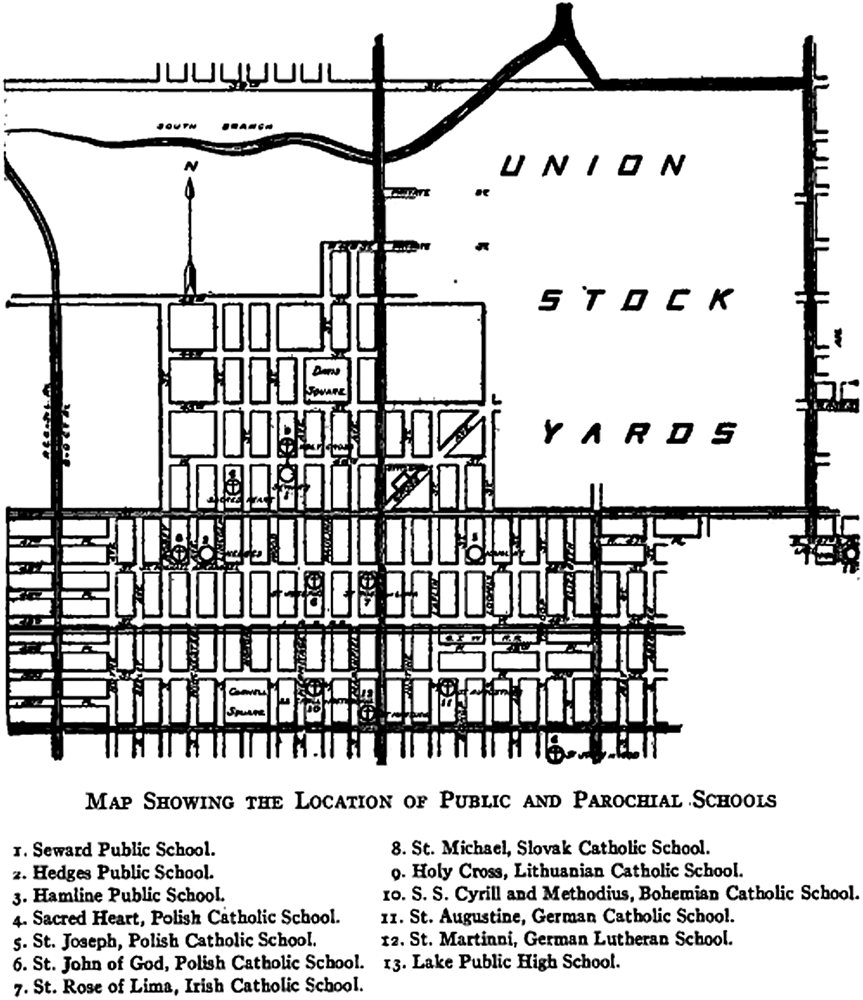
Transfers were particularly common in Chicago’s “Back of the Yards” neighborhood, which featured an array of public and parochial schools. Louise Montgomery, The American Girl in the Stockyard District (Chicago, 1913), 9.

School transfers, in other words, became a major source of concern. The Wisconsin Bureau of Labor and Industrial Statistics implored school officials in 1911 to undertake a great “system of registration of children” in a context of constant upheaval: “Parents move from one district to another, families move in from different states. Children enroll in one parochial school for a time, and leaving it enroll in another, or in the public school. Children in the [public] school withdraw and enroll in a private or parochial school.”Footnote 33 Tracking attendance in this endless maze of transfers was no simple task. When New York City’s head of attendance enforcement recommended a permanent census to track school transfers in 1907—“necessary because of the migratory characteristics of a larger part of the city’s population”—he noted that hundreds of thousands of children changed schools every year. “Many people move from place to place, often two or three times within a school year,” the administrator noted, leading to “non-attendance and truancy.”Footnote 34 Compelling attendance under these conditions would be impossible unless city officials had mechanisms to follow children from school to school, ensuring that they had properly enrolled and that attendance officials did not count them twice.
Within densely populated cities filled with parochial schools, the dilemmas posed by school choice and unregulated transfers became more acute. Parents and children who transferred schools to avoid attendance and evade truant officers became tropes in reports issued by reformers and school officials. A popular belief among administrators, echoed by the Cleveland superintendent in 1902, was that “pupils who do not wish to attend school register with the parochial schools and almost immediately cease attendance and spend their time as they wish, either upon the streets or at work.”Footnote 35 Skeptical truant officers frequently discussed finding children on the street only to be told they “belonged to a Catholic school,” “transferred to the Catholic school,” off for a “religious holiday,” or free because the parochial school “teacher is sick.”Footnote 36 A truant officer in Maryland reported that “there have been so many cases of this kind that I could spend my entire time . . . and be kept busy.”Footnote 37 One attendance official from York, Pennsylvania, grew so concerned about all the children in the streets claiming to be from Catholic schools that he worried about his job safety and, writing to the superintendent, suggested that children from private schools wear official badges on days their schools were closed.Footnote 38
Social workers echoed these accounts, targeting immigrant Catholic parents who they believed used transfers to parochial schools to shield their children from receiving a formal education. A 1906 study by Gertrude Howe Britton, a social worker in Chicago, recounted several of these examples. She discussed James G. of the Goodrich School, a twelve-year-old boy and “one of many who use the device of being transferred from the public school to the parochial school and from the parochial school to the public school to cover their absence from both.” James, like his mother, told truant officers that he “belonged to a Catholic school,” which Britton believed to be a lie. The mother of seven-year-old Alice L. similarly deceived school authorities into thinking the child was enrolled in the parochial school, as did Maggie T.’s mother, who enrolled her child in the parochial school under the belief that social workers could no longer “interfere with her.” Throughout Chicago, she noted, “the loop-holes afforded by the transfer system are made use of to escape attendance in either school.”Footnote 39 In a report issued eight years later, settlement house workers in Chicago found little had changed, noting a “serious problem” created by “transfers from public and parochial schools.”Footnote 40 While no quantitative evidence suggested that the majority of children who transferred between public and parochial schools did so to avoid enrollment, anecdotes like these were used to persuade a legion of child welfare workers—already suspicious of immigrant values—to reform the attendance system.
City and state school officials believed that the solution to unregulated school choice lay in superior bookkeeping. Beginning in the 1880s, state superintendents began insisting that private schools turn over their attendance registers to public officials. Without these returns, reformers argued, officials could not determine how many children outside public schools received any education at all. Wisconsin’s state superintendent of public instruction endorsed forcing parochial school officials to hand in attendance reports three times in his annual reports in the late 1880s.Footnote 41 In 1891, when the U.S. Commissioner of Education, William T. Harris, asked Rhode Island’s State Commissioner of Education, Thomas Stockwell, to comment on the “relation of the State to private schools,” it was precisely this need for statistics that dominated the discussion. Stockwell called for a series of accounting mechanisms: accurate enrollment data for private schools buoyed by the use of uniform registers and annual returns by private schools. Amid the “chaos and ignorance” of school attendance in the state, Stockwell wrote, only an “accurate statement of facts” by private schools would suffice.Footnote 42
Legislatures responded to these pleadings by incorporating reporting requirements into their school codes. In Ohio’s compulsory attendance statute, passed in 1889, the legislature mandated that private schools provide local attendance officers with their enrollment data. As one Ohio official recounted the law’s aim: “Suppose [the truant officer] finds on the street or in a factory a boy thirteen years old, and he says, ‘My boy, have you attended a school one hundred days?’ He says, ‘Yes, sire.’ ‘Where?’ ‘At Father Quigley’s, at St. Francis de Sales.’ It is necessary for the officials charged with the enforcement of that law to know whether that is true or not.”Footnote 43 As more children attended parochial schools, states required more accurate attendance data. Connecticut, Rhode Island, and New York also passed laws in the 1880s and 1890s requiring private schools to maintain attendance records and furnish them to local officials. By 1925, twenty-three other states had enacted similar provisions.Footnote 44
Reporting requirements aimed to regulate the act of choosing schools itself. In other words, they sought to mitigate the perceived dangers of parallel urban school systems with high rates of mobility between them. To school superintendents across the country, such requirements fulfilled a glaring need, as one Rhode Island superintendent put it, to “adequately gover[n] frequent change of school relations.”Footnote 45 These laws “would answer the question where the child really belongs,” a Pennsylvania city superintendent wrote.Footnote 46 They would “determine the degree of effectiveness with which the compulsory attendance law is being enforced,” one study found.Footnote 47 A Wisconsin official added that, by addressing the transfer process itself, reporting requirements would “prevent . . . the whimsical changing from one school to another so common in the parochial schools.”Footnote 48 Once school officials solved the “poorly worked-out system for keeping track of the child,” compulsory attendance statutes could be properly enforced, and the chaos produced by parallel school systems properly coordinated.Footnote 49
As administered by superintendents and attendance officers, new transfer laws devised mechanisms with which to follow children from school to school. When initially passed in the 1880s and 1890s, truant officers employed blunt policing methods to obtain the data they sought. In Toledo, Ohio, in 1890, a truant officer simply walked into a parochial school and demanded that the priest turn over a list of enrolled pupils. When the priest, Reverend Patrick Francis Quigley, indignantly refused the request—believing it an assault on the church’s privacy rights—the officer had him imprisoned and, ultimately, criminally prosecuted.Footnote 50
In the ensuing decades municipalities and states developed more sophisticated methods to track and enforce attendance. Amateur truant officers engaged in less policing of individual children and schools. Rather, they became professional members of “attendance services” and focused more heavily on prevention, persuasion, and bureaucratic welfare services for “maladjusted” children.Footnote 51 In New York City, more than one hundred truant officers employed by the Bureau of Attendance investigated 375,000 cases of truancy in one year (1916–17) alone.Footnote 52
The process for determining attendance statistics itself shifted. Cities in the nineteenth century had administered an annual “school census” to register how many children lived in the city and attended school annually.Footnote 53 While state departments of instruction used these statistics primarily to distribute annual state appropriations, reformers focused on compulsory attendance found the census woefully inadequate, since it failed to account for the frequent residency changes throughout the year. To address the reality of shifting populations, cities in the early twentieth century gradually adopted permanent or continuous censuses. New York State’s 1908 permanent census law stipulated that parents of school-aged children report to authorities when their children reached compulsory school age, or when they moved addresses or schools. State legislatures also wrote the continuing census into their compulsory attendance statutes, mandating that children who moved from one school to another report the transfer to local authorities.Footnote 54
Once equipped with more accurate demographic data, cities then implemented increasingly strenuous pupil accounting practices. School districts across states created uniform attendance procedures, ensuring that children who transferred schools within the state—whether within the public system or between public and parochial schools—would be tracked efficiently. A cottage industry of administrative experts arose, producing new standard forms and mechanisms for superintendents and attendance officers to track students.Footnote 55 Typically, students leaving one school for another received a “transfer card” to present to their new school. A copy of the transfer card would then be sent to the attendance department, which would update the student’s permanent record card. If the child was absent at the new school for three or four days, attendance departments would alert the truant officers, triggering an investigation. One researcher studying 346 cities found that 245 required private schools to cooperate with attendance officers.Footnote 56
More stringent, bureaucratic attendance mechanisms legally mandated the compliance of parochial schools. Resistance of the sort that got Father Quigley jailed in Ohio dissipated as parochial school administrators increasingly found reasons to comply with, even embrace, public oversight over attendance. Thus, while the Cleveland superintendent still found “no willingness displayed on the part of [parochial] schools to furnish us” with data a decade after the Father Quigley incident, by the 1910s and 1920s such expressions among public officials were uncommon.Footnote 57 Experts on compulsory attendance laws and their enforcement noted that Catholic schools generally followed attendance procedures. In one of the Progressive Era’s most detailed and sweeping analyses of compulsory attendance enforcement, published in 1921, Forest Chester Ensign described how, in New York City, “parochial schools, formerly distinctly suspicious of any law or ruling which touched their interests, now welcomed the assistance and supervision of the State Department, thus marking one more advance in the direction of unification in the educational activities of the state.”Footnote 58 New York City’s director of school attendance frequently identified the “close cooperation” between city officials and parochial schools, the latter of whom he claimed provided assistance “cheerfully.”Footnote 59 As evidence for such cooperation, he described how the number of children formally listed as “discharged” to the public schools—that is, those who exited the attendance department’s accounting system entirely—had dropped by over one-half between 1911 and 1918. Rather than attribute this drop to parents’ increased preference for public education, the director instead surmised that it was due to “an assimilation of the procedure of the public schools by the parochial schools,” creating a common system of attendance.Footnote 60
Catholic officials in New York City and elsewhere corroborated these accounts. The superintendent of Brooklyn’s Catholic Parish Schools, Joseph McClancy, remarked in 1916 that the city’s attendance officials “handle . . . the manner at once creditable to themselves and cordial to the Catholic school officials.”Footnote 61 Even Catholic officials in Toledo had moved past the bitter relationships between city officials and parochial schools typical in Father Quigley’s day. In 1912, Toledo’s Bishop, Joseph Schrembs, told a gathering of Catholic school authorities that “we ought to meet the stand[ards] of the State in the spirit of kindliness in all matters pertaining to the general welfare of the child, and I can see no good reason for refusing certain elementary politeness.” He urged “greater compliance in Catholic schools in general,” and admonished his colleagues to refrain from “excessive criticism of the public school” as well.Footnote 62 Catholics and public school officials alike observed the change in attitudes toward state regulations.
Why did Catholic school authorities eventually comply with new attendance regulations? Many observers noted that compliance was a crucial means of increasing attendance. Parochial school enrollments, after all, benefited from public attendance officials who enforced orderly transfers and enrollments. Parochial schools, one public official assured an audience of Catholic educators, “have access to the attendance officers, thereby giving them the same facilities for a high percentage of attendance as the public schools.”Footnote 63 Ellwood Cubberley, the influential Stanford University education professor, also acknowledged that extending compulsory attendance laws to parochial schools placed the latter “on the same plane as public schools in the matter of school attendance, and . . . extends to them the public facilities for enforcing attendance.”Footnote 64 Evidence from Catholic archives suggests parochial school officials saw these benefits clearly. Philadelphia’s Catholic archdiocesan school superintendent, Philip McDevitt, for example, frequently corresponded with the city’s chief attendance officer, urging him to provide assistance with parochial school truants in return for Catholic compliance with all reporting requirements.Footnote 65 Catholic officials thus understood that public supervision was essential to boosting private school attendance.
III
In addition to attendance problems, unregulated school choice posed instructional challenges as well. How would parents be assured of private school quality absent public standards? How could public secondary schools ensure that private primary school graduates met entrance requirements? As increasing numbers of Catholic parents sought to enroll their children in secondary schools, parochial primary schools benefited from cooperating with state officials around issues of curriculum and teaching standards. Children, too, had much to gain from a private school system that met modern, state mandates. To ensure seamless matriculation between private primary and public secondary schools, parents demanded that parish institutions as closely as possible conform to local and state standards.
Reflecting the increased importance of educational attainment in American life, Catholic parents and children, like most Americans, turned to public high schools with growing vigor in the decades surrounding the turn of the twentieth century. High school attendance in the United States doubled every decade from 1890 to 1930, spurred by increased urbanization, stronger compulsory attendance and child labor laws, the gradual decline in the youth labor market, and the literacy, numeracy, and vocational skills required by twentieth-century industrial jobs.Footnote 66 High school attendance varied dramatically by ethnicity, and Catholic families from more rural, traditional cultures such as southern Italy were particularly resistant to the institution. By the 1930s, however, the high school fulfilled its reputation as the “people’s college,” becoming the normative experience for American teenagers and, as those who graduated from high school discovered, a ticket to the skilled professions.Footnote 67
While Catholic parents and children sought access to secondary education, parochial secondary schools were scarce. Costs in many cases were prohibitive. Public high schools originated, by design, as expensive enterprises. Their mid-nineteenth-century advocates believed that physically imposing structures and well-paid instructors would attract middle-class parents away from the private toward the public sector.Footnote 68 Cities in the early twentieth century constructed similarly grandiose edifices. New high schools featured science laboratories, elaborate vocational training programs, state-of-the-art gymnasiums, and swimming pools. By World War I, 79 percent of the public high schools accredited by the North Central Association had manual-training programs, 83 percent had cooking classes, and 68 percent had courses in typing.Footnote 69 By the second decade of the twentieth century, average per capita costs per pupil enrolled could exceed $100.Footnote 70
Immigrant Catholic communities, in contrast, struggled to fund parochial primary schools, despite estimates that costs averaged only $8 per pupil.Footnote 71 As a result, according to one report authored at the turn of the century, only fifty-three Catholic parishes had official “high schools” attached to their larger elementary branches, enrolling a total of fewer than two thousand students nationwide. More than ten times that number attended “private” rather than “parochial” institutions—tuition schools run by religious orders or Catholic colleges for the benefit of the middle classes, in contrast to the legions of parish schools that aspired to universal Catholic attendance.Footnote 72 While the number of Catholic high schools would increase considerably over the next three decades, they would never educate Catholic children in proportions similar to parochial elementary schools. The vast majority of Catholic parents who aspired to send their children to secondary schools had little choice but to elect public high schools.Footnote 73
Rising numbers of transfers between private primary schools and public high schools introduced a new set of dilemmas. Since their inception in the early nineteenth century, public high schools had imposed numerous requirements for admission, usually in the form of written entrance examinations. As urban public schools grew into standardized and centralized systems, and as the demand for secondary education burgeoned, most high schools gradually dropped these requirements, assuming that graduates from public primary schools met the standards.Footnote 74 Graduates of private elementary schools hoping to attend public high schools, however, were another matter. Many urban school systems in the late nineteenth century continued to require private school graduates to pass an entrance exam in order to matriculate into a public high school.Footnote 75
Given the growing attendance in Catholic schools, cities in the early twentieth century began implementing a different method for assessing parochial school quality, one that colleges used for high school graduates: accreditation.Footnote 76 The development of Milwaukee’s school laws was a case in point. In the 1880s and 1890s, the city’s schools permitted public elementary school graduates to enroll in the Milwaukee public high school “without further examination.” The school board did not extend that allowance to private school students, however, who in addition needed to produce a certificate indicating that their course of instruction was “equivalent to that of the public schools.”Footnote 77 In 1901 the board changed course and began to admit private school students into city high schools without an examination, provided that their schools met the “equivalency” standard.Footnote 78 A school board committee on course instruction soon began judging the schools that met this standard, adding their names to a growing list of approved, or “accredited schools.”Footnote 79 A similar process characterized Chicago, as well as other cities, where small committees composed of public school teachers and administrators would visit private schools, produce a report, and recommend accreditation or not.Footnote 80
With this stamp of official approval, children who graduated from accredited parochial primary schools had the advantage of attending high school without the added strain of an entrance exam or, for those with no high school ambitions, the “stigma” of having attended a nonaccredited institution. A study of Chicago parochial schools in the 1920s found that “nonaccredited [parochial] schools experience some difficulty in retaining pupils who intend to enter public high schools.” The author attributed the exodus of students from seventh and eighth grade in large part to the desire “to avoid the examinations they would have to take to enter the public high school if they graduated from a nonaccredited parochial school.”Footnote 81 Absent public approval, in other words, Catholic parents who sought public secondary schooling for their children would have no choice but to avoid the private sector.
In the increasingly crowded urban marketplace of schooling, diocesan officials understood that regulations caused parents to seek schools that resembled one another, conforming to the same standards. As early as 1904, Buffalo’s diocesan school superintendent, E. F. Gibbons, told a gathering of Catholic school administrators that raising standards to conform with public expectations was essential to attract students and parents hoping to attend high school. “There are the children and their parents, who are only too apt to place the modest little [parochial] school in damaging contrast with a fine public school, with its complete staff of teachers, free books, and every inducement to pupils,” he announced.Footnote 82 By the 1920s, administrators talked openly about a “Catholic educational market” amid the new educational demands imposed by parents. One administrator noted that “Catholic parents are becoming increasingly aware of the handicaps under which the graduates of non-accredited schools labor,” particularly for those students anxious about eventually attending Catholic high schools.Footnote 83 Reverend Daniel Richard Sullivan, who led a Catholic high school, was particularly colorful about how students and parents yearned for state approval of Catholic schools. Speaking in front of the Catholic Educational Association of Pennsylvania in 1923, he remarked that “young women at least, like their mothers, have an eye for standard quality both in toilet articles and in education, and will take what bears a recognized stamp and no other. The very first questions they ask you are ‘what is the rating of your school? Is it approved? How do its graduates stand with my state board and with the professional schools?’. . . . They, and not the pastors, are in a position to recommend schools to their pupils, and they evaluate schools in terms of the standardizing agencies and not otherwise.”Footnote 84
Other contemporaries agreed. When George Johnson in 1925 looked back on the previous several decades of Catholic education, he noted that “Catholic parents [have] expected the same type of education from us that the children of their neighborhood receive in the public school across the street.”Footnote 85 In 1928, a Catholic woman from Buffalo, writing privately to the editors of America, argued that the magazine’s exhortations regarding universal parochial school attendance were meaningless unless Catholic schools “are brought up to a high standard.” “Catholics do not want their children’s education branded as inferior to others,” she wrote. Catholic school graduates from institutions with low standards “feel bitter about such things, when they find they are unable to compete with others in the educational and business and professional world.”Footnote 86 Parental and student demand for Catholic education, in other words, had clear limits. Parochial schools that failed to meet local and state standards were unable to compete with public schools that guaranteed parents an automatic bid to the high school and, so it seemed, the job market.
To assuage these parents, Superintendent Gibbons recommended enhancing standards, which would “protect our graduates when they present themselves for matriculation in higher schools.” In New York State, the examinations offered by the Regents of the University afforded just such a possibility. Gibbons argued that the exams, given to students hoping to attend the state’s high schools and colleges, “offer at least one great advantage to our parish schools, viz., a common ground upon which our pupils can meet those of the public schools, and prove their ability to measure up to the public-school or State standard.” Like other parochial school administrators, Gibbons welcomed the exams that would accompany accreditation because they pressured parochial schools to raise their standards. In addition, publicly sponsored examinations gave diocesan and parish authorities the ability to quantify and publicize the quality of their institutions to Catholic parents. “We must advertise in this age of advertising,” he remarked. “We shall display our wares if we wish to draw customers.”Footnote 87 Accreditation offered the stamp of state approval that diocesan administrators knew would appeal to ambitious, upwardly mobile Catholic parents.
A savvy and pragmatic administrator, Gibbons admitted that such standards, when imposed from outside Catholic authorities, might resemble “ignominious slavery,” but acknowledged that there was little parochial schools could “do to escape” from public standards. “It seems to me that in New York we must be careful not to adopt any plan that would be out of harmony with that of the state schools,” he concluded. “Our schools simply have to measure up to their requirements.”Footnote 88 State standards could thus provide parochial schools with the opportunity to publicize their quality. As another Catholic educational leader noted, conforming to the “same standards” as public schools “would seem the part of wisdom, if only for the protection of our reputation and prestige.”Footnote 89 Catholic schools had every incentive to meet the various voluntary and involuntary requirements states and localities hoped to impose on schools through accreditation and other regulations.
Accreditation and parental demand thus forced Catholic administrators to raise their standards, even though they often resented the pressure. As one Catholic educator put it in 1917, schools seeking accreditation did so “as a necessary means of subsistence, or as a consequence of competition for local patronage” rather than as a “matter of election or choice.”Footnote 90 A speaker at the National Catholic Educational Association’s 1907 meeting similarly admitted that parochial schools were raising standards and centralizing administration not for an intrinsic reason, but “in order to compete with the public schools.” Accreditation and state regulation, these administrators acknowledged, brought Catholic schools into more competition with public education, not less.Footnote 91
New state standards, like regulations of school transfers, created a more fluid world of school choice, where parents moved their children between public and private schools with greater confidence. A 1930 study found that public schools continued to place transfers from parochial schools into lower grades, but that standardization tended to lessen the “danger of discrimination in the event of transfer.”Footnote 92 Dissertations by Catholic University students in the 1930s and 1940s argued that Catholic compliance with accreditation had been “highly desirable.”Footnote 93 On the subject of fledgling Catholic high schools, one even remarked that the “pressure exerted by accrediting agencies has done more to raise the standards” than “any action taken within the Catholic body itself.”Footnote 94 Without this voluntary “pressure” by local and state authorities, Catholics would not have patronized parochial schools in such consistently large numbers. In an age where Americans saw educational attainment and advanced schooling as central to upward mobility, Catholic schools responded to state regulation and accreditation by raising their standards. In doing so, they attracted students to their schools, before sending them off to public high schools with the proud stamp of state approval.
IV
When a researcher for the National Catholic Welfare Conference, Charles Lischka, set out in 1924 to compile a list of state laws regulating parochial schools, his book surprisingly ran to more than one hundred pages. It detailed often intricate, state-imposed guidelines on private school attendance, accreditation, teacher certification, curriculum, accounting, student health, buildings, and many other policy areas. In the preface to his text, Lischka declared that even Americans steeped in school law would find it a “revelation” to read the variety of regulations and restrictions affecting private schools. States required medical inspection and fire drills. In more than a dozen northern states, local school committees certified or inspected private schools. A still-larger number required courses on the Constitution, civics, patriotism, and English as the official language of instruction in the school. Michigan and Nebraska mandated that teachers in parochial schools obtain the same occupational license as those in public schools.Footnote 95
As observers like Lischka and others noted, with these new laws two urban systems “under quite distinct management” became vastly more coordinated and standardized.Footnote 96 Public regulation pressured diocesan officials to link their attendance and curriculum with public schools. Catholic administrators, understanding the importance parents placed on public institutions and public approval, complied with increasing alacrity. By the 1920s, the nation’s two million Catholic school students attended institutions that increasingly reflected public standards. In an ideal world, urban children transferring from parochial to public systems felt the effects of this coordination when they arrived at their new school. Their new teacher would have an enrollment card with the child’s name, old school, and grades. The child would be familiar with American history and civics and be comfortable with a teacher instructing in English. He or she also would be familiar with fire drills, medical inspections, and vaccinations. Most important, coming from a school with similar standards, the child was ready to learn, at the same ability level as his or her peers.
School choice flourished a century ago not because of an absence of government regulation, but because of public policies that rationalized school transfers and standardized instruction. Standardized public and parochial educational systems enabled Catholic parents to choose between schools that they could be assured were roughly equivalent academically. Catholic school administrators, meanwhile, relied on this regulated system of schooling to compete with public schools and attract the approval of public high schools. The continued expansion of public school alternatives in the Progressive Era was thus inextricably linked to the dense texture of laws and administrative procedures that enveloped them. School choice depended as much on public regulatory authority as on private parental action.