Introduction
Younger age of onset for major depressive disorder (MDD) has been associated with higher frequency of positive family history (FH) of depression in first-degree relatives and higher genetic loading in some studies (Weissman et al. Reference Weissman, Wickramaratne, Merikangas, Leckman, Prusoff, Caruso, Kidd and Gammon1984, Reference Weissman, Merikangas, Wickramaratne, Kidd, Prusoff, Leckman and Pauls1986; Lyons et al. Reference Lyons, Eisen, Goldberg, True, Lin, Meyer, Toomey, Faraone, Merla-Ramos and Tsuang1998), while not in others (McGuffin et al. Reference McGuffin, Katz, Watkins and Rutherford1996; Kendler et al. Reference Kendler, Gardner and Prescott1999; Sullivan et al. Reference Sullivan, Neale and Kendler2000). These studies have used different age thresholds to define early age of onset, varying from 20 to 50 years of age (McGuffin et al. Reference McGuffin, Katz, Watkins and Rutherford1996; Rende et al. Reference Rende, Weissman, Rutter, Wickramaratne, Harrington and Pickles1997; Lyons et al. Reference Lyons, Eisen, Goldberg, True, Lin, Meyer, Toomey, Faraone, Merla-Ramos and Tsuang1998; Klein et al. Reference Klein, Schatzberg, McCullough, Dowling, Goodman, Howland, Markowitz, Smith, Thase, Rush, LaVange, Harrison and Keller1999), making it difficult to reconcile the findings across studies. There is evidence that familial loading varies with age of onset. In Weissman et al.'s (Reference Weissman, Wickramaratne, Merikangas, Leckman, Prusoff, Caruso, Kidd and Gammon1984) study recurrence risk in first-degree relatives of individuals with MDD appeared to decrease from 5.0 to 3.6, 2.5 and 1.6 for different onset-age thresholds (respectively 20, 30, 40, and over 40 years of age). Heritability estimates have also been shown to vary when considering early- (<30 years) and late-onset MDD (>30 years), with estimates respectively of 0.47 and 0.10 (Lyons et al. Reference Lyons, Eisen, Goldberg, True, Lin, Meyer, Toomey, Faraone, Merla-Ramos and Tsuang1998). Similarly, another twin study indicated that age of onset had a significant and nonlinear association with familial liability: the hazard ratio (HR) for MDD increases with younger age of onset with a linear effect, but the effect is greater when onset occurs early in life and declines in later years (i.e. past age 35 years) (Kendler et al. Reference Kendler, Gatz, Gardner and Pedersen2005). More recently, from the analysis of the STAR*D sample it has been shown that major depression patients with positive FH for depression have younger age of onset when compared with depression patients without FH for depression (Nierenberg et al. Reference Nierenberg, Trivedi, Fava, Biggs, Shores-Wilson, Wisniewski, Balasubramani and Rush2007). In summary, the majority of studies support the evidence that earlier age of onset of MDD is associated with positive FH and a greater genetic loading to the disease. However, there is no clarity yet on whether a younger age of onset constitutes a continuum for increased risk or whether a specific age threshold represents substantial increase of familiality.
In the present study, we tested whether age of onset is influenced by FH of depression and anxiety, gender and neuroticism in individuals with recurrent MDD. These variables were selected because they are factors preceding the onset of depression and have been identified as possible risk factors for developing the disorder. Anxiety appears to partially share genetic factors with depression (Kendler, Reference Kendler1996; Kendler et al. Reference Kendler, Davis and Kessler1997; Sullivan et al. Reference Sullivan, Neale and Kendler2000; Lieb et al. Reference Lieb, Isensee, Hofler, Pfister and Wittchen2002a); depression prevalence differs by gender (Kornstein et al. Reference Kornstein, Schatzberg, Yonkers, Thase, Keitner, Ryan and Schlager1995; Kornstein, Reference Kornstein1997; Kendler et al. Reference Kendler, Gardner, Neale and Prescott2001); neuroticism has been shown in both cross-sectional (Dunkley et al. Reference Dunkley, Blankstein and Flett1997; Cheng & Furnham, Reference Cheng and Furnham2003) and longitudinal (Kendler et al. Reference Kendler, Neale, Kessler, Heath and Eaves1993) studies to be a risk factor for depression, and twin studies have suggested a degree of shared genetic influence on neuroticism and MDD (Kendler et al. Reference Kendler, Neale, Kessler, Heath and Eaves1993; Fanous et al. Reference Fanous, Gardner, Prescott, Cancro and Kendler2002). We then compared the clinical features of MDD in patients with FH versus patients without FH for depression or anxiety.
Method
Participants
A total of 1022 MDD Caucasian patients and 1000 ethnically-, age- and gender-matched non-affected controls were recruited, as part of a large initiative at GlaxoSmithKline in collaboration with academic centers. The collection of data and biospecimens was conducted to perform genetic studies and provide new insight for the identification of novel therapeutic targets (Roses et al. Reference Roses, Burns, Chissoe, Middleton and St Jean2005). Participants were recruited at the Max Planck Institute of Psychiatry and at two satellite recruiting sites (BKH Augsburg and Klinikum Ingolstadt, Germany). The three recruiting hospitals obtained approval by their respective research ethical boards to conduct the present study, and all individuals gave their written informed consent to participate in the study after receiving complete description of the study. Cases were assessed when euthymic and were included if: (1) Caucasian; (2) ⩾18 years of age at time of participation; (3) had a diagnosis of moderate or severe recurrent MDD [Diagnostic and Statistical Manual of Mental Disorders (DSM)-IV (APA, 1994) or International Classification of Disease (ICD)-10 (WHO, 1993)].
Affected individuals were excluded if they: (1) had ever experienced mood incongruent psychotic symptoms; (2) had a lifetime intravenous drug use or dependency diagnosis; (3) had depression solely due to alcohol or substance abuse or secondary to medical illness or medication.
For the purpose of this study, only affected individuals were included in the analyses. Of the 1022 patients with MDD recruited, 23 individuals who presented depression episodes with psychotic symptoms were excluded from the analysis.
Clinical assessment
For each affected individual, detailed clinical information was collected through a psychiatric interview administered by an experienced research assistant who received official training to administer Schedules for Clinical Assessment in Neuropsychiatry (SCAN) interviews. All cases were interviewed using SCAN (WHO, 1998; Celik, Reference Celik2003) following SCAN guidelines. Items of psychopathology in the SCAN interview were rated for presence and severity according to the worst and second worst episodes of depression identified by the individual. In addition, all cases completed the Eysenck Personality Questionnaire (EPQ; Eysenck & Eysenck, Reference Eysenck and Eysenck1968), and the Brief Life Events Questionnaire (Brugha et al. Reference Brugha, Bebbington, Tennant and Hurry1985). Demographics, country of origin, personal and family medical history, alcohol and smoking habits, medications taken during the last 6 months, and vital signs (e.g. weight, height and heart rate) were assessed in all participants.
Age of onset of depression was assessed retrospectively and defined as the age at which the first manifestation of MDD that required medical intervention occurred, as reported by the participants.
Co-morbid anxiety was defined as the presence of at least one of the following symptoms during an acute episode of depression: (1) general rating of anxiety (probe question assessing presence of anxiety or attacks of panic); (2) general rating of phobia (probe question assessing presence of phobias); (3) free-floating anxiety (clear-cut anxiety accompanied by an affect of fear and apprehension); (4) anxious foreboding with autonomic symptoms (fear that something dreadful is going to happen, accompanied by autonomic symptoms). The above four symptoms were selected based on a published paper showing that they define an anxiety dimension in a factor analysis of depression psychopathology, and that the anxiety factor show familial aggregation (interclass correlations between siblings=0.335, p<0.001) (Korszun et al. Reference Korszun, Moskvina, Brewster, Craddock, Ferrero, Gill, Jones, Jones, Maier, Mors, Owen, Preisig, Reich, Rietschel, Farmer and McGuffin2004). FH of depression and FH of anxiety were self-reported: participants were asked whether their immediate family members (parents, brothers, sisters or children) had ever been told by a doctor about having ‘depression that needed treatment’ (post-partum depression was assessed separately, as well as bipolar disorder) and ‘anxiety or panic disorder’ (obsessive/compulsive disorder was assessed separately). Individuals were considered to have a positive FH if reported one or more first-degree relative with the disorder. Other clinical features that are included in the analyses, such as suicide attempts, suicide thoughts, mood reactivity, pathological guilt, morning depression and weight changes during depressive episodes were considered to be present if they characterized both worst and second worst episodes. Interference with activities and response to treatment indicate respectively the functional impairment due to depression (little to moderate interference versus severe) and the response (‘satisfactory’ versus ‘not satisfactory’) to ‘adequate antidepressive therapy’ with no specification whether pharmacological or psychotherapeutic treatment, as indicated by the participant during the interview.
Data analysis
A sample of 999 MDD patients was analyzed. MDD age of onset was used to estimate time-to-event for each patient. Survival analysis methods were applied to estimate the difference of MDD age of onset in depressed patients stratified by FH of depression. The SAS System Release 8.2 (1996; SAS Institute, Inc., Cary, NC, USA) lifetest procedure was used to compute non-parametric estimates of the survivor function by the product-limit method, also called the Kaplan–Meier method (Kleinbaum, Reference Kleinbaum1996). The log-rank test was used to make an overall comparison of the survival functions and the likelihood ratio test was used to estimate the homogeneity of survival functions between strata. A multivariate Cox proportional hazards model (Cox, Reference Cox1972) was applied in order to determine how the MDD onset varies depending on predictive variables, such as gender, FH of depression and of anxiety, and neuroticism (as measured by the EPQ, used as a continuous variable). HR estimates and confidence intervals (CIs) were calculated. The overall significance of the models was evaluated by the likelihood ratio test. To determine whether the HR was constant across time, a series of Cox proportional hazards models were run, in order to test the different effect of the covariates across different times of onset. Cox models were performed censoring age of onset at each decade, starting at 20 years, as well as for distinct age of onset periods: less than or equal to 20 years old, between 21 and 50 years old, and age of onset after 50 years old. The first set of models allowed us to determine whether HRs changed as we restricted age of onset of depression to up to 20 years old, 30 years old, etc. We extended this approach by then examining the magnitude of the HR estimates in specific periods of age of depression onset, thereby allowing for non-proportional hazards across age and covariate (e.g. FH depression) by time interaction. Finally, we wanted to test whether there were symptoms that could best predict the patient's belonging to class of FH. Symptoms of anxiety, suicide attempts, suicide thoughts, mood reactivity, pathological guilt, morning depression, weight loss and weight gain during depressive episodes, functional impairment due to depression and response to antidepressant therapy were entered in a stepwise multivariate logistic model to predict FH of MDD (FH+ and FH−). All of the above symptoms were measured by the SCAN interview. Odds ratios and 95% CIs were used to quantify the strength of these associations. A backward stepwise model was fitted at the 0.05 significance level for the predictive variables. The likelihood ratio test was used to evaluate the overall significance of the model. All the analyses were performed using SAS software (version 8.2, SAS Institute).
Results
Sample description and psychopathological characteristics
The average age at interview was 51.34 (s.d.=13.63) years (range 18.9–87.5). The average MDD age of onset was 37.66 (s.d.=13.54) years (range 7–84), and the median was 37.00 years. The 5th, 10th, 25th, 75th, 90th and 95th percentiles were, respectively, 18, 20, 27, 47, 57 and 62 years. Gender ratio was 2:1; 26.2% (n=262) of the sample had anxiety symptoms, of which 51% had formal diagnosis of an anxiety disorder (DSM-IV); 52.4% (n=523) of the sample reported to have at least one first-degree relative with depression, and only a minority (11.3%, n=113) had anxiety FH. Mean age of onset and current age, gender and depression FH rates were compared across sites and no significant differences were found; this variable was not introduced in the following analyses.
Age of onset probability function and Cox regression model
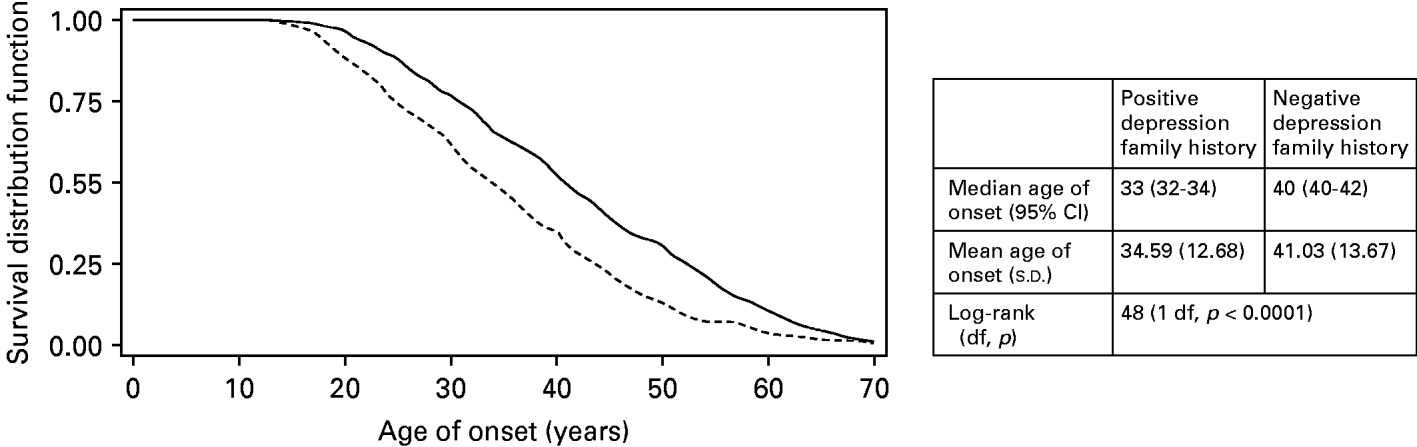
The subgroup with positive FH showed significantly younger mean age of depression onset. The median age of onset was 7 years earlier in those who were FH positive versus negative for depression (33 versus 40 years old, respectively). Neither the median age of onset nor the 75th percentile of the FH+ and the FH− groups overlapped, confirming the hypothesis that a positive FH signals an earlier MDD onset. Results of this analysis are presented in Fig. 1.
Age of onset probability function stratified by depression family history: negative depression family history (—); positive depression family history (- - -). CI, Confidence interval; s.d., standard deviation; df, degrees of freedom.

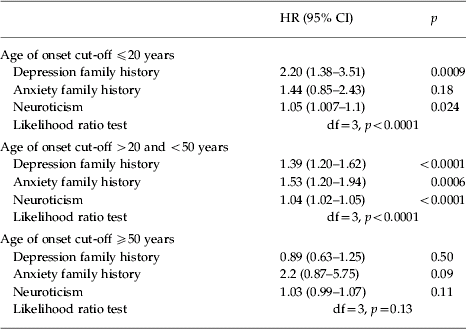
A Cox proportional hazards model was applied: positive FH of depression and positive FH of anxiety each had an independent and similar association with age of onset of depression (HR=1.4, p<0.0001). Because all study participants had an onset of depression, a higher hazard of MDD at earlier ages for FH positive versus negative for depression, as indicated in Fig. 1, would necessitate a reverse association at later ages. Therefore it was useful to stratify the analysis by age period. Cox regression models for different age cut-offs (i.e. censoring at 20, 30, 40, 50, 60 years) were performed in order to test the association for the covariates across age groups, revealing variation in covariates' effect on age of onset. This approach indicated a higher-magnitude HR association for FH of depression at younger ages (i.e. prior to 20 years old) that diminished as the age range under study expanded. Consequently, we stratified age of onset into three age periods (⩽20, 21–50, and >50 years old), as shown in Table 1. The magnitude of HR for depression FH was highest for onset of depression by age 20 years old (HR=2.20, 95% CI 1.38–3.51) and diminished to 1.39 (95% CI 1.20–1.62) for ages 21–50 years, and the direction of association changed slightly for age 50 or more years (HR=0.89, 95% CI 0.63–1.25). Associations for neuroticism and FH of anxiety disorders were relatively stable for depression onset prior to age 50 years, although limited power may have limited precision of estimates for anxiety FH in the early-onset group (⩽20 years). No effect of gender on HR estimates was observed and interactions of predictor variables with gender were not significant; therefore they were not used in the fitted model. We also tested for interaction between covariates and found no significant effect, thus interaction effects were not included in the final model.
Cox regression models by age groups

HR, Hazard ratio; CI, confidence interval; df, degrees of freedom.
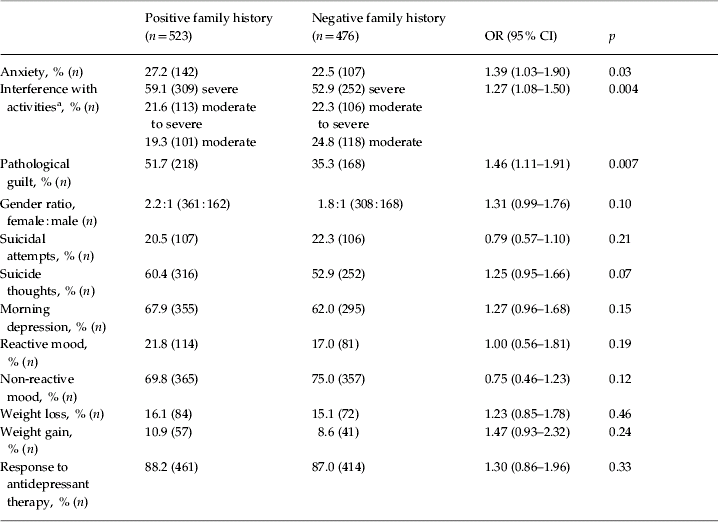
Finally, in an exploratory analysis, we evaluated whether clinical symptoms were associated with FH of depression, using a stepwise logistic regression model. Twelve depressive symptoms were included in the model as predictive for the positive FH of depression (Table 2). Among 999 observations considered in the model, 105 were deleted due to missing values in the predictive variables. After fitting the model only three symptoms (pathological guilt, interference with daily activities and anxiety) remained at the 0.05 significance level. The likelihood ratio test for the fitted model was statistically significant (p=0.0003). Other features, such as gender, morning depression, mood reactivity or non-reactivity, suicidal thoughts or attempts, significant weight changes during depressive episodes and response to the antidepressant therapy did not show any significant association with depression FH. In addition, the mean age of onset (calculated in the whole sample, n=999 patients) was 34.59 years (range 7–78 years) in the group with FH, and 41.03 years (range 12–84 years) in the group without FH of depression. The average duration of the disease for FH+ and FH− was, respectively, 14.4 (s.d.=11.48) years and 12.86 (s.d.=10.34) years and differed significantly between the groups (p=0.02).
Clinical characteristics by family history of depression and estimated ORs with 95% CIs from stepwise multivariate logistic regression model fitted at the 0.05 significance level

OR, Odds ratio; CI, confidence interval.
a Considered as a continuous variable.
Discussion
The results of this study support three main conclusions. First, positive FH for depression is associated with younger age of onset for depression. Second, other variables, including higher familiality for anxiety and higher neuroticism scores, are also related to age of depression onset. Third, presence of FH of depression appears to be associated with clinical features such as anxiety and pathological guilt, and a more severe functional impairment.
Survival analysis showed that individuals with FH of depression tend to develop the illness before individuals who do not have a positive FH. This finding has been already shown by several published studies using a different approach (Mendlewicz & Baron, Reference Mendlewicz and Baron1981; Weissman et al. Reference Weissman, Merikangas, Wickramaratne, Kidd, Prusoff, Leckman and Pauls1986). Previous studies have usually stratified by an arbitrary age cut-off (early versus late onset) and compared rates of depression in relatives between early- and late-onset depression groups. Based on the survival curve in this study, there is no evidence of a clear cut-off age by which early- and late-onset depression can be identified as distinguished entities, at least relative to FH of depression. Individuals with either positive or negative FH may develop MDD at any time during the course of their lives. However, the variation in the effect of FH on the onset of depression was clear when running Cox models for different age groups. Based on the effect size of depression FH, it was possible to identify an early-onset group, for which the cut-off was age 20 years, a mid-age onset with age range between 20 and 50 years, and a late-onset group (i.e. >50 years). The late-onset group showed a different pattern of association from the early-onset and mid-onset groups in which depression FH signaled lower hazard of depression. This finding suggests that in late onset depression other factors, such as environmental factors or concurrent medical pathology, might play the main role as suggested by previous studies (Salloway et al. Reference Salloway, Malloy, Kohn, Gillard, Duffy, Rogg, Tung, Richardson, Thomas and Westlake1996; Steffens et al. Reference Steffens, Plassman, Helms, Welsh-Bohmer, Saunders and Breitner1997; Kendler et al. Reference Kendler, Gatz, Gardner and Pedersen2005). The variation of the FH− versus the environment effect on age of onset across lifespan could not be ruled out with the current design.
Besides the finding relative to the link between positive FH of depression and an earlier onset, already suggested by the literature, we tested whether other variables could influence depression age of onset. We found that the presence of positive FH of anxiety and higher scores of neuroticism independently determines a younger age of onset of MDD, whereas no differences in age of onset are determined by gender. To our knowledge this is the first study exploring the impact of anxiety FH and neuroticism on depression age of onset. These data are in line with evidence arising from twin studies suggesting shared genetic factors between anxiety, neuroticism and depression (Kendler et al. Reference Kendler, Neale, Kessler, Heath and Eaves1993; Kendler, Reference Kendler1996). However, it is important to note that the association for each of these two variables is independent from the effect of FH of depression, and their effect size appeared to be relatively stable in the early- and late-onset groups. The absence of a gender effect on age of onset contrasts with the evidence that women are more likely to have an earlier age of onset of depression than are men, with symptoms arising during the mid-teenage years, whereas men usually become symptomatic during age 20 to 29 years (Ernst & Angst, Reference Ernst and Angst1992). However, we cannot rule out an effect of gender on the age of onset, as it may be linked to factors not included in the model and different from those implicated in the familial aggregation of MDD (e.g. interaction with environmental effects; Neumeister et al. Reference Neumeister, Konstantinidis, Stastny, Schwarz, Vitouch, Willeit, Praschak-Rieder, Zach, de Zwaan, Bondy, Ackenheil and Kasper2002; Eley et al. Reference Eley, Sugden, Corsico, Gregory, Sham, McGuffin, Plomin and Craig2004). Also, recruitment bias may have affected results: only individuals with a history of severe depression (recurrent depression with at least two moderate to severe episodes) were included in the study and a female:male gender ratio of 2:1 was imposed to reflect gender rates in the population. Finally, presence of FH of depression may be associated with specific clinical features and a greater perceived interference of depression with daily activities. This replicates previous studies in which ‘degree of impairment during worst episode’ predicted risk of depression in the co-twin (Kendler et al. Reference Kendler, Neale, Kessler, Heath and Eaves1994, Reference Kendler, Gardner and Prescott1999) or – more generally – was associated with familial depression (Gershon et al. Reference Gershon, Weissman, Guroff, Prusoff and Leckman1986; Lieb et al. Reference Lieb, Isensee, Hofler, Pfister and Wittchen2002a, b). Previous studies also indicated a relationship between co-morbid anxiety and a positive FH of depression (Weissman et al. Reference Weissman, Merikangas, Wickramaratne, Kidd, Prusoff, Leckman and Pauls1986; Kendler et al. Reference Kendler, Neale, Kessler, Heath and Eaves1994), and sharing of genetic factors between the two disorders (Kendler et al. Reference Kendler, Walters, Neale, Kessler, Heath and Eaves1995). To our knowledge, only one previous study indicated that feelings of guilt predicted risk of MDD in relatives; however, its effect was no longer significant after correction for multiple testing (Kendler et al. Reference Kendler, Gardner and Prescott1999). Due to the lack of studies exploring this specific symptom as a psychopathological characteristic of familial depression, these findings need to be replicated and further investigated. No association was found between a positive FH of depression and suicidal thoughts or suicide attempts. These findings, together with previous studies (Malone et al. Reference Malone, Haas, Sweeney and Mann1995; Lieb et al. Reference Lieb, Isensee, Hofler, Pfister and Wittchen2002a, Reference Lieb, Isensee, Hofler and Wittchenb; Goodwin et al. Reference Goodwin, Beautrais and Fergusson2004), suggest that the risk for suicide behaviors may be independent from FH of depression.
The present study has a number of strengths, including sample size and a comprehensive clinical assessment. Importantly, recruitment was irrespective of either age of onset or FH status. Both early and late ages of onset were well represented in the sample. However, several limitations should also be considered. Data were collected retrospectively, and so recall bias may have affected results: estimation of age of onset may be particularly difficult for patients with long duration of illness, with the possibility of differential reporting of age of onset by depression FH status. In addition, an ascertainment bias is possible in which FH+ individuals might have greater awareness of the disorder than individuals with no FH of depression, resulting in earlier treatment seeking. Finally, in the oldest individuals limited awareness of early-onset depression at the time of their childhood may have led to a late recognition of the disorder. Thus, the reported age of onset may have been biased toward a later onset, especially in the group of oldest individuals. A second limitation is that data on psychopathology in relatives were reported by the participant (without further investigation) and rather than contacting first-degree relatives. There is general agreement that, compared with direct interview (i.e. family study method), surrogate information derived by informants yields an under-report of FH, showing higher specificity than sensitivity (Andreasen et al. Reference Andreasen, Rice, Endicott, Reich and Coryell1986; Weissman et al. Reference Weissman, Wickramaratne, Adams, Wolk, Verdeli and Olfson2000; Lieb et al. Reference Lieb, Isensee, Hofler and Wittchen2002b). This may have affected our results, most likely determining an underestimation of the effect of the FH on age of onset and diminishing our power to detect differences in clinical features between groups. Another limitation of our study relates to the use of neuroticism as predictor of age of onset although it was assessed at the time of interview (thus measuring current neuroticism). Although neuroticism has been shown to be relatively stable through adult life (McCrae & Costa, Reference McCrae and Costa1990; Kendler et al. Reference Kendler, Neale, Kessler, Heath and Eaves1993) and to be present before the onset of depression (Angst & Clayton, Reference Angst and Clayton1986; Hirschfeld et al. Reference Hirschfeld, Klerman, Lavori, Keller, Griffith and Coryell1989; Kendler et al. Reference Kendler, Neale, Kessler, Heath and Eaves1993), it increases during acute phases of the illness. There is also the evidence for a chronic effect (McCrae & Costa, Reference McCrae and Costa1990), so that individuals with a history of lifetime depression also report elevated neuroticism. Thus, the association between neuroticism and early age of onset might result from an indirect association with the earlier onset. The duration of illness differed slightly between FH+ and FH−, and the FH− individuals were older at the time of interview (data not shown). The finding of neuroticism influencing depression age of onset cannot be clarified in a cross-sectional study such as the present one and needs to be replicated in longitudinal studies.
Finally, because of the effect of help-seeking bias and self-selection results, this sample of affected individuals might not be representative of non-clinical samples and of depressive disorder in general (Kendler, Reference Kendler1995). However, the mean, median and percentiles for age of onset in our total sample were similar to the data reported in the study of Kendler et al. (Reference Kendler, Gatz, Gardner and Pedersen2005), indicating that our sample is representative of depression in the general population, at least relative to MDD age of onset.
These data have implications for the identification of key phenotypic features that can be used to identify more homogeneous and heritable subgroups of depression. Although early-onset depression has been showed to have a higher familiality and genetic loading (Weissman et al. Reference Weissman, Wickramaratne, Merikangas, Leckman, Prusoff, Caruso, Kidd and Gammon1984, Reference Weissman, Merikangas, Wickramaratne, Kidd, Prusoff, Leckman and Pauls1986; Lyons et al. Reference Lyons, Eisen, Goldberg, True, Lin, Meyer, Toomey, Faraone, Merla-Ramos and Tsuang1998), and age cut-offs have been suggested as selection criteria or stratification variables for genetic studies, our results suggest that this might not be the best way for analysis of genetic data. Based on our data, the effect of depression familiality is strongest when onset is before or at age 20 years; however it should be noted that familial depression, as well as non-familial depression, may onset at any age during the lifespan. Thus, stratifying depression sample by a cut-off age of onset would yield to the definition of subgroups that are likely to be genetically heterogeneous. FH of MDD or the use of age of onset as a quantitative variable might represent a more appropriate way for analysing genetic data. The absence of a clear cut-off age of onset in relation to familiality may also give partial explanation for the differences in results across similar studies, in which different ages have been used as the cut-off, dividing the groups inconsistently and somewhat arbitrarily. The results from the present study are also suggesting that individuals with onset after age 50 years do not appear to be very informative in genetic studies.
In summary, a large and clinically thoroughly characterized sample of patients with recurrent MDD is showing that the presence of positive FH in patients' first-degree relatives substantially contributes to a younger age of onset, particularly when the onset is before age 20 years. FH of anxiety and neuroticism also contribute to a younger onset, but none of these factors is associated with MDD for onset after age 50 years.
Acknowledgements
We acknowledge the study participants, the academic investigators and the numerous scientists in Genetics Research and other R&D Divisions in GlaxoSmithKline who helped to make this work possible. We particularly acknowledge Shyama Brewster for her contribution to the initiation and progression of data collection, and Lisa Squassante for her statistical support.
Declaration of Interest
F.T., I.P., J.D.P., A.D.M., L.T.M., H.D.C. and P.M. were all full-time GlaxoSmithKline employees at the time this paper was submitted.