Bertolt Brecht and Helene Weigel co-founded the Berliner Ensemble (BE) on 1 September 1949 in what would soon become East Berlin, the capital of the German Democratic Republic (GDR). Brecht's aims for the theatre company had already been set out in a document written for local officials in either late 1948 or early 1949. He intended to experiment with his new way of making theatre, theorized during his exile from Germany (1933–48), and prove his theatre to be innovative and radical in practice. Although he described his approach in the accessible phrase ‘a realistic, new mode of performance’, his notion of realism was not a mimetic representation of reality, but a dialectical examination of it.Footnote 1 Brecht understood that a single institution would be limited in its ability to disseminate his new method. Consequently, he stated that, in due course, he wanted to produce ‘model productions with which [the company he envisaged] could tour Germany’, and expected its work to be ‘recorded, disseminated and made available to provincial theatres’. Thus, before the company had been founded, or even given its name, Brecht was already convinced that its work would possess qualities that could serve as an example to other theatres and that the means would be available to transmit these qualities for those unable to see the productions live.
This article explores the various means the BE employed to document its work and how they varied over time. As will be shown, the approaches to documentation not only described the different forms the company employed, but related them to Brecht's understanding of the company as an innovative creative force. Brecht instigated particular ways of documenting performance that were linked to a specific set of aims. I will be arguing that the BE's sense of purpose can be related to the ways it chose to document its work. Initially, the company understood its productions as models of a new practice, a practice that could be successfully imitated. It thus sought to document the methods employed as a way of introducing a new way of making theatre to other institutions. As time went on, however, and after Brecht died in 1956, the documentation began to transform from a reflection on practice to a more conventional record of practice. The changes in documentation were not, however, programmatic, but rather responsive to the changes the BE underwent over time. As will become apparent, the nature of the documentary material and the ways in which it was collected and articulated reveal as much about the work done at the company as about the way the work was regarded. This relationship informs the subsequent analyses with a view to revealing the changing nature of the BE as it negotiated its function over time.
Modelbooks and their documentary functions
Brecht's theatre practice is perhaps best known today through the production of Modellbücher (modelbooks). Their publication started in 1949 with the Antigonemodell 1948, a documentation of Brecht's production of his own adaptation of Antigone in Chur, Switzerland. Brecht initially used a commercial publisher as a means of disseminating his method, although the book sold so poorly that plans for further volumes were postponed.Footnote 2 The one that has endured, the Couragemodell 1949, documenting Brecht and Erich Engel's groundbreaking production of Mother Courage and Her Children at the Deutsches Theater, was published two years after Brecht's death, in 1958.
The formal differences between the Antigone and Courage modelbooks betray the struggle to document the final production while seeking to expose the nature of that process at the same time. The Antigonemodell is structured in a linear fashion.Footnote 3 It opens with an introductory essay that sketches the modelbook's ambitions and its limitations. What follows is a series of pages organized according to a standard form. When open, each right-hand page presents two images. Beneath each one is a textual reference point from Brecht's adaptation of Antigone, to locate the reader in the play. Each left-hand page offers either a fuller description of the images to reveal more about what was happening onstage or a catechism of question and answer, aimed at teasing out production decisions. These sections are followed by sketches made by designer Caspar Neher, and then the complete text of Brecht's adaptation.
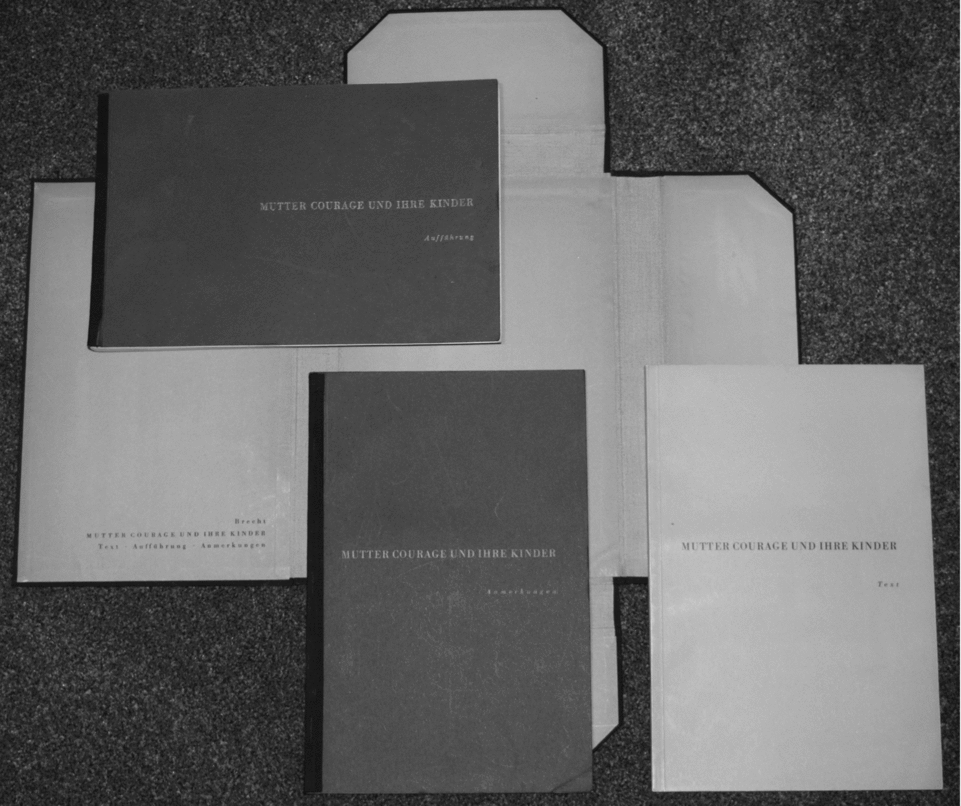
By the time of the Couragemodell’s publication, the dialogical linearity of the Antigone material had been replaced by what one might today call a more hypertextual variant: the modelbook came in three discrete parts, housed in an elegant fold-out box (Fig. 1).Footnote 4 Readers could separately consult the full text of Mother Courage, a chronological photographic account of the production and a set of commentaries in whichever combination they wished. The ability to compare the different elements asynchronously leads Adam J. Ledger to conclude, with reference to modern digital documentation, that this modelbook's form ‘continue[s] to have implications for theatre and performance practices today’.Footnote 5 This is a rather different position from the once-dominant view that Brecht's modelbooks aimed at nothing less than ‘theatrical hegemony’, the authorial dictation of how a production should be staged.Footnote 6 Sean Carney offers a corrective by observing that ‘the lesson to be learned, or the wisdom to be imparted by the modelbooks seems to reside precisely in the difference between the modelbooks and the theatrical production that employs them’.Footnote 7 It would be impossible simply to copy the three categorically different materials in the modelbooks; they served instead as an exemplar of practice that was consciously designed to provoke variation. In scene ii, for example, there is a photograph of Courage's son Eilif performing a sword dance. The notes state, ‘the young man is executing a dance he has seen somewhere. It is not easy to make such things evident’.Footnote 8 The photograph cannot attempt to offer anything but an approximation of what will take place in performance; it is indicative, but serves merely as a starting point for rehearsal work based on the premises of the commentary. Indeed, the acknowledgement of the difficulty involved in making ‘such things evident’ could sum up the central performance problem that Brecht sets his readers.
Brecht, Couragemodell 1949, open. Photograph by D. Barnett.

Matthew Reason notes that a major motivating feature for documenting performance is to save it for posterity, to record a historical occurrence: ‘those wanting to save performance . . . deem documentation an end in its own right’.Footnote 9 This was not Brecht's primary impulse. The modelbooks not only allow a production to be described, but, more importantly, also convey a dynamic tension between the documented work and the processes that led to it. He was thus able to avoid the problems that had dogged him concerning the meanings of theoretical terms he had coined, such as Verfremdung (‘making the familiar strange’) or Gestus, the untranslatable term relating the actor's body to the figure's social context. Brecht noted, ‘there is no purely theoretical way of approaching the modern epic theatre; the best thing is practical copying, along with a wish to find out the reasons for groupings, movements and gestures’.Footnote 10 That is, Brecht was encouraging readers both to imitate what they saw in the modelbooks and to reflect on their actions, with the modelbooks’ rationales and commentaries providing additional guidance. The documentation was concerned with posing questions, and therein lay its activating quality.
The modelbooks mark a very public attempt to disseminate the Brechtian method. The other major work of published documentation was the 1952 volume Theaterarbeit (Theatre Work).Footnote 11 Detlev Schöttker has suggested that it is this book, rather than the modelbooks, that is the most important and comprehensive work Brecht published on the practice of epic theatre.Footnote 12 This estimation may well be correct in that the book examines the BE's first six, very diverse, productions with a view to teasing out both confluences and divergences in their design and realization. This desire is signalled in the table of contents, which is split in two. The first part lists the main sections as they appear in page order, from the first production, Mister Puntila and His Man Matti (premiere November 1949) to material on models and theatre skills. The second applies a thematic approach, using overarching titles such as ‘direction’ or ‘set, costume and make-up’ to direct readers to various articles dispersed throughout the volume. This structure led John Fuegi to describe the book as ‘rather haphazard’, a position that ignores the productive qualities of the montage principle it adopts.Footnote 13 Not unlike the modelbooks, Theaterarbeit confronts readers with a series of collisions and actively invites them to read selectively and asynchronously. They can move between any of the six productions in order to compare similar phenomena and distil common features and divergent outcomes of the dialectical method.
What links the modelbooks with Theaterarbeit is the production of difference: the difference between the model and the copy, between one production and another, between the document and actual work in the theatre. In each case, it is the method that informs the epiphenomena of the productions. The documentation seeks to connect dialectics and performance to two main ends: to give a concrete example employing the dialectical method, and to suggest its wider applicability, something more clearly demonstrated in the variety of productions found in Theaterarbeit. There is thus a connection between the aims of the documentation and those of the company. As is well known, Brecht the playwright, director and theorist wanted to replace the imitation of surface reality (naturalism) with representations that investigated the processes that produced the surface. What emerges in the published documentation is that he sought to extend that idea to the way he recorded his own productions. They were not to be viewed as finished products to be admired, but as the endpoints of complex processes that were to be unpicked and acted upon.
Notate: Documentation for insiders
Not only was the BE's documentation outward-facing; the company also wanted to ensure that its own processes were recorded and reflected upon. From the first production onwards, Brecht insisted that his directorial and dramaturgical assistants compile Notate. This is not the usual German word for ‘notes’, which is Notizen, but suggests something more extensive; it thus already signals its special quality. Notate were not only a record of rehearsals, but an attempt to account for the decisions taken there as well. Take, for example, this observation made during the rehearsals of Synge's The Playboy of the Western World (premiere May 1956): ‘the play's romanticism shouldn't only be used for atmosphere; the romanticism should also inform the story. It has to be made strange [verfremdet] to a certain extent: it has to facilitate the great legend’.Footnote 14 Here the category of romanticism is treated as a dialectical factor in the construction of the plot. It does not represent a passive milieu, but an active contributor to the action itself: the ‘playboy’, Christie Mahon, becomes a hero for a short time after he announces that he has killed his father, tapping into romantic notions of heroism that precede his first entrance. The Notat articulates an analytical insight that proposes how the play's style can be further used to connect form and content. In rehearsals in 1953 for Erwin Strittmatter's Katzgraben, a Notat describes the actors’ input and shows how their ideas led to new discoveries. In one scene the actors questioned the potentially banal detail of whether a wife should light her wealthy husband's cigar. The answer was that she should not, and the reasons given went far beyond the simple act itself: ‘she fulfils her duties as a wife, that's what religion asks of her, but nothing more. She will not support vice. There's a difference between selling tobacco and smoking it yourself’.Footnote 15 The note thus sets the actors further challenges predicated on the contradictions identified by the original question.
Other Notate in the archive as a whole reflect on the circumstances under which decisions were made, speculate on problems encountered and discuss potential solutions.Footnote 16 Assistants Peter Palitzsch and Hans Bunge both recount that the submission of Notate to Brecht was initially a process in which Brecht offered comments of his own and countersuggestions.Footnote 17 Palitzsch felt that he was benefiting from Brecht's input and that he learned a great deal through the exchange. The Notate were thus a site of debate and contestation, not a faithful record of events. Once the assistants had understood the form and function of the Notate, they no longer submitted them to Brecht's scrutiny. For assistant Egon Monk, Notate provided ‘the basis for the discussion after the rehearsal, known as the “critique”’.Footnote 18 That rehearsal involved ‘critique’ also attests to the dynamic at work here: production decisions were not allowed to stand unquestioned, but were in dialogue with the rest of the scenes, open to further interrogation and consultable in the Notate of previous days.
It should also be noted that there was no single ‘Notate-taker’ for any given production. It was not uncommon, under Brecht's leadership, for two or three sets of Notate to be compiled simultaneously by different assistants. The objective was thus not to produce one set of authoritative records; the divergences between the different documents would undermine singular claims to objectivity. Instead, the Notate, when read together, presented a potentially contradictory account of the process, reflecting the nature of the rehearsals themselves. Brecht did not direct alone and solicited performed input from his cast (which he termed ‘inductive rehearsal’) and suggestions from his assistants to interrogate the different performance possibilities of the dramatic text.Footnote 19 By extension, the discrepancies in the Notate also provoked discussion as a productive tool for further work, enshrining performativity rather than descriptive passivity in the documentation.
One of the essays in Theaterarbeit reports that the Notate provided the basis for the further rehearsal work and were later analysed in the modelbooks.Footnote 20 That is, they offered informed analysis and contributed to the commentary sections. Only six modelbooks were published in total: in addition to the Antigone and Courage models, books appeared on Señora Carrar's Rifles (1952) and Life of Galileo (1956), as well as two dedicated to minor plays staged by the BE for the benefit of workers’ amateur theatre groups. The BE archive, on the other hand, is very well stocked with Notate for almost all the productions that were staged while Brecht was artistic director (1949–56). The importance Brecht placed on their compilation can be seen in an incident in which assistant Benno Besson lost the Notate for the BE's third production, The Tutor (premiere April 1950). This carelessness angered Brecht so greatly that Besson was excluded from Brecht's circle for over a year.Footnote 21 While Brecht did not break with Besson and had him direct major productions in the years that followed, his response demonstrates the investment he placed in the documentation that was an essential part of his rehearsal process.
While no further modelbooks were published from the twenty or so productions staged under Brecht's leadership, the BE nonetheless compiled in-house modelbooks for all of them. They were usually made well after the premiere of the show in question and had a more summative function than the formative Notate. In-house, the format varied between purely photographic documentation and combinations of photographs and reference points taken directly from the plays’ texts. Unlike the evolving, reflective Notate, the modelbooks were necessarily fixed in their representations. Nonetheless, they documented an ideal performance because the books were not compiled from the photographs of a single run. Assistants selected the most eloquent images (that brought out the clearest meaning in onstage groupings or gestures) from the hundreds taken over many rehearsals and performances.Footnote 22 Thus the emphasis was not so much on accurate record as on exemplary practice.
The modelbooks were to be read in tandem with the Notate. Taken together, such documentation served a number of functions. First, the compilation of documentary material was considered a productive training activity for the assistants.Footnote 23 The process of negotiating with Brecht, mentioned above, and choosing particularly fitting photographs helped the assistants develop a careful eye for the details that Brecht's theatre wanted to display to its audiences. The moments they chose to discuss and analyse in the Notate engaged them directly in Brecht's staging processes, ultimately equipping them for projects of their own, such as when Egon Monk was entrusted with directing a double bill of plays by Gerhart Hauptmann in 1951 at the age of only twenty-three. Second, the BE itself worked quite slowly, producing on average three productions a year, and these could remain in the repertoire for some time. The documentation thus helped ‘maintain’ the productions as a complex reference point during lengthy runs. Third, the documentations were intended for eventual loan, a cheap alternative to the expense associated with a full publication. While Brecht publicized the opportunity to borrow the documentation in the Couragemodell, and thus opened the offer to all readers, it is likely that theatre-makers and scholars were the intended audience.Footnote 24 It is difficult to gauge the levels of demand when this modelbook was published in 1958, but there was certainly a flood of interest in the years that followed. Statistics compiled by the BE show that from 1964 to 1967, for example, the company sent the modelbooks of twenty-three different productions to 165 theatres. Sixty-three remained within the GDR, twenty-nine went over the border to the Federal Republic of Germany (FRG), and seventy-three were sent further afield to Europe and beyond, to Cuba, Argentina, the USA, Turkey, Sri Lanka, Israel and Egypt.Footnote 25 Elsewhere, the BE received 729 visitors to its archive between 1964 and 1969, just under half of whom came from countries outside the GDR. Finally, the compilation of Notate and modelbooks at the BE reflected its ambitions to engage self-consciously with its new kind of theatre-making and to disseminate its methods beyond Berlin.
As already discussed, the practice of taking Notate was not primarily concerned with the act of recording the details of rehearsal. Rather, it formed part of a production process whose participants preferred not to settle on particular decisions, but to return to, re-evaluate and potentially redirect them.Footnote 26 This notion of process tallies with Fredric Jameson's evaluation of the early BE as ‘one continuous master class, to which a paying public is invited only on selected occasions’.Footnote 27 The workshop nature of the BE under Brecht was concerned with experimentation and making discoveries, activities that were not, by their very nature, schematic. Assistant Egon Monk summarizes the position concisely: ‘there was always a basis, but it was developed anew for every production’.Footnote 28 This ‘basis’, as evidenced by the various projects’ Notate, was the dialectical investigation of the play and its contexts, and the investigation was a critical one. Criticism did not stop once the production had premiered: the assistants were required to monitor performances nightly, not only to note errors, but also to suggest improvements.Footnote 29 The emphasis on an ongoing process in which many members of the company were engaged confirms that the early BE was indeed more concerned with the imaginative and critical exploration of the dramas it chose to stage than with their outcomes, the more traditional ends of a theatre company. As such, the mode of documenting the productions offers itself as an important part of a feedback loop: the deliberately analytical and speculative Notate mark their own provisional status as material for further development.
Documentation and its discontents 1: the creep of directorial managerialism
Brecht was a good teacher. After his death in August 1956, his three closest assistants, Benno Besson, Peter Palitzsch and Manfred Wekwerth, continued his work as directors in their own right. Tensions among the trio led to Besson's departure from the BE in 1959, and Palitzsch, dissatisfied with the company, chose to remain in the West when the Berlin Wall was erected in August 1961. Wekwerth, who became the BE's de facto artistic director, was keen to develop the Brechtian legacy, but found himself in a different situation from his master. He was now responsible for a company with an established international reputation.
The BE's first major triumph after Brecht's death, The Resistible Rise of Arturo Ui (premiere March 1959) had shown that the directing team of Palitzsch and Wekwerth had the measure of Brechtian method. Wekwerth later teamed up with head dramaturge Joachim Tenschert to stage Brecht's unfinished Shakespeare adaptation, Coriolan, in 1964. The production, again, was a great success, featuring in many international tours and remaining in the repertoire until 1979. Both productions were documented with Notate taken by a new generation of assistants. Wekwerth and his collaborators were apparently furthering Brecht's practices not only in their rehearsal methods, but also in their practice of documentation. Yet the dossier on Coriolan reveals that all was not functioning quite as Brecht had planned.
The Notate and other paperwork in the archive represent a shift from the input of the cast to the input of the directorial team, a shift from Brecht's to Wekwerth's approach to rehearsal. The actors were supplied – in a practice not unknown under Brecht's leadership – with reading material on Shakespeare's sources and his times, commentaries on Coriolanus, and archival extracts from Brecht's initial engagement with adapting Shakespeare's play in the early 1950s.Footnote 30 A series of reflections on interpretive problems concerning the text, mostly written by Wekwerth pre-production, follow. The actors were then presented with a ‘second, supplementary file on the Tragedy of Coriolanus at the Berliner Ensemble’, itself another thick compilation of thoughts and analyses written by the director and his assistants.Footnote 31 It is clear that Brecht's immanent approach to collectively and inductively making discoveries was being pre-empted. Back in the BE's first season, textual adaptation and rehearsal mutually informed each other, as John Rouse observes in the developments of The Tutor: ‘the changes from text to text, as the production team absorbed what they were learning in rehearsals, were hardly minor’.Footnote 32 The movement towards a more managerial approach to rehearsal, in which the ensemble becomes more a function of decisions taken by the director, is evident here. In addition, one of the sections of the first batch of reading material, written by Wekwerth, was entitled ‘First Notate on the Konzeption of 1963’. A Konzeption was a written interpreted approach to directing a play. This method reduces the freedom to make discoveries, associated with Brecht's inductive method, and, indeed, it became associated with state control in GDR theatres.Footnote 33 The production dossier does not, however, exclusively include directorial and dramaturgical musing, and there are also more conventional Notate that focus on rehearsal.
That Wekwerth and his team believed Coriolan marked a productive development of the Brechtian tradition is evident in their commitment to documentation. The sheer effort and resources required to work through the lengthy rehearsal process show that the company was not simply going through the motions.Footnote 34 The work was certainly lauded in the presses of both Germanys, although there were two notable dissenters, one from the East and one from the West, who questioned the vitality of the production when compared with the BE of the 1950s.Footnote 35 Both wondered whether a drive towards technical perfection was obscuring the dialectical vigour once associated with Brecht's theatre. The pressure to produce high-quality theatre had exerted a powerful influence over the nature of the BE's production work, and this was reflected in the move to the more conventional top-down direction documented in the archive file.
While Coriolan proved to be a popular success, a disastrous production of Brecht's Saint Joan of the Stockyards in June 1968 showed what could happen when the new emphasis on a Konzeption failed. Again, rather than investigating the text through dialectical inquiry in rehearsal, the creative team, headed by Wekwerth, was initially engaged in finding a viable reading of the material pre-production. His quandary centred around staging a play about the crisis of capitalism when the GDR's West German neighbour was economically strong and getting stronger. The Notate themselves start to record rehearsals rather than comment on them. As one of Brecht's old friends, Bernhard Reich, noted after observing rehearsals, ‘And [Wekwerth] sits there, surrounded by his team – these people write up every comment’.Footnote 36 The lack of reflection indicates that the BE was turning away from the workshop character, identified by Jameson. It was becoming a more conventional theatre, intent on securing the output (the production) rather than nurturing the process (inductive, dialectical rehearsal). The change in the form of the documentation suggests that the BE was losing its Brechtian verve, where each rehearsal process presented the potential to make fresh discoveries. However, that the practice of extensive documentation persisted suggests that Wekwerth and his colleagues were still convinced that their work could be productive for both the company and other theatre-makers.
Documentation and its discontents 2: post-Brechtian theatre
By the end of the 1960s, the BE was in trouble. It had stopped producing important work and no longer set the standard for innovative theatre in the GDR.Footnote 37 New blood was required, and this came in the person of Ruth Berghaus. She had worked as an assistant and then as a director at the BE in the 1960s, rising quickly to lead the company when Helene Weigel died in 1971. Berghaus took a very different approach to direction from Wekwerth, something that can be seen in her treatment of Brecht's Señora Carrar's Rifles in 1971.
The play is concerned with a mother in the Spanish Civil War who is initially reluctant to let the Republicans use the firearms referred to in the title, but does so when her son is murdered by Franco's Nationalists. Berghaus decided to challenge the model status of the production that Egon Monk had staged at the BE in November 1952. As assistant Peter Konwitschny put it in 1971, ‘the “noblesse” of the [Carrar] model has no function today’; that is, Berghaus wanted the production to move away from the exemplary and to focus on the bitter struggle of a single Spanish family against the Fascists.Footnote 38 The shift of emphasis has important implications for the documentation practices that Brecht sought to promote. As discussed above, Notate were originally designed to interrogate material generated in rehearsal by Brecht's dialectical method. The concept of a method that was both specific to a production yet transferable to others signalled one of the ambitions of the early documentation process. Berghaus, schooled at Wekwerth's BE, had proposed in 1967 at the conference that founded the Verband der Theaterschaffenden (Association of Theatre-Makers) that GDR theatres as a whole adopt the valuable practice of taking Notate. She cited Brecht as her inspiration.Footnote 39 By 1971, she had reached a different conclusion. With respect to her work on Brecht's In the Jungle of the Cities (premiere January 1971), she noted, ‘Since our work has an experimental character, the play brings with it particular complications, and as Notate at the BE can be freely consulted, we must not give the impression that this is a theory for dealing with Brecht's early plays’.Footnote 40
These thoughts can be extended back to Carrar and forward to the other productions Berghaus staged at the BE until she was forced out of office in 1977 for mounting and sponsoring productions that were perceived to be too distant from Brecht's approaches. The ‘experimental character’ she mentions is closely connected to her post-Brechtian approach to directing. Here, she did not jettison Brechtian principles, but sought to reform them. The premise of Brecht's model and the transferability of the dialectical method are predicated on an ability to generalize. Such an impulse is founded on particular assumptions concerning epistemology. A discourse runs through Brecht's theoretical works that suggests a movement from ignorance to knowledge. He allies, for example, the dialectic of Verfremdung (making the familiar strange) with the acquisition of mastery over the phenomenon in question.Footnote 41 By the 1970s, Brecht's optimism was in need of qualification. It was not that Berghaus, or other post-Brechtian theatre-makers, doubted the dialectical connections between individual, society and history, or Brecht's critique of surface naturalism. Rather, they were wary of the conclusions that could be reached, preferring to leave contradictions more provocatively open than Brecht, and this had an effect on the ways they staged dramas.
As a result, Berghaus sought in Carrar to explore revolutionary consciousness and how it developed. She did not want to suggest that Carrar's final decision to use her rifles in the struggle against Fascism was either certain or inevitable, which was a possible conclusion that could be drawn from a model production. The actors’ cool delivery left questions about motivation open, and silences and pauses deliberately invited the audience to question these pregnant moments. A reviewer from the West welcomed the fact that Berghaus had distanced the production ‘from the fussiness of that “impulse of showing” that in recent years . . . had become ossified into a pedantic insistence on pointing the finger’.Footnote 42 The stage was no longer a repository of lessons, but a provoker of questions that were nonetheless anchored in social reality.
It is no coincidence that the practice of rigorous documentation declined at the BE in the 1970s. The Notate are more evaluative, weighing up the decisions taken, and not as fulsome as those made in the 1950s. The idea of a method is no longer to be found in this work: instead, each of Berghaus's dialectical directions addressed particular problems rather than seeking to anchor them in a more generalized context. Even Berghaus's only critical success, her production of Heiner Müller's Cement in October 1973, was accompanied by notes that are more descriptive than analytical or reflective. In one scene, for example, Russian revolutionaries engage in what seems to be an empty gesture: ‘the men fire the women up for political action, but they're indifferent to what becomes of it’.Footnote 43 The observation describes what is happening onstage, but does not account for the decisions taken, as did the Notat for The Playboy, above. The action is open and its meaning is delegated to the audience. The notes on this production offer insight into a particular process, not a reflective consideration of wider methodological concerns.
Around 1974, the manufacture of modelbooks virtually ceased, having been on the decline since the late 1960s. Brecht viewed the construction of the modelbooks, along with the compilation of Notate, as a training exercise for his assistants. By this time, such training was no longer deemed helpful or necessary. In the 1950s, it was allied with the criticism and development of the Brechtian method, but two different approaches to dialectical theatre at the BE had effectively neutralized it. Berghaus found the generality of the method too all-encompassing, preferring to probe specific moments and situations for contradictions. The Party appointed Wekwerth Intendant as a ‘safe pair of hands’ in 1977 when Berghaus was deemed to have strayed too far from what was expected at Brecht's theatre. He returned with his ‘top-down’ approach and the perpetuation of his now-tired Brechtian orthodoxy. This entrusted the formulation of a Konzeption to the director and the dramaturgical team before rehearsal began with the acting ensemble. Actor Angelika Ritter reports that the effect was often negative: when directing, ‘Manfred Wekwerth forced people into such a tight framework, so I was never really free’.Footnote 44
Even though the production of modelbooks was halted, the GDR's Association of Theatre-Makers, mostly in association with the GDR's Brecht Centre, produced four book-length documentations of BE productions between 1982 and 1987 as part of a wider series that was available for purchase. It would be difficult, however, to compare these to Brecht's published modelbooks in terms of either their form or their content. There was no attempt to take up Brecht's combination of text, image and commentary, and the documentations were more explicatory and illustrative than open and activating. Of course, the new publications were not required to do any more than to record and comment on the productions. Their form and their ambition suggest that their authors were interested in framing the work and influencing the reader's reception, not stimulating theatre-makers to look on and seek to imitate a theatrical process.
Times had certainly changed at the BE since Brecht's day. The extensive dramaturgical research and discussions of the 1960s had started to undermine the heuristic thrust of Brecht's documentary strategies. The post-Brechtian turn taken by Berghaus had also re-functioned the documentation she produced into a complex record of a singular process. At the same time, Berghaus also increased the number of productions the company produced annually, something Wekwerth built on when he returned to the BE in 1977. As a result, one may conclude that sheer pressure on time and staff prevented the compilation of the rich and nuanced Notate seen in the 1950s. Assistants were no longer trained in the art of responding to rehearsals and tended mostly to record them, if they were indeed compiling Notate at all. Creative teams were moving from project to project rather than lingering over different dialectical avenues that could be traversed in rehearsal. There is, of course, a link between the rise in productivity and the sorts of theatre made. The BE's mission no longer entailed disseminating a radical method and making use of its resources to study and experiment with dramatic material. Over the years, it had transformed itself from a workshop to a theatre, and this is reflected in its approach to documentation. A practice that was once integral to the realization process had become an appendage to it.
The rule and the exception
The 1980s, a stagnant period for the GDR, both economically and culturally, were hardly an exciting one for the BE. The company scored few critical or popular successes, and its documentation practices reflect its focus on regular production at the expense of in-depth dialectical rehearsal. The archive often includes only sparse materials: the BE, a company with a particular relation to posterity, no longer invested in recording its own present. By the 1990s, the documentation process had virtually stopped: the dossiers mainly contain the odd conceptual essay, filed as a matter of record, and a collection of newspaper reviews. This tallies with the political situation in which the company found itself after German reunification. Unlike Berlin's Volksbühne, which successfully reinvented itself as an iconoclastic, deconstructive stage that attracted an engaged, youthful audience, the BE found itself weighed down by the burden of its Brechtian past and the uncertainty of its present. Its struggle for identity was greatly hampered by the City of Berlin's decision to appoint five Intendanten (general managers) to lead the company from 1992. Peter Palitzsch, one of Brecht's earliest assistants, was one of the new leaders, and he complained in 1993 that the BE did not understand its own function and asked which factors or perspectives were influencing production work. The response of post-Brechtian playwright, director and fellow Intendant Heiner Müller was hardly constructive: ‘there isn't a political situation, there's only a vacuum, an emptiness, there's no human substance’. His only suggestion was that the turgid state of affairs required disruption, something he considered his own plays provided.Footnote 45
As it happened, it was one of Müller's productions, not of one of his own plays, but of Brecht's, that proved to provide the only major documentation in the Brechtian mould to emerge at the BE in the 1990s. The Resistible Rise of Arturo Ui (premiere June 1995) garnered critical plaudits and remains an often-sold-out feature of the repertoire. The volume of Notate in the archived file is surprising, given that the practice had virtually ceased by the 1990s. Müller was certainly no stranger to either the Brecht or Berliner Ensemble archives, and the Notate echo the more analytical mode found in the dossiers of the 1950s. At times they can appear redolent of orthodox Brechtianism. Dialectical ideas ran through the central character's construction, for example: ‘Ui doesn't have a personality of his own, he's actually a nobody who always has to be constructed by others’.Footnote 46 Yet the production should not be mistaken for a Brechtian imitation: the Notate betray the post-Brechtian impulse of articulating and accumulating contradictions without seeking to resolve them, a negative dialectics in the mould of Adorno, as opposed to Brecht's implicitly positive dialectics. An early note registered Müller's desire ‘to demolish order; to destroy Brecht's harmony’.Footnote 47 The documentation thus strikes an interesting balance between Brechtian dialectical inquiry and a drive to problematize it. As a result, it would be difficult to infer that Müller was offering readers a model or a method as such. He was, however, setting out an inductive directorial journey that sought to engage with Brecht in order to open up and complicate the findings. His Ui thus signals a qualified revival of Brechtian documentation in the 1990s and reflects an interesting meditation on the Brechtian method, in that Müller accepts it in order to destabilize it. Therein he makes a connection back to the 1950s and gestures to a possible reignition of the BE as a theatre workshop. However, Müller died six months after Ui’s premiere, and so he was unable to probe his practices further.
When Claus Peymann took over as Intendant in 1999, he turned his back on the company's Brechtian heritage, never seeking to replicate the methods developed by Brecht or modified by his more progressive successors. He continued to stage Brecht's plays and to have them staged, but there was not the desire to pursue inductive direction, and the practice of taking Notate was definitively discontinued.
Conclusion
In this article, I have identified a connection between Brecht's ambitions for the Berliner Ensemble and their evolution over time as indicated by changes in documentation practice. This is not a strictly causal relation, but a correlation between documentary form and artistic self-understanding. Brecht allied the innovations of his stagecraft with a dynamic developmental process, recorded in and furthered by the Notate. The Notate and modelbooks were intended to be shared among BE staff, theatre-makers and scholars as useful models of how the dialectical method could be applied to a great range of dramatic material. Documentation had the performative quality of provoking change in the way theatre was made both within and without the BE.
The late 1950s and the 1960s marked a change in the BE's approach to making theatre, based, in part, on the long runs of major plays by Brecht, such as Mother Courage and her Children and The Caucasian Chalk Circle. The company seemed no longer interested in the variegated applicability of Brecht's method, preferring instead to spend long rehearsal periods perfecting productions that would run and run, based on conceptual plans established in advance of rehearsal. The shift from collective ensemble activity to a more managerial treatment of interpretive questions is reflected in the adoption of a more traditional ‘documentation-as-record’ approach. Post-Brechtian theatre, as typified by Ruth Berghaus, returned to Brecht's experimental staging practices, but not to those associated with their documentation: notes tended to record decisions and describe dialectical processes. This type of theatre understood itself as a ‘one-off’. Consequently, there was no method to be ‘learned’ and documentation, again, was charged with recording the process rather than suggesting its transferability.
The incidence and forms of documentation at the BE betray the transformation of the company from an innovative workshop that also showed its productions publicly, to a conventional theatre focused on frequent production. A dialectical interpretation of this shift does not, however, conclude that it was necessary, brought about by the pressures to compete with other Berlin theatres. After all, Brecht's BE was far less productive than, say, its neighbour, the Deutsches Theater, in the 1950s, but still drew large crowds and plaudits from domestic and international audiences.Footnote 48 Müller's Ui suggests that older practices of speculative rehearsal and documentary reflection might have offered a viable mode of working. History, however, has recorded this production as a welcome aberration, not the start of a new phase. The documentation suggests that a different course could well have been possible for the beleaguered company, had it chosen to accept and refashion the Brechtian challenge for its post-socialist context.