



1 Introduction
The past twenty-five years have seen growing interest in non-canonical clausal agreement, i.e. a set of phenomena where the morphological cues signaling the relation between a predicate and one of its dependents fail to align in the expected manner.Footnote [2] However, these advances are skewed in that they are overwhelmingly focused on agreement in clauses with verbal predicates. This paper contributes to this vital area by investigating an understudied set of non-canonical agreement contexts found in copular clauses, i.e. sentences with non-verbal predicates. In particular, we examine binominal copular clauses, i.e. sentences where the copula links two nominals, as in [NP1 BE NP2].Footnote [3]
A striking peculiarity of binominal copular clauses is that there is variation across languages with respect to which noun phrase controls agreement. In some languages, for example English and French, agreement is consistently with the first noun phrase (NP1), while in others, such as German, Italian, Persian and Portuguese, a subset of copular clauses show agreement with the second noun phrase (NP2). We will refer to the latter pattern of agreement as an NP2 agreement pattern. This variation is illustrated in (1) with English, Portuguese (Costa Reference Costa, Castro, Ferreira, Hacquard and Salanova2004) and German.

While copular constructions have long been an object of inquiry, the peculiarities of the NP2 agreement pattern – in particular person agreement with NP2 – and the formal derivational conditions that enable it have received relatively little attention, with the exception of groundbreaking work by Moro (Reference Moro1997) for Italian and subsequent work on Germanic languages (Den Dikken Reference Den Dikken1998, Heycock Reference Heycock2012) and Portuguese (Costa Reference Costa, Castro, Ferreira, Hacquard and Salanova2004).Footnote [4] Previous research in Generative syntax has converged on the idea that NP2 agreement follows from the syntax of a special class of copular clauses – specificational clauses – which have been argued to involve inversion (see Section 2 below).Footnote [5] This has been pursued along two lines:
-
(i) NP1 has moved over NP2 to a position in the left periphery, as is shown by (2a) below, but NP2 is the actual structural subject and so NP2 agreement is in fact canonical agreement (Heggie Reference Heggie1988);
-
(ii) NP1 has moved over NP2 into the structural subject position, as is shown by (2b). NP2 is not the structural subject, but at the point in the derivation when agreement occurs it is the closest available NP (Mikkelsen Reference Mikkelsen2005, Heycock Reference Heycock2012, building on Moro Reference Moro1997).

In this paper we assess two previously undescribed cases of NP2 agreement in Persian and Eastern Armenian.Footnote [6] These cases are distinct in that one (Persian) is restricted to specificational contexts and the other (Eastern Armenian) is seen in both specificational contexts and with equatives, the latter being especially noteworthy in light of claims in the previous literature linking NP2 agreement with specificational contexts. We develop an alternative account of NP2 agreement that dissociates it from the syntax of inversion. This account is framed within the minimalist theory of Agree (Chomsky Reference Chomsky, Martin, Michaels and Uriagereka2000 inter alia), in which agreement is modeled as a formal relation between the agreement target (the probe) and the agreement controller (the goal). In this approach, probe–goal mechanics determine the availability of agreement. These include an operation that matches the probe and the goal (Match) and an operation that copies features of the goal to the probe (Agree). We propose that NP2 agreement arises when the phi-feature structure of NP1 is defective relative to the probe, with specificational contexts being just a subset of the relevant cases. This proposal permits a unification of our two case studies that would be challenging for previous accounts.
The rest of this paper proceeds as follows. Section 2 gives background on the typology of copular clauses. Section 3 introduces the case of Persian NP2 agreement in specificational contexts. Section 4 establishes for Persian that NP2 is not the structural subject in the relevant cases. In other words, it is not the case that NP2 is the real subject and NP1 is simply fronted to a higher position (ruling out type (i) analyses). Section 5 introduces the Eastern Armenian case study. Crucially, we show that, in Eastern Armenian, NP2 agreement is not restricted to specificational contexts, but rather involves a sensitivity to 1st or 2nd person (participant) NP2s (ruling out type (ii) analyses). Section 6 provides an analysis of Eastern Armenian that situates NP2 agreement within the broader phenomenon of person-sensitivity. We extend this analysis to the Persian pattern in Section 7, thereby unifying both cases of NP2 agreement as resulting from a phi-defective NP1. Section 8 deals with contexts with two 3rd person NPs. Section 9 is a conclusion.
2 Copular clauses: Some background
The syntax and semantics of copular clauses, while superficially simple, belies an underlying complexity and heterogeneity which have been intensively studied.Footnote [7] Since Higgins (Reference Higgins1973), it is common to differentiate at least three subtypes of copular clauses: predicational, specificational, and equative. The examples in (3) illustrate the three major types of copular clauses:

In (3a) NP1 is a referential noun phrase and NP2 is a nominal predicate. In (3b) it is NP2 that is referential, and NP1 introduces a description that is satisfied by NP2.Footnote [8] In (3c) both NP1 and NP2 can be construed as referential.
Higgins (Reference Higgins1973) also introduced a fourth type referred to as identificational and shown in (4) below. Following Mikkelsen (Reference Mikkelsen2005) and Moltmann (Reference Moltmann2010) (contra Heller & Wolter Reference Heller, Wolter and Groen2008), we take identificational clauses to be a subtype of specificational clauses.

We now lay out our assumptions about the structure of the three major types of copular clauses. It is well established that the different types manifest special syntactic properties, e.g. connectivity effects, extraction patterns and information structure patterns (Higgins Reference Higgins1973, Rapoport Reference Rapoport1987, Heggie Reference Heggie1988, Moro Reference Moro1997, Heycock & Kroch Reference Heycock and Kroch1999, Sharvit Reference Sharvit1999, Mikkelsen Reference Mikkelsen2005, Den Dikken Reference Den Dikken, Everaert and van Riemsdijk2006a, Reference Den Dikkenb). These have been argued to follow from distinct underlying structures and/or distinct syntactic derivations, with considerable heterogeneity among the existing analyses. The clearest syntactic and semantic differences separate specificational (i.e. inverted) clauses from the others. This is perhaps why NP2 agreement has been taken to follow from specificational syntax, one more in a cluster of its special properties. As stated above, we argue in this paper that NP2 agreement is not a reflex of inversion, but this does not undermine the inversion analysis and its ability to account for other distinctive properties.
While inversion is widely accepted as a crucial step in the derivation of specificational clauses, there are numerous unresolved questions. One prominent issue has to do with whether inverted (specificational) clauses take equative or predicational structures as their source. According to Heycock & Kroch (Reference Heycock, Kroch, Alexaidou, Fuhrhop, Kleinhenz and Law1998, Reference Heycock and Kroch1999), Heycock (Reference Heycock2012) and Den Dikken (Reference Den Dikken, Everaert and van Riemsdijk2006a, Reference Den Dikkenb), specificational clauses and equatives share the same source structure, while for Moro (Reference Moro1997) and Mikkelsen (Reference Mikkelsen2005) the shared source is a predicational clause. Another related question is whether equatives have a distinct status. This question comes down to whether there is such a thing as a syntactically instantiated identity relation (as opposed to the more canonical predication relation). Some authors (Moro Reference Moro1997, Adger & Ramchand Reference Adger and Ramchand2003) reject the existence of an identity relation and argue that the underlying relation is predicational for all copular clause types. Others (Heycock & Kroch Reference Heycock, Kroch, Alexaidou, Fuhrhop, Kleinhenz and Law1998, Reference Heycock and Kroch1999; Mikkelsen Reference Mikkelsen2005; Heycock Reference Heycock2012) propose that equatives are a distinct syntactic type, though there are differences of opinion with respect to how equatives relate to the other types (for Mikkelsen they are unrelated, for Heycock & Kroch (Reference Heycock, Kroch, Alexaidou, Fuhrhop, Kleinhenz and Law1998, Reference Heycock and Kroch1999) and Heycock (Reference Heycock2012), specificational clauses are a special case of equatives).
Abstracting away from the details reviewed above, all of these analyses reduce the syntax of copular clauses to two broad types – canonical vs. inverse order – and align the inverse order with specificational clauses. We assume the canonical structure in (5) below for predicational and equative clauses (following Moro Reference Moro1997, Heycock & Kroch Reference Heycock, Kroch, Alexaidou, Fuhrhop, Kleinhenz and Law1998, Mikkelsen Reference Mikkelsen2005, Heycock Reference Heycock2012), and we assume the inverse structure in (6) for specificational clauses. (This structure is most closely aligned with Heycock Reference Heycock2012, but see also Moro Reference Moro1997, Heycock & Kroch Reference Heycock, Kroch, Alexaidou, Fuhrhop, Kleinhenz and Law1998, Mikkelsen Reference Mikkelsen2005, Den Dikken Reference Den Dikken, Everaert and van Riemsdijk2006a, Reference Den Dikkenb).Footnote [9]

In both (5) and (6), NP1 and NP2 are introduced in a small clause. In (6) the small clause is selected by a functional head F, which is the locus of the inversion step. We assume that subsequent movement of NP1 to the specifier of T occurs for reasons related to the EPP.
In the following section we turn to the Persian case study, where we will see that NP2 agreement aligns with the class of specificational clauses, as per previous claims in the literature.
3 Agreement in Persian copular clauses: Basic facts
In this section, we lay out the agreement pattern in Persian copular clauses with two noun phrases, and show that Persian has NP2 agreement in specificational clauses but NP1 agreement elsewhere.
We begin by pointing out that Persian exhibits a straightforward pattern of subject agreement in core transitive and intransitive clauses, as shown in (7), with agreement highlighted in bold.

The form of the verb co-varies with the person and number features of the subject. This is consistent with other nominative-accusative languages (e.g. English), where agreement correlates with nominative case assignment: the subject receives nominative case and controls agreement on the verb. Agreement is never with the object noun phrase in these sentences.Footnote [10]
While agreement in non-copular contexts is consistently with the subject, agreement in the copular context is sometimes with NP1, as seen in the predicational sentences in (8), and sometimes with NP2, as in the specificational clauses in (9).Footnote [11]

Note that to identify a clause as specificational special attention must be paid to its interpretation. Informally speaking, in a specificational interpretation NP1 introduces something like a description and NP2 specifies the entity or entities that fit the description. Furthermore, NP2 is typically new information for the hearer. Let us elaborate on the specificational reading of (9b). A felicitous context for this example with the intended reading would be one where a detective, let’s say Hercule Poirot, has concluded a murder investigation and identifies the murderer by announcing: The murderer is you. We will refer to this as the Poirot reading.Footnote [12]
The Persian NP2 agreement pattern in (9) illustrates a clear departure from some other nominative-accusative languages such as English and French in which the agreement in copular sentences is no different from that in core transitive/intransitive sentences, i.e. agreement in copular clauses in these languages is consistently with NP1 as in (1a).
Persian identificational clauses, which we take to be a sub-type of specificational clause, also exhibit NP2 agreement, as shown in (10). For these examples a natural context would be identifying people in pictures.

Unlike specificational/identificational clauses, equatives in Persian exhibit NP1 agreement. This is most apparent in assumed identity contexts like (11), where we can clearly contrast the phi-features of NP1 and NP2 (see Heycock Reference Heycock2012).

Assumed identity cases are felicitous in such contexts as dreams, or any other setting (e.g. the game of charades) where individuals swap identities. The examples in (11) are taken from a popular romantic song.
The contrast in agreement between equative and specificational clauses can be best seen in minimal pairs where a difference between NP1 and NP2 agreement forces an interpretive difference: NP1 agreement leads to an assumed-identity equative reading, while NP2 agreement requires a specificational reading. Heycock (Reference Heycock2010) demonstrates this for German (12) and we can replicate the contrast in Persian (13). In (13a) the sentence has specificational semantics, whereas in (13b) we have an assumed identity interpretation.

Further examples of the same split are given in (14), where the specificational sentence (a) could be used in a context where the speaker is identifying herself (‘Sabah’ as a name), and the assumed identity sentence (b) could be used in a game of charades (‘Sabah’ as an individual).

This section has laid out the basic agreement facts in Persian copular clauses, where agreement with NP2 occurs in specificational (and identificational) clauses but not in predicational or equative clauses. We now turn our attention to the question of whether NP2 agreement in the specificational cases is truly a matter of non-canonical agreement. We examine an alternative possibility, that NP2 is the real subject and NP1 is fronted to a higher position, thus making the agreement underlyingly canonical. However, we reject this analytic possibility, a conclusion that is in keeping with other recent cross-linguistic analyses of specificational clauses.
4 On NP2 not being in Spec,TP in Persian
In this section we present several arguments against a topicalization analysis of NP1 which takes NP2 to be in subject position in specificational clauses, and we further show that these arguments can extend to languages with NP2 agreement. We then turn to Persian and provide several arguments to the same effect. We conclude that NP2 in Persian is consistently in a position below TP and is not the structural subject. For convenience, in what follows, we will describe this lower position as VP-internal, though given the dominant small clause analysis of copular clauses, VP could better be identified as PredP.
In seminal work by Heggie (Reference Heggie1988), specificational clauses in English are analyzed as involving leftward movement of the copular complement (NP1) over the structural subject (NP2) to an A-bar position higher in the clause, as schematized in (2a) above, repeated here for convenience:

Under this approach, A-bar movement is taken to be an obligatory component of the syntax of specificational (inverted) clauses, but not predicational or equative (canonical) clauses. Such a structure allows for a straightforward analysis of NP2 agreement in specificational clauses as canonical subject agreement. However, subsequent work has converged on a different analysis for specificational clauses which still involves inversion but takes the surface position of NP1 to be the structural subject position of the clause, leaving NP2 lower in the clause (2b). Numerous arguments have been given to this effect for English.Footnote [13] For instance, Heycock (Reference Heycock1994) and Rothstein (Reference Rothstein2001) argue that a Heggie-style analysis of specificational clauses (2a) is on the wrong track because it requires positing generalized movement of be to C (uncharacteristic of a non-V2 language) in order to derive the surface [NP1 BE NP2]. They also argue that (2a) makes incorrect predictions about word order in structures with modals (e.g. *The winner might John be). Further arguments are provided by Den Dikken (Reference Den Dikken2006b) including subject–auxiliary inversion in (15), subject-to-subject raising in (16), binding in (17) and (18), and subordination in (19).


In (15) the specificational NP1 undergoes subject–auxiliary inversion; this is expected if NP1 is in Spec,TP but unexpected if NP1 is in a left-peripheral A-bar position. In (16) the specificational NP1 undergoes raising to subject, which is only expected if NP1 is in Spec,TP. In (17a) a pronoun in NP2 of a predicational clause can be bound by a quantifier in NP1, but in (17b), a specificational clause where by hypothesis the NP containing the pronoun has moved over the small clause subject, the pronoun cannot be bound. This is unexpected if inversion is to a left-peripheral A-bar position, on the assumption that A-bar movement feeds reconstruction. We can compare (17b) with a clear case of A-bar fronting (18), where binding of the fronted pronoun is possible. In (19b) we see that NP1 in specificational clauses is grammatical in subordinate contexts where A-bar fronting would be ungrammatical (20) (see also Heycock Reference Heycock1994):Footnote [14]
Of course, English is an NP1 agreement language. One might argue that NP2 agreement languages should differ in precisely this respect, with NP2 in these languages being the structural subject of the clause. Below we present arguments against NP2 as structural subject in Persian, but before turning to Persian it should be noted that arguments against NP2 as structural subject in other NP2 agreement languages can be found in the literature, as well. For example, Den Dikken (Reference Den Dikken, Everaert and van Riemsdijk2006a) shows that some of the same arguments used for English also apply to Dutch, an NP2 agreement language. In (21) we see that Dutch specificational clauses are grammatical in subordinate contexts, whereas Den Dikken notes that topicalization is impossible in embedded clauses in Dutch.

In (22) we see that specificational subjects can undergo subject–auxiliary inversion. As before, this is unexpected unless NP1 is in subject position Spec,TP.Footnote [15]

Having looked at several arguments against a topicalization analysis of specificational clauses in several NP1 and NP2 agreement languages, we now turn to Persian, for which we present arguments from prosody, cliticization patterns, adverb placement, VP-preposing and binding.
We begin by noting that the prosodic behaviour of copular clauses is suggestive of NP2 being in a VP-internal position. In Persian, the subject and the predicate form two separate domains with respect to sentential stress, with the leftmost element in the verb-phrase domain receiving primary stress and the subject receiving secondary stress (see Kahnemuyipour Reference Kahnemuyipour2009). In all copular clauses, NP2 receives primary stress, which is consistent with a VP-internal position. An example is given in (23), where the full form of the verb ‘be’ is used to provide a stressable item in that position.

If the example in (23) was the result of true topicalization of NP1, one might argue that main stress should have been on the verb – see (24).Footnote [16] (Note: Underlining marks the word/phrase with the highest prosodic prominence at the sentence level.)

However, the argument from stress is undermined by a confound: specificational clauses across languages are characterized by a restrictive information structure such that NP2 is obligatorily focused. Focused nominals in Persian receive primary stress independent of their syntactic position (Kahnemuyipour Reference Kahnemuyipour2009); thus, one could argue that the primary stress on NP2 in (23) above is a result of its being focalized and not a consequence of being in a low structural position. That said, this confound does not exclude the possibility that NP2 is indeed in a low focus position. See Kahnemuyipour Reference Kahnemuyipour2001 for independent arguments in support of there being a low vP-internal focus position in Persian.
Stronger support for the idea that NP2 is in fact in a VP-internal position comes from the cliticization pattern in copular clauses where the copula can be deleted and its agreement marker cliticized to preceding VP-internal material, as noted earlier, in footnote 11. The agreement marker in (23) can cliticize to NP2 if the copula is null; this is another indication that NP2 is VP-internal. In fact, we can construct a minimal pair, as in (25), where both examples have a single NP but differ, under our analysis, as to whether that NP is VP-internal (corresponding to NP2 in a specificational clause with a null NP1) or VP-external.

In (25a), which has a presentational reading, we take the subject to be null and man ‘I’ to be the NP2 of an identificational clause (a sub-type of specificational clause per our assumptions). Note that cliticization to NP2 is possible here. In (25b), on the other hand, the interpretation we get is an existence reading for which we take man ‘I’ to be in subject position; this is further indicated by primary stress on the verb since it is at the left edge of VP. In this case, cliticization to the NP is impossible. One might wonder whether cliticization to the NP in (25b) is prohibited because – unlike (25a), where the NP is focused – here the NP is not focused, instead the copula is. However, (26) demonstrates that cliticization is bad in this structure even if the NP is focused.

The dialogue in (26) sets up a contrastive focus reading for the subject of the second sentence (Pari o Taghi) but cliticization to this NP is not acceptable. Thus, we conclude that the cliticization contrast between (25a) and (25b) above does not reflect a difference in information structure but rather it reflects the different structural positions of the NP. Cliticization is only possible if, as per our analysis, the NP is VP-internal, as in (25a). In (27) we see another instance of the impossibility of cliticization to a VP-external NP, where the subject of a predicational clause cannot host the agreement clitic in the second conjunct, even when it is focused.

Another argument against the idea that NP2 is in Spec,TP in NP2 agreement cases comes from the position of temporal adverbs. While Persian typically allows a wide range of word orders, the most natural position for temporal adverbs is after the subject, as shown in (28) for a canonical transitive clause.

When it comes to copular sentences, the most natural place for the temporal adverb is after NP1, which is expected if we take NP1 to be in the subject position Spec,TP. We can see in (29a) that in a predicational copular clause, the temporal adverb goes after NP1.

The example in (29b) shows a specificational copular clause where the position of the temporal adverb is still after NP1 despite there being NP2 agreement. Crucially, if NP2 was in subject position in (29b), the temporal adverb should be able to follow it, contrary to fact (29c).Footnote
[17]
 $^{,}$
Footnote
[18]
However, in true topicalization cases, the temporal adverb can follow the subject, as seen in (29d).
An anonymous JL referee notes that the degraded word order in (29c) is likewise observed in (30c), which is not a specificational clause but rather a predicational clause with a fronted adjectival predicate.

Here, the sole NP is plausibly in subject position.Footnote [19] (30a) shows the corresponding predicational clause without fronting; (30b) shows the fronted version without the adverb. Since there is degradation in cases like (30c), where the low NP is plausibly in subject position, one might argue that this undermines the claim that the degradation in (29c) is because the lower NP is not a subject. In other words, the parallel between (29c) and (30c) might be taken to suggest that in both cases NP2 is in a subject position. However, we argue that the parallel between specificational clauses and copular clauses with fronted adjectival predicates is illusory. For one, while both (29b) and (30b) are similar with respect to information structure insofar as the low NP must be focalized, they differ in that (30b) only allows contrastive focus, whereas a specificational clause (29b) allows information focus as well. Thus, (29b) is felicitous as the answer to a context question like (31a) but (30b) is infelicitous as an answer to the parallel context question in (31b).Footnote [20]

A closer look at adverb placement patterns reinforces the conclusion that (29b, c) and (30b, c) do not involve parallel structures. While placing the adverb after the lower NP2 results in a degraded (29c), it is natural after NP1 in (29b). There is no equivalently natural position for the adverb in the predicational clause with a fronted adjectival predicate, as (32) shows.

We conclude that the naturalness of the position of the adverb after NP1 in (29b) is a good indication that NP1 actually is in the subject position.
The next argument against NP2 as subject comes from VP-preposing in Persian. Persian has a very productive VP-preposing operation which takes the predicate and places it before the subject, resulting in a sentence with a marked information structure (Kahnemuyipour Reference Kahnemuyipour2009). This operation is shown for a non-copular sentence in (33).

When this operation is applied to a specificational copular clause like (23) above, it takes NP2 with it, as shown in (34), which is the only acceptable way to topicalize the copula, providing support for the VP-internal position of NP2.

It should be noted that in a scrambling language like Persian, word order permutations may arise through different mechanisms with varying information structure effects. For example, one might raise the possibility that an order like that in (34) above derives from a predicational clause where man ‘I’ is the subject and the predicate is postposed. However, we note that cliticization of the agreement marker to man is possible in (34). As discussed above, this is not expected to be possible if man is external to the VP as it would be if the source structure were a predicational clause. The preposing analysis of (34) is further supported by the distribution of the VP-adjoined adverb qat’an ‘definitely’, as in (35), where the adverb appears on the left edge with the preposed VP.

If we compare the VP-preposed specificational structure in (34)–(35) with a postposed counterpart of (33a), shown in (36), we see a clear contrast: while the postposed (36a) is marked yet felicitous in an appropriate context, the addition of the adverb in (36b) is ungrammatical.

This suggests that the clause-initial position of the adverb is incompatible with postposed structures, providing further support for the idea that (34)–(35) are not postposed.
The final argument comes from binding. Recall from the discussion of English (17) above that a pronoun in NP1 of a specificational clause cannot be bound by a quantifier in NP2. This is unexpected if inversion is to a left-peripheral A-bar position, on the assumption that A-bar movement feeds reconstruction, which is supported for English by (18). These results are replicated in Persian. In a predicational clause (37), a pronoun in NP2 can be bound by a quantifier in NP1, but in a specificational clause (38) a pronoun in the inverted NP1 cannot be bound by a quantifier in NP2.

Meanwhile, (39) shows that with A-bar fronted VP-preposing, a pronoun in the fronted constituent can be bound by a quantifier to its right, suggesting that A-bar movement feeds reconstruction for binding purposes in Persian.

We conclude from these facts that Persian specificational clauses do not involve A-bar fronting.
In this section we have provided arguments from the literature against a topicalization analysis of the inverted NP1 in specificational clauses and have added Persian-specific arguments from prosody, cliticization, adverb placement, VP-preposing and binding. On the basis of these arguments, we rule out an analysis of the NP2 agreement pattern as canonical subject agreement (contra (2a) above). In Section 6 we develop an alternative analysis of these agreement facts. In this analysis, NP1 is taken to be in the Spec,TP subject position and NP2 in a VP-internal position regardless of which NP controls agreement. We now turn to the Eastern Armenian case study, where we show that NP2 agreement is not limited to specificational clauses.
5 NP2 Agreement in Eastern Armenian
We begin by laying out the basic facts of copular clause agreement in Eastern Armenian. Predicational copular clauses like (40) show NP1 agreement, and specificational clauses like (41) manifest NP2 agreement.

So far this pattern is reminiscent of Persian. Also as in Persian, we find evidence that NP2 in Eastern Armenian is low, and not in the structural subject position. The first piece of evidence comes from the position of temporal adverbs. In Eastern Armenian, the most natural place for the temporal adverb is after the subject, as we can see in the predicational clause in (42).

Crucially, placing the temporal adverb after NP2 is ungrammatical in (42), indicating that the temporal adverb cannot appear internal to the VP domain. In the inverted (specificational) (43), the preferred position for the temporal adverb is still after NP1, and placing the adverb after NP2 is ungrammatical.

This provides evidence against an analysis which takes NP2 to be in the structural subject position, and NP1 to be in a fronted A-bar position. Note that in a truly topicalized sentence, the temporal adverb can appear after the second NP (44).

Another piece of evidence against NP2 being the structural subject comes from VP preposing. Armenian has a productive process that fronts the VP, as in (45) (see Kahnemuyipour Reference Kahnemuyipour2009).

The process also applies to copular clauses, as in the specificational example in (46b) – derived from (46a) – where the copula fronts with NP2, suggesting that both are inside VP.

There is a potential confound in (46b) because it is string ambiguous with a predicational clause in which NP1 has been focalized as in (47b), which would be derived from the predicational clause in (47a).

This is due to a special property of the Eastern Armenian copula (and auxiliary) which obligatorily cliticizes to focalized elements (Comrie Reference Comrie1984; Tamrazian Reference Tamrazian1994; Tragut Reference Tragut2009; Kahnemuyipour & Megerdoomian Reference Kahnemuyipour and Megerdoomian2011, Reference Kahnemuyipour and Megerdoomian2017). This confound is compounded by the fact that the pragmatic conditions under which (46b) and (47b) are felicitous are difficult to differentiate. To circumvent this problem, we show the preposing pattern using the future form kəlini, which does not have the aforementioned clitic properties. Thus (48b), the preposed counterpart of (48a), is not ambiguous, and we still see that NP2 fronts with the copula, suggesting that it is VP-internal.

So far, we have shown that Eastern Armenian greatly resembles Persian insofar as it has NP2 agreement in specificational clauses and NP2 is lower than the structural subject position. However, there is a crucial difference between Persian and Eastern Armenian, which we turn to next. In Persian assumed identity contexts, agreement is consistently with NP1 (see (13) and (14) above), whereas in Eastern Armenian, NP2 agreement can arise even in assumed identity contexts. The availability of NP2 agreement in assumed identity clauses is a counterexample to the claim that NP2 agreement is a consequence of specificational syntax (Sigurðsson Reference Sigurðsson, Hartmann and Molnárfi2006, Heycock Reference Heycock2012). In light of this we give multiple contexts in order to demonstrate the robustness of the NP2 agreement pattern. What we see is that NP2 agreement always arises when NP1 is 3rd person and NP2 is 1st or 2nd person, as in (49a, b), (50a, b) and (51a, b).

If NP1 is 1st or 2nd person, then NP1 agreement arises, as we see in (49c, d), (50c, d) and (51c, d).Footnote [21] We take this pattern to indicate a preference for agreement with a 1st or 2nd person NP over a 3rd person NP.Footnote [22]
In this section we have seen that in Eastern Armenian agreement is with NP1 for predicational clauses, NP2 for specificational clauses, and NP1 or NP2 for equative (assumed identity) clauses, depending on the phi-features of the NPs. We will take this phi-sensitivity as our point of departure in the next section, where we formulate an analysis of the Eastern Armenian facts. We then turn to the Persian pattern and provide an account that unifies the two cases.
6 NP2 agreement as a phi-sensitivity
In this section we provide an analysis of the Eastern Armenian copular agreement pattern as a person-sensitivity.Footnote [23] The challenge is to capture the alternation between NP1 and NP2 agreement, as outlined above. Our starting point is the 1st/2nd person preference observed in the assumed identity (equative) clauses in (49)–(51). The generalization there was that NP2 agreement always arises when NP1 is 3rd person and NP2 is 1st or 2nd person. If NP1 is 1st or 2nd person, then agreement is with NP1. Below we give an analysis that captures these generalizations, and then we extend this analysis to specificational clauses in Eastern Armenian. We set aside copular clauses with two 3rd person NPs until Section 8.
We develop the analysis within Chomsky’s (Reference Chomsky, Martin, Michaels and Uriagereka2000, Reference Chomsky and Kenstowicz2001) Agree framework, where the operation Agree is defined as a relation between two elements in a syntactic domain: a probe and a goal. The probe is an unvalued set of features on a functional head that must receive a value from some other syntactic constituent, i.e. the goal. The unvalued probe triggers the search for a goal in its search domain (i.e. its c-command domain) and defines the search criteria (e.g.
 $\unicode[STIX]{x03C6}$
probes
 $\unicode[STIX]{x03C6}$
, wh probes wh, etc.). The operation whereby a goal satisfies the search criteria defined by the probe is called Match and the operation whereby the unvalued probe is valued by a matching goal is Agree. When more than one potential goal exists in the search domain, it is the closest matching element that Agrees, where closeness is defined by c-command.
Our first objective is to understand how NP2 agreement takes place in assumed identity (equative) clauses where NP1 is 3rd person and NP2 is 1st or 2nd person. First of all, if both NP1 and NP2 are potential controllers, then it must be the case that they share a single AGR domain. We can also deduce that the probe must be higher in the structure than NP1. We can establish this because there is a clear preference for NP1 agreement: if NP1 is 1st or 2nd person, then it will Agree, regardless of the features of NP2 – see (52) (see also Section 8). If the probe were located below NP1 we would expect NP2 agreement to be privileged, with NP1 agreement arising only when NP2 agreement failed (Béjar Reference Béjar2003).

We assume the probe is in T (head of the Tense Phrase TP). This is further suggested by the NOM–NOM case pattern in Eastern Armenian copular clauses. This basic Agree configuration is schematized in (53), where the unvalued probe in preceded by an underscore:

While this configuration captures the preference for NP1 agreement and the shared AGR domain, it does not in itself explain how the NP1–NP2 alternation arises. We take the 1st/2nd person preference to suggest a person-hierarchy effect reminiscent of phenomena that have been observed in many other agreement systems (see Silverstein Reference Silverstein and Dixon1976, Zwicky Reference Zwicky, Beach, Fox and Philosoph1977, Macaulay Reference Macaulay1992, Hale Reference Hale, Albizu and Fernández2001, Nichols Reference Nichols2001, Béjar Reference Béjar2003 and Béjar & Rezac Reference Béjar and Rezac2009). We model the preference pattern using the general mechanics of Chomsky’s Agree framework as described above, with modifications adapted from Béjar (Reference Béjar2003) and Béjar & Rezac (Reference Béjar and Rezac2009), who build in person-sensitivities by manipulating the feature structure of the probe. This modifies the search criteria that determine whether NP1 or NP2 will count as the goal. In other words, the alternation between NP1 and NP2 agreement reduces to a locality effect. A priori, NP1 is privileged because it is the closest NP in the domain of the
 $\unicode[STIX]{x03C6}$
probe. Only when NP1 fails to Agree (that is, when it fails to meet the criteria established by the probe) can an agreement relation be established with the farther NP2.
Whereas in the conventional implementation of phi-Agree (Chomsky Reference Chomsky, Martin, Michaels and Uriagereka2000, Reference Chomsky and Kenstowicz2001), the probe searches for phi-features as a bundle, the modified Agree mechanics that we adopt assume a more fine-grained probe that searches for particular phi-features. The refined search criteria needed to capture the Eastern Armenian facts require a feature system that treats 1st and 2nd persons as a natural class. We adopt the [participant] feature of Harley & Ritter (Reference Harley and Ritter2002; see also Halle Reference Halle, Bruening, Kang and McGinnis1997, among others), which identifies a natural class of 1st and 2nd person, to the exclusion of 3rd person. The contrast between 1st and 2nd person is modeled, in turn, by a [speaker] feature on 1st person forms. We also assume that the minimal feature that all person forms have is a deictic feature [
 $d$
]. The [
 $d$
] feature thus provides a means of identifying all deictic NPs as a natural class. Note that the features are ordered by semantic entailment relations. This is reflected in the representations below, where lower features entail higher features.Footnote
[25]

We take the probe in Eastern Armenian to be specified for the features [
 $d$
] and [participant]. In this system, in order for Agree to succeed, the features of the goal must be a superset of the probing features (see Béjar Reference Béjar2003, Reference Béjar, Harbour, Adger and Béjar2008 for details).Footnote
[26]
The phi-features of a 1st or 2nd person NP will be a superset of the probe and will Agree, but the phi-features of a 3rd person NP will not. Therefore, if NP1 is 1st or 2nd person, it halts the search making NP2 agreement impossible as in (55). This covers the cases of equative NP1 agreement that we saw in (49c, d), (50c, d), (51c, d), and (52) where NP1 is 1st or 2nd person. NP2 agreement becomes available when NP1 is 3rd person and fails to Match/Agree as in (56). This covers the cases of equative NP2 agreement that we saw in (49a, b), (50a, b) and (51a, b).Footnote
[27]

We should note that the same analysis can capture the cases of NP2 agreement with 1st or 2nd person NP2 that we saw in Eastern Armenian specificational clauses (41) above. This follows from the fact that NP1 is 3rd person and fails to Agree, similar to (56). We will, however, have more to say about the feature structure of NP1 in specificational clauses in Section 8, with technical implications for Eastern Armenian.
In this section we have laid out an analysis which takes the failure of NP1 agreement to depend on its status as 3rd person. This analysis captures the distribution of NP2 agreement in Eastern Armenian equatives and specificational clauses with 1st and 2nd person NPs. Still to be addressed are equative and specificational clauses with no 1st or 2nd person NP, as well as predicational clauses. We will return to these in Section 8. But first we turn to the Persian copular agreement pattern in Section 7.
7 Back to Persian
In the previous section we provided an analysis of NP2 agreement in Eastern Armenian copular clauses, which arises even in assumed identity contexts, contrary to standard assumptions. The question now is how to deal with languages like Persian, which have NP2 agreement in specificational contexts but not in assumed identity ones. The crux of the problem is that 3rd person NP1s in Persian-type languages pattern in two ways: they are transparent with respect to Agree in specificational contexts, but visible to Agree in assumed identity contexts. The system proposed for Eastern Armenian predicts (incorrectly for Persian) that a 1st or 2nd person NP2 should control agreement when NP1 is 3rd person, regardless of the copular clause type. What is required is a system where NP1 fails to Agree only in specificational clauses. We will show that our solution for Eastern Armenian can be extended to Persian, with a modification of the probe structure.
The question is what special property does the NP1 in a specificational clause have or lack? Similar to what we proposed for Eastern Armenian, we posit here that the transparency of the Persian NP1 in specificational clauses arises because its feature structure is impoverished relative to the feature structure of the probe (the latter being what sets the criteria for successful Agree). In Eastern Armenian we related the asymmetry between the probe and the transparent 3rd person NP1 to the presence/absence of a [participant] feature. For Persian specificational clauses, we take the goal to have an impoverished feature structure due to the special structure of specificational subjects. One of the defining properties of specificational subjects is that they can only be construed as intensional expressions. They lack an extensional interpretation and cannot therefore be used deictically. We follow Romero (Reference Romero2005), Heycock (Reference Heycock2012) and, most specifically, Den Dikken (Reference Den Dikken2006b) in treating the intensional NP as a concealed CP, along the lines of (57).Footnote [28]

The special structure of the DP in (57) has consequences for its feature specification. For a typical DP, we take D to be the locus of phi-features. We assume that the phi-features on D enter the derivation unvalued, and that they are valued via Agree with phi-features lower down in the nominal complex (e.g. # on NumP, gender on the root) (Adger & Harbour Reference Adger and Harbour2007, Danon Reference Danon2011, Kucerova Reference Kucerova2014) or that they are valued contextually by a deictic assignment function (Kucerova Reference Kucerova2014). The D in (57) has a defective phi-bundle. This is because a full complement of phi-features would not be valued by phi-features lower in the structure – e.g. the phi-features on murderer in (57) – as they are contained inside a CP. Furthermore, given the strictly intensional interpretation available to the DP, there cannot be an assignment of phi-features to D via deixis. This is comparable to the unavailability of temporal deixis for defective T.
We model the defectiveness of D by positing an impoverished phi-structure. Rather than having a full complement of phi-features, we take the defective D to have just the minimal feature required to be recognized in the syntax as a nominal category. We call this feature [
 $n$
].Footnote
[29]
We can now model the Persian pattern using the same kind of probe–goal mechanics that we saw above. The only difference is in the articulation of the probe. For Persian, we take the Probe on T to minimally involve [_
 $n$
] and [_
 $d$
]. The feature [
 $n$
] on the intensional DP is thus insufficient to satisfy the more richly articulated probe. In (58) we show how these assumptions combine to derive the transparency of NP1 in the case of a Persian specificational clause. As in Eastern Armenian, we take the location of AGR in (58) to be on T for reasons that include a NOM–NOM case pattern and the impossibility of the accusative marker -raa on either NP1 or NP2. Note that the order of NP1 and NP2 in (58) is the output of the inversion step schematized in (6a) above.Footnote
[30]

Let us now turn to the problem of Persian assumed identity contexts, where unlike Eastern Armenian, a 3rd person NP1 is not transparent. Crucially, an extensional NP1 does not have the structure in (57). It is a regular, non-defective DP, and will have canonical phi-features. As noted in Section 6, we take the minimal phi-structure of an extensional DP to include [
 $n$
] and [
 $d$
].Footnote
[31]
The result, as shown in (59), is that in Persian an extensional NP1 will always satisfy the probe thereby blocking NP2 agreement. In (59) this is schematized for a 3rd person NP1, however the same result would obtain if NP1 was a more richly articulated 1st or 2nd person.

In this section, we have shown how the agreement facts in Persian copular clauses can be treated as a phi-sensitivity phenomenon, given the right probe structure. In doing so, we have unified the accounts for the Persian and Eastern Armenian agreement patterns and reduced their differences to variation in the probe structure. In Eastern Armenian, the probe is more finely articulated. It includes a [participant] feature, and as such overlooks a 3rd person NP1 regardless of whether it is extensional or intensional. In Persian, the probe is articulated only as far as the deictic feature [
 $d$
], and consequently an extensional NP is sufficient for agreement – regardless of its person specification. This gave us the crucial difference in the agreement behaviour of the two languages in assumed identity contexts.Footnote
[32]
In the above discussion, we have abstracted away from contexts involving two 3rd person NPs. This is the topic of the following section.
8 Copular clauses without participants
In this section we investigate the agreement patterns in Persian and Eastern Armenian copular clauses without a participant NP, i.e. copular clauses with two 3rd person NPs. In fact, copular clauses with two 3rd person NPs were the contexts originally noted in the literature on NP2 agreement (for example, Moro Reference Moro1997 for Italian, Costa Reference Costa, Castro, Ferreira, Hacquard and Salanova2004 for Portuguese), where it was shown that, in specificational clauses with a singular NP1 and a plural NP2, agreement is with the plural NP2, as shown in the following famous example from Moro (Moro Reference Moro1997: 28):

We have seen above that Persian behaves like these languages showing NP2 agreement in specificational contexts involving a participant. The expectation is that the same pattern will extend to copular clauses with two 3rd person NPs. This is what is predicted by the system proposed in the previous section as well. The intensional NP1 will be transparent leading to agreement with the extensional NP2. The feature structure of a 3rd person NP2 is sufficient in our system to value the probe. This prediction is borne out, as shown in (61).Footnote
[33]
 $^{,}$
Footnote
[34]

More generally, in 3rd person contexts, our analysis predicts the attested outcomes. In predicational and assumed identity copular clauses, we should see agreement with the first 3rd person NP because it is extensional. The relevant examples are given below. In predicational clauses exemplified in (62), agreement is with the extensional plural NP1.

In assumed identity (equative) contexts, where we can vary the number on NP1 and NP2, agreement is nevertheless with the first NP, singular in (63a) and plural in (63b).

The context for these examples is the game of charades discussed above and exemplified for Persian in (14). In (63a), we can take Sabah to have acted out the three individuals in NP2 and in (63b), we can take the three individuals in NP1 to have all acted out Sabah in a game of charades played the previous day.
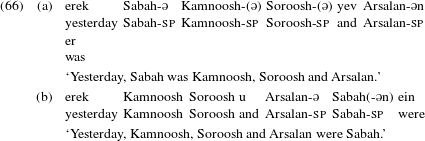
So far we have noted that agreement in Persian copular clauses with two 3rd person NPs is exactly as predicted by the system developed in Section 7. Agreement is always with an extensional NP and if there are two extensional NPs, with the first one. The question becomes more interesting when we look at a language like Eastern Armenian. Recall from the discussion in Section 6 that in Eastern Armenian agreement is consistently with the participant NP when there is one. We attributed this agreement pattern to the probe having the feature [participant] articulated in its feature structure. When both NPs are participants, NP1 controls agreement, as expected. The question we are raising now is what happens when there is no participant NP in the copular clause and the search for a matching participant goal fails. An examination of the relevant facts in Eastern Armenian reveals that in the absence of a participant NP, agreement is with the highest extensional NP. In other words, when both NPs are 3rd person, Eastern Armenian behaves exactly like Persian. The Eastern Armenian facts are given in (64)–(66). In (64), we have examples of specificational copular clauses, where agreement is with the plural extensional NP2.

Examples of predicational clauses are given in (65) where agreement is with the extensional NP1.

In (66), where both NPs are extensional, agreement is with the higher NP1.
The question is how we can account for the above facts given the articulated [participant] probe we proposed in Section 6. We seem to need a mechanism which turns the Eastern Armenian probe into the Persian probe when the first cycle of Agree fails, i.e. no [participant] NP is found to match the articulated feature structure. A mechanism of this kind has been argued for in the literature on agreement. Béjar (Reference Béjar2003) argues that a failed probe remains active in the derivation (see also Rezac Reference Rezac2003, Béjar & Rezac Reference Béjar and Rezac2009) and proposes that the failure of the initial cycle of Agree results in a reduction of the probe’s feature structure. This structural change, referred to here as Probe Reduction and formulated in (67), augments the set of possible controllers by reducing the criteria for Match.

We now extend the notion of Probe Reduction to the context of agreement in Eastern Armenian copular clauses with two 3rd person NPs. When the first cycle of Agree fails in the absence of participant noun phrases, the feature structure of the probe is impoverished from the bottom, eliminating the [participant] feature and resulting in a probe structure identical to that of Persian. This mechanism and how it leads to agreement with the extensional NP2 in a specificational clause is shown schematically in (68), where shading indicates probe reduction.

The predicational and assumed identity (equative) cases can be accounted for in a similar fashion. The only difference has to do with which NP is the closest match for this reduced feature structure. In these cases, it is the higher NP1 that controls agreement, as expected (compare (59)).Footnote [35]
In this section we have investigated the agreement pattern of copular clauses with two 3rd person NPs. We showed for Persian that agreement alternates between NP1 and NP2 as predicted by the probe structure proposed in Section 7. For Eastern Armenian we addressed the derivational consequences of having an articulated [participant] probe in clauses with two 3rd person NPs. We proposed that a derivational mechanism (Probe Reduction) makes the highest extensional NP a Matching goal. This correctly predicts NP2 agreement in Eastern Armenian 3rd person specificational clauses, but NP1 agreement in predicational and assumed identity (equative) contexts.
9 Conclusion
In this paper we have investigated the availability of non-canonical NP2 agreement in copular clauses in two understudied languages, Persian and Eastern Armenian. We began by showing that this pattern does not arise from ordinary subject agreement where NP2 is the structural subject, with NP1 fronted. We further showed that a strict correlation between NP2 agreement and the syntax of inverted specificational clauses is not adequate to capture a full range of cross-linguistic patterns. We have argued instead that the derivational conditions giving rise to NP2 agreement reduce fundamentally to properties of the probe–goal system, and can be treated as a person-sensitivity familiar from a broader range of contexts. Whereas person-sensitivities are typically framed in terms of more salient phi-features relating to person and animacy, the data in this paper suggest that in fact the relevant features for some languages may be even higher in the phi-feature entailment structure (our [
 $d$
] and [
 $n$
]) (see also Cowper & Hall Reference Cowper, Hall, Burelle and Somesfalean2002). Different articulations of the probe, cross-linguistically, yield contrasting agreement outcomes, leading to the different types of systems discussed here. While we have focused on Persian and Eastern Armenian in this paper, this set of proposals plausibly extends to languages with similar properties. The Persian pattern is instantiated in other languages (e.g. Romance, Germanic and Turkic). The Eastern Armenian pattern seems more unusual but may turn out to be less so if more languages are thoroughly investigated. These systems do not exhaust the attested range of variation, for instance a prominent third pattern is uniform NP1 agreement even in specificational contexts, as found in English (1a) above and French. We leave to future research the possibility that the pattern found in these languages might also be analyzed as a reflex of differential probe articulation (e.g. minimal [
 $n$
]) or Probe Reduction.



