INTRODUCTION
An important question in the field of language development has focused on whether children acquire a grammar on the basis of hearing language despite an apparent poverty of the stimulus (Chomsky, Reference Chomsky1980). Standing in opposition to this claim are naturalistic observations of caregiver–child interactions that reveal a link between children's acquisition of syntax and the frequency of their language input (Hoff, Reference Hoff2006; Huttenlocher, Vasilyeva, Cymerman & Levine, Reference Huttenlocher, Vasilyeva, Cymerman and Levine2002; Huttenlocher, Waterfall, Vasilyeva, Vevea & Hedges, Reference Huttenlocher, Waterfall, Vasilyeva, Vevea and Hedges2010). In particular, the syntactic structures produced more frequently by caregivers tend to appear earlier in children's speech than structures produced less frequently (Huttenlocher et al., Reference Huttenlocher, Waterfall, Vasilyeva, Vevea and Hedges2010). For example, studies reporting on languages with late acquisition of the passive syntactic form, such as English (Maratsos, Fox, Becker & Chalkley, Reference Maratsos, Fox, Becker and Chalkley1985) and Spanish (Berman & Slobin, Reference Berman and Slobin1994; Pierce, Reference Pierce1992), report few passives in children's input. In contrast, the early acquisition of passives in speakers of other languages (e.g. Zulu: Suzman, Reference Suzman1987; Sesotho: Demuth, Reference Demuth1990; Inuktitut: Allen & Crago, Reference Allen and Crago1996; Quiché Mayan: Pye & Quixton Poz, Reference Pye and Quixtan Poz1988) is accompanied by a high frequency of passives in the speech of these languages (see also Demuth, Moloi & Machobane, Reference Demuth, Moloi and Machobane2010). However, while these studies reveal strong relations between language input and syntax acquisition, causal effects are difficult to establish given the observational methodologies used.
Direct manipulations of language input, such as within the structural priming paradigm (Pickering & Ferreira, Reference Pickering and Ferreira2008), have supported and extended findings from the input literature that employs naturalistic observation techniques. Originally used with adults (Bock, Reference Bock1986), the structural priming paradigm has been used with children to reveal a causal role of syntactic input (Huttenlocher, Vasilyeva & Shimpi, Reference Huttenlocher, Vasilyeva and Shimpi2004; Whitehurst, Ironsmith & Goldfein, Reference Whitehurst, Ironsmith and Goldfein1974). A classic example of the priming technique is the picture-description task in which children are exposed to descriptions of transitive scenes (e.g. A dog with a bunny running behind it) using prime sentences in either passive (The dog was chased by the bunny) or the structurally distinct active (The bunny chased the dog). Results from studies using the priming technique show that after exposure to passive prime sentences, young children are more likely to describe new target transitive scenes (depicting different objects and actions than the primes) using passives than after hearing descriptions in the active (Brooks & Tomasello, Reference Brooks and Tomasello1999; Huttenlocher et al., Reference Huttenlocher, Vasilyeva and Shimpi2004; Messenger, Branigan & McLean, Reference Messenger, Branigan and McLean2011; Savage, Lieven, Theakston & Tomasello, Reference Savage, Lieven, Theakston and Tomasello2003). In fact, structural priming has been shown for children as young as 2;7 (Shimpi, Gámez, Huttenlocher & Vasilyeva, Reference Shimpi, Gámez, Huttenlocher and Vasilyeva2007; see also Bencini & Valian, Reference Bencini and Valian2008; Savage et al., Reference Savage, Lieven, Theakston and Tomasello2003), despite the limited production of full English passives in spontaneous speech until around five years of age (Harris & Flora, Reference Harris and Flora1982; Maratsos et al., Reference Maratsos, Fox, Becker and Chalkley1985). These findings of structural priming support those from studies using naturalistic observation techniques that suggest children's acquisition of syntax is partly determined by the frequency of their language input. However, there remain questions concerning the mechanisms underlying this relation between language input and later language development, and more specifically the relation between language input and structural priming.
Structural priming: activation or implicit learning?
A promising account of the role of input is that language comprehension and production involve an implicit learning process. That is, structural priming effects are thought to reflect a process whereby exposure to syntactic forms serves to change, or strengthen, structural representations (Bock & Griffin, Reference Bock and Griffin2000; Ferreira & Bock, Reference Ferreira and Bock2006). This is akin to children's facility to implicitly learn the statistical features of experimentally induced language input (Gómez & Gerken, Reference Gómez, Gerken, Tomasello and Bates2001; Saffran, Aslin & Newport, Reference Saffran, Aslin and Newport1996). Indeed, recent findings from laboratory-based priming studies using natural languages have supported implicit learning as a viable mechanism of language development (Bock, Dell, Chang & Onishi, Reference Bock, Dell, Chang and Onishi2007; Kidd, Reference Kidd2012; Rowland, Chang, Ambridge, Pine & Lieven, Reference Rowland, Chang, Ambridge, Pine and Lieven2012). For example, in the error-based implicit learning model formalized by Chang and colleagues (Chang, Dell & Bock, Reference Chang, Dell and Bock2006; Chang, Dell, Bock & Griffin, Reference Chang, Dell, Bock and Griffin2000), the learner attempts to predict subsequent words in a heard sentence, and when there is a mismatch with target words (i.e. an error is made), this information is used to adjust internal representations so that, subsequently, correct predictions can be made. In other words, children learn syntactic structures from their input by gradually adjusting internal representations in order to correctly predict heard sentences. The learning is thought to be implicit because it is an incidental and unconscious (i.e. implicit) process.
In contrast to this implicit learning model, structural priming effects have been characterized as the result of a transient or residual activation of existing representations of syntax (Cleland & Pickering, Reference Cleland and Pickering2003; Pickering & Branigan, Reference Pickering and Branigan1998), a view that predicts short-term and temporary priming effects (Branigan, Pickering & Cleland, Reference Branigan, Pickering and Cleland1999). Yet there is a growing body of literature that suggests priming is long-lived in adults (Bock et al., Reference Bock, Dell, Chang and Onishi2007; Bock & Griffin, Reference Bock and Griffin2000; Kaschak, Kutta & Schatschneider, Reference Kaschak, Kutta and Schatschneider2011). These long-lasting effects have also been found in young children who are just beginning to acquire these forms in speech, evidence coming from both monolingual English speakers (Huttenlocher et al., Reference Huttenlocher, Vasilyeva, Cymerman and Levine2002; Savage et al., Reference Savage, Lieven, Theakston and Tomasello2003), as well as from slightly older children learning English as a second language (Gámez & Vasilyeva, Reference Gámez and Vasilyeva2015). In a study with monolingual English-speaking four-year-olds, Savage, Lieven, Theakston, and Tomasello (Reference Savage, Lieven, Theakston and Tomasello2006) showed that structural priming lasts up to a month. In another priming study with Spanish-speaking English Language Learners (ELLs; children who speak a language other than English as the primary language at home), six-year-olds at the very beginning stages of learning English (English exposure mean = 9 months; Gámez & Vasilyeva, Reference Gámez and Vasilyeva2015) were more likely to use English passives after exposure to passives than actives. These results with ELLs, who are similar in age to the older children in previous priming studies (e.g. Huttenlocher et al., Reference Huttenlocher, Vasilyeva and Shimpi2004), as well as theoretically similar in exposure levels to younger age groups in previous studies (e.g. Shimpi et al., Reference Shimpi, Gámez, Huttenlocher and Vasilyeva2007) due to such low exposure to English, support and extend previous findings with monolingual English speakers, suggesting that priming may not reflect the activation of a static, pre-existing structural representation. Instead, these results suggest that learning is taking place.
Structural priming and discourse function
Although evidence of structural priming in children provides important insights into the possible mechanisms of language learning, in particular suggesting an experience-dependent adjustment to the system, this work nevertheless has some limitations related to the specific features of English. For example, in English, the primary way to emphasize the patient of the action in a transitive scene is with the use of the passive. Given this strong association between the syntactic form of the passive and the discourse perspective provided by passives (focus on the patient; see also discourse function as used by Vasilyeva & Waterfall, Reference Vasilyeva and Waterfall2012), it has thus been difficult to isolate their respective roles in the existing priming literature specifically, and language learning more generally. That is, it is not yet known whether the increase in the production of passives in English within the priming paradigm reflects the activation and/or subsequent learning of the prime's syntactic form, or its corresponding discourse perspective, or both.
Most research assumes the observed effects of structural priming are meaning-independent (Bock & Loebell, Reference Bock and Loebell1990). Yet there is accumulating evidence of meaning-sensitive effects of structural priming in adults, primarily in other languages in which meaning and form is less attached. For instance, in studies by Pickering and colleagues (Bernolet, Hartsuisker & Pickering, Reference Bernolet, Hartsuiker and Pickering2009; Vernice, Pickering & Hartsuiker, Reference Vernice, Pickering and Hartsuiker2012), Dutch speakers were required to read prime sentences (types of clefts) that were manipulated as to whether the agent (‘It is the cowboy who is hitting him’) or the patient (‘It is the cowboy who he is hitting’) was emphasized. Results showed there was a greater likelihood of producing a passive after a prime that emphasized a patient than a prime that emphasized an agent. Because prime and target sentences were syntactically unrelated in this study, the author argued that the results demonstrated non-syntactic structural priming.
In the current study, we ask whether the process of priming of transitive forms in young children is similarly meaning-sensitive. To do so, we turned to the examination of a language in which it is possible to separate the syntactic form and discourse perspective. In particular, the Spanish language uses a variety of syntactic forms to foreground the patient and demote the agent of a transitive action (Jisa, Reilly, Verhoeven, Baruch & Rosado, Reference Jisa, Reilly, Verhoeven, Baruch and Rosado2002; Tolchinsky & Rosado, Reference Tolchinsky and Rosado2005). We explain the details of these agent-demoting forms in the following sections.
The passive voice in Spanish
The choices available in Spanish to foreground the patient of an action include the fue-passive, se-passive, and impersonal subjectless forms (see Tolchinsky & Rosado, Reference Tolchinsky and Rosado2005, who also focus on the less-commonly used middle voice). The fue-passive is structurally similar to the be-passive in English; they both contain a patient in the subject position, an auxiliary verb, a transitive verb, and a prepositional phrase including ‘by’, and the agent of the action (e.g. Los boletos fueron vendidos por la ciudad ‘The tickets were sold by the city’). To achieve the same discourse perspective as the fue-passive (e.g. foregrounding boletos ‘tickets’), Spanish relies on the structurally distinct se-passive (e.g. Se venden boletos ‘Tickets are sold’) and impersonal subjectless forms (e.g. Se vende boletos ‘Tickets are sold / One sells tickets’). These forms are similar to each other in that they exclude an agent, and instead include the impersonal se, along with a patient and a verb (‘se+verb+patient’ or ‘patient+se+verb’ given the somewhat flexible word order). One of the ways in which the se-passive and impersonal subjectless forms differ is with respect to number marking: in se-passives, the verb is in the third person singular or plural, while in impersonal subjectless passives the verb is always in third person singular. Thus, when the sole noun phrase of an utterance is third person singular (e.g. La ventana se rompe ‘The window is breaking itself / Someone is breaking the window’), it can be argued that it is ambiguous as to whether it is a se-passive or impersonal subjectless form. Therefore, for the purposes of this study, we refer to the impersonal/se-passive form.
There is general consensus that fue-passives occur rather infrequently in spoken Spanish, perhaps given the availability of the alternate passive forms which do appear more frequently in oral speech (Berman & Slobin, Reference Berman and Slobin1994; Jisa et al., Reference Jisa, Reilly, Verhoeven, Baruch and Rosado2002; Tolchinsky & Rosado, Reference Tolchinsky and Rosado2005). In fact, the Spanish fue-passive is considered to be primarily a written and literary form. In their developmental analyses of oral narratives, Berman and Slobin (Reference Berman and Slobin1994) found that the Spanish fue-passive was absent in young children's narratives and, in fact, not present until adulthood. Yet Jisa et al. (Reference Jisa, Reilly, Verhoeven, Baruch and Rosado2002) and Tolchinsky and Rosado (Reference Tolchinsky and Rosado2005) found that fue-passives were used by grade-school children in the written modality. These studies show a developmental progression in the use of fue-passives, which the authors explain might be the result of an increase in exposure to written language. Indeed, Green (Reference Green1975) found frequent occurrences of passives in the analyses of journalistic, scientific, and literacy texts (see also Real Academia Española, 2009). Due to its infrequent production in children's speech, the fue-passive is considered to be a late-emerging form, appearing in Spanish even later than in English (Berman & Slobin, Reference Berman and Slobin1994).
The susceptibility of priming in Spanish: methodological considerations
The existing priming studies with Spanish monolinguals have not demonstrated classical evidence of syntactic priming, as modeling of the fue-passive has not resulted in a reproduction of its syntactic structure. In the first study we are aware of using the priming paradigm with young, native, Spanish speakers (Gámez, Shimpi, Waterfall & Huttenlocher, Reference Gámez, Shimpi, Waterfall and Huttenlocher2009), five-year-old children were presented with drawings described using either active or fue-passive sentences, and were asked to describe novel drawings. Priming was induced for actives. However, children did not produce the fue-passive form provided for them. Instead, children used the alternate passive forms available in Spanish, suggesting children were paying attention to the discourse perspective provided by the primes (i.e. emphasizing the patient by downplaying the agent). A similar non-syntactic effect of priming has been shown in young children in Russian, which, similarly to Spanish, uses a variety of forms to focus on the patient (Vasilyeva & Waterfall, Reference Vasilyeva and Waterfall2012).
The lack of conventional priming of the fue-passive form may be a reflection of methodological features of the structural priming paradigm used with young children. In fact, in several studies, structural production priming for English passives has been induced only after efforts are made to reduce the demands of the priming task, especially for the youngest participants (i.e. three-year-olds; Bencini & Valian, Reference Bencini and Valian2008; Shimpi et al., Reference Shimpi, Gámez, Huttenlocher and Vasilyeva2007). Specifically, as a way to reduce the cognitive demands required of young children, namely attention to the priming task, these studies require children to repeat the experimenter's prime before describing a target picture (Bencini & Valian, Reference Bencini and Valian2008; Shimpi et al., Reference Shimpi, Gámez, Huttenlocher and Vasilyeva2007). Repetition of the prime is often a standard methodological feature of structural priming studies, even with older children, as a way to ensure attention to the task (e.g. Goldwater, Tomlinson, Echols & Love, Reference Goldwater, Tomlinson, Echols and Love2011; Kidd, Reference Kidd2012).
While we agree that repetition may increase attention to the task, we explore the possibility that the role of repetition may go beyond attention, to also play an important role in children's learning of the primed form (Gámez & Vasilyeva, Reference Gámez and Vasilyeva2015). For example, while comprehension of the fue-passive in Spanish has been shown to be above-chance level by five years of age (see Pierce, Reference Pierce1992), its production does not occur until much later (Jisa et al., Reference Jisa, Reilly, Verhoeven, Baruch and Rosado2002). Passive exposure in a structural priming paradigm was not enough to impact children's production of that specific passive form, though it did increase passive descriptions of transitive scenes (Gámez et al., Reference Gámez, Shimpi, Waterfall and Huttenlocher2009). By directly manipulating repetition in the current study in a between-subjects design, we can more concretely compare whether repetition leads to an increase in the use of the fue-form, as compared to a general increase in general passives, indicating attention to discourse function.
It is worth noting that in cases where repetition of the prime is not required, the methodological task has been modified from the simple picture-description task to include a child-friendly game. For example, Messenger and colleagues (Messenger et al., Reference Messenger, Branigan and McLean2011; Messenger, Branigan, McLean & Sorace, Reference Messenger, Branigan, McLean and Sorace2012) conducted the priming task, in which children described target pictures following the experimenter's prime descriptions, as part of a classic card game of Snap, in which the perceived goal was to collect matching prime and target picture cards. Though these studies included three-year-olds (youngest age = 3;4), the mean age-group was slightly older at four years of age (4;1), perhaps to ensure the game is age-appropriate. Using this modified task, a significant priming effect has been found for English passives without repetition of each prime sentence (note that the number of passives produced by the three- versus four-year-olds was not reported). To be clear, although most priming studies with young children are conducted under the guise of a game (see Vasilyeva, Waterfall & Gómez, Reference Vasilyeva, Waterfall, Gomez and Hoff2011), to date, the studies with the youngest age group (2;7) most closely follow the original picture-description task (Shimpi et al., Reference Shimpi, Gámez, Huttenlocher and Vasilyeva2007). Thus, we adapted the original picture-description task, with the manipulation of repetition, in order to ensure comparability between our study and earlier child studies.
The present study
In the current study, we used the structural priming technique with young Spanish-speakers as a way to manipulate the frequency of exposure to and repetition of fue-passives and measure the effects of brief manipulations of this linguistic experience. Our primary research question was whether, in Spanish speakers, hearing and repeating a fue-passive would increase the likelihood of using that form, or whether it would increase the likelihood of using more common, yet structurally distinct, Spanish forms that similarly emphasize the patient (i.e. the discourse perspective). In particular, given the separability of the discourse function from syntactic structure in Spanish, we ask whether the increased use of fue-passives within the priming paradigm reflects the implicit learning of the prime's syntactic form or its corresponding discourse perspective, or both. To that end, we first assess children's productive use of the fue-passive and alternate passive forms without any experimenter input (Study 1). In Study 2, children were exposed to an experimenter's picture descriptions in either the fue-passive or active form and we varied whether or not children repeated the modeled form.
STUDY 1: BASELINE TASK
METHOD
Participants
Fourteen six-year-old children (M = 6·09 years; SE = 0·09 years), who ranged in age from 5;7·29 to 6;8·6, served as participants in this study (girls = 7; boys = 7). Consistent with the conventional description of this population (e.g. Bedore, Fiestas, Pena & Nagy, Reference Bedore, Fiestas, Pena and Nagy2006), children in our sample were deemed functionally monolingual because they had over 80% of their output in Spanish and less than 20% of their input in English (see Pearson, Fernandez, Lewedag & Oller, Reference Pearson, Fernandez, Lewedag and Oller1997). Parental report indicated Spanish as the home language, and children were instructed primarily in Spanish at school, which is consistent with the early Transitional Bilingual Education (TBE) model. In early-TBE programs, the native language is the primary language of instruction – in this case Spanish – with time devoted to explicit English Language Development (ELD) instruction. Teachers filled out a researcher-developed questionnaire about classroom language practices and reported using Spanish as the primary mode of instruction. They also reported spending, on average, 30 minutes of instructional time on ELD.
Materials
Task stimuli
A modified version of the materials found in Gámez and Vasilyeva (Reference Gámez and Vasilyeva2015) and Vasilyeva and colleagues (Vasilyeva, Huttenlocher & Waterfall, Reference Vasilyeva, Huttenlocher and Waterfall2006) were used as stimuli for this study. There were a total of 20 black-and-white drawings (10 target; 10 prime) depicting transitive scenes (e.g. a dog chasing a rabbit). The drawings depicted common lexical items (familiar nouns, mostly animals, performing common actions) and the animacy of the agents/patients varied across pictures, such that half of the pictures contained animate patients/agents and the other half contained inanimate patients/agents. These drawings were created using drawing software InDesign CS (Adobe, 2005, version 3.0·1), using 14-pt lines.
Language assessments
The parallel English and Spanish versions of the Woodcock Language Proficiency Battery-Revised (WLPB-R; Woodcock, Reference Woodcock1991; Woodcock & Muñoz-Sandoval, Reference Woodcock and Muñoz-Sandoval1995) were used to obtain valid descriptions of children's oral language proficiency in English and Spanish, respectively. The WLPB-R is a standardized assessment of oral language proficiency derived from a cluster of five oral language subtests: Memory for Sentences, Picture Vocabulary, Oral Vocabulary, Listening Comprehension, and Analogies. The raw scores on each subtest can be converted to standardized scores and combined to yield an overall language proficiency score (M = 100; SD = 15 standard points). The test also provides a CALP (cognitive-academic ability language proficiency) score that provides an estimate of how difficult the child will find the demands of English instruction. The CALP score scale is 1 = ‘Negligible English’, 2 = ‘Very Limited English’, 3 = ‘Limited English’, 4 = ‘Fluent English’, and 5 = ‘Advanced English’. Refer to the WLPB-R (Woodcock, Reference Woodcock1991) for a complete description of each subtest.
Procedure
The experimenter began by telling the child they would play a game in which the child would describe a set of drawings while the experimenter listened quietly. The child proceeded to describe the set of 10 target drawings (the 10 prime pictures were not used in this study), presented in random order, without receiving any input from the experimenter. Immediately following the target picture description task, the WLPB-R was administered. The language of the WLPB-R testing was fixed, such that the English version of the tests was administered first, followed by the Spanish version approximately one week later. The picture description task took 5 minutes and the language assessment took 30 minutes at each testing session. Spanish–English bilinguals administered all tasks in Spanish, except for the English-language proficiency assessment that was administered at the end of the testing session.
Coding
Children's picture descriptions were transcribed and coded by native Spanish-speaking research assistants (RAs) as active, fue-passives, alternate passives, or other. Responses were scored as active if they contained an agent + transitive verb + patient (La pelota quebro la ventana ‘The ball broke the window’). Responses were coded fue-passives if they contained a patient + fue + transitive verb + por (‘by’-phrase) + agent (La ventana fue quebrada por la pelota ‘The window was broken by the ball’). The alternate passives category included se-passives, impersonal subjectless passive, or function-passives. As noted earlier in the ‘Introduction’, we combined impersonal subjectless and se-passive forms into one category, and coded responses as impersonal/se-passives if they contained a patient and the clitic se, but not an agent. Moreover, given the somewhat flexible word order in the Spanish language, the impersonal/se-passive forms were allowed to take the form of se + verb + patient (Se vende el boleto; se quebra la ventana) or patient + se + verb (El boleto se vende; La ventana se quebra). In addition to these two grammatical passives, Spanish learners at the early stages of language learning have been shown to use function-passives, which are forms that are not part of adult Spanish grammar, but may indicate incomplete mastery of the fue-passive form (Espinoza, Reference Espinoza1997; Gámez et al., Reference Gámez, Shimpi, Waterfall and Huttenlocher2009). This form is made up of elements of the fue-passive, except that it also contains the impersonal se. Function-passives were coded as such if they contained patient + se + transitive verb + por + agent (El arbol se rompio por el rayo ‘The tree is breaking itself by the lightning’). Finally, utterances were coded as other if they did not contain any of the forms above. The agreement rate calculated for the double-coding of 20% of children's responses (n = 28) into the three categories (active, passives, and other) was 100%. In addition, the WLPB-R test items were scored according to the rules in the WLPB-R technical manual (Woodcock, Reference Woodcock1991), which yielded standard scores and CALP scores.
RESULTS
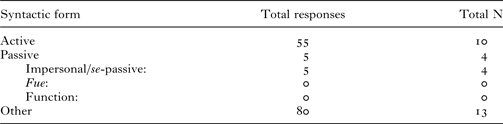
Each child contributed 10 picture descriptions for a total of 140 responses. Critically, there was no use of fue-passives. As shown in Table 1, the majority of children's responses were coded as other (57% of responses), followed by active (39% of responses). Five utterances were classified as alternate passives (4% of responses), specifically, impersonal/se-passives. There were no function-passives. It is worth noting that code-switching to English was minimal and occurred for 6 total utterances at the lexical level. That is, 5 children used a total of 6 English words (snowman = 4; shark = 1; monkey = 1) in 6 Spanish utterances.
Children's responses by syntactic form, Study 1
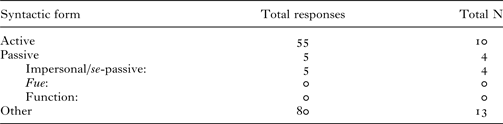
note: The total number of responses was 140 (N = 14).
The results of the WLPB-R (Woodcock, Reference Woodcock1991) language proficiency assessments further revealed children's Spanish dominance (M Oral Language Score = 93·70; SD = 10·43) over English (M Oral Language Score = 62·38; SD = 13·21); children were on average 2·43 standard deviations below the norming sample in English and less than half a standard deviation in Spanish. In fact, the mean CALP score was 2·5, corresponding to very limited to limited English proficiency. Of note, 3 children (2 boys; 1 girl) were unavailable for follow-up testing in Spanish, and thus the Spanish mean was calculated with scores from 11 children.
STUDY 2: PRIMING TASK
In Study 1, children's baseline descriptions of the transitive scenes revealed no use of fue-passives, which is consistent with previous priming studies in Spanish (i.e. Gámez et al., Reference Gámez, Shimpi, Waterfall and Huttenlocher2009). These data also mirror earlier baseline findings of children's reliance on active forms to provide transitive scene descriptions (Shimpi et al., Reference Shimpi, Gámez, Huttenlocher and Vasilyeva2007). These studies with young children also provide the groundwork from which to compare results from a priming manipulation in Study 2, where we controlled for the type of transitive sentence described to the child, as well as whether the child repeated the primed form. That is, given previous findings that young English-speaking children more readily show priming effects after repetition of the modeled form (Bencini & Valian, Reference Bencini and Valian2008; Shimpi et al., Reference Shimpi, Gámez, Huttenlocher and Vasilyeva2007), Study 2 included two independent variables: Prime Type (Active vs. Passive) and Procedure Type (Repeat vs. No Repeat).
METHOD
Participants
The participants for this study included 56 six-year-old Spanish-speakers (M = 6·11 years; SE = 0·05 years), ranging in age from 5;7·14 to 6;8·9. This was a multi-site study in which additional children were sampled from the same TBE classrooms from Study 1 and TBE classrooms in a Latino neighborhood in the western United States with similar demographics (none of the children from Study 1 were included in Study 2). Thus, all children were native speakers of Spanish, spoke Spanish as the primary language at home, and were instructed primarily in Spanish at school, with minimal English instruction as consistent with the TBE model.
Measures
Production task
The same 20 black-and-white drawings (N Prime = 10; N Target = 10) from Study 1 were used in this study. The set of Prime stimuli was paired with transitive sentences (active, passive). Take, for example, the drawing of a ball and a broken window. A description of this scene using a passive was La ventana fue quebrada por la pelota ‘The window was broken by the ball’, whereas in active voice it was La pelota quebro la ventana ‘The ball broke the window’. The ‘Appendix’ lists the priming sentences.
Comprehension task
To assess children's comprehension of actives and passives, children were presented with 10 trials of comprehension items. Each comprehension item consisted of two black-and-white drawings depicting transitive actions in which the role of the characters was reversed (e.g. a hippopotamus licking a giraffe vs. a giraffe licking a hippopotamus). Each item was paired with either an active or passive sentence that described one of the drawings.
Language assessments
The English version of the WLPB-R (Woodcock, Reference Woodcock1991) was used to assess English language proficiency.
Procedure
Children were randomly assigned to Prime Type (hearing either active or passive prime sentences) and Procedure Type (repeating the prime sentence or not), with the restriction that each group included an equal number of children (n = 14 each) and that gender was evenly distributed (boys = 7; girls = 7). The production priming task was explained to the children as a game in which they would listen to an experimenter describe a set of drawings (in active or passive) in Spanish and then would be asked to describe a set of different drawings on their own. In the repeat condition, children repeated the experimenter's prime sentence immediately after hearing it. The repetition of sentences occurred in blocked form. At the end of the last picture description in the block, children were asked to describe the block of 10 target pictures. When a child did not repeat the prime sentence, s/he was asked to do so again, at which point all children repeated the experimenter's sentences (see Savage et al., Reference Savage, Lieven, Theakston and Tomasello2003, for a similar methodology). In the no-repeat condition, the child proceeded to describe the block of 10 target stimuli immediately after hearing the block of 10 prime sentences (which were not repeated by the child). Children's responses were audiotaped.
Following the priming task, children were administered a comprehension task in which they were asked to point to one of two pictures that corresponded to a sentence (either active or passive) recited orally by an experimenter. Then, due to time constraints imposed by the schools, only the English version of the WLPB-R (Woodcock, Reference Woodcock1991) was administered to children as a way to ensure the study's sample as functionally monolingual. Testing lasted approximately 40 minutes; the production and comprehension priming tasks took 10 minutes, and the language assessment took 30 minutes.
Coding
As in Study 1, children's picture descriptions were coded by native Spanish-speaking RAs as either active, fue-passive, alternate passives (impersonal/se-passives, function-passives), or other. Reliability reached 97·32% (Cohen's kappa = .960) and this was established by double-coding 20% of the responses. In addition, scores on the syntactic comprehension task were calculated as the number of correct trials out of 10 possible trials. Standard scores and CALP scores were calculated for the WLPB-R subtests.
RESULTS
Language assessments
As in Study 1, the participants in this study scored below the WLBP-R normative sample in English (M Oral Language Score = 65·65; SD = 17·33), indicating limited English proficiency. The mean CALP score was 2·68, which reflects the sample's very limited to limited English proficiency. Given that these data were collected at multiple sites, we thought it important to ensure that higher-proficiency speakers were not concentrated in one group. A one-way analysis of variance revealed no significant main effect of Procedure Type for the overall oral language proficiency score (M No-repeat = 65·63; SD = 18·60; M Repeat = 65·68; SD = 16·35) (F(1,55) = 0·034, p > .05), nor for any of the subtests (p > .01 with Bonferroni correction for multiple comparisons).
Production priming task
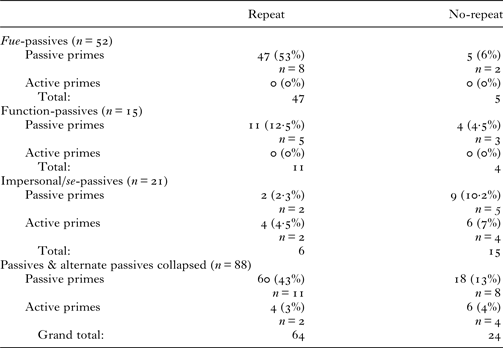
A total of 560 picture descriptions were produced, with each child contributing 10 responses. Most responses were coded as active (n = 269; 48% of total responses) or other (n = 203; 36% of total responses). Of primary interest were responses coded as passive and alternate-passives (n = 88 total; 16% of total responses). Table 2 shows the total number of fue-passive, impersonal/se-passives, and function-passives within each condition (Prime Type: active, passive; Procedure Type: repeat, no-repeat). As shown in Table 2, collapsing across procedure type, there were more fue-passives produced than any of the alternate targets; this difference was driven by the repeat condition. In fact, the majority of fue-passive responses were produced in the repeat condition; none were produced following active primes. Children were also more likely to produce the ungrammatical function-passive after repeating a passive prime than when not repeating the prime; there were no function-passives produced in the active condition. In contrast, the use of the structurally distinct impersonal/se-passives was more pronounced in the no-repeat than repeat condition. Of note, there were more alternate passives (combining function-passives and impersonal/se-passives) produced following passive than active primes in both the repeat (13 vs. 4) and no-repeat condition (13 vs. 6).
Passive responses by prime type and procedure type, Study 2

note: The percentage of passive type in parentheses was calculated out of the total number of passives produced (n = 88).
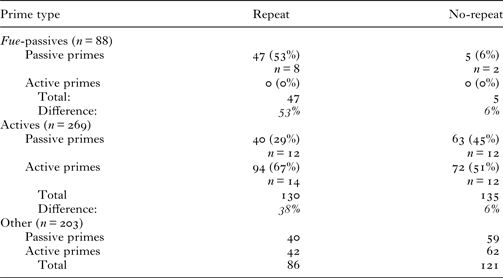
Table 3 shows that whereas the overall production of fue-passives (collapsing across prime type) varied as a function of procedure type, there was no difference in the overall production of actives between the two procedure types. However, the difference between the number of active responses produced following active than passive primes was greater in the repeat condition than in the no-repeat condition. In addition, the number of responses coded as other was greater in the no-repeat condition than repeat condition.
Children's responses by prime type and procedure type, Study 2
notes: There were a total of 560 responses collapsing across conditions. In parentheses is the proportion of target responses calculated out of the possible number of responses per child (n = 10). Priming effect is italicized.
Table 3 also shows the effect for actives and passives. A priming effect was calculated as the difference in the proportion of target responses (active, fue-passive) over the total number of responses (n = 10 per child; n = 140 per condition). Specifically, children were 53% more likely to produce a fue-passive sentence following repetition of fue-passive primes than active primes, and 38% more likely to produce an active sentence following repetition of active primes than passive primes, which Cohen (Reference Cohen1988) considers large effect sizes (d passives = 1·88, d actives = 1·90). When not asked to repeat the prime, children were also more likely to produce passives (9%) and actives (6%) following passive and active primes, respectively, though the effect sizes were smaller than in the repeat condition (d passives = 0·56, d actives = 0·20).
The greater likelihood of passive and active responses following passive and active primes, respectively, and as a function of repetition, was assessed using mixed-effects logistic models. Prime Type was included as a between-subjects, dichotomous factor (Active = 0; Passive = 1) as was the Procedure Type (No-Repeat = 0; Repeat = 1), and Item Order was a within-subjects, continuous factor (1 through 10). As random effects, we had intercepts for Participants and Item Order as well as by-Participant and by-Item Order random slopes for the effect of Prime Type and Procedure Type. Due to convergence problems, we did not add all possible interaction terms in the model; we added only the Prime Type and Procedure Type interaction term. Similarly, the model predicting fue-passive responses led to convergence problems, likely due to the lack of passives following active primes, which indicates a clear experimental effect. Thus, we report on results of a passives-as-outcome model in which we used fue-passive and alternate passive responses together as the outcome variable.
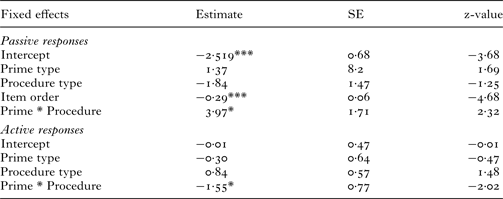
Table 4 shows the results of the final passives-as-outcome model. We found a significant interaction effect between Prime Type and Procedure Type (p < .05), indicating a larger priming effect for passives when the passive prime was repeated. There was also a significant negative main effect of Item Order, indicating that the probability of responding with a passive decreased with the duration of the experiment. Of note, this final model (AIC = 344·4; Deviance: 308·4) was superior to a null model that included only the random effects structure (AIC = 371·3; Deviance: 343·3; χ2 = 34·89, df = 4, p < .001).
Mixed-effects logistic model results
notes: Prime type (passive = 1; active = 0); procedure type (repeat = 1; no-repeat = 0); *** p < .001; ** p < .01; * p < .05.
Table 4 shows the results of the final actives-as-outcome model. There was a significant interaction effect between Prime Type and Procedure Type (p < .05), indicating a stronger priming effect for actives when the active prime was repeated. Of note, the model excluded Item Order as it was found to be a non-significant factor (Coeff = 0·02; SE = 0·07; z-value = 0·36; p = .716). This final model (AIC = 692; Deviance: 670) was superior to a null model that included only the random effects structure (AIC = 701·8; Deviance: 685·8; χ2 = 15·81, df = 3, p < .01).
To further investigate the effects of repetition of the prime, we examined the likelihood that children would produce passives after having produced a passive on the preceding trial. In doing so, we focused only on the repeat condition, as it resulted in the great majority of passives. We found that 80% of passive responses were produced following a passive – this included a passive produced on the first trial after repetition of a passive (n = 8). Thus, children were more likely to produce a passive when they had produced a passive on the preceding trial. It is also worth noting that there was a greater number of passives (total = 64) produced in the first half of the experiment (n = 39) than in the second half (n = 25).
Comprehension task
A significant effect of prime type was also evident for children's comprehension of passives, but only after repetition of the prime. Specifically, children in the repeat condition had an average comprehension score of 73·6% (SE = 0·48) for passives, which is significantly different from chance (50%) (t(13) = 4·95, p < .001, CI .95[0·13, 0·34]). In contrast, children's comprehension of passives in the no-repeat condition was at 52·9%, scoring virtually no different from chance (50%) (t(13) = 0·530, p > .05, CI .95[−0.09, 0·15]. For actives, children's comprehension score was 80·7% following repetition and 90% when not asked to repeat, which are both significantly different from chance (t Repeat(13) = 5·59, p < .001, CI .95[0·19, 0·43]; t No-repeat(13) = 12·72, p < .001, CI .95[0·33, 0·47].
DISCUSSION
An important question raised in the study of language development, for both theoretical and practical purposes, is how language input affects young children's syntactic skills. Experimental findings of children's increased productivity and comprehension of a particular syntactic form after increased experience with that form, within the context of a priming study (Bencini & Valian, Reference Bencini and Valian2008; Huttenlocher et al., Reference Huttenlocher, Vasilyeva and Shimpi2004; Shimpi et al., Reference Shimpi, Gámez, Huttenlocher and Vasilyeva2007), corroborate the positive relation between input frequency and language skill found in naturalistic observation studies of caregiver–child interactions (e.g. Huttenlocher et al., Reference Huttenlocher, Waterfall, Vasilyeva, Vevea and Hedges2010). Despite the stark contrast in the frequency of exposure to particular syntactic forms in other languages, prior structural priming studies with young children have been focused primarily on English. Given the reliance on actives and existence of a variety of passives in Spanish (i.e. se-passive, impersonal subjectless passive), which differ in their frequency of spontaneous use (Berman & Slobin, Reference Berman and Slobin1994; Jisa et al., Reference Jisa, Reilly, Verhoeven, Baruch and Rosado2002; Tolchinsky & Rosado, Reference Tolchinsky and Rosado2005), we tested the conditions under which Spanish-speaking children would increase their productivity with and comprehension of the rare and oft-considered literary term, the fue-passive. Specifically, using the structural priming paradigm, we tested whether children's production and comprehension of the fue-passive form, over the alternate passives, was dependent on children's repetition of the form, which is a methodological feature found in many structural priming studies with young children (Bencini & Valian, Reference Bencini and Valian2008; Goldwater et al., Reference Goldwater, Tomlinson, Echols and Love2011; Kidd, Reference Kidd2012).
The present study indeed demonstrated the positive impact of modeling and repetition of the rare and infrequently used fue-passive Spanish form on young Spanish-speakers’ subsequent production and comprehension of this form. Starting with a baseline study, which revealed children's preference for actives over passive forms to describe transitive actions, we established that passives, particularly fue-passives, are virtually non-existent in the spontaneous speech of young Spanish speakers. Using the structural priming paradigm in Study 2 to model either active or fue-passive picture descriptions, we found that exposure to and repetition of active or passive primes significantly increased children's use of active or passives, respectively. In particular, children's production of the Spanish fue-passive increased past baseline usage and was higher overall in comparison to the more frequently encountered alternate Spanish passive forms. Moreover, after exposure and repetition of fue-passive primes, children's comprehension of the fue-passive was above chance levels. In contrast, children's comprehension of fue-passives was virtually no different than chance when not asked to repeat. For actives, children's comprehension was above chance in both the repeat and no-repeat conditions. As we detail below, these study findings of an increase in fue-passives are in line with the view that an implicit learning process (Chang et al., Reference Chang, Dell and Bock2006; Ferreira & Bock, Reference Ferreira and Bock2006), rather than a transient activation of a pre-existing representation (Cleland & Pickering, Reference Cleland and Pickering2003; Pickering & Branigan, Reference Pickering and Branigan1998), is the mechanism guiding the process of language comprehension and production.
The nature of syntactic representations and the role of experience
Our main finding that structural priming occurred for fue-passives only after repetition of the prime sheds light on the nature of young Spanish-speakers’ syntactic representations. In particular, the lack of a priming effect for the fue-passive form, without repetition, indicates that young Spanish speakers might have an initially weak representation of this rare and infrequently used form (Jisa et al., Reference Jisa, Reilly, Verhoeven, Baruch and Rosado2002). The chance-level comprehension of fue-passives without repetition of the prime, contrasted with above-chance comprehension of the fue-passive after repetition, also provides evidence that young Spanish speakers do not yet have full command of the fue-passive, yet that short-term exposure through repetition can increase facility with this form. Further, given the design features of this study, with target picture descriptions being lexically unrelated to the prime sentences, these findings suggest that the effect of priming was not tied to particular lexical items (Tomasello, Reference Tomasello2000). Thus, the dynamic and lexically independent fue-passive form is likely represented at an abstract level.
The results of the present study with functionally monolingual, Spanish-speaking children mirror those of the few existing priming studies in Spanish in confirming the difficulty in priming the fue-passive, and further suggest that repetition is an important factor to consider in the development of this still-emerging form. For example, in a cross-linguistic priming study of passives in English and Spanish, Vasilyeva and colleague (Vasilyeva, Waterfall, Gámez, Gómez, Bowers & Shimpi, Reference Vasilyeva, Waterfall, Gámez, Gómez, Bowers and Shimpi2010) did not find priming effects for the fue-passive. They examined whether picture descriptions using the passive in one language would prime the subsequent use of the passive in the other language. The results showed that although hearing a Spanish fue-passive led to an increase in children's production of the English passive, there was no priming in the other direction from English to Spanish. In another cross-linguistic study (Hartsuiker, Pickering & Veltkamp, Reference Hartsuiker, Pickering and Veltkamp2004), native Spanish-speakers with moderate to high levels of English proficiency showed a greater likelihood of producing passives in English after exposure to Spanish passives. However, there was no evidence of two-way priming; the authors do not report data on an increase in Spanish fue-passives after exposure to English passives. Though we were not able to directly compare two-way priming in Spanish and English given our sample's functionally monolingual status, our results suggest that mere exposure to English passives does not guarantee an increase in production of Spanish fue-passives. Instead, our findings suggest that the fue-passive, though rare in oral speech, can be induced through repetition-based priming.
The finding of a repetition effect can be explained in several ways, of which we offer two. First, as has been suggested by others (Goldwater et al., Reference Goldwater, Tomlinson, Echols and Love2011; Kidd, Reference Kidd2012; Shimpi et al., Reference Shimpi, Gámez, Huttenlocher and Vasilyeva2007), requiring child participants to repeat the prime may have ensured their attention to the task of describing transitive scenes. Yet, if the children in the no-repeat condition in this study were not attending to the task, we likely would not have seen an increase in their baseline usage of the alternate passives after fue-passive primes; children's responses would have mirrored those found in the baseline study. Given this evidence against the role of repetition as a purely attention-getting device, we turn to our second explanation, which is that repetition of the prime may have functioned for children as additional experience with the rather infrequently encountered fue-passive form. In particular, repetition of the prime may have provided children with practice in using the structural elements of the form (Gámez & Vasilyeva, Reference Gámez and Vasilyeva2015). For instance, as noted previously, a distinguishing feature of the fue-passive, that sets it apart from its active and alternate passive counterparts, is the ‘by’-phrase, which serves the purpose of highlighting the patient of the action. It is plausible that the act of repeating a passive prime served as a rehearsal of the ‘by’-phrase as a means by which to focus on the patient, instead of the agent, of the scene depicted in the pictures. Corroborating the hypothesis that repetition functioned for children as practice with the defining features of the fue-passive is that after repetition of fue-passive primes, the young Spanish-speakers in this study were more likely to produce not only fue-passives, but also function-passives, which, while not grammatical forms in Spanish, contain the fue-passive's ‘by’-phrase. Second language learners of Spanish have also been shown to use function-passives (Espinoza, Reference Espinoza1997), which has been taken as evidence of developing mastery of the fue-passive form (Gámez et al., Reference Gámez, Shimpi, Waterfall and Huttenlocher2009).
The increase in our sample's use of function-passives after repetition of the prime shows evidence of children's creative construction in their production of passives. That is, function-passives include elements of both the infrequently encountered fue-passive (i.e. ‘by’-phrase) and the more frequently encountered se-passive (i.e. clitic se). Perhaps the function-passives served as an intermediate step in children's progression from comprehending and producing se-passives to comprehending and producing fue-passives. In other words, these creative responses may signal that learning about syntax may be taking place. In fact, the findings that priming without repetition is readily induced for passives in older English monolinguals (e.g. Huttenlocher et al., Reference Huttenlocher, Vasilyeva and Shimpi2004; Savage et al., Reference Savage, Lieven, Theakston and Tomasello2003) and adults (Bock et al., Reference Bock, Dell, Chang and Onishi2007), but not in older Spanish monolinguals (see also Gámez et al., Reference Gámez, Shimpi, Waterfall and Huttenlocher2009) – for whom the frequency of passives in much lower than in English – lends support to the view that experience with using the form, and not necessarily age, is important for supporting syntactic learning.
The underlying processes guiding structural priming and language learning
Indeed, in addition to providing insight into the nature of young Spanish-speakers’ mental representations of syntax, the present study is informative about the processes involved in developing, and in particular accessing and utilizing, syntactic information. Of primary interest, the existence of a priming effect for fue-passives in young children who may not have a full command of use and comprehension of this form suggests that priming does not simply reflect a residual activation of fully-formed, existing syntactic structures (Cleland & Pickering, Reference Cleland and Pickering2003; Pickering & Branigan, Reference Pickering and Branigan1998). Instead, the increase of a rare form indicates a longer-term change to the system, thus lending support to an implicit learning account (Chang et al., Reference Chang, Dell and Bock2006; Chang et al., Reference Chang, Dell, Bock and Griffin2000; Ferreira & Bock, Reference Ferreira and Bock2006; Savage et al., Reference Savage, Lieven, Theakston and Tomasello2006).
As noted, when children were required to repeat the prime as part of the priming task in this study, we found a significant increase in their use of fue-passives from baseline. In contrast, when not asked to repeat the experimenter's fue-passive sentences, children in this study were more likely to use the alternate impersonal/se-passive form that, like the fue-passive, emphasizes the patient of the action and demotes the agent. Gámez and collegues (Reference Gámez, Shimpi, Waterfall and Huttenlocher2009) similarly showed that Spanish monolinguals did not produce the fue-passive form modeled for them, and instead used the alternate passive forms available in Spanish. The present study extends this prior literature in demonstrating that the use of se-constructions decreased after repetition of the prime, while the production of fue-passives increased.
Together, these findings lead us to argue that priming effects in young children, without repetition, may reflect an implicit learning of passives by way of their discourse function. That is, we interpret the significant increase of alternate passives after exposure to fue-passives – a replication of previous studies (Gámez et al., Reference Gámez, Shimpi, Waterfall and Huttenlocher2009) – as evidence that the locus of priming was the discourse function. More specifically, our results suggest that the discourse perspective provided by fue-passives activated a focus on the patient of the transitive scene. The prediction based on one model of the implicit learning view of priming, the error-based implicit learning model, is that children expected input to mirror the active sentences typically found in their input. When exposed to multiple exemplars of fue-passives, however, children's predictions resulted in an error, and thus internal representations were adjusted so that later on their own productions could parallel the input, that is, to name the patient of the transitive scene (note the flexible word order in Spanish). In this case, because of the low frequency of the fue-passive, and thus its weak representation, it is possible children were primed to use the alternate Spanish passives, which may have been more readily available for production and, similar to fue-passives, highlighted the patient of the transitive scene.
Given that impersonal/se-passives are more frequent in the input than fue-passives, when continually faced with linguistic input that highlights the patient of a transitive scene, children may have eventually come to expect the next sequences of words to form an impersonal/se-passive. Yet because children's own repetition of fue-passives may have increased their attention to the ‘by’-phrase and served as practice in using this structural element as a means by which to demote the agent and focus on the patient of the scene, the error-based implicit learning account would predict that children's internal representations would be adjusted so that children produced structures that not only focused on the patient, but also incorporated the ‘by’-phrase. In this case, repetition of the fue-passive form resulted in increased production of both fue-passives and function-passives that emphasize the patient of the scene and include a ‘by’-phrase.
There is some evidence that, in this population of Spanish speakers, children's output may indeed be important for gaining knowledge about language. In a study of the home language factors associated with language learning in Spanish-speaking preschool and kindergarten students, Bohman and colleagues (Bohman, Bedore, Peña, Mendez-Perez & Gillam, Reference Bohman, Bedore, Peña, Mendez-Perez and Gillam2010) found that while the amount of both home language input and output was positively associated with semantic learning (e.g. responses to questions such as “Tell me all of the foods you can eat for lunch”; p. 7), children's language output exerted more influence over their morphological and syntactic learning than did their input (e.g. replacing or providing past tense -ed to test items). The authors suggest that producing language provides practice in using the morphology and syntax of the language. Our current findings corroborate this account. In a similar vein, we suggest that perhaps children learned about the fue-passive by attending to the preposition in the ‘by’-phrase, which the increase in children's use of function-passives would suggest.
It is worth noting that, in this study, we used a blocked design – children described a block of target pictures without experimenters’ input – whereas previous studies involving repetition of the prime sentences intermixed the prime sentences with target sentences. The use of our current design ensured that the prime sentences and children's repetition of them were blocked, thus further ensuring that children would not simply repeat the experimenters’ sentences in describing their own target pictures. Imitation of the prime was a likely outcome, as one of our findings suggests: children were more likely to use a passive immediately preceding a passive (i.e. the last prime sentence and children's own target descriptions in passive). It is also worth noting, however, that even though children were more likely to produce a passive following the production of a passive, these were not full reproductions of each other. Children used the same syntactic form, but with different lexical items.
At the same time, our results showed that the production of passives decreased during the duration of the experiment, which might appear to argue against a learning account (see Branigan et al., Reference Branigan, Pickering and Cleland1999). However, Jaeger and Snider (Reference Jaeger and Snider2013) suggest that because speakers are sensitive to prior and recent experience within the linguistic environment, they are continuously adapting to the statistics in their linguistic environment. Thus, their prediction errors (i.e. surprisal) and hence, the priming effect, should also change as a function of the recent experience. In other words, because the children in this study were sensitive to the intensive exposure to fue-passives, and updated the information about the statistics of the current linguistic environment, the expected prediction error was minimized, thereby minimizing the prime effect over the course of the experiment. Future research will more directly explore this finding.
Limitations and future directions
The present study demonstrated that young Spanish-speakers’ production and comprehension of the rare fue-passive could be enhanced by exposure to input containing this form and repetition of this form, a finding that has not been reported elsewhere (Gámez et al., Reference Gámez, Shimpi, Waterfall and Huttenlocher2009). Our results, for example, the increase in children's use of the function-passive, led us to posit that beyond ensuring children's attention to the task, repetition of the prime form served as practice for children in using the critical elements of the fue-passive, including the ‘by’-phrase, in their own output. It can also be argued, however, that repeating the form doubled children's exposure to the form, and that this enhanced exposure, instead of children's own output, is responsible for the increased production and comprehension found in this study. As noted, we adopted the methodology used in prior studies with English monolinguals (Bencini & Valian, Reference Bencini and Valian2008; Huttenlocher et al., Reference Huttenlocher, Vasilyeva, Cymerman and Levine2002; Savage et al., Reference Savage, Lieven, Theakston and Tomasello2003) in order to ensure comparability between the tasks used in those studies and ours. In keeping with this methodology, we did not systematically vary the amount of exposure children received to the prime form. In light of recent evidence of a lack of difference in the magnitude of priming from comprehension-to-production (exposure only) compared to priming from production-to-production, at least in adults (Tooley & Bock, Reference Tooley and Bock2014), future research would do well in further exploring how repetition functions to increase children's production and comprehension of the fue-passive form: through practice in using the critical structural elements of the prime, through enhanced exposure to the prime, or both.
CONCLUSION
The structural priming paradigm has been used with young children to demonstrate the direct effect of input on children's syntactic development. The current research focused on young Spanish-speaking children, revealing effects of input and repetition in children's syntactic production and comprehension of a relatively rare passive form. Given that the child sample included in this study is older than in prior priming studies with children (e.g. Shimpi et al., Reference Shimpi, Gámez, Huttenlocher and Vasilyeva2007), the study findings reveal the importance of experience to learners of low initial exposure levels, rather than simply maturation or age, as had been the focal point of prior studies. Moreover, these results support an account of priming as implicit learning rather than residual activation, as the primed form is particularly rare in spoken language, and thus assumed to be in a dynamic state. Because the current study examines a language in which the discourse function can be expressed in multiple ways, it allowed us to tease apart the effects of syntax and semantics. That is, our findings lead us to argue that priming effects in young children reflect an implicit learning of syntax by way of its discourse function.
APPENDIX
List of priming sentences
Transitive (passive/active)
A: El río inundió al pueblo ‘The river flooded the town.’
P: El pueblo fue inundado por el río ‘The town was flooded by the river.’
A: La pelota quebró la ventana ‘The ball broke the window.’
P: La ventana fue quebrada por la pelota ‘The window was broken by the ball.’
A: La tierra cubrio la camioneta ‘The dirt covered the truck.’
P: La camioneta fue cubierta por la tierra ‘The truck was covered by the dirt.’
A: La lluvia mojó al árbol ‘The rain watered the tree.’
P: El árbol fue mojado por la lluvia ‘The tree was watered by the rain.’
A: La bicicleta arruinó la gorra ‘The bicycle ruined the hat.’
P: La gorra fue arruinada por la bicicleta ‘The hat was ruined by the bicycle.’
A: La foca vistió al pingüino ‘The seal dressed the penguin.’
P: El pingüino fue vestido por la foca ‘The penguin was dressed by the seal.’
A: El puerco empujó al tigre ‘The pig pushed the tiger.’
P: El tigre fue empujado por el puerco ‘The tiger was pushed by the pig.’
A: La hermana golpeó al hermano ‘The sister hit the brother.’
P: El hermano fue golpeado por la hermana ‘The brother was hit by the sister.’
A: El papá beso al bebé ‘The dad kissed the baby.’
P: El bebé fue besado por el papá ‘The baby was kissed by the dad.’
A: El cocodrilo mordió a la ardilla ‘The crocodile bit the squirrel.’
P: La ardilla fue mordida por el cocodrilo ‘The squirrel was bitten by the crocodile.’