INTRODUCTION
Over 50,000 cancer patients undergo autologous (patient receives own cells) or allogeneic (donor cells) hematopoietic stem cell transplantations (HSCT) per year (Goldman & Horowitz, 2002). In the few studies examining neuropsychological functions throughout the transplantation process, cognitive dysfunction has been reported (Harder et al., 2005). This finding is not surprising given the multiple intensive treatments these patients receive, including high-dose myeloablative chemotherapy, total body irradiation, and/or immunosuppression, all of which have independent cognitive sequelae. Characterization of both short- and long-term consequences of central nervous system dysfunction is important for clinical management and research (e.g., capacity to provide consent). As treatments improve survival rates, many patients are able to return to employment or school after HSCT and need to be aware of the cognitive recovery process.
Despite extensive literature addressing cognitive and psychiatric consequences of some types of cancer (e.g., breast cancer) and specific types of treatment (e.g., tamoxifen, radiation), there are few studies that examine adult HSCT patients. Compared with healthy adults, HSCT patients have impairments before and after transplant in several areas, including executive functioning, psychomotor speed, attention, learning and memory, and visuospatial skill (Andrykowski et al., 1990, 1992; Booth-Jones et al., 2005; Harder et al., 2002, 2005; Meyers et al., 1994; Parth et al., 1989) suggesting multifactorial etiology. Factors associated with impairments include cranial radiation, older age, lower premorbid IQ, and chronic graft versus host disease (Booth-Jones et al., 2005; Sostak et al., 2003). Cognitive impairments are associated with poor outcome both acutely (e.g., delirium) and long-term (e.g., reduced quality of life) (Booth-Jones et al., 2005; Fann et al., 2002; Meyers et al., 1994). And although there appears to be evidence of transplant-associated cognitive impairment, differences in the methodology of the previous studies obscure conclusions about specific areas of deficit and their course. Methodological inconsistencies include differences in test selection, different follow-up intervals (2 weeks to 10 years), and restriction of participants to narrow diagnostic groups or groups who no longer receive HSCT (e.g., breast cancer).
Only a handful of studies were located with prospective assessment of cognitive deficits in adult HSCT patients (Ahles et al., 1996; Meyers et al., 1994; Parth et al., 1989; Peper et al., 2000; Sostak et al., 2003; Syrjala et al., 2004; Wenz et al., 2000). Although mild cognitive impairments were observed at baseline in some of these studies, follow-up data were mixed, with most showing declines or no improvement in neuropsychological functioning after transplant (Ahles et al., 1996; Meyers et al., 1994; Parth et al., 1989; Sostak et al., 2003; Wenz et al., 2000). For example, in a recent and well-designed study, Syrjala et al. (2004) found a decline on all cognitive tests from baseline to 80 days posttransplant. By the 1-year follow-up, however, scores had returned to the baseline level, although memory and verbal fluency scores remained half a standard deviation below normal, despite average IQ in the sample. Thus little is still known about the course of cognitive functioning after HSCT, particularly during the first months after transplant. Therefore, we sought to replicate and extend previous work by prospectively assessing neuropsychological and psychiatric functioning using standard and well-validated measures immediately before and 100 days after HSCT in 30 adult patients at the University of Iowa Holden Comprehensive Cancer Center. We hypothesized that both neuropsychological and psychiatric functioning would improve after transplantation.
MATERIALS AND METHODS
Patients and Procedures
The protocol and all study procedures were approved by the University of Iowa Institutional Review Board. Patients were recruited upon their admission to the University of Iowa Blood and Marrow Transplantation Program (BMTP) inpatient unit for an allogeneic or autologous bone marrow or peripheral blood HSCT from 2004 to 2005 (65% agreed to participate). All patients provided written informed consent and were financially compensated for their participation. Patients were assessed at a pretransplantation visit before any preparative treatments occurred with a 90-min screening battery that assessed cognitive and psychiatric functioning, delirium, and demographic and medical information. Patients were reassessed at 100 days posttransplantation using the same battery. During their inpatient stay, patients also completed testing twice weekly with a briefer battery to monitor for delirium; those results are presented elsewhere (Beglinger et al., in press). All assessments were conducted by a trained research assistant or neuropsychologist. Alternate forms of tests were not used so that “cognitive rebound” and practice effects could be examined, which have been linked with long-term outcome in other patient samples (Newman et al., 2001).
Measures
Medical history
A semistructured clinical interview was used to gather the following information: demographics (age, education, handedness, employment, and marital status); history of diagnosis (date and specific diagnosis); past treatment (medications/procedures); other significant medical history; family history; cognitive history (current complaints and onset); psychiatric history (current complaints and onset); and history of alcohol, drug, and/or tobacco use.
Neuropsychological functioning
The following neuropsychological tests were administered to assess the areas most prone to dysfunction in patients who underwent HSCT: (1) The Modified Mini-Mental State Examination (3MS) is an expanded version of the MMSE, which assesses global cognitive functioning on a 100-point scale (Teng & Chui, 1987); (2) Trailmaking Test Parts A and B (Reitan, 1955); (3) The Repeatable Battery for the Assessment of Neuropsychological Status (RBANS) (Randolph et al., 1998) is a brief battery of tests measuring attention, language, visuospatial/constructional abilities, and immediate and delayed memory; (4) The Wechsler Abbreviated Scale of Intelligence (WASI) (Psychological Corporation, 1999) provides an estimate of Full Scale IQ based on two subtests (Vocabulary and Matrix Reasoning); (5) A visual analog scale of thinking clarity, which ranges from 1 (“trouble with thinking”) to 100 (“clear thinking”), and the patient draws a line to represent their current cognition.
Psychiatric assessment
The Symptom Checklist-90-Revised (SCL-90-R) (Derogatis et al., 1974) is a 90-item self-report symptom. It yields three global indices of distress [Global Severity Index (GSI), Positive Symptom Total (PST), Positive Symptom Distress Index (PSDI)] and nine primary symptom dimensions [Somatization (SOM), Obsessive-Compulsive (O-C), Interpersonal Sensitivity (I-S), Depression (DEP), Anxiety (ANX), Hostility (HOS), Phobic Anxiety (PHO), Paranoid Ideation (PAR), and Psychoticism (PSY)]. Visual analog scales of pain and mood were also administered.
Delirium assessment
The Delirium Rating Scale (DRS) (Trzepacz et al., 1988) is a scale of delirium severity based on all available information from patient interview, family, and nurses' reports, cognitive tests, and medical reports, measured over a 24-hr period (cutoff >12). The Memorial Delirium Assessment Scale (MDAS) (Breitbart et al., 1997) measures delirium presence and severity and can be administered multiple times in 1 day (cutoff ≥ 8). The following tests were also given twice weekly during the inpatient stay to measure neuropsychological status and assist with delirium assessment: Trail Making Test, 3MS, and the RBANS List Learning, Coding, Fluency and Digit Span.
Statistical Analyses
Neuropsychological tests were administered and scored according to their respective manuals, and converted to standardized scores (M = 100; SD = 15). SCL-90-R scores were converted to gender-corrected, nonpatient T scores (M = 50; SD = 10). One-sample t tests were used to compare participants' baseline scores with the theoretical normative value. Paired t tests were used to compare baseline and 100-day follow-up performances on all measures. Pearson correlations were calculated to determine the associations between the main psychiatric and neuropsychological variables at baseline: SCL-90-R (GSI, PST, PSDI), RBANS Total Score, Trails A and B, and WASI FSIQ.
RESULTS
Patient Characteristics
A total of 32 patients consented to participate in the study, but 2 patients who completed the baseline assessment did not proceed to a HSCT and their data were excluded from the analyses. The average length of time between baseline assessment and transplant was 11.6 days (±19.2). At the time of the 100 days posttransplantation assessment, 6 patients were deceased and 2 declined to participate, and these patients' performances could only be included in the baseline assessment analyses.
The majority of patients had lymphomas or leukemias (67%). An equal number of patients received autologous (N = 15) and allogeneic (N = 15) transplants. Patients who underwent an autologous HSCT received high-dose, multi-agent chemotherapy for myeloablative therapy. Allogeneic HSCT patients mostly received total body irradiation and high-dose chemotherapy or Busulfan-based high-dose chemotherapy. There was 1 patient who had a previous allogeneic HSCT, and 1 patient who had a previous autologous HSCT. Patient characteristics are shown in Table 1.
Demographic characteristics of patients undergoing hematopoietic stem cell transplantation (N = 30 patients)

Baseline Results
Neuropsychological assessment
Scores on the neuropsychological measures are presented in Table 2. The sample performed within the average range on an estimated measure of IQ [WASI 2 subtest FSIQ = 105.4 (14.6)]. However, average performance on the neuropsychological screening battery was nearly a standard deviation lower [RBANS Total Score = 92.4 (17.4)]. Two RBANS Indexes were 1 SD below FSIQ: Immediate Memory (M = 88.3; SD = 20.2) and Attention (M = 88.7; SD = 19.7). Additionally, as a group over half (10) of the 18 individual cognitive test scores were below average compared with normative values. The most striking deficits were on Trails B (Z = −1.7), RBANS List Recall (Z = −1.1), and Trails A (Z = −.9). Using one-sample t tests to compare performance on the major neuropsychological measures, our sample was significantly lower than the normative data on nearly all tests (RBANS Total, p = .024; TMT A, p = .002; TMT B, p ≤ .0001). Subjective report of cognitive clarity was moderately positive (73.3 on a scale from 1–100).
Neuropsychological performance pre- and 100 days posttransplant

Psychiatric assessment
Compared with normative data, participants endorsed more psychiatric symptoms (PST, p < .0001) and also reported greater symptom severity (GSI, p < .0001) and distress (PSDI, p < .0001). Five of the nine primary symptom dimensions were significantly higher (p < .001) in the HSCT participants compared with nonpatient normative data (SOM, O-C, DEP, ANX, and PSY). Only 1 participant scored above the cutoff for delirium on either the DRS or MDAS at baseline, and this score was in the mild range. The average subjective pain rating was low (16.5 on a scale from 1 to 100) and global mood rating was mildly positive (65.1 on a scale from 1 to 100). None of the three primary SCL-90-R variables were significantly correlated with the main neuropsychological variables at baseline.
Posttransplantation results
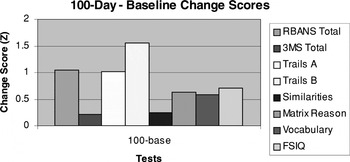
As seen in Table 2, half of the measures significantly improved at the follow-up. The greatest changes were found on the RBANS with a Total score improvement of 16 points (t = 4.35; p < .001). Two RBANS Index scores were improved (Immediate Memory, p < .0001 and Delayed Memory, p = .02), as well as the four individual verbal memory subtest scores (List Learning, p < .0001; Story Memory, p = .02; List Recall, p < .0001; and Story Recall, p = .001). Additionally, improvements were found on Trails A (p = .001), Trails B (p = .001), the 3MS (p = .05), WASI Matrix Reasoning (p = .02), and WASI Full Scale IQ (p = .007) (Fig. 1).

Standardized change scores on main neuropsychological outcome variables. Change scores were calculated by subtracting the Z score at baseline from the Z score at the 100-day follow-up based upon normative data. RBANS, Repeatable Battery for the Assessment of Neuropsychological Status; 3MS, Modified Mini-Mental State Examination; FSIQ, Full-Scale IQ.
On the SCL-90-R, participants endorsed fewer symptoms at the follow-up (PST t = 2.16, p = .04). Improvements were observed on two of the nine primary symptom dimensions (DEP t = 3.06, p = .006; ANX t = 3.02, p = .007). There were no changes on the delirium measures and analog scales of pain, mood, and thinking clarity.
DISCUSSION
Despite showing mild impairments on measures of psychomotor speed, complex attention, and verbal memory just before transplant, performances significantly improved by the 100-day follow-up in this small sample of adult patients undergoing HSCT. These preliminary results demonstrate that cognitive impairments 3 months following HSCT were rare (e.g., only 1 of 30 patients had an RBANS Total score below the 10th percentile after transplant). Pretransplant psychiatric symptoms were also improved on follow-up. This study adds to the few prospective investigations on neuropsychological and psychiatric changes after HSCT. Knowledge about the potential for neuropsychiatric “rebound” after treatment will be helpful for patients and families and may alleviate concerns as patients begin to experience changes in mood and cognition before and immediately after transplant. Although these results were gathered in a relatively small sample, they offer preliminary evidence that many patients have the capacity to improve their cognition with repeated cognitive stimulation in the first months after treatment. This is increasingly important as advances in HSCT are associated with better remission rates and more patients returning to work or school.
Although our study most closely matches that of Syrjala et al. (2004), our patients showed greater improvement at the follow-up. There are several potential explanations. First, our participants had higher premorbid IQ, which might indicate greater cognitive reserve. Second, our follow-up occurred approximately 1 month later than theirs (80 vs. 100 days), and it is possible that some of the acute cognitive dysfunction had resolved in our patients by the time of testing. Repeated assessment over the first weeks and months after transplant would answer the question of when improvements are first detected. Third, emotional improvements after transplant may have also contributed to higher scores. Finally, and potentially most importantly, our patients were assessed on a subset of the battery twice weekly after transplant until discharge as part of delirium monitoring. Most participants completed four such sessions, and this repeated exposure to cognitive testing and/or greater familiarity with the testing process and the examiner may have contributed to greater improvement in our participants. However, direct practice effects do not fully explain the improvement, as half of the tests that were administered repeatedly did not show significant change between baseline and follow-up (RBANS Fluency, Coding, Digit Span). Additionally, past research with HSCT patients also used repeated testing paradigms and most showed no improvement after transplant. The existing literature provides little context, due to the paucity of studies with this number of repeated assessments over this brief retest interval. For example, practice effects on the RBANS have only been reported for two testing sessions across much longer periods of time (Duff et al., 2005; Randolph et al., 1998): those scores rose from 1.4 to 8.1 points upon retesting after 38 weeks, which is notably smaller than those scores found here. So, although some improvement in the current study is undoubtedly attributable to practice effects, there also appears to be some additional improvement.
Some limitations of the current study should be noted. The participants in the present sample had heterogeneous diagnoses and conditioning regimens, and it will be important to examine if specific deficits are associated with certain forms of treatment in future studies and how emotional status is related to improvements. Our sample size was also relatively small, and the test battery was limited to mainly screening measures, so these results should be considered preliminary and need to be replicated. There was no control group to allow a direct assessment of practice effects. Finally, the generalizability of these findings may be limited to high-functioning groups, as our average patient was highly educated and may have greater cognitive reserve.
In conclusion, these results indicate that adult cancer patients can experience some cognitive recovery in the first few months following transplant, particularly on memory measures. Depression and anxiety symptoms also lessen. Nursing staff and other members of the treatment team should be aware of these patterns so they can educate patients and families about the symptoms and their course. Future research should examine the course of decline and recovery immediately following transplant and whether certain cognitive profiles are specific to diagnostic subgroups.
ACKNOWLEDGMENTS
The authors thank the patients and their families who participated in this research and welcomed us for repeated assessments during their treatment; the nurses and treatment staff of the BMTP who assisted with delirium monitoring; Karen Parrott, RN, for participant recruitment; and Chiachi Wang, MS. for statistical assistance. This research was supported by grant IRG 77-004-25 from the American Cancer Society to authors LJB and KD, administered through the Holden Comprehensive Cancer Center at the University of Iowa.