In an essay entitled “Variations on Negations and the Heresy of Black Feminist Creativity,” Black feminist Michele Wallace explores the difficulties of producing and presenting a “black female cultural perspective, which for the most part is not allowed to become written in a society in which writing is the primary currency of knowledge” (Wallace Reference Wallace1990, 54). Although she anticipates that some might find a defense of Black female cultural and political criticism “elitist,” she nevertheless remains, “convinced that the major battle for the ‘other’ of the ‘other’ [i.e., Black women] will be to achieve a voice, or voices, thus inevitably transforming the basic relations of dominant discourse. Only with these voices—written, published, televised, taped, filmed, staged, cross-indexed, and footnoted—will [Black women] approach control over [their] own lives” (66).
From this vantage point, the scholarly work that has been published on gender and Black politics and Black women in politics gives voice both to the political trials and triumphs of Black political women and those scholars, male and female, who record and interpret their experiences. Recently, there has been a welcome growth in the number and variety of scholarly studies on gender and Black politics and Black women's political experiences (see e.g., Smooth and Tucker Reference Smooth, Tucker and Springer1999; Harris Reference Harris, Collier-Thomas and Franklin2001; Harris-Lacewell Reference Harris-Lacewell2001; Alexander-Floyd 2003; Hawkesworth Reference Hawkesworth2003; Berger Reference Berger2004; Hancock Reference Hancock2004; Simien Reference Simien2006; Smooth Reference Smooth2006; Brown Reference Brown2007; and Jordan-Zachery Reference Jordan-Zachery2007). This more recent work builds on earlier scholarship that provided a foundation for Black women's and gender studies in political science (see, e.g., Prestage Reference Prestage and Epstein1975; Reference Prestage and Rodgers-Rose1980; Reference Prestage, Jones and Adams1987; Reference Prestage1991; King Reference King and Smith1977; Terrelonge Reference Terrelonge and Freeman1984; Lewis et al. Reference Lewis and Klein1985; Tate Reference Tate1993; Braxton Reference Braxton1994; Gay and Tate Reference Gay and Tate1998; Cohen Reference Cohen1999; James Reference James1999). Scholarly work by political scientists on Black gender politics and/or Black women in politics is a critical intervention in academic discourse that seeks to give voice to Black women in the way that Wallace describes. Furthermore, though there has been a recent surge of research on Black women in the civil rights and Black Power movements and even in contemporary political activism (see, e.g., Springer Reference Springer1999; Collier-Thomas and Franklin Reference Collier-Thomas and Franklin2001), little is known about Black female political participation in the formal processes of government. By emphasizing the political life and history of those Black women involved in the formal political arena and the intersection of gender and Black politics, recent Black feminist scholarship in political science gives a more complete picture of the varied ways in which Black women engage in politics. Importantly, these scholars take up the mantle provided by Jewel Prestage (Reference Prestage1991) in her seminal piece, “In Quest of African American Political Woman,” which detailed the full range of informal and formal politics in which Black women have engaged, by exploring a broad spectrum of political participation by Black women in the U.S. and globally and the gendered contexts in which they operate.
Given the advent of Black and women's studies over the past several decades, it is especially curious that the development of political science scholarship centering on the experiences of Black women is so limited. What accounts for the much-lamented dearth of literature on Black women in politics and Black gender politics? How does the current state of political science in particular and the nature of academe in general conspire to limit the production, professionalization, and success of Black women in political science? Why have women and politics and Black politics as sub-fields, two areas of study marginalized within the discipline, themselves marginalized the study of race and gender, respectively? As the above comments and questions suggest, to account for the state of research on Black women we must examine the state of Black women political scientists.
Some may wonder why it is necessary to begin a discussion on increasing Black women's and gender studies scholarship in the discipline by focusing on the production and professionalization of Black female political scientists.Footnote 1 After all, being a Black female is neither a prerequisite nor a sufficient qualification for studying Black women's political participation or Black gender politics. Nevertheless, it is true that Black female scholars have been those most likely to investigate the politics in which Black women engage and are embedded. This connection is understandable, as Black women scholars may have the most invested in understanding these political dynamics. Given this reality, it is necessary to determine the factors that inhibit and/or promote the professionalization of Black female political scientists and that affect their research production, tenure and promotion, and wellbeing in colleges and universities. In what follows, I identify several key constraints along the professional trajectory for Black female political scientists—their credentialization and professional development along with the theoretical and political disposition of our discipline—that curtail and constrain their scholarly voices and, thus, the voices of those Black women whose lives often form the basis of their work. In doing so, I plot some of the necessary steps in facilitating the future production of Black female Ph.D.s and scholarship on women and gender in Black and U.S. politics, and present a constellation of research trajectories that can serve as a frame for constituting Black women's and gender studies as a sub-field in political science. Ultimately, I argue that a Black feminist approach to institutional transformation, one that buttresses mentoring efforts with examination and alteration of the day-to-day practices of political science education and departmental management, is necessary to increase the number of Black female political scientists and thereby facilitate the production of scholarship on Black gender politics and Black women as political actors. Notably, although I focus on Black women, two important points of clarification are in order. First, the challenges Black women face with regards to professional promotion extend to women of color more generally; secondly, the disciplinary barriers to race, class, and sex equality encountered in political science prevail throughout the academy. This analysis is relevant, therefore, to a broader range of scholars.
Challenges along the Pipeline
Since racism, sexism, and class inequality pervade U.S. institutions and culture, there are challenges that would-be Black women political scientists face along the entire course of their careers, beginning at the undergraduate level. Unsurprisingly, historically White colleges and universities are particularly hostile environments for Black women. The racism and sexism they experience in and outside of the classroom undermine their chances for achieving the kind of academic success and preparation necessary to make them viable candidates for graduate study. For those women of color from low socioeconomic or working-class backgrounds, negotiating the college terrain is made particularly difficult. The critical nexus of material resources, cultural capital, and information and opportunity networks are part of the hallmark of racial, gender, and class privilege along the entire academic career track. The existence of programs and initiatives that provide contexts for acclimation to undergraduate or graduate study and the awarding of scholarships or loans are beneficial, but ultimately insufficient. In addition to access to material resources, information and opportunity networks in particular are not universally accessible and difficult to obtain (Takara Reference Takara2006, 466–7). People from socio-economically privileged backgrounds, for instance, have information and opportunity networks via parents, relatives, family acquaintances, and people in university settings who will prepare them for getting into college, assist them in succeeding academically, and facilitate their entrance into academe. Black women as a whole, on the other hand, have an especially difficult time finding mentors who will encourage them to attend graduate school and assist them in navigating that process. Moreover, even though there have been many positive changes in terms of opening up the ranks of our discipline to White women and racial minorities, much of what students get exposed to in a typical curriculum in these settings is not structured or presented in a way that makes it relevant to the Black experience. Too often departments relegate the study of race and gender to one or two courses. And, when departments do offer classes that discuss race and gender, they often focus on the work of a handful of scholars recognized in the discipline as opposed to the broad spectrum of scholarship on women and politics and Black politics. In contrast, while sexism is still a limiting barrier in academe, one of the reasons that historically Black colleges have been more successful in recruiting Black students into the field of political science (Ards and Woodard Reference Ards and Woodard1992, 253–5) is that the substance of their curricular offerings is directly relevant to the life experiences of Blacks. They also provide students an environment unfettered by the assumption of Black intellectual inferiority ubiquitous at White institutions, in which students can optimize their learning experiences, get equipped for graduate school, and find able mentors.
Those Black women who enter political science graduate programs have a related, but more pronounced set of challenges. First, as at the undergraduate level, Black women are often assumed to be academically ill-equipped or out-of-place. Most Black women have more than a few anecdotes that highlight the deeply-ingrained racist and sexist ideology permeating graduate programs. Professors and even other students will question, directly and indirectly, one's legitimacy as a scholar. Our presence is seen as such a contradiction that people will assume that we are student workers, secretaries, or even common criminals as opposed to graduate students. (One of my friends referred to this as “academic racial profiling.”) As Nirmal Puwar (Reference Puwar2004) explains in Space Invaders, the entrance of minorities into traditionally all White spaces marks them as “bodies out of place.” Their presence highlights the raced and gendered construction of spaces in ways that simultaneously disrupt and expose “the weight of the sedimented past” (1). This special rupture signifies the liminal space in which Black and other women of color operate within political science in particular and academe more generally. Ella Edmondson Bell and Stella M. Nkomo, two noted Black female scholars in the business management field, argue that this liminal state is best captured through Gloria Anzaldua's metaphor of the borderlands and Patricia Hill Collins' work on the outsider-within. Black women, they argue, traverse two competing cultures or a borderland space in which they operate, but, as outsiders-within, not as full members on equal footing with others (Bell and Nkomo Reference Bell and Nkomo1999). Significantly, this “chilly climate” (Anonymous and Anonymous 1999) Black women encounter in graduate school is pervasive throughout the academic pipeline.Footnote 2
A second difficulty stems from the lack of career support. Mentoring is a key tool in the recruitment and retention of minorities (see, e.g., Roach Reference Roach1999; Johnson-Bailey Reference Johnson-Bailey2004).Footnote 3 Still, as the promotion and reward structures become increasingly less defined, Black female graduate students and young assistant professors find themselves more in need of, but still short on, capable mentors. One study conducted by the American Sociological Association, for instance, noted that although Blacks have greater access to mentoring as undergraduates, they have less access to mentoring particularly regarding publishing compared to their White peers; this lack of mentoring “is important for understanding later career leakage since graduate school and early career productivity has long-term implications for academic careers” (Spalter-Roth and Erskine Reference Spalter-Roth and Erskine2007, 6). Black women political scientists have also historically lacked the formal peer mentoring and networking that has been critical to developing Black female scholars and scholarship on Black women in other fields.Footnote 4 Again the differential access to information and opportunity networks proves critical. As Kathryn Waddell Takara explains in “A View from the Academic Edge,” “Since Black women may be excluded from the informal but powerful social sphere where networking and exchange of career-building information are often shared, they will lack the support and understanding accorded to members of the dominant group” (Takara Reference Takara2006, 465).
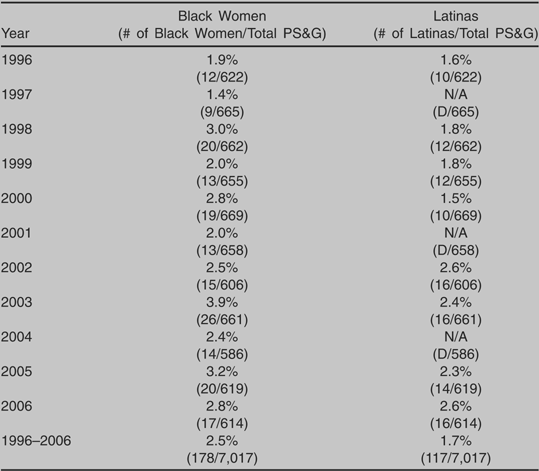
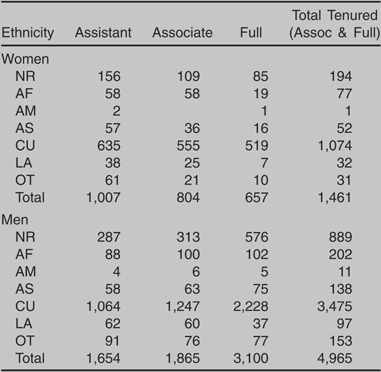
This lack of career support, in part, explains the low number of Black women who receive Ph.D.s and/or are granted tenure in political science. More specifically, as Table 1 details, of the 7,017 doctorates granted in political science between 1996 and 2006, only 178, or 2.5%, were awarded to Black women. Also, according to data provided by the American Political Science Association (APSA), only 77 Black women faculty with appointments in U.S. political science departments have tenure, including only 19 ranked as full professors (see Table 2). Importantly, as previously noted, other women of color in the discipline confront similar difficulties and challenges to those that I detail herein. The situation of Latinas in political science is a case in point. The number of Latinas receiving Ph.D.s in political science has slightly increased since 1996, but remains dismally low. Between 1996 and 2006, only 117, or 1.7%, of political science Ph.D.s were awarded to Latinas (see Table 1). Likewise, only 32 Latina faculty with appointments in U.S. political science departments are tenured (see Table 2). Although Black men and Latinos also fare poorly in terms of these key indicators (Ph.D.s and tenure), Black women and Latinas lag especially far behind their male counterparts in terms of promotion to the associate and full professor levels (see Tables 1 and 2).Footnote 5 The lag between women and men of color in terms of promotion is the result not just of poor mentoring, of course, but of other sexist social arrangements within and without the academy, such as preference for hiring or giving opportunities to male instructors, differing expectations with regards to gendered behavior, particularly regarding service requirements, and differences in family caretaking.Footnote 6 These trends are a tangible outcome of the effects of race, class, and gender inequality.
Percentage of Black Women & Latina Ph.D.s Produced in Political Science & Government (PS&G), 1996–2006

D = suppressed to avoid disclosure of confidential information.
Note: (1) Counts are for all doctorate recipients regardless of citizenship status. (2) Actual numbers provided in parentheses.
Source: NSF/NIH/USED/NEH/USDA/NASA, 2006 Survey of Earned Doctorates.
Faculty with Appointments in U.S. Political Science Departments

Note: NR = No Response, AF = African American, AM = American Indian, AS = Asian Pacific American, CU = Caucasian, LA = Latino/a, OT = Other
Source: APSA
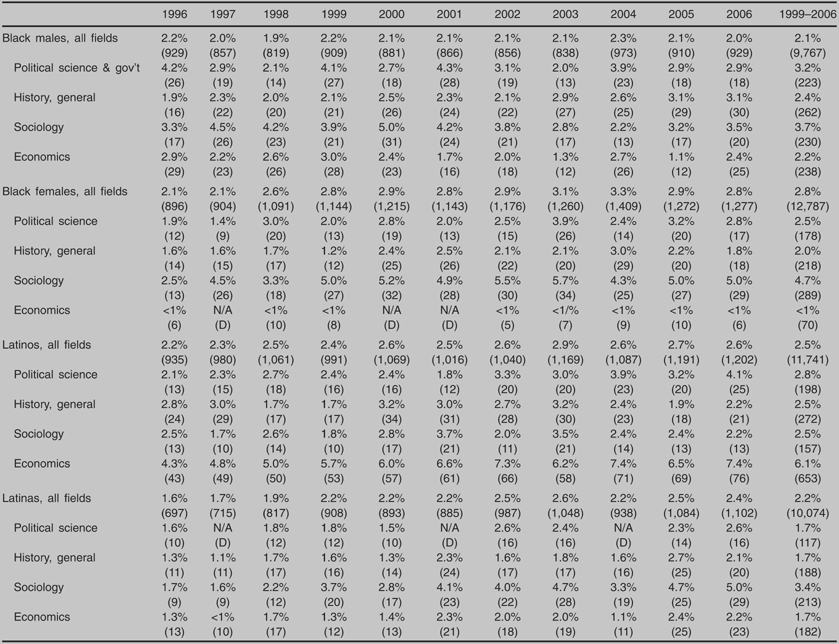
Notably, the barriers that Black women face in political science in terms of attaining Ph.D.s and gaining promotion are present in other disciplines as well. Only 2.8% of all doctorates awarded between 1996 and 2006, for instance, were awarded to Black women (see Table 3). These numbers are especially low, given that Black women in the U.S. comprise roughly 6.8% of the U.S. population, according to the U.S. Census Bureau (McKinnon and Bennett Reference McKinnon and Bennett2005, 1). The average for political science (2.5%) falls below the average for all fields (2.8%) (see Table 3).Footnote 7 When compared to other social science disciplines, namely history, sociology, and economics, sociology has the highest percentage of Black female Ph.D.s produced between 1996–2006 (4.7%), followed by political science (2.5%), history (2.0%), and economics (<1%). In terms of the production of Latina Ph.D.s, sociology ranks the highest of the four social sciences in question (3.4%), followed by a three-way tie for the other three fields (1.7%). Interestingly, between 1996 and 2006, only sociology generated a greater number of Black female and Latina Ph.D.s compared to Black men and Latinos (4.7% compared to 3.7% and 3.4% compared 2.5%, respectively).Footnote 8
Percentage of Black and Latino/a Doctorate Recipients, by Sex and Selected Field of Study, 1996–2006

D = suppressed to avoid disclosure of confidential information.
Note: (1) Counts are for all doctorate recipients regardless of citizenship status. (2) Actual numbers appear in parentheses.
Source: NSF/NIH/USED/NEH/USDA/NASA, 2006 Survey of Earned Doctorates.
In addition to dealing with a hostile climate and insufficient mentoring, Black women have limited options for pursuing a specialty in Black gender studies and Black women and politics. There is no department of political science that has a special emphasis on Black women's political participation. While many departments are working to boost their number of scholars who have expertise in Black politics and women and politics, few traditional political science graduate programs recognize these as official sub-fields. Rutgers University is the only institution with a formal Women and Politics sub-field. Similarly, Howard University and Clark Atlanta University are the only two Ph.D.-granting institutions with Black politics as a formal sub-field. These settings offer a number of advantages. They attract cohorts of students who are invested in learning about and contributing to these sub-fields, provide a more expansive array of course offerings, and provide greater options in terms of producing dissertation topics. Nevertheless, these departments can still present challenges for those who want to study both Black politics and women and politics. In other settings, graduate students have to seek out programs that have at least a core group of scholars whose research and teaching overlap with their own interests and with whom they can work and then earn graduate certificates in women's studies or Black studies programs through other parts of the campus. In some cases, the demand for courses and mentoring, particularly in terms of developing dissertation topics, can outstrip what professors are able to supply, regardless of their commitment level.
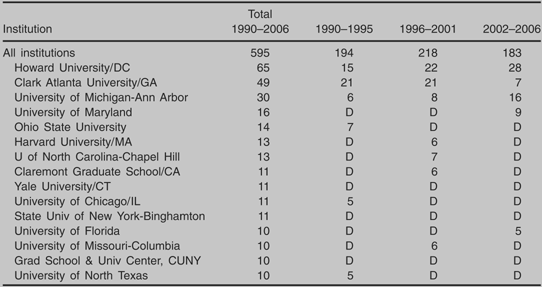
The success of some institutions in recruiting and producing Black political scientists suggests that there are lessons to be learned that can be transformative for political science education. Historically, Howard and Atlanta universities have consistently been among the top producers of Black Ph.D.s (Ards and Woodard Reference Ards and Woodard1992, 253–5). More specifically, between 1996–2006 Howard and Clark Atlanta universities were the top two producers of Black Ph.D.'s in political science, generating 65 and 49 Black Ph.D.s, respectively, or 19.2% of total political science Ph.D.s awarded to Blacks (see Table 4). An important question to consider is that if HBCUs have a proven track record of recruiting, retaining, and producing Ph.D.s, then what can we learn from these institutions in terms of recruitment and retention? Also, certain historically White institutions, such as the University of Michigan-Ann Arbor (Ards and Woodard Reference Ards and Woodard1992), have been successful in recruiting and retaining Black scholars, which include women. Between 2002 and 2006, in fact, the University of Michigan-Ann Arbor, ranked second, behind Howard University, followed by third-ranked University of Maryland and fourth-ranked Clark Atlanta; notably, these four institutions (Howard, University of Michigan-Ann Arbor, University of Maryland, and Clark Atlanta) produced 60 of the 183, or almost 32.8% of, Black Ph.D.s awarded during this timeframe (see Table 4). These various institutional sites must be studied in order to glean critical parameters for institutional change and to further enhance such environments to maximize the production of Black female Ph.D.s., in particular.
Top 15 Doctorate-Granting Institutions Awarding Political Science Doctorates to Black Doctorate Recipients, 1990–2006

D = suppressed to avoid disclosure of confidential information.
Source: NSF/NIH/USED/NEH/USDA/NASA, 2006 Survey of Earned Doctorates.
Once Black females attain their Ph.D., their professional development is conditioned by structural and institutionalized problems endemic to academic labor that are further complicated by racism, sexism, and class challenges. The attendant costs of academic life (e.g., conferences and research trips), for instance, can be difficult to manage, particularly for Black women from poor or working-class backgrounds. As Michelle M. Tokarczyk and Elizabeth A. Fay observe in their edited volume Working-Class Women in the Academy (Reference Tokarczyk and Fay1993), “The first job search itself is formidable to many students as they begin to experience the rounds of uncompensated professional expenses” (12). They also note “[T]here is often an expectation that family will subsidize the fledgling academic. For those who are doubly not gentlemen—women from the working-class—these expectations represent difficult barriers” (13). The preference for Ivy League minted Ph.D.s is also a constraining factor on the job market (12), as Black women, particularly those who are not from middle- or upper-class backgrounds, make different choices (for material and/or personal reasons) in terms of where they secure their degrees. Once in an academic position, trying to prepare to teach new courses, serve on committees, and jumpstart a research agenda creates stress for most new faculty. But, being Black and female compounds the difficulties of academic work in a variety of ways (see, e.g., Turner Reference Turner2002). We suffer from harassment from students who are unaccustomed to and uncomfortable with having Black women as authority figures, and often lack institutional support in confronting these issues.Footnote 9 Such harassment includes, but is not limited to, “hate mail, hate speech, constant questioning of qualifications, personal attacks, and an increased level of everyday undergraduate complaint about teaching styles, grades, [and] reading assignments” (Painter Reference Painter2000). “ ‘Bitch, go back to Africa,’ ‘Black bitch,’ and … ‘I don't want a colored teacher’” are examples of verbal comments Pope and Joseph record in their study of student harassment of female faculty of African descent (Reference Pope, Joseph and Benjamin1997, 255–6). In addition to these issues, Black women, like their Black male counterparts, suffer from “cultural taxation” (Padilla Reference Padilla1994, 26), doing an unequal share of service work by being asked to serve on committees and perform other types of service, particularly to support and/or exemplify diversity. This work, which in many cases may be important and necessary for the functioning of the institution, is nevertheless not given as much weight as research in evaluations.
Aside from these basic challenges to producing scholarly work, Black women political scientists are further constrained by the conventions of political science scholarship and limited access to publishing outlets. Political science research is heavily invested in and wedded to quantitative methodology, and this presents a number of problems for those producing research. Quantitative analysis of Black women and politics is important and necessary, but a full range of methodological approaches is required to adequately capture the political experiences of Black women. In addition to re-thinking theoretical frames, scholars have found it necessary to use a variety of methodological approaches to investigate Black female political actors. Heeding Audre Lorde's caution that “the master's tools will never dismantle the master's house” (Reference Lorde1984), students of Black women in politics have expanded the application of traditional quantitative methodology and utilized qualitative and interpretive methodologies as well. Those who utilize quantitative methodologies, for instance, have used these approaches to account for race and gender in the political process. And, indeed, there is a pressing need to develop survey items that attempt to measure gender dynamics as opposed to sex and research projects that focus on “contextual and culturally specific” research (Carroll and Zerilli Reference Carroll, Zerilli and Finifter1993, 72). But, as Susan J. Carroll and Debra J. Liebowitz have noted, “The choice to use methods that are viewed as unconventional can be a difficult one for women and politics researchers whose scholarship is already viewed as marginal to the discipline of political science” (Reference Carroll, Liebowitz and Carroll2003, 9). Their subject matter and unconventional methodological choices or applications make it that more difficult to find venues for publication (Carroll and Liebowitz Reference Carroll, Liebowitz and Carroll2003, 9). In their research on comparative publication rates for Black politics research, Ernest J. Wilson III and Lorrie A. Frasure (Reference Wilson, Frasure and Rich2007) make a similar observation. In a research survey of political science, sociology, history, and economics during two periods, 1970–1985 and 1986–2003, Wilson and Frasure found that, although all of the disciplines under examination showed some increase in the number of full-length articles on Black issues appearing in top journals in the more recent timeframe, political science continued to lag behind sociology and history (17–18). Of the 2,272 articles published in the American Journal of Politics, American Political Science Review, and Journal of Politics between 1970–1985, for instance, “only 34 or 1.49 percent included topics directly related to black politics” (18). The same trend held between 1986–2003; for these same journals, “only 38 or 1.48 percent” of their 2,554 journal articles centered on Black politics (18). Since subject matter marginalization and methodological conventions restrict publication opportunities for Black politics researchers and women and politics researchers in general, scholars who do work on gender and Black politics and/or Black women in politics are particularly taxed to find publishing opportunities since their work bridges two sub-fields seen as marginal in the discipline, women and politics and African American politics. The small number of sub-field specific journals available to women and politics and black politics scholars further complicates this situation. The Journal of Women, Politics, & Policy (formerly Women & Politics), Politics & Gender, and National Political Science Review have served as important forums for research for women and politics and Black politics, respectively, but there is a pressing need to create more publishing outlets and for existing journals to publish more work by and about Black women.
Finally, the scholarship on the political lives of Black women and Black gender politics has been constrained by their marginalization within the women and politics and Black politics sub-fields. Other scholars have remarked on the limited amount and development of research on Black women's political experiences and Black gender politics and the lack of interface between women and politics and Black politics research (see, e.g., Simien Reference Simien2006). Often, scholars are basing their work on threads of analysis in a handful of articles or in some cases one classic piece. This is true despite the decades long call by Black feminists to focus on the relationship between race and gender and the current emphasis throughout the academy as a whole to incorporate race and gender analysis into our research.
Ironically, many of the same criticisms scholars in the women and politics and Black politics sub-fields have made regarding the discipline as a whole, Black feminists who study Black women and politics are now making regarding these sub-fields. Scholars within the Black politics and women and politics sub-fields, for instance, have argued that politics is inherently raced or gendered (see, e.g., Jones Reference Jones1972; Pateman Reference Pateman1988). They have argued that it is impossible to understand the workings of political institutions, political behavior, or social change without accounting for race or gender. Members of both sub-fields have presented or utilized critiques of the “scientific” assumptions that undergird positivism and/or illuminated our understanding of the political function of political science scholarship itself (see, e.g., Carroll and Zerilli Reference Carroll, Zerilli and Finifter1993; Jones Reference Jones and Smith1977). They have forced discussion of critical issues, caused many to re-think the way they conduct their research, and made room, however limited, for the development of gender- and race-based scholarship. Importantly, Black feminist scholars have been and are increasingly making those very same claims within and across these two sub-fields. We are saying that analysis of women and politics that does not consider race and analysis of Black politics that does not include gender are, at best, inadequate; we are demonstrating the theoretical and explanatory value of such an approach (see, e.g., Simien Reference Simien2006; Smooth Reference Smooth2006; Alexander-Floyd 2007; Jordan-Zachery Reference Jordan-Zachery2007). We are insisting, as others have, that it is necessary to examine the political import of our work, particularly for those of us who labor on the margins of our discipline, for to exclude either race or gender from political research is to unwittingly support and affirm the unequal power relations that cohorts within both sub-fields have worked so diligently to unmask and unmake.
While a focus on race and gender is necessary and will likely produce additional scholars and scholarship, an important caution is necessary: we not only need to expand and develop the body of scholarship on women and gender in Black and U.S. politics, but to do so in a way that ensures its integrity. While some scholars ignore considerations of Black women in politics and Black gender politics altogether, others give short shrift to the complexities of Black women's history and experiences or are insufficiently grounded in the multidisciplinary scholarship developed on this subject. Anne DuCille's assessment of “the occult of true Black womanhood” is particularly relevant here. She writes:
Much of the newfound interest in African American women [in the academy as a whole] that seems to honor the field of black feminist studies actually demeans it by treating it not like a discipline with a history and a body of rigorous scholarship underpinning it, but like an anybody-can-play pickup game played on an open field. Often the object of the game seems to be to reinvent the intellectual wheel: to boldly go where in fact others have gone before, to flood the field with supposedly new ‘new scholarship’ that evinces little sense of the discipline's genealogy. Moreover, many of the rules that the academy generally invokes in doing its institutional business—making appointments, assigning courses, promoting faculty—are suspended when what is at stake is not the valorized, traditional disciplines of western civilization but the more marginal, if popular, fields within African American studies [which center on Black women]. (DuCille Reference DuCille1996, 94–5)
Our focus on quantitative research can leave us especially vulnerable to the problems DuCille describes, as the temptation is present to simply add Black women as an extra variable for analysis, without taking account of history or context or being conversant with the political theory produced on Black women's political experiences or Black gender politics. The recent attention in our discipline to incorporating intersectionality as a research paradigm (Hancock Reference Hancock2007) is in danger of giving way to the genealogical myopia DuCille describes, as scholars aim to produce intersectional research without a firm grounding in this longstanding body of scholarship both within political science and other disciplines or a commitment to the social justice project from which it emerged. As noted earlier, quantitative analysis that focuses on Black women is necessary and sorely lacking. But, the complexity of gender and Black women's political experiences cannot be adequately captured without reformulating quantitative research techniques and utilizing alternative methodologies. In any case, whatever methodology is in place, scholars must be well-versed in the scholarship and debates regarding Black women's and gender studies within our own and other disciplines, specifically, and within feminist and womanist theory, generally. As DuCille points out, in the warped racial and sexual politics of the academy, it is not uncommon for those who merely dabble in the subject, who have no real expertise regarding Black women or African American studies, to get jobs and publish. There are no easy solutions to these dilemmas, but ultimately “Training may be the critical factor … in terms of both the cultural competence we must bring to the field and the professional guidance we must give to the students we bring into the field” (119).
Toward Black Feminist Institutional Transformation
Addressing these various levels of challenges will require a variety of responses. First, efforts to increase the number of Black women and members of under-represented groups generally in political science should build on the base of programs already in place by promoting initiatives for institutional transformation. The American Political Science Association (APSA)'s Ralph Bunche Summer Institute, the APSA's Minority Graduate Fellows Program, and the National Conference of Black Political Scientists' Graduate Assistance Program have been important means for recruiting minorities and sustaining their graduate work. Also, the adoption by the APSA of the mentoring initiative begun by the Women's Political Caucus constitutes a major advance in the effort to support underrepresented groups in our field. The Economics Pipeline Project (Collins Reference Collins2000, 146), which consists of mentoring, outreach, and summer programs, and the American Sociological Association's Minority Fellowship Program (Spalter-Roth and Erskine Reference Spalter-Roth and Erskine2007, 5–6), represent two examples of similar efforts at increasing diversity in other social science disciplines. These various programs, however, represent the first generation of efforts to increase members of under-represented groups within traditional disciplines. Despite their positive effects, they are insufficient in counteracting the interworkings of racism and sexism within departments.
Increasingly, attention is being given to not only supporting individuals through training, mentoring, and financial support, but to altering the environments in which they operate. A second generation of initiatives is aimed at countering the institutional racism and sexism that undermine members of under-represented groups. In this regard, political science can benefit from responses to similar challenges in terms of recruitment, retention, and promotion experienced in other disciplines. In recognition of the challenges that minorities face at the undergraduate level, for instance, members of the American Sociological Association started the Minority Opportunities through School Transformation (“MOST”) program, which conducted a multi-year pilot study that “engag[ed] 18 departments in reexamining and changing curriculum, climate, research training, mentoring, and outreach” (Spalter-Roth et al. Reference Spalter-Roth, Levine and Sutter2001, 6). As a result they have gone a long way in terms of developing models for departmental change throughout their profession.
Similarly, the National Science Foundation (NSF) has developed an ADVANCE initiative that focuses on studying institutional barriers for women in science and engineering. “With each of the three types of ADVANCE awards [for Fellows, Institutional Transformation, and Leadership], NSF seeks to support new approaches to improving the climate for women in U.S. academic institutions and to facilitate women's advancement to the highest ranks of academic leadership” (“ADVANCE” 2002, 1). The broad-scale model of institutional change embodied in the ADVANCE program could be usefully employed in our discipline. While the APSA has worked to secure funding from the NSF ADVANCE program to address gender inequality in political science as a discipline, the ADVANCE initiative is not slated for implementation throughout the discipline at the time of this writing. Whether funded by the NSF or other foundations, similar efforts in our own field focused on discipline-wide, institutional change would buttress the mentorship, scholarship, and summer programs already in place or being developed by the APSA and the National Conference of Black Political Scientists.Footnote 10 As two anonymous female authors relay in their piece “Tenure in a Chilly Climate” (Anonymous and Anonymous 1999), it is important to make visible how inequality is sustained within departments, as a focus on discreet cases trains our sights on the perceived deficiencies of individuals, “leaving intact the perception of control”; they underscore that following the right mentoring advice or dutifully fulfilling research, teaching, and service requirements does not shield one from discrimination or failed promotions (91). Approaches that deal solely with equipping individuals or examining discreet cases fails to account for entrenched repetition of patterns and norms, which prohibit equality in the workplace. Significantly, political science as a discipline could build a more comprehensive model of institutional, disciplinary change by adopting a Black feminist frame of reference. A Black feminist frame of reference that viewed identity as mutually constitutive would assess and address not only gender inequality, but also class and racial inequality as they impact our discipline.Footnote 11 We could then cast the penetrating questions posed by the aforementioned anonymous authors in a Black feminist vein: “What if, rather than evaluating individual [White females or male or female faculty of color] as successes or failures, we evaluated individual departments? What if those concerned with the status of women [and racial minorities] in the profession looked beyond hiring records and numbers [at the graduate and professorial levels] and examined whether departments created an environment where women [and minorities] could flourish?” (93). How could we understand, moreover, the often hidden operation of economic disadvantage that compounds and complicates the effects of racial and/or gender inequality?Footnote 12 Second, political science departments must work to ensure that race and gender politics are engaged across the curriculum, as well as in “Black politics” or “women and politics” courses. Finally, given that the particularities of Black women's political participation and Black gender studies require their use, those engaged in Black women's and gender studies should be at the forefront of championing methodological diversity within political science. More specifically, we should help to create an environment in which qualitative and interpretive methodologies are appreciated as important and legitimate in their own right, and not viewed as secondary or mere compliments to quantitative methodology.
Conclusion
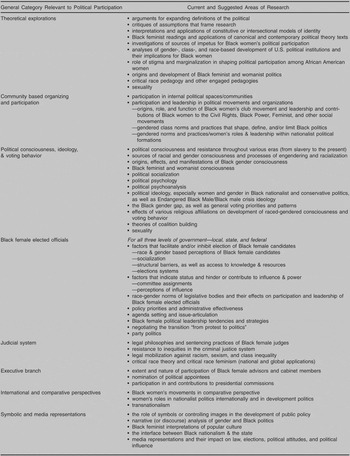
The urgency of dealing with these various issues and problems in the professional development of Black female political scientists is highlighted by the dearth of literature on women and gender in Black politics. To be sure, the research trajectories signaled by recent scholarship on Black gender politics and Black women in politics are merely suggestive of the possibilities of research on these subjects. The table below, “Framing the Field of Black Women's & Gender Studies in Political Science” (Table 5), captures a broader range of research constituting the field of Black women in politics. It provides a useful point of engagement for those developing courses or outlining research trajectories for this important field of study.
Framing the Field of Black Women's and Gender Studies in Political Science

Of course, one might ask: what are the implications of enacting a Black feminist approach to institutional transformation? Why should the discipline as a whole be concerned about the production of Black female (or other women of color) Ph.D.s.? The answer to these questions is at least two-fold. First, the production of Black female Ph.D.s can be a key component of the disruption of educational practices that affirm inequality in our political system and beyond. Second, as I have argued throughout, the marginalization of Black women (and other women of color) is inseparable from the question of scholarly production. Given that race, class, and gender have been so central to the development of U.S. political institutions and discourse, it must take center stage in the production of political science scholarship if we are to render meaningful and adept analyses of the political world. As Ernest J. Wilson III and Lorrie A. Frasure (Reference Wilson, Frasure and Rich2007) observe: “In the United States, structurally induced racial and ethnic impositions are the nucleus from which cultural, social, political, and economic institutional arrangements spring forth, influencing preference formation, public opinion, as well as individual and collective group interests” (19). Given this reality, we cannot fully or accurately comprehend the functioning of the political world absent the work and perspectives of Black women and other women of color in our discipline. To be sure, in a more particular vein, if we are to remain “in quest” of Black political woman (Prestage Reference Prestage1991) and committed to understanding the complex dynamics that condition her political practice, Black women in our discipline and others committed to their well-being will have to continue to creatively employ their energies to increase the number of Black female political scientists. We must make political science a more hospitable place for their voices and, thus, those of their subjects.