Implications
Rubber seed oil (RO) is a by-product of the rubber industry and rich in polyunsaturated fatty acids. This is the first in vivo study investigating the effects of diet RO on nutrient digestibility, rumen fermentation and rumen fatty acid profile of dairy cows. Our results indicate the potential of RO as a feedstuff in dairy cow diets to improve nutrients digestibility, ruminal fermentation and ruminal fatty acid profile by enhancing trans-11 C18:1, cis-9, trans-11 conjugated linoleic acid and α-linolenic acid. These findings provide a theoretical basis for the application of RO in livestock production.
Introduction
Vegetable oils rich in polyunsaturated fatty acids (PUFA) have been used in dairy cow diets to alter the milk fatty acids (FA) composition and especially to enhance PUFA content (Loor et al., Reference Loor, Herbein and Jenkins2002; Bu et al., Reference Bu, Wang, Dhiman and Liu2007), which has been shown to have potential health benefits, including anticarcinogenic properties (Roche et al., Reference Roche, Noone, Nugent and Gibney2001). Rubber seed oil is a by-product of the rubber industry with the main origin of RO being in the Guangdong, Guangxi and Yunnan provinces of China. The levels of total unsaturated fatty acid (UFA) and PUFA in RO can amount to 83% and 59%, respectively (Pi et al., Reference Pi, Gao, Ma, Zhu, Wang, Zhang, Xu and Bu2016). Compared to the flaxseed oil (FO), which is a common vegetable oil rich in α-linolenic acid (ALA), RO is rich in ALA. In FO, ALA contributes approximately 55% of the oil’s total FA; whereas, in RO, the ALA content is lower at 22%. It is notable that previous rat toxicological and brine shrimp tests showed that RO had no acute toxicity effects and was not found to contain any hazardous linamarin (Abdullah & Salimon, Reference Abdullah and Salimon2010). In addition, our previous study reported that RO and FO supplementation (as a source of ALA) can increase milk production and alter milk fat FA composition by increasing vaccenic acid (VA), conjugated linoleic acid (CLA) and ALA and decreasing the concentration of saturated fatty acid (SFA) (Pi et al., Reference Pi, Gao, Ma, Zhu, Wang, Zhang, Xu and Bu2016), suggesting the potential of RO as a feedstuff in dairy cows dietary.
The process of biohydrogenation (BH) reduces the rumen outflow of PUFA and contributes to the accumulation of cis and trans isomers in ruminant products, including CLA and trans monoene. Hence, the extent and type of the rumen BH process will determine both the amounts and structures of FA leaving the rumen. In addition, PUFAs can be toxic to rumen microorganisms (Jenkins, Reference Jenkins1993) that play an important role in the digestion and metabolism of nutrients. Thus, the FA structure present in the rumen may influence digestion physiology. Studies have shown that high dietary oil levels could decrease the counts of ruminal bacteria and protozoa (Dohme et al., Reference Dohme, Machmuller, Wasserfallen and Kreuzer2001; Yang et al., Reference Yang, Bu, Wang, Hu, Li, Wei, Zhou and Loor2009). On the other hand, supplementing ruminant diets with oil seed and vegetable oils had a negative effect on ruminal digestion of neutral detergent fibre (NDF) and organic matter (OM) (Jenkins, Reference Jenkins1993; Martin et al., Reference Martin, Rouel, Jouany, Doreau and Chilliard2008; Lunsin et al., Reference Lunsin, Wanapat, Yuangklang and Rowlinson2012b). Thus, such negative changes may limit the amount of RO that can be incorporated in the diet of dairy cows. However, information on the effect of dietary supplementation of RO on nutrient digestibility of dairy cows is scarce.
Feeding vegetable oils rich in PUFA can change rumen fermentation by enhancing the molar percentage of propionate (Jalc and Ceresnakova, Reference Jalc and Ceresnakova2002; Yang et al., Reference Yang, Bu, Wang, Hu, Li, Wei, Zhou and Loor2009). In vitro studies have even demonstrated that the acetate to propionate ratio changed significantly by adding unsaturated C18 fatty acid (Li et al., Reference Li, Wang, Li and Bu2012; Gao et al., Reference Gao, Wang, Jing, Sun, Wu and Shi2016). In addition, a previous in vitro study using a rumen-simulation technique found that 4% RO supplements significantly changed the rumen fermentation pattern by decreasing both the acetate level and the ratio of acetate and propionate (Shi, Reference Shi2014), suggesting that PUFA-enriched RO impacts on rumen fermentation. However, to date, there are no studies investigating the effect of RO on rumen fermentation in vivo. Therefore, the objective of this study was to investigate the responses of nutrient digestibility (total tract), rumen fermentation characteristics and rumen FA profile of lactating dairy cows to diet supplementation with RO and FO. We hypothesise that dietary supplementation with RO could also improve the nutrients’ digestibility, change the rumen fermentation pattern and enhance cis-9, trans-11 CLA and ALA profiles in ruminal fluid in comparison with FO.
Material and methods
The animal experiment was performed at Tianjin Mengde Dairy Farm (Tianjin, China). All experimental procedures were approved by the Institutional Animal Care and Use Committee of the Chinese Academy of Agricultural Sciences (Beijing, China).
Cows, experimental design and treatments
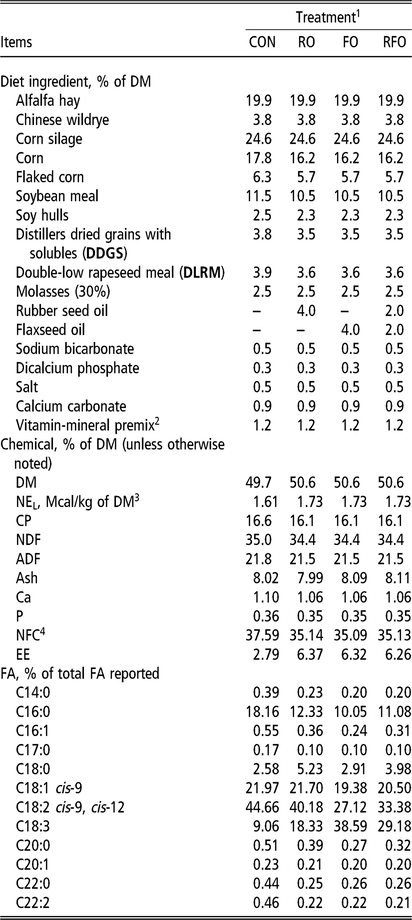
The details of the animal experimental design were reported in our previous study (Pi et al., Reference Pi, Gao, Ma, Zhu, Wang, Zhang, Xu and Bu2016). Briefly, 48 mid-lactation healthy Chinese Holstein dairy cows (163 ± 25.3 days in milk, 29.6 ± 2.42 kg of milk/day and parity 1.8 ± 1.25) were randomly assigned to one of four treatments (n = 12) in a completely randomized design. The total duration of the experiment was 8 weeks, during which the cows were fed a basal diet (CON) or the basal diet supplemented with 4% RO, 4% FO or 2% rubber seed oil plus 2% flaxseed oil (RFO) on a DM basis. The FO was supplied by Huajian Axunge Co., Ltd (Shanxi, China), and the RO was supplied by Kunming Institute of Botany, Chinese Academy of Sciences (Kunming, China). The ingredients and chemical composition of the diets are presented in Table 1. The diet was formulated to meet or exceed the nutrient demand according to the Feeding Standards of Dairy Cattle, China NongYe HangYe Biaozhun/Tuijian-34. During the experimental period, cows were housed in a mechanically ventilated barn divided into four plots with 12 cows each and fed individually, with free access to fresh water. At the beginning of this experiment, cows were gradually adjusted to the experimental diets over a 1-week period. Diets were fed as a total mixed ration (TMR) three times daily (05:30, 13:30 and 18:00 h) to ensure <10% refusals. The oils were stored at 4°C and were added fresh as the final component after mixing the other dietary ingredients. The TMR containing oil supplements was made once daily and stored under shade until fed at later time. Cows were milked three times daily (at 05:00, 13:00 and 21:00 h) with individual milk yields recorded at each milking.
Ingredient and chemical composition of the experimental diets for dairy cows

RO = rubber seed oil; FO = flaxseed oil; DM = dry matter; NEL = net energy for lactation; CP = crude protein; NDF = neutral detergent fibre; ADF = acid detergent fibre; NFC = non-fibre carbohydrate; EE = ether extracts; FA = fatty acids.
1 Cows were fed a basal diet (control; CON) or basal diet supplemented with either 4.0% rubber seed oil (RO), 4.0% flaxseed oil (FO) or 2.0% rubber seed oil + 2.0% flaxseed oil (RFO). The CON diet was also used for feeding during the pre-trial period.
2 Contained (per kg of DM): a minimum of 313 500 IU of vitamin A; 104 500 IU of vitamin D; 5000 IU of vitamin E; 780 mg of Cu; 780 mg of Fe; 780 mg of Mn; 3900 mg of Zn; 30 mg of Se; 50 mg of I; 65 mg of Co.
3 Calculated value (based on China Standard NY/T 34, 2004).
4 NFC = 100 – % NDF − % CP − % EE − % Ash.
Sampling, measurements and analysis
The quantity of daily feed offered and refused was recorded for individual cows. Samples of TMR were collected daily and frozen at −20°C before subsequent analysis. Orts were sampled twice weekly from each cow, composited for each treatment, and frozen at −20°C for further analysis. Weekly representative samples of TMR from each treatment were analysed for DM content by oven drying at 60°C to a constant weight.
Faecal samples (approximately 100 g wet weight) were collected from the rectum of each cow every 6 h on day 53, 54 and 55 of the experiment, resulting in 12 representative faecal samples per cow according to Zhou et al. (Reference Zhou, Zhang, Zhao, Zhang, Zhu, Bu and Wang2015). Samples from each time point were divided into two portions, and samples were pooled across sampling times for each cow. A 10% volume of 6 M hydrochloric acid was added to one pooled portion from each cow immediately after sampling for subsequent nitrogen analysis. All faecal samples were dried at 60°C for 48 h, ground using a Wiley mill (Arthur H. Thomas Co.) and passed through a 1-mm mesh screen. During each 3-day collection period, TMR and ort samples were collected daily and stored at −20°C for subsequent analysis. Total-tract nutrient apparent digestibility (TTAD) was calculated using acid-insoluble ash (AIA) as an internal marker based on the concentration of AIA in the diet and faeces (Van Keulen and Young, Reference Van Keulen and Young1977). The crude protein (CP; N × 6.25) content of feed samples was determined using the macro-Kjeldahl nitrogen test (AOAC International, 2000; method 976.05) with a Kjeltec digester 20 and a Kjeltec System 1026 distilling unit (Tecator AB). The contents of NDF and ADF were determined using procedure A by Van Soest et al. (Reference Van Soest, Robertson and Lewis1991) using heat-stable amylase (type XI-A of Bacillus subtilis; Sigma-Aldrich, St. Louis, MO), but without sodium sulphite for the NDF. The ash content was determined by incineration at 550°C overnight, and the OM content was calculated by AOAC International (2000; method 942.05). The ether extract (EE) content was determined using a Soxtec system HT6 apparatus (Tecator AB) according to AOAC International (2000; method 920.39).
Samples of ruminal fluid (approximately 100 ml) were collected 3 h after morning feeding on day 49 using an oral stomach tube (Shen et al., Reference Shen, Chai, Song, Liu and Wu2012). The first 10 ml sample was discarded to eliminate saliva contamination that would falsely elevate the pH, volatile fatty acid (VFA) and ammonia nitrogen (N) levels. Ruminal liquor samples were strained through four layers of cheesecloth, and pH was determined immediately after collection (6250 membrane pH meter, Yibo Instruments Corp., Shanghai, China). Samples for ammonia-N analysis were acidified with 1 mol/l HCl, and those for VFA analysis had 1 ml of 25% meta-phosphoric acid added to 5 ml of rumen fluid to deproteinize the sample. All the samples were then stored at −20°C until analysis. Ammonia-N concentration was determined using the sodium salicylic acid and hypochlorous acid spectrophotometric method (Feng & Gao, Reference Feng and Gao1993). Microbial crude protein (MCP) concentration was analysed using a spectrophotometer (UV-2450), according to the method of Makkar et al. (Reference Makkar, Sharma, Dawra and Negi1982). The VFA concentration was determined by gas chromatography (model 6890, Series II; Hewlett Packard Co., Avondale, PA, USA) as described by Liu et al. (Reference Liu, Wang, Bu, Liu, Liang, Liu, Wei and Zhou2009). Ruminal FA profile analysis was conducted using the method described in Pi et al. (Reference Pi, Gao, Ma, Zhu, Wang, Zhang, Xu and Bu2016). The methane production was calculated according to the method of Moss et al. (Reference Moss, Jouany and Newbold2000) as follows: methane production (mmol/l) = 0.45 × acetate (mmol/l) − 0.275 × propionate (mmol/l) + 0.4 × butyrate (mmol/l). The correlation coefficient of the prediction of methane production from VFA concentrations is 0.882.
Statistical analysis
All the data were analysed as a completely randomised design using the MIXED procedure of SAS (version 9.2, SAS Institute Inc., Cary, NC). The statistical model included cow as a random effect and treatment as a fixed effect. The MIXED statistical model is as follows:

where Y ij = observation from animals, μ = overall mean, T i = treatment effect (i = 1–4), and e ij = random error.
Orthogonal contrasts included the following: CON v. oil supplemented diets to test the effect of oil supplementation; RO v. FO to test the effect of high rubber seed oil v. high flaxseed oil; and RFO v. RO + FO to test the additive effect of rubber seed oil and flaxseed oil. The significance level was declared at P < 0.05. Correlation analyses were assessed by Pearson’s correlation test using GraphPad Prism version 5.00 (GRAPHPAD Software, San Diego, CA, USA). Significant correlation was considered at P < 0.05.
Results
Milk yield, nutrients intake and total tract apparent digestibility
The results of milk yield were reported in our previous study (Pi et al., Reference Pi, Gao, Ma, Zhu, Wang, Zhang, Xu and Bu2016). Briefly, oil supplementation significantly increased milk yield by 10.98% (14.02%, 10.98% and 7.95% for RO, FO and RFO, respectively) (P < 0.05). In addition, milk fat content was decreased in dairy cattle fed the RO, FO or RFO treatments (3.19% on average) compared with the CON (3.62%) (P < 0.05). However, oil treatment had no effect on milk fat yield (P > 0.05). Milk lactose yield was increased in dairy cattle fed the RO, FO or RFO treatments (1.40, 1.39 and 1.37 kg/d, respectively) compared with the CON (1.29 kg/d) (P < 0.05).
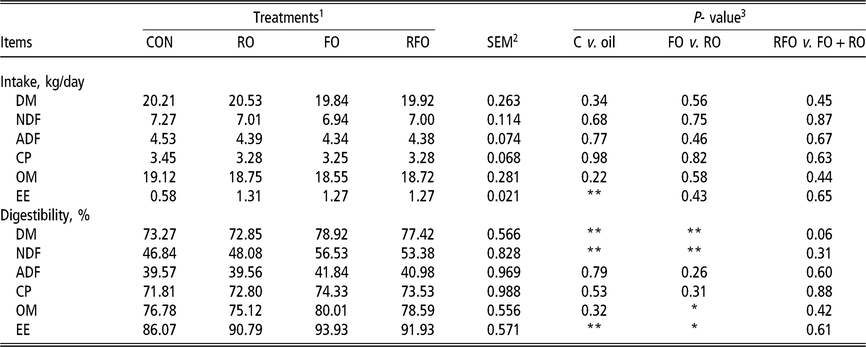
There were no differences in DM, NDF, ADF, CP and OM intake between the CON group and the oil groups; however, all the oil treatment groups showed increased intake of EE (P < 0.05) (Table 2). In addition, there were no differences in nutrient intake among the oil groups (P > 0.05). For TTAD, oil treatment groups significantly increased the TTAD of DM, NDF and EE compared with the CON group. However, there were no differences in the TTAD of ADF, CP and OM between the CON group and the oil groups (P > 0.05). In addition, the TTAD of DM, NDF, OM and EE were higher in the FO group than RO group (P < 0.05). Feeding the blend of RO and FO (RFO) did not result in any significant differences in TTAD of nutrients compared with feeding them separately (P > 0.05).
Effects of dietary rubber seed oil and flaxseed oil supplementation on nutrient intake and total tract apparent digestibility of dairy cows

RO = rubber seed oil; FO = flaxseed oil; DM = dry matter; NDF = neutral detergent fibre; ADF = acid detergent fibre; CP = crude protein; OM, organic matter; EE, ether extracts.
1 Cows were fed a basal diet (control; CON) or basal diet supplemented with either 4.0% rubber seed oil (RO), 4.0% flaxseed oil (FO) or 2.0% rubber seed oil + 2.0% flaxseed oil (RFO). The control diet was also used for feeding during the pretrial period.
2 SEM = Standard error of least squares means.
3 CON v. oil = CON v. oil (RO, FO, RFO); RO v. FO = RO v. FO; RFO v. RO + FO = RFO v. RO plus FO.
*P < 0.01, **P < 0.001.
Ruminal fermentation parameters
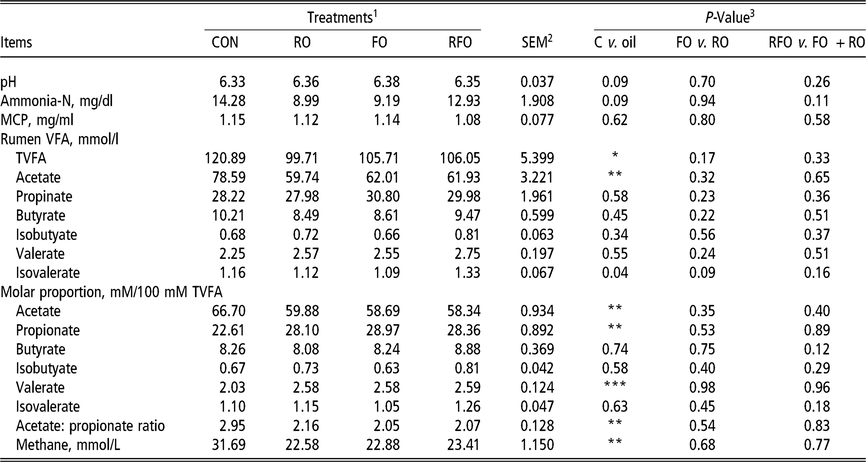
Results of the ruminal fermentation parameters are shown in Table 3. Compared with the CON group, oil groups had no effect on pH, the concentrations of ammonia-N and MCP (P > 0.05). Oil groups significantly decreased the concentration of total VFA, the proportion of acetate and the ratio of acetate and propionate, but increased the proportion of propionate and valerate compared with CON (P < 0.05). However, there were no differences in the rumen fermentation parameters between the three oil groups (P > 0.05). In addition, feeding the blend of RO and FO (RFO) also showed no significant differences in rumen fermentation parameters compared with feeding them separately (P > 0.05). Oil groups significantly decreased the production of methane compared with the control group (P < 0.05).
Effects of dietary rubber seed oil and flaxseed oil supplementation on rumen fermentation characteristics of dairy cows

RO = rubber seed oil; FO = flaxseed oil;MCP = microbial crude protein; VFA = volatile fatty acid; TVFA = total volatile fatty acid.
1, 2, 3 For further description, check footnotes of Table 2.
*P < 0.05, **P < 0.001, ***P < 0.01.
Ruminal fluid and milk fatty acid profiles
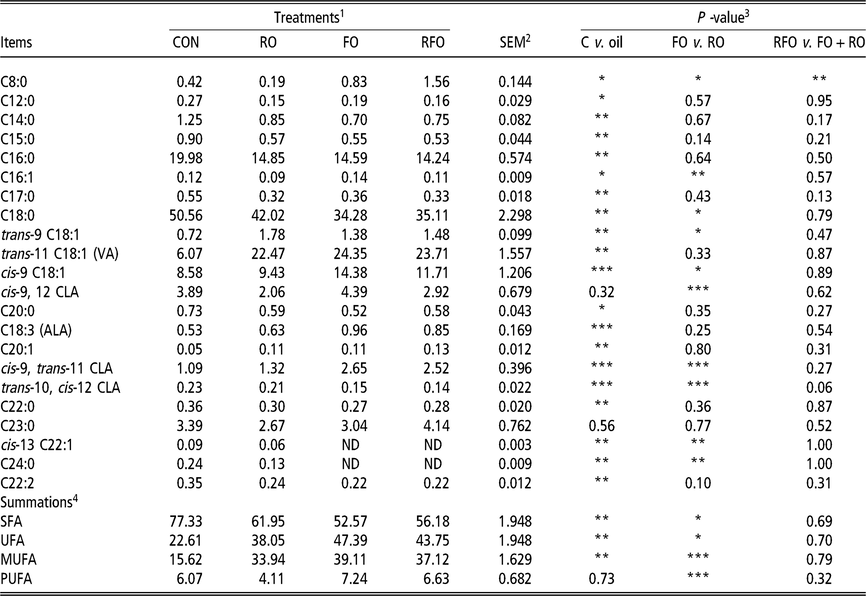
The FA composition in ruminal fluid is shown in Table 4. Compared with CON, oil groups significantly increased the levels of VA, cis-9, trans-11 CLA, ALA, total UFA and total monounsaturated fatty acids (MUFA) in rumen, while markedly decreasing the content of total SFA (P < 0.05). The concentrations of cis-9, trans-11 CLA, total UFA and total PUFA in the ruminal fluid of FO groups were higher than that in RO (P < 0.05). There were no significant differences seen from offering compared with feeding the oils separately (P > 0.05). The composition of FAs in milk was reported in our previous study (Pi et al., Reference Pi, Gao, Ma, Zhu, Wang, Zhang, Xu and Bu2016). Briefly, the proportions of short-chain fatty acids (C4:0, C6:0, C8:0, C10:0, C12:0 and C13:0) and medium-chain fatty acids (C14:0, C14:1, C15:0, C16:0 and C16:1) were lower (P < 0.05) in milk from cows fed RO, FO, or RFO compared to CON. The proportion of long-chain fatty acids (C18:0, trans-9 C18:1, VA, cis-9 C18:1, cis-9, trans-11 CLA and ALA) in milk fat were increased (P < 0.05) in cows fed RO, FO or RFO compared with CON.
Effects of dietary rubber seed oil and flaxseed oil supplementation on rumen fatty acid proportions of dairy cows (g/100 g total FA)

RO = rubber seed oil; FO = flaxseed oil; FA = fatty acids; VA = vaccenic acid; CLA = conjugated linoleic acid; ALA = α-linolenic acid; ND = not detected; SFA = saturated fatty acids; UFA = unsaturated fatty acids; MUFA = monounsaturated fatty acids; PUFA = polyunsaturated fatty acids.
1,2,3 For further description, check footnotes of Table 2.
4 SFA, sum of C8:0, C12:0, C14:0, C15:0, C16:0, C17:0, C18:0, C20:0, C22:0 and C23:0; UFA, total unsaturated FA reported; MUFA, sum of C16:1, trans-9 C18:1, trans-11 C18:1 (VA), cis-9 C18:1, C20:1 and cis-13 C22:1; PUFA, sum of cis-9, 12 CLA, trans-10, cis-12 CLA, cis-9, trans-11 CLA, C18:3 (ALA) and C22:2.
*P < 0.01, **P < 0.001, ***P < 0.05.
Correlation analysis
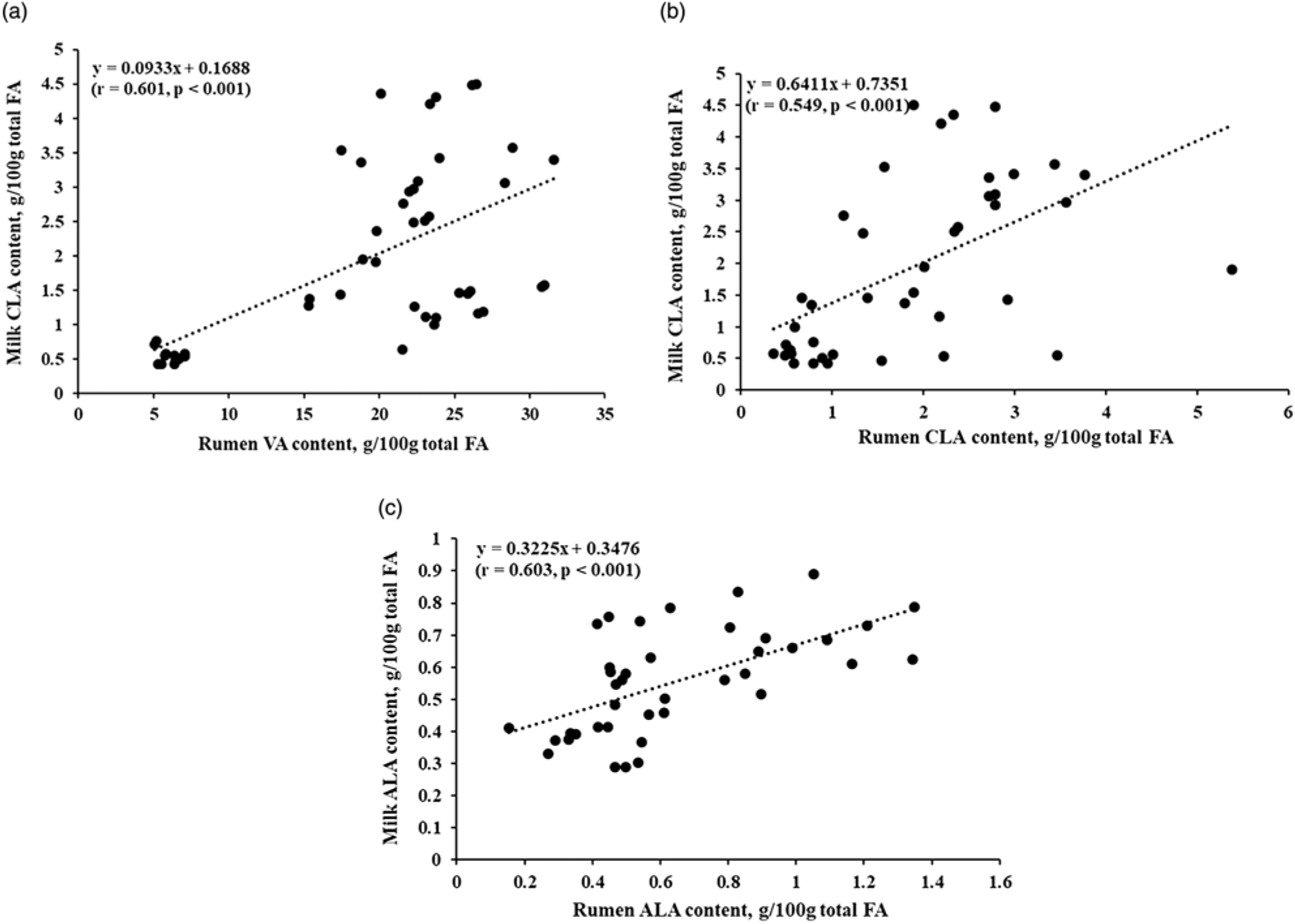
The correlation relationships between rumen FA and milk FA profiles were evaluated in this study (Figure 1). The results showed that ruminal VA content was positively correlated with cis-9, trans-11 CLA content in milk (P < 0.001) (Figure 1a). Both the contents of cis-9, trans-11 CLA and ALA in rumen were positively correlated with these FA profiles in milk (P < 0.001) (Figure 1b and Figure 1c).
(a) Correlation between proportion of VA in rumen and proportion of cis-9, trans-11 CLA in milk of dairy cows. (b) Correlation between proportion of cis-9, trans-11 CLA in rumen and proportion of cis-9, trans-11 CLA in milk of dairy cows. (c) Correlation between proportion of ALA in rumen and proportion of ALA in milk of dairy cows. CLA = conjugated linoleic acid; FA = fatty acid; VA = vaccenic acid; ALA = α-linolenic acid.

Discussion
Previous studies showed that high levels of dietary oil rich in UFA can influence the rumen BH (Loor et al., Reference Loor, Ueda, Ferlay, Chilliard and Doreau2004; Maia et al., Reference Maia, Chaudhary, Bestwick, Richardson, McKain, Larson, Graham and Wallace2010) and cause negative effects on nutrient digestion and fermentation due to the hydrophobic and amphiphilic nature of oils (Onetti et al., Reference Onetti, Shaver, McGuire and Grummer2001; Martin et al., Reference Martin, Rouel, Jouany, Doreau and Chilliard2008; Lunsin et al., Reference Lunsin, Wanapat, Yuangklang and Rowlinson2012b). However, the effects of dietary RO supplementation on rumen digestion and metabolism are unknown. Thus, this is the first in vivo study investigating the effects of diet RO and FO on nutrient digestibility, rumen fermentation and rumen FA profile of dairy cows. We observed that supplementation with oils improved the TTAD of nutrients (DM, EE and NDF) and shifted the rumen fermentation towards propionate reflected by the higher level of propionate and decreased ratio of acetate and propionate. In addition, the oils used also altered the rumen FA profiles by increasing the levels of VA, cis-9, trans-11 CLA and ALA and decreasing the total SFA level.
Rubber seed oil and flaxseed oil improved the total tract apparent digestibility of nutrients
Kholif et al. (Reference Kholif, Morsy and Abdo2018) and Kholif et al. (Reference Kholif, Morsy, Abd El Tawab, Anele and Galyean2016) reported that flaxseed oil supplementation at approximately 2.4% of DM improved DM, EE and NDF digestibility. In addition, one in vitro study also observed that diet supplementation of plants oils at 3% of DM could enhance the digestibility of NDF and EE using a rumen-simulation technique (Vargas et al., Reference Vargas, Andres, Snelling, Lopez-Ferreras, Yanez-Ruiz, Garcia-Estrada and Lopez2017). In consistent with these studies, we observed that FO and RO supplementation in dietary at 4% of DM also could increase the digestibility of DM and NDF in this study. Conversely, studies noted a decrease in DM, OM and NDF digestibility using flaxseed oil in dairy cows dietary at relative higher levels (5.8% of DM) (Martin et al., Reference Martin, Rouel, Jouany, Doreau and Chilliard2008), highlighting that the effect of oil supplementation depends on the level of oil being fed. In addition, compared with FO group, RO group significantly decreased the digestibility of NDF, DM, EE and OM. Considering the levels of these oil supplementation in dietary were same and the main FA composition (ALA) were difference between FO (39%) and RO (18%) (Pi et al., Reference Pi, Gao, Ma, Zhu, Wang, Zhang, Xu and Bu2016). Thus, these differences in nutrients digestibility between FO and RO group may be due to the differential FA composition. On the other hand, a previous study showed that diet addition with roughage (cassava hay) could ameliorate the negative influence on apparent digestibility of DM and OM when supplementing with 4% of rice bran oil (Lunsin et al., Reference Lunsin, Wanapat and Rowlinson2012a). In this study, the ratio of forage to concentrate was 50:50, indicating that the higher percentage of forage in the base diet may ameliorate the negative influence on nutrient digestion by oil supplementation due to the ability of forage to promote normal rumen function for maximum biohydrogenation. Ueda et al. (Reference Ueda, Ferlay, Chabrot, Loor, Chilliard and Doreau2003) also observed that increasing the forage portion of the dairy cow diet decreases the negative effects of flaxseed oil compared with increasing the proportion of concentrates in the diet.
Rubber seed oil and flaxseed oil shifted the ruminal fermentation pattern
In this study, RO and FO supplementation had no effects on rumen pH value and ammonia-N. It was consistent with previous research reported that diet supplementation of plant oil had no effects of rumen pH value and ammonia-N level of dairy cows (Lunsin et al., Reference Lunsin, Wanapat, Yuangklang and Rowlinson2012b). However, when feeding supplemental lipid, the molar proportion of ruminal acetate decreased and propionate increased; concomitantly, the ratio of acetate:propionate decreased (Onetti et al., Reference Onetti, Shaver, McGuire and Grummer2001). We also observed that RO and FO supplementation have the same effects on acetate and propionate composition in rumen. Studies showed that dietary high non-fibre carbohydrate (NFC) or starch could increase the ruminal propionate production and decrease acetate production (Ma et al., Reference Ma, Tu, Zhang, Deng and Diao2015; Philippeau et al., Reference Philippeau, Lettat, Martin, Silberberg, Morgavi, Ferlay, Berger and Noziere2017) or have no effect on individual VFA (Wei et al., Reference Wei, Zhang and Liu2018). However, in this study oil groups had the similar content of NFC in the dietary compared with the CON group (37.59% v. 35.11%). Thus, dietary NFC or starch may have limited impact on the rumen VFA composition in this study. In addition, one in vitro study showed that rapeseed oil, sunflower oil, flaxseed oil or rubber seed oil supplementation could enhance the rumen fermentation pattern with a higher molar proportion of propionate and a smaller acetate to propionate ratio (Jalc and Ceresnakova, Reference Jalc and Ceresnakova2002; Shi, Reference Shi2014). Rice bran oil supplementation in dietary at 4% of DM (Lunsin et al., Reference Lunsin, Wanapat and Rowlinson2012a) or flaxseed oil supplementation in dietary at 2.4% of DM (Kholif et al., Reference Kholif, Morsy and Abdo2018) also increased the proportion of propionate whilst the acetate proportion was decreased in vivo. Previous studies reported that the ruminal VFA concentration depends on feed digestion and activity of ruminal microflora and feed additives (Morsy et al., Reference Morsy, Kholif, Kholif, Matloup, Salem and Elella2015; Kholif et al., Reference Kholif, Morsy and Abdo2018). Thus, the increased ruminal propionate concentration may be due to the enhanced DM and NDF digestibility with dietary oil supplementation in this study. Moreover, a larger propionate production reflects a higher conversion of glycerol because of the hydrolysis of dietary triacylglycerol into propionate (Kholif et al., Reference Kholif, Morsy and Abdo2018). Hence, the increased propionate level from RO and FO is probably due to channelling of excess reduced nicotinamide adenine dinucleotide to propionate production, owing to increased accumulation of hydrogen resulting from inhibition of methanogens by PUFA in the rumen (Patra and Yu, Reference Patra and Yu2012), thereby favouring the succinate pathway that converts carbohydrate to propionate (Van Houtert, Reference Van Houtert1993) and increasing the alternative flow of hydrogen to produce propionate (Xie et al., Reference Xie, Wang, Guan and Liu2018).
Volatile fatty acids not only provide energy for ruminants but also maintain the homeostasis of rumen environment. Propionate originating from the rumen can be used as a precursor to synthesize milk lactose (Huhtanen et al., Reference Huhtanen, Blauwiekel and Saastamoinen1998). In this study, milk lactose yield was greatly increased by oil supplementation (8.53%, 7.75% and 6.20% in RO, FO or RFO groups, respectively) compared with CON (Pi et al., Reference Pi, Gao, Ma, Zhu, Wang, Zhang, Xu and Bu2016), with the propionate proportion increased by 24.28%, 28.13% and 25.43% in RO, FO or RFO groups, respectively, compared with the CON in the rumen. Similarly, a previous study showed that dietary supplementation with fish oil enhanced the milk lactose yield of dairy cows (Keady et al., Reference Keady, Mayne and Fitzpatrick2000). In addition, studies showed that dietary supplementation with flaxseed oil increased rumen propionate production in parallel with increased milk lactose production from dairy cows (Kholif et al., Reference Kholif, Morsy and Abdo2018) or lactating goats (Kholif et al., Reference Kholif, Morsy, Abd El Tawab, Anele and Galyean2016).
We also found that RO and FO supplementation decreased the calculated methane levels. Research has shown that flaxseed oil supplementation reduces the number of ruminal protozoa (Yang et al., Reference Yang, Bu, Wang, Hu, Li, Wei, Zhou and Loor2009) and methanogens (Guyader et al., Reference Guyader, Eugene, Meunier, Doreau, Morgavi, Silberberg, Rochette, Gerard, Loncke and Martin2015), that is, the main methane producers, which were competed for hydrogen availability due to the ruminal biohydrogenation of UFA (Toprak, Reference Toprak2015). However, in other trials, protozoa and methanogen numbers remained unchanged after dietary flaxseed oil supplementation (Popova et al., Reference Popova, McGovern, McCabe, Martin, Doreau, Arbre, Meale, Morgavi and Waters2017; Popova et al., Reference Popova, Guyader, Silberberg, Seradj, Saro, Bernard, Gerard, Martin and Morgavi2019). Although the population of methanogens and protozoa was not measured in this experiment, our in vitro study found that both the population of methanogens and the production of methane were greatly reduced after 4% RO supplementation (Shi, Reference Shi2014), indicating that RO inhibited the rumen methane production by reducing the population of ruminal methanogens which need further investigation.
Rubber seed oil and flaxseed oil altered the rumen fatty acid composition
Dietary PUFA can be bio-hydrogenated by microorganisms after the PUFA enter the rumen and the final product is mainly C18:0 (Wahle et al., Reference Wahle, Heys and Rotondo2004). However, the incompleteness of the hydrogenation process produces a series of intermediate products such as C18:1, CLA and their isomers (Wahle et al., Reference Wahle, Heys and Rotondo2004). In this study, diet supplementation of RO and FO, either alone or in combination, increased the levels of VA, cis-9, trans-11 CLA, ALA, total UFA and total MUFA in rumen, while markedly decreasing the content of total SFA (P < 0.05). These results are consistent with a previous in vitro study with RO (Shi, Reference Shi2014) and FO (Wang et al., Reference Wang, Song, Son and Chang2002), which showed that RO and FO supplementation greatly increased the levels of VA, cis-9, trans-11 CLA and total UFA in a rumen fermentation system.
The effects of oil supplementation on the fatty acid profile and BH of ruminal digesta depend on the type and amount of oil added and on the diet to which the oil is incorporated (Shingfield et al., Reference Shingfield, Kairenius, Arola, Paillard, Muetzel, Ahvenjarvi, Vanhatalo, Huhtanen, Toivonen, Griinari and Wallace2012). The addition of RO at an appropriate dose could, in theory, contribute to the production of healthier products from ruminant livestock (Pi et al., Reference Pi, Gao, Ma, Zhu, Wang, Zhang, Xu and Bu2016). Milk fat CLA originates both from ruminal BH of dietary PUFA and from endogenous conversion of VA by Δ9-desaturase in the mammary gland of dairy cows (Griinari et al., Reference Griinari, Corl, Lacy, Chouinard, Nurmela and Bauman2000). In support of this, supplementation with RO and FO increased the contents of VA in rumen, which was positively correlated with the contents of cis-9, trans-11 CLA in milk (Figure 1a). FAs from the rumen are an important source for the milk fat synthesis. The levels of VA, cis-9, trans-11 CLA and ALA in the rumen were significantly increased by oil treatment, and these FAs can form the basis for increasing their content in milk fat as shown in our previous research (Pi et al., Reference Pi, Gao, Ma, Zhu, Wang, Zhang, Xu and Bu2016). Indeed, we observed that the profiles of CLA and ALA in the rumen were positively correlated with the profiles of those FAs in milk in this study (Figure 1b and c), suggesting that nutritional strategies intervene the rumen FA profile could improve milk fat quality.
Bauman and Griinari (Reference Bauman and Griinari2001) proposed the BH theory, stating that diets causing milk fat depression (MFD) alter ruminal lipid metabolism resulting in the formation of specific BH intermediates that directly inhibit milk fat synthesis. However, some CLA isomers, such as trans-10, cis-12 CLA (Baumgard et al., Reference Baumgard, Corl, Dwyer, Saebo and Bauman2000) and trans-10 octadecenoic acid (Shingfield et al., Reference Shingfield, Saebo, Saebo, Toivonen and Griinari2009) were shown to cause MFD. Our previous study showed that dietary supplementation with rubber seed oil and flaxseed oil decreases the level of milk fat (Pi et al., Reference Pi, Gao, Ma, Zhu, Wang, Zhang, Xu and Bu2016). However, the proportion of trans-10, cis-12 CLA present in the rumen 3 h after feeding significantly decreased with oil supplementation, pointing that other factors may contribute to the decreases of milk fat, for example, the negative effects of dietary oils on ruminal acetate concentration in this study (Onetti et al., Reference Onetti, Shaver, McGuire and Grummer2001), as the precursor of milk fat synthesis. In addition, lower mammary lipogenesis associated with supplementing the diets of animals with PUFA-rich oil may be another reason (Chilliard et al., Reference Chilliard, Ferlay and Doreau2001), which requires further investigation.
Conclusions
Dietary supplementation with 4% rubber seed oil and flaxseed oil improves total tract apparent digestibility of nutrients (dry matter, neutral detergent fibre and ether extracts) and shifts the rumen fermentation pattern by increasing the proportion of propionate. In addition, cows offered rubber seed oil and flaxseed oil showed altered rumen fatty acid composition with enhanced vaccenic acid, cis-9, trans-11 conjugated linoleic acid and α-linolenic acid. These findings provide a theoretical basis for the application of rubber seed oil in livestock production.
Acknowledgements
This research was supported by research programmes from the National Key Research and Development Program of China (2018YFD0501600), the Agriculture Science and Technology Innovation Program (ASTIP-IAS07), Chinese Academy of Agricultural Science and Technology Innovation Project (CAAS-XTCX2016011-01) and Beijing Dairy Industry Innovation Team (BAIC06-2019).
Declaration of interest
The authors declare no conflicts of interest.
Ethics statement
The experimental design and procedures were approved by the Institutional Animal Care and Use Committee of the Chinese Academy of Agricultural Sciences following the requirements of the Regulations for the Administration of Affairs Concerning Experimental Animals.
Software and data repository resources
Data are not deposited in an official repository.