Introduction
Latrophilin (LPH) belongs to a subfamily of neuronal adhesion G-protein-coupled receptors (aGPCRs). It was originally isolated from bovine brain and known as receptors of α-latrotoxin, a neurotoxic component of black widow spider venom (Krasnoperov et al., Reference Krasnoperov, Bittner, Beavis, Kuang, Salnikow, Chepurny, Little, Plotnikov, Wu and Holz1997; Lelianova et al., Reference Lelianova, Davletov, Sterling, Rahman, Grishin, Totty and Ushkaryov1997; Mee et al., Reference Mee, Tomlinson, Perestenko, De, Duce, Usherwood and Bell2004). Typically, the LPHs family comprise three isoforms LPH-1, LPH-2, and LPH-3 in most vertebrates, whereas only one in insects (Sugita et al., Reference Sugita, Ichtchenko, Khvotchev and Südhof1998; Boucard et al., Reference Boucard, Maxeiner and Südhof2014). As an important component of GPCRs, LPHs can transmit multiple signals to regulate the growth, development, and reproduction in eukaryotes (Meza-Aguilar & Boucard, Reference Meza-Aguilar and Boucard2014). Studies in vertebrates showed LPHs play an important role in nervous system. For instance, LPH-1 was reported to be closely associated with the mental disorders such as schizophrenia and bipolar disorder in human and mice (Chen & Chen, Reference Chen and Chen2005; Kellendonk et al., Reference Kellendonk, Simpson and Kandel2009; Bonaglia et al., Reference Bonaglia, Marelli, Novara, Commodaro, Borgatti, Minardo, Memo, Mangold, Beri and Zucca2010). Null mutant of lph-3 mice led to a hyperactive phenotype in behavioral tests which accompanied by increasing the levels of dopamine and serotonin in the dorsal striatum (Wallis et al., Reference Wallis, Hill, Mendez, Abbott, Finnell, Wellman and Setlow2012). It was also reported that lph-3 mutation in exon 20 was the reason of equine degenerative myeloencephalopathy, which caused degeneration of the motor neurons in the spinal cord and progressive development of symmetric ataxia predominantly in the hind limbs (Posbergh, Reference Posbergh2015). Furthermore, in Danio rerio, the loss of lph-3.1 function caused a reduction and misplacement of dopamine-positive neurons in the ventral diencephalon and further caused hyperactive/impulsive motor phenotype (Lange et al., 2012; van der Voet et al., Reference Van Der Voet, Harich, Franke and Schenck2016). All these results suggested that lphs are essential for normal development of nervous system. In addition to the role in mental disorders and nervous system, it has been reported that lphs are also essential for the embryogenesis in vertebrates. Null mutant of lph-1 mice causes embryonic lethal, and lph-2 is essential for the normal development of embryonic chicken heart which has been regarded as a novel regulator of the epithelial–mesenchymal transition (Doyle et al., Reference Doyle, Scholz, Greer, Hubbard, Darnell, Antin, Klewer and Runyan2006; Silva & Ushkaryov, Reference Silva and Ushkaryov2010). These results suggested that lphs play an important role in nervous system and embryogenesis in vertebrates.
Although there is only one lph existed in insects, it still plays essential roles in regulating nervous system and embryogenesis. In Drosophila melanogaster, RNA interference (RNAi) against CG8639/lph induced hyperactivity and lost sleep (Van Der Voet et al., Reference Van Der Voet, Harich, Franke and Schenck2016). RNAi of lat-1 (a homolog of lph-1) in Caenorhabditis elegans resulted in embryo lethality by affecting establishment of anterior–posterior tissue polarity (Langenhan & Russ, Reference Langenhan and Russ2010; Muller et al., Reference Muller, Winkler, Fiedler, Sastradihardja, Binder, Schnabel, Kungel, Rothemund, Hennig, Schoneberg and Promel2015). These results revealed the conserved functions of lph between the vertebrates and invertebrates. Interestingly, recent studies in invertebrates showed novel functions of lph. Further, in C. elegans, RNAi against lat-1 led to a higher paralysis rate than control after exposure to aldicarb (Mee et al., Reference Mee, Tomlinson, Perestenko, De, Duce, Usherwood and Bell2004), which was an acetylcholinesterase inhibitor and killed insects by overstimulation of the nervous system (Oh & Kim, Reference Oh and Kim2017). This result suggested that lph may play an important role in the susceptibility to anticholinesterase insecticides. Simultaneously, our recent studies in T. castaneum showed that RNAi of Tclph significantly increased susceptibility to organophosphates (OPs) and carbamates, further caused the higher mortalities compared with control groups (Gao et al., Reference Gao, Xiong, Wei, Liu, Liu, Xie, Song, Bi and Li2018). Knockdown of Tclph caused the decline on egg laying in females (Gao et al., Reference Gao, Liu, Liu, Xiong, Song, Wei, Wei and Li2017), which suggested Tclph plays important roles in anticholinesterase susceptibility and fecundity in T. castaneum. However, it is still not clear how does lph play such important roles in T. castaneum. To elucidate these issues, we further performed transcriptome profiling analysis between the control and ds-lph insects. It showed that RNAi of Tclph changed a large amount of multiple metabolism detoxification enzymes which were participated in cellular detoxification processes. Among these detoxification enzyme, two carboxylesterase (cce, also called est/ces/carE) genes, Tces4 and Tcest6, as typical metabolism detoxification enzyme gene were changed markedly in ds-lph insects (Gao et al., Reference Gao, Xiong, Wei, Liu, Liu, Xie, Song, Bi and Li2018).
Notably, in insects, cces were involved in resistance for a larger number of insecticides including OPs, carbamates, and pyrethroids (Kim et al., Reference Kim, Issa, Cooper and Zhu2015; Zhang et al., Reference Zhang, Li, Ge, Yang, Guo, Zhu, Ma and Zhang2015). In Locusta migratoria, RNAi against Lmcesa1 or Lmcesa2 caused the significantly increased susceptibility of the nymphs to chlorpyrifos (Langenhan & Russ, Reference Langenhan and Russ2010; Muller et al., Reference Muller, Winkler, Fiedler, Sastradihardja, Binder, Schnabel, Kungel, Rothemund, Hennig, Schoneberg and Promel2015). In Anopheles gambiae, the activities of CCEs in the carbofuran-, bendiocarb-, and pyrethroid-resistant strains were higher than those of the susceptible strains, suggesting that the elevated activities of CCEs in the resistant strains may be responsible for resistance to these insecticides. In Nilaparvata lugens, OPs, and carbamate resistance is based on the amplification of a cce gene, Nlest1. Besides, cces also affect reproduction process of insects (Robin et al., Reference Robin, Bardsley, Coppin and Oakeshott2009; Durand et al., Reference Durand, Chertemps, Francois, Rosell, Dekker, Lucas and Maibeche-Coisne2014). In Sogatella furcifera, suppression of cce precursor Sfest1 expression led to dramatically reduced egg laying, oviposition period, and longevity of female (Ge et al., Reference Ge, Huang, Jiang, Gu, Xia, Yang, Liu and Wu2017). In Drosophila ananassae, null mutant fly of est4 caused the reduction of fertile (Krishnamoorti & Singh, Reference Krishnamoorti and Singh2017). These results indicated that lph and cces may have some intrinsic link on insecticides tolerance and reproduction of organisms.
Here, we focused attention on two cce genes, Tcest4 and Tcest6, and characterized the interactions between these two genes and Tclph, to clarify the potential regulatory mechanisms of Tclph in T. castaneum. We first investigated the possible roles of Tcest4 and Tcest6 in insecticide resistance. Then, we tested the response of these two genes in ds-lph insects after exposure to carbofuran and dichlorvos insecticides. Finally, the possible mechanism of Tcest4 and Tcest6 in Tclph-regulated reproduction was also investigated. Our results will provide a novel clue on how that Tclph affected the insecticides susceptibility and fecundity through regulating Tcest4 and Tcest6 in T. castaneum.
Materials and methods
Insect strains
A laboratory colony of T. castaneum Georgia-1 (GA-1) line insects were used for all these experiments and reared 40% relative humidity in whole wheat flour with 5% brewer yeast powder at 30°C under standard conditions (Song et al., Reference Song, Huang, Liu, Li, Gao, Wu, Zhai, Yu, Xiong, Xie and Li2017; Xiong et al., Reference Xiong, Zhai, Yu, Wei, Mao, Liu, Xie and Li2018).
RNA extraction and cDNA preparation
Samples for early eggs (1 day old), late eggs (3 days old), early larvae (1 day old), late larvae (20 days old), early pupae (1 day old), late pupae (5 days old), early adults (1 day old), late adults (7 days old) were collected during eight developmental stages. Central nervous system, gut, fat body, epidermis and hemolymph were dissected from late larvae of T. castaneum. While, epidermis, central nervous system, tentacle, elytra, fat body, malpighian tubule, gut, ovary, and testis were dissected from late adults of T. castaneum. Total RNAs were extracted from these samples and tissues by using RNAiso™Plus (TaKaRa, Dalian, China) following the standard protocol. The yields of the isolated RNAs were determined by NanoDrop 2000 Spectrophotometer (Thermo Scientific, Waltham, MA, USA). The RNAs were only used when the Abs260 nm/Abs280 nm ratio was >1.8 and the RNAs integrity was further evaluated by 1% agarose gel electrophoresis. Then, 500 ng of total RNAs was converted to cDNAs by HiScript II Reverse Transcriptase (Vazyme, Nanjing, China).
Quantitative real-time PCR
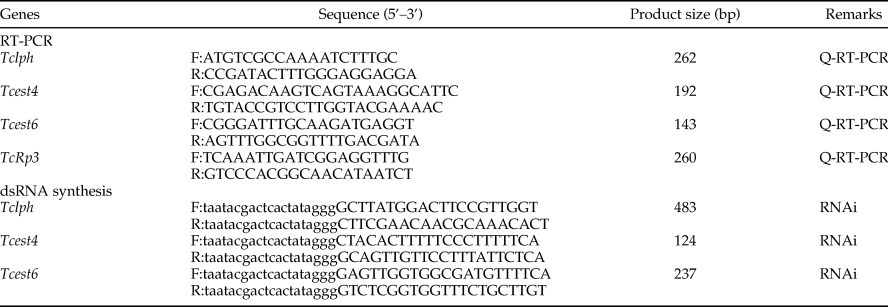
Quantitative real-time PCR (qRT-PCR) was performed with ChamQ SYBR qPCR Master Mix (High ROX Premixed) (Vazyme) by StepOnePlus Real-Time PCR System (Applied Biosystems, Foster City, CA, USA). The qRT-PCR was programmed at 95°C for 10 min, followed by 40 cycles of 95°C for 15 s and 60°C for 1 min, finally at 95°C for 15 s, 60°C for 1 min, and 95°C for 15 s. The data are expressed here as the relative mRNA levels normalized to a control gene, T. castaneum ribosomal protein S3 (rps3) (Begum et al., Reference Begum, Li, Beeman and Park2009), using the 2−ΔΔCT method (Livak & Schmittgen, Reference Livak and Schmittgen2001; Wang et al., Reference Wang, Liu, Zhou, Yi, Pan, Wang, Zhang, Wang, Yang and Xi2018). The primers were listed in table 1.
Primers used for qRT-PCR analysis and dsRNA synthesis in this study.

F means forward primers; R means reverse primers. Letters in lowercase are the T7 promoters for dsRNA synthesis.
Double-strand RNA synthesis and injection
For preparing double-strand RNAs (dsRNAs), gene-specific primers containing a T7 polymerase recognition promoter were designed with the Primer Premier 5.0 (table 1). The primers were used for PCR amplification and PCR products were further used as templates for dsRNAs synthesis with TranscriptAid™ T7 High Yield Transcription Kit (Fermentas, Vilnius, Lithuania). A total of 200 ng of dsRNAs in 200 nl was injected into the body cavity of each larva. Insects injected with an equal volume of physiological buffer only (IB) and non-injected wild type (WT) insects were denoted as negative controls. At least three biological replications were performed for independent injection.
Induction analysis in response to insecticides
Two selected insecticides including carbofuran (purity 98%) and dichlorvos (purity 98%) (Sigma-Aldrich, Munich, Germany) were used to evaluate contact toxicity to late larvae (20 days old). Median lethal concentration (LC50) diluted with acetone were used for each insecticide as follows: 1 mg ml−1 for carbofuran and 10 mg ml−1 for dichlorvos. At the time point showing the highest RNAi efficiency, approximately 170 µl of each insecticide solution or acetone (control) was used to treat the 50 late larvae from ds-lph or control (IB and WT) group for 1 min. Then the treated larvae were placed on a Whatman filter paper for drying in the air (about 2 min), they were transferred into an 8 ml glass vial and kept under the standard conditions as previously described (Lu et al., Reference Lu, Park, Gao, Zhang, Yao, Pang, Jiang and Zhu2012). After the insecticide treatment, surviving beetles were randomly selected to determine the expression of Tcest4 and Tcest6 at each of six follow-up time points (12, 24, 36, 48, 60 and 72 h) by using qRT-PCR. Three biological replicates were performed for each treatment.
Bioassay of insecticide susceptibility
At the time point showing the highest RNAi efficiency, approximately 50 µl of each of two insecticide solution including carbofuran (1 mg ml−1) or dichlorvos (10 mg ml−1) was applied into 15 beetles from ds-est4, ds-est6 or control (IB and WT) group following the procedure described. The mortalities of the treated and control larvae were assessed every 12 h after the insecticide treatment in 3 days. Here, the insects were considered dead if they were unable to move and no response when disturbed with a tweezer or brush, and each bioassay was replicated three times.
Behavior analysis
The larval injections were followed by the observation of the noticeable morphological defects, mortality, and female egg-laying and egg-hatching rate. Eight days adults from six replications of larval RNAi injections were utilized for single pair mating (average 8–10 pairs per replication). Three of these replications were used to examine reproductive recovery by backcrossing with the WT beetles. Eggs laid over 3 days were collected, counted, and held for hatchability measurement and observation of development. The hatching rate of the offspring was investigated at ~15 days after the eggs were collected.
Imaging of gonads and measurement of eggs size
The gonads were dissected from the injected beetles on eighth day post-adult eclosion. Eggs laid over 3 days were collected following the procedure described in ‘Behavior analysis’ section for length and width measurement of eggs. Images of gonads and eggs were taken using an Olympus SZX16 (Olympus Corporation, Tokyo, Japan) stereomicroscope. Image-Pro-Express software (Media Cybernetics, Silver Spring, MD, USA) was used to control the microscope, image acquisition, and exportation of TIFF files. The images were processed using Photoshop CS4 software (Adobe Systems Inc., San Jose, CA, USA) for converting RAW format to EPS format, which then were compatible with the Adobe Illustrator version 4.0 software (Adobe Systems Inc.) vector graphics image editor program. The length and width of eggs was measured by using ImageJ software (Schneider et al., Reference Schneider, Rasband and Eliceiri2012).
Determination of enzyme activity
For enzymatic activity determinations, ~15 larvae were homogenized in 10 volumes of 0.15 M NaCl. The equal amount of homogenate was used to measure the activities of CCEs by spectrophotometrical method following the commercial kits instructions (Nanjing Jiancheng Bioengineering Institute, Nanjing, China).
Statistical analysis
All data were expressed as the mean ± SE. Fold changes in gene expression between control and treated beetles, differences among the tissues and development stages, and insecticides bioassay were subjected to Student's t-test and one-way analysis of variance (ANOVA) in combination with a Fisher's least significant difference (LSD) multiple comparison tests, respectively, by using the SPSS statistics program (Chicago, USA). ***/### indicates P < 0.001, **/## indicates P < 0.01, and */# indicates P < 0.05.
Results
Tclph negatively regulated Tcest4 and positively regulated Tcest6 transcripts
In order to identify the interaction of Tcest4 and Tcest6 with Tclph, RNAi was performed. QRT-PCR analyses showed Tclph, Tcest4, and Tcest6 were effectively knockdown by the corresponding dsRNA injection (fig. S1). RNAi against Tclph further upregulated Tcest4 expression (2.9-fold, P < 0.05) and downregulated Tcest6 (1.79-fold, P < 0.05), respectively. While knockdown Tcest4 and Tcest6 did not affect the expression of Tclph (fig. 1). However, depression of Tcest4 remarkably elevated the expression level of Tcest6, and Tcest6 RNAi also increased the expression of Tcest4. These results implied that Tcest4 and Tcest6 are two downstream genes for Tclph, and Tclph negatively regulates Tcest4 and positively regulates Tcest6.
Interaction of Tclph, Tcest4, and Tcest6. Late larvae were injected with ds-lph, ds-est4, and ds-est6. Physiological buffer-injected beetles (IB) and wild type beetles (WT) provided controls. The induction of Tclph, Tcest4, and Tcest6 was separately examined on the five groups (WT, IB, ds-est4, ds-est6, and ds-lph) using qRT-PCR. Data were shown as mean ± SE from three independent experiments. Different letters above the standard error bars indicated significant differences based on the one-way ANOVA followed by Fisher's LSD multiple comparison test (P < 0.05).

Temporal and spatial expression pattern of Tcest4 and Tcest6 in T. castaneum
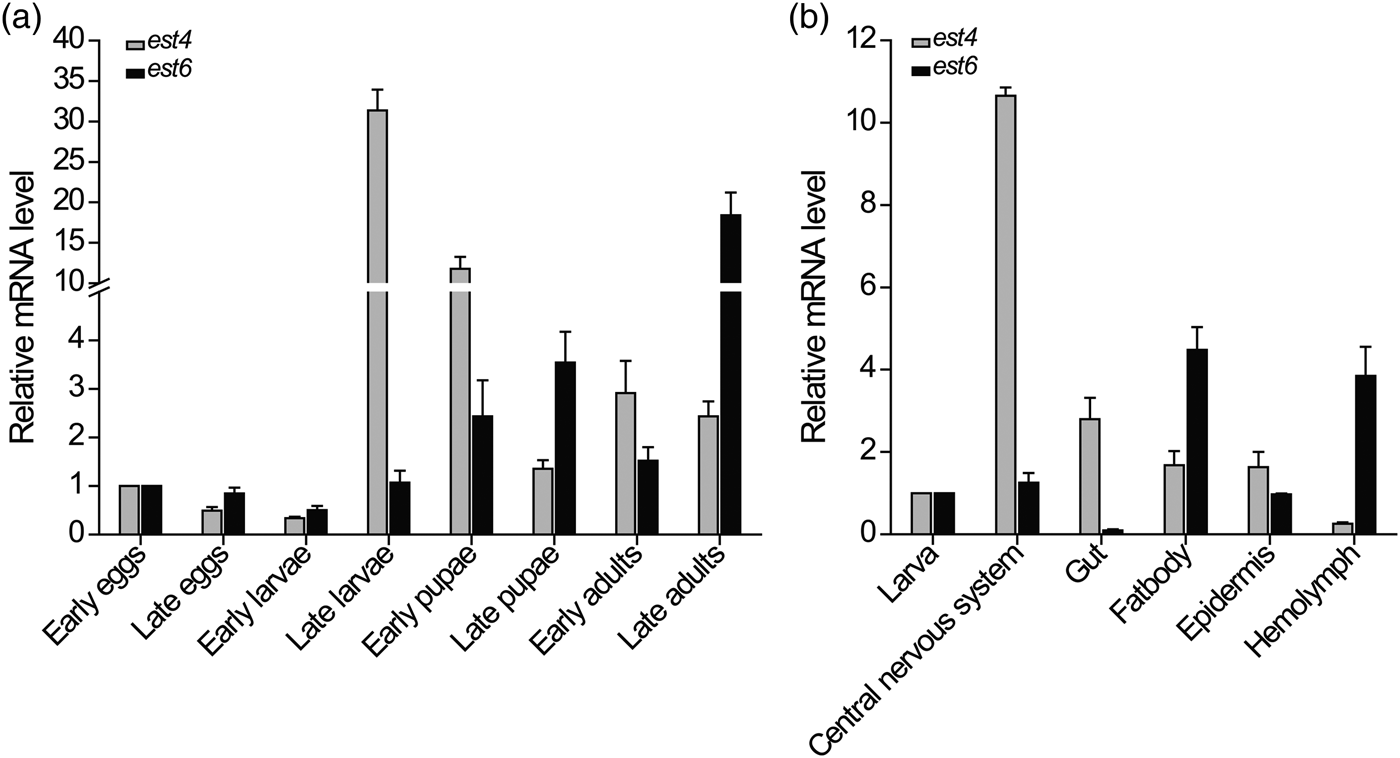
These two cce genes were expressed throughout all the stages of development. Typically, Tcest4 was highly expressed at the late larvae stage, followed by early pupae stage. Whereas Tcest6 was abundantly accumulated at the late adults stage, followed by early and late pupae stage (fig. 2a). The spatial expression patterns showed Tcest4 was mainly expressed in central nervous system, as well as slightly expression in other tissues. However, Tcest6 was predominantly expressed in fat body and hemolymph (fig. 2b).
Temporal (a) and larvae spatial expression patterns (b) of Tcest4 and Tcest6 in T. castaneum by qRT-PCR. Tribolium ribosomal protein 3 (rps3) transcript with the same cDNA template served as an internal control. Tissues were isolated from late larvae. Data were shown as mean ± SE from three independent experiments.

The induction of Tcest4 and Tcest6 by insecticides treatment
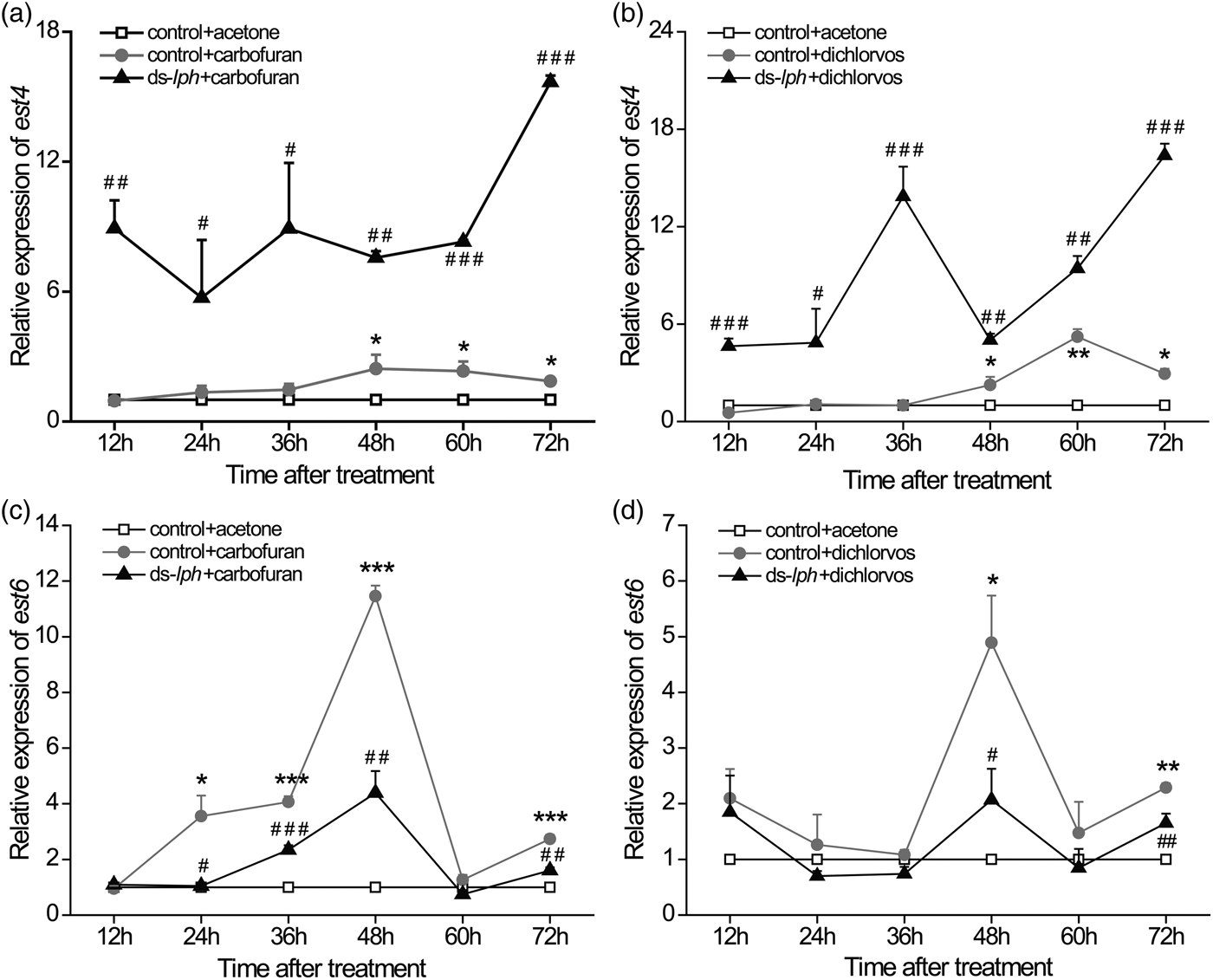
To investigate how Tcest4 and Tcest6 were involved in the detoxification, the expression of Tcest4 and Tcest6 were examined at 12, 24, 36, 48, 60, and 72 h after exposure to carbofuran and dichlorvos insecticides. Tcest4 was increased 2.4-, 2.3-, 1.8-fold at 48, 60, 72 h after exposure to carbofuran treatments, respectively, compared with acetone treatments; it was increased 2.2-, 5.2-, 2.9-fold at 48, 60, 72 h after treated with dichlorvos, respectively (figs 3a, b). While, the expression of Tcest6 was also elevated 3.5-, 4-, 11.5-, 2.7-fold at 24, 36, 48, 72 h after treated with carbofuran, respectively; and increased 4.9-, 2.3-fold at 48, 72 h after carbofuran treatment, respectively (figs 3c, d).
The response of Tcest4 and Tcest6 to insecticides exposure with/without RNAi of Tclph. Late larvae of ds-lph and control group treated with both carbofuran (10 mg ml−1) and dichlorvos (1 mg ml−1) solution. Acetone-treated IB beetles provided negative controls, which had been ascribed an arbitrary value of 1. The mRNA amounts Tcest4 and Tcest6 were determined by qRT-PCR after 12, 24, 36, 48, 60, 72 h later insecticides treated. Data were shown as mean ± SE from three independent experiments. Significant differences between the acetone treated and insecticides treated were identified with ‘*’; significant differences between insecticides treatment and insecticides treated after ds-lph injected were identified with ‘#’. Three replicates were employed per time point. Statistical significance was assessed by one-way ANOVA followed by Fisher's LSD multiple comparison test (***/###P < 0.001, **/##P < 0.01, */#P < 0.05).

RNAi against Tcest4 and Tcest6 increased the susceptibility to insecticides
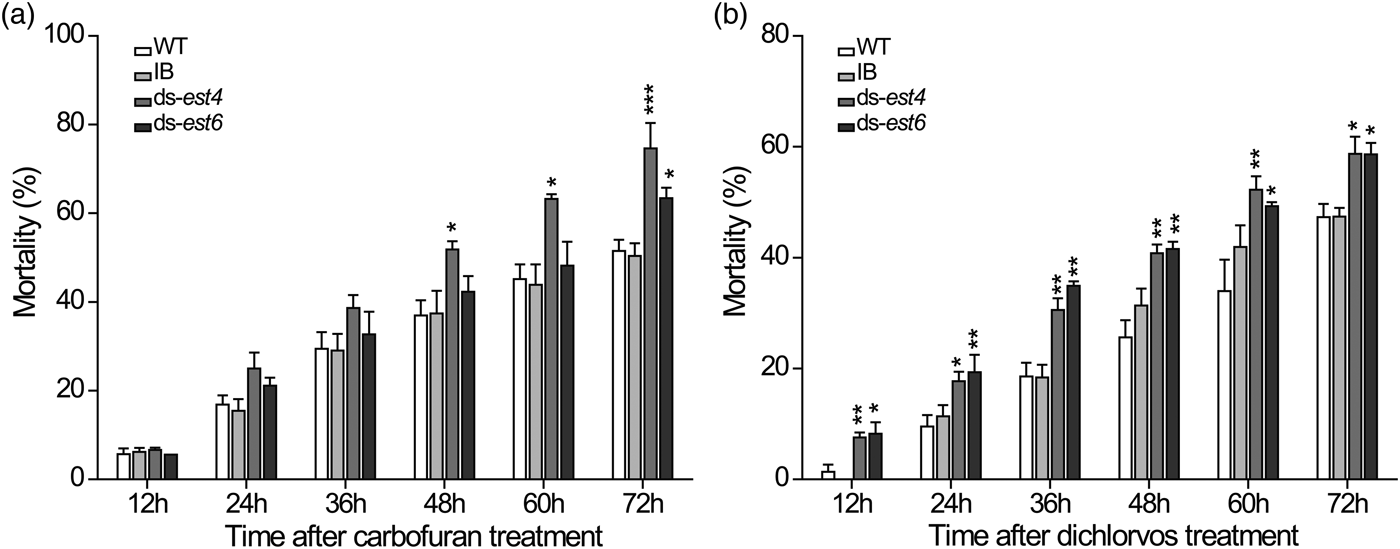
Knockdown efficiencies of Tcest4 and Tcest6 were reached at ~87 and ~84% reduction in gene expression, respectively, on the fourth day after RNAi injection (fig. S1). Then, we detected the T. castaneum susceptibility to insecticides by treating with LC50 carbofuran and dichlorvos. The mortality statistical data show that the cumulative mortalities were 74.6 and 63.4% in the group injected with ds-est4 and ds-est6, respectively, after treated with carbofuran 72 h (fig. 4a). After treated with dichlorvos 72 h, the cumulative mortalities were 58.7 and 58.6% in ds-est4 and ds-est6 injected group, respectively (fig. 4b). All these results showed either Tcest4 or Tcest6 knockdown beetles exhibited a significantly faster and higher mortality response compared with controls, which suggested Tcest4 and Tcest6 were important in metabolic carbofuran and dichlorvos detoxification in T. castaneum.
Susceptibility of T. castaneum to carbofuran (a) and dichlorvos (b) after Tcest4 and Tcest6 was knockdown. IB and WT served as negative control. Ds-est4 and ds-est6 beetles were injected with dsRNA against Tcest4 and Tcest6, respectively. Data were shown as mean ± SE from three independent experiments. ‘*’ indicated significant differences in mortality rates between dsRNA-treated beetles and IB or WT. Statistical significance was assessed by one-way ANOVA followed by Fisher's LSD multiple comparison test (*** P < 0.001, ** P < 0.01, * P < 0.05).

Tcest4 was promoted and Tcest6 was repressed after insecticides treatment in ds-lph-injected beetles
To further explore that whether Tclph participated in insecticides resistance through regulation of Tcest4 and Tcest6 in T. castaneum, the Tcest4 and Tcest6 transcript levels were examined at 12, 24, 36, 48, 60, and 72 h after insecticides treatment in ds-lph-injected beetles. As shown in figs 3a, b, when compared with insecticides treatment only, the expressions of Tcest4 were increased 4.6- to 16.38-fold in ds-lph group after carbofuran and dichlorvos treated 12–72 h. However, the expressions of Tcest6 were reduced 70.5, 42.4, 61.7, and 41.4% in ds-lph group after carbofuran treated 24, 36, 48, 72 h, respectively (fig. 3c); and reduced 57.9 and 27.6% after exposure to dichlorvos 48 and 72 h, respectively.
RNAi of Tcest6 gene reduced female egg-laying and egg-hatching rate
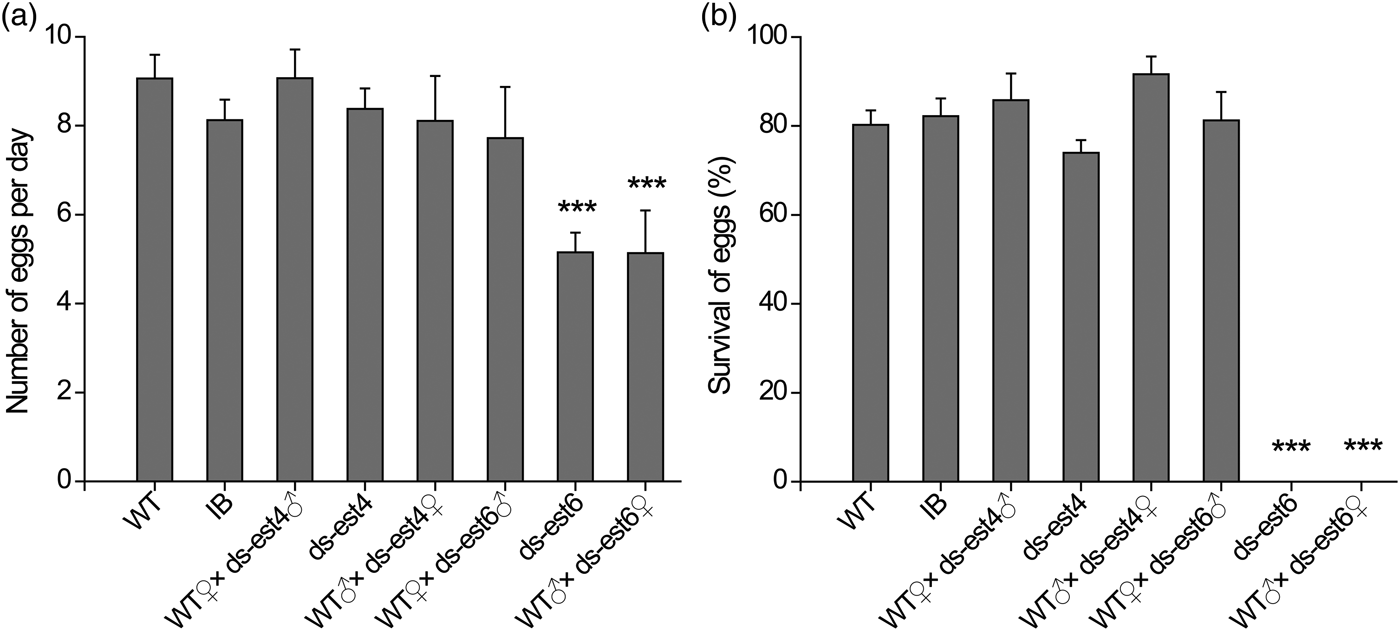
To identify whether Tcest4 and Tcest6 are involved in the fecundity deficiency of Tclph in T. castaenum, RNAi was performed by knocking down the expression of Tcest4 and Tcest6 in 15 days old larvae. Ds-est6 beetles laid an average of 5.15 ± 0.44 eggs/day/female, while 9.06 ± 0.54 eggs were produced by the WT females per day (fig. 5a). Furthermore, all of the ds-est6 eggs could not hatch into larva, whereas WT hatching rate is 80.2% (fig. 5b). Meanwhile, the inhibition of number of eggs and survival rate were recovered by back-crossing with WT females, but not WT males (figs 5a, b). However, RNAi of Tcest4 had no influence on female egg-laying and egg-hatching rate. These results showed that the effect of Tcest6 RNAi on T. castaneum adult fecundity was female specific as well as ds-lph. It indicated that Tclph may affect the fecundity through the Tcest6 in T. castaneum.
The effect of RNAi for Tcest4 and Tcest6 on female egg-laying (a) and egg-hatching rate (b). ♂ and ♀ represented males and females, respectively. WT♀ × ds-est4 ♂, ds-est4 male crossed with WT female adult; WT♂ × ds-est4♀, ds-est4 female crossed with WT male adult; WT♀ × ds-est6 ♂, ds-est6 male crossed with WT female adult; WT♂ × ds-est6♀, ds-est6 female crossed with WT male adult. Female egg laying was presented as egg number per female per day. Egg-hatching rate was calculated as the percentage of the number of hatched larvae vs the total number of the eggs laid. Each bar represented mean ± SE of more than 20 pairs of beetles from three independent experiments. Statistical significance between dsRNA-treated beetles and control was assessed by one-way ANOVA followed by Fisher's LSD multiple comparison test (*** P < 0.001).

RNAi of Tcest6 gene affected ovary development and eggs size
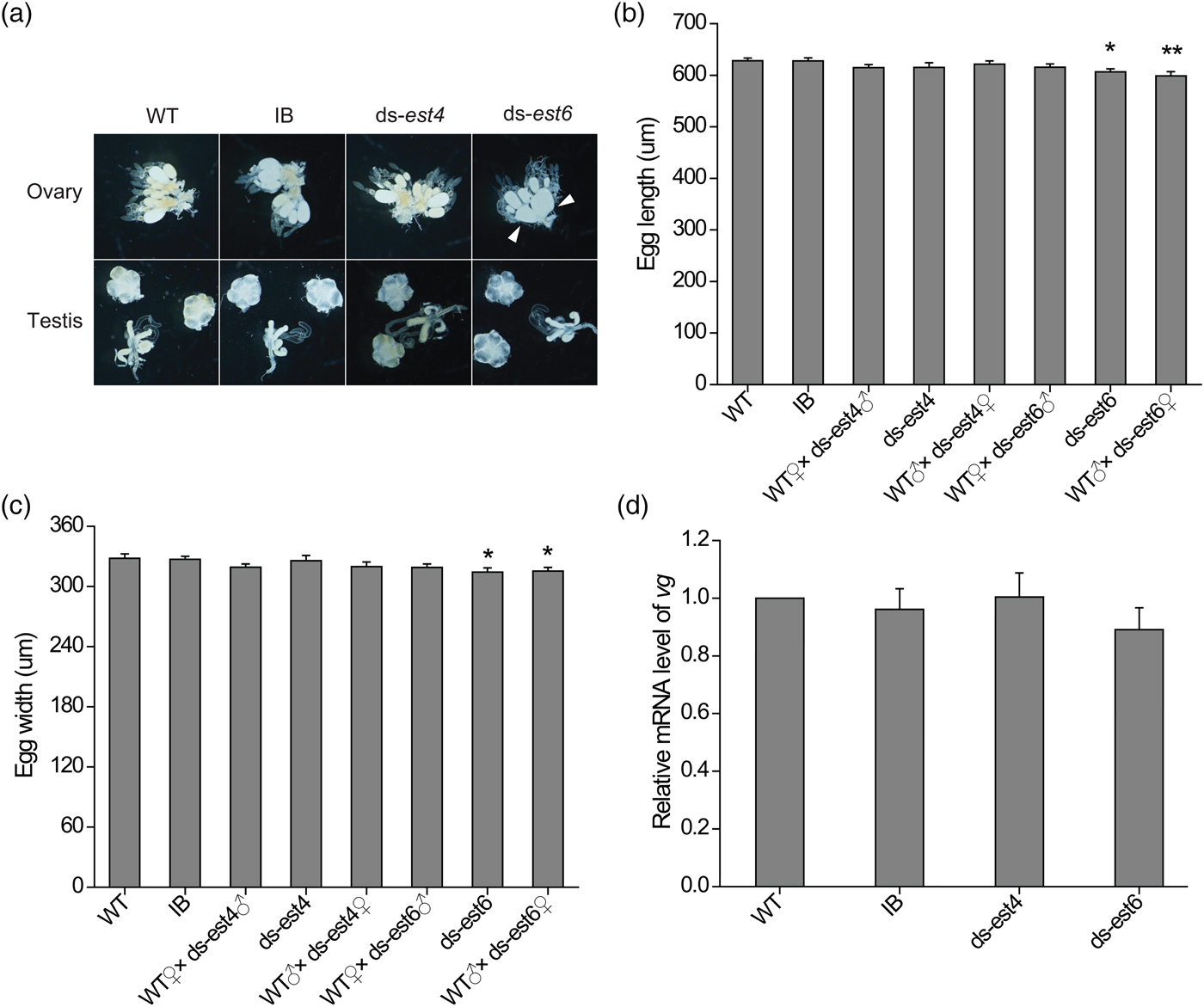
The dissections results showed, in ds-est6 beetles, the fully developed eggs stuck into the lateral oviducts (75%, n = 28). In ds-est6 beetles, the mean size of eggs was 606.50 ± 6.05 µm length and 314.43 ± 4.20 µm width, which were significantly shorter than 628.03 ± 5.36 µm length and 328.01 ± 4.50 µm width in WT (WT, n = 35) (figs 6a, b, c). Whereas ds-est4 have no effect on ovarian and egg development (figs 6a, b, c). To identify whether fecundity deficiency of ds-est6 was due to affecting the vitellogenin (vg) production, the same as Tclph, the expression of vg was measured using qRT-PCR. However, the expression of vg in ds-est6 beetles has no significant difference with the control groups (fig. 6d).
The effect of Tcest4 and Tcest6 on ovary phenotype (a), egg length (b), egg width (c), vg expression (d) by larval RNAi. IB and WT served as negative control. Ds-est4 and ds-est6 beetles were injected with dsRNA against Tcest4 and Tcest6, respectively. Arrowheads in A indicated the lateral oviducts clogged by mature eggs. ♂ and ♀ represented males and females, respectively. WT♀ × ds-est4♂, ds-est4 male crossed with WT female adult; WT♂ × ds-est4♀, ds-est4 female crossed with WT male adult; WT♀ × ds-est6♂, ds-est6 male crossed with WT female adult; WT♂ × ds-est6♀, ds-est6 female crossed with WT male adult. The mRNA amounts vg were determined by qRT-PCR. Each bar represented mean ± SE of more than 15 pairs of beetles. Statistical significance between dsRNA-treated beetles and control was assessed by one-way ANOVA followed by Fisher's LSD multiple comparison test (**P < 0.01, *P < 0.05).

Discussion
Our previous study has shown that Tclph was involved in the anticholinesterase insecticides susceptibility and fecundity in T. castaneum (Gao et al., Reference Gao, Liu, Liu, Xiong, Song, Wei, Wei and Li2017; Gao et al., Reference Gao, Xiong, Wei, Liu, Liu, Xie, Song, Bi and Li2018). To further identify the regulatory mechanisms of Tclph in these important biological processes, we performed the transcriptome analysis between the control and ds-lph beetles. The results showed that multiple detoxification enzyme genes including cytochrome P450s (cyps), cces, odorant-binding proteins (obps), and chemosensory proteins (csps) were affected in ds-lph beetles. Among these, the expression of two genes of cce family, Tcest4 and Tcest6, were significantly changed. In this study, we identified the interaction between Tcest4, Tcest6, and Tclph to elucidate the regulation mechanism of these two genes in the Tclph-mediated signal pathway.
After carbofuran or dichlorvos treatment, the transcripts of Tcest4 and Tcest6 were significantly induced. Knockdown Tcest4 or Tcest6, the mortality of beetles was significantly increased compared with the controls (figs 3 and 4), indicating that Tcest4 and Tcest6 were involved in insecticides susceptibility in T. castaneum. It is well known that one of the common mechanisms of increased insecticides susceptibility in insects was decreased detoxifications. As the essential members of three detoxification metabolism enzyme systems, cces have shown mediated insecticides detoxification in several species. For instance, cce1 and cce2 RNAi led to the increased mortality in L. migratoria (20.9 and 14.5%, respectively) when chlorpyrifos was applied to this insect (Zhang et al., Reference Zhang, Li, Ge, Yang, Guo, Zhu, Ma and Zhang2013). Furthermore, L. migratoria nymphs injected with cce9 and cce25 dsRNAs followed by malathion exposures increased the mortality from 34 to 65% and 54%, respectively (Zhang et al., Reference Zhang, Li, Ge, Yang, Guo, Zhu, Ma and Zhang2013). In Bactrocera dorsalis, BdcarE4 or BdcarE6 knockdown flies exhibited a significantly faster and higher mortality response to malathion when compared with controls (Wang et al., Reference Wang, Huang, Lu, Jiang, Smagghe, Feng, Yuan, Wei and Wang2015). Additionally, it has been shown that insect cces could also be involved in resistance to many insecticides through gene amplification, upregulation of mRNA and point mutation. In Culex quinquefasciatus, duplication of est3 and est2 in resistant strains contribute to insecticides resistance (De Silva & Hemingway, Reference De Silva and Hemingway2002; Hawkes & Hemingway, Reference Hawkes and Hemingway2002). In Aedes mosquito, cceae3a has been implicated in conferring temephos resistance with upregulation more than 60-fold in resistance population compared with the susceptible population (Poupardin et al., Reference Poupardin, Srisukontarat, Yunta and Ranson2014). In L. cuprina and M. domestica, Gly137Asp mutation of LcαE7 or MdαE7 in diazinon-type resistant strains led to OPs resistance (Newcomb et al., Reference Newcomb, Campbell, Ollis, Cheah, Russell and Oakeshott1997; Claudianos et al., Reference Claudianos, Russell and Oakeshott1999). Considering the induced expression of Tcest4 and Tcest6 after beetles exposure to insecticides, it suggested that both Tcest4 and Tcest6 were involved in insecticides susceptibility in T. castaneum.
The spatial expression pattern of Tcest4 showed that it was abundantly expressed in central nervous system. The similar phenomenon has also been found in L. migratoria, A. gambiae Oxya chinensis. The cces in these species were tissue-specific highly expressed in central nervous system, which have been known to protect the brain and other neural tissues from damages of the peroral xenogenous toxicity (Strode et al., Reference Strode, Steen, Ortelli and Ranson2006; Zhang et al., Reference Zhang, Li, Ge, Guo, Zhu, Ma and Zhang2014a; Zhang et al., Reference Zhang, Song, Wu, Yang, Zhang, Li, Ma and Guo2014b). While Tcest6 was highly expressed in fat body and hemolymph, which are known as the primary detoxification organs in insects with many enzymes to digest, neutralize ingested toxins and defend against toxic substances (Yu et al., Reference Yu, Lu, Li, Xiang and Zhang2009; Zhang et al., Reference Zhang, Li, Ge, Guo, Zhu, Ma and Zhang2014a; Yang, Reference Yang2016). These results suggest that Tcest4 and Tcest6 may differentiate their function but they still share the similar function in detoxification of insecticides.
Further, in ds-lph beetles, although Tcest4 was promoted while Tcest6 was repressed after insecticides treatment, the CCEs enzyme activity was still reduced compared with the IB, which supports Tclph participates in insecticides susceptibility by positively regulating Tcest6 and negatively regulating Tcest4 (Fig. S3). But the enhanced expression of Tcest4 after Tclph knockdown (on both cases, either with or without insecticide treatment) is the compensatory effect to the down-expression of Tcest6, while it did not completely compensate the effects of the down-expression of Tcest6. Moreover, the reduced CCE enzyme activity caused the decreased detoxifications in T. castaneum which did not change the trend of beetle's resistance to insecticides after Tclph RNAi. Similarly, Tcest6 also just partially compensate to the effects of RNAi of Tcest4, but those beetles still decreased the resistance to insecticides. Interestingly, the compensatory effect between Tcest4 and Tcest6 is also been found in other members of cce genes. In human, the expression of cce3 increased after cce1 silencing in macrophages (Zhao et al., Reference Zhao, Bie, Wang, Marqueen and Ghosh2012). In house flies, loss of αe7 gene function confers overproduction of the CYP6A1 protein (Sabourault et al., Reference Sabourault, Guzov, Koener, Claudianos, Plapp and Feyereisen2001). These results indicated that Tclph was involved in insecticide susceptibility through positively regulating Tcest6, as well as it could partially compensate for insecticide susceptibility by negatively regulating Tcest4 when the T. castaneum larvae losses lph.
Moreover, larval RNAi of Tcest6 in T. casataneum reduced female egg-laying and egg-hatching rate with inflate ovarioles, which further confirmed that it had an effect on reproduction (fig. 5 and 6). The similar function has also been found with other members of cces. In S. furcifera, knockdown cce precursor gene est1 dramatically reduced egg laying and oviposition period, accompanying reduced soluble protein content in ovary and soluble sugar in adult females (Ge et al., Reference Ge, Huang, Jiang, Gu, Xia, Yang, Liu and Wu2017). In D. ananassae, deletion of est4 caused the female fecundity deficiency with reduced triglycerides level in larval hemolymph (Krishnamoorti & Singh, Reference Krishnamoorti and Singh2017). These results indicate the role of cce genes in reproduction has been interconnected with protein synthesis and lipid metabolism. While some secreted CCEs including JHE and β-esterase regulate reproduction through regulating the hormone and pheromones signal (Oakeshott et al., Reference Oakeshott, Claudianos, Campbell, Newcomb and Russell2005). JHE stimulates reproduction maturation at the adult stage by degrading the content of JH in hemolymph (Feng et al., Reference Feng, Ladd, Tomkins, Sundaram, Sohi, Retnakaran, Davey and Palli1999; Hirai et al., Reference Hirai, Kamimura, Kikuchi, Yasukochi, Kiuchi, Shinoda and Shiotsuki2002). β-esterase affected reproductive function though disturbed the pheromone signaling (Ishida and Leal, Reference Ishida and Leal2005; Oakeshott et al., Reference Oakeshott, Claudianos, Campbell, Newcomb and Russell2005). However, in D. melanogaster, est6 regulate the fecundity with a novel mechanism. The est6 in the sperm ejaculatory duct of the adult male fly is transferred to the female fly during mating and modifies its subsequent egg-laying and remating behaviors (Gilbert & Richmond, Reference Gilbert and Richmond1982). Thus, these results demonstrated that Tclph RNAi affect T. castaneum female reproduction probably mediated by Tcest6 and further indicated that negatively regulated Tcest4 most likely is just compensated to downexpression of Tcest6.
In this study, we demonstrate two members of cce family: Tcest4 and Tcest6 are positively involved in the insecticide tolerance of T. castaneum. There is a compensatory mechanism existed once one of these two genes was knockdown. Tclph participates in the insecticides susceptibility most likely by positively regulating Tcest6 and negatively regulating Tcest4 to reduce detoxifications of T. castaneum. Moreover, Tcest6 play important roles in the Tclph-mediated reproduction process. Our study provides a new insight to the regulatory mechanism of Tclph in insecticides susceptibility and fecundity of T. castaneum, we also provide a new potential target for the insecticides. Future study may need to focus on other Tclph-downstream genes to fully demonstrate the functional mechanism of Tclph in T. castaneum.
Supplementary material
The supplementary material for this article can be found at https://doi.org/10.1017/S0007485318000895
Acknowledgements
This work was supported by the National Natural Science Foundation of China (grant number 31572326 & 31872970).
Conflict of interest
None.