Introduction
Many countries face the complex task of raising employment rates for people with disabilities to ensure equal access to the labour market in line with the United Nations (UN) Convention on the Rights of Persons with Disabilities. Moreover, people with disabilities constitute an attractive labour market reserve as the employment rate in European countries reached a new high of 74.6% in 2022 (European Commission, 2023). Despite these civil rights and economic incentives, the employment rates of people with and without disabilities differ substantially in practically all countries listed in publications from the European Union (EU), Organisation for Economic Co-operation and Development (OECD) and World Health Organization (WHO) (OECD, 2010; WHO, 2011; European Commission, 2023). This is also the case in Denmark, where the employment rate for people with disabilities has been constant at just below 30% for more than two decades (Larsen et al., Reference Larsen, Jakobsen and Højgaard Mikkelsen2021).
Undoubtedly, the lack of success in minimising the gap between people with and without disabilities has explanations relating to both people with disabilities (the supply side), private and public companies (the demand side) and the public employment system (PES, the potential matchmakers). Although most job matches occur outside the PES, studies show that people with disabilities are more frequently in contact with the PES than people without disabilities (Larsen & Larsen, Reference Larsen and Larsen2017), and when asked who helped them get their current job, a significantly larger proportion of respondents with severe disabilities mention the PES (Thuesen & Shamshiri-Petersen, Reference Thuesen, Shamshiri-Petersen, Bredgaard, Amby, Holt and Thuesen2020). Hence, if countries wish to design policy measures that succeed in raising the employment rate of people with disabilities, the PES is a highly relevant actor.
People with disabilities have been a part of the ordinary employment system in many countries since the beginning of this century, often owing to an overall shift towards a workfare/work-first approach to active labour market policies without a specific focus on people with disabilities (Boeltzig et al., Reference Boeltzig, Pilling, Timmons and Johnson2010; Author, 2015). Denmark and Germany are examples of this (Author, 2015; Rauch & Dornette, Reference Rauch and Dornette2010). A common denominator in existing policy measures aimed at increasing the employment rate of people with disabilities is that they involve the PES either in an exclusively public setting or through privatised contracts with the PES. Thus far, the few existing studies of policy measures have identified varying results, with some measures showing either no or directly negative results on the employment rate of people with disabilities, e.g. quota schemes and restrictions in eligibility requirements for disability benefits (ILO, 2019; McHale et al., Reference McHale, Pennington, Mustard, Mahood, Andersen, Jensen, Burström, Thielen, Harber-Aschan, McAllister, Whitehead and Barr2020), whilst others have demonstrated some effect, e.g. lowering incapacity benefit levels (Barr et al., Reference Barr, Clayton, Whitehead, Thielen, Burström, Nylen and Dahl2010). Multidisciplinary workplace intervention programs have showed a positive effect (Rydland et al., Reference Rydland, Bentsen and Ervik2023), and finally, specific programs from the supported employment tradition such as Individual Placement Support (IPS) have ensured ordinary/competitive employment (Modini et al., Reference Modini, Tan, Brinchmann, Wang, Killackey, Glozier, Mykletun and Harvey2016) in many countries.
So far, the sparse literature on disability and the PES has focussed on policy measures. However, other factors can affect how the PES assists people with disabilities. One such factor is the output of administrative reforms, which is the focus of this study, namely the Danish large-scale Structural Reform of 2007, which altered the division of tasks between the municipal, regional and national levels, including the PES (The Structural Commission, 2004a). In other countries, similar large-scale administrative reforms have altered the structure of the PES, e.g. Germany, Norway, Australia, the UK and the USA (Karagiannaki, Reference Karagiannaki2007; Askim et al., Reference Askim, Christensen, Fimreite and Lægreid2010; Rauch & Dornette, Reference Rauch and Dornette2010; Boeltzig et al., Reference Boeltzig, Pilling, Timmons and Johnson2010; Considine et al., Reference Considine, Lewis and O’Sullivan2011). In Denmark, the UK and the USA, the reforms included merging two separate departments to give citizens so-called ‘one-stop shops’ and integrated/better services.
In line with other scholars, we argue that governance and managerial reforms influence the delivery of policy, as structure and formalised co-operation also highlight specific features of policy (Toonen, Reference Toonen, Guy Peters and Pierre2003; Batley, Reference Batley2004; Henman & Fenger, Reference Henman and Fenger2006; Brodkin & Marston, Reference Brodkin and Marston2013). This focus supplements the prior focus on street-level bureaucrats by looking at the street-level organisation as a forum for policy interpretation and delivery (Brodkin & Marston, Reference Brodkin and Marston2013). This leads us to the research question guiding this study:
How has the large-scale administrative reform of 2007 affected the role and structure of the PES in assisting unemployed people with disabilities?
In the following, we present a framework that delineates our understanding of administrative reforms and how we can study the results of these reforms by comparing them with the objectives of the reforms. We outline how disability became a part of the PES in Denmark and as such an inherent part of the regime of active labour market reforms. Next, we explain the methodology behind the study, before presenting and discussing the results.
Administrative reforms
In our definition of managerial reform, we rely on the work of Pollitt and Bouckaert (Reference Pollitt and Bouckaert2017, p.8), who describe public management reform as ‘deliberate changes to the structures and processes of public sector organisations with the objective of getting them (in some sense) to run better’. Hence, there is a distinction between formal policy reform and organisational/managerial reform, as the latter does not necessarily involve policy change (Van Berkel & Borghi, Reference Van Berkel and Borghi2007; Larsen, Reference Larsen, Brodkin and Marston2013). Henman and Fenger (Reference Henman and Fenger2006, pp. 6–7) define three categories of managerial reform: ‘decentralisation, privatisation and restructuring administrative responsibilities’ (for case studies, see e.g. Cox, Reference Cox1998; Knox & Carmichael, Reference Knox and Carmichael2005; Lopez-Santana & Moyer, Reference Lopez-Santana and Moyer2012). Meanwhile, others focus on paradigms such as New Public Management as examples of administrative reform (Toonen, Reference Toonen, Guy Peters and Pierre2003). A common example of this is the movement towards the workfare (also known as work-first) paradigm that swept Western welfare states for decades (Henman & Fenger, Reference Henman and Fenger2006; Brodkin, Reference Brodkin, Brodkin and Marston2013).
We consider the Danish structural reform of 2007 as an example of restructuring administrative responsibilities in the terminology of Henman and Fenger, although the reform included simultaneous decentralisation and recentralisation through performance measurements.
The overall objectives of the reform as stipulated in the political agreement were:
-
To create larger administrative units better equipped to solve their tasks by merging municipalities (from 271 to 298) and counties/regions (from fourteen to fifteen).
-
To bring service delivery closer to the citizens by moving additional tasks to the municipal level. It was believed that this would increase democracy and accountability.
-
To make service delivery more coherent by reducing the number of organisations involved. (Ministry of Internal Affairs and Health, 2004).
For the PES, this meant that it was placed in the municipalities instead of having both a national and a municipal level. This brought the service delivery closer to the citizens and reduced the number of organisations involved. As the reform of the PES fulfils the overall objectives of the reform, it can be considered a success from an instrumental perspective (Askim et al., Reference Askim, Christensen, Fimreite and Lægreid2010). However, as Pollitt & Bouckeart (Reference Pollitt and Bouckaert2017, p.128) note, results are a ‘slippery concept’, and measuring or evaluating effects of a reform is a complex task (for similar arguments, see e.g. Christensen & Lægreid, Reference Christensen and Lægreid2007; Askim et al., Reference Askim, Christensen, Fimreite and Lægreid2010). The issue of attribution, i.e. cause–effect relations, makes this even more complex. Put differently: How can we know that an outcome is an effect of a specific reform? (Pollitt, Reference Pollitt1995). This point seems even more relevant when we study a reform more than a decade after its adoption.
Acknowledging that it is not possible to identify cause–effect relations, we use Pollitt and Bouckeart’s (2017, pp.133–137) three interconnected categories of results:
a) Operational results are discrete and quantifiable, e.g. output and outcome effects such as processing more clients and assisting more people in competitive jobs.
b) Process results are broader in scope and focus on management and decision-making, including streamlining administrative processes. Process results often lead to shifts in administrative culture and concern quality of service and satisfaction (as perceived by both employees and citizens).
c) Systems-level results are more abstract and include changes in ‘the overall capacity of the political or administrative system’ (ibid, 134) in terms of political control, accountability, coordination and steering (Askim et al., Reference Askim, Christensen, Fimreite and Lægreid2010). Even more abstract, it refers to a shift towards an ‘ideal state’ (Pollit & Bouckeart, 2017, p.135) or ideological state, e.g. privatisation or increasing accountability and democracy by decentralising decision-making. Pollitt and Bouckeart identify two types of systems-level results. In line with Askim et al. (Reference Askim, Christensen, Fimreite and Lægreid2010), we have chosen to gather them in one category.
The objectives of the reform focus on results at the process and systems levels. One could argue that the objective of equipping the administrative units ‘to solve their tasks’ implies an operational result, i.e. placing more people in jobs. However, here we run into an attribution issue as e.g. societal economic fluctuations are a known mechanism affecting the employment rate (Askim et al., Reference Askim, Christensen, Fimreite and Lægreid2010, p.326). Additionally, the Danish PES does not register disability. Merging administrative units into a one-stop shop could be viewed as a process result, just as increasing accountability by bringing the service closer to the citizens could be classified as a systems-level result. However, Pollitt and Bouckeart argue that we need to examine the actual practice and not take an instrumental approach. As the overall objectives of the reform do not refer to the PES or its subsection that works with unemployed with disabilities, the first part of the analysis focusses on identifying the objectives of organising the PES to assist unemployed people with disabilities.
Disability and employment prior to the structural reform
In the decade preceding the structural reform of 2007, major changes took place in Danish employment policy that also affected the management of the PES. Others have described these changes as a move towards active labour market policies, the workfare project and a work-first approach – a development that swept most Western countries in one shape or another (see e.g. Torfing, Reference Torfing1999; Barbier, Reference Barbier, Lind, Knudsen and Jørgensen2004; Brodkin & Marston, Reference Brodkin and Marston2013). A central component was a focus on labour market supply and active participation in the paid labour market, activation policies and to some extent reduced access to unemployment benefits (Brodkin & Marston, Reference Brodkin and Marston2013). In a Danish context, this led to the inclusion of all types of unemployed, including people with disability, in the PES at the beginning of the century. This also took place in both the UK and the USA (Karagiannaki, Reference Karagiannaki2007; Boeltzig et al., Reference Boeltzig, Pilling, Timmons and Johnson2010). Hence, these developments also entailed changes in the efforts to assist people with disability to obtain or retain employment, even though it was not explicitly mentioned in the policies. The purpose of this section is to describe the elements in the policy and governance of the PES related to disability prior to the reform.
Policy
During the 1990s, new employment policies in Denmark caused significant changes. The common assumption behind the reforms was that high unemployment was caused by structural factors, such as a mismatch between competences and the labour market (Torfing, Reference Torfing1999). The headline of the reforms was active labour market policy, mixing human capital building focussed on activation (training and education) combined with shorter periods of unemployment benefits and mandatory activation (Larsen, Reference Larsen, Brodkin and Marston2013). However, during the 1990s, regulations of different groups of unemployed were harmonised, leading to The Municipal Activation Act of 1996 and the Act on Active Social Policy of 1998. In 2001, the newly appointed liberal/conservative government gathered the responsibility of all target groups into the newly created Ministry of Employment (Amby, Reference Amby2015). In the following years, the employment reform ‘More people in jobs’ (2002/2003) officially gathered target groups in the Act on Active Labor-Market Policy with the aim of raising the employment rate, finding ‘the shortest way’ to employment and minimising access to benefits (Larsen, Reference Larsen, Brodkin and Marston2013). Concurrently, the 1990s also gave rise to two important policy measures: first, the Act on Compensation for Handicapped in Employment, which enabled people with disabilities to get a variety of aids to compensate for their disability, e.g. personal assistance or physical aids such as screen reader software; and second, the flexjob scheme, introduced in the late 1990s, which enabled people with reduced work ability to gain employment, where the employer received subsidies from the municipality equivalent to between half and two-thirds of the person’s salary.
Disability was hardly mentioned in regard to the training and education approach of the 1990s or in the 2002/2003 reforms, which led Author (2015) to label people with disabilities as ‘the target group that disappeared’. The reforms in 2002/2003 required people with disabilities to be available to the labour market to the same extent as other people. However, they were not defined as a target group in the employment policy.
Governance
Prior to the structural reform, the PES was a two-tier system in which the state had responsibility for insured unemployed on employment benefits whilst the municipalities had responsibility for people on social assistance benefit, early retirement benefits and later also people in flexjobs. The structure of the state-run PES was decentralised to fourteen employment regions, corresponding to the number of counties at the time. The municipal structure was divided between the 271 municipalities. The passing of the Compensation Act gave rise to a need for specialised knowledge and administrative capacity, which led to the creation of a disability advisor in each employment region (in the state system). Placing the disability advisor in the state-run PES seemed natural, as the act targeted people in regular employment who were eligible for unemployment benefits. Although the Compensation Act was expanded during the following decade, also for people under the municipal PES, the disability advisor and administration of the act stayed in the employment regions of the state. An analysis of personal assistance under the Compensation Act identified vast administrative differences between the fourteen employment regions, calling for common guidelines (Ministry of Finance, 2004).
The structural arrangement prior to the reform of 2007 is summarised in Table 1.
Main elements of structure in the PES prior to the reform

Methods
The present study is a spin-off from a larger project entitled ‘A Better Match between Persons with Mobility Impairments and the Labour Market’.Footnote 1 The purpose of that project was to systematically describe, understand and assist in improving the labour market situation for persons with mobility impairments. However, the project also entailed data focussing on disabilities in general (not ‘just’ mobility impairments), and so this present study does not focus on a particular form of impairment.
Document analysis
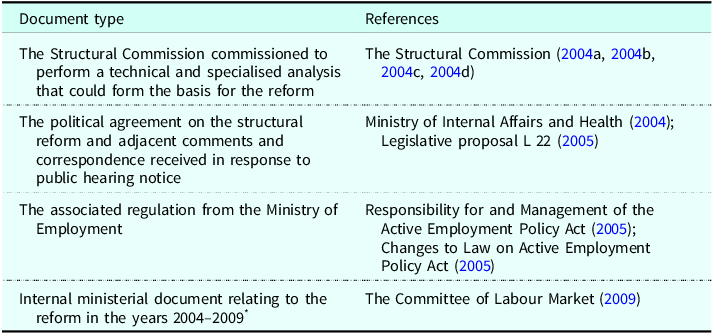
Studying the content and changes of a reform from more than a decade ago has its limitations, so we employ document analysis as our method to uncover the arguments for changing the structures concerning the efforts to assist people with impairments to find employment. The advantage of documents is that they – if not tampered with – are stable over time, unaffected by researchers, exact and in a highly digitised society as the Danish, publicly available (Yin, Reference Yin1994; Bowen, Reference Bowen2009). As Table 2 shows, the empirical data for the document analysis consists of a) documents produced by the structural commission in preparation for the reform, b) the political agreement on the structural reform and adjacent comments and correspondence received in response to public hearing notice, c) associated regulation from the Ministry of Employment made as a consequence of the reform and d) internal ministerial documents relating to the reform in the years 2004–2009.
Documents

* This document was obtained through a public records request sent to the Ministry of Employment requesting access to all internal documents containing the words ‘disability’, ‘the National Unit for Job and Handicap’ and/or ‘disability keyperson’. The Ministry found only one document mentioning one or more of the three search terms.
Owing to the large amount of data (exceeding 2,000 pages) and the far-reaching consequences of the reform involving service delivery in practically all welfare areas in Denmark, we chose to perform a thematic coding (Fereday & MuirCochrane, Reference Fereday and MuirCochrane2006) by using the search function in Adobe Reader with the search terms ‘disability’ (in Danish: handicap) and ‘lasting impairment’ (in Danish: funktionsnedsættelse), as these are the most precise terms used to describe the target group. After identifying relevant passages, we excluded those not mentioning employment. The purpose of the document analysis was to identify the objectives guiding the reform, and so in the final step of thematic coding, viz. category construction, we coded the data by using the following categories:
-
The objectives of the suggested structure including supporting or opposing arguments
-
Information about the National Unit for Job and Handicap and the National Knowledge and Specialized Advisor Organization on social affairs (VISO)
-
Information about the disability keyperson
Survey
The survey data were collected as part of another project in 2019. The original survey aimed to uncover the job centres’ practices and priorities in assisting people with disabilities in general and people with mobility impairments in particular. For this study, we found it useful to employ the same dataset to examine the extent to which the job centres’ practices comply with the objectives of the reform. The survey data relevant for this study are included in two surveys.
➜ Disability keypersons (n = 117)
➜ Caseworkers (n = 336)
Respondents amongst disability keypersons were identified through a national list that is regularly updated on the website of the Department of Employment and Recruitment. One-hundred seventeen respondents answered at least one question (69.2% response rate).
Owing to the highly decentralised public employment system in Denmark, nationwide data on caseworkers are not available. Therefore, we found the participants for the survey in two steps. Information about managers with responsibility for different target groups in the employment service was gathered by contacting the heads of the 94 municipal job centres. This proactive strategy resulted in emails for 289 managers, who were asked to give us contact information for up to five caseworkers in their department. On this basis, 494 caseworkers were invited to take part in the survey, and the response rate was 68% (n = 336).
The surveys covered the following themes: background questions, counselling efforts for unemployed in the job centre, focus on unemployed with mobility impairments in the job centre, compensation for disability, co-operation with other authorities, co-operation with private and public companies, and the employment situation in the local area.
The object of study is the professional practices of caseworkers, and we do not view the participants as vulnerable or the topic as particularly sensitive. The project adheres to the Danish Code of conduct for research integrity (Ministry of Higher Education and Science, 2014).
Results
The purpose of this study is to examine the subsection of the PES that is responsible for unemployed people with disabilities after the structural reform. The analysis starts with identifying the objectives of how the PES should be organised to assist unemployed people with disabilities on the basis of documents from The Structural Commission, including the following legislation.
The work of The Structural Commission
In the publications of The Structural Commission, disability is primarily discussed in connection with social affairs, such as housing, medical treatment and education. In general, the Commission notes that there is a need to maintain a specialised advisory function (The Structural Commission, 2004b, p.584). However, the Commission argues that gathering the responsibility for people with disabilities in the municipalities could help realise visions of coherent assistance functions (The Structural Commission, 2004b, p.663). This form of objective could be viewed as a systems-level result. Only in one instance do the Commission’s publications mention disability in connection with employment. In a sectoral chapter, the Commission notes that there is a need for specialisation regarding minor groups of people with ‘particular’ issues such as disabilities (The Structural Commission, 2004d, p.227). One solution is the use of external actors; however, the document does not describe who these actors could be or the governance structure of this function.
The political agreement on the structural reform and the subsequent legislation
Overall, the municipal PES took over the responsibility for all types of unemployed, including people receiving assistance through the Compensation Act (Changes to Law on Active Employment Policy Act, 2005; Responsibility for and Management of the Active Employment Policy Act, 2005).
The political agreement stipulates that a national unit for disability and employment will be established and that municipal job centres can contact the VISO for guidance (Ministry of Internal Affairs and Health, 2004). Reports connected to the political agreement show a concern about how to secure sufficient specialised knowledge on disability amongst the political opposition parties outside the agreement and amongst non-governmental organisations (NGOs) such as The Danish Disability Counsel, Disabled People’s Organisations Denmark and Center for Equal Treatment of People with Disabilities (Legislative proposal L 22, 2005). One concern put forward in the joint response from the NGOs regards the disability advisors of the state-run PES. The NGOs comment that it is unclear where and how the current specialised knowledge will be used in a new governance structure (Legislative proposal L 22, 2005). The minister of employment responds that every job centre will have knowledge about disability, and that some job centres will have more knowledge than others and be required to disseminate that knowledge (Legislative proposal L 22, 2005).
In the first evaluation of the job centres’ efforts on disability, Rambøll Management Consulting (2009a, 2009b) reports that a national unit for handicap and jobs exists, and that all job centres have established at least one disability keyperson. Rambøll quotes the Ministry of Employment’s description of the disability keyperson on its webpage:
The disability keyperson will work for the entire job centre. The efforts to assist people with disability is not restricted to citizens on early retirement benefits, social assistance or in employment. The disability key person is tasked with securing that information from the national unit is channelled to the caseworkers at the job centre. The disability keyperson will contact the national unit for disability and employment. They must communicate questions from other caseworkers to the national unit and contribute to the priority of retention and integration of people with disabilities becoming an important part of the employment efforts in the job centres (Rambøll Management Consulting, 2009a, p.33).
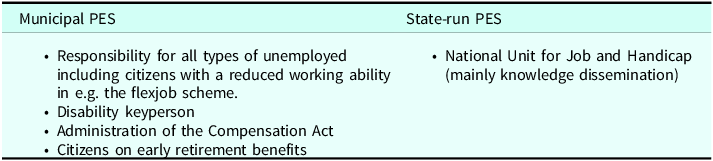
Hence, the intention of this new mode of governance was that ‘all employees in the job centres through the disability keyperson can assist people with impairments in their search for employment’ (The Committee of Labour Market, 2009). It was stipulated that the National Unit for Handicap and Job and the disability keyperson had a counselling role, the latter providing information to caseworkers, conducting seminars on relevant subjects, such as compensatory schemes and creating statistics on the topic (ibid). One job centre (Jobcenter Vejle) was administratively and physically connected to the national unit. Why this exact job centre was chosen is not specified in either the agreement or the internal document. The structural arrangement after the reform of 2007 is illustrated in Table 3.
Main elements of the structure in the PES after the reform

As this analysis demonstrates, the objectives of the reform regarding the PES and disability are few and vague. The overall objective seems to be to realize visions of coherent assistance functions – a systems-level result that is hard to evaluate. The means to reach this objective is through structural changes within the administration (process results): a national unit for job and disability and VISO, which caters to all matters related to disability. Each job centre appoints one or more disability keypersons as mediators between the national unit and the individual municipal job centres. However, information about this keyperson and their tasks is sparse and only accessible through a government website and an internal ministerial document. We argue that this, in all probability, is due to a lack of focus on people with disability in the reform. This interpretation is in line with Bowen (Reference Bowen2009, p.33):
The absence, sparseness, or incompleteness of documents should suggest something about the object of the investigation or the people involved. What it might suggest, for example, is that certain matters have been given little attention or that certain voices have not been heard.
In the next part of the analysis, we focus on the disability keyperson, as this position is the only formal requirement on the job centres. We study the role of the PES as manifested in the keypersons and examine the process results of the reform to identify whether the practices at the job centres coincide with what was formulated in the reform.
The disability keyperson more than a decade later
Although we found that political objectives regarding disability and unemployment are both sparsely and vaguely articulated, we derive two main points about the intended organisation and role of the keyperson:
1. Keypersons should work for the entire job centre, and efforts to assist people with disability should not be restricted to certain target groups such as recipients of specific benefits.
2. Keypersons function primarily as consultants.
The following sections analyse and discuss the fulfilment of these two intentions, starting with the first one.
Organisation and target groups
The 2009 Rambøll survey found that 72% of the disability keypersons referred to job centre sections targeting insured unemployed. Just 15% worked with unemployed on cash benefits, whilst the remaining 13% worked in sections devoted to more than one type of subsidy (Rambøll Management Consulting, 2009a, pp.33–34).Footnote 2 Using these percentages for comparison, the 2019 survey shows a clear shift in placement during the decade between the surveys. As Fig. 1 shows, most keypersons have been shifted away from sections for insured unemployed, as only 5% of the keypersons report being placed in this section. The placement of keypersons seems less systematic today, although a general tendency is that many keypersons are placed in sections targeting citizens with chronic or temporary illness, e.g. the flexjob scheme (10%) or sick leave benefits (38%). Although, the latter category caters to insured unemployed, there is still a noticeable drop.
Placement in the job centre. Keypersons were asked in a free-text question to specify the section in which they were situated. The answers were subsequently categorised (N = 117).

We caution that, owing to ambiguous answers, we were unable to determine the placement of 22% of respondents, implying that the percentages in Fig. 1 are underestimated. Yet, 48% of respondents specified that they worked either in the section for citizens on sick leave benefits or for citizens referred to flexjob schemes. If we remove the group of respondents who responded ambiguously to the question of placement, 61% of the remaining respondents were situated in these two sections. As hinted above, both sections target citizens who are unable to work for a period or require a reduced working scheme owing to lasting impairments. In comparison, only 5% of respondents (6% if we remove ambiguous replies) were situated in sections for insured unemployed who are in principle ready to work.
The generally narrower focus on citizens who are subsidised because they cannot work full-time appears to be at odds with the political intentions of not restricting disability keypersons’ engagement with certain target groups. The more likely explanation of the shift in placement of keypersons thus seems to be organisational contingencies within local job centres rather than deliberate strategic governance. Before the municipal job centres were established, the state-run PES was responsible for services granted by the Compensation Act and for insured unemployed. Therefore, it seemed reasonable in an administrative perspective to place disability keypersons in sections working with insured unemployed before municipal job centres were established. With the merging of the state-run and municipal PES in the structural reform, the municipal job centres became responsible for all target groups in the employment system, including the task of granting compensating aids. Thus, one can imagine practical reasons for why it was convenient to move keypersons to new sections. First and foremost, it seems easier to enrol disability keypersons in the section where caseworkers are managing most cases involving people with disabilities.
Case management versus consultant role: tasks performed by keypersons
In our document analysis, we found only sparse instructions about the keypersons’ tasks. In comparison, the above quote from the web page of the Ministry of Employment from 2009 described a bridging role between job centres and the Unit for Job and Handicap. Channelling information and knowledge to job centre colleagues and securing a high priority for disability in employment efforts were articulated as the overarching goals for keypersons (Rambøll Management Consulting, 2009a, p.33). A similar description is currently found on the web page of the Agency of Labour Market and Recruitment, which is a department under the Ministry of Employment. The agency concedes that execution of the keyperson role may differ between job centres but stipulates that, overall, ‘the keyperson is functioning as a disability consultant internally within the job centre and in collaborations with external partners’ (The Agency of Labour Market and Recruitment, 2021). The agency highlights knowledge dissemination, network building, and linking knowledge and effort between job centre and the Unit for Job and Handicap as central tasks. Notably, neither description states that keypersons should take part in case management – in fact, case management is not even mentioned.
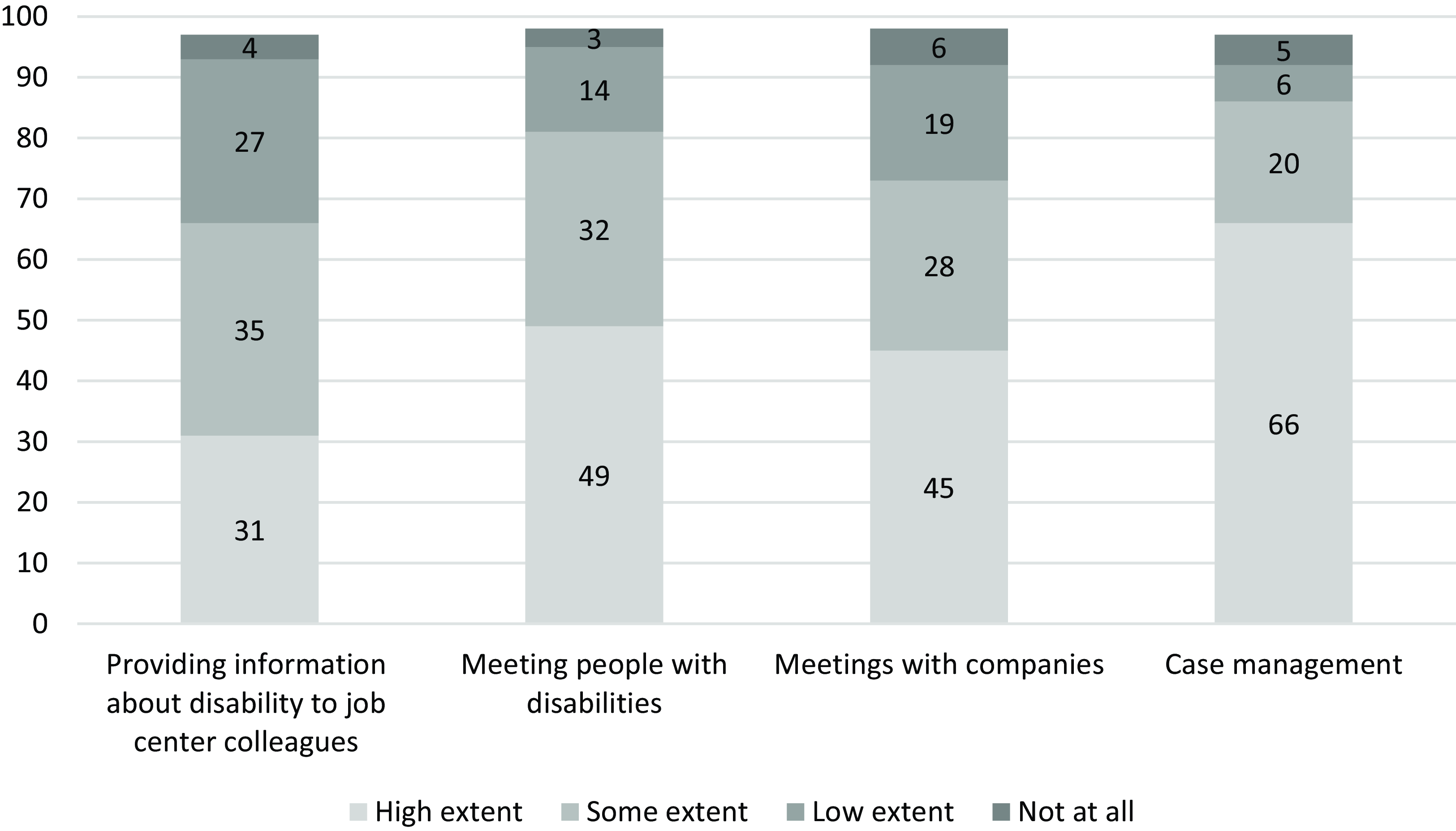
In the figure, we distinguish between (administrative) ‘case management’ and ‘meeting people with disabilities’ to identify the extent to which the keyperson meets clients or instead has an internal administrative function that reads client descriptions in casefiles. Two categories (‘other tasks’ and ‘I do not know’) also appeared in the survey but have been removed from the figure to optimise visualisation.
The 2019 survey shows that keypersons are highly involved in case management and less in consulting. One question asked keypersons to evaluate the extent to which they work with four specific tasks (Fig. 2). If we take the percentages of respondents who reported working with a given task to a high or to some extent to measure the involvement of keypersons in each task, it is possible to rank the tasks according to involvement: case management (87%), meetings with people with disability (81%), meeting with companies (73%) and providing knowledge about the disability arena to job centre colleagues (66%). Basing the ranking on the percentage working with the respective tasks to a high degree yields the same results. Thus, the two tasks that can be associated with consultant work attained the lowest degree of involvement.
Keypersons’ responses to the question ‘to which extent do you work with the following tasks as disability keyperson?’ (n = 113).

The 2012 survey, reported by Authors (2015), posed a similar question featuring the same four tasks to disability keypersons. When we apply measures equivalent to those described above, the internal ranking of tasks in the 2019 survey was the same as in 2012. This suggests that the high degree of involvement in case management, compared with consulting tasks, has been a stable feature of the role over time, despite recurring, albeit sporadic, political promotion of consultant tasks.
The prominence of case management is not only recognised amongst the keypersons. Sixty-three percentage of the caseworkers stated that the keyperson handles decisions about granting extra services for people with disability (Fig. 3). Only 29% of the caseworkers responded that they handle approval, or that it is handled elsewhere in the job centre. This indicates that granting extra services may be an issue where caseworkers tend to lend authority to disability keypersons in the case management.
Caseworkers’ responses to the question ‘who handles decisions regarding granting of services for people with disabilities?’ (N = 195).

It is important to stress that our analytical focus on case management is not meant to dismiss the value or magnitude of the consultant work that keypersons evidently do carry out. More than 66% reported working with all four tasks displayed in Fig. 2, and only 2.7% reported not working with knowledge dissemination about disability. What we do say is that the keypersons’ work is far more practically oriented than what was intended politically. Again, what seems to be at stake here is that the needs and demands of the day-to-day running of job centres tend to produce practical tasks, such as case management.
Conclusion
The purpose of this study has been to examine how the large-scale administrative reform of 2007 affected the role and structure of the PES in assisting unemployed people with disabilities more than a decade after the reform. We do this by comparing the objectives of the reform with the actual practice, in line with recommendations by Pollit and Bouckeart (2017). The apparent conclusion is that the responsibility for job seekers with disability shifted to the municipal job centres from the state-run PES, who had the authority to grant compensatory aids prior to the reform. We identify a great deal of ambiguity in the objectives of the reform and argue that this contributes to a low degree of systematisation in the implementation. This particularly concerns the disability keyperson in the job centres, which surfaces in studies immediately after the reform and in our survey from 2019. In practice, many of the keypersons were placed in sections focussed on unemployed people with a reduced work ability, but without a broad connection to all types of unemployed as the reform intended. Additionally, the keypersons’ tasks were, to a large degree, of an administrative nature, which is also not in line with the reform.
The analysis primarily focusses on process results, as these are the only ones identifiable in the documents related to the reform. One could view the overall objective of making the service delivery more coherent (which is also mentioned by the commission in the documents pertaining to the reform) as a systems-level result. We would argue that the lack of systematisation in the job centres is an indication that the implementation of the reform has not reached this objective.
Finally, the obvious operational result would be a decrease in the gap between the employment rate of people with and without disability – however no such goal is mentioned in the documents concerning the reform.
Implications for social policy development and the research field
In this section, we put forward two issues that have implications for both social policy and the research field hereof.
As noted in the analysis, we view the effect of the Danish structural reform of 2007 on the PES’s efforts to assist people with disabilities as an example of how administrative reforms impact subjects who are not politically contested or even prominent on the political agenda. As formulated by Pollitt & Bouckaert(Reference Pollitt and Bouckaert2017, p.8), administrative reforms are informed by ‘more or less well-specified ideas’. The idea behind this reform was at best only marginally linked to disability and employment as a consequence of policy reforms from 2002 to 2003. Hence, the case stands out in comparison with the other studies of administrative reform mentioned in the introduction because of its focus on a subject that exists in the slipstream of more prominent issues such as work-first policies. However, as our analysis shows, the structural reform does have consequences for the PES and its ability to place people with disabilities in employment, and this serves as a reminder to policymakers that administrative reforms have greater implications than perhaps expected. For the research field, our results warrant more implementation studies with a specific focus on similar areas that are not prominent on the political agenda.
In the analysis, it also becomes evident that a key component in the administrative reform is the creation of a disability keyperson who is supposed to act as a liaison between the specialised knowledge of the National Unit for Handicap and Disability and individual caseworkers. In Denmark, only a handful of publications have studied the role and position of this function, and all but one are reports commissioned by the Agency of Labour Market and Recruitment (see e.g. Rambøll 2009a, 2009b; Amby, Reference Amby2015; Marselisborg Consulting, 2021). This type of function is also understudied in an international perspective (Boeltzig et al., Reference Boeltzig, Pilling, Timmons and Johnson2010). A similar function exists in e.g. the USA and the UK, and in a scoping review comparing the two countries, Boeltzig et al. (Reference Boeltzig, Pilling, Timmons and Johnson2010) find, in line with our results, that the role (in their study labelled a disability specialist) is not clearly defined and therefore, in many instances, has low priority. The review identifies satisfaction within the PES with the existence of the function – a process effect – but no operational effects are found concerning e.g. the employment rate of people with disabilities. The similarities between very different types of welfare states are interesting, and in line with Boeltzig et al., we call for more research in this field at both the national and international level. For the development of social policy, we argue that, if policymakers wish to introduce new functions in the PES with the goal of successfully helping clients, it would be preferable to clearly outline the function and task of that function. By doing this, it would be easier for policymakers to identify local implementation practices that are not in line with the goal of the reform.
Competing interests
The author(s) declare none.