INTRODUCTION
In the past two decades, the femtosecond laser ablation of metals and its nonequilibrium energy transport have been very active research topics (Bashir et al., Reference Bashir, Rafique and Ul-Haq2007; Fisher et al., Reference Fisher, Fraenkel, Zinamon, Henis, Moshe, Horovitz, Luzon, Maman and Eliezer2005; Gamaly et al., Reference Gamaly, Luther-Davies, Kolev, Madsen, Duering and Rode2005; Lam et al., Reference Lam, Tran and Zheng2007; Mirdan et al., Reference Mirdan, Jawad, Batani, Conte, Desai and Jafer2009; Muhammad et al., Reference Anwar, Latif, Iqbal, Shahid Rafique, Khaleeq-Ur-Rahman and Siddique2006; Ozaki et al., Reference Ozaki, Bom, Ganeev, Kieffer, Suzuki and Kuroda2007, Reference Ozaki, Bom and Ganeev2008; Trtica et al., Reference Trtica, Radak, Gakovic, Milovanovic, Batani and Desai2009). In most theoretical treatments, only electron-phonon collisions are taken into account for the electron diffusion process during and after femtosecond laser pulse ablation (Amoruso et al., Reference Amoruso, Ausanio, Bruzzese, Gragnaniello, Lanotte, Vitiello and Wang2006; Brorson et al., Reference Brorson, Kazeroonian, Moodera, Face, Cheng, Ippen, Dresselhaus and Dresselhaus1990; Fann et al., Reference Fann, Storz, Tom and Bokor1992; Sun et al., Reference Sun, Vallee, Acioli, Ippen and Fujimoto1993, Reference Sun, Vallee, Acioli, Ippen and Fujimoto1994). However, the recent pump-probe measurements have revealed that the role of electron-electron collisions becomes essential for the electron relaxation at electron temperature around or above 1 eV (Brorson et al., Reference Brorson, Kazeroonian, Moodera, Face, Cheng, Ippen, Dresselhaus and Dresselhaus1990). The electron-phonon collisions dominanting electron diffusion are valid only in the low electron temperature regime. Thus, extending the conventional two-temperature model from the low temperature regime dominated by electron-phonon collisions to the high temperature regime through modifying the electron thermal conductivity associated with the electron-electron collisions is crucial.
Experiments have confirmed that the features of the femtosecond laser ablation process are greatly influenced by the quantity of laser energy absorbed by the target (Vorobyev & Guo, Reference Vorobyev and Guo2005). The absorption coefficient introduced by the Lambert-Beer's law accounts for the attenuation of the absorbed energy in the target (Arun et al., Reference Arun, Wu, Venkatesan, Ogale, Chang and Dijkkamp1987), and the absorptivity refers to the magnitude of the ratio of absorbed energy to incident energy (Zhang et al., Reference Zhang, Li, Li, Guan, Hou and Tan2005). They both describe the ability of absorbing laser energy for target. For the thermal mechanism dominates almost all the physical effects in the process of femtosecond laser ablation, the absorption coefficient and the absorptivity are important optical parameters in the femtosecond laser ablation. A lot of literatures consider the absorption coefficient and the absorptivity as constant in femtosecond laser ablation. However, the effect of electron temperature on the absorption coefficient and the absorptivity is distinctive.
In order to describe the thermophysical effects of femtosecond laser ablation of metal target, a tailored theoretical model including temperature-dependent heat capacity, thermal conductivity of the electron, the absorption coefficient, and absorptivity is presented in this paper. The modified model is used to simulate femtosecond laser ablation of copper target. We obtain the time-dependence of temperature for three different laser fluences, and the space- and time-dependence of temperatures of the target. The satisfactory agreement between our numerical results and experimental data of ablation rate indicates that temperature dependence of heat capacity, thermal conductivity, absorption coefficient, and absorptivity in femtosecond laser ablation of metal target should not be neglected.
The Effect of Temperature on Heat Capacity and Thermal Conductivity of the Electrons
Normally, the thermophysical properties of electron such as the heat capacity and thermal conductivity of the electrons are all temperature dependent. The electron heat capacity is usually a linear function of the electron temperature, given by

where C′e is a constant.
The electron thermal conductivity can be described by

where υF is the Fermi velocity, and τ is the electron momentum relaxation time.
For good conductors, such as metals, the electron-electron collision frequency may be determined by υe−e = AT e2, whereas the electron-phonon collision frequency is proportional to T l, namely, υe−ph = BT l. Here A and B are constants, and both contribute to the electron collision frequency υ. A relationship between the electron momentum relaxation time τ and the electron-electron and electron-phonon collision frequency for electron temperature below the Fermi temperature is given by (Wang et al., Reference Wang, Riffe, Lee and Downer1994)

Substituting Eq. (3) into the expression of the electron thermal conductivity, we can obtain the following equation:

where κ0 = υFC′e/(3B) is the electron heat conductivity at room temperature (T e = T l = 300 K).
Electron Temperature Dependences of the Absorption Coefficient and the Absorptivity
It is assumed that a pulsed laser beam irradiates on a target surface vertically. The electric field intensity in the target can be described as follows:

E 0 is the electric field intensity at x = 0, ω is the incident laser angle frequency, υ is the laser propagation velocity in target satisfying the following relation:

where c is the laser propagation velocity in vacuum. n c is the complex refractive index, which can describe the optical characters of material,

where n is the refractive index, κ is extinction coefficient.
Substituting Eqs. (6) and (7) into Eq. (5) yields

By the operation of module to Eq. (8), we have

According to Lambert-Beer-Bouguer law, when laser irradiates the target surface, the laser intensity attenuates in exponent in the target, which can be expressed by (Andrea & Antonio, Reference Andrea, Antonio and Roger1994)

I(0, t) is the intensity of the incident laser, β is the absorptivity of the target, b is the absorption coefficient of the target.
In the target, the intensity equals to the square of the module of the electric filed intensity, namely |E|2 = I(x, t). Based on this relation, comparison of Eq. (9) with Eq. (10) gives the following relation:

where λ0 is the laser wavelength in vacuum.
It is well known that Maxwell equation in the isotropical medium can be described by (Guo, Reference Guo1997)
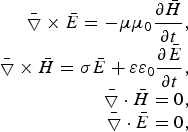
where μ and μ0 are the magnetic conductivities of the target and vacuum. σ is the target conductance, ɛ is the target relative permittivity, ɛ0 = 8.85 × 10⁻¹²C 2N −1m −2 is the permittivity of vacuum.
Substituting Eq. (8) into Eq. (12), we obtain the refractive index n and the extinction coefficient κ as the functions of the conductance σ and the permittivity ɛ as follows:

where ɛ0 = 8.85 × 10⁻¹²C 2N −1m −2 is the permittivity of vacuum.
The conductance of general metal is generally in the range ~108–1012Ω−1m−1, the relative permittivity is in the range 0–100, and in the conditions of this paper, the laser angle frequency is 2 × 10¹⁵, we can regard that
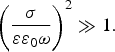
So Eq. (13) can be simplified into
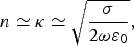
σ can be presented as a function of electron temperature T e (Sun, Reference Sun2002):
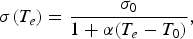
where σ0 is the target conductance at initial temperature T 0, α is the target temperature coefficient of resistance. For general metal, α is in the range ~400 × 10−5 − 700 × 10−5 K −1 (Billings et al., Reference Billings and Frederikse1972).
Substituting Eqs. (15) and (16) into Eq. (11) yields

This is an important relationship that we derived in this paper. From this formula, it can be found that the absorption coefficient monotonously decreases following target temperature when the resistance temperature coefficient and irradiated laser wavelength are both constants.
With the same point of view, we discuss the absorptivity, namely the ratio of the absorbed intensity to incident intensity. When a laser irradiates a target surface vertically, the target absorptivity is generally described as follows (Sun, Reference Sun2002):

where R is the target reflectivity.
Substituting Eqs. (15) and (16) into Eq. (18) gives

This is another important relationship that we derived indicating the relation between the resistance temperature coefficient, the laser wavelength, the target electron temperature and the absorptivity.
S(x, t) is the heat source, which can be expressed as follows:

In experiments, the laser beam indeed has a transverse intensity profile. Transverse mode describes the energy distribution of laser spot. Transverse mode is divided into base transverse mode and high-order transverse mode. Beam quality of the base transverse mode is the best. Base transverse mode is Gaussian beam. Gaussian pulse can be used to accurately describe the incident laser intensity (Amoriso et al., 2006; Fisher et al., Reference Fisher, Fraenkel, Zinamon, Henis, Moshe, Horovitz, Luzon, Maman and Eliezer2005, Reference Fisher, Fraenkel, Henis, Moshe and Eliezer2001; Gamaly et al., Reference Gamaly, Luther-Davies, Kolev, Madsen, Duering and Rode2005). In our paper, we adopt the Gaussian pulse to describe the incident laser:
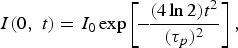
here I 0 is the maximal laser power density.
Substituting of Eqs. (17), (19), and (21) into Eq. (20), we get the heat source as follows:
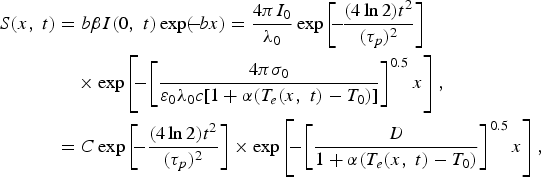
where C = 4πI 0/λ0, D = 4πσ0/ɛ0λ0c.
The effects of the copper d-band on femtosecond laser absorption are discussed in the literature (Fisher et al., Reference Fisher, Fraenkel, Zinamon, Henis, Moshe, Horovitz, Luzon, Maman and Eliezer2005). Copper has a fully-occupied d-band, a few electron-volts below the Fermi level. The Fermi level is located in the half-occupied, nearly free-electron (NFE) s-band, 7–8 eV above the bottom of the conductivity band. In copper, the d-band is 3–4 eV wide, and its upper edge lays 2.0–2.2 eV below the Fermi level. Thus, the presence of the d-band does not affect the NFE character of copper for the 800 nm central wavelength of the laser at electron temperature below 1 eV. It is acceptable to not consider the d-band absorption for the 800 nm central wavelength of the laser at electron temperature below 1 eV (Fisher et al., Reference Fisher, Fraenkel, Zinamon, Henis, Moshe, Horovitz, Luzon, Maman and Eliezer2005).
Verification of Absorption Coefficient Analytic Approximation
In order to verify the validity of the absorption coefficient analytic approximation, we present a comparison between the experimental results (Fisher et al., Reference Fisher, Fraenkel, Henis, Moshe and Eliezer2001) and theoretical predictions for the absorption. The theoretical predictions include theoretical data of the Maxwell equations and theoretical data of our analytic approximations. The following are Maxwell equations for radiation propagation in the medium (Fisher et al., Reference Fisher, Fraenkel, Zinamon, Henis, Moshe, Horovitz, Luzon, Maman and Eliezer2005),
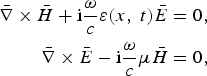


where ɛ(ω, x) is the dielectric permittivity of the target at the incident radiation frequency ω, and σ(x, t) is the conductivity of the target.
The absorption coefficient A is evaluated as (Fisher et al., Reference Fisher, Fraenkel, Henis, Moshe and Eliezer2001)
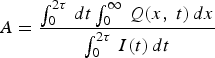
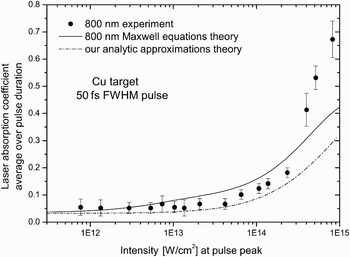
Figure 1 presents a comparison between the experimental results and the theoretical predictions for the absorption of λ = 800 nm wavelength, 50 fs full width at half maximum duration laser pulses in high-quality commercial copper targets (Fisher et al., Reference Fisher, Fraenkel, Henis, Moshe and Eliezer2001). Solid curve represents the theoretical data of the Maxwell equations. Dash dot curve indicates the theoretical data of our analytic approximations. Figure 1 shows that two different theoretical curves are both consistent with the experimental data. The two theoretical curves and the experimental curve show the increase movement in absorption. However, there is a big difference between the theoretical data of our analytic approximations and the experimental data after laser intensity exceeds 3 × 10¹⁴ W/cm2. From the above analysis, we can clearly see that our analytic approximations are accurate when laser fluence is not very high (0.2–0.4 J/cm2). Our analytic approximations are not very well for high fluence, it should be upgraded to obtain better approximations in the following research.
Comparison of the experimental results with the theoretical predictions for 800 nm wavelength.

The Improved Two Temperature Model
The original two-temperature model was formulated by S.I. Anisimov et al. (Reference Anisimov, Kapeliovich and Perelman1974). The following is the improved two temperature model, which considers the effect of electron temperature on the electron heat capacity, electron thermal conductivity, absorption coefficient and absorptivity.
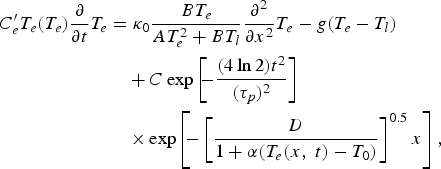
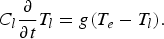
For Eqs. (27) and (28), the initial condition is

and the boundary conditions can be expressed as:

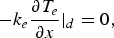
where T 0 = 300 K is the initial temperature, which is uniform across the target, d is the depth of the target.
RESULTS AND DISCUSSION
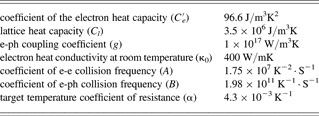
Under the initial condition (29) and the boundary conditions (30) and (31), Eqs. (27) and (28) are numerically solved by a finite difference scheme. The thermal and optical properties of gold in Table 1 are adopted (Schafer et al., Reference Schafer, Urbassek and Zhigilei2002; Elsayed-Ali et al., Reference Elsayed-Ali, Norris, Pessot and Mourou1987).
Thermal and optical properties of copper

The Time-Dependence of Electron and Lattice Temperature of Target
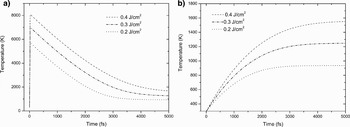
The temporal evolution of the electron and lattice temperatures at the metal surface for different laser fluence is shown in Figure 2. The maximum temperature of the electron temperature at the surface is in the range 5500–8000 K for the laser fluence varying from 0.2–0.4 J/cm2. The surface electron and lattice temperature increase with increasing laser fluence. For a fixed laser fluence, the electron temperature first rapidly increases along with the ablation time, while suddenly decreases when it reaches the maximum in Figure 2a. And the temperature of the lattice raises gradually in Figure 2b.
Temporal evolution of electron temperature (a) and lattice temperature (b) at the surface for the copper target irradiated by a 100 fs, 800 nm pulse at 0.2 J/cm2, 0.3 J/cm2, 0.4 J/cm2, respectively.

The Space- and Time-Dependence of Electron and Lattice Temperature of Target
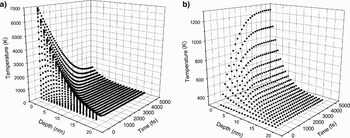
Figure 3 shows the space- and time-dependence of electron and lattice temperature in target. As we can see from Figure 3a, at a fixed location, the electron temperature first rapidly increases along with the ablation time, while suddenly decreases when it reaches the maximum. As shown in Figure 3b, the temperature of the lattice raises gradually. For a fixed time, the temperature of electron and lattice decreases along with depth, and the maximum temperature appears at the surface.
Electron temperature distribution (a) and lattice temperature distribution (b) at different times and position predicted by the improved two-temperature model for the copper target irradiated by a 100 fs, 800 nm pulse at 0.4 J/cm2.

We can analyze the phenomenons as follows: when considering the transport of absorbed energy into the depth of the material, we have to distinguish three processes occurring in successive time intervals. The first process is electron thermal diffusion by electron-electron collisions. The second interval is the hot-electron bath cooled by electron-phonon interaction. The third state is reached when electrons and the lattice are in thermal equilibrium, where the common thermal diffusion drives the heat dissipation into the material.
The first stage is the absorption of the laser energy through photon-electron interactions within the ultrashort pulse duration. It takes a few femtoseconds for electrons to reestablish the Fermi distribution. This characteristic time scale or the mean time for electrons to restore their states, is called the electron relaxation time. Within the duration of a single ultrashort pulse, the change of lattice temperature is generally negligible. The second stage is the energy distribution to the lattice through electron-phonon interactions, typically on the order of tens of picoseconds. Although the electron-phonon collision time may be comparable to the electron-electron collision time, it takes much longer time to transfer energy from free electrons to phonons due to the phonon mass is much greater than the electron mass. The evolvement of electron and lattice temperature in this paper is consistent with many experiments (Brorson et al., Reference Brorson, Kazeroonian, Moodera, Face, Cheng, Ippen, Dresselhaus and Dresselhaus1990; Fujimoto et al., Reference Fujimoto, Liu, Ippen and Bloembergen1984; Hertel et al., Reference Hertel, Knoesel, Wolf and Ertl1996).
Ablation Rate Per Pulse as a Function of Laser Fluence
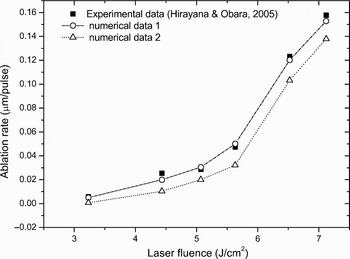
In order to argue the correctness of the improved two-temperature model in this paper, we compare our calculated ablation rate with the experimental data, and the result of the model without considering electron temperature-dependent heat capacity, thermal conductivity of the electron, absorption coefficient and absorptivity, shown in Figure 4. Curve 1 represents how the ablation rate depends on laser fluence based on our model Eqs. (22) and (23). Curve 2 stands for the model without considering electron temperature-dependent heat capacity, thermal conductivity of the electron, absorption coefficient and absorptivity. In our simulation, it is assumed the thermal conductivity of electron to be 318 W/mK, specific heat of electron to be 67.7 J/m3K, the absorptivity to be 0.06, and the absorption coefficient to be 7.88 × 10⁵/m (Eesley, Reference Eesley1986).
Dependence the ablation rate on the laser fluence, curve ○ (numerical data 1) represents the improved model, see text in detail.

In the experiment, the intensity autocorrelator and the powermeter at the exit of the amplifier periodically monitored the drifts in the pulse width and output energy in order to ensure a stable pulse energy on the copper target. An 80 mm focal length fused silica convex lens is used to focus the attenuated laser pulses onto the copper substrate. The pulse width and the center wavelength are 100 fs and 800 nm, respectively. The ablation rate is estimated as an averaged value over 300 sbsequent pulses. The ablation depths after laser ablation are measured using a mechanical stylus (Dektak-3030) (Hirayana & Obara, 2005). In the simulation, the pulsewidth τp and the center wavelength λ0 are 100 fs and 800 nm in the heat source Eq. (22). The range of the maximal laser power density I 0 is from 0.1 J/cm2 to 2 J/cm2.
The details on how the ablation dynamics was modeled are given as follow: When the femtosecond laser irradiates the target, it takes a few femtosecond for electrons to absorb the laser energy through electron-photon interactions. Within the duration of a single femtosecond pulse, the change of lattice temperature is generally negligible. Then the energy will be distributed from the electrons to lattice through electron-phonon interactions. The lattice reaches to the same temperature as electron's temperature, eventually. When the electron temperature and lattice temperature are equal, the common thermal diffusion drives the heat dissipation into the material. The electron temperature and the lattice temperature are both functions of target depth x and time t, that is to say, T = T(x, t). x refers to the spatial coordinate in the direction perpendicular to the target surface. The ablation rate is the depth x when the lattice temperature reaches the boiling point, 2811 K for copper in the simulation (Hirayana & Obara, 2005).
Figure 4 displays the relationship between the ablation rate and laser fluence. The ablation rate is estimated from the depth which becomes heated above the boiling point, 2811 K for copper in the simulation (Hirayana & Obara, 2005). Both curves 1 and 2 ascend with the increasing time. As curve 1 takes into account the effect of the variation of heat capacity, thermal conductivity of the electron, the absorption coefficient and the absorptivity, it is obviously higher than curve 2 for the increment of absorbed energy. The experimental data come from Hirayama and Obara (Reference Hirayama and Obara2005). Obviously, this figure shows a better agreement between our model (curve 1) and the experiment than curve 2.
Hirayama and Obara said that the MD simulation results are not well consistent with the experimental results of the ablation rate in their paper (Hirayama & Obara, Reference Hirayama and Obara2005). They also explained that the difference in the ablation rate between the experiment and the simulation may be due to optical parameters of the material, especially the absorption coefficient which has been considered as constant. They indicated that the absorption coefficient may be changed due to the heating up of the laser-irradiated surface (Hirayama & Obara, Reference Hirayama and Obara2005).
In our paper, based on the electron-phonon and electron-electron collision frequency, we can obtain the temperature-dependent heat capacity and thermal conductivity of the electron. The electron temperature-dependent absorption coeffcient and absorptivity can be deduced through a combination of optical properties of solids and Maxwell's law. The temperature-dependent heat capacity and thermal conductivity of the electron, as well as electron temperature-dependent absorption coeffcient and absorptivity are all considered in this improved two-temperature model. The tailored two-temperature model is solved using a finite difference method. It is very easy to precisely define the initial and boundary conditions in the finite difference method. The simulation results of the ablation rate are consistent with the experimental results.
CONCLUSIONS
In order to describe femtosecond laser ablation of metal target, an improved thermal model considering electron temperature-dependent heat capacity, thermal conductivity of the electron, absorption coefficient and absorptivity has been developed in this paper. The present model is used to simulate femtosecond laser ablation of copper target. The satisfactorily good agreement between our numerical results and experimental results of ablation depth confirms that the tailored model is a much more satisfactory theoretical framework in femtosecond laser ablation of metal target. The analysis to the ablation characteristics is important to understand the basic mechanisms involved in the femtosecond laser-target interaction. We hope the present model will be helpful for the experimental investigation of the application of femtosecond laser.
Acknowledgments
This work was supported by the National Natural Science Foundation of China through Grant Nos. 10904177, 10675048, 10604017, 10804132 and by the Scientific Research Foundation for Doctor of Chongqing University of Posts and Telecommunications No. A2009-15.