

Introduction
Process-based models (PBMs) are important tools for predicting and understanding the impacts of climate change on grassland systems. The models should be able to simulate changes in sward nutritional value (NV) over time in order to better understand the interactions between grasslands and ruminant nutrition. Changes in the NV of forage may not only alter animal performance but also the need for other feeds, the management and productivity of the system, the quality of final products and the environmental impacts of production. Climate change is expected to affect the NV of grasslands by affecting plant physiological processes, and via effects on species composition. An increase in temperature may cause an increase in NDF and lignin content of forages, thus reducing digestibility by domestic herbivores. On the other hand, under high CO2, analyses on both temporary and permanent grasslands indicate a strong increase in soluble sugar content, which increases the energetic value and the aptitude for ensiling of grass. Conversely, a decrease of the CP content in grass dry matter up to 30% is observed. The reduction in the forage protein and energy content lowers the rumen microbial synthesis and availability of microbial proteins for ruminant growth and production, and may also lead to increased production of methane (a greenhouse gas) by methanogens in the rumen. Ruminants kept in extensive systems that are based on low protein forages may be sensitive to these negative effects. On the contrary, an increase in soluble sugar and decrease in CP content would rather be positive for ruminants in intensive high protein forage systems. Modelling grassland NV is often based on variables describing the energy and protein content of forage. However, a wide range of variables are used to define forage NV in experimental data, presenting challenges for modellers. Further complication arises from the dissimilar feeding regimes used across the different production systems in countries and regions.
The aim of this work was to review the extent to which current grassland PBMs are capable of characterising the NV of forage species in grassland swards in relation to projected climate change. This includes the identification of the modelling approaches used, the key characteristics of the forages represented and the production systems these models have been developed for.
Results and discussion
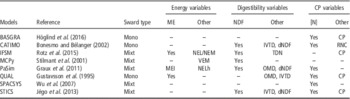
This publication is the first step towards gathering and clarifying information about the possibilities of modelling NV. Different methods for simulating the NV of forages were reviewed from literature and a questionnaire survey was sent to MACSUR (Modeling European Agriculture with Climate Change for Food Security) knowledge hub partners in order to obtain information about how NV value was characterised in different models. Here, we briefly review eight PBMs for which information was found (Table 1). In general, most grassland PBMs simulate the nitrogen concentration in the plant material which can be used to evaluate forage CP content, development of cell wall, and its digestibility, but energy value is simulated in only a few models.
The main variables used to describe the nutritive value of forages in the studied process-based models
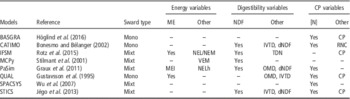
ME=metabolisable energy; [N]= nitrogen concentration of forage; Mono=monoculture; IVTD=in vitro true digestibility of dry matter; dNDF=in vitro digestibility of NDF; RNC=relative nitrogen concentration; Mixt=mixture; TDN=total digestible nutrients, NEL=net energy of lactation; NEM=net energy of maintenance; VEM=available energy for milk production; MEI=metabolisable energy intake; NELh=net energy content of the ingested herbage; OMD=organic matter digestibility.
PBMs tend to be fairly comprehensive in their consideration of weather variables that are expected to change, but there are still some parts that could be improved. For instance, the effect of (CO2) on photosynthesis (or radiation use efficiency) is usually taken into account, but the effect on water use efficiency is not always simulated. In addition, the effect of extreme weather conditions such as frost and heat waves, or air pollutants, are often lacking. At first, the PBMs may seem to have only few variables in describing forage NV, but these particular variables are the most essential ones to consider (OM digestibility, NDF content and digestibility, and CP content), and which are very useful for planning feeding strategy by producers and agricultural consultants. The current uncertainties in relation to PBMs modelling forage NV are related to (1) the simulation of the physiological adaptation of plants to changes in environmental conditions (e.g. plant acclimatory effects, Zaka et al., Reference Zaka, Frak, Julier, Gastal and Louarn2016); (2) the simulation of the formation and senescence of tillers, (3) the simulation of the dynamics of leaf chemical composition including water soluble carbohydrates, (4) the simulation of the response of carbon and nitrogen-allocation to environmental change, (5) the quantification of the relative importance of grazing regime and harvest dates. For parameterisation, these uncertainties relate to (6) the use of information from field and laboratory trials with different genotypes to parameterise for alternative cultivars (e.g. to represent developmental stages of plants) and (7) the need to improve the link between plant and soil models with respect to the effects of soil water and soil nitrogen. A more comprehensive review is still required in order to understand whether current PBMs are capable enough to assess the effects of climate change on NV. There is a strong need for data including frequent time series of forage NV from experiments in which climate change is mimicked.
Acknowledgements
This paper was produced through the international research project FACCE MACSUR – Modelling European Agriculture with Climate Change for Food Security – a FACCE JPI knowledge hub; the work was supported at national level by MMM (Finland), INRA (France), CRA-W (Belgium), BBSRC (UK), AAFC (Canada), The Research Council of Norway (Norway), Swedish Research Council for Environment and SLU (Sweden).