Introduction
Providing children with severe to profound hearing loss with bilateral cochlear implants has become the norm in many countries. Bilaterally implanted children have been shown to develop better speech recognition, especially in noise,Reference Strøm-Roum, Laurent and Wie1–Reference Vincent, Bébéar, Radafy, Vaneecloo, Ruzza and Lautissier4 better sound localisation abilitiesReference Asp, Mäki-Torkko, Karltorp, Harder, Hergils and Eskilsson3–Reference Strøm-Roum, Rødvik, Osnes, Fagerland and Wie5 and better spoken language learning,Reference Boons, Brokx, Frijns, Peeraer, Philips and Vermeulen2 and are more relaxed and confident listenersReference Asp, Mäki-Torkko, Karltorp, Harder, Hergils and Eskilsson3, Reference Scherf, van Deun, van Wieringen, Wouters, Desloovere and Dhooge6 than their unilaterally implanted peers. Importantly, this has been reflected in an improved quality of life, as evaluated by parents or using disease-specific quality of life questionnaires.Reference Scherf, van Deun, van Wieringen, Wouters, Desloovere and Dhooge7, Reference Sparreboom, Snik and Mylanus8
Bilateral cochlear implantation can be either sequential, where the implants are provided months or years apart, or simultaneous, where the implants are provided during the same surgical event or same day. Children who receive simultaneous bilateral cochlear implants have shown better expressive word developmentReference Boons, Brokx, Frijns, Peeraer, Philips and Vermeulen2 and higher speech perception scoresReference Gordon and Papsin9 than have children implanted sequentially, especially those with longer intervals between implantation. Additionally, simultaneous bilateral cochlear implantation has been shown to be as safe as sequential implantation, in that it does not result in a greater amount of peri- or post-operative complications.Reference Grainger, Jonas and Cochrane10, Reference Broomfield, Murphy, Emmett, Wild and O'Donoghue11 Further, simultaneous bilateral cochlear implantation is associated with reductions in the cumulative operating theatre time, total provision of analgesics and anti-emetics, and hospital stay, compared with that necessitated by sequential implantation.Reference Grainger, Jonas and Cochrane10, Reference Ramsden, Papsin, Leung, James and Gordon12 Accordingly, experts have recommended that eligible children should be simultaneously implanted when possibleReference Papsin and Gordon13, Reference Maria and Oghalai14 and ‘as soon as possible after definitive diagnosis of deafness’.Reference Ramsden, Gordon, Aschendorff, Borucki, Bunne and Burdo15
The present paper reports on the simultaneous bilateral cochlear implantation of a five-month-old boy and his subsequent development. All procedures contributing to this work complied with the ethical standards of King Saud University cochlear implant committee and with the Declaration of Helsinki of 1975 (as revised in 2008).
Case report
The subject's bilateral profound sensorineural deafness was detected during neonatal hearing screening. The aetiology was attributed to parental consanguinity. At two months old, he was presented to our centre. His hearing loss was confirmed and he was fitted with hearing aids. At five months old, he was diagnosed with Usher syndrome. Computed tomography and magnetic resonance imaging revealed normal anatomy of the temporal bone. Upon completion of the three-month hearing aid trial, from which he did not benefit, the subject received simultaneous bilateral cochlear implantation, at five months old. He was bilaterally first fitted with an externally worn audio processor four weeks later, at the age of six months.
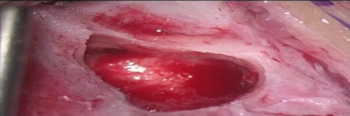
The subject received two Concerto standard cochlear implants (Med-El, Innsbruck, Austria). The surgical procedure entailed a lazy S-shaped postauricular incision, mastoidectomy and insertion via cochleostomy. Impedance and auditory nerve response telemetry values were measured intra-operatively. The electrodes of both cochlear implants were fully inserted, at a depth of 31.5 mm. Intra-operatively, there was significant bone marrow bleeding (Figure 1), which was controlled with diamond burrs and bone wax. The subject's facial recess was slightly narrow.
Significant bone marrow bleeding during mastoidectomy.

Anaesthesia was induced by inhalational anaesthetic sevoflurane 6 per cent in oxygen, and fentanyl (2 mcg/kg) was given intravenously. Intubation was performed without muscle relaxant. Anaesthesia was maintained by sevoflurane 2–3 per cent volume concentration with nitrous oxide in oxygen (50:50 per cent). The subject was hemodynamically stable during surgery, with blood oxygen saturation at 99 per cent. At the end of surgery, the subject was extubated while deeply anaesthetised, and sent to the post-anaesthesia care unit in good condition. The surgical time was approximately 4 hours.
Post-operatively, the subject's mild bilateral hematoma was resolved with a pressure dressing and one dose of dexamethasone. The subject was allowed to return home on the second day after implantation.
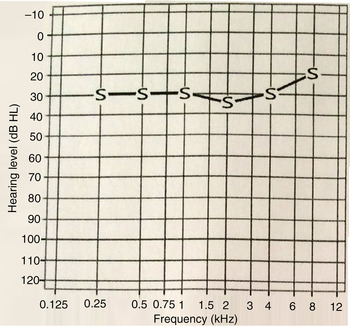
At 12 months old, the subject's aided hearing threshold levels were 15 dB HL at 250 Hz and 25 dB HL at 500–8000 Hz (Figure 2). At 14-months-old (after 8 months of cochlear implant experience), the subject scored 30 out of 35 on the LittlEars® Auditory Questionnaire, a score well above the norm-curve for his chronological and hearing age.Reference May-Mederake, Kuehn, Vogel, Keilmann, Bohnert and Mueller16 In addition, he scored a 5 on the Categories of Auditory Performance test,Reference Archbold, Lutman and Marshal17 indicating that he understood common phrases spoken in a familiar context. His parents, who were extremely satisfied with the results, reported that the subject could produce up to 10 functional words and a wide variety of sounds.
The subject's common sound field (‘S’) hearing threshold levels with both implants on, at 12 months of age.

Discussion
Most surgeons prefer not to operate on very young children because of the risks inherent in anaesthetising children younger than 12 months. The morbidity, mortality and life-threatening adverse events are significantly higher in this age group than in older age groups.Reference Keenan, Shapiro and Dawson18–Reference Tiret, Nivoche, Hatton, Desmonts and Vourc'h20 In addition to the risks from anaesthesia, cochlear implantation in children younger than 12 months of age carries greater risks in terms of facial nerve anatomy, device fixation, intra-operative bleeding and device migration associated with skull growth.Reference Cosetti and Roland21
The King Saud University cochlear implant committee approved the subject reported herein for simultaneous bilateral cochlear implantation, despite his not meeting the usual age limit. This is because he had a highly motivated family, and because the subject needed to have the implant as early as possible to maximise auditory development, before the Usher syndrome induced vision loss. The subject's family was highly motivated in part because their older son, who also has profound hearing loss and Usher syndrome, was implanted at four years old, and has had disappointing audiological results and learning difficulties which the family attributed to his decreased vision. In order to avoid a repetition of this experience, the family was extremely keen and enthusiastic for the present subject to be implanted as soon as possible.
Few children under 12 months old have been reported to have received simultaneous bilateral cochlear implantation, and even fewer under the age of 6 months.Reference Peters, Wyss and Manrique22 Early bilateral implantation is specifically recommended for children with Usher syndrome.Reference Schramm23
We are aware of only one case in which a child younger than the present subject (a four-month-old) received simultaneous bilateral cochlear implantation.Reference Broomfield, Murphy, Emmett, Wild and O'Donoghue11 The authors did not provide any details regarding whether any adverse events were experienced or on his or her future audiological development, so it is difficult to compare this case with that of the present study.
Wie reported on 21 subjects who received simultaneous bilateral cochlear implantation, 15 of whom where 12 months old or younger at the time of implantation, and 2 of whom were 5 months and 5.5 months old respectively.Reference Wie24 After nine months of device use, the subjects' mean listening performance score was equivalent to that of their normal hearing peers, as measured by the LittlEars Auditory Questionnaire. The scores of the earliest implanted subjects were not provided; however, it was noted that subjects who were younger at first fitting of the processor had higher listening performance scores than those who underwent implantation later. These data are in line with our findings.
Several previous studies included children who underwent simultaneous bilateral cochlear implantation under 12 months of age;Reference Boons, Brokx, Frijns, Peeraer, Philips and Vermeulen2, Reference Vincent, Bébéar, Radafy, Vaneecloo, Ruzza and Lautissier4, Reference Peters, Wyss and Manrique22–Reference Tait, Nikolopoulos, De Raeve, Johnson, Datta and Karltorp27 however, none of the studies' results are directly comparable to those of the present case. Some of the studies did not report on surgical data, adverse events or speech perception development. Other studies provided mean but not individual scores, making it impossible to separate the scores of those implanted when aged 12 months or younger from those who were implanted later. Finally, some of the studies provided speech perception scores after comparatively long follow-up times, when the child was six years old for example. The only points of commonality between the results of subjects in the aforementioned studies and the results of the subject in the present study are the safety of the surgical procedure and the derivation of benefit from device provision.
• This paper describes the simultaneous bilateral cochlear implantation of a five-month-old child with profound deafness and Usher syndrome
• Usher syndrome induces vision loss; early bilateral implantation is specifically recommended for affected children
• Implantation was safely conducted: the subject experienced easily resolvable intra- and post-operative adverse events
• At the time of writing, the 14-month-old subject's audiological performance was age-appropriate
• In some cases, the benefits of early simultaneous bilateral cochlear implantation performed by an experienced team outweigh the risks
Surgically, the intervention in our case was successful. The surgical duration, approximately 4 hours, was in line with previously reported times.Reference Grainger, Jonas and Cochrane10–Reference Ramsden, Papsin, Leung, James and Gordon12, Reference Migirov and Kronenberg28 When simultaneous bilateral cochlear implantation is performed by a surgeon with substantial experience in temporal bone surgery, in a clinic with a facial nerve monitor, the risks are minimal and, in some cases, the benefits certainly outweigh the risks. Thus far, early implantation has enabled the present subject to develop age-appropriate hearing and the rudiments of spoken language, much to the delight of his parents.
Conclusion
Our five-month-old subject safely underwent simultaneous bilateral cochlear implantation. Post-operatively, he is developing age-expected speech understanding skills. Such early implantation may be preferable in certain cases, especially when managed by experienced surgeons using the appropriate technology.
Acknowledgement
We would like to thank Michael Todd (Med-El), who worked on a version of this manuscript, for his medical writing services.