Introduction
Emergency preparedness for mass-casualty incidents (MCIs) entails planning for resources and preparing large stockpiles of pharmaceuticals and medical supplies to be deployed when needed. In the United States, such stockpiles are maintained at the state level and are supplemented by the Strategic National Stockpile (SNS) of the Centers for Disease Control and Prevention (CDC; Atlanta, Georgia USA). The SNS is a “national repository of antibiotics, chemical antidotes, antitoxins, life-support medications, [intravenous] IV administration, airway maintenance supplies, and medical/surgical items.”Reference El Sayed, Tamim and Mann 1 The assets in the SNS are determined based on many factors, such as “current biological and/or chemical threats, the availability of medical material, and the ease of dissemination of pharmaceuticals.”Reference El Sayed, Tamim and Mann 1 Keeping these stockpiles current and potent can be very expensive with varying shelf lives of the different components in the inventory and the usually low likelihood of use. Successful planning is based on using best available evidence to estimate actual resources requirements in times of crisis.
Most of the literature examining MCIs consists of a specific event description or summaries of lessons learned after the event. Recommendations based on expert group opinion cite specialty medications, IV fluids, blood products, sedatives/analgesics, specific antibiotics, antivirals, and vaccines as required for mass-casualty events and disasters. 2 Emergency Medical Services (EMS) are at the forefront of the response to MCIs and large-scale events. In recent years, US EMS agencies suffered from recurrent shortages of essential medications.Reference Koenig, Lim and Tsai 3 , Reference Erich 4 Planning for adequate supplies and for pharmaceutical surge capacity is therefore needed. Mutual linkage is one essential preparedness mechanism for EMS systems to ensure faster deployment and better coordination of resources during the actual response to an MCI. Another important preparedness component consists of data driven planning to ensure that EMS agencies have the needed resources in a timely manner, including local availability or stocking of essential medication supplies. Examining the actual EMS practice in MCIs can therefore help EMS agencies better prepare for MCIs and keep essential medications available at hand.
The National Emergency Medical Services Information System (NEMSIS; Salt Lake City, Utah USA) maintains a US national EMS database. The NEMSIS 2012 dataset includes EMS activations submitted by EMS agencies in 42 states and territories. 5 - Reference Dawson 7 This repository allows access to examine MCIs at a national level, to evaluate trends in the prehospital management of MCI patients, and to estimate resource requirements and, more specifically, medication use at a national or local level in the event of an MCI.
This study used the NEMSIS 2012 dataset to describe the types and frequencies of medications given during MCIs by different levels of EMS providers. The goal of this project was to provide EMS agencies at all service levels with information regarding prehospital medication administration for better planning and estimation of resource requirements for field management of MCI victims.
Methods
Study Design
This retrospective, cross-sectional study used the NEMSIS 2012 public research dataset released by the NEMSIS Technical Assistance Center (TAC). Institutional Review Board exemption for use of this de-identified dataset was obtained from the American University of Beirut (Beirut, Lebanon).
Study Setting
The NEMSIS TAC maintains a national EMS database that collects 83 variables using standardized definitions and formats from US states and territories.Reference Mann, Kane, Dai and Jacobson 8 Data are collected locally by different EMS agencies, aggregated at the state level, then submitted to the NEMSIS national database. Submissions from different states vary in terms of inclusion criteria and proportion of EMS activations submitted. 5 The National Emergency Medical Services Information System is considered a convenience sample, on a national scale, for EMS activations in the US.Reference Dawson 7 A single patient activating the EMS system might be represented in the national database more than once, due to multiple EMS vehicles responding to the patient care event and reporting to the state database. Thus, the term EMS activation represents a patient encounter by a single responding vehicle. The unit of analysis in this study was “EMS activation” rather than individual patients since the national EMS database provides a de-identified database structure prohibiting analysis at a patient level. Each activation was therefore treated as an independent entry.
Study Population
The 2012 NEMSIS national dataset includes information on 19,831,189 EMS activations.Reference Dawson 7 Emergency Medical Services activations that were recorded as MCI either at dispatch (the complaint dispatch reported to the responding unit), or on scene by the EMS provider, were included.
Available Data
The primary objective of this study was to describe types and frequencies of medications given to patients during MCIs by different levels of EMS providers. Standardized definitions in the NEMSIS manual were used. An MCI is defined as:
An event which generates more patients at one time than locally available resources can manage using routine procedures or resulting in a number of victims large enough to disrupt the normal course of emergency and health care services and would require additional non-routine assistance. 5 , Reference Mann, Kane, Dai and Jacobson 8
A medication given is any medication administered to the patient and that is part of the “list of all medications the agency has implemented and available for use.” The US national drug index or coding scheme (RxNorm), which would allow for a single code to be assigned to a single drug, was not utilized initially by NEMSIS. Thus, NEMSIS TAC staff generated a clean standardized coded list of medications from a text field as part of the publically available dataset. For level of care of providers, the Center for Medicare and Medicaid Services (CMS) Service Level for the EMS encounter was used and divided the levels into five categories: Unknown, Basic Life Support (BLS; BLS and BLS emergency), Advanced Life Support (ALS; ALS Level 1, Level 1 emergency, and Level 2), Air Medical Transport (AMT) including both fixed wing (Airplane) and rotary wing (Helicopter), and Specialty Care Transport (SCT). Additional variables that were analyzed to better characterize the study population included: Urbanicity (population setting using United States Department of Agriculture (USDA; Washington, DC USA) and Office of Management and Budget (OMB; Washington, DC USA) definitions), 5 primary role of the responding unit, primary symptom, possible injury, and providers’ primary impression.
Data Analysis
The Statistical Analysis Software (SAS) version 9.1 (SAS Institute, Inc; Cary, North Carolina USA) was used for the management and analyses of the data. Categorical variables were summarized using frequencies and percent. Nonparametric techniques (ie, Chi-square tests) were conducted to evaluate differences in medication administration by EMS service level. Fisher’s exact test was used when needed. Statistical significance level was set at P<.05.
An overall count of all medications given for all MCI-related activations and a calculation of frequencies by types and count were conducted initially. This was followed by a descriptive characterization of the study population and an analysis of the types of medications and corresponding frequencies by different EMS service levels. Two different denominators (total medications given N=11,268 and total MCI activations N=26,110) were used to report percentages. Medication frequency is the count of a specific medication divided by the total count of all reported medications given. For example, if the total count of all medications is 10 and the count of a specific medication is two, regardless of whether the same activation or different activations (ie, a medication could be given more than once), then that medication frequency is equal to 20%. The medication frequency “per activation” is the percentage of EMS MCI activations for which a specific medication reportedly was given divided by total number of MCI activations. For example, if 10 activations were available and Activation 1 had a medication given once (or twice) then the medication frequency per activation is 10%.
Results
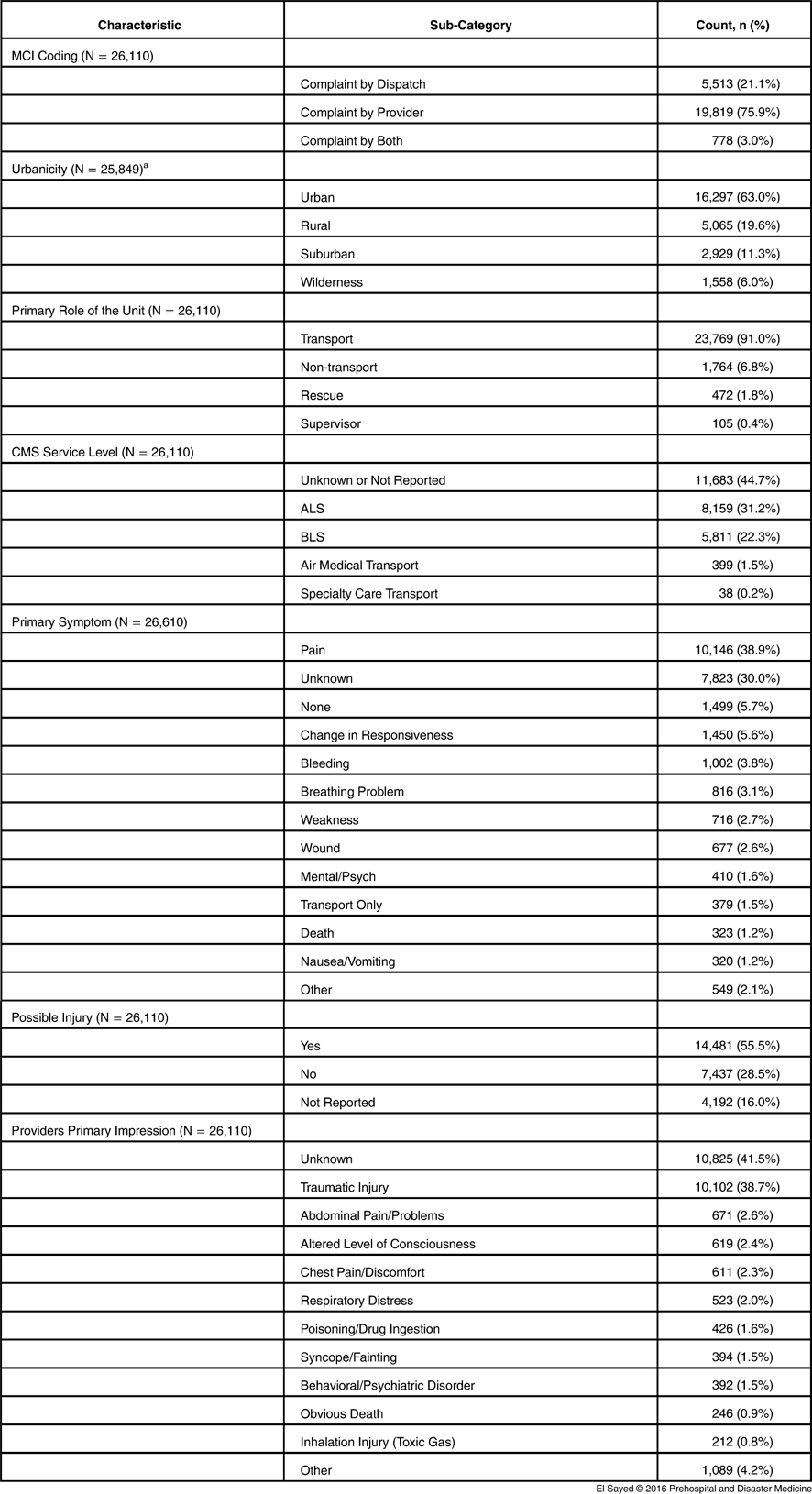
A total of 53,334 EMS activations were recorded as an MCI. All MCI-related activations recorded as “call cancelled,” “no patient found,” or “patient refused treatment” were excluded. The 26,110 remaining MCI activations were included and analyzed. More than one-half of the activations (63.0%) were in an urban setting. The primary role of the EMS unit reporting the activation was transport (91.0%). The five categories of EMS level of care were identified with “Unknown” accounting for a large portion of the activations (44.7%; Table 1). Injury was reported in 14,481 (55.5%) activations. The most common reported primary symptom was pain in 10,146 (38.9%) activations. Provider’s primary impression was unknown in 10,825 (41.5%) activations followed by traumatic injury in 10,102 (38.7%) activations (Table 1).
MCI Activations Study Population Characteristics

Abbreviations: ALS, Advanced Life Support; BLS, Basic Life Support; CMS, Center for Medicare and Medicaid Services; MCI, mass-casualty incident.
a Activations with missing “Urbanicity” (261) were included in the overall frequencies calculation but not in the Urbanicity one.
Medication Given
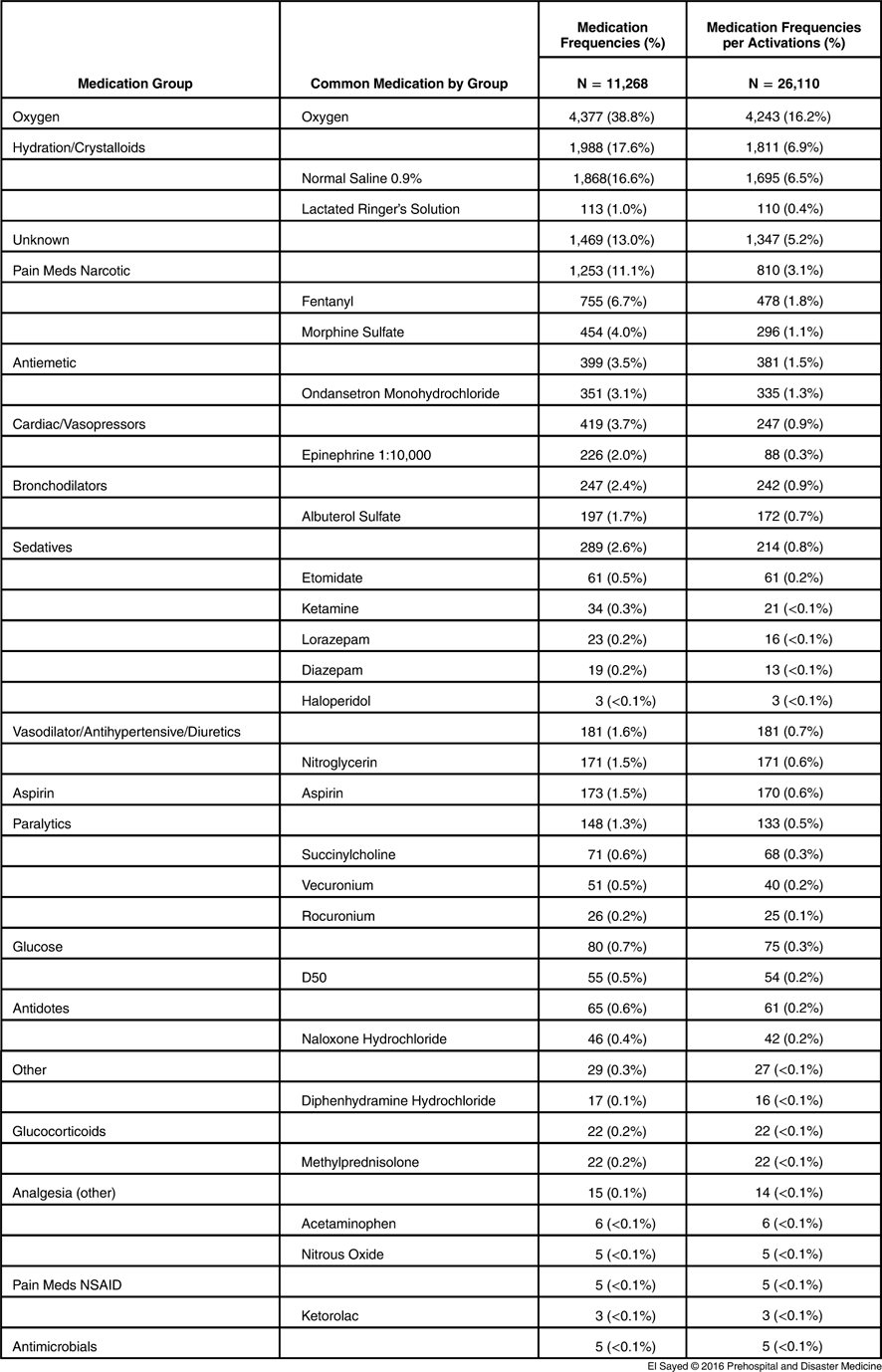
Overall, more than 80 different medication types were administered in MCI activations. Eighteen large groups of medications were identified. Oxygen was the predominant group (16.2%), followed by crystalloids (6.9%; Normal Saline 0.9% and Lactated Ringer’s Solution), unknown (5.2%), analgesics (3.2%; mainly narcotics including Fentanyl and Morphine Sulfate), antiemetics (1.5%; Ondansetron Monohydrochloride), cardiac/vasopressors/inotropes (0.9%), bronchodilators (0.9%; Albuterol Sulfate), sedatives (0.8%), and vasodilators/antihypertensive (0.7%; mainly Nitroglycerin). Antidote administration was not reported frequently with only 0.2% of MCI activations receiving one type of antidote, including Naloxone Hydrochloride, Glucagon, Thiamine, Activate Charcoal, Amyl Nitrite, or Tetanus antitoxin.
Most Common Medications by Count and by Activations

Abbreviation: NSAID, nonsteroidal anti-inflammatory drug.
Medication Frequencies (Table 2)
When assessing individual medication count, a total of 11,268 medication administrations were reported for all MCI activations. Oxygen was most predominant (38.8%) followed by, in descending order: Normal Saline 0.9% (16.6%), Unknown (13.0%), Fentanyl (6.7%), Morphine Sulfate (4.0%), Ondansetron Monohydrochloride (3.1%), Epinephrine 1:10,000 (2.0%), Albuterol Sulfate (1.7%), Aspirin (1.5%), and Nitroglycerin (1.5%).
Medication Frequencies per Activations (Table 2)
A total of 7,021 (26.9%) activations had at least one medication administered with Oxygen being the most common medication given (16.2%) followed by, in descending order: Normal Saline 0.9% (6.5%), Unknown (5.2%), Fentanyl (1.8%), Ondansetron Monohydrochloride (1.3%), Morphine Sulfate (1.1%), Albuterol Sulfate (0.7%), Nitroglycerin (0.6%), Aspirin (0.6%), and Lactated Ringer’s solution (0.4%).
Medication Group by EMS Service Level
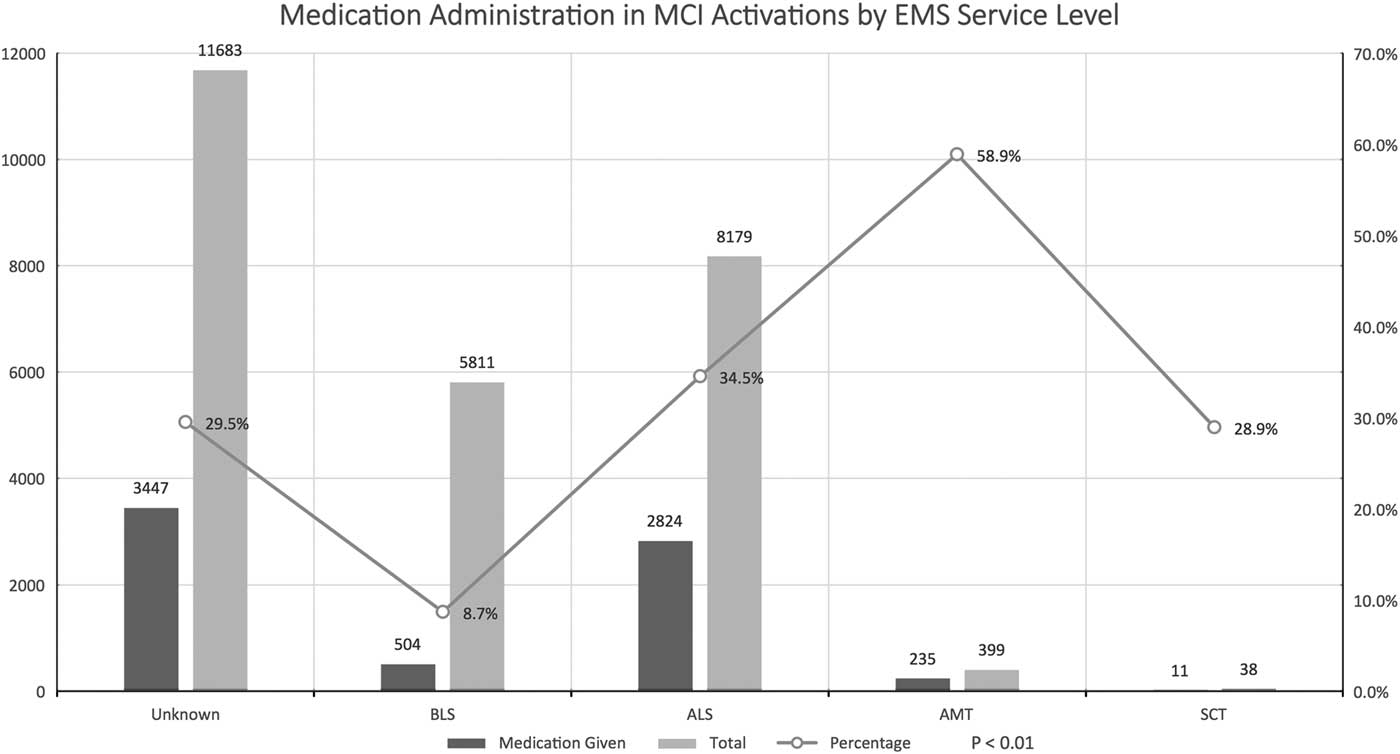
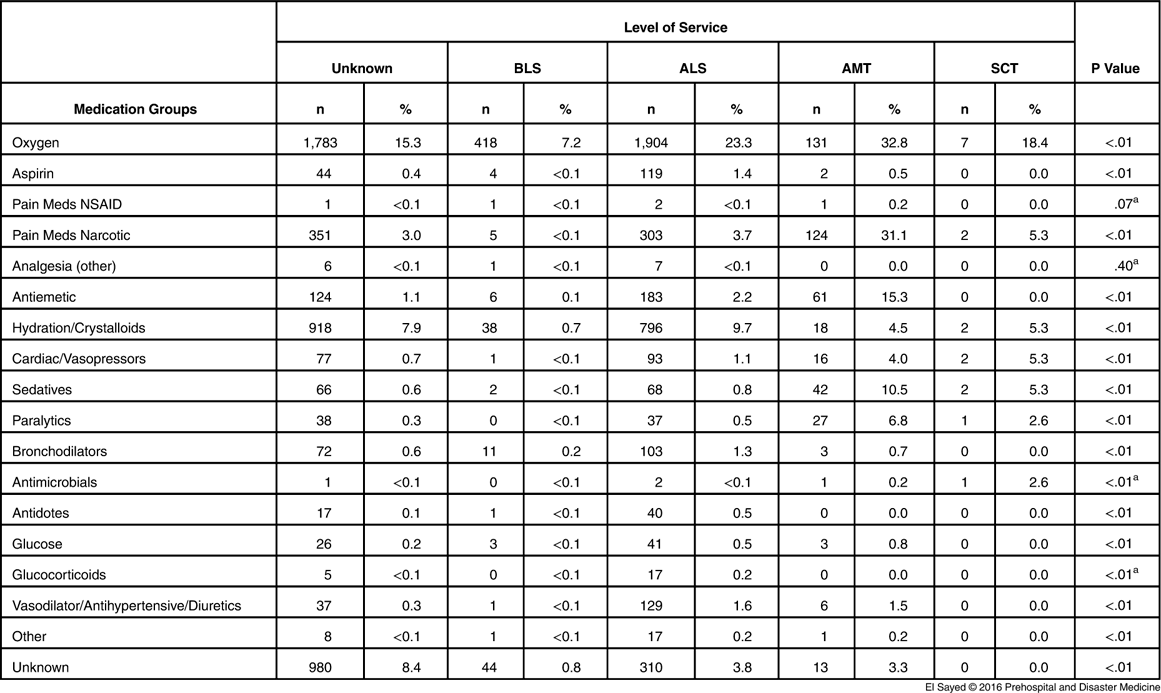
Reported rates of at least one medication administration during MCI activations varied by EMS service level (Figure 1). Air Medical Transport service level activations had the highest frequency of reported activations where at least one medication was given (58.9%; Table 3). This was followed by ALS service level activations (34.5%), Unknown service level activations (29.5%), SCT service level activations (28.9%), and BLS service level activations (8.7%). When examining types of medications given by EMS service level, Oxygen remained the most common medication administered across all levels of care. For BLS activations, Oxygen was most common (7.2%); however, medications given were not reported commonly. Higher medications administration frequencies were reported in ALS activations mainly for Oxygen (23.3%), hydration/crystalloids (9.7%), narcotic pain medications (3.7%), and antiemetics (2.2%). Air Medical Transport service level activations had the highest reported frequencies for medications given mainly for Oxygen (32.8%), pain medications (31.1%; mainly narcotics), antiemetics (15.3%), and sedatives (10.5%). The number of SCT service level activations was low (N=38) with Oxygen being the most common medication reported (18.4%). The difference between the frequencies of medications given by level of care provided was statistically significantly for overall medication administration (P<.01) as well as across all medications groups (P<.01) with the exception of “Analgesia (other)” (P=.40) and “Pain medications (nonsteroidal anti-inflammatory drug; NSAID)” (P=.07; Table 3).
Medication Administration in MCI Activations by EMS Service Level. Abbreviations: ALS, Advanced Life Support; AMT, Air Medical Transport; BLS, Basic Life Support; EMS, Emergency Medical Services; MCI, mass-casualty incident; SCT, Specialty Care Transport.

Medication Groups by EMS Service Levels Comparison

Abbreviations: ALS, Advanced Life Support; AMT, Air Medical Transport; BLS, Basic Life Support; EMS, Emergency Medical Services; NSAID, nonsteroidal anti-inflammatory drug; SCT, Specialty Care Transport.
a P value for Fisher exact test. For all others, Chi square test was used.
Discussion
This study is the first to use a national EMS dataset to quantify medication use and to examine current management trends in EMS activations coded as MCI. It highlights that events most commonly considered “MCIs” by providers (based upon the NEMSIS definition) involve mechanical trauma. Medication types used during MCIs and their corresponding administration frequencies are described. This study has important implications in helping EMS agencies, at any level of care, plan for medication stockpiles needed in the event of an MCI and assess their needs for improved preparedness using best evidence from a national dataset. By examining medication frequencies or how often medications are given, EMS administrators can plan for medication stockpiles for potential MCIs in an evidence-based manner. Similarly, EMS medical directors can use medication frequencies per activations, or how often medications are administered per activations, to devise EMS protocols specific to MCIs and incorporate relevant medications in a more systematic manner.
In the NEMSIS 2012 dataset, medication administration was reported in up to 26.9% of MCI activations. Oxygen was the predominant medication across all EMS service levels for MCI activations. Crystalloids, antiemetics, and pain medications (narcotics) administrations were reported less commonly. A large proportion of MCI activations in the study population had a diagnosis (provider primary impression) of unknown or traumatic injury. Emergency Medical Services protocols for trauma management in the US focus on reduced scene time, fast transport to an appropriate trauma center, and limited interventions, mainly immobilization, Oxygen administration, and minimal fluid resuscitation in addition to pain management. The types of medications administered in MCI activations, using NEMSIS data, mirror this practice.
Reported medication administration rates were significantly different by EMS service level. Air Medical Transport and ALS activations had much higher reported frequencies of medication administration than BLS. This finding directly is related to the scope of practice of EMS providers in the US and is consistent with the fact that higher level of care is provided during ALS or AMT activations, including IV access insertion, medication administration, and monitoring. In addition to that, using CMS billing level for level of care provided might have resulted in higher reported rates of medication administration since billing is linked tightly to medication administration, especially at the ALS Level 1 and ALS Level 2 activations. 9 A study by Sporer et al examining prehospital medication administration and emergency medical dispatch codes in an urban EMS, all ALS systems reported a rate of medication administration in 19% of calls examined compared to 27% in this study of MCIs. They, however, did not count Oxygen as a medication. 10 Oxygen was the most common medication reported during MCI activations in this study, which has important implications for agencies in terms of preparedness. Previous published reviews highlight the importance of planning for Oxygen needs and the challenges of securing enough Oxygen supply after MCIs or disasters.Reference Sporer and Wilson 11 , Reference Ritz and Previtera 12 This study provides evidence that Oxygen is a critical consumable resource, not only for hospitals, but also for EMS during response to MCIs.
The higher frequencies of medication administration in the AMT activations reflect the higher acuity or complexity of cases that usually are transported by air (rotary or fixed wing) with most US-based EMS systems having in place guidelines for air medical dispatch, mainly for trauma patients, and that are based on anatomic, physiologic, or situational high-acuity criteria.Reference Blakeman and Branson 13 The types of medications used also reflect airway management procedures with higher frequencies of sedatives and paralytics reported than in the other EMS level of care activations.
Limitations
This study utilized data from a national database that may be subject to information and selection bias since inconsistencies in the measurement and reporting of clinical variables, treatment options, and transport practices may differ systematically among reporting agencies. Also, missing data, mainly for EMS level of care, were not excluded from the study, but were reported as a separate category to allow for comparison. Although it is likely that not all medications given were documented in the national database, there is little reason to believe that specific types of medications are more or less likely to be documented. Thus, the differences in ratios (or percentages) reported between the prevalence of the different medication groups are likely not overtly influenced by systematic bias. This study did not differentiate between MCI types. Studies examining specific types of MCIs may reach different results, especially that some MCI types directly influence the types of medications administered (such as chemical exposure and antidote administration). Finally, NEMSIS data represent EMS resource activations and not the number of treated patients. For the purposes of this study, this fact allowed focus on actual medication administration frequency, types, and utilization patterns across multiple providers who may have cared for the same MCI patient over the course of an actual incident.
Conclusion
Results from a national dataset suggest that several groups of medications are used by EMS during MCI activations. Oxygen, crystalloids, and narcotic pain medications are most common. The frequencies and types of medications used varied by EMS level of care. Emergency Medical Services agencies at all service levels can use the findings of this study to plan for MCIs and prepare their medication stockpiles in an evidence-based manner.
Acknowledgement
The authors would like to acknowledge and thank all of the participating EMS providers, EMS agencies, and state EMS offices who support and provide data to the NEMSIS National Database.