Introduction
Several studies have documented an association between retrospectively reported childhood adversities and the new-onset of psychiatric disorders (Cohen et al., Reference Cohen, Brown and Smaile2001; Collishaw et al., Reference Collishaw, Pickles, Messer, Rutter, Shearer and Maughan2007; Fergusson et al., Reference Fergusson, Horwood and Lynskey1996; Fristad et al., Reference Fristad, Jedel, Weller and Weller1993; Wark et al., Reference Wark, Kruczek and Boley2003; Widom, Reference Widom1999; Someshwar et al., Reference Someshwar, Holla, Pansari Agarwal, Thomas, Jose, Joseph, Raju, Karle, Muthukumaran, Kodancha, Kumar, Reddy, Kumar Nadella, Naik, Mitra, Mallappagiri, Sreeraj, Balachander, Ganesh and Viswanath2020). Evidence from these reports consistently suggests the role of childhood abuse, neglect, and maltreatment in both the disorders of internalizing (depression, anxiety, and stress-related disorders) and externalizing spectrum (substance use and conduct disorders) (Cohen et al., Reference Cohen, Brown and Smaile2001; Collishaw et al., Reference Collishaw, Pickles, Messer, Rutter, Shearer and Maughan2007; Fergusson et al., Reference Fergusson, Horwood and Lynskey1996). The National Comorbidity Survey (NCS) and NCS-replication from the USA, and the World Mental Health Survey that had looked into the relationship between multiple childhood adversities and psychiatric disorders were done in adult samples introducing the possibility of recall bias (Green et al., Reference Green, McLaughlin, Berglund, Gruber, Sampson, Zaslavsky and Kessler2010; Kessler et al., Reference Kessler, McLaughlin, Green, Gruber, Sampson, Zaslavsky, Aguilar-Gaxiola, Alhamzawi, Alonso, Angermeyer, Benjet, Bromet, Chatterji, de Girolamo, Demyttenaere, Fayyad, Florescu, Gal, Gureje and Williams2010). Childhood adversities are not the only antecedent risk factors for later onset psychiatric disorders (Bellis et al., Reference Bellis, Hughes, Leckenby, Jones, Baban, Kachaeva, Povilaitis, Pudule, Qirjako, Ulukol, Raleva and Terzic2014). Some of these other factors are also associated with childhood adversities, such as migration. A systematic review of studies conducted in the USA showed migrants were more likely to experience adversities during childhood (Solberg & Peters, Reference Solberg and Peters2020). Similar findings were also observed from Italy (Gambaro et al., Reference Gambaro, Mastrangelo, Sarchiapone, Marangon, Gramaglia, Vecchi, Airoldi, Mirisola, Costanzo, Bartollino, Baralla and Zeppegno2020),in which incident psychopathology during childhood and adult life was more common among migrants than the non-migrant study participants (Gaber et al., Reference Gaber, Bouyrakhen, Herpertz-Dahlmann, Hagenah, Holtmann, Freitag, Wöckel, Poustka and Zepf2013). A few other factors, although did not have direct evidence of association with adversities, could independently be linked with mental illness, such as family history of psychiatric disorders in the first-degree relatives and perinatal insults. A significant familial aggregation was reported among various psychiatric disorders cutting across the diagnostic spectrum (Kendler et al., Reference Kendler, Davis and Kessler1997). Some evidence also suggests a mediating effect of adverse childhood experience in the relationship between family history of mental illness and onset of psychiatric disorders among respondents (Jung et al., Reference Jung, Goldstein and Grant2016). There is growing evidence demonstrating that both the antenatal and natal insults independently, either through drugs and alcohol or metabolic derangements, contribute to difficult temperament and behavior disturbances in children (Frey et al., Reference Frey, Eichler, Stonawski, Kriebel, Wahl, Gallati, Goecke, Fasching, Beckmann, Kratz, Moll, Heinrich, Kornhuber and Golub2018; Modesto et al., Reference Modesto, Tiemeier, Peeters, Jaddoe, Hofman, Verhulst and Ghassabian2015)
However, these studies either examined the association of single childhood adversity or explored association with a single psychiatric disorder. In view of the co-occurrence and sub-additive interactions between childhood adversities, it may be more appealing to study all childhood adversities together (McLaughlin et al., Reference McLaughlin, Green, Gruber, Sampson, Zaslavsky and Kessler2012). In addition, most reported studies were from higher income settings and the nature and severity of adversity are likely to be very different from lower- and middle-income countries (LMICs) both from social and cultural perspectives. Therefore, there is a need to study the link between adversities and psychiatric disorders from a representative low- and middle-income population.
Moreover, a multitude of antecedent risks such as the familial, perinatal, developmental, and adverse childhood experience contribute to later onset psychopathology. Some of these have a tendency to co-occur. It is, therefore, prudent to think, these risk factors may form distinctive clusters of risk.
The aim of our research was to generate risk clusters from a large, varied, and representative sample of children, adolescents, and young adults from a LMIC setting. We further examined the association of these risk clusters with later onset manifest psychopathology.
Methods
Study design
We report findings from the cross-sectional baseline data obtained from the Consortium on Vulnerability to Externalizing Disorders and Addictions (cVEDA), an accelerated longitudinal cohort from children and adolescents, in India between 2014 and 2016. The cohort profile and the study protocol have been published elsewhere (Sharma et al., Reference Sharma, Vaidya, Iyengar, Zhang, Holla, Purushottam, Chakrabarti, Fernandes, Heron, Hickman, Desrivieres, Kartik, Jacob, Rangaswamy, Bharath, Barker, Orfanos, Ahuja and Murthy2020; Zhang et al., Reference Zhang, Vaidya, Iyengar, Sharma, Holla, Ahuja, Barker, Basu, Bharath, Chakrabarti, Desrivieres, Elliott, Fernandes, Gourisankar, Heron, Hickman, Jacob, Jain and Jayarajan2020). The history of all exposure-related variables (e.g., environmental adversities, impact during pregnancy, migration) was collected retrospectively from structured interviewed completed by reliable informants, usually a parent.
Sample
The participants were aged between 6 and 23 years (mean = 14.1 years; SD = 4.56). The study was conducted across seven sites of India: Chandigarh, Imphal, Kolkata, Rishi valley, Bengaluru (two sites), and Mysore. The sites were situated in the northern, southern, eastern, and north-eastern regions of the country. The selection of sites was not only based on the geographical distribution but also was to ensure a varied exposure to environmental adversities in the sample. Two of these sites (Postgraduate Institute of Medical Education and Research, Chandigarh and National Institute of Mental Health and Neuro Sciences, Bengaluru) recruited children of patients with established current diagnoses of substance use disorders. The study participants from Kolkata were offspring of coal mine workers, a migratory population with higher rates of parental alcohol use. Imphal has long been subject to socio-political conflict. The cohort from Saint John’s Research Institute, Bengaluru, Mysuru, and Rishi Valley consisted of children and adolescents, from schools, colleges, and agricultural households. While participants from Imphal and Mysore were residents from urban areas, elsewhere they were from a mix of urban and rural neighborhoods. We have statistically controlled for the site-heterogeneity. The cohort profile with details of participants including measures has been published elsewhere (Zhang et al., Reference Zhang, Vaidya, Iyengar, Sharma, Holla, Ahuja, Barker, Basu, Bharath, Chakrabarti, Desrivieres, Elliott, Fernandes, Gourisankar, Heron, Hickman, Jacob, Jain and Jayarajan2020).
Quality assurance and quality control
We integrated the quality control measures from the preparatory phase of the study. It included interviewer training, both on-site and on-line, mock interview assessments, and direct feedback. There were weekly recruitment meetings to check the completeness of data entry and for troubleshooting. The study coordinator visited the individual centers to monitor adherence with the clinical protocol.
Measures
All instruments were administered by trained research assistants, to participants who had provided full informed consent (for adults) and assent (for those less than 18 years). The study was approved by respective ethics committees of all the participating centers.
We explored a range of developmental and adverse environmental exposures during childhood and adolescence with structured and validated instruments. For the elicitation of developmental risks, we gathered systematic information regarding the family history of psychiatric and substance use disorders, antenatal, perinatal, and neonatal history, and developmental delays. The early environmental stressors were elucidated by adverse childhood experience, school environment, and a structured history of migration.
For participants between the age groups of 18 and 23 years, all instruments were administered to the participants except for the Pregnancy History Instrument, which was administered to the mother. Research assistants administered all the questionnaire.
The following instruments were used for the assessments for these risk factors: Family History Questionnaire (Weissman et al., Reference Weissman, Wickramaratne, Adams, Wolk, Verdeli and Olfson2000), Pregnancy History Instrument-Revised (Buka et al., Reference Buka, Goldstein, Seidman and Tsuang2000), School Climate Questionnaire (SCQ) (Domínguez et al., Reference Domínguez, Ruiz, Huertas and Alonso-Tapia2020), Adverse Childhood Environment-International Questionnaire (ACE-IQ) (Adverse Childhood Experiences International Questionnaire (ACE-IQ), n.d.), and migration questionnaire from the National Sample Survey of India (22. National Sample Survey Office. Migration in India 2007–2008 [Internet]. Ministry of Statistics & Programme Implementation, Government of India; 2010. Available from: http://www.Mospi.Gov.in/Sites/Default/Files/Publication_reports/533_final.Pdf - Google Search, n.d.). Almost all migration in the Indian context refers to internal migration. This is in contrast to migration in Europe and North America.
Manifest psychopathology was diagnosed with the Mini-International Neuropsychiatric Interview-5 (MINI) (Sheehan et al., Reference Sheehan, Lecrubier, Sheehan, Amorim, Janavs, Weiller, Hergueta, Baker and Dunbar1998). The MINI for children (MINI-KID) was used for the childhood and adolescent psychopathology between 6 and 17 years age (Sheehan et al., Reference Sheehan, Sheehan, Shytle, Janavs, Bannon, Rogers, Milo, Stock and Wilkinson2010). We assessed the current prevalence of all manifest psychopathology, except for suicidality (for which lifetime prevalence was assessed).
Detailed descriptions of these assessment tools are provided as supplementary text.
Analysis
Imputation of missing data
At the first level, we ran the imputation at the scale-item level so that we could calculate total scores. As the items within a scale were likely to have the highest correlations, we did this as the first step. Also, due to the nature of different scales & items - some being continuous, some ordinal and some categorical, we employed different imputation algorithms (predictive mean matching, randomForest, logreg) for each of the scales. At the second level, after computing the scale or domain totals, we did another imputation. This time, we used a cut-off of no more than >25% of missing data per subject to impute. After excluding those cases that had >25% missing data for the summary scores and had no MINI data, we were left with 8300 participants. Prior to each imputation, we ran Little’s test for missing completely at random (MCAR), which tests whether there are systematic differences between the observed and missing data on any of the other available/complete data. A non-significant value for this test indicates that the data were "MCAR." This was fulfilled for all imputations that were run.
Statistical analysis
8300 cVEDA participants (6–23 years), who had complete data available for the scales used in this study, were included. We used the adverse environmental exposure related, pregnancy-related variables, and family history of psychiatric or substance use disorders to generate risk clusters of the participants. The relevant risk variables were adjusted for age and sex. Using Statistical Package for Social Sciences (SPSS version 22, IBM), we used two-step cluster analysis to generate risk clusters. Two-step cluster analysis could be considered as a combination of a K-means cluster and a hierarchical cluster analysis. Two-step cluster can deal with both ordinal and scale data. It also automatically selects the number of clusters with the best cluster quality, assessed by the average silhouette coefficient value of all objects in the cluster. These groups were compared for the frequencies of new-onset psychiatric and substance use disorders. We grouped the psychiatric disorders as externalizing (oppositional defiant disorder, conduct disorder, attention deficit hyperactivity disorder, substance use disorders), internalizing disorders (depression and anxiety disorders), psychosis (all schizophrenia spectrum disorders), and suicidality. Comparison was done by Chi-square test. We have made ten comparisons. The adjusted level of significance after Bonferroni correction was <0.005. Additionally, we compared the severity of substance use between the groups, by Mann–Whitney U test.
Results
Sample
The mean age of the sample was 14.1 years (SD = 4.56; range = 5–24; median = 14 years). There was a slight preponderance of females (52.8%). The participants were mostly single (97.7%) and Hindu (73.4%) by religion. The average years of attained education was 8.9 years (SD = 4.9; range = 0–21; median = 8 years). A slightly higher proportion of the participants was from urban (59%) areas and a large majority was from nuclear families (78%).
Description of environment and developmental risk variables
The risk variables can be broadly classified as familial, developmental and environmental risk factors. The individual variables in these categories were: history of psychiatric and substance use disorders, presence of any maternal risk factors, delivery-related complications, neonatal risk factors, presence of any developmental delay, history of migration in the family, exposure to any adverse experiences in childhood, and school climate. Maternal risk factors were present in 33.7%, delivery-related complications were reported by 32.1%, neonatal complications were reported by 12.2% and developmental problems were present in 23.7% of the participants. Family history of psychiatric disorders was reported among first-degree relatives in 23.3% of participants. Nearly 15% of the study participants were migrant populations. The mean of ACE-IQ and SCQ total scores were 6.59 (SD = 6.97, range = 0–55) and 71.69 (SD = 8.0, range = 23–84) respectively. On ACE-IQ, around 51% participants each reported a history of childhood neglect and household challenges in childhood, followed by childhood abuse and community challenges, which were reported by 47.4% and 32.0% respectively.
Cluster analysis
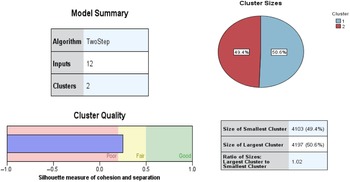
Two-step clustering based on these 12 developmental and environmental risk variables produced 2 clusters with fair cluster quality (average Silhouette score = 0.2). The size of the two clusters was roughly the same between the two groups: 4197 (50.5%) and 4103 (49.5%) participants, and a size ratio between largest and smallest cluster of 1.02. Figure 1 illustrates these results.
Cluster quality and the cluster details.

Two-step cluster analysis in the SPSS is expected to produce the best cluster solution and optimal number of clusters, but we nevertheless checked the veracity of this by examining the auto clustering table which summarizes the process of determining the number of clusters. Our decision on the number of clusters was determined by the Bayesian Information Criteria (BIC) change and ratio of distance measures. BIC change ratio (1 in two-cluster solutions as opposed to 0.499 in the 3-cluster solution), and ratio of distance measures (1.967 in two-cluster solution as compared to 1.320 in the 3-cluster solution). We labeled these clusters as high- and low-risk clusters (HRC and LRC, respectively) based on the distribution of the risk variables.
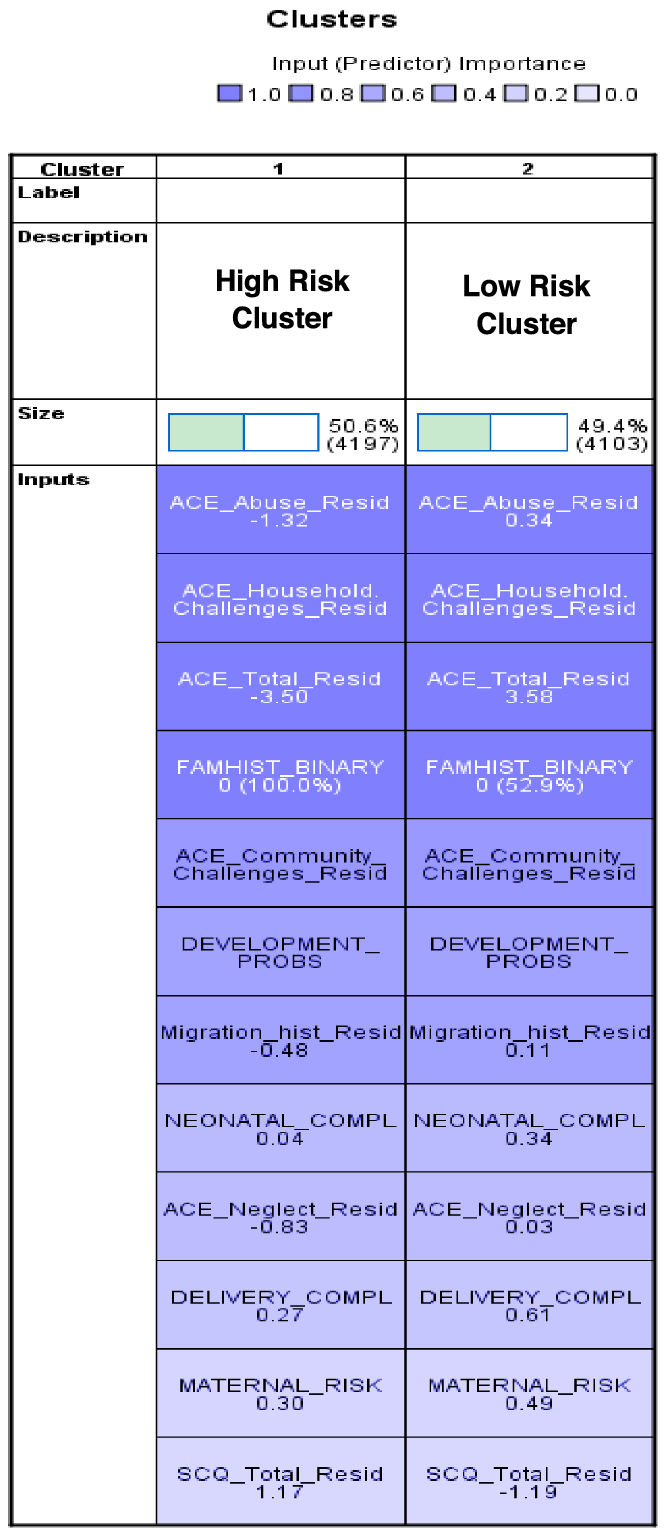
The variable with the maximum predictor importance was the presence or absence of a history of childhood adverse experiences, with a positive history of 67.5% in the LRC, and 93.7% in the HRC. The other variables that had a high predictor importance were adverse childhood experience of household challenges, adverse childhood experience of abuse and a positive family history of psychiatric disorders in any first-degree relative. The lowest predictor importance was shown by a SCQ. Figure 2 shows predictor importance for each variable in the cluster analysis.
Predictor importance of clustering variables. ACE_Abuse_Resid, Adverse Childhood Experience (abuse subscale); ACE_Household Challenges_Resid, Adverse Childhood Experience (household subscale); ACE_Community Challenges_Resid, Adverse Childhood Experience (community challenges subscale); ACE_Neglect_Resid, Adverse Childhood Experience (Neglect subscale) FAMHIST_BINARY, Family History of psychiatric disorders (Present vs. absent); DEVELOPMENT_PROBS, History of developmental delay (Present vs. absent); Migration_hist_Resid, History of migration (Present vs. Absent); NEONATAL_COMPL, History of neonatal complications (Present vs. Absent); DELIVERY_COMPL, History of delivery complications (Present vs. absent); MATERNAL_RISK, Pregnancy-related factors (Present vs. Absent); SCQ_Total_Resid, School Climate Questionnaire.

Comparison of the distribution of demographic and risk factors in the two clusters
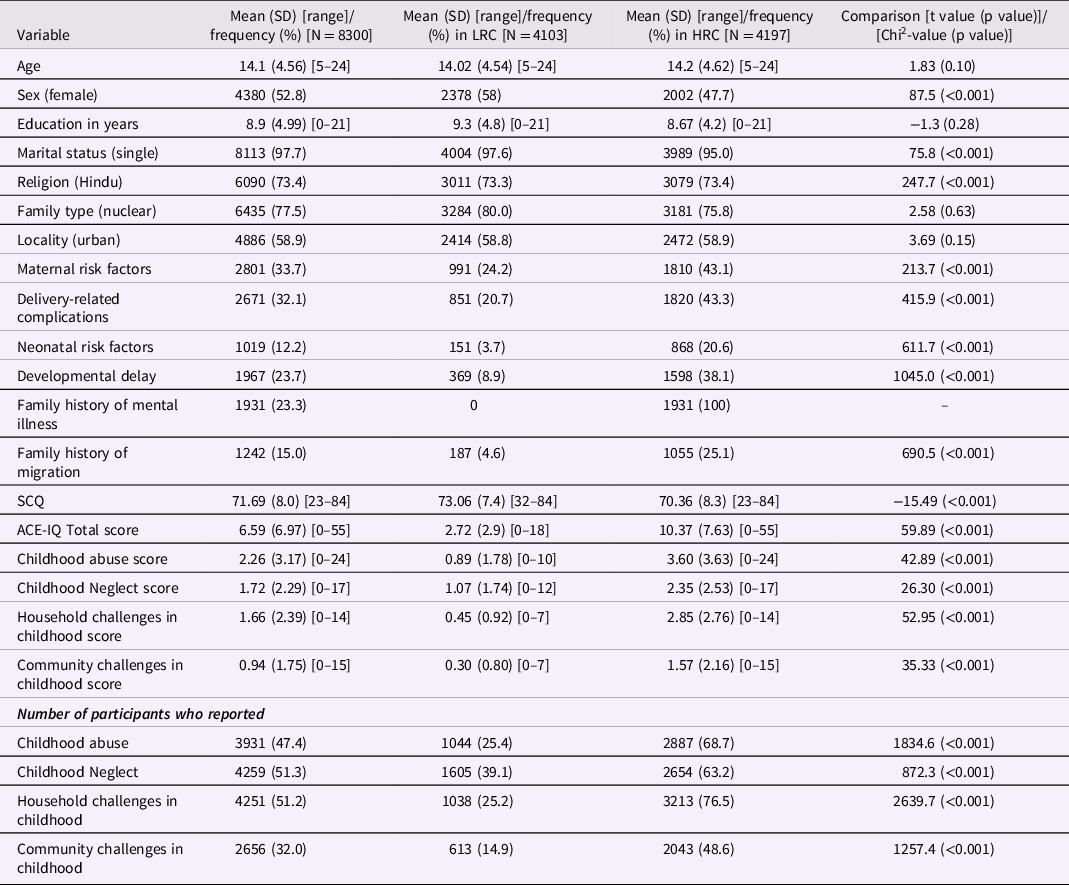
Proportion of men was significantly higher in the HRC. We also compared the distribution of the risk factors in the LRC and HRC. The HRC had significantly higher frequencies of family history of mental illness, maternal and neonatal risk factors, delivery-related complications, developmental delays, history of migration, and all domains of adverse childhood experience than the LRC. However, the scores in the SCQ were significantly higher in the LRC than the HRC. Table 1 depicts these comparisons.
Distribution of demographic and risk factors between the two clusters

SCQ = School Climate Questionnaire; ACE-IQ = Adverse Childhood Experiences-International Questionnaire.
Comparison of the prevalence of psychiatric disorders between the high- and low-risk clusters
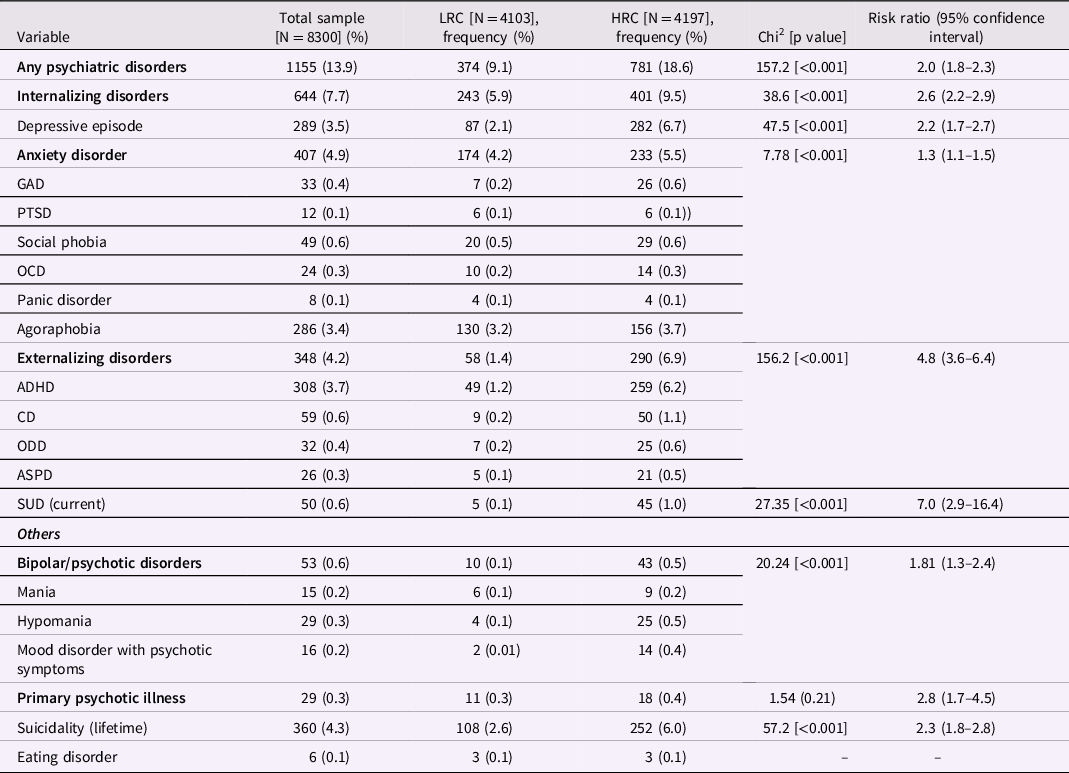
The rates of any psychiatric disorders were significantly more in the HRC than the LRC. Among the categories, the occurrence of current internalizing, externalizing, bipolar or psychotic mood disorders were significantly higher in the HRC than the LRC. The lifetime prevalence of suicidality, too, was significantly higher in the HRC than the LRC. The strengths of association, measured by the risk ratios were as follows: any psychiatric disorder (RR = 2.0, 95% CI 1.8–2.3), externalizing (RR = 4.8, 95% CI 3.6–6.4) and internalizing disorders (RR = 2.6, 95% CI 2.2–2.9), and suicidality (2.3, 95% CI 1.8–2.8). Please see Table 2 for further details.
Comparison of the occurrence of psychiatric disorders between the two clusters

LRC = Low-Risk Cluster; HRC = High-Risk Cluster; GAD = Generalized Anxiety Disorder; PTSD = Post Traumatic Stress Disorder; OCD = Obsessive Compulsive Disorder; ADHD = Attention Deficit Hyperactivity Disorder; CD = Conduct Disorder; ODD = Oppositional Defiant Disorder; ASPD = Antisocial Personality Disorder; SUD = Substance Use Disorder; Significant values after Bonferroni Correction: p < 0.005.
Discussion
The analysis from this large multi-centric cohort in India demonstrated two broad major findings: (a) risk clustering based on multiple concurrent childhood adversities, family dysfunctions, and developmental characteristics could segregate the sample in two distinct HRC and LRC; and (b) manifest psychopathology and substance use disorders were significantly more common in the HRC compared to the LRC. These findings are relevant for enriching our understanding of manifest psychopathology and behavioral disturbances from a holistic developmental perspective, with possible implications for prevention and management.
The strengths of our study lies of the following facts: (a) it was possibly the first large scale, multi-centric study from LMIC of a multitude of familial, developmental, and environmental childhood risk factors for manifest psychopathology later in life, (b) use of standardized and validated assessments, not only for the risk factors but also for the diagnosis of psychopathology, (c) minimizing the recall bias by using reliable informants, (d) analysis done by adjusting for age and sex, and minimizing concerns of multiple comparisons by conservative statistical measures, and (e) less than 5% missing data, and performing a robust missing data analysis.
The pattern of clustering of risks in our study is similar to those observed in recent studies from high-income countries (McLaughlin et al., Reference McLaughlin, Green, Gruber, Sampson, Zaslavsky and Kessler2012; Bussemakers et al., Reference Bussemakers, Kraaykamp and Tolsma2019). Additionally, we found that the family history, prenatal, antenatal insults and developmental delay, and migration incorporated in the cluster analysis, grouped together with the childhood adversities. This suggests that there is co-occurrence of familial, developmental, and environmental risk factors in the formation of risk clusters. This co-clustering could be explained by common social and environmental factors contributing to childhood adversities also might influence the pregnancy outcomes, which in turn could affect the developmental outcome in the offspring (Miranda et al., Reference Miranda, Maxson and Edwards2009). A higher prevalence of migration history in the HRC was supported by previous literature (Solberg & Peters, Reference Solberg and Peters2020; Gambaro et al., Reference Gambaro, Mastrangelo, Sarchiapone, Marangon, Gramaglia, Vecchi, Airoldi, Mirisola, Costanzo, Bartollino, Baralla and Zeppegno2020).However, the findings are not always consistent. Studies from the USA, done on immigrant population showed lower prevalence of adversities among first generation immigrants: this particular phenomenon is labeled as the “immigrant paradox” (Vaughn et al., Reference Vaughn, Salas-Wright, Huang, Qian, Terzis and Helton2017). The reason for migration, socioeconomic status of the immigrant population, and the native state of origin might influence the association between adversities and migration (Melchior et al., Reference Melchior, Moffitt, Milne, Poulton and Caspi2007). In our study, we did not look into the role of these variables.
The association of HRCs with new-onset psychiatric disorders, too, was supported by both retrospective and prospective studies in the past (Cohen et al., Reference Cohen, Brown and Smaile2001; Green et al., Reference Green, McLaughlin, Berglund, Gruber, Sampson, Zaslavsky and Kessler2010; Kessler et al., Reference Kessler, Davis and Kendler1997; Kessler et al., Reference Kessler, McLaughlin, Green, Gruber, Sampson, Zaslavsky, Aguilar-Gaxiola, Alhamzawi, Alonso, Angermeyer, Benjet, Bromet, Chatterji, de Girolamo, Demyttenaere, Fayyad, Florescu, Gal, Gureje and Williams2010; McLaughlin et al., Reference McLaughlin, Green, Gruber, Sampson, Zaslavsky and Kessler2012; Rijbroek et al., Reference Rijbroek, Strating, Konijn and Huijsman2019). The odds of association between the HRC and externalizing disorders as a group was higher than the strength of association with internalizing disorder, psychosis, and suicidality. Therefore, our study suggested a possibility of a differential impact of adversities on various psychiatric disorders as suggested by the different OR values for the various factors. A study from the USA, in a large cohort of adolescents also showed a stronger association of behavior disorders (similar to externalizing disorders in our study) with childhood adversities than fear and distress disorders (similar to internalizing disorders) (McLaughlin et al., Reference McLaughlin, Green, Gruber, Sampson, Zaslavsky and Kessler2012). The association of adversities with problematic tobacco, alcohol, and cannabis use (but not with other substance use) could be explained by (a) very low prevalence of other substance use in both the groups, hence, the study was not powered to detect significant differences; (b) the mean age of the sample was 14 years and use of illicit drugs would not be common at this age. Whereas the association with licit drugs and cannabis (the leaves, Bhang, is legal in India), might suggest the gateway pattern of drug use (Kandel & Faust, Reference Kandel and Faust1975). A prospective study of the sample can shed light on this.
The results of the study should be interpreted in light of the following limitations. First, variations across sites in the language of interview, interviews by different raters, and response rates could potentially increase the variations in estimates. However, we imposed rigorous quality control measures to minimize such inconsistencies. Second, another limitation associated with retrospective recall of childhood events cannot be ruled out. However, we believe that these limitations do not invalidate the major findings of this study. Third, in our study, substance use is very likely to be under-reported as it relies on self-disclosure. This is especially true in the non-psychiatry hospital samples. Children interviewed in schools are not likely to disclose substance use, due to their concerns about the stated zero tolerance for substance use in schools. Fourth, the cohort consisted of normal and at-risk population. Therefore, the prevalence of the developmental risk factors may not be representative of the general population.
We briefly discuss the implications of our study results and directions for future research. Addressing childhood problems could have a potential role in preventing adult psychopathology. However, the co-occurrence and clustering of childhood adversities, maladaptive family functioning, and difficult temperament suggested a multi-pronged and multisystemic approach is required to address the problem holistically. Screening and identification of adversities are prerequisites of any intervention. The reluctance of children to disclose and health workers discomfort to enquire about adversities contribute to the non-identification of severe childhood adversities during the healthcare contact (Read et al., Reference Read, Hammersley and Rudegeair2007). Our study results have again reiterated the importance of early screening and intervention for childhood adversities to prevent future psychopathology. LMICs like India, where there are no dedicated child care agencies or no national level preventive program is in place, our study result should act as a wake-up call for the policymakers to start addressing the problem. Moreover, our results provided an empirical rationale for conducting further prospective research in this area to explore the mediating, modifying, and confounding factors contributing to the association between childhood adversities and psychiatric disorders. These factors could be the potential targets for preventive interventions. Future studies should also be carried out from a genetic epidemiological perspective to examine the role of the “third variable” and its interaction or correlations with adversities to produce the outcome of interest, i.e. mental illness (Majumder & Mukherjee, Reference Majumder, Mukherjee and Majumder1993; Jaffee & Price, Reference Jaffee and Price2007; Uher, Reference Uher2014). The differential impact of adversities on particular groups of psychiatric disorders, suggested by our results, could be studied further. Finally, in addition to the risk factors, studies could also investigate the protective factors and resilience that might mediate or modify the relationship between adversities and psychiatric disorders.
In sum, in this large multi-site cohort it was seen that a comprehensive array of social-environmental and developmental factors could classify Indian children, adolescents and young adults into homogeneous clusters at high or low risk of psychopathology. These biopsychosocial determinants of mental health may have practice, policy and research implications for people in LMICs.
Supplementary material
The supplementary material for this article can be found at https://doi.org/10.1017/S0954579422000050
Data availability statement
The data that support the findings of this study are available from the corresponding author, [AG], upon reasonable request.
Funding statement
Gunter Schumann (Centre for Population Neurosciences and Precision Medicine, IoPPN, King’s College London) and Vivek Benegal (Department of Psychiatry, National Institute of Mental Health and Neuro Sciences, Bangalore) received the Newton-Bhabha Grant for the cVEDA study, jointly funded by the Medical Research Council, UK (https://mrc.ukri.org/; Grant no. RCUK | Medical Research Council MR/N000390/1) and the Indian Council of Medical Research (https://www.icmr.nic.in/; Sanction order, letter no. ICMR/MRC-UK/3/M/2015-NCD-I). The funders had no role in study design, data collection and analysis, decision to publish, or preparation of the manuscript. The study protocol was peer-reviewed by both the funding bodies.
Conflicts of interest
None.
Ethical standards
The cVEDA study received clearance from the Health Ministry’s Screening Committee, Ministry of Health and Family Welfare, Government of India, and ethics approvals at all participating centers in India (IEC) and in the UK. The study also has an internal ethics advisory board that reviews any ethical issues that arise and supports recruitment centers in their operations.