INTRODUCTION
Lawyers are a central component of any judicial or administrative process in civil disputes (Poppe and Rachlinski Reference Poppe and Rachlinski2015) and are key gatekeepers and brokers to accessing rights. Legal counsel is an important determinant of how well claimants, especially vulnerable individuals, are able to secure restitution. Represented clients tend to fare better in a range of legal arenas (Seron et al. Reference Seron, Frankel, Van Ryzin and Kovath2001; Painter Reference Painter2011; Berrey, Nelson, and Nielsen Reference Berrey, Nelson and Nielsen2017a; Ryo Reference Ryo2018), but the stakes are especially high in “poverty law,” encompassing cases where claimants with less human, social, and cultural capital rely heavily on their advocates to help them navigate the legal system. In the United States, the underresourced legal aid system provides some assistance but often falls short in terms of whom it can serve, what types of cases it can take, and what level of support is available.
The existing law and society research tends to focus on the ability to access effective legal counsel. However, less attention has been paid to the lawyer-client relationship itself, and particularly what aspects of that relationship generate client (dis)satisfaction. It is worth examining how clients engage with their lawyer because—aside from objective claim outcomes—these experiences can impact clients’ confidence in the claims process and their willingness to mobilize their rights in the future. From a procedural justice perspective, access to legal services is critical, especially for immigrant workers who lack the language capacity and legal knowledge to navigate administrative bureaucracies directly. Yet, access to legal services alone is insufficient; to achieve favorable outcomes, high-quality client-attorney interactions that facilitate communication and understanding are necessary. These interactions ensure that clients feel their needs are heard and that at the end of the process, they are willing to engage the system again in future disputes. Client attitudes are also consequential for the integrity of the labor protection regime, where formal legal claims are the primary engine of enforcement (Lind and Tyler Reference Lind and Tyler1988). Poor lawyer-client relationships can also cause emotional distress, thus exacerbating the harm vulnerable claimants have already incurred in the workplace (Berrey, Nelson, and Nielsen Reference Berrey, Nelson and Nielsen2017a, 144).
While attorneys are critical allies, they can also be a source of stress for clients who are struggling to communicate and work with them. On the one hand, lawyers are crucial in helping clients navigate judicial and administrative bureaucracies, where a go-it-alone strategy is almost certain to produce an inferior outcome. On the other, structural constraints can impact the quality of that representation, leading to feelings of dissatisfaction and legal cynicism. Lawyers face a number of challenges that can frustrate their clients, including overwhelming caseloads, small support staffs, and limits on what they are able to do for clients. Clients’ own characteristics (such as familiarity with the law, language ability, and class standing) may also impact their satisfaction with their lawyer. It is therefore important to unpack how different types of clients relate to their lawyers.
To this end, this article examines the experience of low-wage clients engaged in workplace disputes, the role that legal status plays in shaping their relationship with their lawyer, and how these experiences shape their understanding of the US legal system. I draw on a sample of immigrant workers (thirty-one documented, thirty-five undocumented) who have sought advice from a workers’-rights clinic in California. I argue that undocumented status multiplies existing challenges that low-wage claimants already face and can impact why and how clients seek out legal counsel, the expectations clients have of their lawyers, and their eventual sense of satisfaction—or frustration—with their lawyer and the outcome of their claim.
In the remainder of this article, I review the extant literature on the role lawyers play in helping claimants access their rights, the factors that shape lawyer-client relationships, and how immigration status shapes legal consciousness. After presenting data that confirms some of the universal issues that all low-wage workers are likely to encounter, I then discuss the differences between documented and undocumented clients. I focus specifically on the way that legal status shapes expectations that clients have of their lawyers, affects their outlook about the future and their labor market mobility, and alters their notions of justice. I conclude that illegalized individuals, as they are described by legal scholar Joel Sati (Reference Sati2017), inhabit a position relative to the state that can breed legal cynicism, with significant consequences for their future legal mobilization.
LITERATURE REVIEW
Why Lawyer-Client Relationships Matter
Despite cultural concerns about the turn toward an overly “litigious society” (Galanter 1983), legal advocates are a critical resource and an important part of our democratic system. Access to legal counsel is vital not just for individual claims but also for collective action and social movements (Bell Reference Bell1976; Andersen Reference Andersen2006; Cummings Reference Cummings2009). Indeed, so-called cause lawyers play a key role in social movement strategies and help advocates frame rights issues (Sarat and Scheingold Reference Sarat and Scheingold1998). As such, lawyers provide claimants with many advantages, advantages that can multiply for repeat clients, who from their earlier experiences have learned how the system works and to exploit structural bias in their favor (Galanter Reference Galanter1974). In general, repeat clients benefit from positive lawyer-client relationships. However, many clients in the poverty law arena tend to be “one-shotters”—that is, first- and one-time claimants—and with them, the results are more mixed. In these cases, lawyers face particular constraints that can negatively affect their relationships with their clients (Kritzer and Silbey Reference Kritzer and Silbey2003).Footnote 1
Part of remedying inequality, therefore, requires ensuring a productive lawyer-client relationship for everyone: Expanding access to lawyers who can help individuals mobilize their rights under the law, especially those who lack the resources to pursue justice on their own (A. K. Chen and Cummings Reference Chen, Scott and Cummings2013; Albiston Reference Albiston2018). Addressing the “two-tier system of access to justice” has received a lot of focus, especially in the rural United States where legal resources are scarce (Albiston, Li, and Nielsen Reference Albiston, Li and Nielsen2017). Yet even when a claimant is able to retain legal counsel, their actual experience with their lawyer deserves scrutiny, as this experience is consequential for both parties. For the lawyer, having a satisfied clientele is important for maintaining their livelihood and professional legitimacy. For the clients, satisfaction with their lawyers can impact their trust in the broader legal system and their willingness to mobilize their rights in the future.
Before proceeding further, we should distinguish between different types of lawyers. Though private and public interest attorneys each play a role in expanding access to justice, they arguably face distinct constraints. Profit motives are central to both, but public interest lawyers have alternative sources of funding to supplement income from client and attorney fees. However, public interest lawyers are also constrained in the types of cases they can take and often refer more complicated cases to private attorneys. For both types of lawyers, the options or legal remedies they can offer clients are limited, and these financial, time, or legal constraints can exact an extraordinary evidentiary and psychic burden on their clients (Berrey, Nelson, and Nielsen Reference Berrey, Nelson and Nielsen2017b). Given a lawyer’s various constraints, their goals for a given case do not thus always align with their client’s, and this misalignment can cause significant discord.
In their classic study of divorce lawyers, Sarat and Felstiner (Reference Sarat and Felstiner1988) find that lawyers and clients bring “different agendas and views of the social world” (737) to the table and construct different “vocabularies of motive” to interpret behavior. Moreover, their data make clear that “for most clients, the divorce lawyer is a stranger whose loyalty cannot automatically be assumed and must to some extent be earned” (764). Though labor and employment lawyers inhabit a distinct professional space from divorce lawyers, the same potential for mismatched goals and outlooks exists. Lawyers and clients might disagree about the monetary value of legal services, what demands are worth pursuing, and a reasonable timeline for their case. Clients also value a sense of fair treatment and respect, and miscommunications can inflame feelings of disrespect or even betrayal (Gleason and Roberts Reference Gleason and Roberts1993; Berrey, Hoffman, and Nielsen Reference Berrey, Hoffman and Nielsen2012). These impressions, in turn, are filtered through the claimant’s own history of legal mobilization and determine their view of legal structures as either empowering or oppositional (Silbey Reference Silbey, Mark and Hanrahan2005). To this end, gender, race, and socioeconomic status all shape individuals’ narratives about the law (Ewick and Silbey Reference Ewick and Silbey1998).
Heinz and Launmann (Reference Heinz and Laumann1994) also argue that power dynamics can vary between lawyers and their clients, with lawyers typically assuming more authoritative positions with their “lower-class clients.” The result is that “wealthier, more ‘establishment’ clients are accorded more deference within the profession than are those who serve individual, poorer clients” (135). The data presented here reveal that further power distinctions exist among low-wage workers: Such workers with legal status are more likely to challenge their legal counsel than immigrants without legal status, resulting in a relatively higher degree of conflict.
Immigration Status and Mobilizing Worker Rights
Apart from the importance of legal representation, several other factors can shape the experience and trajectory of a legal claim (Best et al. Reference Best, Edelman, Krieger and Eliason2011). For example, many scholars have examined how class shapes narratives about the law (Ewick and Silbey Reference Ewick and Silbey1998), as do race (Calavita and Jenness Reference Calavita and Jenness2014) and gender (Marshall Reference Marshall2005). Less is known, however, about differences within the immigrant population in the legal mobilization process. Some research has focused on the role of lawyers in immigration law cases (for example, Barnes Reference Barnes2003; Ryo Reference Ryo2018), though immigrants are navigating a range of rights arenas beyond immigration law. Specifically, immigrants play a particularly important role in the workers’-rights space, as undocumented immigrants are more vulnerable to poor workplace conditions (Hall, Greenman, and Farkas Reference Hall, Greenman and Farkas2011; Hall and Greenman Reference Hall and Greenman2014), often due to their employment in high-risk industries (Bernhardt, Spiller, and Theodore Reference Bernhardt, Spiller and Theodore2013).
A very small minority of low-wage workers ever mobilize an employment claim or retain a lawyer (Alexander and Prasad Reference Alexander and Prasad2014). In general, few clients secure lawyers in civil litigation, where claimants do not enjoy the right to counsel. Yet across a range of institutional contexts—from discrimination claims (Nielsen et al. Reference Nielsen, Nelson, Lancaster and Pedriana2008) to workers’ compensation (Bernacki and Tao Reference Bernacki and Tao2008) to everyday wage and hour hearings (Fritz-Mauer Reference Fritz-Mauer2016)—having a lawyer proves extremely useful.Footnote 2 As with other areas of law that Galanter (Reference Galanter1974) and others have explored, lawyers in labor and employment law cases have specialized knowledge that allows their clients to navigate claims processes more successfully. These lawyers can also efficiently and effectively frame workplace claims and pursue strategies for restitution and settlement.
For immigrants choosing to mobilize their workplace rights, the relationship with a lawyer is especially important. Though they have many formal protections under US labor and employment law (Griffith 2012), undocumented immigrants are particularly disadvantaged in the claims process. Apart from language barriers and unfamiliarity with US bureaucracies, their immigrant legal status poses other practical challenges, including the ability to secure a job, avoid dangerous workplace conditions, access affordable counsel, and seek remedies for workplace violations (Garcia Reference Garcia2012).
There are many reasons why undocumented individuals may be reluctant to engage with the very rights bureaucracies designed to protect them. For one, fear of deportation is pervasive, especially since the reach of federal immigration authorities is multiplied by state, local, and private actors (Lahav Reference Lahav1998; Stumpf Reference Stumpf2006; García Hernández Reference García and Cuauhtémoc2015) and the apparatus disproportionately racializes Latinos in the United States (Armenta and Vega Reference Armenta, Vega and Deflem2017). In jurisdictions where police coordinate with immigration authorities, even seemingly benign interactions with everyday policing can place individuals in the deportation pipeline (Armenta Reference Armenta2017). And while immigration enforcement has not typically been carried out at the courthouses and administrative proceedings where the undocumented pursue their claims, this practice has increased in recent years (Griffith and Gleeson Reference Griffith and Gleeson2019). These risks presumably make access to legal counsel even more important to undocumented immigrants.
Notions of illegality also pervade public discourse in state processes that exclude and marginalize (some would say terrorize) certain immigrants (Menjívar and Kanstroom Reference Menjívar and Kanstroom2013; Sati Reference Sati2017). This discourse can influence the decisions not only of key actors in the legal system but also of the clients themselves, as they try to determine their rights under the law and their expectations of those advocating on their behalf (Gleeson Reference Gleeson2010; Enriquez Reference Enriquez2016). Undocumented immigrants’ precarious position before the law may also shape their perceptions about the future and their ultimate decision about whether mobilizing their rights is worth the risks (Abrego Reference Abrego2011). These positionalities are also likely to influence undocumented clients’ relationships with the legal advocates shepherding them through the claims bureaucracy.
Aside from their workplace challenges, undocumented immigrants face some of the highest obstacles to obtaining legal counsel. (For example, they are barred from receiving federally funded legal aid and may hesitate to present themselves before government authorities for fear of deportation.Footnote 3) On the positive side, there is a thick network of service providers in immigrant-friendly receiving contexts like the San Francisco Bay Area that provide legal advocacy and other services (de Graauw Reference de Graauw2016). Yet we know little about how immigrant workers access and engage with their lawyers outside of the immigration law arena. Undocumented claimants can and do exercise significant agency in the process of legal mobilization (Paret and Gleeson Reference Paret and Gleeson2016). However, their chance of success depends heavily on lawyers, and thus understanding the lawyer-client relationship, the focus of the analysis presented here, is key.
METHODOLOGY
To analyze immigrant access to justice and client satisfaction, we should first look to the workplace and the labor standards enforcement bureaucracy that buttresses it. The bulk of the data for this research is drawn from interviews with low-wage immigrant workers who have sought the help of a legal aid clinic to address their workplace claim. Low-wage workers encounter several obstacles. First, they often have difficulty securing counsel, especially in cases that will yield few material rewards to either the client or attorney. Furthermore, “marginal workers” also face a myriad of structural challenges in mobilizing even those rights that are fully afforded to them under the law (Garcia Reference Garcia2012). Workers may also confront cultural differences between their “common place” sense of justice (Ewick and Silbey Reference Ewick and Silbey1998) and the actual workings of the justice system.
The lawyer-client relationship has been examined by many scholars, who often focus on the contours of the legal profession (for example, Heinz and Laumann Reference Heinz and Laumann1994; Seron Reference Seron2007; Liu Reference Liu2013) or the divergent views of lawyers and their clients—whether plaintiffs or defendants (for example, Sarat and Felstiner Reference Sarat and Felstiner1997; Barnes Reference Barnes2003; Berrey, Nelson, and Nielsen Reference Berrey, Nelson and Nielsen2017a). In this article, however, I focus on how client experiences vary and the role that legal status plays in shaping clients’ assessment of their lawyers.Footnote 4
In a broader study, I conducted an initial survey of 471 claimants. These survey respondents are sampled from five nonprofit workers’-rights clinics across the San Francisco Bay Area that serve low-wage claimants.Footnote 5 Each of these clinics works with some combination of supervising attorneys, law students, volunteer lawyers, and paralegal support staff. Clinics accepted donations for their services but otherwise did not charge for their services. These clinics relied primarily on philanthropic support, which allowed them to forgo federal funds that would preclude them from serving undocumented clients (LSC 2020). Many clients were referred to the clinic from government agencies, which were familiar with these organizations and their ability to help claimants navigate their bureaucracy. Workers who visited these organizations were given advice regarding their workplace claim, and in some cases provided with referrals to a private attorney (Gleeson Reference Gleeson2016).Footnote 6
Following this initial survey, I then completed interviews on a rolling basis with ninety-one respondents, which took place from 2012 and 2014. These respondents represent the entirety of those initial survey respondents who indicated that they were willing to participate in a follow-up, were reachable at the time of the follow-up, and with whom I was eventually able to conduct a subsequent interview. Interviews took place on average one to three years after an initial survey; willing respondents were contacted and interviewed at a place of their choosing, with the help of a team of bilingual research assistants (English, Spanish, Mandarin).Footnote 7 This two-step approach was not intended to be a systematic longitudinal design. In fact, the nature of the labor enforcement process is such that claims can vary substantially in the routes and timelines they follow. However, few studies have employed an approach that captures individual experiences toward the beginning and the end of the claims process. Therefore, I adopted this approach to reveal the various challenges that emerge at each stage.
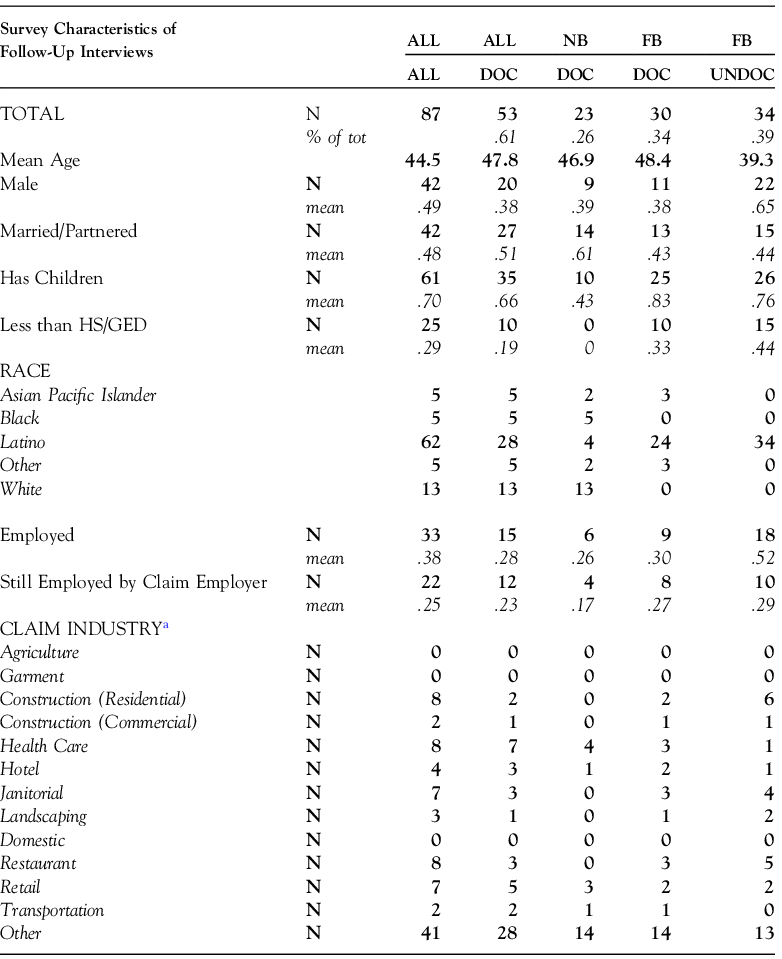
In this article, I focus on the subset of sixty-six respondents who are foreign-born in order to home in on the differences between documented and undocumented claimants. Table 1 provides key sample characteristics. The immigrant sample is overwhelmingly Latino. Two-thirds of respondents spoke to us in Spanish. Consistent with the broader population, undocumented immigrants are indeed younger than their documented counterparts, and a higher proportion of undocumented respondents are men. They also have lower levels of formal education; 44 versus 33 percent of undocumented respondents have less than a high school degree. Consistent also with population labor market indicators, undocumented respondents were more likely to be employed than documented respondents, but both groups were equally likely to still work for the employer against whom they were bringing a claim (about a quarter of claimants in each group). Workers were employed across a variety of industries, and all subsamples were fairly dispersed (Pew Research Center 2011; Migration Policy Institute 2020). While legal status is most certainly experienced intersectionally in this diverse sample, a small subsample size prevents an extensive comparative analysis of these additional characteristics.
Sample: Key Characteristics of Follow-Up Sample (based on data from initial survey)

NB = Native Born; FB = Foreign Born
a Some respondents selected more than one category.
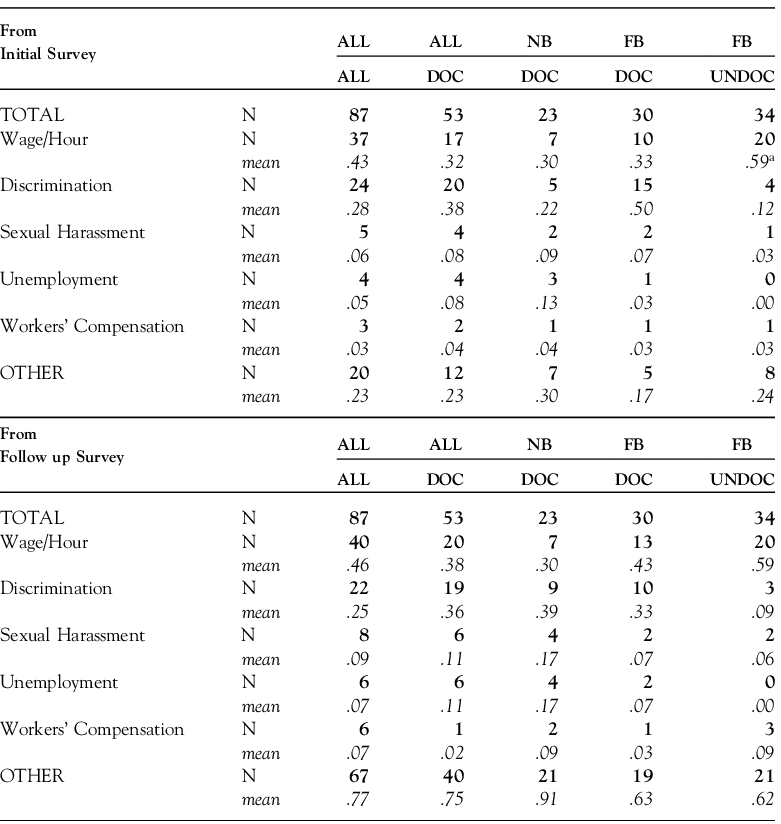
Workers I spoke with were navigating a range of workplace issues such as wage theft, workers’ compensation for on-the-job injuries, discrimination, sexual harassment, and unemployment benefits (see Table 2). Each of these issue areas corresponds to respective federal, state, and sometimes local administrative enforcement agencies. These complaints do not generally require a lawyer, but often legal representation is allowed. Predictably, the distribution of claim types does differ between documented and undocumented workers: Roughly a third of documented claimants brought wage and hour claims, while 59 percent of undocumented interviewees did.Footnote 8 This analysis reflects data from a range of claim types in each subgroup of respondents.
Sample: Claim Type by Immigration Status

a. I.e., 59 percent of undocumented respondents (20/34) were engaged in wage theft cases.
* Note. The claim types are not mutually exclusive. Workers often came in with multiple issues (pertaining to multiple statutes/agencies).
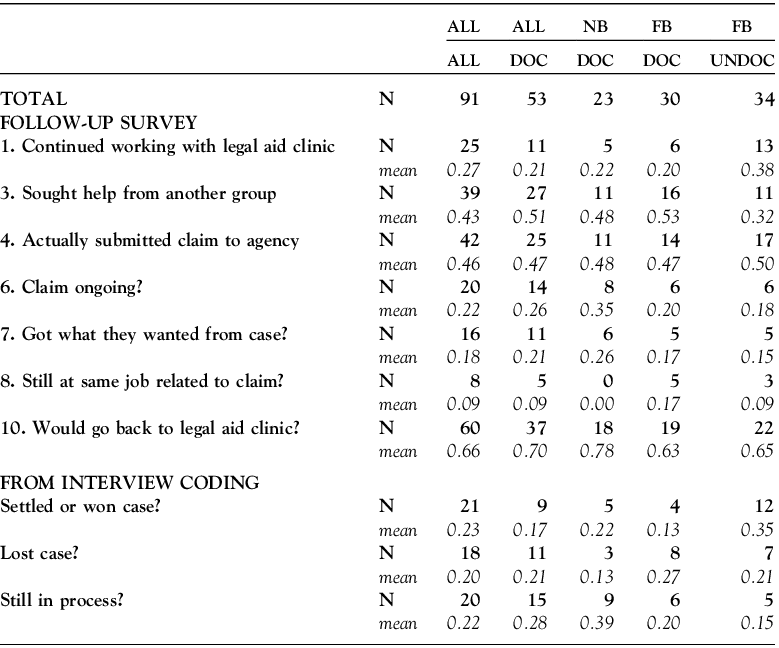
Though all initial survey respondents were pursuing their claim with the help of a legal aid attorney, some workers ultimately chose to pursue their case alone, some continued to receive help from the clinic, and others sought help from another clinic or private lawyer. Still others chose not to pursue their case for a variety of reasons (see Table 3). This analysis focuses on claimants’ experiences while they engaged legal counsel.
Sample: Claimant Responses by Immigration Statuss

Note. Based on follow-up interviews. These only include those cases where the outcome was definitively clear (that they settled or won their case, lost their case, or were still in process).
The respondents are self-selected by the types of claims and types of workers making them. Especially for those undocumented workers operating in a climate of deportability (despite strong protections in the relatively immigrant-friendly context of California under the Obama administration), legal status remained an important part of their risk calculation when filing a workplace claim. As a result, one might argue that the undocumented claimants in this sample who were willing to take such risks are especially self-selected. However, it is important not to assume that deportability totally constricts behavior and decisions; rather, one must allow for the agency of undocumented workers, who take any number of risks on a daily basis to survive and provide for their families (Paret and Gleeson Reference Paret and Gleeson2016). However, given a certain level of risk aversion, I suggest that focusing on the experience of undocumented claimants provides a conservative estimate of the challenges facing undocumented immigrants more generally, assuming more severe challenges for nonclaimants who choose not to come forward. To supplement these findings, I also draw on informal interviews with staff and volunteers at survey sampling sites, as well as on observational data gleaned as a volunteer over five years at a small workers’-rights clinic on the California Central Coast (Gleeson Reference Gleeson2016).
The timing and location of the data collection is also worth noting. Claimants were surveyed and later interviewed in the San Francisco Bay Area during the Obama administration. Looking back, this appears to be a golden era compared to the extreme rhetoric of the current presidential administration. However, even during this earlier period, immigration enforcement remained in full force, both at the border and in the interior (Golash-Boza Reference Golash-Boza2015; Macías-Rojas Reference Macías-Rojas2016), often through the efforts of “silent audits” that leveraged workplace surveillance and spread fear in immigrant communities (Griffith and Gleeson Reference Griffith and Gleeson2019), including in California. The employment sphere has been, and certainly remains, the leading terrain of immigration enforcement—or what Griffith (Reference Griffith2011) refers to as immployment law. In this context, workplace claims are a useful arena in which to investigate how immigration status determines the ways in which individuals engage with advocates to help them mobilize their rights.
FINDINGS
In this section, I begin by reviewing the common challenges that claimants face in mobilizing their rights and that inevitably shape their relationship with their lawyer. To be sure, low-wage workers contend with difficult workplace conditions, which labor and stratification scholars have detailed at length (Bernhardt, McGrath, and DeFilippis Reference Bernhardt, McGrath and DeFilippis2007; Milkman, González, and Narro Reference Milkman, González and Narro2010; Kalleberg Reference Kalleberg2011). However, immigration status shapes the experiences of claimants in fundamental ways as well. I discuss three ways in which status distinguishes the challenges facing documented and undocumented immigrants. First, I outline how documented and undocumented claimants hold differing opinions about lawyers’ efficacy in the claims process and their different expectations of their lawyers. I then consider how status affects the claimants’ sense of their future in the United States. I end by discussing how these factors affect claimants’ notions of justice—with undocumented claimants ascribing to more utilitarian, as opposed to abstract, interpretations of a claim’s success.
Common Challenges among Low-Wage Workers
Legal counsel is critical for explaining to workers their rights, outlining the possible routes for restitution, and then helping workers navigate bureaucracies (Gleeson Reference Gleeson2016). These legal advocates can be especially crucial for empowering undocumented workers who have been disenfranchised from the political process (Bejarano et al. Reference Bejarano, Juárez, Mijangos García and Goldstein2019). Interviews with documented and undocumented low-wage claimants confirm that low-wage workers of all statuses are likely to struggle with finding a willing lawyer and obtaining the funds to retain them. Workers often relied on family and friends to secure legal aid, specifically on recommendations for one of the many local community organizations.Footnote 9
Though they all made an initial visit to the legal aid center, not everyone I spoke with was ultimately represented by the center. Some received advice during the visit, and many were counseled that they simply did not have a legal case, which was understandably frustrating to them. Many cases were either too complex or beyond the scope of the workers’-rights clinic. Some of these cases were referred to private counsel, though not all claimants ultimately found (or could afford) a lawyer willing to take their case. Some decided to pursue their case despite the challenges, for instance the determined, documented respondent who opted to fight his employer alone after his coworkers abandoned the claim.Footnote 10
For those workers who did find a lawyer to take their case, they often faced a litany of other challenges, including language barriers and delayed communications. Claimants of all types seemed to care deeply about meaningful and regular contact with their lawyer, and often had a hard time with the sporadic updates they received about their case and the long waits in between consultations. One documented claimant explained, “It’s been really hard, because I never talked with him [my lawyer], only with the secretary.” This worker was especially frustrated that without their lawyer’s help, they could not decipher the legalese in the documents they were receiving.Footnote 11 Another undocumented claimant recounted a similar frustration: “[My lawyer] never even called me back …. They could have just called and said, ‘You know what, we can’t do anything.’” When the claimant’s lawyer did eventually respond that nothing could be done at the moment, it caused further frustration with the process: “Why waste my time going back if I know they can’t do anything.”Footnote 12 Interviews with pro bono and volunteer lawyers, who often have a heavy workload and are hamstrung by a slow-moving system, make clear that these lapses in communication do not necessarily indicate that they do not value their clients. While there are no doubt “bad apple” lawyers, the findings presented here do not point to intentional predation or neglect.
In their study of the lawyer-client relationship, Berrey, Nelson, and Nielsen (Reference Berrey, Nelson and Nielsen2017b)’s interviews reveal that much of this frustration stems from clients’ perceptions of their lawyer’s efficacy, doubts over whether the lawyer was working efficiently toward resolving their case, and the lawyer’s failure to “connect emotionally” with their concerns (141). Most important for the findings I discuss here, clients in that study also reported a significant power imbalance in their relationship with their lawyer, a “forced deference” (142). The style or personality of individual attorneys could contribute to these concerns, but they also reflect broader structural elements: the slowness of the bureaucracy, the immense caseload many attorneys have to take on, and the incentive structure of labor and employment lawyering.
While resolving their case was important to all workers, the client-attorney relationship was also shaped by other factors not exclusively related to achieving a quick resolution. Better understanding what drives this relationship will therefore allow us to paint a fuller picture of what produces, for example, a claimant’s legal cynicism or confidence in rights mobilization. While documented and undocumented clients face many common challenges—and too often both groups emerge from the claims process empty-handed—immigration status mediates how claimants process case outcomes and experience their relationship with their most important ally: their lawyer.
Differences across Immigration Status
This article focuses on two significant axes of difference across workers’ immigration status. First, I acknowledge the ways that immigration status clearly shapes how workers experience and understand the harms they have experienced. Employer sanctions policies grant employers disproportionate power over undocumented workers, fueling workplace abuse and limiting their remedies for redress. Furthermore, because undocumented workers are also unable to work legally, and because their ability to remain in the country is uncertain, the stakes are higher in considering their attorney’s advice over how to pursue and settle their claim.
Second, legal status also affects how workers navigate the claims bureaucracy and the various gatekeepers they encounter in the claims process, including their lawyers. My findings indicate that undocumented workers relate to their lawyers from a disadvantaged position and tend to be skeptical of the integrity of the legal process as a whole. They ultimately have lowered expectations of their lawyers and are seldom interested in dragging out their case. Constrained by their own deportability and inability to work legally, they also understand that their lawyers must walk a fine line in advocating for them.
To this end, I consider three arenas where legal status affects client satisfaction: (1) the client’s views about the efficacy of the claims process and their expectations of their lawyers, (2) their confidence in remaining in the United States and in their future labor market mobility, and (3) whether they defined their struggle for justice in abstract versus more pragmatic terms.
Efficacy and Expectations of Lawyers
Clear differences emerged in how documented and undocumented immigrants sought out legal counsel and navigated the claims process. Documented claimants in this sample were more likely to file complex discrimination claims, while most undocumented workers brought relatively more straightforward wage theft claims. Yet, we should note that workplace violations often occur in clusters (e.g., women who are sexually harassed are likely to also experience wage theft), and that lawyers themselves play an important role in choosing which rights workers should mobilize (Alexander, Eigen, and Rich Reference Alexander, Eigen and Gear Rich2016). Comparing workers across similar types of claims, I find that even documented claimants possessed a more optimistic outlook than their undocumented counterparts. I argue that, at least in part, these differences stem from documented claimants’ relatively more privileged positionality under US law.
On the whole, documented workers seemed more confident of their ability to pursue their claim and saw their lawyer as an asset in the fight against better-resourced employers. For these respondents, lawyers played an important role in helping them mobilize their rights. They were persistent in seeking a way forward, even when their case seemed unlikely to succeed. For example, Amalio, a legal permanent resident and forklift driver, recounted being fired for organizing during a union campaign. He had worked ten-hour days for almost fifteen years, and when he refused management’s offers to dissuade his coworkers from joining the union, he was fired under the pretense of a business downturn. After his union proved unwilling to help, Amalio visited many lawyers, including the legal aid clinic where I first met him. Though appreciative, he was ultimately skeptical of the clinic’s quality and sought out private counsel instead. “They [the legal aid clinic] are maybe not the best experienced or prepared, though they do their best …. I think my case really needs a professional to reach a resolution,” he explained, still assured that there was a legal path forward.
In fact, many of the documented workers with whom I spoke were relatively confident in their ability to resolve their claim. This was true especially for those who had previously been undocumented and felt that their new legal status empowered them to claim their rights. Leila, for example, had been detained in the mid 2000s but was subsequently able to adjust her status through her daughter. She had worked at an assembly plant for the past fifteen years using false papers. After she secured her papers, she attempted to update HR documents accordingly, as she knew many of her fifty or so coworkers had also done.Footnote 13 Approaching management directly, she explained to her boss: “‘Hey Sam, look, I have my papers and I need to change my social, etc., and I talked to Human Resources in Chicago.’” She was told she would have to wait while the company consulted their own lawyer. She felt that she was being unfairly singled out. Leila and several others in a similar predicament sought help from the workers’-rights clinic, and the company eventually relented. Empowered by this experience, Leila later returned to the clinic again with several other coworkers, this time for help in addressing the plant’s increasingly hostile environment of sexual harassment. In this case, the clinic was limited in what they could do. They filed a workers’-compensation claim, which stalled. While Leila appreciates the help she has received from the clinic over the years, she was also frustrated. “Our rights were violated [by the company],” she explains. Her coworker added: “And they [the clinic lawyers] ultimately couldn’t do anything for us.”
Despite their setbacks and occasional frustration with the process, documented workers like Leila were confident in their rights and that an effective lawyer could help them to mobilize those rights. Take Marcela, a naturalized citizen from Peru who had been told repeatedly by her manager at a big box retailer in a densely Latino area of town that she was not allowed to speak Spanish at work, even to clients looking for help. After receiving repeated threats of disciplinary action from the Human Resources department, this seasoned retail worker sought help from the local legal aid clinic. Marcela felt indignant: “They [management] know good and well that as a worker, you’re not able to pay a lawyer. You might be able to pay an initial consultation, but after that, you can’t keep [fighting] against … a big corporation.”Footnote 14 Eventually, her manager was transferred, but Marcela was given a negative annual review and denied a raise in an effort, she felt, to “push her out of her job.” She eventually quit, and after eight months (which she spent cleaning houses on the side), found another equally precarious job. When she reflects on the role that her lawyers at the clinic played, she is grateful for their help but deeply unsatisfied with the outcome of her case.
Like these documented workers, the undocumented claimants I spoke to also sought out a lawyer to help them navigate their claim through a government bureaucracy, confront their boss, and face the grave risk of coming forward. However, they had a different outlook on the process, one that was more cautious and measured. Rather than viewing lawyers as a resource for better mobilizing their rights in an essentially fair system, undocumented claimants saw their lawyers as a necessity: the only way to been seen as legitimate under the law. Compared to their documented counterparts, undocumented claimants also had more modest expectations of what a lawyer could do for them, and had no expectations of complete allyship. Though they were deeply grateful for the help they received from counsel, many nonetheless understood their lawyers to be yet another elite actor in a system that looked upon them as personae non gratae and that treated their rights as disposable.
For example, Angélica had been in the country almost two decades without papers, and generally had not faced much trouble finding work. In her last job, though, she endured egregious sexual harassment from a manager, who exposed himself to female coworkers and made lewd comments. He had also repeatedly threatened to report the women to immigration authorities. After initially visiting the legal aid clinic, Angélica and her sister found a private lawyer who guided them through three successive attempts to settle the case. Her attorney, though initially optimistic, ultimately became unconvinced that they stood a good chance at trial. Having borrowed money from family and friends to pay the substantial retainer fees, the women were desperate and eventually settled for an amount that was a third of what the company had offered. While Angélica found work at another company as a cleaner, she ultimately left that position as well when she tired of having to fend off still more sexual advances.
Angélica was not particularly jubilant about the outcome of her case, but she had mostly deferred to her lawyer along the way. She ultimately emerged feeling skeptical of the process: “Maybe they [her lawyer] messed up my case …. Maybe they thought, well, they are undocumented. They don’t know much. Maybe they thought they could take advantage of us.”Footnote 15 Her status as an undocumented worker helped shape Angélica’s perspective of the claims process as “arbitrary and capricious” (Silbey Reference Silbey, Mark and Hanrahan2005). Like other undocumented respondents, Angélica had fairly low expectations about her claim and what her lawyer could accomplish. Many undocumented claimants like her assumed that their options were inherently limited, which made them quick to settle and more reluctant to draw out their case or contest their attorney’s strategy, revealing the unequal power structure operating within the claims process.
Unlike documented claimants, undocumented respondents were also less likely to have or pursue an independent vision for mobilizing their rights, adopting a more laissez-faire approach with their lawyers. This was the case for Yosimar, an undocumented landscaper from El Salvador who just missed the cutoff for qualifying for deportation relief and work authorization under the Temporary Protected Status Program. He described his boss as an exploitative racist who constantly hurled threats at him and once even abandoned him at a job site. When this boss fired him without pay, Yosimar sought help to recoup his wages. He reported a good experience with clinic lawyers: “I did what the lawyer told me to … always … She gave me the options, and I would ask, ‘What do you think? Is this good?’”Footnote 16 Yosimar did not feel like he was in a good position to contest his lawyer’s approach, feeling as if he was at their mercy.
This is not to say that undocumented claimants like Yosimar did not criticize the claims process or have their own ideas about what they wanted to achieve. Rather, they relied heavily on their attorneys to help them guide them through what seemed to them like a game. That is, rather than seeing the legal bureaucracy as a system capable of producing justice—lawyers as an essential guide for procuring such justice—many undocumented claimants adopted a more cynical view in which lawyers were seen as a value-neutral asset. Cintia, a home health care aid, ascribed to this view.Footnote 17 She worked around the clock to care for the elderly mother of a Colombian family; she was paid only $1,500/month and was responsible for all her food expenses. The clinic lawyers helped her reach a wage and hour settlement with which she was satisfied. However, she remained skeptical of the justice system and the lawyers that were expert in navigating it: “Everywhere in the world there are lawyers that work for the devil, who know how to work a deal.”
By contrast, workers with papers generally described their lawyers with a sense of idealism and agency. They tended to have higher expectations about the outcome of their claim. Thinking about what he would have done differently, Amalio—the lawful permanent resident forklift driver I described above—had a simple answer: Get the best lawyer you can. He had searched high and low for legal representation, and felt that his biggest mistake was that he had chosen the wrong lawyer. “Invest, invest, pay a lawyer,” he said. “It’s something that will cost you, but you will [have to] pay it. I think that if I [had], I would have been able to fix my case. But I didn’t make the decision I should have.”Footnote 18 If he had the resources, Amalio assured me that he would attempt to reopen his case.
Perceptions of the Future
The claimants I interviewed also thought a lot about what the future would hold for them as they considered how to navigate their claim. As lawyers laid out various options, they understandably had to seriously consider what life beyond the claim would look like, as well as the enormous time and energy costs they would incur in fighting their employer. Documented immigrant workers often placed significant value on getting their job back and were invested in building their life in the United States, even if many assumed they would one day return to their country of origin to retire. Their undocumented counterparts, though, seemed more resigned to living in uncertainty, and most had no expectations of retaining their jobs. They worried about finding another job without papers and were conscious of the ever-present threat of deportation.
For documented workers, their future plans were more certain. For example, Amalio and his wife had a ten-year plan for returning to Jalisco (in the Mexican state of Colima). Though his adult children were in the United States, he didn’t want to become the perpetual “babysitter” for his grandchildren and preferred to return in order “to rest and live another life, more in peace.”Footnote 19 Having lost his job as a forklift driver, he planned to find work through a temp agency, save up, then one day head back to Mexico. Josué, a naturalized citizen who had come to California in the early 1970s, also had definite plans for the future despite his turbulent work situation. He had fought his employer after being denied his pension. Though his union had conceded there was nothing it could do, Josué resolved to keep looking for a lawyer who could help him fight. Legal battles notwithstanding, his plan was to retire and return to Culiacán (Sinaloa) with his wife and children.
Many older documented claimants idealized a return to Mexico, and these plans hinged on working hard to save up first. Finding the right lawyer to fight their case was a crucial part of that plan. Julio, also a naturalized citizen, left his job as a mechanic after years of not getting paid for all his hours worked.Footnote 20 He finally quit after a dispute that ended with his boss dropping the car bay door on his shoulder and the police being called. He was referred to a private lawyer, who ultimately turned down his case once it became clear that the owner would not pay Julio the $70,000 he was owed. Julio gave up looking for a lawyer to take his case and eventually found another job. He regretted abandoning his case, feeling that if he had had the energy to fight, he would have eventually won. His advice to others would be to “find someone who can help them, [inform them] of their rights and what they can do.” He urged that they not “give up” as he had and instead “charge ahead” to find the right lawyer. Like Amalio and Josué, Julio planned to one day return to his hometown in Durango, Mexico, to retire.Footnote 21 Their documented status allowed these claimants the freedom to envision a future life in the United States or their country of origin.
Alternatively, undocumented claimants must live with—and plan around—perpetual uncertainty about the future. Among my respondents, returning to their country of origin seemed inevitable, but it was seen as a necessity rather than a choice. The threat of deportation meant that they were living on borrowed time and could not be certain how long they would be allowed to stay. For them, the deportation regime was ever-present (even during the Obama administration and in the immigrant-friendly context of the San Francisco Bay Area). Perhaps more important, as unauthorized migrants, their work lives were also uncertain and their labor mobility much more constrained. Furthermore, the safety net (while stretched exceedingly thin for all low-wage workers) was largely nonexistent for undocumented workers. Unlike Rogelio,Footnote 22 a green-card holder in his fifties who relied on public benefits to sustain his family through periods of low pay and unemployment, undocumented workers had few options for assistance. They could not rely on unemployment insurance, a social security retirement, or access to Medicare for support and future planning purposes.
Given this precarious situation, work authorization greatly impacted how workers evaluated their options during the claims process. Indeed, Goldring and Landolt (Reference Goldring and Landolt2011) find that precarious legal status “becomes a source of vulnerability in the short run as well as a long-term trap because low-wage and precarious jobs become a ‘sticky’ web for people with precarious status” (336). Unlike the documented workers I interviewed, undocumented workers harbored no illusions of getting their job back after filing a claim, and they also seemed more willing to compromise during the settlement phase of the claim. Their employment—formally forbidden under the law—had always been precarious. Not all employers would look the other way when they presented their paperwork or had none to provide. Many of these undocumented claimants, while absolutely willing to fight for their rights, were ultimately realistic and agreed to settle for “whatever they could get.”
These data cannot predict how claimants will feel long after their claim has been put to rest. However, a key complicating factor for many of the undocumented claimants I interviewed was their uncertain time horizon and limited employment options as long as they lacked work authorization. Yosimar, for instance, had spent many years in the United States and was good at his craft (landscaping).Footnote 23 He also understood, though, that he was hemmed in by his status: “Without papers, you can’t work in many other places …. Here, they pay me in cash, like most places I can find work.” While he had no immediate plans to return to El Salvador (from which he fled due to violence and lack of economic opportunity), he admitted that “I don’t know what the future brings. I feel content here, but like I said, sometimes there are problems with bosses because sometimes they just pay you what they want, and well, you just have to do what you can do …. And since I don’t have many options … I have to keep working, because what else am I going to do?”
Undocumented status also compounded overall economic and legal precarity. For example, Joel had an overtime dispute with the owner of the restaurant where he had worked for twelve years. Knowing his undocumented status, the owner called the police when Joel threatened to file a claim against him. Like Yosimar, Joel was undeterred: “I told him [his boss], ‘I’m not afraid of the police or anyone.’ And so I went to the front to wait for the police to show up.” They simply told Joel to go home, but ultimately, a legal clinic was able to help Joel negotiate a $5,000 settlement with the owner, far less than what he was owed. Nevertheless, Joel understood there was little more that could realistically be done: “The lawyer couldn’t do anything more than what he had to, and told me, ‘It’s this [the settlement offer] or nothing. You decide. Do you want them to give you a little?’ I was finally like, fine, I’ll accept it. [It’s] better than nothing.”Footnote 24 Even though the restaurant owner never paid the settlement, Joel was glad to have stood up to his boss—“I didn’t want to do nothing,” he said—and grateful for the attorney’s help.
For others like Joel, settlements seemed like a decent deal, given the time and hassle involved in the claims process and the demands of daily life. This was the case for Jaime, who worked for a caterer who regularly stole the crew’s tips. The legal center took his case and negotiated a settlement that fell far short of the amount owed but still “was a good offer.” His attorneys warned Jaime that the case “would take a lot of time” and counseled him to “take the money and be done with it.” Reflecting on his options, Jaime explained why this was sound advice: “The reality is that it takes a lot of time. You just can’t [handle] the appointments with the lawyers, asking for time off from work, so it was ultimately better for me to settle so that I could keep working.”Footnote 25
In effect, both the legal system and the labor market were stacked against undocumented workers like Jaime from the get-go, and many viewed paying a large sum to a lawyer as a tax of sorts on their precarious position. Though documented workers dreamed of a future when they might return to their country of origin, they were still tethered to, and committed to building, a life in the United States. They were therefore more reluctant to settle for less and indignant when their claim was discarded as unwinnable.
Notions of Justice
Overall, documented respondents exhibited confidence in a legal system that gave them standing to exercise their workplace rights and they viewed lawyers as an important asset in their attempt to do so. While documented claimants often saw their claim as having the potential to change employer behavior and advance justice, undocumented workers seemed guided by more pragmatic considerations.
For example, the documented worker Amalio did not hesitate to use the threat of a lawyer to confront his boss over a perceived injustice: “[My boss] said, ‘Lawyer? For what?’ And I told him, ‘Because this [firing] is unjust!’” While Amalio was ultimately unable to find a lawyer to take his case, he seemed convinced that the right one would help him get his job back and punish the company for its bad behavior: “It was unjust what the company was doing with the workers … because they weren’t giving us the right to defend ourselves.”Footnote 26 Lawful permanent resident Carmelo described similarly ambitious, idealistic aims. He lost his job after he alleged that the new management had illegally fired all Latinos en masse. He described his unjust termination claim as extending beyond his specific firing: “If I lose the case, it’s not a problem … but I want to see justice in the court.”Footnote 27 Both men were willing and prepared to engage the system and fight.
Marcela, another documented worker, discussed above, was equally idealistic in pursuing a claim, which concerned the right to speak Spanish at her retail job. In filing the claim, she sought to defy stereotypes about fragile immigrant women:
They see us women as defenseless, weaker. They think we won’t fight … They think we’ll yield, and they want to stay in our way. I think that this manager thought I’d just stay quiet. He probably thought, “She’s a Latina—ignorant. She won’t say anything. I’m going to say and do what I want to her.” Well, I fought for my rights, for my language …. We can defend ourselves, and there are resources to help us … to make them listen to us. The fact that I am an immigrant and don’t speak English doesn’t mean there isn’t someone who can help you translate. But the important thing is to want and have the guts to defend yourself.Footnote 28
Like Marcela, many of the documented workers I spoke to saw their claim as broader in scope than their individual grievance; they idealistically viewed filing as a way to stop patterns of rampant workplace abuse they had witnessed. For example, Alfredo, a naturalized citizen from Peru, described how his boss would regularly ignore workers who complained about rampant wage theft, meal and rest break violations, the refusal to allow accumulated sick time, and unpaid overtime. He explained his decision to seek a lawyer: “Employees would make claims against her [the boss], but she didn’t pay them [any] mind. And why didn’t she care? Because no one did this [secured a lawyer] …. So that’s why I decided I’m going to do it legally, and with evidence.”Footnote 29 With the help of the clinic’s legal team, Alfredo attended a hearing at the Labor Commission to face off against the company’s corporate lawyer. Ultimately, his attorney encouraged him to take about half of what he was owed, given that his missed breaks were nearly impossible to prove.
Alfredo describes his experience at the clinic legal team as excellent, and he especially appreciated the help with translation; even though his English was good, he wanted to navigate the legal proceeding in his native tongue. However, he looks back on the aftermath of his nominally successful claim as a massive injustice: “Since [leaving] that job, I haven’t been able to find work, and I think it is unfair. If I had robbed the place and they had fired me, fine, that’s a punishment. Even if they had sent me to jail. But no, it wasn’t my fault, and after having worked for so long, it’s unjust, and I am suffering still because I can’t find work.”
Other documented claimants expressed a similarly personal sense of justice, an outlook that could clash with the more cautious, clinical view of their lawyers. Many were at a standstill with their claim, often told that their case was futile, which engendered a deep sense of injustice in them. For example, Elvira, a naturalized Mexican immigrant and driver for an adult day care facility, was disappointed by her employer’s unfair practices as well as her own inability to find a lawyer willing to fight for her. After ten years working for her company, she was involved in an accident, subsequently had her hours reduced, and was eventually laid off. Elvira was infuriated that she had “seen other workers involved in worse accidents … and they did nothing and allowed them to keep working. I had one accident in so many years, and they did this to me.”Footnote 30 Her various attorneys—consulted at the Labor Commission office she visited, on the radio program she called into, at the workers’-rights clinic she attended, and finally at the Mexican Consulate—all told her that as an at-will employee it would be very hard to win a discrimination case. Nonetheless, she felt that they were all wrong, secure as she was in her conviction that she had been mistreated.
Generally, undocumented claimants were more skeptical of the utility of continuing to fight. They were often more willing to reach a compromise and did not begrudge their lawyers for suggesting that they do so. For example, Memo was a machine operator who sought help for a workers’-compensation claim after an accident. He recalled that the hearing was intense: “They [opposing counsel] would say it was the worker’s fault …. The company lawyer was very aggressive and intimidating.” Memo eventually deemed that getting fired was a very real possibility if he pursued his claim further. Therefore, he took what he could from the claim settlement, was thankful to still have his job, and resolved to work at a slower pace. Looking back on his predicament, he felt grateful to his lawyers, who “made it possible for me to have hope, continue my life, and to have rights.” Even though these lawyers had been willing to help him in a protracted fight, “All I wanted [was] to … get healthy, and with God’s help, keep working.”Footnote 31
Fredy, another undocumented immigrant, was also satisfied with the modest success of his claim. After years of mistreatment and nonpayment of wages—and his bosses threatening to call the police and immigration authorities if he complained—Fredy turned to the wage and hour clinic for help and took his case to the Labor Commissioner. He ultimately won a reduced settlement, which he attributes to his boss again “taking advantage of his status.” Though financially and emotionally beleaguered by the process, and still injured from a fall for which he was never compensated, he was very happy with his lawyers and would “100 percent go back to the clinic again for help.” When asked what he would do differently, he focused largely on his employers rather than his counsel, wishing they would “change their perspective, not mistreat their workers, and see that someone who is working and expending effort daily in their job is worth something and should be compensated—even giving them a raise, even telling them ‘Good job’ so that they would be motivated to keep working.”Footnote 32 Fredy recounted the toll the claim took on him and his family but feels the claim served its purpose. Beyond his settlement, he was also ultimately able to leverage his claim to apply for a U-Visa for victims of crime.
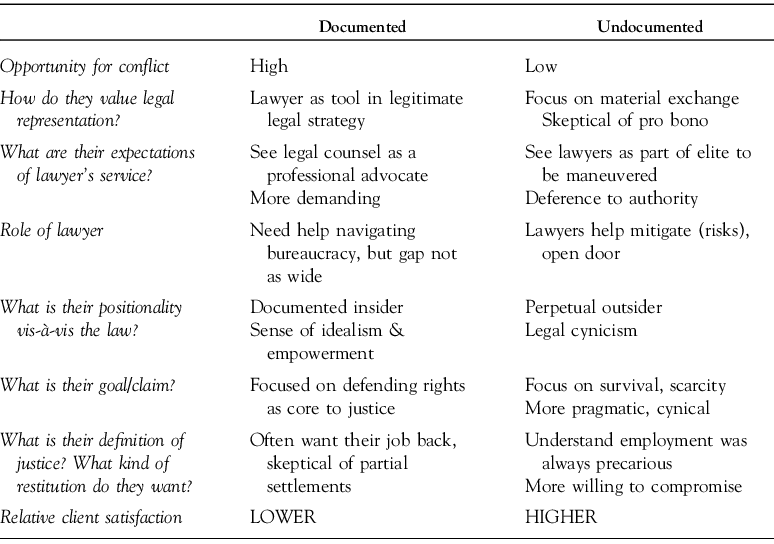
In sum, these accounts show how immigration status influences the lawyer-client relationship from the perspective of immigrant claimants themselves (see Table 4). While documented claimants had a firmer sense of their rights—including keeping their job, recouping back pay, and receiving full restitutions—they were also more idealistic in their fight for justice. Undocumented workers—who exercised enormous agency in bringing forward their claims despite the associated costs and risks—exhibited a more cynical attitude toward the system but also greater satisfaction with the claims process.
Dimensions of Immigration Status and Client Satisfaction

CONCLUSION
This article has examined the experience of immigrant low-wage workers navigating the workers’-rights regime. I interviewed both documented and undocumented claimants who have pursued an array of claims (ranging from wage theft to sexual harassment, workplace injury, and claims of unjust termination). My goal has been to uncover how immigration status shapes these workers’ experiences, how they understand the harms they have experienced, and how they navigate the claims bureaucracy and their relationship with their lawyers. Findings confirm that these low-wage workers, like their native-born counterparts, face a common range of challenges, such as trouble finding a lawyer willing to take their claim, the inability to afford an expensive private attorney, communication difficulties, and trouble understanding what restitution the law actually provides. However, I also find that immigration status differentiates the sources of (dis)satisfaction between immigrant claimants and their lawyers in at least three ways.
First, I find that documented workers entered into the claims process with greater confidence that they were owed certain rights that the labor standards enforcement bureaucracy should be able to enforce. Moreover, they had higher expectations that their lawyers would be able to realize those rights. This outlook generally made them less willing to settle or compromise, and they often felt indignant when their lawyers suggested that they did.
Second, I find documented and undocumented workers held different visions for the future and for how their claim should be resolved. Those with papers, while inhabiting exceedingly precarious positions in the low-wage labor market, often felt strongly that they should fight to keep their job. While many envisioned a future retirement back in their country of origin, they were firmly entrenched in the United States. Undocumented workers, by contrast, confronted a far more uncertain future in an environment where they had no legal right to work, were cognizant of the looming threat of deportability, and were largely pessimistic that legal reforms would materialize anytime soon. They therefore tended to prefer a quick resolution to their case, and while they were often unhappy with their ultimate settlement, they generally did not blame their lawyers for the outcome.
Finally, my analysis uncovers key differences in how documented and undocumented claimants frame their claim intentions and their struggle for justice. While those with papers certainly hoped to recoup material losses, many also talked about their claim as an opportunity to fight for justice, to challenge the power employers held over them, and hopefully to improve conditions for others. This idealistic stance often motivated them to keep fighting and challenge their attorney’s attempts to settle for less. As for undocumented workers, they often framed their claim in more pragmatic terms, focusing on their immediate losses, calculating the slim odds that fighting longer and harder would produce better results, and acknowledging the reality that working without papers had always been and would continue to be precarious.
In effect, I find that undocumented workers adopted a more sober understanding of the law that generated more modest goals for restitution. This outlook ultimately led to fewer conflicts with their lawyers and a greater sense of resignation to—if not satisfaction with—their claim outcome. While it is possible that these different viewpoints could reflect advice that undocumented workers are given—leading some to be less confident about their ability to pursue their claim—I posit that this is unlikely given my sample. Undocumented workers in California have been afforded some of the strongest protections in the country (which have become even stronger since this research was conducted) (Griffith 2017), and my interviews with legal advocates does not suggest that there is a two-tier strategy for rights mobilization (Gleeson Reference Gleeson2016).
These findings are significant because they illuminate how immigrant workers perceive and experience their lawyers, and how this perception in turn impacts their sense of procedural justice. They also reveal an important mechanism for how legal status generates inequality despite the availability of formal rights. Much of the extant literature focuses on the instrumental barriers that render the undocumented “marginal workers” (as Garcia (Reference Garcia2012) describes them) and on the challenges they face in accessing workplace rights. Here I also highlight the way immigrant legal status shapes their legal consciousness and their relationship with their most important broker: their lawyer. Deportability is a palpable concern throughout the claims process for undocumented immigrants. However, sociolegal scholars must also pay attention to the disenfranchising nature of illegality, how it socializes potential claimants, and the hegemonic pressure it exerts on individuals who have come forward to demand their rights.
Why focus so intently on workers’ relationship with their lawyers rather than on policy makers, judges, and other street-level bureaucrats? I argue that aside from shepherding workers through complicated legal terrain, these lawyers are also the most proximate embodiment of the legal regime, and as such are crucial to how workers interpret the justness of that regime. Beyond the immigrant workforce, these findings are relevant also for analyzing the potential for agency and empowerment among other legally disenfranchised claimants, as well as the role that legal counsel and other brokers can play.
Moving forward, this research will prove relevant not only for how we understand the role of individual attorneys in advancing worker rights but also the role of civil society (e.g., the various workers’-rights clinics that these respondents visited) in “making rights real” (Epp Reference Epp2010; de Graauw Reference de Graauw2016). These findings also help inform the ongoing legal scholarship that argues for greater investment in community lawyering and for organizing approaches that could help ease some of the challenges that the workers described here experience in navigating their claim (Gordon Reference Gordon2007; Fine and Gordon Reference Fine and Gordon2010; Fine Reference Fine2017). As Cummings (Reference Cummings2009) and others have shown, individual legal claims need not be disconnected entirely from organizing efforts and the groups advocating for their resolution. These legal-organizing partnerships are in and of themselves a way to improve claimants’ experience with the legal system (Cummings and Rhode Reference Cummings and Rhode2010; Cummings 2012; A. K. Chen and Cummings Reference Chen, Scott and Cummings2013). Research confirms that improving such experiences is especially important for undocumented claimants. Investing in more public interest law is a key move in this direction but must be paired with a continued focus on how immigration status continues to drive inequality in this domain, even as we improve protections for all workers.