Implications
Designing suitable farrowing and lactation environments that maximise both sow and piglet welfare, while maintaining economically efficient and sustainable enterprises, is a continuing challenge. It is not unreasonable to consider designing housing systems based on the biological specifications of the animals involved. Therefore, this review documents the considerable amount of literature describing biological needs of sows and piglets. It demonstrates the evolutionary significance and thus the function of certain behavioural patterns that continue to be displayed by domestic animals. Identification of biological needs allows synthesis of appropriate design criteria for farrowing and lactation systems that optimise both welfare and animal production.
Introduction
It is not unreasonable to suggest that agricultural practices in livestock farming systems should be based on the biological needs of the animals involved. However, this is rarely the case, with different managerial constraints (e.g. finance, labour and space) often resulting in a compromise with the animals’ biological needs. Perhaps the most prevalent illustration of this occurs during the farrowing and lactation period for the domestic sow. During this period the majority of domestic sows (approximately 70% in United Kingdom, BPEX, 2004; 95% in EU and 83% in United States, Johnson and Marchant-Forde, Reference Johnson and Marchant-Forde2009) are housed in farrowing crates, which are behaviourally and physically restrictive and raise serious welfare concerns. However, the farrowing crate was initially developed to reduce building space requirements, provide safe working access to the piglets, reduce labour input and improve piglet survival (Edwards and Fraser, Reference Edwards and Fraser1997). Piglet survival is one of the most important outcomes of the farrowing period for the three main stakeholders (sow, piglets and farmer); the piglets obviously need to survive, their survival is the key to profitability for the farmer and the sow can measure her inclusive fitness in terms of reproductive success. To facilitate maximum survival there must be co-ordinated expression between behaviours of the sow and piglets, and their interaction with the environment. These interactions are complex, involving a series of conflicts between parent and offspring who have different needs at different stages of farrowing. The conflicts further increase as the needs of the farmer are taken into account. As a result, designing a suitable farrowing environment is a continuing challenge and one that has been the subject of sustained scientific interest (Edwards, Reference Edwards1996; Arey, Reference Arey1997; Edwards and Fraser, Reference Edwards and Fraser1997; Wechsler and Weber, Reference Wechsler and Weber2007).
Designing a suitable housing system based on the biological specifications of the animals concerned involves asking questions about their needs, both behavioural and physiological. The latter include very obvious requirements including provision of appropriate nutrition and climate to ensure maximum growth, development, health and productivity. The former has received a great deal of attention from ethologists, animal welfare scientists and, increasingly, by a concerned public. This has occurred partly because the consideration of ‘behavioural needs’ when designing housing systems for livestock is often over-looked within the industry, despite many recommendations by scientists to adjust environments to meet these needs (Brambell, Reference Brambell1965; Farm Animal Welfare Council, 1992; Edwards, Reference Edwards1996; European Food Safety Authority, 2007).
Failure to recognise the importance of behavioural needs may actually be counter-productive in terms of maximising animal productivity, since it has long been accepted that the performance of species-typical behaviour contributes to the biological fitness of an animal (Hamilton, Reference Hamilton1964a and Reference Hamilton1964b). Agriculture has exploited the animals’ natural ability to adapt to their environment (Baxter, Reference Baxter1983). Domestication and intensive breeding strategies have resulted in physiological changes in the pig, which have capitalised on the heritability of traits such as litter size and growth rate, in order to have an ‘improved’ and efficient farm animal. However, the influence domestication has had on the behavioural needs of the pig is less clear, with certain behaviours apparently robust to the changes brought about by intensive selection (Stolba and Wood-Gush, Reference Stolba and Wood-Gush1980 and Reference Stolba and Wood-Gush1981). Nest building behaviour in the peri-parturient sow is an example of a behavioural pattern stubbornly being attempted despite, in the majority of intensive agricultural practices, an environment that precludes its natural performance and appears to render its original function unnecessary. The motivation to perform behaviours that on the surface appear unnecessary in a production environment suggests that they still have some biological significance to the animal.
The concept of ‘behavioural needs’ has been the subject of much debate and detailed scientific analysis (e.g. Dawkins, Reference Dawkins1977; Baxter, Reference Baxter1983; Hughes and Duncan, Reference Hughes and Duncan1988; Jensen and Toates, Reference Jensen and Toates1993). For the purpose of this review, the term ‘behavioural need’ is generally used to describe the need to perform a specific behaviour pattern whatever the environment and even if the physiological needs which the behaviour serves are fulfilled in other ways (Baxter, Reference Baxter1983; Jensen and Toates, Reference Jensen and Toates1993). Possible behavioural needs can be catalogued by identifying species behaviours with important survival value which occur spontaneously in all environments, and by measuring the preferences of animals (Hughes and Black Reference Hughes and Black1973; Dawkins, Reference Dawkins1977). However to demonstrate a true need, it should be shown that failure to meet this need results in a compromise in welfare by demonstrating negative consequences when these actions cannot be performed satisfactorily (e.g. performance of abnormal behaviour, physiological stress response or increased incidence of pathology).
Therefore, this review describes which behavioural patterns are displayed by pigs in natural and semi-natural environments during the various phases of farrowing, and then determines whether they have endured domestication and what their functional significance is. To discuss the motivational framework contributing to these behaviours, the physiological processes that accompany them are explored. Further experimental evidence of true biological needs is reviewed, leading to the synthesis of recommended design criteria to accommodate them in a farrowing environment. The next critical step in an overall design process is to address the challenges of accommodating these criteria while taking account of the needs of the farmer. However, the focus of this review will remain the needs of the animals themselves, with subsequent work considering the issues for the farmer.
Nest building phase: nest-site seeking, isolation and building
Sow behaviour and physiology
Nest building is a well-documented behavioural pattern in pigs (Gundlach, Reference Gundlach1968; Frädrich, Reference Frädrich1974; Stolba and Wood-Gush, Reference Stolba and Wood-Gush1984; Jensen, Reference Jensen1986), with a recent review highlighting its continued interest in animal science (Wischner et al., Reference Wischner, Kemper and Krieter2009). It is an innate behaviour, unaltered by domestication (Jensen, Reference Jensen2002) and displayed by all members of the family Suidae, with the exception of the Common warthog (Phacochorerus africanus) which tends to burrow in order to give birth to the young (MacDonald, Reference MacDonald2000). An increase in locomotory activity occurs approximately 2 to 3 days before parturition. The sow seeks isolation from the herd and wanders away in search of a suitable nest site. Jensen (Reference Jensen1986) reported that expectant sows travelled 2.5 to 6.5 km during the pre-parturient period in search of suitable sites, often building ‘mock-nests’ during this search, the functional significance of which is still unknown. This heightened period of activity is also evident in peri-parturient sows kept indoors, with reports of expectant sows in 5 m2 pens, ‘travelling’ on average 30 km (Baxter, Reference Baxter1991). Chosen nest sites are often isolated and at least partially enclosed, affording sows a protected nest site while still being able to maintain vigilance for potential approaching threats (Stolba and Wood-Gush, Reference Stolba and Wood-Gush1984). In addition, nest-site location is considered with excretory and feeding locations taken into account; observations of wild boar report that dung is found in concentrated, specific areas ‘some’ metres away from any nest sites (Wiepkema, Reference Wiepkema1986). Concentrated areas for dunging may serve some territorial function, but also it is important that these areas are away from nest sites to control the risk of disease. Once chosen, a concave depression is created by hollowing out the ground, or by rooting up soil and vegetation into a pile and then rooting a central depression (Hafez et al., Reference Hafez, Sumption and Jakway1962; Graves, Reference Graves1984). Hollowing out the ground involves digging and rooting behaviours, patterns also observed in domestic sows kept in farrowing crates though re-directed towards floors, bars and drinkers (Lawrence et al., Reference Lawrence, Petherick, Mclean, Deans, Chirnside, Vaughan, Clutton and Terlouw1994). After hollowing out a nest site, branches are gathered to border the hollow before collecting and arranging grass and leaves to line the nest.
Accompanying nest-building behaviour is a range of endocrine changes that have been the subject of a recent review (Algers and Uvnäs-Moberg, Reference Algers and Uvnäs-Moberg2007) and therefore will only briefly be outlined here. Widowski et al. (Reference Widowski, Curtis, Dziuk, Wagner and Sherwood1990) demonstrated, by injection of prostaglandin (PGF2α) into pre-partum gilts, which changes in plasma concentrations of prolactin elicited nest-building activities. Further investigations (Castrén et al., Reference Castrén, Algers, de Passillé, Rushen and Uvnäs-Moberg1993a; Damm et al., Reference Damm, Bildsøe, Gilbert, Ladewig and Vestergaard2002) have correlated specific nest-building behaviours with specific hormones; time spent carrying and depositing substrate correlated positively with prolactin and progesterone, but negatively with somatostatin concentrations in plasma (Castrén et al., Reference Castrén, Algers, de Passillé, Rushen and Uvnäs-Moberg1993a). Nosing and arranging this substrate correlated negatively with plasma oxytocin (Damm et al., Reference Damm, Bildsøe, Gilbert, Ladewig and Vestergaard2002). Therefore, performance and completion of nest building appear to be influenced by both internal and external factors (Jensen and Toates, Reference Jensen and Toates1993). There must be a ‘switch-off’ mechanism because performance of nest building is no longer functional during parturition. Baxter (Reference Baxter1983) suggested that udder comfort switches off nesting behaviour, although provision of a comfortable substratum does not abolish the behaviour (Arey et al., Reference Arey, Petchey and Fowler1991). In general, nest-building behaviour abates approximately 4 h before parturition. Oxytocin levels have already started to increase 6 h before parturition (Algers and Uvnäs-Moberg, Reference Algers and Uvnäs-Moberg2007) and the sow enters a ‘quiet phase’ before parturition begins.
Functional importance of the nest-building phase
From the detailed descriptions of site choice and construction, as outlined above, the main functions of the nest appear to be protection for piglets from inclement weather conditions and camouflage from potential predators. Thus, its function for wild populations of pigs is obvious, but this does not explain why the action of building a nest should remain so strong in our domestic population of indoor pigs, where the risks from climatic extremes and predation are obsolete. It is possible that the behaviour has persisted simply because of lack of selection against its occurrence, or lack of genetic variation in the control mechanisms within the domesticated population. However, Jensen and Gustafsson (Reference Jensen and Gustafsson1997) theorized that costly behaviour strategies which are optimal in wild conditions may pay off less in the domesticated situation, and therefore have a negative cost-benefit balance promoting suppression. Nest building is just such a costly behavioural pattern, involving increased activity and complex construction for as much as 24 h before further energy expenditure during farrowing and lactation. When exploring the importance of behaviours from a life history point of view, a functional aspect of behaviour is based on the contribution that it makes to fitness, as measured by reproductive success (Daan and Tinbergen, Reference Daan and Tinbergen1997). Therefore, we can hypothesise that it is not just the nest that contributes to reproductive success by protecting the offspring, but also the motivation to build and the performance of building that nest. Feedback from building and completing a nest can affect neuro-endocrine regulation of maternal behaviour (Castrén et al., Reference Castrén, Algers, de Passillé, Rushen and Uvnäs-Moberg1993a; Damm et al., Reference Damm, Pedersen, Marchant-Forde and Gilbert2003; Pedersen et al., Reference Pedersen, Damm, Marchant-Forde and Jensen2003; Algers and Uvnäs-Moberg, Reference Algers and Uvnäs-Moberg2007) during farrowing, with evidence that positive parturient maternal behaviour is influenced by the satisfaction of the nest-building phase (Arey et al., Reference Arey, Petchey and Fowler1991; Jensen, Reference Jensen1993; Damm et al., Reference Damm, Pedersen, Marchant-Forde and Gilbert2003; Pedersen et al., Reference Pedersen, Damm, Marchant-Forde and Jensen2003). For example, several authors have proposed a link between high nest-building activity and reduced risk of crushing (Andersen et al., Reference Andersen, Berg and Bøe2005; Pedersen et al., Reference Pedersen, Jorgensen, Heiskanen and Damm2006). The more complete and functional the nest is, the more likely the sow is to end nest building and begin the more somnolent farrowing phase. Sows that continue to display nest-building activity during farrowing are increasing the risk of crushing for their piglets, as well as prolonging farrowing duration with increased risk of piglets being born dead (Baxter et al., Reference Baxter, Jarvis, D’Eath, Ross, Robson, Farish, Nevison, Lawrence and Edwards2008). Duration of farrowing has been shown to be longer in sows housed in crates rather than in pens in some (Thodberg et al., Reference Thodberg, Jensen and Herskin2002; Oliviero et al., Reference Oliviero, Heinonen, Valros, Halli and Peltoniemi2006), although not all, studies (Cronin et al., Reference Cronin, Barnett, Hodge, Smith and McCallum1991; Fraser et al., Reference Fraser, Phillips and Thompson1997). It is possible that the inadequacy of nest-building behaviour in crated environments may influence the duration of farrowing and therefore the incidence of stillbirths. The lack of space and substrate when sows are kept in standard farrowing crates precludes feedback from nest-building behaviour and has been shown to constitute a stress for the sow (Lawrence et al., Reference Lawrence, Petherick, Mclean, Deans, Chirnside, Vaughan, Clutton and Terlouw1994; Jarvis et al., Reference Jarvis, Lawrence, Mclean, Deans, Chirnside and Calvert1997 and Reference Jarvis, van der Vegt, Lawrence, Mclean, Deans, Chirnside and Calvert2001; Damm et al., Reference Damm, Pedersen, Marchant-Forde and Gilbert2003). Further work dissociating the effects of space and substrate demonstrated that space restriction per se induced elevated hypothalamic pituitary adrenal (HPA) activity which is deemed indicative of physiological stress (Jarvis et al., Reference Jarvis, Calvert, Stevenson, van Leeuwen and Lawrence2002). There is also evidence that savaging behaviour is more prevalent in animals housed in farrowing crates (Cronin et al., Reference Cronin, Simpson and Hemsworth1996; Jarvis et al., Reference Jarvis, Lawrence, Mclean, Chirnside, Deans and Calvert1998) and savaging sows are more restless and hyper-responsive to their piglets and environment (Ahlström et al., Reference Ahlström, Jarvis and Lawrence2002) than non-savaging sows. It has been proposed that because the restrictive nature of this environment is inadequate to satisfy nest building, the need to nest build may not be ‘switched-off’. The sow is thus ill prepared for the somnolent phase of parturition, with potentially fatal consequences for the piglets. Thus despite the absence of offspring at this stage, nest building is arguably a critical phase for piglet survival and consequently remains an evolutionary important behaviour.
Needs-based design criteria for the nest-building phase
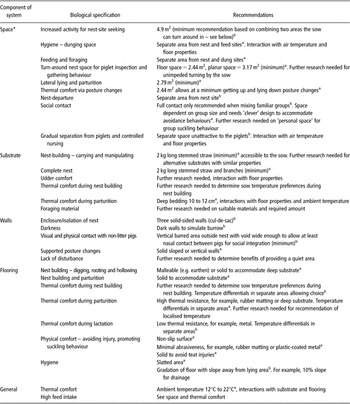
From the evidence presented above, it is clear that in order for the species behaviour patterns of the sow to be met during this phase, the following criteria should be considered for design: space, enclosure, substrate and suitable flooring. These criteria need elaboration and attempts are made to quantify and summarise them (Table 1).
Summary of design recommendations to meet the biological needs of sows during farrowing and lactation

aRecommendations derived from one or more specific references.
bRecommendations based on synthesising and interpreting the literature reviewed.
*Space calculations based on an ‘improved’ sow weighing 350 kg.
Space
It is assumed when determining spatial needs for animals, that they are geometrically similar and that the minimum amount of space required is determined by the animal’s size and body shape (Baxter and Schwaller, Reference Baxter and Schwaller1983). This ‘body space’ can then be added to, to accommodate behavioural requirements. During the nesting phase, space is required to allow the animal to increase its activity, to ‘seek’ a nest site, build the nest and to have separate nesting, excretory and feeding sites.
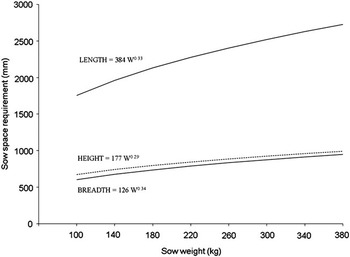
Sows normally circle around when constructing the nest, and this may define the minimum space needed for the nest itself. In an experiment looking at the space preferences in different farrowing crates (Phillips et al., Reference Phillips, Fraser and Thompson1992), sows consistently preferred the largest width, which permitted them to turn around. This, together with the previously cited evidence for elevated HPA axis activity when turning is prevented, indicates that the minimum space criterion during this phase should allow this behaviour. Quantification of the required space can be derived from the comprehensive work looking at spatial needs of sows in confinement by Baxter and Schwaller (Reference Baxter and Schwaller1983) and Petherick (Reference Petherick1983a), who used the principle body dimensions of length, height and width to determine the area occupied by any weight of pig. Using these estimates, Baxter and Schwaller (Reference Baxter and Schwaller1983) determined minimum space requirements for the 95th percentile sow weight that they measured (238 kg): 1.90 m2 (2334 mm long × 810 mm wide × 870 mm high; see Figure 1). The genetic ‘improvement’ in mature breeding females has resulted in body weights of many commercial multiparous sows between 300 and 350 kg without undue fatness (Whittemore and Kyriazakis, Reference Whittemore and Kyriazakis2006). Such an observation has also been made by other researchers (Moustsen et al., Reference Moustsen, Poulsen and Nielsen2004) and in response to Danish sows steadily increasing in size over the last 20 years without farrowing crates changing to accommodate this increase, these authors took detailed measurements of sows entering and leaving farrowing crates in order to provide an improved biological basis for farrowing crate dimensions. The authors provided their minimum recommendations based on the dimensions of the 95th percentile of the population of sows measured, thus hoping to accommodate the largest of the population. Sows in the 95th percentile weighed 352 kg, were 2.00 m long, 0.47 m wide, 0.95 m tall and measured 0.71 m from the middle of the sow’s udder to her back (i.e. breadth). From these data, it is evident that minimum space recommendations should be revised for all forms of accommodation by re-calculation based on the 95th percentile of current average weights. For the biological needs of farrowing sows, the above methods described (Baxter and Schwaller, Reference Baxter and Schwaller1983) were used, and assuming linear relationships, Baxter and Schwaller’s graph (Figure 1) was extrapolated and it was estimated that an ‘improved’ sow of 350 kg needs at least 2.44 m2 of floor space to get up and lie down comfortably (2654 mm long × 923 mm wide and 968 mm high; Table 1). By adding to the width of this space, a sow would be able to turn around (Robertson et al., Reference Robertson, Alliston and Bruce1972). Curtis et al. (Reference Curtis, Hurst, Gonyou, Jensen and Muehling1989), using Robertson et al.’s (Reference Robertson, Alliston and Bruce1972) data proposed the allometric equation of 15.4W0.33 (where W = body weight) to determine width for sows to turn around in gestation crates. However, Robertson et al.’s calculations were determined based on designing a stall that a sow could not turn around in and therefore involved the animal squeezing against the stall or crate sides to achieve a turning circle. Without conducting detailed experiments, similar to those undertaken by Baxter and Schwaller (Reference Baxter and Schwaller1983), the additional width required for turning around unimpeded by a late gestation sow can only be estimated. Lou and Hurnik (Reference Lou and Hurnik1994) designed an Ellipsoid crate that allowed pigs to turn around (average weight 206 kg) with a floor space of 1.80 m2 and a planar space (space at sow’s shoulder height) of 2.51 m2. If we were to over estimate width needed to turn around and assume the sow needed at least its body length in all planes to turn comfortably, then according to Petherick’s calculation (Reference Petherick1983a), Lou and Hurnik’s 206 kg sow needs a crate planar width of 1.74 m to accommodate a comfortable 360° turn. In fact, 1.20 m was provided and sows were able to turn around. Adjusting for the difference between this expected width and actual width of 0.54 m, when applied to a 350 kg sow, results in a planar width of 1.53 m and a planar area of 3.17 m2 (sow length × planar width) for turning around, thus giving our current, minimum design criterion for space (Table 1).
Overall, space requirements of sows (dimensions of pen) expressed over weight (W = body weight). Extrapolated from Baxter and Schwaller (Reference Baxter and Schwaller1983).

In addition to turning around, the sow species behaviour patterns suggest requirement for additional space to increase activity and separate excretion and feeding areas. Overlap of the excretory area with either the nest or feeding area will result in impaired hygiene and is likely to increase the risk of adverse health consequences in this and subsequent lactation stages. In addition, overlap of the nest and feed area will increase activity and divert focus of attention within the nest, thus increasing risk of piglet mortality after farrowing. Evidence regarding preferred excretory and lying sites for sows is rare (Wiepkema, Reference Wiepkema1986), which is unsurprising given the lack of choice presented to the majority of farrowing sows housed in crates. However, studies looking at gilts (Damm and Pedersen, Reference Damm and Pedersen2000) and piglets in the farrowing environment showed that in general pigs, when given the opportunity, will keep separate areas for excretion and resting (Whatson, Reference Whatson1978; Petherick, Reference Petherick1983b). Without detailed work determining the area needed to satisfy feeding and dunging needs, we can only estimate this based on the calculations already described. Space required for feeding can be described as ‘static’, with the requirement that the sow has to be able to stand up and feed. Therefore, as described above, a 350-kg sow would require 2.44 m2 of floor space for feeding. In addition, the sow needs to be able to exit the feeding area, however space provided for nesting or excretion could accommodate this requirement. Based on the above calculations, floor space required for a 350-kg sow to have a separate excretion site, in which it can turn around would be the same amount described for nesting (i.e. at least 2.44 m2 floor space and 3.17 m2 planar space – Table 1). However, it is likely to be the properties of the space, not just the quantity that will determine suitability for meeting needs. For example, pigs prefer to excrete in spaces away from feeding and nesting sites (Baxter, Reference Baxter1982). In addition, excretory areas can be created by providing temperature differentials, whereby intended dunging areas are cooler (Randall et al., Reference Randall, Armsby and Sharp1983) than lying areas (Table 1). With these factors in mind, it is possible that quantity of space could be reduced if substituted by attention to detail and clever design.
Enclosure
In tests looking at the choice of nest site, Hunt and Petchey (Reference Hunt and Petchey1987) demonstrated that sows always chose farrowing locations that were inside, or against a solid wall, never out in the open. This matches the choices of sows under natural and semi-natural conditions (Stolba and Wood-Gush, Reference Stolba and Wood-Gush1984) where 40% chose total enclosure and 89% chose partial enclosure. However, the amount of enclosure needed to satisfy nest-site choice is still not clear. Providing nest sites that are enclosed on three sides with a side open or partly open would facilitate isolation and vigilance for potential threats (Table 1). Under natural conditions, the nest often includes a roofed area of vegetation, providing protection from inclement weather as well as concealment from potential predators. There are contradictory reports as to the benefits of a roof under indoor farm conditions. Phillips et al. (Reference Phillips, Fraser and Thompson1991) found that providing a ‘roof’ had no positive influence on site choice between totally enclosed, partially enclosed or open crates and that enclosure was preferred more by younger sows. When a crude form of enclosure was given to animals farrowing in crates by providing a Hessian roof (Cronin and Vanamerongen, Reference Cronin and Vanamerongen1991), maternal behaviour was influenced positively and it was suggested that the make-shift roof offered a sense of nesting completion for the sow. The crates in this experiment had no further enclosure, and therefore it is possible that the influence was not roof specific.
Substrate
Substrate manipulation, as well as enclosure appears to contribute to perception of nesting completion and, in preference tests with both elements offered, sows made a choice based on the pre-formed nest sites that also offered sufficient quantity of straw to satisfy nest-building behaviour (Arey et al., Reference Arey, Petchey and Fowler1992). Such has been the case in other nest-building species; in farmed mink, for example, when provided with an artificial nest (nest box), kit survival and vitality was improved and maternal stress post partum was reduced (Malmkvist and Palme, Reference Malmkvist and Palme2008). However, there appeared to be greater benefits from providing an artificial nest in conjunction with access to straw, with less variable duration of parturition displayed by these animals with the enriched nests. Hutson (Reference Hutson1988) tested a limited number of sows and gilts in an operant conditioning experiment and, based on a low motivation for sows to lift a lever 10 times to obtain 1 kg of straw, it was concluded that straw is unimportant to prepartal sows. However, this claim is unsupported by the majority of other research in this area (Arey et al., Reference Arey, Petchey and Fowler1991 and Reference Arey, Petchey and Fowler1992; Arey, Reference Arey1992; Damm et al., Reference Damm, Vestergaard, Schröder-Petersen and Ladewig2000). Arrangement of nest-building material provides feedback to the expectant sow and, without suitable feedback from this activity to signal that nesting is complete, some sows may continue to be motivated to nest build even during farrowing (Thodberg et al., Reference Thodberg, Jensen, Herskin and Jørgensen1999; Damm et al., Reference Damm, Vestergaard, Schröder-Petersen and Ladewig2000). This constitutes a risky situation for the newborns and therefore is counter-productive for reproductive success.
Thus, substrate is important, but the unresolved issue is quantifying the necessary amount and type of substrate. There have been reports of sows making very complex nests outdoors, with 255 kg of substrate in one nest (Zanella and Zanella, Reference Zanella and Zanella1993). Such extreme quantities are impractical and most likely unnecessary under indoor conditions. The complexity of nesting substrates can influence behaviour; Damm et al. (Reference Damm, Vestergaard, Schröder-Petersen and Ladewig2000) demonstrated that gilts given branches and straw were better able to construct a ‘complete’ nest than gilts only provided with straw. Arey et al. (Reference Arey, Petchey and Fowler1991) gave two groups of sows sandy depressions with straw available from a dispenser and absence or presence of pre-formed nests with 23 kg of straw on the floor. The first group removed 23 kg of straw and used it for nest building, while the latter group removed 9.5 kg in addition to the 23 kg already pre-formed. Recent work by Damm and Pedersen (L Pedersen, personal communication) has recorded the amount of substrate carried by sows during the nest-building phase and they have recommended that a minimum of 2 kg of long-stemmed straw be provided to all sows pre partum as nesting material (Table 1). Alternative nesting materials have been studied (Widowski and Curtis, Reference Widowski and Curtis1990), with recommendations that providing a cloth tassel that animals can pull, tear and manipulate may also provide benefits even if the material cannot result in the building of a suitable nest. This is particularly relevant for animals kept in crates, as the majority of the tassel remains at the front of the crate, where sows can continue to access it, whereas straw is often pushed to the back of the crate during nest building, and becomes unavailable (Table 1).
Flooring
Additional preference tests have been performed on the properties of the floor, with 100% of sows choosing to farrow in an earthen pen site that could be hollowed out compared to a concrete floor (Haskell and Hutson, Reference Haskell and Hutson1994). It is possible that this earthen site offered qualities in addition to its deformability, including greater udder comfort for the sow or lower thermal conductivity, and clarification of which properties are of importance needs further research. If physical comfort is a key aspect, then quantity of substrate on the floor or area of ‘comfortable’ flooring should accommodate a sow lying laterally for parturition. Arey et al. (Reference Arey, Petchey and Fowler1991), in their preformed nest experiments already described, noted that 100% of sows farrowed in the sandy depression, potentially because of similar, ‘comfortable’ qualities. Thodberg et al. (Reference Thodberg, Jensen, Herskin and Jørgensen1999) suggested that the sand provided in their experiments gave important feedback, in addition to that provided by the substrate available. Thus, flooring with malleable properties to accommodate nest building activities is recommended (Table 1). Thermal comfort is also likely to be a consideration of the nest site and, in choice experiments offering sows a concrete floor or a mat floor with varying amounts of straw, sows appeared to show a preference for flooring that offered the greatest thermal resistance (the mat with the most amount of straw – Hunt and Petchey, Reference Hunt and Petchey1987), thus limiting the loss of heat via conduction. However, when sows were offered a heated (34°C) or non-heated floor space there was no difference regarding their choice of farrowing area (Pedersen et al., Reference Pedersen, Malmkvist and Jørgensen2007). Thus, further and more detailed investigations are needed on temperature preferences of nesting sows (Table 1).
In addition, the drainage properties of the floor, as well as the provision of space, will facilitate hygiene. Perforated or slatted flooring has been shown to have higher hygiene than solid floors (Rantzer and Svendsen, Reference Rantzer and Svendsen2001), however there may be negative consequences from such flooring regarding injury to both piglets and sows (see later section). Defined areas with different floor types and gradation in solid flooring to facilitate pen hygiene by creating a drainage slope, would offer a compromise to satisfy these needs (Table 1).
Parturition, early lactation and nest-occupation
Sow behaviour and physiology
Sow behaviour during this phase is characterised by prolonged lateral lying and udder exposure. Despite only rudimentary maternal care during parturition in this species, sows in semi-natural environments will get up during parturition to inspect their offspring, making nose-to-nose contact before rooting the nest to move piglets out of the way and then resuming lateral lying (Gundlach, Reference Gundlach1968; Jensen, Reference Jensen1986). Reactivity patterns of farrowing sows have been described by several authors (Jensen, Reference Jensen1986; Jarvis et al., Reference Jarvis, Mclean, Calvert, Deans, Chirnside and Lawrence1999; Pedersen et al., Reference Pedersen, Damm, Marchant-Forde and Jensen2003), with sow’s responsiveness being highest in the first 2 h of parturition followed by a prolonged (approximately 6 h) non-responsive phase and then, in conjunction with general activity, responsiveness returns. This pattern is accompanied by endocrine changes (Algers and Uvnäs-Moberg, Reference Algers and Uvnäs-Moberg2007), but is also influenced by the environment. During farrowing an increase in plasma oxytocin concentrations, promoting uterine contraction for piglet expulsion (Castrén et al., Reference Castrén, Algers, de Passillé, Rushen and Uvnäs-Moberg1993b), also results in continuous let-down of colostrum from the teats. Feedback from the udder, stimulated by massage from piglets, also increases oxytocin concentration and milk let-down (Algers et al., Reference Algers, Madej, Rojanasthien and Uvnasmoberg1991). Colostrum availability declines exponentially during the first 24 h of secretion, before changing to milk by 30 h post partum (Le Dividich et al., Reference Le Dividich, Rooke and Herpin2005). In the early stages of the lactation period, sows generally do not leave the nest site. Observing sows under semi-natural conditions, Jensen (Reference Jensen1986) reported that for the first 2 days post partum the majority of sows spent 90% of their time in the nest, with the remaining 10% of the time occupied by brief foraging ventures outside. During this nest-occupation phase, sows will spend a large part of the time initiating suckling bouts and nursing their piglets at 30 to 70-min intervals.
Piglet behaviour and physiology
Almost immediately after birth the piglet will start udder and teat seeking behaviours, relying on a mixture of visual, auditory, olfactory and tactile stimuli (Jeppesen, Reference Jeppesen1981; Morrow-Tesch and McGlone, Reference Morrow-Tesch and McGlone1990; Parfet and Gonyou, Reference Parfet and Gonyou1991). Welch and Baxter (Reference Welch and Baxter1986) suggested that the thermal and tactile properties of the udder are unique in the extrauterine environment, offering salient characteristics similar to those of the intrauterine environment, and therefore highly attractive to the newborn piglets. Colostrum flow is continuous during parturition and piglets have access to relatively plentiful colostrum for approximately 12 h after the birth of the first piglet (Fraser, Reference Fraser1980), before cyclical let-down (approximately every 30 min) of colostrum begins. The diffuse epitheliochorial nature of the porcine placenta means that piglets are born without immune protection, having to acquire maternal antibodies through ingesting colostrum (Gaskins and Kelley, Reference Gaskins and Kelley1995). To acquire passive immunity the small intestine of the newborn piglet undergoes dramatic functional changes immediately post partum (for review see Xu et al., Reference Xu, Wang and Zhang2000). During the first day of life, the neonate’s small intestine has the ability to absorb macromolecules, such as intact immunoglobulins (IgGs), across the brush border membrane. The capacity for macromolecule absorption diminishes as early as 24 h (Rooke and Bland, Reference Rooke and Bland2002) and is usually complete by 48 h post partum, a phenomenon generally referred to as gut closure (Gaskins and Kelley, Reference Gaskins and Kelley1995). Though having an early time window for gut closure limits the time for IgG absorption, it also reduces the chances of pathogens entering the gut and subsequent disease risks. It is noteworthy that the earliest time for sow nest-site departure coincides with gut closure and thus the cessation of passive immunity acquisition by the piglets.
To achieve a high intake of colostrum, gain warmth and establish a teat order, piglets prefer to lie close to the udder during the first 24 h of life. However, there is a trade-off between udder access and the risk of being crushed by the sow. This risk is enhanced when a piglet’s energy reserves are low and Weary et al. (Reference Weary, Pajor, Thompson and Fraser1996) concluded that crushings are at least partly the result of the nutritional challenge facing piglets. They found that piglets with slow weight gain spent more time in risky areas underneath their sitting or standing mother. Crushing predominantly occurs as the sow makes a posture change from standing to lying or when rolling (Damm et al., Reference Damm, Forkman and Pedersen2005; Weary et al., Reference Weary, Phillips, Pajor, Fraser and Thompson1998) and the risks associated with these posture changes are dependent on the environment in which the sow farrows and her maternal behaviour. In a study by Wechsler and Hegglin (Reference Wechsler and Hegglin1997), it was demonstrated that the quality of the sow’s pre-lying behaviour influenced the risk of crushing. Sows that lay down vertically rather than flopping, and those that paid attention to their piglets’ location in the nest prior to lying down, had fewer crushed piglets in their litter. Although this study was limited to a small sample size of 11 sows, similar results have been described by other authors (Signoret et al., Reference Signoret, Baldwin, Fraser and Hafez1975; Blackshaw and Hagelsø, Reference Blackshaw and Hagelsø1990) with sows observed to root through the straw with their noses and group their piglets before lying down considered the more careful mothers.
Newborn piglets are also susceptible to hypothermia as, from the moment they are born and make the transition from the intrauterine and thermoneutral environment to the extrauterine environment, they experience a dramatic reduction in ambient temperature (by approximately 15°C to 20°C – Herpin et al., Reference Herpin, Damon and Le Dividich2002). Consequently, the lower limit of the thermoneutral zone (the lower critical temperature – approximately 34°C Mount, Reference Mount1968) is not achieved, and the piglet is at risk of becoming chilled. The physiological immaturity of the newborn piglet contributes to its vulnerability; it is born with very little insulating adipose tissue and no brown fat (Herpin et al., Reference Herpin, Damon and Le Dividich2002), so can only fuel heat production and increase its core body temperature by mobilising energy reserves, present as glycogen and fat and then catabolism of its skeletal muscle. Glycogen reserves present in muscle are low and depleted quickly (Herpin et al., Reference Herpin, Le Dividich and Vanos1992) and most fat that is present is not available for mobilisation as it is structural fat (Herpin et al., Reference Herpin, Damon and Le Dividich2002). Catabolism of skeletal muscle is also limited as the process of protein oxidation is poorly developed in the neonatal pig (Schmidt and Herpin, Reference Schmidt and Herpin1998). In addition the domestic, typical ‘pink’ piglet has lost much of the physical protection from pelage that its wild ancestors (i.e. wild boarlets) have (Foley et al., Reference Foley, Seerley, Hansen and Curtis1971). The need to preserve homeothermy is therefore closely linked to the need to ingest colostrum, and the post-birth drop in body temperature is only reversed once this is achieved (Noblet and Le Dividich, Reference Noblet and Le Dividich1981; Baxter et al., Reference Baxter, Jarvis, D’Eath, Ross, Robson, Farish, Nevison, Lawrence and Edwards2008).
After farrowing, as continuous colostrum supply switches to more cyclical milk let-downs every 30 to 70 min (Fraser, Reference Fraser1980; Lewis and Hurnik, Reference Lewis and Hurnik1985), a teat order develops, with strong individual teat fidelity. Suckling not only fulfils basic physiological needs but also assists in establishing bonds between mother and offspring. As with teat-seeking behaviour, recognition appears to involve a mixture of olfactory, auditory and tactile stimuli. Odour cues are important with respect to individual teat recognition by the piglets (Jeppesen, Reference Jeppesen1982; Morrow-Tesch and McGlone, Reference Morrow-Tesch and McGlone1990). Auditory cues are most evident before and during suckling, or in distress situations. The sow commences suckle grunting before let-down, signalling to the piglets to gather at the udder (for review see Fraser, Reference Fraser1980). Further to these olfactory and auditory stimuli, tactile stimuli are evident as the piglets display pre- and post-let-down suckling massage of the udder, and piglets are often observed post-let down going to the sow’s head to make nose-to-nose contact.
Functional importance of behaviours during the parturition and nest occupation phase
Once the piglets are born, they face a number of significant challenges arising from an unpredictable mother and environment. In order to survive piglets must get to the udder, show vigour in acquiring and maintaining a functional teat and thus ingest vital colostrum to aid energy balance, preserve homeothermy and promote immune-function (Baxter et al., Reference Baxter, Jarvis, D’Eath, Ross, Robson, Farish, Nevison, Lawrence and Edwards2008). This requires effective synchronisation between behaviours of the sow and her piglets. The functional importance of neonatal piglet behaviours is self-evident from the description of physiology. One of the most frequently reported piglet mortality syndromes is hypothermia and starvation leading to piglet lethargy, subsequent crushing and death (English and Morrison, Reference English and Morrison1984; Weary et al., Reference Weary, Pajor, Thompson and Fraser1996; Edwards, Reference Edwards2002). However, thermal comfort represents one of the areas where there is potential for parent-offspring conflict. The temperature zone of thermal comfort for a sow is between 12°C and 22°C (Black et al., Reference Black, Mullan, Lorschy and Giles1993), and at temperatures above 22°C, adult pigs are increasingly susceptible to heat stress. Heat stress affects lactational output by lowering feed intake, thus contributing to decreased piglet weight gain and increased sow lactational weight loss (Stansbury et al., Reference Stansbury, McGlone and Tribble1987). In contrast, the small size and immature physiology of the newborn piglet results in a lower critical temperature of 34°C (Herpin et al., Reference Herpin, Damon and Le Dividich2002). Thus, a compromise must be reached to balance these conflicting needs. Investigations of the thermal properties of nest sites in ‘natural’ farrowing conditions show that the nests are robust to climatic extremes (Algers and Jensen, Reference Algers and Jensen1990), maintaining an average temperature in winter of 20.3°C despite outdoor temperatures averaging −1.5°C. Thermal image data from commercial outdoor huts, taken at the time of farrowing, showed that hut temperature averaged 14.7°C, whereas within the deep straw bedding and at the udder of the sow, temperature averaged 31.5°C (Baxter et al., Reference Baxter, Jarvis, Sherwood, Robson, Ormandy, Farish, Smurthwaite, Roehe, Lawrence and Edwards2009). This evidence further supports the functional role of nest building behaviour by domestic sows to balance thermal needs and the functional significance of a nest during parturition and nest occupation.
Movement by the sow during farrowing is risky for the piglets, with more passive maternal behaviour thought of as positive to allow safe udder access for the piglets. However, under natural and semi-natural conditions sows will get up, turn around and inspect their piglets (Gundlach, Reference Gundlach1968; Jensen, Reference Jensen1986). The functional significance of this was questioned by the authors because of the risks involved. However, in a more natural setting, early interaction with the piglets may enhance the mother–young bonds and litter recognition before returning to the herd. This factor is unlikely to be as important in a conventional indoor situation, where dam and offspring remain together alone until weaning. However, recent work suggests that interaction with piglets is important to allow positive maternal behaviour to develop; Andersen et al. (Reference Andersen, Berg and Bøe2005) demonstrated that ‘non-crushing’ mothers were observed to spend more time making nose-to-nose contact with piglets before lying down, as well as reacting to a piglet distress call by making contact with piglets sooner than ‘crushers’.
Auditory cues regulate social and nutritional relationships between mother and offspring (Puppe et al., Reference Puppe, Schön, Tuchscherer and Manteuffel2003) and not only do the rhythmic vocalisations of the sow during nursing assist with synchronous feeding behaviour, they also provide an auditory ‘fingerprint’, unique to the sow, that the piglets can use for recognition of their own mother. It appears that, even within the first few hours after birth, piglets are rapidly learning the unique composition of vocalisations by their mother (Walser, Reference Walser1986). Work by Horrell and Hodgson (Reference Horrell and Hodgson1992) showed that, as early as 36-h old, piglets were able to recognise the vocalisations of their own mother over those of an alien sow.
Tactile stimulation performed by the piglets at the udder fulfils several functions; suckling massage releases prolactin that assists with adapting maternal physiology to cope with lactation (Algers et al., Reference Algers, Madej, Rojanasthien and Uvnasmoberg1991) and, dependent on the time spent massaging, increases the teat milk yield for the next suckling – the ‘restaurant hypothesis’ (Gill and Thomson, Reference Gill and Thomson1956; Algers and Jensen, Reference Algers and Jensen1985). Nose-to-nose contact between piglet and sow post let-down is thought to signal need and reaffirm bonds and recognition. Recognition of their own mother is an important task for the newborn piglet since pigs are social animals, naturally living in groups where mothers, often themselves related, will synchronously give birth to multiple young (Gundlach, Reference Gundlach1968). Frequencies of these nasal contacts under semi-natural conditions were found to decrease substantially with time after farrowing and to stabilise to a low level on day six post partum (Stangel and Jensen, Reference Stangel and Jensen1991), coinciding with the average nest abandonment day also observed by these authors. Under more intensive conditions, it would seem that this recognition is not warranted, as sows and piglets generally do not mix before weaning. Thus, it can be hypothesised that this nose-to-nose contact behaviour has persisted more as a way of signalling need and reaffirming a bond to solicit milk.
Needs-based design criteria for the parturition and nest occupation phase
The needs of the sow during farrowing depend on the satisfaction gained from the nest-building phase. A quiet, enclosed area with a suitable and complete nest should result in a sow that performs increased lateral lying during farrowing (Jarvis et al., Reference Jarvis, Mclean, Calvert, Deans, Chirnside and Lawrence1999). The needs of the piglet during this crucial time are more complex than those of the sow; however, they are invariably linked to the behaviour of the sow. Given that the satisfaction of the nest-building phase directly influences the parturition phase, the criteria for nest building apply here: suitable space, enclosure, substrate and flooring. The evidence presented above suggests that thermal comfort, physical protection of piglets via suitable walls and substrate, as well as lack of disturbance are additional attributes to consider.
Space
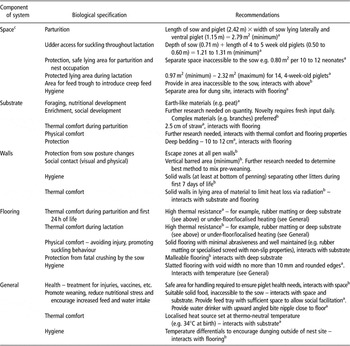
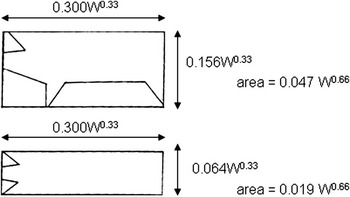
Static space required during parturition can be calculated in a very simple manner, with the sow needing to lie laterally and have enough space to facilitate birth and suckling for the piglets (Table 2). Petherick (Reference Petherick1983a) developed an equation for determining space needed for a pig to rest on its sternum or be fully recumbent (Figure 2). Using these equations and assuming that the sow is static while giving birth, a 350-kg sow lying laterally is 2.07-m long and 1.08 m in depth and occupies 2.24 m2 of space. In addition, there needs to be dynamic space for the piglets to be born safely and to walk around the sow to access the udder and suckle colostrum.
Summary of design recommendations to meet the biological needs of piglets during farrowing and lactation

aRecommendations derived from one or more specific references.
bRecommendations based on synthesising and interpreting the literature reviewed.
cSpace recommendations for an ‘improved’ sow weighing 350 kg and an ‘optimum’ birth weight piglet of 1.6 kg
‘Pigtographs’ by Petherick (Reference Petherick1983a) showing the space requirements for a pig resting fully recumbent or on its sternum (W = body weight in kg; area in m2).

Using the same equations but applying these to an optimum weight piglet of 1.6 kg (Roehe and Kalm, Reference Roehe and Kalm2000), whose dimensions would be 0.35-m long and 0.07-m wide, a 350-kg sow giving birth to 1.6 kg piglets would require a minimum floor space of 2.79 m2 (Table 2). This is based on a rather crude assumption that in order for the piglet to negotiate access to the udder the existing area allowing lateral recumbency for the sow must now accommodate a piglet being born and then walking around its mother. Therefore, the nest-size space is based on the following equation:

Suckling space should also be considered, at farrowing and during lactation. Work already described above providing body dimensions of farrowing sows (Moustsen et al., Reference Moustsen, Poulsen and Nielsen2004) was added to, to provide body dimensions of suckling piglets (Moustsen and Poulsen, Reference Moustsen and Poulsen2004a); these authors recommended that the width between the sow’s udder and any solid surface should be a minimum of 0.50 to 0.60 m to allow 4 to 5-week-old piglets to all suckle comfortably in the space envelope between the sow’s front and back legs when lying laterally. Thus, the conclusions drawn from these combined data are that the depth would need to be between 1.21 and 1.31 m for lateral lying and comfortable suckling throughout lactation (Table 2).
From the evidence presented above the sow also needs to be able to turn around and inspect her piglets, as well as perform piglet gathering or grouping behaviour before lying down. Therefore, similar calculations for the nest-building phase can be made and a 350 kg sow should have a nest-size that facilitates turning (Table 1). Recent work by Weber et al. (Reference Weber, Keil, Fehr and Horat2009) compared piglet mortality in loose-housed systems in Switzerland in relation to pen size. They and other groups observed no difference in mortality levels in crateless pens measuring over 5 m2 compared with crated accommodation (Cronin et al., Reference Cronin, Lefébure and McClintock2000; Weber et al., Reference Weber, Keli, Fehr and Horat2007), suggesting that where studies have shown higher mortality in crateless pens than in crates (Blackshaw et al., Reference Blackshaw, Blackshaw, Thomas and Newman1994; Marchant et al., Reference Marchant, Rudd, Mendl, Broom, Meredith, Corning and Simmins2000), this was a result of the pens being under 5 m2. Consequently, Weber et al. (Reference Weber, Keil, Fehr and Horat2009) suggest this should be the minimum space requirement for unimpeded piglet gathering behaviour. However, further research is needed to give accurate figures for both comfortable turning and unimpeded gathering behaviour. In addition, during the nest occupation phase, the space needs to facilitate hygiene to avoid detrimental effects on piglet health. Therefore, the space has to provide a defined excretion area away from the nest site, as described in the nest-building phase (Table 1).
Protection
Protection for the newborn piglet is paramount to its survival since crushing by the dam, as either proximate or ultimate cause, is the most frequently recorded reason for mortality. Though, under more natural settings, sows and piglets occupy the same space in the nest, under commercial indoor housing conditions it is generally accepted, and indeed recommended (Defra publications, 2003), that ‘a solid and dry lying area’ away from the sow be provided so that the piglets can ‘all rest at the same time’ and be protected (see also CoE, 2001). This area, often referred to as a creep, also makes it possible to provide different microclimates, as well as separate nutritional provision (see later section) and facilitates easier access for health checks and husbandry procedures. However, it requires additional space (Table 2). Detailed work in Denmark (Moustsen and Poulsen, Reference Moustsen and Poulsen2004b) studied piglet dimensions (weight, length, height and depth) in different postures, with the average snout to tail length of 4-week-old piglets measuring 0.56 m, their shoulder width 0.13 m and their depth measuring 0.14 m. Thus, these authors determined that to accommodate 10 to 12 piglets until weaning at 4 weeks of age, a creep should be no less than 0.80 m2 (Table 2). Further investigations by these authors have resulted in recommendations that each piglet, when weaning at 4 weeks of age should have a solid, dry area of 0.069 m2. Therefore, recommendations for high litter sizes of 14, 4-week-old piglets would require an area of 0.97 m2 (Table 2) available to them (V. Moustsen personal communication). However, such minimum recommendations only allow resting in a ventral position. To allow full lateral recumbency, which is a position increasingly adopted as the piglet gets heavier and older (Ekkel et al., Reference Ekkel, Spoolder, Hulsegge and Hopster2003), 0.166 m2/piglet would be needed (Table 2). It is possible that such lying areas do not have to be provided solely in the creep; protective space (e.g. underneath sloped walls) may accommodate a number of resting piglets as they get older and heavier. At this time their thermogenic abilities are well developed (Herpin et al., Reference Herpin, Damon and Le Dividich2002) and therefore the need for all piglets to simultaneously access a heated area may decrease.
Deep bedding (10 to 15 cm depth) also has protective properties (Table 2); it is a malleable, non-uniform mattress cushioning sow posture changes and offering a buffer to piglets from fatal crushing (Baxter et al., Reference Baxter, Jarvis, Sherwood, Robson, Ormandy, Farish, Smurthwaite, Roehe, Lawrence and Edwards2009). This is most likely more effective when the flooring is also malleable (e.g. earth, sand; Table 2) and under outdoor conditions piglets observed to be crushed by their mothers have appeared up to 4 h later from underneath the sow relatively unharmed and have survived to weaning (E Baxter, unpublished observation).
The care and control with which the sow lies down will influence piglet survival, and providing sows with a supportive surface to lean against during their descent has been shown to reduce crushing (Baxter, Reference Baxter1991; Marchant et al., Reference Marchant, Broom and Corning2001). In the latter study, 89% of sows preferred to use sloped walls, farrowing rails or creep sides to lie down against rather than descend unsupported. Damm et al. (Reference Damm, Moustsen, Jørgensen, Pedersen, Heiskanen and Forkman2006) enhanced this work by discriminating which was the most preferred choice of supportive structure. They concurred that the majority preferred support regardless of its form, but found that sows preferred solid sloped or vertical walls over farrowing rails (Table 1). Moreover, a recent survey by Weber et al. (Reference Weber, Keil, Fehr and Horat2009) showed no significant influence of the presence of piglet protection bars on piglet losses. The traction and comfort of the floor will also influence lying behaviour, thus protection for the piglets (Damm et al., Reference Damm, Forkman and Pedersen2005), as well as the health and welfare of both sow and piglets (Boyle et al., Reference Boyle, Regan, Leonard, Lynch and Brophy2000). In the latter study, Boyle et al. (Reference Boyle, Regan, Leonard, Lynch and Brophy2000) demonstrated when rubber mats were given instead of metal slats sow comfort was improved and slipping reduced (Table 1).
Thermal comfort
As stated previously, thermal comfort represents an area of potential parent–offspring conflict and the design challenge involves balancing the dichotomised needs of the sow and piglets. Although sows are at risk from heat stress at temperatures above 22°C, recent evidence suggests that sows show a preference for warmer areas in the immediate post-partum period (Phillips et al., Reference Phillips, Fraser and Pawluczuk2000; Pedersen et al., Reference Pedersen, Malmkvist and Jørgensen2007) and certainly will avoid metal flooring, potentially because of the cooling properties of this floor type (Table 1). Both Pedersen et al. (Reference Pedersen, Malmkvist and Jørgensen2007) and Phillips et al. (Reference Phillips, Fraser and Pawluczuk2000) found the majority of sows chose to lie on floors with temperatures of 34°C and 35°C, respectively, post partum and for the following 3 days, after which there was a pronounced change to preference for the cooler floors (Phillips et al., Reference Phillips, Fraser and Pawluczuk2000). In both cases, in order to facilitate choice, the sows were loose-housed and thus posture changes to regulate their temperature were possible. Further research is necessary before recommending a floor temperature of 35°C as a design criterion in all circumstances, as sows might develop heat stress, particularly if their mobility is restricted. Even if mobility is not restricted, as in loose-housed environments, if sows do not have access to cooler areas they can develop heat stress, as evidenced by Malmkvist et al. (Reference Malmkvist, Damgaard, Pedersen, Jørgensen, Thodberg, Chaloupková and Bruckmaier2009). These researchers heated the floor fully to 34°C, limiting behavioural thermoregulation and resulting in increased plasma levels of cortisol and ACTH for sows housed in this treatment.
To meet the thermal needs of the piglet, while safeguarding sow comfort, the provision of facilities to create a microclimate are important. Within the nest area, provision of bedding plays an important role. Deep bedding slows heat loss, having a thermal resistance 11 times greater than that of concrete slats and 22 times greater than solid, wet concrete flooring (Wathes and Whittemore, Reference Wathes and Whittemore2006). Mount (Reference Mount1967) demonstrated that piglets in contact with a concrete floor lost 40% more heat than those in contact with 2.5 cm of straw. Deep bedding will also help reduce evaporative heat loss by speeding the physical removal of placental membranes. In the absence of deep bedding, an artificially heated creep area of suitable size (see above) can provide an effective microclimate provided that piglets can be attracted to use this area at an early age. Creep designs have attempted to exploit the piglet’s attraction to the stimuli of warmth and softness (Welch and Baxter, Reference Welch and Baxter1986) by providing temperature differentials (Burri et al., Reference Burri, Wechsler, Gygax and Weber2009; Vasdal et al., Reference Vasdal, Møgedal, Bøe, Kirkden and Andersen2010), water beds (Ziron and Hoy, Reference Ziron and Hoy2003) or simulated udders (Lay et al., Reference Lay, Haussmann, Buchanan and Daniels1999). However, most piglets prefer to lie at the udder of the sow for at least 24 h after parturition. Nevertheless, a creep area, to provide an effective microclimate either using heat lamps or heat mats, is recommended (Table 2). If this is not provided then the minimum recommendations to facilitate thermal comfort for piglets at this stage would be provision of straw at a depth of at least 2.5 cm (Table 2), given an ambient room temperature no greater than 22°C to avoid sow heat stress (Table 1).
Lack of disturbance
Isolation of the nest site selected under natural conditions minimises risk of disturbance. There is evidence that disturbance during parturition will negatively influence oxytocin levels (Lawrence et al., Reference Lawrence, Petherick, Mclean, Gilbert, Chapman and Russell1992). Certainly, the length of the non-responsive phase after the birth of the last piglet may depend on how quiet the nest site is, and may influence subsequent restlessness of the sow and risk of piglet crushing. Analysis of data from both indoor and outdoor farrowing systems indicates that group farrowing in more confined circumstances significantly increases mortality risk (Edwards and Fraser, Reference Edwards and Fraser1997; Marchant et al., Reference Marchant, Rudd, Mendl, Broom, Meredith, Corning and Simmins2000). Sow reactivity is a potential risk factor; though sow responsiveness to the distress calls of a piglet have been considered positive maternal behaviour (Wechsler and Hegglin, Reference Wechsler and Hegglin1997; Andersen et al., Reference Andersen, Berg and Bøe2005), when sows farrow in individual pens which are in close proximity, they may respond vigorously to distress calls from outside their own nest, to the potential detriment of their own piglets. Together with disturbance from external activities on the pig unit, this consideration indicates a requirement for further research to evaluate the benefits of a quiet nest site. The degree of enclosure afforded to the nest site will influence disturbance levels; however, clarification of the relative importance of visual and auditory isolation is needed (Table 1).
Nest departure and social integration
Sow and piglet behaviour and physiology
At this stage, in mid lactation, sow and piglet behaviours are reasonably well aligned, with both mother and offspring sharing similar biological goals. Thus, in this section, their behaviours are described together. In a free-range system, piglets will leave the nest site before they are ready for weaning. Gundlach (Reference Gundlach1968) reported that piglets stayed close to the nest for 7 to 14 days post partum and, after venturing out, often returned to suckle and re-establish attachment with the sow via piglet-initiated nose-to-nose contacts. Strategies of newborn ungulates are usually divided into two types; ‘hiders’ and ‘followers’ (Lent, Reference Lent1974). Hiders tend to stay in vegetation and await a parental signal to leave this protected site, whereas followers stay close to their parent(s). As a result of building a nest, pigs have generally been described as hiders (Lent, Reference Lent1974). However, Jensen and Redbo (Reference Jensen and Redbo1987) described piglets at the time of nest-leaving as entering an intermediate phase in their behavioural development as they change from a ‘hider’ to a ‘follower’ strategy. On adventures out of the nest, piglets will follow their mother during foraging bouts. Sows will increase these foraging bouts as lactation progresses and the energy demands become more intense, causing sows to mobilise their body reserves (Quesnel and Prunier, Reference Quesnel and Prunier1995) and switch from an anabolic to a catabolic state (Valros et al., Reference Valros, Rundgren, Špinka, Saloniemi, Rydhmer, Hultén, Uvnäs-Moberg, Tománek, Krejcí and Algers2003). Milk production then peaks by the 3rd week in lactation, before gradually declining (Elsley, Reference Elsley1971). When accompanying the sow on ventures out of the nest, piglets mix with other litters and engage in important social behaviours before returning to the nest to suckle. Petersen et al. (Reference Petersen, Vestergaard and Jensen1989) identified an age-dependent high motivation for piglets to integrate or establish social bonds outwith their litter. Piglets were observed to interact with non-litter mates of the same age between 2 and 6 weeks post partum and thereafter they interacted with other group members.
Functional importance of behaviours during this phase
Nest departure and re-integration into the social group serves certain fundamental functions for sows and piglets in natural environments; it allows sows to increase their foraging territory and feed intake during this period of increased metabolic demand for lactation. For the piglets, early adventures out of the nest site allow interaction with a diverse environment, which may have importance for nutritional and long-term behavioural development. Research on the influence of rearing in ‘impoverished’ conditions (i.e. barren environments such as the farrowing crate) has shown that the complexity of the nursing environment can influence subsequent cognitive abilities of pigs (de Jong et al., Reference de Jong, Prelle, van de Burgwal, Lambooij, Korte, Blokhuis and Koolhaas2000), their ability to cope with stressful situations (de Jonge et al., Reference de Jonge, Bokkers, Schouten and Helmond1996) and may influence future maternal behaviour of any female offspring (Schouten, Reference Schouten1987). Thus, it is possible that piglets reared in a more enriched environment are better adapted for challenges later in life, including social integration. In addition, the foraging activities displayed outside the nest site satisfy the piglets’ desire to perform exploratory behaviours, rooting and manipulating substrates and beginning the adaptation to solid food intake. The early socialisation benefits the piglets by reducing the impact of weaning (Pajor et al., Reference Pajor, Weary, Fraser and Kramer1999; Hessel et al., Reference Hessel, Reiners and Van den Weghe2006), particularly reducing the effects of mixing aggression. D’Eath (Reference D’Eath2005) demonstrated that pre-weaning mixing of piglets reduced aggression levels at weaning and this socialisation appeared to equip piglets with social skills that benefitted them in the long term, enabling them to more rapidly form stable dominance hierarchies during future aggressive encounters with unfamiliar pigs. Social integration at this time is also important for the sow to minimise aggressive interactions associated with re-integration that might impede her fitness. Aggression is a major problem among un-familiar pigs and can lead to severe injury and physiological stress responses which can have detrimental effects on reproductive parameters (Arey and Edwards, Reference Arey and Edwards1998). Such overt aggression could also risk injury to the piglets if they share this social space. Under natural or semi-natural conditions pigs maintain established groups where aggression is regulated via ‘avoidance order’, with specific behavioural patterns reducing risk of attacks by dominant individuals (Jensen, Reference Jensen2002). In studies determining the influence of recognition on aggressive interactions post-mixing (Olsson and Svendsen, Reference Olsson and Svendsen1997) there was a clear effect of acquaintance with reduced aggression between pigs that recognised each other from their previous groups. Arey (Reference Arey1999) concluded that sows from the same gestational group rarely fought when mixed after 4 weeks separated in farrowing crates, thus recognition is a key factor in post-mixing aggression.
Needs-based design criteria for the nest-departure and social integration phase
Design criteria at this stage must consider the need for enrichment and social contact, and therefore the space and partition design to facilitate the latter. In addition, physical health and nutritional development for the piglet should be considered. For the former, flooring is an important factor.
Space
Space is required in order to leave the nest site. The defined space described in the previous sections to facilitate pen hygiene could accommodate the need to leave the nest site (Tables 1 and 2). Quantifying this criterion is difficult because it is more than likely that once the nest site has been left, qualitative aspects of the space are more important than actual physical area. However, in order to facilitate full social integration, additional space would be required for sows and litters to mix. The extent of this space requirement depends on how many litters and sows would be mixing, and whether the sows were familiar (i.e. came from the same social group or gestation pen). In addition to the sum of each individual’s physical space requirements, space for appropriate social interaction must be considered (Baxter, Reference Baxter1985). If animals are unfamiliar space allocation is an important factor to accommodate the agonistic interactions associated with establishing a new hierarchy (Jensen, Reference Jensen1982) and facilitate escape by losers of conflicts. Amongst familiar animals, signalling of submission and avoidance of dominants also requires space (Jensen, Reference Jensen2002). Group size is therefore likely to be a factor influencing requirement for space per sow, with smaller total space allowances resulting in greater aggression; Jensen (Reference Jensen1984) showed that in a group of five sows, in order for avoidance behaviours to be displayed, each sow would need 3 m2 of space. In these stable groups, aggressive interactions are observed mainly in relation to competition for resources and therefore space requirements are dependent on resource accessibility (Baxter, Reference Baxter1985). Such resources include space for resting, feeding and excretion. However, the work carried out thus far has not included space for nursing, and whether such activity requires additional ‘personal space’ to that required for simply lying laterally needs additional research (Table 1). In group-housed systems, where sows and litters mix for lactation, space given (per sow and litter) varies considerably (e.g. 27 m2 – Kerr et al., Reference Kerr, Wood-Gush, Moser and Whittemore1988v. 8 m2 – Halverson et al., Reference Halverson, Honeyman and Adams1997), with group size also varying. Baxter (Reference Baxter1985) recommends that instead of extravagant allowances for social space, it is better to consider clever design (Table 1) allowing interaction with the ability to display submission, reduced aggression and specific activities (e.g. nursing).
The social dynamic of the group is crucial when making decisions about pre-weaning mixing and it is recommended that lactational mixing only be attempted when the sows are familiar with each other (i.e. from the same gestational group; Table 1). If this cannot be achieved, some degree of social contact can be afforded by partitions which enable visual, olfactory and even nasal contact between adjacent sows. In pre-weaned pigs, it has been shown that such ‘fenceline’ contact can reduce aggression at subsequent mixing (Waran and Broom, Reference Waran and Broom1993) and there is anecdotal evidence of similar benefits in sows (Dellmeier and Friend, Reference Dellmeier and Friend1991). Mixing of piglets to facilitate early socialisation prior to weaning could occur without mixing of sows. By providing an additional area to that of the farrowing pen, inaccessible to the sow or providing pop-holes between farrowing pens to be opened during later lactation, unfamiliar piglets could socialise. However, although there are reported benefits (D’Eath, Reference D’Eath2005) to pre-weaning mixing, there are also reported negative consequences, including an increase in risk of disease transmission and pre-weaning fighting with the potential to negate the post-weaning benefits (Parratt et al., Reference Parratt, Chapman, Turner, Jones, Mendl and Miller2006). There are also reports of the presence of foreign litters increasing teat disputes, disrupting nursing frequency and thus reducing milk intake (Pedersen et al., Reference Pedersen, Studnitz, Jensen and Giersing1998). Thus, the costs and benefits of pre-weaning mixing make recommendations difficult. Until further definitive evidence is presented, an interim measure, which allows physical contact between neighbouring sows and their litters (e.g. through barred walls) may be beneficial in reducing the negative effects of weaning on both sows and their piglets. Such design would require no extra space, but would require different wall partitions with contact areas (Tables 1 and 2).
Enrichment
Substrate provided regularly could satisfy the need for an enriched and diverse environment. In addition, provision of substrates has been shown to decrease anti-social behaviours, including belly nosing and aggressive interactions with pen mates (Beattie et al., Reference Beattie, O’Connell and Moss2000). Any form of enrichment should have properties that accommodate the motivated behaviours for the animals concerned (Van de Weerd et al., Reference Van de Weerd, Docking, Day, Avery and Edwards2003) which, in the case of piglets, include foraging and exploratory behaviours. Earth-like materials such as peat, mushroom compost (Beattie et al., Reference Beattie, Walker and Sneddon1998) and more complex materials such as branches (Pedersen et al., Reference Pedersen, Holm, Jensen and Jørgensen2005) have been shown to be preferred as enrichment substrates over straw (Table 2). The amount of substrate necessary to fulfil this enrichment function in young piglets has not, to our knowledge, been quantified. Most enrichment experiments indicate that it is the novel aspect of the enrichment that stimulates exploratory behaviour. In piglets aged between 4 and 8 weeks, Fraser (Reference Fraser1985) observed two main peaks in activity that coincided with delivery of fresh straw. These piglets were provided with either 1 or 2.5 kg of fresh straw twice daily in two experimental groups, with activity levels not significantly different. Research in older pigs also suggests that relatively small quantities of straw, if presented daily, appear to be almost as effective at generating greater straw-directed behaviour and less pig-directed and pen-directed behaviour as large amounts (Kelly et al., Reference Kelly, Bruce, English, Fowler and Edwards2000). However, Day et al. (Reference Day, Burfoot, Docking, Whittaker, Spoolder and Edwards2002) found that an increasing provision of straw resulted in an increase in the proportional frequency of rooting and ploughing behaviours and an associated decrease in potentially damaging pig-behaviours, such as tail-biting. Further research is needed to determine the quantities of substrate needed to provide pre-weaned piglets with an enriched and diverse environment. Although substrate is likely to encourage foraging behaviours, at this stage, food that aids nutritional development (i.e. creep feed) should also be provided (see later section on nutritional development and weaning; Table 2).
Flooring
If the enrichment provided is to be straw (despite its less preferable rooting and foraging properties than some other substrates) then it is possible that, as substrate is required to fulfil other functions such as physical and thermal comfort, the quantity can first be defined with these needs in mind. The amount of straw needed for thermal comfort will depend on other properties of the environment. Fraser (Reference Fraser1985) showed a distinct preference in weaned piglets for bedded areas when the ambient temperature was between 18°C to 21°C and not at 25°C to 27°C. When thermal comfort was not compromised there was no clear preference for lying on bedded or concrete areas. These results suggest that thermal comfort is of greater importance than physical comfort in young pigs. Straw bedding can reduce the prevalence of skin lesions and bursae in older pigs (Mouttotou et al., Reference Mouttotou, Hatchell and Green1999) but pressure from hard flooring is likely to cause less discomfort in younger, lighter piglets. However, hard flooring could cause discomfort and injury for young piglets when they make contact with the floor during the vigorous activity of suckling. Mouttotou and Green (Reference Mouttotou and Green1999) found a positive correlation between time spent suckling and incidence of carpal skin abrasions between 4 and 6 days of age. Thus deep straw bedding, at least during the 1st week of life, could have protective benefits for younger piglets (Table 2). In order for this recommendation to be fulfilled, the flooring where the straw is provided needs to be solid to prevent the straw falling through the slats (Tables 1 and 2). It is clear from the literature that the amount of bedding required for physical comfort is poorly defined, especially in relation to the age and weight of pigs, and therefore such quantification requires additional research.
Properties of the floor, such as slip-resistance, abrasiveness, surface profile, hardness, void width (slatted floors) and thermal resistance (already discussed) are important factors that contribute to its injury potential. As with thermal comfort, physical comfort requires balancing sow and piglet needs. For example, slip-resistance, particularly for the sow, needs to be achieved without modifying the floor’s characteristics in such a way that predisposes injury through excessive abrasion (McKee and Dumelow, Reference Mckee and Dumelow1995). Abrasion is a common risk for suckling piglets, with mixed reports as to which flooring material causes the highest incidence of knee damage: Furniss et al. (Reference Furniss, Edwards, Lightfoot and Spechter1986) found that the worst knee damage was seen on an old cement screed. In contrast, Clark (Reference Clark1985) found that newly installed concrete screed had the highest abrasive properties, whereas the same floor after 3 months continuous use had the lowest abrasiveness. Therefore, both floor material and its deterioration over time require consideration; repairing solid flooring and using specialised screed offering both grip and low abrasion properties has shown to decrease piglet injuries (Zoric et al., Reference Zoric, Nilsson, Lundeheim and Wallgren2009). Any flooring needs to demonstrate these two properties (Tables 1 and 2); straw-bedding (Vellenga et al., Reference Vellenga, Vanveen and Hoogerbrugge1983; Edwards and Lightfoot, Reference Edwards and Lightfoot1986) or solid flooring covered with peat (Zoric et al., Reference Zoric, Nilsson, Mattsson, Lundeheim and Wallgren2008) offer the lowest risk of injury. However, hygiene is an important consideration and slatted floors assist with hygiene (Rantzer and Svendsen, Reference Rantzer and Svendsen2001), as well as thermal comfort for the sow during lactation in warm conditions. Incorrectly designed slatted flooring can cause injuries to piglet feet (particularly the coronet and footpads, Lewis et al., Reference Lewis, Boyle, O’Doherty, Brophy and Lynch2005), as well as damage to sow teats and legs (Edwards and Lightfoot, Reference Edwards and Lightfoot1986). If slatted floors are to be used (e.g. in the dunging area), the recommended void width is no greater than 10 mm with rounded edges (Mitchell and Smith, Reference Mitchell and Smith1978; see Table 2), and plastic-coated metal has been shown to be less injurious than steel (Furniss et al., Reference Furniss, Edwards, Lightfoot and Spechter1986; Lewis et al., Reference Lewis, Boyle, O’Doherty, Brophy and Lynch2005). In addition, void width with respect to use of straw or other substrate that may cause clogging needs to be considered. Many new plastic types of flooring are now available and widely used, but few have been scientifically assessed.
Thus far, the basic needs such as food and water for the sow have been ignored presuming these are already well catered for as fundamental physiological requirements. However, it is important to emphasise that the sow must increase her feed and water intake during this time to accommodate the significant metabolic demands of lactation. Certain aspects of the environment can hamper this, such as increased environmental temperatures (Black et al., Reference Black, Mullan, Lorschy and Giles1993), as well as restrictive conditions. It has been reported that sows kept in loose-housed environments have a higher intake of food during lactation than animals kept in farrowing crates (Pajor, Reference Pajor1998). It is known that there is a correlation between food intake and heat stress. Recent work has showed that localised cooling of the sow’s shoulders while in the farrowing crate increased sow’ feed intake and consequently piglet weight gain (Silva et al., Reference Silva, Oliveira, Donzele, Fernandes, Abreu, Noblet and Nunes2006; van Wagenberg et al., Reference van Wagenberg, van der Peet-Schwering, Binnendijk and Claessen2006). Designing an environment with temperature differentials could facilitate thermal comfort, as well as encourage the animals to use the defined spaces for the functions they are intended for (Table 1).
Nutritional development and weaning
Sow and piglet behaviour and physiology
Studying pigs under semi-natural conditions, Jensen and Recén (Reference Jensen and Recén1989) observed weaning to occur at 17.2 weeks of age. Prior to weaning, there was gradual separation between the sow and her litter, with progressive changes in suckling behaviour also evident. For example, sows became less permissive of suckling until, after 4 weeks, sows would terminate 100% of sucklings. This has also been demonstrated in experimental indoor systems in get-away pens (GAPs – Bøe, Reference Bøe1991). In this system, where sows could leave the piglets voluntarily without the piglets being able to follow, suckling frequency decreased gradually from 22.9 to 4.3 bouts every 24 h over a 10-week period. During this experiment, average weaning age was between 11 and 12 weeks and half of the sows were observed to wean their piglets before the piglets were 10 weeks of age (Bøe, Reference Bøe1991). The discrepancy between these weaning ages and those observed by Jensen and Recén (Reference Jensen and Recén1989), suggests that many sows would wean earlier if given sole responsibility, yet piglets continue to solicit milk for a much greater period of time if allowed to follow the sow. However, under more natural conditions, it is unlikely that the sow would ever be able to totally leave her litter without, at least, the fittest piglets being able to follow. It could therefore be argued that the expectation that the piglets will follow her is part of the innate behaviour of the sow and that results from experiments using GAPs (Bøe, Reference Bøe1991) are inconclusive regarding motivation to wean earlier than reported ‘naturally’. Regardless of this, conflict is evident: the sow needs an environment that allows time away from the piglets to gradually decrease milk let-downs and promote the weaning process. In contrast, the piglets need an environment where they can follow the sow to prevent litter desertion and prolong the suckling period to allow gradual transition to solid food.
In natural or semi-natural environments, the piglets’ dependency on the sow’s milk for nutrition gradually decreases. Piglets have been observed to display foraging behaviours as early as the first few days post partum (Petersen, Reference Petersen1994) and after 4 weeks old they gradually increase their time spent foraging. Thus, they can survive without milk at this time provided that alternative food resources are available. This is related to season, with weaning being observed to be later when piglets were born between July and October, with expected weaning during the winter months (Jensen and Recén, Reference Jensen and Recén1989).
Functional importance of behaviours during this phase
During the latter stages of lactation, the needs of the sow and her litter become increasingly dichotomised as a power struggle over maternal resources develops because of conflicting evolutionary strategies (Trivers, Reference Trivers1974). The piglets must consider their own survival and soliciting as much milk as possible from the sow will aid in their growth and development. The strategy adopted by the sow is one of balance: she must balance the needs of her current litter with the potential for any future litters, and thus her overall reproductive success. Therefore, in order to maintain body condition while still providing for her current litter, she will reduce the number of milk let-downs per day. This can only be efficiently accomplished by a gradual separation from the litter, thus a control of her lactational output and progressive weaning. Abrupt weaning under more intensive conditions causes nutritional challenges for the young, can slow growth rate and compromise immune function (Algers, Reference Algers1984; Pajor et al., Reference Pajor, Weary, Fraser and Kramer1999). Within 24 h of weaning, there are marked changes in the structure and function of the small intestine resulting from temporary reduction in feed intake (Pluske et al., Reference Pluske, Williams and Aherne1995), with consequential growth check and frequent incidences of diarrhoea. Recently, attention has also been drawn to the possible psychological and long-term consequences of early weaning (Newberry and Swanson, Reference Newberry and Swanson2008; Weary et al., Reference Weary, Jasper and Hotzel2008). Prior to weaning, piglets will be used to regular and synchronised feeding patterns, at this stage controlled by the sow delivering a highly nutritious and palatable milk source (Pluske et al., Reference Pluske, Williams and Aherne1995). Abrupt weaning involves a complete change in the pattern and delivery of food, requiring both behavioural and physiological adaptations by the piglet. If supplementary food is available from at least the 3rd week of lactation, when milk production starts to decline, expression of foraging behaviour has functional consequences for changes in gastric enzyme secretions and gut development (Cranwell, Reference Cranwell1995), allowing the piglet to experience a more gradual weaning process. It is possible that, if these foraging needs are met, then the piglet will take a more active role in weaning; Jensen and Recén (Reference Jensen and Recén1989) proposed the ‘fast-food’ hypothesis whereby a cost-benefit scenario occurs in which the cost of ‘asking’ the sow for milk is gradually outweighed by the benefits of foraging for food.
Needs-based design criteria for the nutritional development and weaning phase
From the evidence presented above, the needs of the piglets and sow during this time will be difficult to balance given the trade-offs and parent–offspring conflict described. Assuming the nutritional needs of the sow are met, the design must consider suitable space and flooring to facilitate sow controlled nursing and physical and thermal comfort, respectively. To meet piglet needs, suitable substrate and feed should be provided to promote foraging and encourage nutritional independence. Approaches to ease the transition to weaning should consider minimising both physiological and psychological stressors. A recent review by Weary et al. (Reference Weary, Jasper and Hotzel2008) summarised these approaches as: increasing weaning age, increasing the time the dam and her young spend apart before weaning and making the solid diet more attractive to the pre-weaned young. With respect to the design criteria, the latter two approaches, in particular, require recommendations on how best to accommodate them.
Space
Designing the space required during this time involves a question of balance; the sow needs space to ‘escape’ her piglets to control lactational output, but the piglets need to avoid total desertion. In GAPs, where the sow could access the feeding and dunging area without the piglets, sows lost less weight and returned to oestrus quicker than sows in confined systems and piglets gained weight and switched to solid food quicker than piglets in confined systems (Pajor, Reference Pajor1998). It has also been shown that in a farrowing environment which allows ‘escape’ by the sow, more ‘sow-controlled’ nursing behaviour developed, which was considered an important aspect of good mothering ability (Thodberg et al., Reference Thodberg, Jensen and Herskin2002). Though benefits of systems where the sow can leave her piglets freely are evident, there are potential risks of the nursing frequency decreasing to a detrimental level for the piglets or complete abandonment (Bøe, Reference Bøe1993). Environments which encourage voluntary gradual separation are recommended (Weary et al., Reference Weary, Jasper and Hotzel2008). Quantifying the space needed to accommodate gradual separation is difficult and, as already mentioned in previous sections, qualitative aspects of the space maybe more important than its actual physical size. Providing defined areas (Table 1), gives the sow options to move away from her piglets. Potentially making certain areas less attractive to the piglets, yet still accessible, would encourage gradual separation; for example, temperature differentials between the defined areas and/or different flooring, enrichment and food provision (Table 1).
Nutritional provision
Design criteria in the previous section to promote social integration and development via appropriate space and substrate will reduce the physical and psychological consequences of early weaning (Newberry and Swanson, Reference Newberry and Swanson2008) (Tables 1 and 2). In addition, suitable substrate and supplementary feed will encourage foraging behaviours to reduce the impact of nutritional challenges and promote weaning decisions in piglets. It is generally accepted that higher intake of solid feed (or creep feed) prior to weaning results in higher intake post-weaning (Aherne et al., Reference Aherne, Danielsen and Nielsen1982). However, individual differences in pre-weaning creep feed intake are evident; Barnett et al. (Reference Barnett, Kornegay, Risley, Lindemann and Schurig1989) found total creep feed consumption varied from 13 to 194 g/piglet and from 107 to 1550 g/litter. In addition, some piglets do not eat solid feed at all prior to weaning; using a faecal dying technique Callesen et al. (Reference Callesen, Halas, Thorup, Bach Knudsen, Kim, Mullan, Wilson and Pluske2007) identified 78% of piglets as ‘eaters’ and 22% as ‘non-eaters’. Individual piglets appear to vary in their feeding strategies, with some electing to continue suckling and engaging in energy consuming teat stimulation and others prepared to start feeding on solids sooner (Bøe and Jensen, Reference Bøe and Jensen1995). Since the former strategy results in a more detrimental impact at weaning, encouraging all piglets to sample solid feed prior to weaning should be a design objective in any farrowing system. Appropriate delivery of this supplementary feed to ensure piglet accessibility (Table 2) may influence the success of nutritional development (Appleby et al., Reference Appleby, Pajor and Fraser1991 and Reference Appleby, Pajor and Fraser1992). Trough designs which increase available feed space and the chance for social facilitation appear to promote feed intake; shallow feeders, rather than traditional hoppers, (Wattanakul et al., Reference Wattanakul, Bulman, Edge and Edwards2005) and Playfeeders (Kuller et al., Reference Kuller, Tobias and van Nes2010) which stimulate exploratory behaviours have proved most successful (Table 2).
Pre-weaning water intake is an over-looked area, and low feed intake is often compounded with low water intake (Dybkjaer et al., Reference Dybkjaer, Jacobsen, Togersen and Poulsen2006). As with food intake, similar approaches to increasing the attractiveness of water dispensers could influence consumption rates. Larger water dispensers (e.g. circular bowls) facilitate social drinking and accommodate the development of synchronous behaviour observed in social animals (Phillips and Fraser, Reference Phillips and Fraser1991). However, in loose-housed environments a water bowl maybe disturbed by the sow and bowls can result in hygiene issues if fouled. After trialling different designs, Phillips and Fraser (Reference Phillips and Fraser2001) showed success via speed of discovery and use with an upward angled bite nipple drinker placed close to the floor (Table 2).
Conclusions
This review has documented the considerable amount of literature describing the biological needs of the sow and her piglets during the different phases of farrowing and lactation. It has highlighted the evolutionary significance, and thus function, of certain behavioural patterns that continue to be displayed under farmed conditions. Identifying and summarising suitable design criteria to accommodate biological needs has highlighted that, despite the abundance of work in this area, there remain out-standing issues requiring additional and detailed research. Quantifying space and substrate need at specific stages, as well as the potential benefits of a quiet nest site are examples of such issues. It is evident that there are a number of trade-offs in operation throughout the phases of farrowing, not only between different animals but also between different goals of the individual, complicating the ability to design a suitable farrowing and lactation environment that meets all biological needs. Though not a focus of this review, further complications will exist when considering the farmer’s interests and a successful system should attempt to reconcile the ‘triangle of needs’ between sow, farmer and piglets, to maximise productivity and welfare.
Acknowledgement
The authors wish to thank the Department for Environment, Food and Rural Affairs (Defra) of the UK for funding.