Introduction
South Africa has the challenge of hosting the 2010 FIFA World Cup, bringing the tournament to Africa for the first time in history. With it came the challenges of hosting a mass gathering of unprecedented scale in the region, and the responsibility of ensuring the safety of spectators and participants during the month-long tournament.
Gatherings of this scale require complex planning to ensure the availability of adequate public health care during the event, and also must integrate the needs of the venue into the existing medical resources of the region.Reference Yancey, Fuhri, Pillay and Greenwald1 Hospital disaster preparedness is critical to community safety, as evidenced by the World Trade Center bombings in New York City and Hurricane Katrina in New Orleans, both of which severely taxed local hospital resources. Terrorist groups and criminals have targeted sporting events dating back to the 1972 Olympic Games in Munich and the 1996 Olympic Games in Atlanta. Furthermore, soccer-specific events such as the Hillsborough and Heysel stadium disasters in England and Italy, respectively, the 2000 stadium stampede in Zimbabwe, and most recently, the gun attack on the Togo national soccer team before the 2010 African Nations Cup have highlighted the need for effective disaster planning by receiving hospitals.2–Reference Wardrope, Ryan, Clark, Crosby and Redgrave4
The Joint Commission in the United States requires each accredited healthcare organization to conduct drills of its emergency management plan twice each year. This is considered a critical element in the emergency management process.5 Despite this requirement, most institutions probably are under-prepared. As evidence, a survey conducted in 2000 of all Level-1 Trauma Centers in the US suggested that these recommendations were not being met, and identified deficiencies in hazardous materials (HAZMAT) training, decontamination equipment, and a HAZMAT emergency response plan.Reference Ghilarducci, Pirrallo and Hegmann6 Additionally, a 2002 survey of emergency department directors in Philadelphia showed inadequacies in disaster exercises involving biochemical agents, the ability to decontaminate patients, and that <2% of all hospitals queried were prepared to care for victims of a biochemical attack.Reference Greenberg, Jurgens and Gracely7 Therefore, drills and preparedness assessments allow hospitals to identify deficient areas so that they may be remedied before a disaster-producing event strikes.
In preparation for the 2010 World Cup, the preparedness of the nine primary receiving hospitals surrounding the World Cup venue in Cape Town, South Africa, were assessed using a novel, online reporting system, and a simulated, long-distance tabletop drill (LDTT). This LDTT focused on the critical care capabilities identified by the responses of players to questions as they related to a presented scenario. This report summarizes the player's responses to questions posed during the exercise, and identifies improvements needed for better preparedness.
Methods
Study Design and Population
In this LDTT, weekly questionnaires were e-mailed to nine different hospitals in Cape Town, South Africa. Survey questions were e-mailed to designated responders of participating hospitals on a weekly basis between May and August of 2009 for a total of 10 weeks. A scenario involving a stampede and crush incident was presented to the hospitals in the form of a weekly “stimuli' in weeks four through seven. Following this scenario, survey questions were distributed requiring their responses. This drill allowed the hospitals to assess their level of disaster preparedness in the period of buildup to the FIFA World Cup, in conjunction with the locally appointed Health Coordinator, who was tasked with ensuring preparedness for the healthcare sector of the tournament. At the end of the drill, each hospital received a detailed report of their performance to the survey questions. This report identified proficient and deficient areas of preparedness, allowing each hospital to make preparations leading up to the World Cup in the nine months preceding the tournament.
Survey Content and Administration
Questions focused on areas of disaster preparedness as highlighted in the Hospital Emergency Analysis Tool.Reference Oster and Chaffee8 After each stimulus was sent, the participating hospitals were charged with data collection as quickly and accurately as possible, which usually required three days to one week to complete. Institutions only reviewed their own response data; however, the study group and local government moderators could monitor data from each of the nine facilities.
Participating Hospitals and Interviewees
The city of Cape Town was chosen for this study due to its involvement in the 2010 FIFA World Cup, and due to the fact that the city could be a target for crowd violence, bioterrorism, or other mass-casualty incidents that quickly could overwhelm local resources. These hospitals were chosen based on their bed capacity and proximity to the soccer stadium, practice venues, the official FIFA Fan Park, and the public viewing areas. Tournament organizers for this region already were considering preparedness assessment strategies prior to the pilot study, and were familiar with the unique challenges of the South African healthcare system.
The contact persons varied from hospital to hospital. Most of these individuals worked in their respective hospital's emergency department; some were hospital managers. However, each of these individuals was responsible for their hospital's disaster plan. Each contact person was encouraged to utilize all resources necessary to answer questions as accurately and promptly as possible.
Survey Items
Questionnaire items were sent weekly to the designated contact person to obtain information regarding six major categories of disaster preparedness encompassing 105 “yes/no” questions. Additional questions were requested at the respondents to provide information regarding the number of beds in the hospital and the different types of staff at baseline and at maximum surge capacity. Also, it was requested that he hospitals' call-down-lists were submitted, as well as a detailed “Hazard Vulnerability Analysis”. For a copy of the survey, Please see online supplementary material.
Data Collection
Answers to the survey questions were input directly into an online system by the respondents. The program recorded the responses with a time stamp into a MySQL database. This database allowed for real-time assessment of the survey responses that could be viewed by the tournament organizers and study organizers as data were received.
Statistical Processing
Data were presented as proportions with 95% confidence intervals (CIs) obtained using the modified Wald method with GraphPad software (www.graphpad.com).
Results
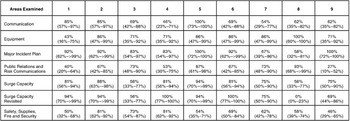
The overall response compliance rate was 98% for all of the survey questions. Data collected from the nine LDTT participating hospitals met 72% (95%CI = 69%–75%) of the overall criteria examined. The highest scores were attained in areas such as equipment with 78% (95%CI = 66%–86%) positive responses and development of a major incident plan with 85% (95%CI = 77%–91%) of criteria met. The lowest scores recorded were in the areas of public relations/risk communications, 64% positive responses (95%CI = 56%–72%), and safety, supplies, fire and security meeting also meeting 64% of the assessed criteria (95%CI = 57%–70%). Surge capacity and surge capacity revisited both met 76% (95%CI = 68%–83% and 68%–82%, respectively).
The results of each hospital meeting the criteria questioned by category are in Table 1, with 95% confidence intervals listed in parentheses.
Percentages of positive responses for each hospital by category

Discussion
The answers to the survey identified proficiencies and deficiencies in regard to disaster preparedness in the hospitals serving Cape Town, South Africa leading up to the 2010 FIFA World Cup. While the hospitals involved responded positively to almost three-quarters of the disaster preparedness survey questions, the distributions were not uniform, but were reflective of the overall state of disaster preparedness similar to that seen in the literature.Reference Ghilarducci, Pirrallo and Hegmann6,Reference Greenberg, Jurgens and Gracely7,Reference Mann, MacKenzie and Anderson9 However, as no direct measurement of hospital preparedness for a single event is available, it was not possible to compare these results to previous data.
Some of the areas examined, such as planning, equipment, and surge capacity, fared very well in LDTT with positive responses recorded in more than three-quarters of survey questioned posed to the individual hospitals. Other questions related to areas such as public relations, risk communications, safety, supplies, fire, and security yielded less than two-thirds of the survey questions reported as positive. However, each of these sections could include at least two different sub-sections in some categories, and these responses should be assessed separately. In the public relations and risk communications section, the hospitals did quite well in regard to questions concerning public relations and the media, but identified a lack of preparation in regards to evidence preservation and in handling the remains of victims of a mass-casualty incident.
This dichotomy also was encountered in the section of safety, supplies, fire, and security. In regard to the questions concerning supplies, disease monitoring, and security, the hospitals responded very well. However, with those questions concerning decontamination equipment and procedures, the hospitals fared worse.
Due to its central importance, “surge capacity” questions were repeated to determine whether the participants of the LDTT were utilizing information that was gathered during the drill. Although one hospital did not respond to the repeated questions, the overall number of surge questions with positive responses increased among the majority of hospitals polled. The reason for the lack of response from this hospital was not clear, but time limitations could have been a factor. The fact that most of the responses improved in this area very well may be representative of the entire drill, and it is likely that if this mechanism was repeated for all sections, then perhaps, more criteria would have been met, improving the overall assessment of disaster preparedness of the hospitals surveyed.
Limitations
This survey utilized and relied upon responses of contact persons in the hospitals being assessed. However, there was no external validation of the correctness of the responses as has been performed in previous similar studies.Reference Kaji and Lewis10,Reference Kaji, Langford and Lewis11 Furthermore, when surge capacity questions were revisited, the responses changed for certain questions. This could reflect an overall inaccuracy of the reporting, or this could have been due to hospital staff gaining increased awareness of disaster preparedness methods and resources as they learned throughout the LDTT drill.
The selected hospitals used for this pilot study in Cape Town also may not reflect the overall hospital preparedness of South Africa in the lead-up to the World Cup. A total of 10 different venues would be utilized, spanning nine different South African cities. The current study examined hospitals in Cape Town, since disaster resources already were present in that geographic location, but conclusions concerning disaster preparedness in this region may not be generalizable to other hospitals surrounding the other World Cup venues.
Finally, while the survey worked to assess disaster preparedness based on the Hospital Emergency Analysis Tool, one must understand that there is no universal tool to assess disaster preparedness. Multiple formats have been described to assess hospital disaster preparedness by examining different aspects of disaster planning.Reference Kaji, Langford and Lewis11 Therefore, it is important to realize that the current study addressed only one method of assessing disaster preparedness.
Conclusions
Overall, the hospitals performed well in the LDTT drill leading up to the 2010 FIFA World Cup. The hospitals performed well in categories of equipment, planning, and surge capacity, but improvements can be made in the areas of public relations/risk communications and safety, supplies, fire, and security.
Mass gatherings, such as the 2010 FIFA World Cup, represent significant challenges for the public health and the healthcare delivery systems. Major areas of public health responsibility related to mass gatherings include healthcare capacity and mass-casualty preparedness, disease surveillance and outbreak response, environmental health and food safety, public information and health promotion. Other major important areas include public health preparedness and response to the use of biological and chemical agents or radionuclear material, and explosives and leadership, operations, and capacity for unified command. In the light of emerging global public health threats from natural or deliberate events, mass- gathering public health and disaster preparedness concepts are closely connected. Effective planning for and response to incidents at mass-gatherings can be achieved through collaboration among event planners, government agencies, and members of the communities-at-risk. The success of the planning depends, in part, on how governments, agencies, communities, and other stakeholders prepare for the public health aspects of such mass gatherings.
Standardizing hospital disaster planning and emergency preparedness is recommended by expanding the use of a standard template for all hospitals applying an all-hazards approach. Finally, continued cooperation and communication between government, private agencies and hospitals is necessary to implement and sustain advancements in emergency planning.
Abbreviations:
SUNY = State University of New york
LDTT = long-distance tabletop drill
HAZMAT = hazardous materials
FIFA = Fédération Internationale de Football Accociation