Introduction
Residents of remote and rural areas have reduced access to healthcare and often experience poorer health outcomes (Canadian Institute for Health Information, 2006; Australian Institute of Health and Welfare, 2008). Although telehealth is a rapidly growing field with the potential to reduce healthcare inequities, applications to the field of geriatrics are in the relatively early stage of development. Interestingly, the first reported clinical application for telehealth was for telepsychiatry consultations in 1970, with a connection between a Boston hospital and a nursing home (Baer et al., Reference Baer, Elford and Cukor1997). A recent review of telepsychiatry practice summarizes the evidence base supporting its use, and also provides practical advice on clinical applications (Shore, Reference Shore2013). Useful guidelines for videoconference-based “telemental health” were published by Yellowlees et al. (2009). A review of geriatric telehealth by Shulman et al. Reference Shulman, Conn and Elford(2006) described ten studies of geriatric telepsychiatry or telepsychology. Nine of these studies compared video with face-to-face assessments with a focus on the reliability of the process. Tests that had been evaluated included the Mini-Mental State Examination (MMSE), other brief cognitive tests, the Brief Psychiatric Rating Scale (BPRS), and the Geriatric Depression Scale (GDS). In general, the studies supported both validity and feasibility of carrying out assessment via interactive videoconferencing. The authors concluded that further work is required to delineate optimal models, which are effective, sustainable, and cost-effective.
A recently published detailed review of telepsychogeriatrics by Ramos-Rios et al. Reference Ramos-Rios, Mateos, Lojo, Conn and Patterson(2012) noted the almost complete lack of studies focused on telepsychiatry consultation for community-dwelling older adults. The authors reviewed nine studies of consultation to nursing homes, ten papers on diagnostic assessment, and five papers on cognitive assessment. The majority of the papers focused on nursing homes suggested that the process is feasible and satisfactory for patients and staff. Two papers suggested improved outcomes and one noted the process to be cost-effective. The studies of diagnostic assessment (including some cognitive tests) suggested good correlations between video and face-to-face assessment.
The District Mental Health Services Older Adults Program (DMHSOAP) is a program of the Canadian Mental Health Association based in Fort Frances, Ontario and funded through the Provincial Ministry of Health and Long-Term Care through the North West Local Health Integration Network (LHIN). Baycrest Centre in Toronto has partnered with DMHSOAP since 2002 to provide telepsychiatry consultations and/or tele-education on a rotating weekly basis to six communities in Kenora and Rainy River Districts of Northwest Ontario, which are approximately 1800 km from Toronto and cover an area with a radius 1,200 km. The consultations were provided by two of the authors (David K. Conn and Robert Madan). The infrastructure for telehealth services was and continues to be provided by the Ontario Telemedicine Network (OTN; www.otn.ca), one of North America's largest and busiest telemedicine networks (Brown, Reference Brown2013). OTN utilizes a secure, closed Internet protocol (IP) network with videoconferencing codecs and cameras with a minimum transmission bandwidth of 384 kilobits per second. Local staff sends a detailed package of information prior to the consultation, which usually includes standardized tests such as the MMSE, Montreal Cognitive Assessment (MoCA), and GDS. The objectives of this project were to (1) evaluate the effectiveness of the current program, including both clinical and educational components; (2) utilize the results to improve any perceived weaknesses of the program; and (3) utilize the results to promote similar programs for other areas of need. A previously published Telepsychiatry Assessment Framework (Boydell et al., Reference Boydell, Greenberg and Volpe2004) was helpful in designing the project. All components of the evaluation were approved by the Baycrest Research Ethics Board.
Methods
The evaluation included a retrospective chart review of the last 100 patients assessed; analysis of sessional evaluation forms of 253 patient assessments and 41 case consultations (2002–2009); a survey of referring physicians and three focus groups of health professionals at the distant sites.
Retrospective chart review
A retrospective chart review was conducted on the last 100 patients seen, covering a period from February 2007 to March 2010. The review focused on demographic, referral, and diagnostic information. Demographic and referral information was gathered from intake assessment forms filled out by DMHSOAP geriatric mental healthcare workers, and diagnostic information and recommendations were gathered through the psychiatrists’ notes from the session and report submitted to referring physicians.
Sessional evaluation survey
A total of 253 patient assessments and 41 case consultations (without the patient being present) were done covering the period from 18 September 2002 to 30 June 2009 across six recipient sites. A survey was completed by patients, family members, and staff following each telepsychiatry session since the inception of the program. These surveys consisted of six short questions, in which respondents evaluated their experience and satisfaction with the service on a 5-point Likert scale. Sessional evaluation surveys were reviewed from the period starting from September 2002 to June 2009. Comments were also provided on many of the surveys, and these were reviewed with particular attention to any incidents involving technical difficulties or failures.
Referring physician survey
Surveys were distributed to local physicians with a self-addressed stamped envelope by geriatric mental health workers from DMHSOAP. The respondents were asked 13 questions reported on a 6-point Likert scale regarding their degree of satisfaction with the telepsychiatry service and their opinion with respect to its value. There were also some questions about the nature of their practice in the community and use of other telehealth services.
Focus groups
Three groups of individuals from six towns met at three different locations to be part of three separate focus groups, which aimed to learn about their experiences with the telepsychiatry program. The participants included ten geriatric mental health workers, one registered practical nurse, one registered nurse, one nurse manager, one counsellor, one client representative, one long-term care worker, one executive director, one program coordinator, and one community liaison worker.
An independent qualitative researcher conducted the interviews by videoconference. Prepared questions were asked using a semi-structured approach, which allowed the participants some latitude to expand their answers beyond the question. Using “content analysis,” transcripts were coded and analyzed for themes using a grounded theory method.
Results
Chart review
The following data refer only to the chart review. The mean age of all patients assessed at the time of consultation was 76.7 years. Ninety-seven percent were aged over 60 years. The youngest person in the sample was 47 years of age, while the oldest was aged 96 years. Sixty-eight percent of all patients seen were females and 32% were males. The majority (65%) was of non-aboriginal background, 17% were of aboriginal background, whereas the ethnic background of 18% was either unknown or not stated. Most patients were seen on one occasion only for consultation except three patients, who were seen for the second time for follow-up of the previous consultation. Location of residence was spread out over a very large region with the largest number of patients living in Dryden (18%) and Fort Frances (18%) but with some living as far away as in Fort Severn in the far north near Hudson Bay. In comparison with the recent data from our Geriatric Psychiatry Community Outreach service at Baycrest, the patients seen in Toronto (face-to-face) were somewhat older (mean age 81.6 years) with a similar male-to-female ratio (36.6% males, 63.4% females).
In many of the cases reviewed the patient was referred for a single reason. However, more often the patient was referred for multiple reasons and this occurred in 53% of the patients. Cognitive impairment was the most common reason for referral, occurring in 54% of all referrals, followed by suspected depression in 35% of all referrals and behavioral problems in 31% of all referrals. Caregiver or family burnout was mentioned as an issue in 9% of the patients reviewed. Other notable reasons for referral were problems with substance abuse and anxiety.
A review of the psychiatrist consultation reports and notes reveals that the most common diagnosis was dementia (54%), followed by depression (28%), mild cognitive impairment (19%), dysthymic disorder (9%), anxiety disorders (8%), and post-traumatic stress disorder (PTSD) (5%). In many cases patients had multiple diagnoses with 27% of the patients having two or more diagnoses. The most common combinations were depression and dementia, which occurred in eight patients, and depression and mild cognitive impairment, which occurred in six patients. The diagnostic profile of recent patients seen face-to-face by our outreach team in Toronto is quite similar (primary diagnoses: dementia or other cognitive disorders 45%, mood disorders 36%, anxiety disorders 7%, adjustment disorders 6%, and other diagnoses 6%).
Medication management was the suggested course of action in 95% of the patients followed by psychotherapy/psychosocial interventions in 31% of the patients and additional investigations were suggested in 33% of the patients. Often a combination of one or all of these three courses of action was suggested. When a trial of new medication was suggested, an antidepressant was suggested in 50% of the patients, the most common being citalopram followed by venlafaxine and tradozone. Cholinesterase inhibitors were suggested in 33% of the patients, the most common being donepezil. A trial of anti-psychotics was suggested in 10% of the patients, the most common being risperidone.
Sessional evaluation survey forms
Evaluation forms were available from all 253 patient assessments and 41 case consultations. Mean scores from session evaluations with regard to ability to see and hear the consultant were in the range of 4.7–4.9 on a scale of 1–5, ranging from strongly disagree to strongly agree. Mean scores for questions regarding the provision of information, whether objectives were met, and overall usefulness of recommendations ranged from 4.6 to 4.85 across all the years. Respondents were consistently positive and satisfied with their experience across all the years. All comments from sessions were reviewed, 681 in total, and of these a very small proportion (22 comments or 3.23%) were related to problems that arose through technical difficulties with the service. There were only nine comments about hearing difficulty, two of which were related to noise at the distant site.
Physician surveys
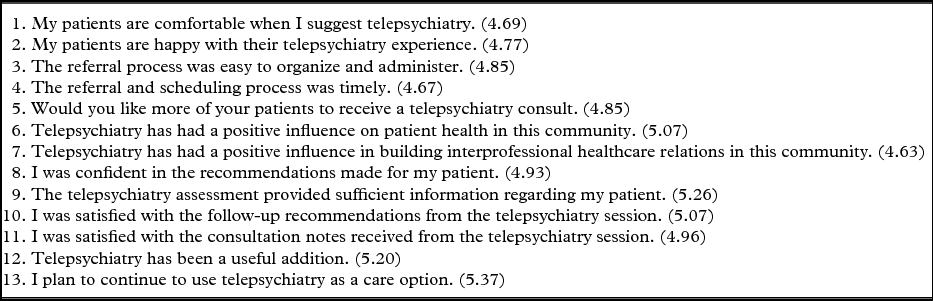
Surveys were distributed to physicians working in the communities of Fort Frances, Emo, Rainy River, Dryden, Sioux Lookout, Red Lake, and Kenora. In total 56 surveys were distributed and 29 were returned with a response rate of 51.8%. Referring physicians had been practicing in the community for an average of 14.2 years, and in the previous year made an average of three referrals to DMHSOAP for psychiatric assessment. Thirteen questions listed in Table 1 were included in the survey. Response options were based on a 6-point Likert scale, ranging from “strongly agree” to “strongly disagree.”
List of questions used in survey of referring physicians with the scores out of 6. Response options were based on a 6-point Likert scale ranging from “strongly agree” to “strongly disagree”

The scores (see Table 1) ranged from a low of 4.63/6 to a high of 5.37/6. Responses from the physician survey suggest that their experience with telepsychiatry has been very positive. The referral and scheduling process has been mainly a positive experience, with a few physicians feeling the process was not as timely as it could have been or difficult to administer. Regarding the effect the program has had on patient and professional community members, all survey respondents felt that the program has had a positive influence on patient health. Overall, referring physicians appeared to be confident and satisfied with the recommendations made for their patients. They felt the assessment provided sufficient information, and were satisfied with the notes provided from the telepsychiatry sessions. The physicians believed that telepsychiatry has been a useful addition to DMHSOAP, and all plan on continuing to use telepsychiatry as a care option for the future.
Focus groups
Perceptions about the program
The focus group participants reported positive experiences with the telepsychiatry program. They recognized that without this service their clients would not receive the specialist consultation, or have to travel far distances for a consult. The service has allowed for family members to be involved in the consultation process by eliminating the need to travel for the appointment. This service has been particularly useful for First Nations aboriginals, who can receive an assessment using an interpreter and include family members. Participants also noted that the program has heightened the status of the local Seniors Mental Health Care Team. The healthcare workers reported that some clients were apprehensive or skeptical about the process, but seemed to adapt quickly. They appreciated being seen in their home community and having specialized care at their doorstep. One participant recalled a patient saying, “. . .it was like being right in the room with the psychiatrist. He was very helpful, the patients and the families were so appreciative because they didn't have to travel.” For healthcare workers, telepsychiatry was initially met with some skepticism and curiosity. One participant noted that telepsychiatry was initially felt as a means to avoid bringing specialists into their remote community, but these thoughts and hesitations quickly disappeared when experiencing telepsychiatry in action.
Enablers
The cohesion and functioning of the healthcare team, collegial relationships, and mutual respect were described as central to the success of the program. The peer relationships between the treating physicians in the northern communities and the specialist were cited as an important factor. The detailed nature of the recommendations that suits each patient, along with the resulting education, was valued. The healthcare team noted that the availability of the consulting psychiatrist to further discuss the case or recommendations after teleconsultation as a strength. Members of the healthcare team reported feeling important and relevant in the care of older patients. They reported that they experience a strong sense of inclusion in developing treatment plans for their patients, noting that their points of view and specialization play an important role in patient care and outcomes.
Barriers
One major barrier was reported to be difficulty in obtaining a referral from some treating family physicians. The healthcare team may need to convince some reluctant or unwilling physicians that the patient would benefit from a telepsychiatry assessment. A few physicians were reported to be categorically opposed to supporting telemedicine and view it as a barrier to securing health services in person within northern communities. One participant recalled the following interaction with a local physician: “And I said . . . ‘why would you not support something like that?’ and he said, ‘because it's just the government's justification not to bring geriatric psychiatrists into the north.’” Another reported barrier was delay in or lack of implementation of the recommendations made by the specialist. Some focus group members considered this to be a manifestation of the resistance of the family physician to the telemedicine process. In addition, the use of locums and the frequent turnover of physicians in northern communities were thought to negatively impact the implementation of recommendations and the success of the telepsychiatry program. Continuity of care for older adults in need of psychiatric care is especially problematic when implementation and monitoring of medications do not occur as break in communication between in and outgoing doctors is possible. Local nurse practitioners often support the continuity of care and facilitate treatment. The focus group participants reported that access to the service could be enhanced with more telemedicine equipment and personnel, including another geriatric psychiatrist.
Team educational seminars
Educational seminars for healthcare teams were reported as invaluable by all participants. They were described as flexible, timely, and relevant. The sessions provided the healthcare teams with skills and confidence to manage situations and to be able to independently suggest a course of action. Some participants stated that telepsychiatry has made it possible for them to expand their repertoire of skills, such as the administration of standardized tests. This has resulted in the team being able to provide more information about the patient when meeting the consultant and in some cases has precluded the need for a referral. These sessions have helped the teams develop a common language when discussing cases and enhance respect and teamwork. As one participant noted the following:
I had the opportunity to do three educational sessions with [the psychiatrist] and I was able to the pick the topics ahead of time which I felt I needed assistance with and he was more than willing to talk . . . translating that information into clinical practice was tremendously helpful.
Discussion
This evaluation is based on feedback from patients, their families, referring physicians, and local healthcare professionals. The conclusions must be considered preliminary as the evaluation did not utilize patient outcome measures. Nevertheless, the project does provide considerable support for the feasibility of such programs. The service has now been running continuously for over ten years. Weaknesses of the study include the fact that it was descriptive and uncontrolled. One other possible weakness is that we did not include non-professional community members in the focus groups. With regard to generalizability, it is important to note that this service operates within a well-established telemedicine network, which provides the infrastructure (technology and scheduling), and that it is fully funded by the Ontario Ministry of Health and Long-Term Care. The psychogeriatric outreach team based in rural Northwest Ontario is also a vital component of this service's delivery model.
On all levels participants appear to have had a very positive experience thus far. Surveys provided to participants in sessions and referring physicians have evaluated their experiences with the service as positive and indicate that it is a welcome addition to the healthcare services that their communities currently receive. However, feedback from our focus groups has indicated some barriers to the success of the program, such as the challenge of timely implementation of recommendations, and resistance by some professionals to the concept of telemedicine. Key factors contributing to the success and longevity of the program include administrative and infrastructure support, presence of telehealth champions, an appropriate funding model, and inclusion of tele-education for staff.
In order for the program to remain a fixture in the community and to overcome barriers of access identified in focus groups, continued program promotion and outreach to local physicians, nurses, and other community healthcare workers is needed. One of the greatest strengths of the telepsychiatry program is the long-standing relationship it has with the local geriatric mental health outreach team and primary care staff. This stability is key in the continued cultivation of professional relationships in order to create a stable and continuous circle of care for patients in localities where transient forms of healthcare are often the norm. This is particularly important regarding access to referrals for telehealth programs. Whitten et al. (Reference Whitten and Mackert2005) found that gatekeepers to such programs were the most significant initial barriers to telehealth.
A Canadian national survey of telepsychiatry programs conducted by Urness et al. Reference Urness, Hailey, Delday, Callanan and Orlik(2004) demonstrated that although telepsychiatry programs have been established across all provinces and territories in Canada, the number of geriatric consultations was low relative to adult and child/adolescent consultations. These numbers suggest a service gap in the Canadian telepsychiatry landscape. Given our rapidly aging population and trends in medical education, which suggest that fewer trainees are choosing geriatrics as a career area for specialization (Diachun et al., Reference Diachun, Hillier and Stolee2006), service gaps will be exacerbated in remote communities, which are already experiencing shortages of other health services. Telepsychiatry services, such as the Baycrest–DMHSOAP partnership, can play an increasingly important role in mitigating the significant systemic and structural barriers of service provision for older adults in remote and rural communities around the globe.
Conflict of interest
None.
Description of authors’ roles
David K. Conn designed the study, analyzed the data, and wrote the paper. Robert Madan assisted with data analysis and writing the paper. Jenny Lam coordinated the project and data collection, carried out the chart review, and assisted with writing. Tim Patterson provided technical support for the focus groups and the program itself. Sandy Skirten assisted with coordination of the physician survey and focus groups.
Acknowledgments
This study was supported by an Alternate Funding Plan (AFP) Innovation Grant from the Ontario Ministry of Health and Long-Term Care, Ontario, Canada. We are grateful to the DMHSOAP staff for its ongoing support and collaboration, and to the Ontario Telemedicine Network for providing ongoing infrastructure and support.