Introduction
In the ageing societies of the Western world, the number of dependent elderly people is expected to grow, while the availability of family carers and the political will to finance professional care are declining. Confronted with a care-gap outlook and pressures to reform welfare states, national and international authorities have intensified calls for social innovation. Nevertheless, despite its widespread diffusion, the notion of social innovation remains loosely defined. At the European level, social innovations are ‘new ideas that simultaneously meet social needs and create new social relationships’ (BEPA, 2010). Indeed, akin to the notion of ‘community’ (Hancock et al., Reference Hancock, Mooney and Neal2012: 354), such definitions of social innovation can be employed to facilitate various imaginaries of alternatives to the traditional welfare state.
Against this background, this article aims to clarify the values of social innovations in the field of domiciliary long-term care (LTC) and to address the issue of their local implementation. More precisely, it provides an analysis of the concrete trajectories of three local innovations for elderly people in Hamburg (Germany), Edinburgh (Scotland) and Geneva (Switzerland). Focusing on the discourses underlying these innovations, the article shows that, in the context of local policy, social innovations originally inspired by a libertarian critique of the welfare state undergo various processes of normalisation, i.e. their libertarian dimensions are reduced both in scope and intensity.
In proposing this argument, we contribute towards filling a gap in the literature on social innovation. First, there is an (often) implicit value positioning of social innovation, as the notion is largely associated with civil society, social entrepreneurship and social movements (Moore and Hartley, Reference Moore and Hartley2008; Evers and Ewert, Reference Evers and Ewert2013). Those values deserve to be explicitly assessed. Second, if the literature acknowledges the dynamic character of innovation (Rogers, Reference Rogers2003; Verleye and Gemmel, Reference Verleye and Gemmel2011; Marques et al., Reference Marques, Gerry, Diniz and Ferreira2012), it usually concentrates on short-term impact, and, therefore, it tends to underestimate the role of public policies (Mahroum, Reference Mahroum2013) and territorial social networks or agreements (Moulaert et al., Reference Moulaert, Martinelli, Swyngedouw and Gonzalez2005: 1973) in the framing of social innovation values.
Theoretically, we consider social innovation as both a dynamic and discursive process that has to be understood in the context of the policy process. Hence, we consider that the policy process includes two dimensions. Firstly, policy processes deal with the formulation and reformulation of policy problems through a discursive struggle. As Jenson (Reference Jenson1989: 238) puts it, the terrain on which actors struggle for representation is the universe of political discourse. From this perspective, an innovation can be understood as a new discourse about elderly care which participates in the struggle for representation in the policy field.Footnote 1 According to Rogers, an innovation is ‘an idea, practice or object that is perceived as new by an individual or other unit of adoption’ (Rogers, Reference Rogers2003: 12). Drawing upon this relative dimension of innovation, we identify local innovations in LTC as local attempts to correct for national shortcomings.
Secondly, a policy process is about taking action in order to achieve policy goals. From a discursive perspective, this dimension refers to the institutionalisation of discourse, that is its transcription into institutional arrangements and concrete policies and practices (Hajer, Reference Hajer1997: 61). Here, the social innovation process is related to the way the innovative discourse is translated and perhaps even stabilised in the LTC policy field. It may involve new forms of assistance or technologies, as well as social, political and institutional procedures and resources, such as certification, financing or monitoring. As the innovative discourse expands and becomes institutionalised, it generates ‘discursive coalitions’ (coalitions of actors who articulate the discourse and contribute to its diffusion through different practices (Hajer, Reference Hajer1997)).
Empirically, this analysis is based upon recent qualitative comparative research on local innovations in LTC, and more specifically upon three out of six embedded case studies that were carried out between 2011 and 2012 in Germany, Scotland and Switzerland.Footnote 2 These three case studies rely upon the analysis of national and local documents and press articles, as well as on twenty-nine interviews with key actors of the local networks in Geneva, Edinburgh and Hamburg. From these data, the networks of actors of local LTC were characterised as well as the main discourses concerning the local innovations and the local home-based care networks and policies.
In the first section of the article, we map out the current academic and political debates regarding the reform of LTC and argue that innovations in this field refer either to a libertarian or to a neo-liberal critique of the welfare state. The second section presents the results of the empirical study. We first describe the three local innovation cases and demonstrate how they make use of the libertarian critique in their respective national contexts. Then we compare the evolution of the first innovative discourse in the policy process. We assess the discourse transformation and institutionalisation and we identify discourse coalitions. The analysis reveals a common normalisation process. The conclusion summarises the main results and elaborates on the forms of normalisation illustrated by our three cases and on the normative rooting of social innovation.
A typology of long-term care innovations
National and international academic and political debates concerning LTC refer to four key dimensions structuring a critical perspective on welfare state arrangements: governance, service provision, quality of care and user participation. Building on a review of the international academic and political literature,Footnote 3 we suggest that contemporary controversies with regards to these dimensions can be grouped into two opposing paradigms: the libertarian critique of the welfare state on the one hand, and the neo-liberal critique on the other hand. On this basis, we can distinguish two models of LTC innovations.
The first dimension of the LTC debate is governance. The concept of governanceFootnote 4 has various meanings, but most of them question, on a descriptive or a normative level, the efficiency of hierarchical forms of regulation and contrast them with network or market-based forms. In the specific domain of LTC, ‘governance’ refers to the organisation of power relations amongst the various stakeholders of that domain. The various modes of steering, determining the content, financing or organising the delivery of domiciliary LTC are at stake here.
Van Kersbergen and Van Waarden (Reference Van Kersbergen and Van Waarden2004) provide a helpful typology of different modes of governance structured around the kind of criticism of the traditional welfare state that these entail: on the one hand, we have types of governance such as ‘governance without government/self-organisation’ or ‘network coordination’ that may be attributed to a libertarian criticism of the welfare state. These types of governance are seen as an alternative to the rigid frame of a bureaucratic, capitalist and patronising welfare state. On the other hand, we have types of governance such as ‘markets and their institutions’ or ‘New Public Management’ which belong to a market driven or a neo-liberal critique. These types of governance are seen as alternatives to public, tax-financed and allegedly inefficient aspects of welfare provision, and reflect the normative idea that organisational and management modes developed in a market environment should be introduced in all kinds of public administrations.
The second dimension is service provision: its design, modes and practical organisation, refers to the fit, or indeed tension, between the diversity of local needs and the diversity of providers and provisions, which constitute the specific local shape of the welfare mix (Evers, Reference Evers, Evers and Svetlik1993). As an analytical tool, the concept of the ‘welfare mix’ helps us to grasp the existing plurality in the provision of LTC delivery in European contexts, characterised by specific configurations of the division, appreciation and remuneration of domiciliary care work amongst public, for-profit and non-profit providers, as well as private households (within which women in particular are working). In the domain of LTC, this dimension is directly linked to the increasing diversity of cultures, languages, religions and sexual identities, hence to a pluralisation and individualisation of needs along with increasingly complex patterns of social inequality.
As Evers (Reference Evers, Evers and Svetlik1993) noted, the various providers not only deliver services, but also spread discourses that legitimise their activities. In doing so they participate in the ‘struggle over needs’ (Fraser, Reference Fraser and Gordon1990). In this struggle for the definition of legitimate needs and fair services, the frame of a homogeneous and uniform welfare provision matches the republican, egalitarian tradition, while the frame of a diversified, adapted, and differentiated provision meets the political tradition of pluralism, multi-religious or multi-cultural societies (for example, Björngren Cuadra and Cattacin, Reference Björngren Cuadra and Cattacin2007). In this context, contemporary discourses of austerity reinforce the egalitarian-universal rationale and give it a minimalist spin: the emphasis is placed upon the need for a minimal standard of provision for each person in need.
Third, the dimension of quality is important for the implicit and explicit norm-setting in the domain of LTC. National and international discourses on quality are often linked to discussions about the effectiveness and efficiency of LTC systems. Thus, this debate is often related to financial issues. Quality assurance strategies can be differentiated into two main types: ‘top-down’ and ‘bottom-up’. Top-down strategies entail the top-down setting and implementation of structural or procedural standards or outcomes, for example minimal standards set as a precondition for accreditation (OECD, 2005: 73). In contrast, bottom-up strategies follow a more reflexive, experience- and performance-based approach. These include cooperative instruments such as quality circles, or educative measures such as qualifications or the training of staff and/or informal carers. In recent years, the long-standing focus on structural and procedural aspects has been replaced by a growing concern for the outcomes of LTCFootnote 5 and for users’ perspectives.
Finally, participation is a crucial dimension of health and social care reforms. Two main approaches concerning the participation of elderly people in both social services and research are of relevance to the field of domiciliary LTC (Beresford and Croft, Reference Beresford and Croft1993; see also Bray, Reference Bray, Kemshall and Littlechild2000; Glasby, Reference Glasby2007; Ray, Reference Ray, Bernard and Scharf Thomas2007). On one side, the consumerist approach based on market principles focuses upon the individual as a ‘consumer’ choosing between services by pondering price and quality. On the other side, the democratic approach is based on the assumptions of democratic citizenship and legitimate collective action and gives participants both access to the agenda and the means to make some changes regarding their own lives, within the domain of LTC provision. In the words of Bray (Reference Bray, Kemshall and Littlechild2000), from this second perspective ‘the focus is upon participatory rights’, rather than on welfare needs. Regarding LTC specifically, the idea is that users should be involved in the planning and delivery of services, individually as well as collectively.
Two paradigms of LTC innovations
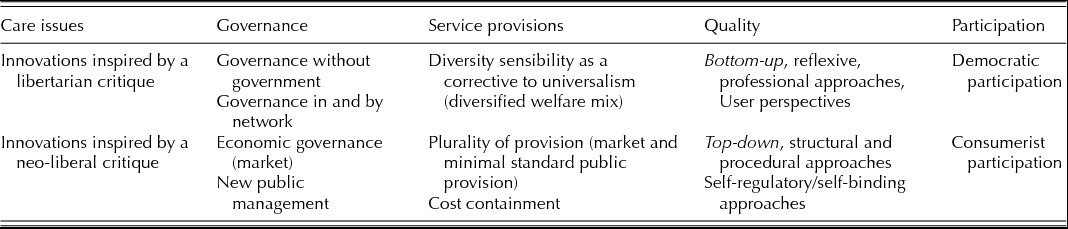
On the basis of the cleavages that cross-cut the four key dimensions of LTC reforms, two opposing paradigms can be identified. These paradigms of LTC innovations are ideal types. As such, they help us to map the discourse and coalition building processes in relation to domiciliary LTC at the local level. Table 1 shows how the central elements of the discourses around each of the four dimensions can be attributed either to a libertarian or to a neo-liberal critique of the welfare state.
Mapping of the LTC debate
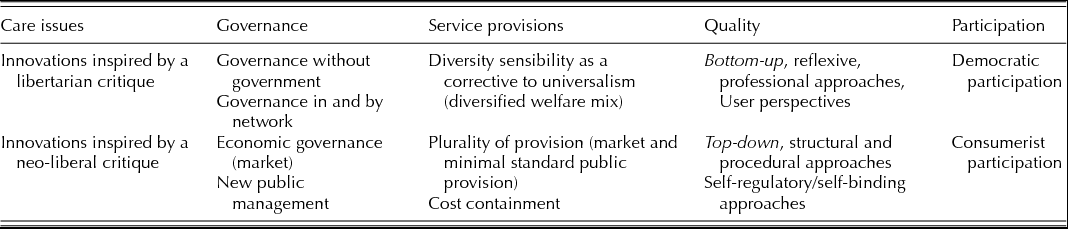
On the one hand we can group elements related to the four key issues discussed above around a libertarian critique of the welfare state, which inspires an initial, libertarian paradigm of social innovation. These innovations aim at open, network oriented modes of governance, and at the provision of diversity-sensitive and needs-based services. Quality is regulated by professional norms, developed in bottom-up processes, and users of LTC have a say in both service development and delivery. They are conceived of as citizens and active participants in political, economic and social life.
On the other hand, we can group elements related to the four key dimensions discussed around a neo-liberal critique of the welfare state that inspires a more rationality centred paradigm of social innovation. This paradigm emphasises a type of governance based on market principles, rationalisation and minimal standard sets of service provision. It favours top-down implemented minimal quality requirements and conceives of users as autonomous consumers choosing between services.
Social innovation trajectories: three empirical cases
The empirical analysis of the trajectories of social innovations is based on three local cases that can be related to at least one dimension of the libertarian critique of the welfare state described above. In Hamburg (Germany), the innovation refers to a libertarian conception of service coordination, in Geneva (Switzerland) to a libertarian conception of quality and participation and in Edinburgh (Scotland) to a libertarian conception of participation.
These cases were selected in different national contexts whose LTC regimes represent different regimes of the welfare state: the German welfare state regime is a subsidiary-based insurance model (Rothgang, Reference Rothgang2010), Scotland illustrates a universalist model (Béland and Lecours, Reference Béland and Lecours2008), and Switzerland has been characterised as a conservative model with liberal features (Obinger, Reference Obinger, Obinger, Starke, Moser, Bogedan, Gindulis and Liebfried2010). Despite these differences, these countries share important characteristics that allow for a comparison of local innovation processes in the field of LTC. Firstly, they are similar with regards to the type of beneficiaries of home-based care service (sex and age), the distribution of care users between home-based care and institutional care, as well as the proportion of informal carers (Falk et al., Reference Falk, Giraud, Kümpers, Lechevalier and Lucas2011: 42). Secondly, these three national LTC care regimes have been recently reformed, and these changes generate new demand for innovation at the local level. Thirdly, the three countries share a tradition of strong and autonomous local authorities. In Switzerland and Germany, care has long been considered a private issue and a local issue. In Scotland, the welfare state is more centralised, but the local level is responsible for the implementation of care services.
In this section, we first situate these local innovations in their national contexts, with regard to the four dimensions of the international debate – governance, diversity of service, quality and participation (a). Then, we provide a comparative analysis of both the initial innovation discourse and its transformation during the various steps of the institutionalisation process, which relates to the implied extension of the coalition of actors (b).
(a) Three social innovations in their national context
As we shall see, the Swiss and German projects are clearly anchored in a social-centred model of innovation, while the Scottish case is more ambivalent. In Switzerland, the governance of the domiciliary care system is characterised by a strong degree of fragmentation, due to federalism and to the salience of private actors in the field of health. Fiscal reform in 2011 clarified the financing system and the distribution of tasks between the cantons and the federal state, but did not resolve the complexity of the system. At the federal level, LTC is regulated by a dual architecture with medical treatment financed through mandatory health insurance and some cash benefits provided through pension insurance. The bulk of the LTC policies are situated at cantonal and sometimes at local level (Giraud and Lucas, forthcoming). Most of the LTC provision is provided through private, mainly non-profit, actors in collaboration with the municipalities or the cantons. These organisations provide standard services of home-based care for dependent elderly. At the federal level, quality issues are mainly addressed through health insurance regulation, whilst issues of participation are very weak and are focused upon the individual choice of services.
In this context, the innovation developed in Geneva consists of collective lunches organised at local restaurants, for older clients of ‘meals-on-wheels’. This innovation was initiated in 2005 by a sub-local branch of the cantonal domiciliary care services in collaboration with a sub-local unit of the municipal social services. This project relates to a libertarian conception of participation as it addresses the problem of frail elderly people's isolation and aims to improve their capacity to participate in local social life (rather than focusing upon the free choice available in a market of services). The quality of care in this project has a similar inspiration as it is based upon the idea that good alimentation for frail elderly people depends more upon beneficiary pleasurable experience (the conviviality of a shared meal) rather than top-down medical or technical criteria.
Since 1995 in Germany, specific compulsory social insurance provides an important part of the funding of LTC for the aged and the market principle organises the delivery of services at the local level. Organised at various scales for specific functions (federal financing, Land-level regulation, local care markets), the governance of the German system is both complex and segmented. As in most other European countries, health and social care provision are not integrated. Provision networks are restricted by competition and demonstrate a rather poor capacity to address diversified needs. Debates and policies fostering participation are weak, while the issue of quality has attracted increasing levels of attention during the last few years.
In this context, the government of the Land of Hamburg (state-level) initiated an instrument of participation open to all actors active in the domain of LTC: the Care Conferences. This instrument is implemented at borough level and should improve communication and coordination amongst the various types of actors: private, public, associative, as well as individuals and beneficiaries. Confirming its libertarian inspiration, one of the decisive initial goals of the instrument was to create socially based coordination capable of balancing the market principle steering the local systems of service provision.
In Scotland, the Free Personal and Nursing Care System introduced after Devolution in 1999 has transformed the Scottish LTC system. This reform granted all people over age sixty-five personal and nursing care free of charge according to their needs. The governance of the system is simple: the central (Scottish) Government provides the funding, while the local authorities take charge of the implementation. Provision networks are organised in different ways, however the segmentation between health and personal care and the lack of service diversity still pose crucial problems. Quality and user participation are central topics in public debates. The quality assurance framework has recently been reorganised and simplified by the Scottish Government, but user participation does not (yet) rely upon strong concrete instruments.
In this context, the powerful local authority of Edinburgh implemented ‘re-ablement services’, with the explicit aim to rehabilitate older people upon release from hospital care. The participative dimension of the innovation relates to libertarianism as it sought to foster the autonomy of the beneficiaries of the re-ablement services. This new service was coupled with a decision to privatise the bulk of the City Council's own domiciliary care services. This far-reaching reform in Edinburgh introduced new care pathways for beneficiaries inspired by a neo-liberal model of innovation: it increased the diversity of services and reformed the governance of the local system through the use of market instruments.
(b) Comparing trajectories of discourse institutionalisation
In Geneva, Hamburg and Edinburgh, the institutionalisation of those innovative discourses generates new coalitions, including new, or at least, partly new actors in the local policy field, and transforms the initial libertarian discourses. This comparative analysis reveals different trajectories of normalisation, which can be related to the specific institutional contexts of local innovation.
In Geneva, the innovative ‘collective lunch service’Footnote 6 was implemented as a pilot project at the level of one of the city's neighbourhoods. As a partnership between a sub-local unit of the cantonal association of LTC service delivery and a unit of the city's social services, the innovation clearly aimed at fostering the small-scale involvement of elderly people in social life, and refining the quality of ‘meals-on-wheels’ services from a bottom-up perspective. As it then expanded to other areas of the city, the project generated new discursive coalitions at a sub-local level, first between non-profit actors and the public sector, but then also including for profit actors (restaurants) and voluntary associations. At this stage, the renewed discourse, inspired by a specific communitarian model, reinforces elements of libertarian participation, as they build on the empowerment of the community and voluntary action.
In a second phase however, the innovation moved vertically, in both the city's social services and the association of service delivery appointed by the canton. The institutionalisation of the innovation discourse by the municipal services came with a new objective: to implement the innovation at the scale of the city. Here, the discourse includes notions of ‘equal treatment’ and ‘equal access’ to the innovative service at city scale. This new discourse also reduces the importance of voluntary action, as professional social workers are considered to be more reliable than volunteers. At their own policy scale, cantonal actors developed a similar policy based on arguments relating to the social dimension of alimentation within the strict limits of the project's implementation frame. Finally, the integration of the original innovative, voluntary and community-based service into a regular, but ad hoc, service of cantonal home-based care, in relation to the professional social workers of the City, drastically reduces the libertarian significance of the model.
In Edinburgh, the social innovation was labelled as a ‘re-ablement service’ and has been implemented by the City Council of Edinburgh from 2009 onwards. The innovation consists in providing six weeks of intensive care, including occupational therapy, for elderly people upon their release from acute hospital care. Initially promoted by a discourse centred upon the autonomy and the capacity of the beneficiaries, the innovation was also part of a wider programme of reorganisation of the City Council's own social services. Its implementation gave way to three types of institutionalisation.
Firstly, the implementation of the re-ablement service by the social work services of the City has enabled the further development of client pathways and the introduction of case management. This puts into practice the original intention of the innovation: to foster the autonomy of the beneficiaries. Secondly, the reorganisation of the social services has triggered intensive criticism of public service delivery within the management offices of these same services, fostering conclusions that their services are ‘inefficient’, ‘bulky’ and ‘non-creative’. In limiting the task of the City Council's own social services to the re-ablement service, the management staff of the local authority has transformed this social innovation into an element of a wider discourse of management and of bureaucratic rationalisation. This discourse was thirdly the basis for the creation of a market of service provision organised via various procedures of tender and client allocation. Private LTC services providers joined the discourse coalition and reinforced the frame of rationalisation of service delivery. This transformation of the discourse towards the neo-liberal pole of LTC reform, emphasising rationalisation, incidentally also weakens the libertarian model.
In Hamburg, the local innovation consisted in ‘care conferences’, a policy instrument aimed at fostering coordination amongst all stakeholders and policy makers concerned by the issue of LTC at the level of the boroughs. Created in the late 1990s, care conferences have received little funding, and their official goal is defined in very broad terms: they are regarded as an open policy instrument that has to be appropriated in differentiated ways by local actors. This discourse aims at counter-balancing the general market-orientation of the federal law on LTC of 1995 by promoting participatory principles and instruments for the coordination of the various actors involved in service delivery. At infra-local level, care conferences have followed diverse paths of institutionalisation in the various boroughs of Hamburg. In one of the boroughs, for instance, the instrument has been appropriated by a coalition formed by a gerontologist at a local hospital involved in various research programmes, and by the head of the health services in the borough administration. These two actors have used the care conferences as a tool for reflection and for public information concerning specific public health issues in connection to LTC (nutrition, transportation, physical activities, etc.). The dimension of guidance by institutional actors has, therefore, prevailed over the mechanism of bottom-up participation that was originally intended. Further on, the local steering committee of the care conferences gathered private and semi-private providers who were very concerned about the possibility of market distortion relating to the organisation of care conferences. These diverging interpretations of the care conferences in the context of this borough have hindered the institutionalisation of the discourse in terms of bottom-up actors’ participation.
Fostering autonomy of beneficiaries, participatory forms of actors’ coordination and delivery as well as bottom-up forms of quality assurance, the initial arguments sustaining our three local innovations at least partly adopt key elements of the libertarian critique of the traditional welfare state: its centralised, hierarchical, paternalist and non-differentiated patterns. At a further stage of institutionalisation via extended actors’ coalitions, these innovations enter trajectories of normalisation that can be related to the institutional context of LTC in each country. As a summary of our empirical findings, we shall firstly compare the normalisation of the content of the innovations and secondly provide an interpretation of their signification in each institutional context by focusing on power relations, and more specifically on scalar interactions and policy styles.
1. In Geneva, the innovative discourse was elaborated by a large coalition of infra-local actors centred on social services beyond their institutional affiliation. The extension of the innovation at city and cantonal scale was accompanied by a process of bureaucratisation that challenged the initial libertarian content. In the case of Edinburgh, the rising influence of the management staff of the City Council's social services added to the original discourse of the ‘autonomy of the beneficiaries’, an objective of staff rationalisation, clearly inspired by the neo-liberal critique of the welfare state. In Hamburg, the institutionalisation of the innovation by a coalition composed of, at infra-local scale, high-ranking institutional actors, prevented the actual embedding of the initial discourse in terms of bottom-up and open participation, and replaced it with a top-down diffusion of public health motives. The importance of market actors also imposed a discourse centred upon possible market-orientation via the instrument of care conferences.
2. Both the scalar power relations and the policy styles typical of each context provide important insights. In the Swiss case, the social innovation discourse is produced and reproduced at a small scale and in an experimental way, typical of Swiss federalism and subsidiarity. The confrontation between bottom-up social dynamics and the administrative context results in a process of normalisation. The Scottish case reveals the importance of the ‘national’ (Scottish) institutional framework, in spite of the strong autonomy of implementation commanded by local authorities. The programme of cost containment was initiated by the Scottish Government, with the consent of Edinburgh City Council, which plays the role of paragon of financial mastery. In the German case, the local level has little power in the context of LTC, and the instrument developed by the Land of Hamburg is weak with no capacity to constrain local actors.
Conclusion
The local level is a very important locus of social innovation, as illustrated by the domain of LTC. Innovative solutions are expected from local actors in order to solve the care-gap problem. In this context, the comparative analysis of three local innovations in LTC provides insights regarding the concrete political trajectory of such local innovations, focusing upon the transformation of the innovation discourse and questioning the values behind the concept of social innovation.
Empirically, we first point out that a cross-cutting cleavage in the international literature on LTC sets into opposition arguments centred upon libertarian values and arguments centred upon neo-liberal values, with regards to central issues such as governance, service provision, quality and participation. The three innovations observed in Geneva, Hamburg and Edinburgh appeared to be, at least partially, influenced by the libertarian model of LTC reform. However, the case studies demonstrated that the process of local institutionalisation, which requires the constitution of extended discourse coalitions, implies, to various extents, a form of normalisation of social innovation.
Theoretically, this contribution confirms the importance of framing innovation in the context of the public policy process, as this allows for a better understanding of the institutional and political conditions for a social innovation to be implemented at the local level. Here, two results may lead to further elaboration in order to improve our understanding of the diffusion of social innovation in European social policies. Firstly, the various forms of the institutionalisation of an innovation are a clear indication that the trajectory of an innovation is a process of differentiation. This finding establishes that the common unequivocal assessments of innovation processes are mistaken. Secondly, mobilising a discursive approach to public policy sheds new light on the ‘social innovation’ content and values. Indeed, the variety of the institutionalisation processes matches the variety of interpretations of social innovation. Here, the prevalence of the neo-liberal model of LTC innovation in the institutionalisation process is striking. This result also questions the status of ‘social innovation’ in social research, whose libertarian character is often taken for granted. Once it is grasped as a discursive dimension of the innovation process, this social or libertarian characteristic of innovation reveals itself as a precarious element that can be reduced, evicted or instrumentalised through the policy process.
Finally, these analyses of three European cases leave us with a balanced consideration of the role of the local level in social innovation. On one side, the local is obviously a place of advanced expertise, experimentation and deliberation in the domain of LTC; on the other side, we are stuck with its poor capacity to maintain the libertarian character of social innovation. Nevertheless, and in spite of being only partially embedded, the appropriation of a social innovation by local actors generates a social learning dynamic that remains a key gain for the innovative process.
Acknowledgement
The authors would like to thank Lea Sgier and the anonymous reviewers for their useful comments on a previous version of the paper. We also thank Thomas Montgomery for the English revision of the text.