


1. Introduction
The term ‘heritage language’ typically refers to ‘a socio-politically minority language, acquired as a first language during the first years of life, as in sequential bilinguals, or simultaneously with the majority language since birth, as in simultaneous bilinguals’ (Montrul Reference Montrul2018:530). This implies that heritage language speakers grow up in a dual-language environment. A heritage language is typically a minority language with limited use and access beyond the home. It is often without academic support and developed under reduced input and output conditions. Such input conditions profoundly affect the development and end-state grammars of heritage speakers. When compared to baseline grammars spoken by monolingually raised native speakers in the homeland or in the diaspora, heritage languages often show a smaller quantity and different quality of input, triggering differences in their grammars (Polinsky & Scontras Reference Polinsky and Scontras2020).
According to the description above, Teochew (Chaozhou), a subdialect of the Min dialect of the Chinese language, spoken in modern-day Singapore, is a heritage language. In Chinese linguistics, the Min dialect is one of the seven major dialects of the Chinese language differentiated mainly by phonological features (Norman Reference Norman, Graham and LaPolla2003). Though these major dialects are genetically related (Ho Reference Ho, Wang and Chaofen2015), they are mutually unintelligible (Chen Reference Chen1999:2). Thus, linguistically, they are more like ‘languages’ from the point of view of mutual intelligibility (Handel Reference Handel, Wang and Chaofen2015). Generally, subdialects of a major dialect are mutually intelligible, though with exceptions (Handel Reference Handel, Wang and Chaofen2015). In Singapore, Teochew is acquired at home and has never been a majority language. Hence, Teochew speakers in Singapore are considered heritage speakers according to the definition in the literature (Polinsky Reference Polinsky2018:4–5). However, due to the dynamic sociolinguistic changes in Singapore’s history, different generations of Teochew heritage speakers encounter different sociolinguistic environments during their age of acquisition (Chew Reference Chew2013).
During the second half of the nineteenth century, there was an influx of immigrants from southern China to Singapore, which was then a British colony. Among them were the Teochew people from the Chaoshan region in the eastern Guangdong province of China. Older Singapore Teochew speakers above the age of 70 typically belong to the second or third generation of these Chinese immigrants. Before Singapore attained self-rule in 1959, Teochew speakers in Singapore congregated in various Teochew enclaves dominating certain occupations and trades (such as agriculture; Tan Reference Tan2018). Similarly, other Southern Chinese dialect groups, such as the Hokkiens, Cantonese, Hakkas and Hainanese also had their respective enclaves (Cheng Reference Cheng, Chong Guan and Bak Lim2019). This was a period of great linguistic diversity in Singapore (Kuo Reference Kuo, Afendras and Kuo1980), with Bazaar Malay and Singapore Hokkien serving as the lingua franca in a multilingual society (Chew Reference Chew2013). During then, Singapore residents could sustain a lifestyle in a mono-ethnic enclave (Li, Saravanan & Ng Reference Li, Saravanan and Ng1997). They lived and worked within a community that was virtually mono-dialectal (Gupta Reference Gupta1994). During the formative years of this group of speakers, Teochew was used within the family domain, with a very high mother tongue retention rate of 98.2% in 1957 (Kuo Reference Kuo1978). In other words, these older Teochew speakers predominantly spoke Teochew at home. Moreover, Teochew speakers formed the second largest group among the Chinese immigrants and the Teochew enclaves enabled them to use this dialect frequently in their daily life. This is in contrast with Teochew heritage speakers born later.
Since 1959, through the expansion of educational opportunities (Gopinathan Reference Gopinathan2015:28–29) and the implementation of bilingual policy in schools (Lee C. 2012), English and Mandarin gradually became the two most socio-politically important languages in Singapore society. However, according to the Goh Report (The Goh Report 1979), 85% of schoolchildren did not speak either of these languages at home. Thus, Hokkien (a subdialect of the Min dialect which is mutually intelligible with Teochew) continued to be widely spoken by the Chinese Singaporean community as an intra-ethnic lingua franca (Lee K. 2012:141). This complex sociolinguistic situation with the Chinese population predominantly using Chinese dialects (and not English or Mandarin) was identified as a factor that caused difficulties when these speakers entered the school system. There was a high failure rate with 30% of students who entered primary school not making it to secondary school (Lee K. 2012:146). As a result, the Speak Mandarin Campaign (henceforth SMC) was launched in 1979 (Lee & Phua Reference Lee and Phua2020). In its initial phase, the campaign aimed at persuading Chinese Singaporeans to replace Chinese dialects with Mandarin as their home language (Kuo Reference Kuo, Chong Guan and Bak Lim2019). To achieve this, the government adopted a top-down, authoritarian stance, placing the burden of speaking Mandarin squarely on the shoulders of Chinese Singaporeans, reminding parents that their children’s future depended on their effort (Teo Reference Teo2005), and urging them to ‘make the psychological breakthrough…to drop dialects at home’ (The Straits Times 8 September 1979:1). After 10 years of promotion, the percentage of households in Singapore which predominantly used ‘Chinese dialects’ declined drastically by the end of the 1980s (Lee Reference Lee and Wei2016). In the family domain, the Teochew Chinese community gradually replaced its own mother tongue with Mandarin and English (Li et al. Reference Li, Saravanan and Ng1997, Xu, Chew & Chen Reference Xu, Chew and Chen2005).
The SMC has caused radical changes in the sociolinguistic environment encountered by Teochew heritage speakers born after 1979 compared to those born earlier. The heavily reduced socio-political status of Chinese dialects in Singapore affected the attitudes and beliefs of speakers towards Teochew, which in turn affected language practices and patterns of language use within the home. Thus, the input available to the group of Teochew heritage speakers born after 1979 was different from the earlier group of Teochew heritage speakers. It is therefore interesting to explore the linguistic properties of Teochew as a heritage language and the variation within this subdialect across time.
Given the important changes in the socio-political contexts, this paper aims to examine how these changes have affected the vocabulary usage of Teochew spoken by different generations of Teochew heritage speakers. Heritage speakers’ lexical repertoires tend to be different from that of their parents or other speakers who have more input (Montrul Reference Montrul2016). Phua & Ho (Reference Phua and Ho2010) supported this observation through a study of the lexical repertoires of young Teochew heritage speakers in Singapore using a picture-naming task. They used a two-tier basic vocabulary list of 200 words based on the Swadesh list refined by Chen (Reference Chen1995) and observed that words in the lower rank were more susceptible to loss compared to those in the higher rank. However, since participants were only instructed to give a ‘Nil’ response for pictures they could not name in Teochew, the experiment was unable to elicit what word (and in what language or dialect) these heritage speakers would have replaced it with. To address this shortcoming, the current study aims to provide ways to explore the vocabulary usage of Teochew heritage speakers in Singapore.
Instead of the picture-naming test, this study collected narratives from the Teochew heritage speakers based on a silent video clip for eliciting responses. One of the best-known prompts for elicitation is the ‘Pear Film’ (Chafe Reference Chafe1980) which is used extensively in the study of narrative development (see Berman & Slobin Reference Berman and Slobin1994). For this current study, participants watched an edited version of the ‘Pear Film’ and were asked to narrate the story while watching it the second time. By gathering samples of different Teochew heritage speakers from different age groups narrating the same story, we can consistently compare how these speakers respond to the same specific task via lexical production. Though the participants may have different perceptions of the video, there is a certain level of consistency in their narration. This experiment captures a snapshot of the participants’ use of Teochew words as they narrate the film. Though the result may not reveal the breadth of their Teochew vocabulary, it sheds light on their use of Teochew words and the trend of extension of Teochew words in their spontaneous speech.
This paper also aims to contribute theoretically to heritage language studies. Unlike more straightforward cases which has only one dominant language with other heritage languages existing alongside it (Montrul Reference Montrul2016, Reference Montrul2018), Singapore’s situation is much more complex (Platt & Weber Reference Platt and Weber1980). In Singapore’s multicultural and multilingual environment, there are always more than one majority languages at any point in time–from the earlier pair of Singapore Hokkien and Bazaar Malay to the later pair of English and Mandarin. At the same time, there are multiple heritage languages, which include all non-Mandarin dialects and many Indian languages. It is important to note that while the pairs of lingua franca in the past 50 years have shifted from Bazaar Malay and Singapore Hokkien to English and Mandarin (Gupta & Siew Reference Gupta and Siew1995, Li et al. Reference Li, Saravanan and Ng1997, Kwan-Terry Reference Kwan-Terry2000, Lee Reference Lee and Wei2016), the heritage languages remain the same. This means that Teochew continued to develop alongside different majority languages across time. Though the sociolinguistic scenario in Singapore is parallel to the minority-within-a-minority setting in the United States reported in Perez, Vasquez & Buriel (Reference Perez, Vasquez and Buriel2016) which shows multiple minority languages in strata, it is important to note that Hokkien was once a lingua franca in Singapore and had only become a heritage language, just like Teochew, after 1979. Undoubtedly, this sociolinguistic situation of a heritage language developing alongside different majority languages across time is not unique, but the particular context is understudied. The heritage languages in these sociolinguistic situations certainly deserve more in-depth study and it is to this end that the current paper aims to contribute by examining the changes of a heritage language like Teochew in Singapore. Such studies will shed more light on heritage languages in a multilingual ecology.
2. Methodology and data
This paper draws on the same Teochew corpus built in 2013 for the research in Lee (Reference Lee and Wei2016). There are two parts to the corpus in Lee (Reference Lee and Wei2016): the first part is an open-ended interview to find out more about the participants’ language usage, and the second part involves the participants watching a short clip from the ‘Pear Film’, then narrating it in Teochew. Lee (Reference Lee and Wei2016) only used the open-ended interview of the corpus and not the second part which is the ‘Pear Film’ narration. This paper makes use of the recordings of the ‘Pear Film’ narrations to discuss changes in the vocabulary usage among the participants in apparent time.
2.1 The Teochew corpus
There were 53 participants ranging from 12 to 86 years of age interviewed in 2013. The call was made to anyone who considered themselves a Teochew speaker. This means that respondents were self-proclaimed Teochew speakers. In Singapore, the official dialect group designation of a child follows that of the father’s. The participants of this study were not chosen based on their official dialect status but on their self-assessment as Teochew speakers.
The first part of the corpus consisted of open interviews. Open interviews were done to gather more background information on each participant. The author personally interviewed each participant. Each interview lasted about half an hour, with a few lasting well beyond that. The interviews were recorded both on audiotape and in writing. These interviews were carried out in Teochew if the participants were able to answer the questions in Teochew, otherwise, they could reply in Mandarin or English.
The second part was the participants’ narration of the ‘Pear Film’ in Teochew. When the data was collected in 2013, the participants were told that a short video would be presented to them. The author played the video for them for the first time. Then, they were asked to narrate the story when the video was shown to them for the second time. All the speakers described the same experimental film by Wallace Chafe, depicting a child stealing pears. The video clip was edited down in length so elderly participants would get less tired than if they had viewed the entire short film. Out of 53 participants, there were 10 participants who did not manage to do the ‘Pear Film’ segment. Some older participants were too tired after the open interview while some younger ones were not confident to narrate in Teochew, reducing the total participants in this part to 43. Two participants were later excluded from the corpus as they did not meet the objective of the experiment–one of them did not grow up in Singapore but migrated to Singapore from Hong Kong as a young adult while the other had received verbal cues from the investigator during her narration. The remaining 41 participants’ educational levels ranged from no formal education to Ph.D. degrees. Their occupations also varied, ranging from working professionals to retirees and from homemakers to secondary school students. This diversity ensures that the corpus contains a wide range of different responses from Teochew heritage speakers of different age groups growing up in Singapore during different times, acquiring the dialect in different sociolinguistic environments, and thus the data is representative of Teochew speakers in Singapore.
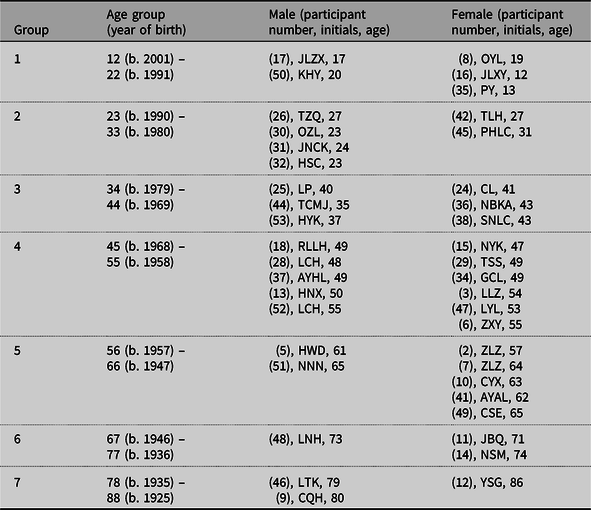
The most significant turning point in the sociolinguistic situation in Singapore was the launch of the SMC in 1979, which affected attitudes towards Chinese dialects among Chinese Singaporeans. Fearing that their children might not perform well in school, many parents heeded the government’s call to drop Chinese dialects and only spoke Mandarin at home. As a result, the Teochew input available to children born before and after the launch of the campaign would differ greatly in quality and quantity. It is therefore predicted that the command of Teochew of the two groups will demonstrate different structural properties. To investigate this hypothesis, the 41 participants were sorted into different groups to facilitate inter-group comparisons. Eleven (of 41) participants, aged 12–33 years at the time of this study, were born after 1979 (when SMC was launched). We divided these 11 participants into two separate groups (namely, Groups 1 and 2) with a 10-year span within each group. Accordingly, the remaining 30 participants, whose ages ranged between 34 and 86 years old were also sorted into five separate groups (namely, Groups 3–7) with a 10-year span within each group. The information for each group is presented in Table 1.
Male and female participants in each ten-year span.

Groups 1 and 2 are bundled together as the youngest cluster, while Groups 6 and 7 form the oldest cluster. Participants in Groups 6 and 7 were born before 1950, when Singapore was still a British colony and Teochew was readily accessible to them as young children at home and in the community. Among all the age groups, they are expected to have the best command of the dialect. As such, they qualify as the relative baseline group for our comparison. Participants in the youngest cluster were all born after the launch of the SMC in 1979. Though participants in this cluster still acquired Teochew at home, the amount of input and frequency of use available to them were much reduced compared to the oldest cluster (Groups 6 and 7).
The participants in the middle Groups 3–5 (ages 34–66 years) were born before the launch of the SMC and most received bilingual education in schools. The linguistic environment of these three groups was most complex. Most of the participants in Group 5 (ages 56–66 years, born in 1947–1957) did not feel the full impact of the bilingual policy while growing up as they could have been older when it was implemented. As such, they were still speaking Teochew at home, Mandarin at school, and Hokkien in the community. Participants in Group 4 (ages 45–55 years, born in 1958–1968) grew up when the bilingual policy in schools was in full force. They learnt Mandarin and English in school while continuing to use dialects at home and in the community. Though participants in Group 3 (ages 34–44 years, born in 1969–1979) were born before 1979, they were below the age of ten when the SMC was first launched. As such, the main difference between Group 3 and Group 4 is that Group 3 grew up in an era when Mandarin was accorded a much higher status than dialects, and the government was promoting Mandarin vigorously to replace Chinese dialects both at home and in the society. In short, they are a product of both the bilingual policy and the SMC. This makes Group 3 more similar to the younger Groups 1 and 2 than Group 4. Hence, we include the data of Group 3 with Groups 1 and 2 in Section 3.
2.2 Relative baseline speakers and other heritage speakers
This paper draws empirical data from the above-mentioned Teochew corpus to examine the language variation and change among Singapore Teochew heritage speakers. The focus is on the vocabulary usage of these heritage speakers. In addition, since these 41 narrations of the ‘Pear Film’ were done by participants distributed across seven different age groups, the current data would also allow us to investigate the changes in vocabulary usage across these age groups in apparent time.
As noted by Montrul (Reference Montrul2016:10), among others, socio-political factors can influence attitudes and language practices affecting the quality and quantity of input that forms the raw material for language acquisition, and the subsequent language development of heritage speakers. This paper hypothesises that with reduced quality and quantity input after the launch of the SMC, the vocabulary usage of Teochew for younger heritage speakers below the age of 44 (i.e. born after 1969) in spontaneous narration would be different from that of those above the age of 44. As such, the participants chosen to be the relative baseline of Teochew will have to come from the older age Groups 6 and 7 in Table 1. As for Groups 4 and 5, their formative years occurred when educational opportunity was expanded (Gopinathan Reference Gopinathan2015:28–29) but the SMC had yet to be launched (i.e. before 1979). By studying the output of heritage speakers across different ages with their corresponding socio-political environment, we expect to observe a cline rather than a sharp break in the vocabulary usage of the Teochew heritage speakers.
Ideally, the number in each age group should be identical, with an equal number of male and female participants. However, this requirement could not be fulfilled since the participation of the Teochew speakers was voluntary. Besides, some of the participants above the age of 70 got tired after the first part of the open-ended interview and could not continue with the narration of the ‘Pear Film’ section, leaving us with only three participants per group for Groups 6 and 7. At the other end of the spectrum, some of the younger participants were not confident enough to continue narrating in Teochew after their interview, thus leaving us with five to six participants per group for Groups 1, 2 and 3. The largest number of participants per group came from Groups 4 and 5, with 11 and seven participants respectively.
2.3 Word list for comparison
This study focuses on the vocabulary usage across different age groups in apparent time, it is therefore imperative to identify a common word list for a meaningful comparison to take place. To do so, we make use of Du Bois’ (Reference Du Bois1980) description, reproduced in Igareda & Matamala (Reference Igareda and Matamala2012), to identify a total of 68 distinct actions performed by six different actors in the clip. However, not every narration was of the same length. The shortest narration was about a minute and thirty seconds while the longest was more than five minutes, with the majority within the range of three to four minutes. Furthermore, not every narration reflects the same actions and actors shown in the video.
To ensure comparability across the various participants, the word list must include words that are important to the progression of the pear story. According to Tomlin (Reference Tomlin1986), there is foreground and background information in online oral descriptive discourse. Foreground information correlates significantly with the frequencies with which participants report events. As such, the best strategy to fulfil this objective is to identify words closely related to the foreground information of the ‘Pear Film’. Tomlin (Reference Tomlin1986) points out that participants tend to report events that are cognitively more salient or significant. This is also true when watching a video. These events are thus foregrounded in an oral description of the unfolding action. He offered important clues towards the identification of these significant events within a video. According to him, the most important guiding principle is that a significant event involves either a major change in scene or a thematic crisis. The ‘Pear Film’ depicts a farmer who is harvesting pears from a tree when a boy on a bicycle steals a basket of his pears. The most dramatic moment in the film is when the boy, riding off with the basket, collides with a rock and falls, spilling the pears on the ground and having his hat flown away. Three other boys help the boy who gives them each a pear. The film ends with the farmer’s discovery that one basket of pears is missing and he realises that the three boys walking by are eating pears which presumably belong to the farmer. Hence, the foregrounded information (i.e. those significant events) identified in the ‘Pear Film’ is as follows:
-
1. A farmer is plucking pears
-
2. A child riding on his bike arrives
-
3. The child sees the basket of pears
-
4. The child goes and takes them
-
5. The child’s bike collides with the rock
-
6. The pears fall on the ground
-
7. Three children help the fallen child pick up the pears
-
8. The children return the hat to the child
-
9. The child gives the three children a pear each from the basket
-
10. The farmer discovers that the pears are missing
-
11. The three children pass the farmer, each with a pear in hand
The words in bold are salient to the English narration of the ‘Pear Film’ and the meanings expressed by these words would therefore be included in our word list. However, as Singapore is an urban city-state with practically no farmland, younger Singaporeans may not be familiar with agricultural terms and tend to skip them. Besides, the older speakers showed variations in identifying the fruit in the video clip, naming them either ‘pear,’ ‘plum’ or ‘loquat’ in their Teochew narrations. Given these considerations, the word ‘pear’ was omitted for comparison while the word ‘farmer’ was kept as it denotes a character in the video and did not have the mixed identification issue as ‘pear’. The list of meanings that makes up our final word list are:
-
1. Actors: child, farmer
-
2. Instruments: hat
-
3. Actions: pluck, see, take, ride, collide, pick up, give, go
-
4. Pronoun references: 3SG pronoun and 3PL pronoun
In Teochew, the first three meanings (‘child’, ‘farmer’, ‘hat’) are rendered as nouns while the next eight meanings (‘pluck’, ‘see’, ‘take’, ‘ride’, ‘collide’, ‘pick up’, ‘give’, ‘go’) are rendered as verbs. In total, we have identified three nouns, eight verbs and two pronouns for intergenerational comparisons. To ensure comparability, only one meaning related to agriculture (‘farmer’) is included. We have also checked these meanings against the Leipzig-Jakarta List of Basic Vocabulary (henceforth referred to as ‘the List’) and noted that almost half of the meanings identified by us are in the List. Although the List has been used to demonstrate borrowability between languages, this paper is not using it for this purpose. Haspelmath (Reference Haspelmath, Martin and Uri2009:41) has pointed out that ‘all loanwords start out as innovations in speech, like other cases of language change, and the process of propagation of the novel word through the speech community is gradual’. As such, this paper hypothesises that those words with meanings in the List would less likely be affected by the propagation of innovations through a speech community than those not in the List. Across time, the behaviors of these two groups of words in the speech behaviors of different generations of heritage speakers would be expectedly different. In other words, this List is used as a lens through which we may observe how different age groups of Teochew heritage speakers employed their lexical repertoires spontaneously across time. Undoubtedly, this is a small set of meanings. However, with half of these meanings in the List being resistant to borrowing (i.e. less likely to be affected by the propagation of innovations) and the other half not being in the List (i.e. more likely to be affected by the propagation of innovations), comparisons of this entire set of meanings across generations would reveal how different age groups of Teochew heritage speakers employed their lexical repertoires spontaneously.
3. Vocabulary usage of the older cluster of heritage speakers (Groups 4–7, ages 45–88, b. 1925–1968)
It is important to establish a relative baseline to compare the heritage speakers of Teochew spoken in Singapore in apparent time. We use the six speakers born before 1950 in our corpus to identify the Teochew words mentioned above to make meaningful comparisons with other groups of heritage speakers. Before presenting the data, the following section will provide a brief linguistic overview of Teochew in Singapore.
3.1 Brief overview of Singapore Teochew
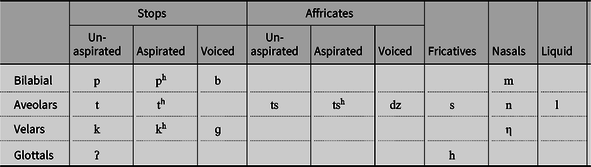
Teochew is a sub-dialect of the Min dialect group (Xu Reference Xu2007:5–7). Hokkien, once an intra-ethnic lingua franca before 1979 but now just one of the many heritage languages in modern Singapore, is also a sub-dialect of the Min dialect group (Ding Reference Ding2016:2–8). These two sub-dialects are mutually intelligible, though their respective native speakers can easily identify the differences between them. As Teochew spoken in Singapore is unlikely to be identical to that in China, we will henceforth refer to it as Singapore Teochew. There are 18 initials (i.e. the consonants in the onset position of a syllable) in Singapore Teochew, which are presented in Table 2 with IPA (Phua, Xiang & Zhao Reference Phua, Xiang and Zhao2016).
Initials of Singapore Teochew.

According to Baxter (Reference Baxter1992), Min dialect has features that cannot be explained in terms of the Middle Chinese as presented in the Qieyun. This is because this dialect group has broken off from the others at an early date. One characteristic of this group is the absence of the initial labiodental [f] (see Table 2), developed as an innovation in other dialect groups after the Min dialect group had already split off from Old Chinese. This is an important difference from the Mandarin phonological system. In other words, words that are pronounced with an initial labiodental [f] in Mandarin would have generally retained the Old Chinese initial bilabial [p] or [ph] in Teochew.
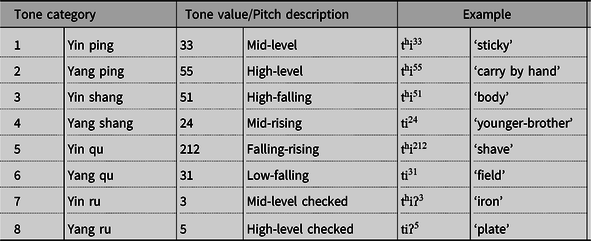
According to Phua et al. (Reference Phua, Xiang and Zhao2016), there are 69 finals (i.e. anything remaining in that syllable beyond the initial consonant which excludes suprasegmental features) in Singapore Teochew. Unlike the Mandarin phonological system, Singapore Teochew does not allow for finals that end with the [-n] coda. Singapore Teochew has eight tones described in Table 3 (Phua et al. Reference Phua, Xiang and Zhao2016).
The eight basic tones of Singapore Teochew.

The following sections will present the vocabulary usage of Teochew heritage speakers in Singapore from different age groups and discuss the variations and changes in their Teochew speech behaviors in apparent time. The data will be presented according to seven age groups, from the oldest to the youngest. We will use different colours to code influences from Hokkien, Mandarin, English, alternative Teochew words and unidentifiable phonological representations. For ease of visualisation and comparison, the colour codes are as follows:
-
Red: Hokkien words and influence
-
Green: Mandarin words and influence
-
Brown: English words
-
Blue: alternative Teochew expression different from the relative baseline speakers
-
Yellow: unidentifiable origin
-
‘—’: missing word in the speaker’s narration
3.2 Vocabulary usage of relative baseline speakers in Group 7 (ages 78–88, b. 1925–1935) and Group 6 (ages 67–77, b. 1936–1946)
Tables 4 and 5 show the eight verbs in Singapore Teochew. The verbs are divided equally into two groups: the four words on the left of the table (i.e. ‘go’, ‘see’, ‘take’, ‘give’) belong to the List, while those on the right (i.e. ‘pluck’, ‘ride’, ‘collide’, ‘pick’) do not. Within the respective groups, the words are arranged in chronological order as they appear in each participant’s narration of the ‘Pear Film’. These Teochew words are transcribed using IPA. As Teochew is a tonal language, the tone value of these words is also noted. In the participant (Part.) column, we identified each participant with a number (e.g. P9) and the letter M or F to indicate the gender (male and female, respectively) of that participant. The participants in each table are arranged according to their numerical order.
Verbs in Singapore Teochew of relative baseline speakers (Group 7, ages 78–88, b. 1925–1935).

Verbs in Singapore Teochew of relative baseline speakers (Group 6, ages 67–77, b. 1936–1946).

The notable gaps in Tables 4 and 5 have two explanations. Firstly, we only recorded four words out of eight from speaker P14F, an elderly participant, because instead of narrating the events in the ‘Pear Film’, she commented on the video by chiding the child in the film for being so greedy and stealing so many pears from the farmer. Secondly, some participants did not use the Teochew word we envisaged for the intended meaning in their narration as they conceptualised the event differently from the others. For instance, even though the child’s collision with the rock was a significant event in the video, the Teochew word for ‘collide’ was missing for both P9M and P46M. This is because their narration focused on the aftermath of this collision (i.e. falling from the bicycle) rather than the collision itself. The same explanation applies to the gaps observed for the meaning of ‘take’ for P48M and that of ‘pick’ for P46M and P48M.
Having addressed the gaps, we observe that the responses for the eight verbs from the six relative baseline speakers from Groups 6 and 7 are almost identical, except for one substituted Teochew word. The typical word that means ‘give’ is [khoʔ3] but P46M used a more specific word [saŋ212] (marked in blue in Table 4) instead. The word [saŋ212] not only expresses the meaning of ‘give’, but more specifically an act of giving a gift. In general, there is consistency and stability within the relative baseline speakers. This allows us to treat their vocabulary usage as a reference to measure against the other heritage speakers’ verbalisations in performing the same task.
Tables 6 and 7 show the three nouns and two pronouns in Singapore Teochew. The first two words on the left of the table are in the List while the three on the right are not.
Nouns and pronouns in Singapore Teochew of relative baseline speakers (Group 7, ages 78–88, b. 1925–1935).

Nouns and pronouns in Singapore Teochew of relative baseline speakers (Group 6, ages 67–77, b. 1936–1946).

The responses for the three nouns and two pronouns from the six relative baseline speakers are almost identical, except for the gaps in the ‘they’ column. This is because the participants had used the noun phrase ‘three children’ to express the meaning of the third person plural in Teochew. Apart from this, P12F used [naŋ55], which is a general word for ‘human’ instead of ‘child’; P11F used a more literary noun phrase [siәu53 hai55 tuŋ55] for ‘little child’ instead of the more common word [nõũ24 kĩã] for ‘child’; and P46M used [h55 teŋ33] ‘gardener’ in place of ‘farmer’.
In summary, Groups 6 and 7 form the oldest cluster who speak Teochew at home and in their community. The Teochew of these speakers demonstrates consistency and stability with very few intra-group variations. Even when variations occurred, the speakers used an alternative Teochew word and did not use any non-Teochew words in their narrations. As such, these speakers serve as the relative baseline to explore the verbalisations of the verbs, nouns and pronouns of all the other younger groups.
3.3 Vocabulary usage of the participants immediately after the relative baseline speakers in Group 5 (ages 56–66, b. 1947–1957)
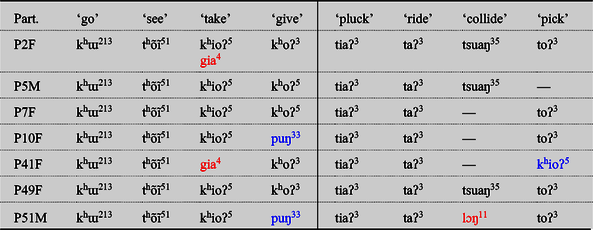
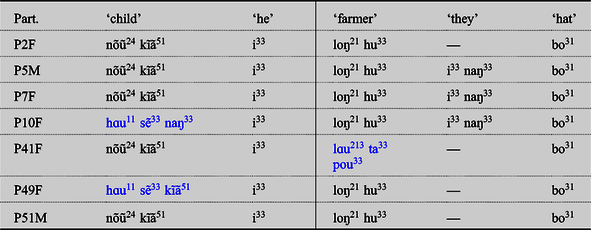
There are seven participants in the age group born between 1947 and 1957. The Hokkien dialect was still the intra-ethnic lingua franca for the Chinese Singaporean community when these participants were growing up. Tables 8 and 9 show the eight verbs, three nouns and two pronouns in Singapore Teochew.
Verbs in Singapore Teochew (Group 5, ages 56–66, b. 1947–1957).

Nouns and pronouns in Singapore Teochew (Group 5, ages 56–66, b. 1947–1957).

In Table 8, we observe the usual gaps for the meanings of ‘collide’ and ‘pick,’ and the previous explanation applies. Apart from this, we also observe the use of alternative Teochew words; P10F and P51M used [puŋ33] ‘distribute to give’ to express the concept of ‘give’.
There is one very important development in the Teochew spoken by this group of heritage speakers not observed in the relative baseline speakers: three out of the seven speakers used a Hokkien word (marked in red in Table 8) to express the intended meaning. For the verb ‘collide’, P2F, P5M and P49F used the verb [tsuaŋ35], just as the relative baseline speakers had done, while P51M used [lɔŋ11]. The authoritative dictionary of modern Chinese dialects compiled by Peking University states that [tsuaŋ35] is a Teochew word, while [lɔŋ11] is a Hokkien word (Department of Chinese Language and Literature at Peking University 1995). This shows the influence of Singapore Hokkien on the speech behavior of this group of Singapore Teochew heritage speakers due to the status of Hokkien as a lingua franca before 1979. Apart from this example, P2F used the Teochew word [khioʔ5] in alternation with the Hokkien [gia4] for ‘take’. As there were several instances in the video that called for the expression of ‘take’, we notice that P2F used the Teochew verb thrice and the Hokkien verb once. Contrastingly, P41F only used the Hokkien verb [gia4] for ‘take’ thrice without alternating with [khioʔ5] during her narration. Instead, this speaker used the Teochew verb for ‘take’ [khioʔ5] to express the meaning of ‘pick’.
As compared to the oldest cluster of Teochew heritage speakers who serve as the relative baseline, the two examples above offer clues that some Hokkien words have begun to be accessible to the Teochew heritage speakers who grew up in an environment where Hokkien was a dominant language in the society.
Next, we will examine the nouns and pronouns. There are gaps and alternative Teochew words in Table 9. For the noun ‘child’, P10F and P49F used [hɑu31 sẽ33 naŋ33] ‘a young person’ and [hɑu31 sẽ33 kĩã51] ‘a young man’ respectively, while the rest in this group used [nõũ24 kĩã51] which was used by the relative baseline speakers. These alternations are reasonable ways to narrate the film. For the meaning of ‘farmer’, which in Teochew would be expressed as [loŋ21 hu33], P41F used a more generic Teochew noun phrase [lɑu213 ta33 pou33] which means ‘old man’. Nevertheless, not much of a different pattern was detected in Table 9.
To summarise, signs of Hokkien influence are present for this group of heritage speakers and this influence is expected to increase in the later groups.
3.4 Vocabulary usage of the heritage speakers in Group 4 (ages 45–55, b. 1958–1968)
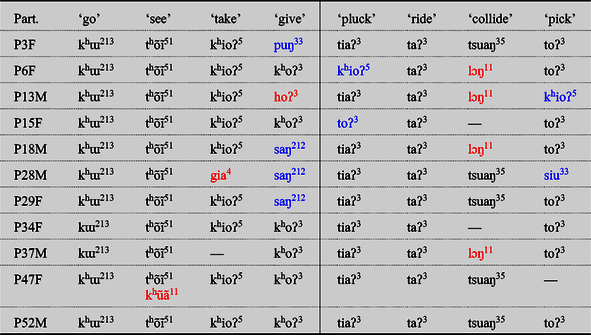
This group of heritage speakers grew up in an era when the bilingual policy was implemented in schools, but before the introduction of the SMC. This means that they spoke Teochew at home and learned both Mandarin and English in schools. Nevertheless, Hokkien was still the intra-ethnic lingua franca for Chinese Singaporeans then. Table 10 shows the eight verbs in Singapore Teochew.
Verbs in Singapore Teochew (Group 4, ages 45–55, b. 1958–1968).

Apart from the usual gaps explained in the previous sub-sections and the use of alternative Teochew words, there are two important developments for this group of Teochew heritage speakers.
First, there seems to be an increase in Hokkien influence on the speech behavior of this group of Teochew heritage speakers, as six out of 11 speakers in this group showed some form of Hokkien influence. The number of meanings being verbalised with a Hokkien word has also increased. P28M used the Hokkien verb for ‘take’ which is [gia4] in place of its Teochew counterpart [khioʔ5]. Similarly, P6F, P13M, P18M, and P37M all used the Hokkien verb [lɔŋ11] for ‘collide’ in place of its Teochew equivalent [tsuaŋ35]. We observed the same phenomenon in the previous group. Apart from these two meanings, Hokkien words were also detected for the meanings of ‘give’ and ‘see’, for example, P13M used the Hokkien verb for ‘give’ which is [hoʔ3] in place of its Teochew counterpart [khoʔ3]. Notably, P47F used two different words to verbalise ‘see’: the word [thõĩ51] is in Teochew and same as those from the relative baseline speakers, while [khũã11] is Hokkien, according to the authoritative dictionary by Peking University. As the meaning ‘see’ occurred several times during the story, we noticed that P47F first used Teochew [thõĩ51] with reduplication to express ‘seeing for a short while’, then alternated it with the Hokkien [khũã11] once, before reverting to the Teochew [thõĩ51] for the rest of her narration.
Second, overgeneralisation of Teochew verbs is observed for the very first time. P6F extended the verb ‘take’, [khĩõ5] in Teochew, to the meaning of ‘pluck’ while P13M also extended the same verb to the meaning of ‘pick’. It is possible that the meanings of ‘pluck’ and ‘pick’ are closely related since P15F used the Teochew word [to?3] ‘pick’ for the meaning of ‘pluck’ as well. This extension of meaning could be an indication that this group of heritage speakers used a smaller set of Teochew words compared to the earlier groups of heritage speakers in performing the same specific task. Heritage language studies have drawn the link between overgeneralisation and the lack of vocabulary knowledge (Montrul Reference Montrul2016:124) and have also shown that vocabularies are smaller for later generation speakers than first generation speakers in both comprehension and production (Montrul Reference Montrul2016:53). However, since the design of this experiment focuses primarily on vocabulary usage, more research will be needed to draw this conclusion.
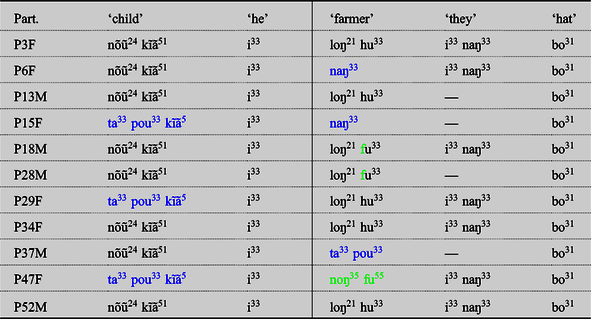
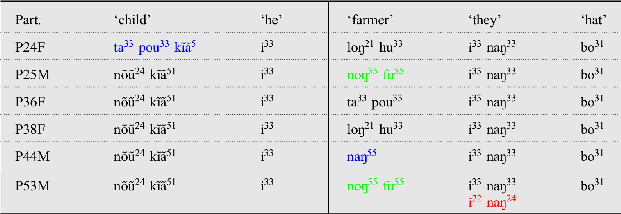
Table 11 shows the response of these 11 heritage speakers for the expression of the three nouns and two pronouns.
Nouns and pronouns in Singapore Teochew (Group 4, ages 45–55, b. 1958–1968).
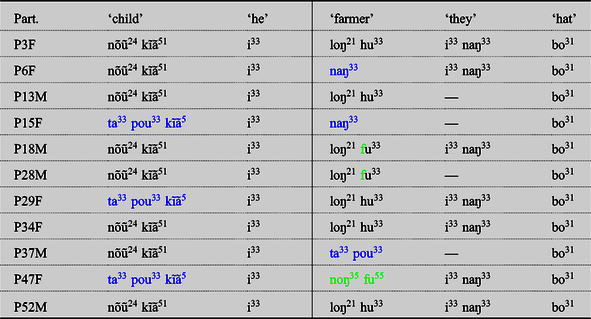
Apart from the usual gaps and the use of alternative Teochew words, there are two important developments for this group of Teochew heritage speakers.
Firstly, nouns have been observed to be less resistant to borrowing than verbs (Tadmor, Haspelmath & Taylor Reference Tadmor, Haspelmath and Taylor2010) and thus more likely to be affected by the propagation of innovations. However, the previous sub-sections have shown quite the opposite for Singapore Teochew heritage speakers. Unlike the verbs, the nouns and pronouns in the three earlier groups (i.e. Groups 5, 6 and 7) do not demonstrate any Hokkien influence. Hence, it is noteworthy that some Teochew heritage speakers in this age group used nouns and pronouns that differ from the earlier groups.
Secondly, and more importantly, such difference is the result of Mandarin’s influence (marked in green in Table 11) on the speech behavior of the Singapore Teochew heritage speakers. This was also not observed previously. The Mandarin influence manifests itself in two ways only for the word ‘farmer’, which is a word closely related to agriculture and not on the List. P47F used the Mandarin word [noŋ35 fu55] in place of the Teochew word [loŋ21 hu33]. Furthermore, we also observed some implicit influence of Mandarin. P18M and P28M initially had the baseline-like pronunciation for the Teochew word for ‘farmer’, but later used a labiodental fricative [f-] instead of the velar fricative [h-] in the second syllable. This use of [f-] in place of [h-] is very subtle since these phonemes are both fricative sounds, but with a different place of articulation. The reason for this phenomenon could be phonetic in nature, but once we take the entire phonological system of Singapore Teochew into consideration, it becomes clear that since Min dialect does not feature labiodentals, the introduction of this fricative into Singapore Teochew utterances indicates a clear difference from the earlier Singapore Teochew heritage speakers. As Singapore Hokkien is also a sub-dialect of Min dialect which does not have any labiodental sounds, this is more likely a Mandarin or a Cantonese influence as their phonological systems have the [f] initial. However, since Cantonese has never been a majority language in Singapore and none of the data that follows has shown any trace of its influence, it is less plausible that the initial [f] has originated from Cantonese. Instead, there is a higher possibility that P18M and P28M were transposing part of their Mandarin phonological knowledge to their Teochew phonological system. A systematic investigation could shed more light on this.
To summarise the findings of Groups 4 and 5, we observe that there continues to be Teochew alternatives like Groups 6 and 7. In addition, there are extensions in the use of Teochew words from one word to another. Furthermore, there is also an increase in Hokkien influence by either alternating the Teochew word with its Hokkien counterpart or using the Hokkien word in place of its Teochew counterpart. The Mandarin influence is also beginning to surface in the form of being used in place of Teochew words or using the Mandarin place of articulation, both in the word for ‘farmer’. An important observation is that the extension of words is usually from those more resistant to borrowing (on the left side of the table), i.e. from the List, to the less resistant ones (on the right). This follows the prediction that words under the List are more stable (thus less likely to be affected by the propagation of innovations) than those that are not on the List.
4. Vocabulary usage of the younger cluster of heritage speakers (groups 1–3, ages 12–44, b. 1969–2001)
As mentioned earlier, the SMC was launched in 1979. As such, apart from heritage speakers born after 1979, we have also included speakers born between 1969 and 1978 in this youngest cluster as they would have also experienced the impact of the SMC on their home language as primary school students. The SMC affected the attitude towards speaking dialects which in turn resulted in a reduction in the quality and quantity of input available to the Teochew heritage speakers in this youngest cluster. It is therefore hypothesised that their Teochew vocabulary usage will be different from the older groups of heritage speakers.
4.1 Group 3 heritage speakers (ages 34–44, b. 1969–1979)
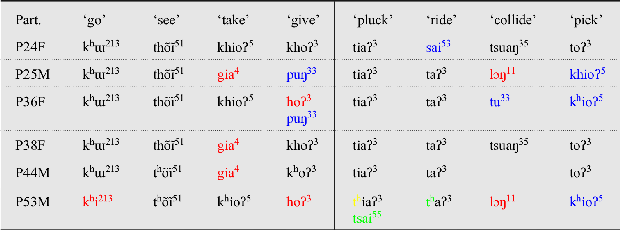
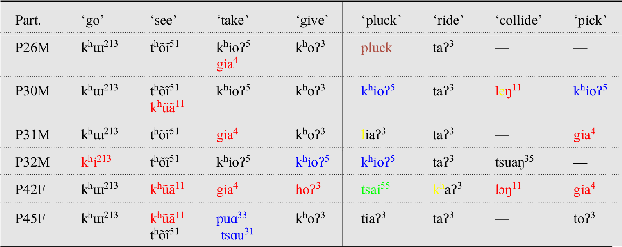
There are three males and three female participants in this group. Table 12 shows the eight verbs in Singapore Teochew.
Verbs in Singapore Teochew (Group 3, ages 34–44, b. 1969–1979),  = Hokkien,
 = alternative Teochew,
 = Mandarin,
 = unknown origin.

This group of heritage speakers shows a more prevalent Hokkien influence in their Teochew than all the previous groups. Previously, we saw how some speakers alternated between Hokkien and Teochew in some words. However, in this group, we no longer observe such alternation. This means that in these cases Hokkien words were more easily accessible to them when they narrated the story. Besides, five out of six participants in this group demonstrated some form of Hokkien influence in their Teochew narrations. Half of the participants (P25M, P38F, P44M) in this age group used the Hokkien [gia4] instead of the Teochew [khioʔ5] for the verb ‘take’, while P36F and P53M used the Hokkien word [lɔŋ11] for ‘collide’ instead of the Teochew word [tsuaŋ35]. Apart from these two instances which have been previously observed, the Hokkien influence has also been expanded to other Teochew words: P36F and P53M used the Hokkien word [hoʔ3] for ‘give’ instead of the Teochew word [khoʔ3], and P53M also used the Hokkien word [ki213] for the verb ‘go’. Only one of the six speakers in this group did not display a Hokkien influence. This shows an increase in Hokkien influence when compared to the previous groups.
Speaker P53M showed an interesting phenomenon in the verb ‘ride’. He seemed to pronounce the baseline-like final ([-aʔ3]) but chose an aspirated initial when there ought not to be one ([th-] in place of [t-]). As the initial for the Mandarin word with the same meaning is an aspirated dental plosive, it is therefore possible that this is due to the Mandarin influence (marked in green in Table 12). As for ‘pluck’, he also used the baseline-like final (i.e. [-iaʔ3]) but with an initial (i.e. [th-] in place of [t-]) of unknown origin (marked in yellow in Table 12). A noteworthy observation here is that after P53M tried to verbalise ‘pluck’ in Teochew with a non-baseline-like initial, he used a Mandarin word instead. This is the first time Mandarin influence is observed on the verbs, though such influence has been observed on one of the nouns for the immediate previous group. Interestingly, the two verbs involved are not on the List, showing that Teochew verbs which are less resistant to borrowing (i.e. more likely to be affected by the propagation of innovations) are more readily affected by Mandarin in the narration.
In addition, speakers in this group used alternative Teochew words, different from the relative baseline speakers. For example, for the verb ‘ride’, the word P24F used [sai53] means ‘drive (a car)’, when the baseline-like verb would have been [taʔ3] for ‘ride (a bicycle)’. Another example is the verb ‘collide’: P36F used [tu33] which means ‘push’ instead of [tsuaŋ35].
There is also an increased tendency to overgeneralise or extend Teochew words by half of the speakers (P25F, P36F, P53M). For example, the word [khioʔ5], which means ‘take’, is overgeneralised for the verb ‘pick’, which would be [toʔ3] for the relative baseline speakers. Such overgeneralisations consistently occur from words with meanings on the List (in the left column of Table 12) to those not on the List (in the right column of Table 12). It shows that this group of speakers could have used a smaller set of Teochew words as compared to the previous groups for the same specific task.
In the past, scholars have generally agreed that the decline in the number of Singapore Teochew speakers is caused by the ascending status of English and Mandarin (Gupta & Siew Reference Gupta and Siew1995). It would be reasonable to assume that these two majority languages would exert the most pressure on Singapore Teochew and that words in these languages would be used in place of their Teochew equivalents during narrations. However, this does not seem to be happening with this age group of heritage speakers and the earlier groups, suggesting that there is a layering effect of influence from earlier majority language (i.e. Hokkien) on the speech behavior of Singapore Teochew heritage speakers. We shall return to this issue in the next section.
Table 13 shows the response of these six heritage speakers for the expression of the three nouns and two pronouns.
Nouns and pronouns in Singapore Teochew (Group 3, ages 34–44, b. 1969–1979),  = Hokkien,
 = alternative Teochew,
 = Mandarin.

Apart from the usual use of alternative Teochew words, the above table demonstrates the continued influence exerted by Mandarin on the speech behavior of Singapore Teochew heritage speakers. Both P25M and P53M used the Mandarin word for ‘farmer’ [noŋ35 fu55] instead of the Teochew word [loŋ21 hu33], a phenomenon first observed in the immediate previous group. Besides, the Hokkien influence is also present as P53M alternated between the Hokkien word [i22 naŋ24] and the Teochew word [i33 naŋ33] for ‘they’. These two words are similar except for their tone values (Zhou & Chew Reference Zhou and Cheng2000) with the Hokkien word having a distinctive mid-rising pitch for the second syllable. This is the very first time we witness the presence of Hokkien influence on Teochew nouns and pronouns.
To summarise, the Teochew words get more overgeneralised for this group of heritage speakers. There are also many more Hokkien words being used in place of their Teochew counterparts, and an increase in Mandarin influences. Overall, this suggests that more non-Teochew words are used in the narration for this group of heritage speakers compared to the earlier groups. This group of heritage speakers was at the formative ages of between one and nine years old when the SMC was first launched in 1979. The Campaign has caused Teochew input at home and in the community of these speakers to be significantly altered in both quality and quantity.
4.2 Group 2 heritage speakers (ages 23–33, b. 1980–1990)
This group of heritage speakers was born after the launch of the SMC. Even though they were still acquiring Singapore Teochew at home at a much-reduced proportion, the input available to them would contain some Hokkien influences, as we have seen in the previous sections. Table 14 below shows the response of these six heritage speakers for the expression of the eight verbs.
Verbs in Singapore Teochew (Group 2, ages 23–33, b. 1980–1990),  = Hokkien,
 = alternative Teochew,
 = Mandarin,
 = English,
 = unknown origin.

A quick survey of Table 14 reveals the extent of Hokkien influence on the speech behavior of Singapore Teochew heritage speakers. This is the first time all the participants in this group either had at least one Teochew word in alternation with a Hokkien word or used a Hokkien word. For instance, P30M and P45F showed alternations for the verb ‘see’ between the Teochew word [thõĩ51] and Hokkien word [khũã11]. As the action ‘see’ appears several times in the video, it is therefore revealing to examine the frequency of these two words. P30M used seven instances of the Teochew [thõĩ51] and four of the Hokkien [khũã11] in his narration, while P45F used one Teochew [thõĩ51] and three Hokkien [khũã11] in her narration. P42F did not have such alternations and only used the Hokkien [khũã11] three times in her narration. Similarly, P26M used the Teochew word for ‘take’ first before alternating it with the Hokkien word, and both words were used with equal frequency in his narration, while P31M and P42F used the Hokkien word [gia4] in place of the Teochew word [khioʔ5]. This suggests that these two Hokkien words (of ‘see’ and ‘take’) have become readily accessible to this group of Singapore Teochew heritage speakers.
The extent of the Hokkien influence can be further observed with the following two examples. First, P42F used more Hokkien words than Teochew words among the eight verbs. Second, even P32M, the only one in this group who could consistently produce Teochew words for the various meanings, also used the Hokkien [khi213] in place of the Teochew [khɯ213] for ‘go’.
The overgeneralisation of words in the List shows that Hokkien influence has taken root in this group of Singapore Teochew heritage speakers. Previously, we have observed the overgeneralisation or extension of Teochew words. Though the data in Table 14 confirms this general trend for this group of younger heritage speakers, there is one important difference. This group of younger heritage speakers not only extended the usage of Teochew words (see the Teochew word [khioʔ5] ‘take’ for P30M and P32M), but also extended the usage of a Hokkien word which was used in place of its Teochew counterpart. This is seen when P31M and P42F not only used the Hokkien word [gia4] in place of the Teochew [khioʔ5] for ‘take’, but also extended this same Hokkien word to ‘pick’.
Apart from the Hokkien influence on the speech behavior of Singapore Teochew heritage speakers, there are two additional observations to suggest that the vocabulary usage of this group of heritage speakers differs from the relative baseline speakers due to the reduced input of this group of speakers. Firstly, the extension of a word to other usage is an indication of a smaller set of Teochew vocabulary being used when performing the same specific task. Not only were such extensions observed in four out of the six participants within this group, a new type of extension has also taken place–a word in the List has been extended to express the meaning of another word in the same List. This is seen in P32M extending the use of the verb for the meaning of ‘take’ (i.e. the Teochew word [khioʔ5]) to express the meaning of another word, ‘give’ (i.e. the Teochew word [khoʔ3]). Previously, the extensions are all from the more stable List (i.e. those meanings in the left column in the tables) to the less resistant ones (i.e. those in the right column in the tables). Secondly, even when the participants produced the Teochew words for the relevant meanings, the phonological shape of these words differs from the earlier groups of heritage speakers. This is seen when P31M verbalised ‘pluck’, the final (i.e. [-iaʔ3]) is baseline-like but a dental lateral sound [l] was used for the initial instead of the baseline-like dental plosive [t]. Incidentally, [t] and [l] share the same place of articulation, differing only in their manner of articulation. It is possible that the participant had some recollection of how this Teochew word sounded but had difficulty retrieving its full phonetic shape. However, a more systematic study on this issue will be needed. Similarly, for ‘ride’, though P42F pronounced the baseline-like final (i.e. [-aʔ3]), she used the velar plosive [kh] instead of the baseline-like dental plosive [t] for the initial. The same explanation is possible here as both are plosives but different only in their place of articulation. Interestingly, P30M seemed to use a word of unknown origin [leŋ11] for ‘collide’. However, this word resembles the Hokkien word [lɔŋ11], with the same initial and coda except for a different main vowel. This suggests that P30M was probably trying to use the Hokkien word for the meaning of ‘collide’ in his narration.
Taken together, it is evident that the Teochew vocabulary usage of this group of young heritage speakers born after the launch of the SMC is rather different from the older heritage speakers in Groups 6 and 7. Such difference is also further demonstrated by the fact that Mandarin and English influences are detected in Table 14 (e.g. the use of the Mandarin word by P42F and the use of the English word by P26M for the meaning of ‘pluck’).
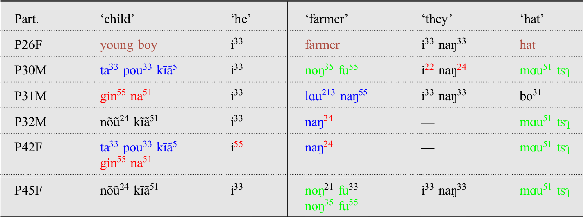
Table 15 shows the response of these six heritage speakers for the expression of the three nouns and two pronouns. It reveals that the vocabulary usage of this group of young heritage speakers demonstrates different patterns compared to the earlier groups. This difference is both extensive and complex in nature. It is extensive in the following ways: firstly, every participant in this group used at least two non-Teochew words in their narrations; secondly, the Mandarin influence on Teochew nouns has spread to more Teochew words. For instance, P30M used the Mandarin word [noŋ35 fu55] for the meaning of ‘farmer’ while P45F alternated between a Mandarin word and a word with Mandarin pronunciation and Teochew tones ([noŋ21 fu33]). Like heritage speakers of earlier groups, this group of young heritage speakers may not be familiar with the agricultural Teochew word for ‘farmer’. However, the fact that P30M, P32M, P42M and P45F (four out of six of them) all used Mandarin [mɑu51 tsɿ] for the word ‘hat’ is noteworthy. Thirdly, in the earlier groups, Mandarin andHokkien were only used for words not in the List, but in this current group, even meanings in the List were affected. For instance, P31M used the Hokkien word for ‘child’ [gin55 na51] in place of its Teochew counterpart while P42F alternated between this Hokkien word with another alternative Teochew word [ta33 pou33 kĩã5] ‘male child’. Using the Hokkien word [gin55 na51] for ‘child’ has not been seen in earlier groups. Besides, P42F also used the Hokkien word [i55] for third person pronoun, which has a different tone than Teochew, in place of the Teochew [i33].
Nouns and pronouns in Singapore Teochew (Group 2, ages 23–33, b. 1980–1990),  = Hokkien,
 = alternative Teochew,
 = Mandarin,
 = English.

This difference shows complexity in two aspects. Firstly, the non-Teochew words used by this group of young heritage speakers had come from a myriad of influences. Apart from Mandarin and Hokkien reported earlier, English is yet another source of influence, though this is restricted to only P26M, who used English for all three nouns: ‘child’, ‘farmer’, and ‘hat’. Secondly, as Teochew, Hokkien and Mandarin have tones, it is therefore interesting to pay attention to the different tone pitch in this group. P32M and P42F attempted to use the more general Teochew word [naŋ55] which means ‘human’ for the word ‘farmer’. Besides using alternative Teochew words like in the earlier groups, a mid-rising tone pitch [naŋ24] was used in place of the baseline-like high-level tone pitch, reflecting Hokkien influence. More significantly, P45F not only used the Mandarin word [noŋ35 fu55] in place of the Teochew word [loŋ21 hu33] for ‘farmer’, she also used a Teochew tone on a Mandarin word, resulting in a hybrid word [noŋ21 hu33] of Mandarin syllables with Teochew tone pitch.
To summarise, this group of young heritage speakers, born after the inception of the SMC, has shown much-changed vocabulary in Teochew. More importantly, there is an increased influence of Hokkien and Mandarin, with the start of English influence noticeable in one of the speakers.
4.3 Group 1 heritage speakers (ages 12–22, b. 1991–2001)
This is the youngest group among the seven groups. The speakers from this group were born between 1991 and 2001, when Mandarin had overwhelmingly replaced Chinese dialects as the dominant home language for more Chinese families (Lee Reference Lee and Wei2016). It is therefore important to note that with fewer Teochew families in Singapore speaking Teochew, these young volunteers who had come forward for this study very likely belong to the minority of Chinese families who have persisted to use Teochew at home, despite the prevalence of the SMC.
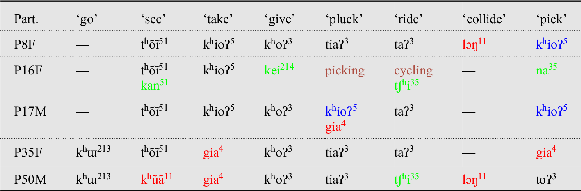
Table 16 shows the response of these five heritage speakers for the expression of the eight verbs. It is not surprising that all participants in this group either alternated at least one Teochew word with a Hokkien, Mandarin or English word, or used a Hokkien, Mandarin or English word in place of its Teochew equivalent. The phenomenon of using Hokkien words in place of Teochew words cannot be explained away by the ‘tip of the tongue’ hypothesis since these Hokkien words have constantly recurred in the older groups of heritage speakers as well. Hence, speakers in this group would have acquired the Hokkien words for these concepts from their input (i.e. from the older groups of speakers). We also continue to see the alternation of a Teochew word with a Hokkien word in P17M. There are also new types of alternation that have not been seen in earlier groups. For instance, P16F alternated a Teochew word with a Mandarin word for ‘see’, and a Mandarin word with an English word for ‘ride’. This suggests that the speech behavior of this youngest Group 1 of heritage speakers demonstrates striking differences from that of the second or third generation of Chinese immigrants from the Chaoshan region in China (i.e. Group 7). This difference is mainly due to the influences of the existing majority languages.
Verbs in Singapore Teochew (Group 1, ages 12–22, b. 1991–2001),  = Hokkien,
 = alternative Teochew,
 = Mandarin,
 = English.

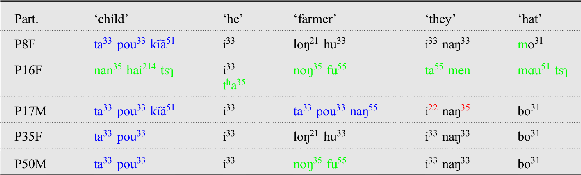
This group of speakers also displayed the usual overgeneralisation of Teochew words in P8F and P17M, and Hokkien words in P35F, indicating the use of a smaller set of Teochew words during narration, which is different from the relative baseline speakers. P16F even used the Mandarin words for the meanings of ‘give’ and ‘pick’ instead of their Teochew counterparts, and alternated the English and Mandarin words for ‘ride’ in her narration. P50M used the Hokkien words ‘see’, ‘take’, and ‘collide’. Therefore, these five participants not only used fewer Teochew words, but also compensated extensively with Hokkien, Mandarin and English words.
To summarise, this group of youngest Teochew speakers had narrated the story using not only Teochew verbs, but also Hokkien, Mandarin or English words in their narration. The increased influence of Mandarin and English is apparent in this group.
Table 17 shows the response of these five heritage speakers for the expression of the three nouns and two pronouns. There is an increasing Mandarin influence for the nouns and pronouns in this group, especially for P16F who used Mandarin for all of them. We continue to see the same use of the Mandarin word for ‘farmer’ (see P50M), and the same influence of Hokkien tone on Teochew words (see P17M). The Teochew nouns and pronouns produced by this group of young heritage speakers (excluding P16F) appear to be more similar to those in Groups 4 and 5. This seems to reverse the trend demonstrated by the young heritage speakers in Group 2 of a much-changed vocabulary usage in Teochew nouns and pronouns when compared to the earlier groups. A possible explanation could be that the volunteers in this age group are those who are confident enough to use Teochew despite reduced input in their environment. They are a minority within their age group, while the majority of them, more likely to be like P16F, may not have responded to the call and therefore are not captured in this study.
Nouns and pronouns in Singapore Teochew (Group 1, ages 12–22, b. 1991–2001),  = Hokkien,
 = alternative Teochew,
 = Mandarin.

5. Conclusion
Based on the analyses above, there are two important observations on the vocabulary usage of the heritage speakers of Singapore Teochew in apparent time. First, the set of Teochew words used by the younger heritage speakers could be smaller as compared to that of the relative baseline heritage speakers (i.e. Groups 6 and 7). As a result, the younger heritage speakers either overgeneralised a Teochew word to extend to other words, or used a Hokkien, Mandarin or English word in place of a Teochew word.
Second, there is an increased influence of Hokkien on Singapore Teochew across the different age groups in relation to the relative baseline speakers. Most studies have attributed the decline of Chinese dialect speakers in Singapore to English and Mandarin being the dominant languages (Gupta & Siew Reference Gupta and Siew1995; Li et al. Reference Li, Saravanan and Ng1997; Kwan-Terry Reference Kwan-Terry2000; Rubdy Reference Rubdy2005; Tan & Ng Reference Tan and Ng2010; Lee C. Reference Lee2012, Reference Lee and Wei2016; Cavallaro & Ng Reference Cavallaro, Ng, John and Yvette2014; Ng Reference Ng2014). Yet, the data shows considerable Hokkien influence on Singapore Teochew when Hokkien is now also considered a heritage language in modern Singapore. One must not ignore the historical fact that Hokkien was once the intra-ethnic lingua franca for the Chinese Singaporean community before 1979. This Hokkien influence is seen in the number of Hokkien words found in the vocabulary of these younger heritage speakers, followed by Mandarin and later English words. A case in point is the verbs ‘take’ and ‘see’, where many heritage speakers either alternated the Teochew words with their Hokkien counterparts or used the Hokkien words in place of the Teochew ones altogether. Due to the frequent occurrences of such phenomena across the different age groups often involving the same set of words, it is therefore unlikely that this is caused by the ‘tip of the tongue’ problem or is an isolated case of lexical borrowing.
A question will inevitably be raised as to why the Hokkien influence has not been observed in the relative baseline heritage speakers (i.e. speakers born before 1946). A likely answer is that though Teochew had been a minority language all along, and that Hokkien was dominant before the launch of the SMC in 1979, the existence of Teochew linguistic enclaves before 1959 had kept out the influence from this dominant language. As such, the visible influence of the Hokkien dialect only came from the later groups of heritage speakers who grew up in a sociolinguistic environment where an urban redevelopment plan had taken place. This was an urban redevelopment that dispersed the concentration of dialect speakers into newly built tall housing estates instituted in the 1960s (Yap Reference Yap2010). Together with the dispersal of Teochew enclaves and urban redevelopment, there was also probable exogamy (i.e. cross-dialectal marriages) beginning in the 1950s (Kuo Reference Kuo1978). These changes facilitated the Hokkien influence on Teochew.
Most studies on heritage language are done in cases where there is only one majority language with the heritage language. This study contributes theoretically to the research in heritage language by presenting a different linguistic situation of Teochew in Singapore, with shifts of several dominant languages from Hokkien to Mandarin and English, and all showing influences in Teochew in historical ‘layering’. The data shows that the earliest influence is Hokkien, followed by Mandarin, and then English. These influences correspond with the time in which these languages were the dominant languages in Singapore society. This shows that the study of heritage languages is closely linked to the larger socio-political linguistic changes across time.
This paper also contributes to the study of the ongoing changes in Singapore Teochew as a heritage language by providing a description of these changes in the use of Teochew vocabulary in apparent time. Future research on Singapore Teochew can be expanded to include more participants to cover more ground. It could also include function words, such as connectives, and even Malay words that may have been used by Singapore Teochew heritage speakers since Malay was also the lingua franca alongside Hokkien before the 1970s, as recorded in Lee (Reference Lee and Chee Hiang2003).
Acknowledgements
We would like to thank the anonymous reviewers who have given us very helpful comments for this paper. This research has been funded by the Academic Research Fund from the National University of Singapore (WBS Nos. R-102-000-112-115 and R-102-000-124-731).