The family Pteroeididae Kölliker, 1880 (Anthozoa: Pennatulacea) is represented in the Mediterranean Sea by two genera: Pteroeides Herklots, 1858 and Crassophyllum Tixier-Durivault, Reference Tixier-Durivault1961 (Vafidis & Koukouras, Reference Vafidis and Koukouras1991). These two genera can easily be distinguished as follows: in Pteroeides the rod sclerites of polyp leaves form strong rays, whereas Crassophyllum has no sclerites on its rachis (Tixier-Durivault, Reference Tixier-Durivault and Grasse1987).
The genus Crassophyllum has a limited distribution worldwide with two valid species, C. cristatum Tixier-Durivault Reference Tixier-Durivault1961, found on the south-west coast of Africa (Williams, Reference Williams1995), and C. thessalonicae Vafidis & Koukouras Reference Vafidis and Koukouras1991, found in the north-east Mediterranean (Vafidis et al., Reference Vafidis, Koukouras and Voultsiadou1994). Both species are very rare; only 29 colonies of C. cristatum, collected from a depth-range of 30–650 m, have been reported to date (Tixier-Durivault Reference Tixier-Durivault1961, Reference Tixier-Durivault1963), and a single colony of C. thessalonicae (the holotype) from a depth of 37–40 m (Vafidis & Koukouras, Reference Vafidis and Koukouras1991).
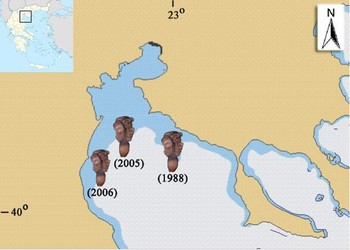
In 2006, five more colonies of C. thessalonicae were collected by bottom trawling from Thermaikos Gulf, a shallow-water embayment in the north-west Aegean Sea (Figure 1). The occurrence of C. thessalonicae in the area is therefore confirmed and the species seems to be well distributed at the northern part of outer Thermaikos Gulf, living on silty and muddy biogenic bottoms, at depths ranging from 30 m to 60 m. Thermaikos Gulf is among the most anthropogenically impacted marine areas in Greece (Chintiroglou et al., Reference Chintiroglou, Antoniadou and Krestenitis2006). Abiotic parameters in the Gulf follow a seasonal cycle: the water column is homogeneous from autumn to spring, whereas a thermocline appears during the summer months; salinity decreases in spring, when inflow from rivers opening into the Gulf is maximized (Krestenitis et al., Reference Krestenitis, Kombiadou and Savvidis2007). Overall, Thermaikos Gulf is considered mesotrophic (Gotsis-Skretas & Ignatiades, Reference Gotsis-Skretas, Ignatiades, Papathanassiou and Zenetos2005).
Map of Thermaikos Gulf indicating the sites from where Crassophyllum thessalonicae has been reported.

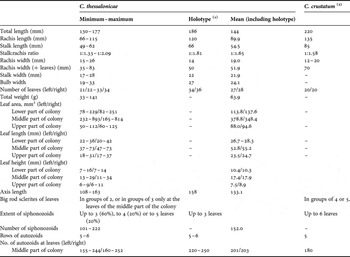
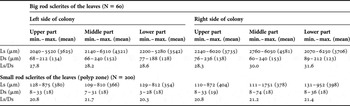
Both the external morphology and that of the sclerites of the five colonies collected corresponded with the original description of the species (Vafidis & Koukouras, Reference Vafidis and Koukouras1991); however, biometric measurements of the body and the sclerites revealed important differences (Tables 1 & 2) and consequently, the original description of the species is modified as follows:
Comparison of the biometry of Crassophyllum thessalonicae and Crassophyllum cristatum.

(1), data from Vafidis & Koukouras (Reference Vafidis and Koukouras1991); (2), data from Tixier-Durivault (Reference Tixier-Durivault1961).
Biometry of rod sclerites from the leaves of Crassophyllum thessalonicae.

Ls, total length; Ds, maximum width; N, number of counted sclerites; min., minimum; max., maximum.
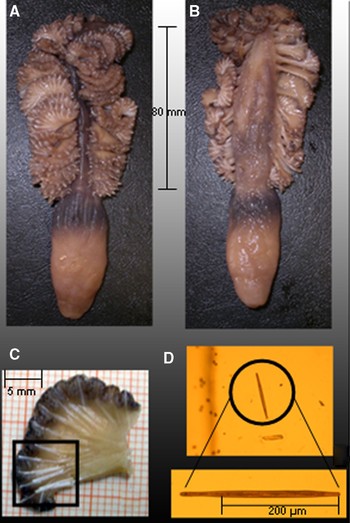
The colony (Figure 2A, B) is stout and fleshy, with a mean length of 144.0 mm (mean length of rachis 89.9 mm and of stalk 54.5 mm). The axis is horny and round in cross-section with a mean length of 133.1 mm and is formed of concentric coats and longitudinal fibres, embedded in the centre of the colony. The rachis is smooth and naked dorsally, without sclerites; it has a mean width of 19 mm in the middle part (51.9 mm including polyp leaves). Near its distal extremity, it bears ventrally a narrow median band of scattered siphonozooids extending downwards usually as far as the third leaf, but occasionally down to the fifth leaf. Twenty-seven and 28 well developed fleshy polyp leaves are spaced regularly along the left and right sides of the rachis, respectively. Leaves are nearly circular in outline and their upper edge is rounded to form a polyp zone (Figure 2C), which is thick and bears 5–6 rows of small autozooids (about 200 on the leaves from the middle part of the colony) and numerous small rod sclerites. Autozooids are well expanded and retractile into a black striped anthostele; each of their tentacles bears 10–12 pinnules on either side. The number of autozooids is usually higher on the right side of the colony. Big rod sclerites occur internally on the dorsal side of the leaf in groups of two (or three for the middle part leaves) arranged en echelon, but without forming rays. A siphonozoid plate is situated at the base of the leaf. The stalk is about 21.9 mm wide, longitudinally striated with a distinct bulb measuring about 24.1 mm below the rachis. Its free end is rounded and bears numerous small rods and rare ovals.
Crassophyllum thessalonicae: (A) ventral view; (B) dorsal view; (C) dorsal side of a polyp leaf showing the embedded big rod sclerites as transparent to white bars; (D) small rod sclerites.

Sclerites are transparent and smooth (Figure 2C, D). Rods from the polyp zone varied from 109 to 1751 µm in length and from 7 to 74 µm in width at the middle part of the colony; this is larger than the previously reported range (Vafidis & Koukouras, Reference Vafidis and Koukouras1991). The length/width ratio of rods is 21.7 and 21.2 for the left and the right side, respectively; these values are much higher than in the holotype (10.7). In the leaves, a decreasing trend in the size of small rods, from the upper towards the lower part of the colony, was observed. Small rods were also smaller in the leaves from the left side; their length/width ratio ranged from 20.3 to 21.7, having increased values in the leaves of the middle part of the colony. Big rods from the leaves varied from 2040 to 6310 µm in length and from 60 to 240 µm in width, in the middle part of the colony, with a length/width of 28.2 and 30 on the left and right sides of the colony, respectively; these values are much lower than for the holotype (38.8). Big rods were larger in size in the leaves from the middle part of the colony, especially at the right side.
A comparison of the biometry of the two Crassophyllum species (Table 1) revealed important differences that could serve as diagnostic characters:
Crassophyllum cristatum: larger in size with a mean at 220 mm for total length; equal number of leaves on both sides of the colony; 20 polyp leaves; siphonozoids extending up to the sixth leaf; constant number (5) of autozooids rows; big rod sclerites arranged in groups of 4–5 in the leaves; dorsal edge of the leaf forming obtuse angle to the siphonozoid band; west coast of Africa (Angola, Guinea and Congo); 30–650 m depth.
Crassophyllum thessalonicae: smaller in size with a mean at 144 mm for total length; unequal number of leaves; mean of 28 and 27 polyp leaves on the right and left sides of the colony, respectively; siphonozoids never exceeding the fifth leaf; five or six rows of autozooids, big rod sclerites arranged in groups of two in the leaves except in the leaves from the middle part of the colony where they occur in groups of three; the dorsal edge of the leaf is parallel to the siphonozoid band; Mediterranean Sea (Aegean Sea); 37–60 m depth.