Introduction
Behavioral and psychological symptoms of dementia (BPSD) include changes in personality, mood and social and interpersonal conduct, repetitive and stereotyped behaviors, appetite and sleep disturbances, and disruptive and aggressive behaviors associated with dementia (Tariot and Blazina, Reference Tariot, Blazina and Morris1993). Alzheimer's disease (AD) and vascular dementia (VaD) are the two most common subtypes of dementia, with AD estimated to account for more than 50% of cases and VaD more than 20% of cases in Australia (Khachaturian et al., Reference Khachaturian2004). Since AD and VaD are known to differ in their cognitive profiles, especially in the early stages (Looi and Sachdev, Reference Looi and Sachdev1999), it is of interest to examine whether BPSD manifest differently in the two disorders.
Some studies have sought to identify specific behavioral or psychological disturbances that distinguish AD from VaD. For example, Sultzer et al. (Reference Sultzer, Levin, Mahler, High and Cummings1993) compared specific BPSD in AD and VaD, finding those with VaD to be higher on five of the 28 items of the Neurobehavioral Rating Scale (although only one item, verbal articulation defect, would remain significant following a Bonferroni correction) and those with VaD to be higher on three of the six factor scores (behavioral retardation, anxiety/depression and verbal output disturbance). Bathgate et al. (Reference Bathgate, Snowdon, Varma, Blackshaw and Neary2001) found that only four out of 72 specific BPSD differentiated AD from VaD. They argued that the differences found were not due to group differences in severity of dementia as their groups were matched for severity; however, they did not explore the relationship between severity of dementia and severity of BPSD. Kim et al. (Reference Kim, Lyons, Shin and Yoon2003) compared BPSD in AD and VaD and found more depression in VaD than in AD, but BPSD overall were only slightly (p = 0.056) greater in VaD. Lyketsos et al. (Reference Lyketsos2000), in a large sample identified through population screening, found that depression was more common in VaD and delusions in AD. Chiu (Reference Chiu2003) reviewed this evidence and suggested that the differences between AD and VaD in BPSD indicate that the concept of “behavioral and psychological symptoms of vascular dementia” (BPSVaD) could be clinically useful. O'Brien (Reference O'Brien2003) noted that BPSD in AD were a better predictor than cognitive impairment of caregiver stress, institutionalization and prescription of medication, but were less well researched in VaD despite the potential to be equally important as predictors of outcome and targets of treatment.
As severity of dementia influences the presence and severity of BPSD, comparison of dementia subtypes needs to take this into account. BPSD is more common in clinic patients with severe dementia (Shah et al., Reference Shah, Ellanchenny and Suh2005), although this was only partially confirmed in a community study (Lyketsos et al., Reference Lyketsos2000) where increasing severity of dementia (as determined by Clinical Dementia Rating scale (CDR; Hughes et al., Reference Hughes, Berg and Danzinger1982) scores) was associated with higher incidence of some BPSD disturbances (agitation/aggression and aberrant motor behavior), but no relationship between total BPSD severity and severity of dementia was found. This could possibly be due to a non-linear relationship of severity of dementia and BPSD. No significant difference emerged in total BPSD scores between AD and VaD groups. Chiu et al. (Reference Chiu, Chen, Yip, Hua and Tang2006) reported more BPSD in AD than in VaD, but they did not control for dementia severity and their groups were not matched on the Mini-mental State Examination (MMSE; Folstein et al., Reference Folstein, Folstein and McHugh1975) or CDR. The study by Sultzer et al. (Reference Sultzer, Levin, Mahler, High and Cummings1993) considered severity of dementia by matching participants in each group on MMSE; however, their analysis did not look at the relationship between severity of dementia and severity of BPSD. Kim et al. (Reference Kim, Lyons, Shin and Yoon2003) noted that BPSD correlated more with severity of dementia in AD than it did in VaD.
Dementia severity can be rated on cognitive, functional or global scales. The MMSE is the most widely used cognitive measure but it is more heavily weighted toward memory impairment, which is more likely to be evident in AD than in VaD (Hodges and Graham, Reference Hodges, Graham and Hodges2001). The global CDR is a method of specifying the severity of dementia impairment which has the advantage of including domains of cognitive and functional impairment. Functional measures include ratings of activities of daily living (ADLs; Katz and Akpom, Reference Katz and Akpom1976) and instrumental activities of daily living (IADLs; Lawton and Brody, Reference Lawton and Brody1969). Common measures of BPSD used over the past 20 years include caregiver-rated measures of the frequency and severity of BPSD, such as the Behavior Problems Checklist (BPCL; Zarit and Zarit, Reference Zarit, Zarit, Lewisohn and Teri1983; Zarit et al., Reference Zarit, Anthony and Boutselis1987) and the Revised Memory and Behavior Problems Checklist (RMBPCL; Teri et al., Reference Teri1992), which are frequently used to measure the severity of BPSD. However, the association of these ratings of BPSD severity to dementia severity is yet to be explored.
Our aim was to examine the relationship of the subtype and severity of a patient's dementia with severity of total BPSD. The hypotheses were that patient's severity of BPSD would not differ across dementia subtypes, and that severity of BPSD would be higher in those patients with greater severity of dementia.
Method
Subjects
We used archival data collected at the Memory Disorders Clinic which has been a part of the psychogeriatric service of the Prince Henry/Prince of Wales Hospitals, Sydney, Australia since 1985. The clinic sees community-dwelling adults with mild to moderate dementia, who are generally independent with regard to basic ADLs. Therefore the sample does not include severe cases of dementia, who typically require assistance with ADLs or live in residential care. All patients assessed from the clinic's inception in 1985 through to 2005 were potential subjects for this study. The patient's medical record was examined to confirm the diagnosis and collect demographic, clinical and caregiver data. The inclusion criterion was that a patient had been given a consensus diagnosis by the memory disorders clinic team of Alzheimer's disease or, depending on extant diagnostic system, multi-infarct dementia according to DSM-III or DSM-III-R (American Psychiatric Association, 1980; 1987) criteria, or vascular dementia according to DSM-IV criteria (American Psychiatric Association, 1994). Cases with features of both AD and VaD (mixed dementia) were excluded.
Medical records were successfully obtained for 833 of 864 individuals who had attended the memory disorders clinic during the period of the study. In 31 cases, medical records could not be obtained because they were archived in the Government Records Repository or in current clinical usage in another section of the hospital. There were 382 patients who had primary diagnoses other than AD or VaD, leaving 451 patients, comprising 377 cases of AD and 74 cases of VaD, who were the sample for this study.
Measures
Caregiver-rated checklists were used as measures of the severity of BPSD. The BPCL (Zarit and Zarit, Reference Zarit, Zarit, Lewisohn and Teri1983; Reference Zarit and Zarit1990; Zarit et al., Reference Zarit, Anthony and Boutselis1987) is a 30-item checklist that was used from 1984 until 1994. Each item is scored from 0 to 2, with the range of total scores being 0–60. The RMBPCL (Teri et al., Reference Teri1992) is a revised 24-item version that was used from 1995 onward. Each item is scored from 0 to 5, giving possible total scores between 0 and 120.
Severity of dementia was measured by ratings of cognition using the MMSE (Folstein et al., Reference Folstein, Folstein and McHugh1975), global severity using the CDR (Hughes et al., Reference Hughes, Berg and Danzinger1982), and functional impairment using ADLs (Katz and Akpom, Reference Katz and Akpom1976) and IADLs (Lawton and Brody Reference Lawton and Brody1969).
Demographic details and the medical history were collected with a self- and caregiver-report questionnaire and checked by at least one clinician for accuracy as described previously by Brodaty (Reference Brodaty1990). Other scales were used to measure vascular risk factors (Hachinski Ischemic Score, HIS; Hachinski et al., Reference Hachinski1975), depressed mood (patient-reported Geriatric Depression Scale, GDS; Brink et al., Reference Brink1982; Yesavage et al., Reference Yesavage1983); and clinician-rated Hamilton 17-item Rating Scale for Depression (HRSD-17; Hamilton, Reference Hamilton1960).
Procedure
The study received approval from the South Eastern Sydney Area Health Service Human Research Ethics Committee. The data used in this study were archival and were collected by reviewing patients’ files and viewing the original documentation of patient-completed, caregiver-completed and clinician-completed measures. Prior to their interview at the memory disorders clinic, all patients and their caregivers completed questionnaires to provide standardized information about their symptoms, history, family history, functional impairment (ADLs and IADLs) and BPSD. The patients completed the GDS. Patients were assessed by a physician undergoing specialty psychiatry training who had also received instruction in administration of the instruments. The physician used a clinical interview and standardized protocol, which included clinical presentation, symptomatology and history, the MMSE, the HRSD-17 and the HIS. Patients underwent neuropsychological assessment, laboratory investigation and neuroimaging with CT or MRI scan. Following all assessments, the data were discussed at a consensus conference attended by all clinicians involved in the assessments, as well as a consultant psychogeriatrician, neuropsychiatrist and neurologist. The CDR was completed and a diagnosis agreed upon. Diagnoses were made according to the current version of DSM criteria and checklists of diagnostic criteria were completed, specifying presence of dementia, subtype of dementia and severity of dementia rated as mild, moderate or severe.
Data analysis
Data were de-identified and entered into a database in SPSS version 15.0. Up to 12 analyses were planned for the data, so a Bonferroni corrected α level of 0.05/12 = 0.004 was applied for all statistical tests. A small number of missing items (typically under 5%) on questionnaires were imputed with the individual's mean for that questionnaire. As the BPCL and RMBPCL are differently scored, the data for each were analyzed separately. The sample sizes were unequal, reflecting the differing prevalence of AD and VaD in the community. However, the assumption of equality of variances that underlies the statistical analyses was not violated (a Levene's test was non-significant).
Results
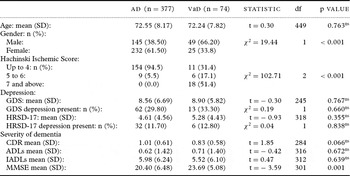
Demographic and diagnostic data including age, gender, HIS and depression scores for each group are reported in Table 1. The groups were well matched for age (t = 0.30, df = 449, p = 0.763) and education (t = −0.792, df = 369, p = 0.429). The AD group were significantly more likely to be female while the VaD group were more likely to be male (χ2 = 19.44, df = 1, p < 0.001). The HIS significantly separated the AD and VaD groups (χ2 = 102.71, df = 2, p < 0.001). Severity of impairment scores on the measures of ADLs, IADLs, MMSE and CDR are reported in Table 1. Severity of impairment was not significantly different for AD and VaD on the measures of ADL (t = 0.42, df = 316, p = 0.672) and IADL (t = 0.47, df = 312, p = 0.639) or CDR (t = 1.85, df = 284, p = 0.066). However, MMSE scores were significantly lower (i.e. more impaired) in patients with AD than in those with VaD (t = 3.59, df = 301, p = 0.001).
Demographic and diagnostic data of subjects

Note: Numbers vary because of missing data. ns = non-significant.
AD = Alzheimer's disease; VaD = vascular dementia; GDS = Geriatric Depression Scale; HRSD-17 = Hamilton 17-item Rating Scale for Depression; CDR = Clinical Dementia Rating scale; ADL = activities of daily living; IADL = instrumental activities of daily living; MMSE = Mini-mental State Examination.
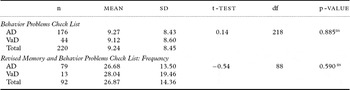
There were no significant differences in depression measured on the GDS (t = 0.30, df = 245, p = 0.767) or the HRSD-17 (t = −0.93 df = 318, p = 0.355) between AD and VaD, even when controlling for gender and severity of dementia. The BPCL and the RMBPCL means and standard deviations for each group (AD and VaD) and for the entire sample are reported in Table 2. There was no significant difference in scores for AD and VaD patients on the BPCL (t = 0.14, df = 216, p = 0.885) or on the RMBPCL (t = 0.541, df = 88, p = 0.59) even when controlling for sex and severity of dementia. There was no significant result when this analysis was repeated separately for DSM-III diagnosed cases of AD and multi-infarct dementia on the BPCL (t = 0.633, df = 197, p = 0.527) and for DSM-IV diagnosed cases of AD and VaD on the RMBPCL (t = 0.541, df = 88, p = 0.59).
Behavioral and psychological symptoms of dementia

Note: The possible range of BPCL scores was 0 to 60. The possible range of RMBPCL frequency scores is 0 to 120.
AD = Alzheimer's disease; VaD = vascular dementia; ns = non-significant.
Greater dementia severity was associated with greater severity of BPSD. The global severity, as measured by CDR, was strongly correlated with BPSD as measured by the BPCL (r = 0.613, n = 212, p < 0.001) and moderately with RMBPCL (although this was not significant after Bonferroni correction; r = 0.304, n = 65, p = 0.014). Functional severity as measured by ADLs and IADLs significantly correlated with the BPCL (r = 0.557, n = 210, p < 0.001 and r = 0.637, n = 211, p < 0.001 respectively) and the RMBPCL (r = 0.384, n = 90, p <0.001; r = 0.284, n = 90, p = 0.004 respectively).
Discussion
This research examined the associations between dementia subtypes, severity of dementia, and severity of BPSD. The groups received diagnosis by a specialist panel of AD or VaD according to established criteria. MMSE scores were lower in patients with AD, which is consistent with the MMSE's weighting towards verbal and memory skills. The groups were equally impaired on a global dementia severity measure (CDR).
The hypothesis that patients’ severity of BPSD would not differ between AD and VaD dementia subtypes was confirmed. This is consistent with the findings of Lyketsos et al. (Reference Lyketsos2000) who found no difference in BPSD for dementia subtypes. The hypothesis that severity of BPSD would be higher in those patients with greater severity of dementia was confirmed with a strong positive association between dementia severity and BPSD. However, where Lyketsos et al. (Reference Lyketsos2000) described BPSD differences with increasing severity of dementia as being few and inconsistent, we found – as have others (Feldman et al., Reference Feldman2003; Peters et al., Reference Peters2006) – that overall BPSD severity correlates with dementia severity. The differing results may be due to the use of a different sample (community based compared to our clinical sample) in the Lyketsos study and their use of a different instrument (the Neuropsychiatric Inventory; Cummings et al., Reference Cummings, Mega, Grey, Rosenberg-Thompson, Carusi and Gornbein1994), or the possibility of a non-linear relationship, which would not have affected our results as our sample comprised only mild to moderate cases of dementia. This has implications for service planning and provision, where it is the overall severity of dementia and severity of BPSD that has greater consequences for caregivers and service providers than the subtype of dementia.
We acknowledge the limitations encountered in conducting research based on archival data in a clinical setting and also on the nature of that setting within an old age psychiatry department even though this would have been mitigated by the high public profile locally in the area of memory disorders. First, there were changes of rating scales over the period of data collection which made analysis more complicated. We do not know what influences may have operated on the responses of caregivers of individuals attending the memory disorders clinic in its early, as compared to more recent, years. It is possible that a clinical sample from a psychogeriatric service may include an over-representation of patients with BPSD which might influence the results. The prevalence of AD is much greater than the prevalence of VaD, as evidenced by the unequal sample sizes in this study. However, the results are only applicable to individuals with AD or VaD with mild to moderate impairment as the sample of clinical outpatients was so restricted.
Secondly, this study did not examine individual BPSD. However, contrary to Lyketsos et al. (Reference Lyketsos2000), we did not find group differences on self-rated or clinician-rated measures of depression. Thirdly, we were unable to differentiate the effects of vascular dementia, such as multi-infarct dementia, small vessel disease, single strategic stroke and non-infarct ischemia, which may have differential effects on BPSD. Fourthly, diagnostic criteria for vascular dementia changed from DSM-III to DSM-IV. When we examined differences between DSM-III diagnosed cases of AD and multi-infarct dementia and DSM-IV diagnosed cases of AD and VaD, there was still no significant difference between the two categories as regards total BPSD scores.
Finally, dementia is a degenerative disease and symptoms take time to emerge and develop. It is possible that the pattern of presented symptoms for an individual could vary over time and diagnoses could change at the time of a follow-up assessment. The present study is of BPSD at the time of diagnosis and it only examined BPSD at the milder end of the spectrum of dementia. Thus, the results may not hold as dementia becomes more severe. Longitudinal research may offer additional information on the development and course of BPSD in different dementia subtypes.
In summary, this study used diagnostic groups well matched for age, education and severity. The study demonstrated that, in a memory disorders clinic population of mild to moderate dementia, the severity of BPSD did not differ between AD and VaD but was related to dementia severity.
Conflict of interest
None.
Description of authors’ roles
C. Thompson was responsible for the conceptualization and design of the study, data collection, data analysis, and preparation of the paper. H. Brodaty was responsible for the conceptualization and design of the study, the assessment of patients and preparation of the paper. J. Trollor and P. Sachdev, the Clinic Specialists, assessed the patients and assisted with preparation of the paper.