In the Sarvāstivāda and Mūlasarvāstivāda schools of Buddhism, the equivalent of the famous Pali Dhammapada (von Hinüber and Norman Reference von Hinüber and Norman2003) and Gāndhārī Dharmapada (Brough Reference Brough1962; Lenz Reference Lenz2003) is the so-called Udānavarga.Footnote 2 The Sanskrit version of this important text is attested in fragments from a large number of different manuscripts that were found, as many other Sarvāstivāda and Mūlasarvāstivāda texts, in the north of the Tarim Basin (present-day Xinjiang, China) on the northern Silk Road (Bernhard Reference Bernhard1965: 28–91).Footnote 3 At almost all of the sites where these fragments were found, Tocharian manuscript fragments have also been found: Qizil, Qumtura, Subeši, Kuča and Duldur Aqur in Kuča region; Šorčuq in Qarašähär region; and Siŋgim in Turfan region. Some manuscripts have been found in Tumšuq and Maralbeši, the home of the Iranian language Tumšuqese.Footnote 4 Another important exception is the Paris manuscript Pelliot Sanskrit Udānavarga 1 (Pauly Reference Pauly1960), which was found in Dunhuang, but is not in any way different from an average manuscript from Qizil or Šorčuq.
The overlap between the find sites of the Sanskrit Udānavarga manuscripts and the area where the local languages Tocharian A and B were spoken is striking indeed, and it raises the question of the distribution in usage of Sanskrit and Tocharian. Obviously, Sanskrit was a religious language of the region, and not a popular vernacular; but the local language, Tocharian, was also used for a large number of genres of Buddhist religious texts. In this paper, the interplay between the religious language Sanskrit and the “popular” languages Tocharian A and B is investigated based on the example of a Tocharian text called the Udānastotra. It is argued that this text followed the Sanskrit Udānavarga in the same, and therefore bilingual manuscript. This observation, along with several other pieces of evidence, suggests that in this “Tocharian” area certain texts, including the Udānavarga, were preferred in Sanskrit while other texts were preferred in Tocharian.
1. The Tocharian Udānastotra
Udānastotra means “praise of the udāna”. As Bernhard (Reference Bernhard and Voigt1969: 875–6) points out, the word udāna in Udānastotra refers to the Udānavarga, whose actual title was “Udāna”, not “Udānavarga”. More specifically, the Udānastotra does not so much praise the UdānavargaFootnote 5 proper, but rather the act of writing it. It is a collection of pious wishes resulting from the merit hopefully gained from writing each chapter of the Udānavarga. For a long time, only a Tocharian B version of this text was known (cf. the overview in Bernhard Reference Bernhard1968: 271), but as Pinault (Reference Pinault and Haneda1990: 67; see also further below) points out, there is evidence also of a version in Tocharian A. The most important contributions on the Udānastotra are the relevant section in Lévi's Fragments de textes koutchéens (Reference Lévi1933), a re-edition of some of the Paris fragments by Thomas (Reference Thomas1966), and an article by Pinault (Reference Pinault and Haneda1990, in particular pp. 58–68). In addition, all fragments of the Paris collection, the Fonds Pelliot Koutchéen, have been made available online on the website of A Comprehensive Edition of Tocharian Manuscripts (cetom) by Georges-Jean Pinault and Melanie Malzahn. It goes without saying that I have made extensive use of these online editions.
The main part of the Udānastotra consists of 31 strophes of 4 times 18 syllables. In each of these strophes, the writing of one of the chapters of the Udānavarga is praised, in the order of the Udānavarga. Since the Udānavarga has 33 chapters, it is two strophes short: Udānavarga chapters 2 and 3 are taken together in the second strophe, and Udānavarga chapters 4 and 5 are taken together in the third strophe (cf. Pinault Reference Pinault and Haneda1990: 59).
A random example of this text is the following strophe, taken from PK AS 4A (the text and translation are based on the online edition of cetom). The metre, which has the usual subdivision of 7 + 7 + 4 syllables, is indicated with the symbol ¦:Footnote 6
PK AS 4A b2–4
paiykalñesa drohavārg
Footnote
7
¦ akālk kñītär-ñ serkene ¦ po cmelaṣṣe
 [27a]
mamāntaṣ ra yolainne ¦ mā ñi t(ā)koy māntalyñe ¦ k
u
ce ṣ krentäṃnne
[27b]
kauṣentai ra sanaṃne ¦ mā wer śono wṣi-ñä nta ¦ tarkoym traṅko
[27c]
aknātsaimpa ṣe śmalyñe ¦ mā ñī tāko ī śänmīmar ¦ krentäṃmp⸗ eṣe 27 Footnote 8
May through the writing of the Drohavarga my wish come true in the circle of all births. [27a]
May I not [bear] malice towards an evil person, even if he is malicious, nor towards those who are good. [27b]
May even towards a murderous enemy hate [and] enmity not reside in me at all [and] may I abandon sin. [27c]
May I not have a meeting with an ignorant one [and] may I come together with good people. 27
Since the Drohavarga is the fourteenth chapter of the Udānavarga, it is obvious that the strophes that correspond to Udānavarga chapters cannot have started with strophe number 1. Indeed, in the best attested version, the Udānastotra treats the Anityavarga, the first chapter of the Udānavarga, in strophe 10. This strophe numbering is found for instance in the parallel PK NS 27, in which the strophe cited above has the number 21. In that more common version of the Udānastotra, the Udānavarga chapters are treated in strophes 10 to 40. In the version from PK AS 4 just quoted, the Udānavarga chapters must have been treated in strophes 16 to 46.
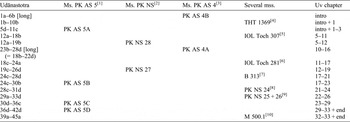
Thus, the difference between the two versions is not caused by any significant difference in the Udānastotra text proper, but by a difference in the introductory strophes to the actual praising of writing the Udānavarga chapters. In the better-attested shorter version this introduction covers strophes 1 to 9 (called Introduction I in Pinault Reference Pinault and Haneda1990: 59), and in the longer version it covers strophes 1 to 16 (called Introduction II by Pinault). The Udānastotra is attested in a number of different manuscripts and fragments. Although the text is almost complete if all fragments are taken into account, some portions are still missing. In particular, because of the two versions with different strophe numbering, working with the Udānastotra can be confusing. Therefore an overview of all the Udānastotra fragments known so far is given in Table 1.
Known Udānastotra fragments

Notes to Table 1:
[1] This manuscript has 6 lines.
[2] This manuscript has 6 lines.
[3] This manuscript has 5 lines; fragment PK AS 4B has the leaf number 61, and fragment PK AS 4A has the leaf number 65.
[4] This manuscript has 7 lines.
[5] This manuscript has 6 lines; it is not the same as the manuscript of fragment IOL Toch 281.
[6] This manuscript has 6 lines; it is not the same as the manuscript of fragment IOL Toch 307.
[7] This manuscript has 5 lines.
[8] This manuscript has 4 lines.
[9] This manuscript has 5 lines; the fragment has the leaf number 82.
[10] This manuscript has 5 lines.
In what follows, I will focus on the introduction of the Udānastotra, whose structure is clarified by newly identified fragments. In particular, the text and the precise function of the shorter Introduction I is discussed.
2. Introduction I of the Udānastotra
The shorter Introduction I of the Udānastotra is attested in fragments of four different manuscripts with exactly the same strophe numbering: S 1, THT 1369, PK AS 5A and SHT 290.10. Strophes 3 to 4 are further found as 6 to 7 in B 103–4. The additional fragment PK NS 130 + 192 preserves no strophe numbers. The strophe numbering of Introduction I continues without any explicit marking into the part of the Udānastotra in which the separate chapters of the Udānavarga are discussed, which starts in strophe 10. Also, the style of Introduction I is very similar to that of the Udānastotra proper, so that there is hardly any break between these two portions of the text: it is very repetitive and full of stereotypical metaphors and wishes (in Tocharian in the optative, translated with “may I …”, etc.).
The main topic of Introduction I is writing: the difficulties pertaining to it, and the merit hopefully to be gained from it. There are clear references to the Udānavarga, which is called udāṃ or pelke in Tocharian B: 1c “… brilliant udāna teaching”; 1d “… this udāna …”; 2b “The thirty three (vargas of the udāna) …”; 4a “… [this] udāna teaching”. At the same time, 1b “May I say all in language following the truth and according to the wisdom of the omniscient!” seems to refer to the following strophes, and perhaps to the Udānastotra proper in particular: it cannot refer to the Udānavarga, since the latter is only copied, without there being any danger of choosing the wrong words.
Owing to the large size of the original manuscript leaves, the fragment THT 1369 allows us to connect PK AS 5A on the one hand with S 1, B 103–4 and SHT 290.10 on the other. Transliterations of the newly identified fragments PK NS 130 + 192, SHT 290.10 and THT 1369 are given in the appendix. For the remaining fragments the reader is referred to cetom, where references to earlier literature can also be found. I have tried to restore the text as far as possible on the basis of the extant fragments. There are still many gaps, but in my view the position of most of the words, word groups and word rests in the verse has now become clear.Footnote 9 In this reconstruction, missing syllables are denoted by –, the symbol that is otherwise normally used to denote unreadable and missing akṣaras.
– – – – – – – ¦ gaṅgavāluk po(yśintaṃ)ts ¦ (kä)ryau śaul(t)s(a)
[1a]
satyānuvarth
Footnote
10
käntwasa ¦ aiśamñesa ṣp poyśiññe ¦ po we(ñim ñäś
) [1b]
– – – – – – – ¦ – – – – läktsetse ¦ udāṃ śāsträ
[1c]
meṃ-ñäkte ra cäñc(are) ¦ piṭakṣeṃ – – ·s· s· ¦ tättāw pelke
1
ylaiñäkte ra ṣe – – ¦ – – – – śpālmeṃ cwī ¦ ślokanmaṣṣi
[2a]
täryāka trai v(a)rga(nma)
Footnote
11
¦ – – ndr· ·ts· m(ai)yy(ā)w (c)e ¦ śāsaṃ pāssi
[2b]
(em)prenmaṣṣe vājr eṅku ¦ po ·e – – āsureṃ ¦ yūkatsy ārwer
[2c]
lā – – – – – – ¦ – – – – – – – ¦ – – – – (
2)
cakravārtti lānte ra ¦ ṣukt bodhyāṅkṣi naumyenta ¦ ce śāstä(r)n(e
) [3a]
– – – – – – – ¦ (ya)ltse s ä sūwa ślo(kanma) ¦ – – – – [3b]
arthanmaṣṣe samudtär ¦ utpattiṣeṃ preṅkentsa ¦ peñiy(acceṃ
Footnote
12
) [3c]
– – – – – – – ¦ – – – – – – – ¦ – – ·ne stmau 3
pelaikneṣṣai kektsenne ¦ arañc(e) ra – – –
Footnote
13
¦ (u)dāṃ śās(trä)
[4a]
cintāmaṇi yukṣeñca ¦ par·
Footnote
14
– – – – – ¦ (śtwā)r⸗ (e)mprenma
[4b]
trai kleṅkentsa tsälpātsiś ¦ ce śastärṣṣe – – – ¦ – – – ts·
[4c]
poyśiññeṣṣai kektseṃne ¦ eśne (u)ṣṇīr men(āktse) ¦ śpālmeṃ śāsträ 4
po poyśintaṃ(ts) – – – ¦ – – – – – – – ¦ – – – – [5a]
– – – – k
u
ṣātre ra ¦ poy(ś)e(ñca)nne
Footnote
15
läksettse
Footnote
16
¦ eñetsñesa
Footnote
17
[5b]
po aiśau(myeṃ)t(s p)apālau ¦ po – – – – – – ¦ – – – – [5c]
(cme)lts(e)
Footnote
18
maṅkāl śāmñe śaul ¦ cwī ste käntwāṣṣ⸗ īndrī(meṃ ¦ – – – –
5)
– – – – – – – ¦ – – – – – – – ¦ – – (śai)ṣṣ(e)
[6a]
(pe)laiknetse kreñcepi ¦ stamalñeṣṣe akālksa ¦ wnolmeṃts k(artseśc
) [6b]
– – – – – – – ¦ – – – – – – – ¦ – – – – [6c]
(cwi yāmorntse) o(ko)s(a) ¦ piś-cmelaṣṣeṃts wikoyträ ¦ aknātsaṃññe
6
se ra kñītä(r) – – – ¦ – – – – – – – ¦ – – – – [7a]
– – – – (akuśa)l ¦ śtwarā-yäkne welyñe ñiś ¦ mā weñim nta
[7b]
āñ(m) – – – warñai po ¦ pelaiknenta tsätkwañceṃ ¦ mā – – – [7c]
– – – – – – – ¦ snai-pele mā pāloymar ¦ po cmelane
7
buddhavacaṃ k u se welyñe ¦ (s)ū(t)rä (winai abhidhārm) ¦ – – – – [8a]
– – – reṃts śastar(n)ma ¦ – – – – (wewe)ñor ¦ ārtar wat no
[8b]
ṣe keklyauṣor eñ(c)imar ¦ ārth vya(ṃ)jantsa ṣañ yk(nesa) ¦ – – – – [8c]
– – – – – – – ¦ ·u m· – – erimar ¦ m⸗ ālyek t(a)śim 8
k u ce te makte paiykāmai ¦ kuce alyeṅkäṃts aklyītsiś ¦ ṣarm(tsa) – – [9a]
– – – – – – – ¦ – – – – – – – ¦ – – – ·n· [9b]
arañcänne piś-cmelṣeṃ ¦ tarya śpālmeṃ naumyenta ¦ mā ñiś marsoy(m
) [9c]
… has been bought with the life of omniscients as numerous as grains of sand in the Ganges. [1a]
May I say all in language following the truth and according to the wisdom of the omniscient! [1b]
… brilliant udāna teaching. [1c]
Lovely like the moon-god … this udāna is set with … of the piṭaka[s]. 1
Like Indra (are the) … of its excellent strophes [2a]
The thirty-three (vargas) [of the udāna] … powerful to protect this teaching. [2b]
Holding the vajra of the truths, ready to conquer all asuras (of) … [2c]
Like of a cakravartin king are the seven jewels of members of enlightenment in this teaching. [3a]
… thousand sons … strophe(s) … [3b]
The ocean of meanings, (adorned?) with the splendid islands of interpretation, [3c]
… is standing in … 3
Like the heart in the body of the law [is this] … udāna teaching. [4a]
Conquering the cintāmaṇi jewel … the four truths. [4b]
… in order to deliver by means of the three vehicles … of this teaching … [4c]
Comparable to the eyes [and] the excrescence on the top of the head ofFootnote 19 the body of the omniscient [is this] excellent teaching. 4
… of all omniscients … [5a]
Like a … umbrella [it is] brilliant among the omniscients through its novelty (?). [5b]
Praised by all wise … all … [5c]
He has the bliss of (birth), human life, … (from) the tongue sense organ … (5)
… world … [6a]
through [my] wish for the establishment of the good law (for the) benefit of the beings. [6b]
May through the fruit (of this deed) the ignorance of [the beings] of the five births disappear! 6
Also this (wish) may be fulfilled … [7a]
May I never speak (evil) speech of [any of the] four kinds! [7b]
(May) the erroneous laws not … such as the self … [7c]
… may I in all births not praise lawlessness! 7
What [is] the buddhavacana speech, [i.e.] sū(tra, vinaya, abhidharma) … [8a]
… teachings, … speech or praise, [8b]
May I seize [it] at the first hearing with meaning and sound (according) to the proper manner … [8c]
May I (not) cause … may I not touch another. 8.
What I have written myself [or] in order to teach others, … cause … [9a]
May I not forget the three excellent jewels in the hearts of the five births! [9c]
In view of the neat transition into the main part of the Udānastotra, the similarity in content, the specificity of the strophes compared to Introduction II (discussed directly below), and the fact that the form of this text seems stable, as it is identical in fragments of five different manuscripts, we have to conclude that this text was indeed a constant, fixed part of the Udānastotra and specially written to be part of it.
3. Introduction II of the Udānastotra
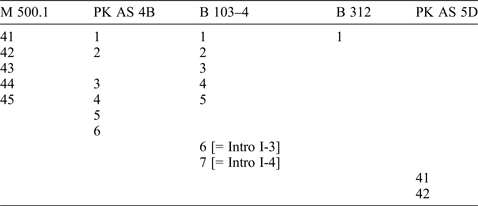
Introduction II presents an altogether different picture. In a confusing way, Introduction II and the Conclusion of the Udānastotra interfere in the different manuscripts. That is to say, parts of Introduction II are found in the Conclusion of the shorter version of the Udānastotra that has Introduction I. Table 2 shows a scheme to give an impression of the relationships between the texts.
Text relationships of Introduction II and Conclusion according to strophe numbers
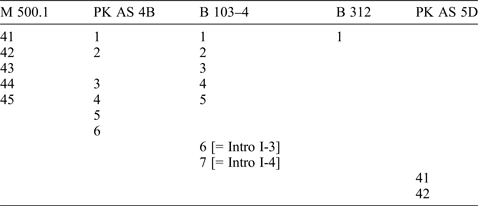
Thus, Introduction II is attested in three manuscripts with the same numbering: B 312, PK AS 4B and B 103–4. Moreover, strophes 41–5 of M 500.1 are parallel. The numbering of strophes 41–5 of M 500.1 is consistent with that of strophes 1–5 of B 103–4. PK AS 4B deviates in not having the third strophe of these manuscripts, and in showing an additional strophe 5 and 6 to come to 6 strophes in total. M 500.1 may have continued with strophes 46–7, but B 103–4 switches in strophe 6 to Introduction I.
We must conclude, with Pinault (Reference Pinault and Haneda1990: 59), that Introduction II and the long Conclusion as in M 500.1, “utilisaient, à une exception près, les mêmes strophes”. All in all, three recensions of the Udānastotra can be distinguished:

Pinault seems to suggest that Introduction II consisted of the 6 strophes that we know of it, followed by the 9 strophes of Introduction I. In other words, the difference between the two introductions would be that Introduction II had an additional 6 strophes at the beginning. Indeed, Introduction II must have been 15 strophes long, and the 6 strophes that are known of it together with the 9 strophes of Introduction I would give us exactly the required total of 15 strophes. However, this does not necessarily follow from the textual material identified so far. In fact, as we will see, there is some overlap between strophe 1 of Introduction I and strophe 1 of Introduction II. This would seem to make it likely that Introduction II may have been followed by elements of Introduction I so as to come to 15 strophes in total, but not by an unchanged and complete version of Introduction I.
Also this first strophe of Introduction II, which overlaps partly with the first strophe of Introduction I, refers to the Udānavarga (taken from cetom):
M 500.1 a4–5; B 103 b5–6; B 312 b5–6; PK AS 4B a1–2
gaṅgavāluk poyśintaṃts ¦ śaulanmasa larona ¦ käryoṣ śpālmeṃ
[1a]
pelaikneṣṣe naumye krent ¦ kleśanmaṣṣeṃ tekanma ¦ wīkäṣṣeñcai
[1b]
arth vyañjantsa kekenoṣ ¦ udāṃ śpālmeṃ paikāmai ¦ wrocc⸗ akālksa
[1c]
aknātsaññe orkamñe ¦ piś-cmelaṣṣeṃts näśītär ¦ ce yāmorsa
1
I have written the excellent udāna, bought with the dear lives of omniscients as numerous as grains of sand of the Ganges, excellent, [1a]
the good jewel of the law, which chases away the diseases of the passions, [1b]
provided with meaning [and] sound, with a great wish: [1c]
May the darkness of ignorance of [the beings] of the five births disappear through this deed! 1
In spite of the obvious thematic similarities in this first strophe, the character of the following ones is decidedly more general, and the style is also different from that of the Udānastotra. This suggests that these strophes were not a fixed part of the Udānastotra and could be exchanged rather freely. This is in accordance with the fact that the numbering is quite confusing – there does not seem to be a fixed form of this text – as well as with the fact that the same strophes occur in B 103–4, at the end of a jātaka manuscript that seems to have not the slightest link to the Udānastotra, and where they are followed by further concluding strophes of a personal character in B 105. Further, no two manuscripts agree on the position of this text: in M 500.1 it is the conclusion of the Udānastotra, but the conclusion of PK AS 5D is completely different; finally, it is the beginning of the Udānastotra in PK AS 4B.
In sum, I do not fully agree with Pinault, who states that “On peut imaginer d'autres combinaisons, car l'introduction et la conclusion n’étaient pas stables, et recouraient à un stock de strophes ‘à tout faire’, peut-être apprises par coeur” (1990: 59). Although this is certainly true of Introduction II and perhaps of both variants of the Conclusion, it does not, so far as I can see, apply to Introduction I. Moreover, as pointed out above, the overlap in content between the first strophes of Introduction I and Introduction II seems to suggest that Introduction II was not followed by a complete and unchanged version of Introduction I.
4. Tocharian Udānavarga literature
The next points I would like to discuss are Tocharian elements and the position of the Udānastotra in Sanskrit Udānavarga manuscripts. As a preliminary, a brief overview of Tocharian Udānavarga literature seems practical, since several versions exist (see Bernhard Reference Bernhard1968: 271–4).
The most important text of the Udānavarga literature seems to have been not the Udānavarga proper, but a verse commentary called the Udānālaṅkāra which includes metrical renderings of the Udānavarga verses themselves, and which is attested both in Tocharian A and Tocharian B.Footnote 20 In Tocharian B, fragments of eight different manuscripts have been distinguished to date, but in all likelihood more fragments are still to be identified. In Tocharian A, which has in general a smaller corpus, corresponding to roughly one-fifth of that of Tocharian B, two leaves of one manuscript have been identified.
The next important text was, according to the number of fragments preserved, which total about a hundred, a bilingual version of the Udānavarga in which each Sanskrit pāda was followed by a literal translation into Tocharian (for references, see Peyrot Reference Peyrot2008b: 83). This Tocharian text is often completely unreadable and makes use of numerous calques, including morphological constructs that occur only here. The text was obviously not meant to be read by itself, but served solely as a reading aid for the Sanskrit Udānavarga in the original. This text is attested both in Tocharian A and Tocharian B, but again Tocharian A has few fragments preserved compared to Tocharian B (according to my current information 11 vs. 89).
Further, two minor texts are attested through one manuscript fragment each. In both languages, a metrical bilingual version is attested. This version is of course close in appearance to the bilingual versions mentioned above, but the crucial difference is that in this case the Tocharian text was meant to be read independently, and not just (but certainly also) as a reading aid for the Sanskrit Udānavarga. Since the Udānālaṅkāra, the Udānavarga with verse commentary, also contains a verse translation of the complete Udānavarga, one might expect that these two texts make use of each other's metrical translations. However, on the evidence of the overlap between fragment B 304 of the metrical bilingual and B 4 of the Udānālaṅkāra, which render the same Udānavarga strophes in a different metre, these metrical renderings of the Udānavarga are different. In both languages, the metrical bilingual version consists of a complete Sanskrit strophe followed by a complete Tocharian strophe.Footnote 21 Finally, a monolingual prose translation in Tocharian B is attested with one fragment.
Although the distribution of these texts over the finds is certainly in part due to chance, it is strongly suggestive that the Udānālaṅkāra metrical commentary and the prose bilingual are well attested compared to the other versions. This circumstance alone points to a system in which the Udānavarga was read in the original Sanskrit version, partly with the help of a prose bilingual, while only the derived Udānālaṅkāra became popular in Tocharian.
5. Tocharian colophons in Sanskrit Udānavarga manuscripts
The fact that speakers of Tocharian preferred the Udānavarga in Sanskrit is also suggested by Tocharian colophons to otherwise monolingual Sanskrit Udānavarga manuscripts. In view of the Tocharian colophons in other Sanskrit texts, for instance in three different versions of Mātṛceṭa's Śatapañcāśatka (Peyrot Reference Peyrot2014: 134–5), this phenomenon is in itself not surprising.
SHT 291 b2 (TochB = Bernhard Reference Bernhard1965: 52, EA)
|| se p[os]taḵ[⸜ a]rya – (–) ntse se ce udāna aklitṟa̱ po pañäkti takoyeno
1
Footnote
22
This book is Ārya…'s.Footnote 23 Who studies this udāna, may they all become Buddhas!
The following lines of this fragment (of a four-line manuscript) are empty.
The example below is written in a cursive, non-calligraphic style and has clearly been added later. Nevertheless, it proves that the manuscript was used by speakers of Tocharian:
SHT 525.56 b4 (TochA = Bernhard Reference Bernhard1965: 31, AA (129))
|| s̱a̱s̱⸜ [pos](t)äḵ⸜ porociṃ saṃ(k)r(ā)m[a](c)ä ( ⸜ )
This book (belongs) to Porociṃ Monastery.
caṣ̱⸜ postäḵ⸜ por[o]ci[ṃ] sa[ṅ]krām̱a̱ṣ̱⸜ [p]re m[aṟ] ( ⸜ ) ///
This book (you may not take?) out of Porociṃ Monastery.
Scribblings that are in parts undecipherable follow in line b5. The monastery name porociṃ also occurs in a later addition to A 54, A 54 a2bis, and in THT 4023.1 (see Ogihara Reference Hirotoshi2014: 112–4). He suggests that porociṃ can perhaps be identified with the so-called “Stadthöhle” in Šorčuq. In any case it seems to be a place in Šorčuq, as also this manuscript was found in Šorčuq: according to Waldschmidt (Reference Waldschmidt1965: 230), it was found in the Stadthöhle or in the Nāgarājahöhle.
In the following fragmentary example, the uddānam, the “summary”, of the Sanskrit Udānavarga is found in lines a6–b3; here only the relevant lines b3–6 are cited.
PK NS 416
b3 /// – || ce u[dā]ṃ tsi(rauñe)
this udāna … energy …
b4 /// (a)[k]āl(k)sa [|] cwi kre[ñce](pi)
… through the wish (for the Buddha worth) … of the good …
b5 /// pelaikne –
… law …
b6 /// || ||
Although this colophon is a little longer, as it seems to cover lines b3–b6, it does not appear to be more than that, since the two double daṇḍas “|| ||” in b6 indicate that an important break follows, or perhaps even that the manuscript ends.
As one might expect, the Tocharian B prose bilingual version is in one manuscript concluded with a colophon in Tocharian:
THT 1362b b2 (TochB = SHT 351.10; cf. Bernhard Reference Bernhard1965: 80, TX (99))Footnote 24
(po) [p](a)ñ(ä)kt(i) śai(ṣṣe)ne ts̱a̱(ṅkoyen)
… may they all rise as Buddhas in the world.
Another Sanskrit text follows in line b3. In this text, tsä(ṅkoyen) must stand for tsaṅkoyeṃ, which is possible in view of the fact that the manuscript is archaic. Alternatively tsäṅkoyem “may we rise” would also be possible.
Because of its fragmentary state, the Tocharian text below cannot be evaluated fully. Obviously, it is a Tocharian text following the Sanskrit Udānavarga, but it does not seem to be a regular colophon, nor does it fit the beginning of the Udānastotra as far as that text is known. However, line b2 seems to be parallel to PK AS 5D b6, i.e. strophe 42 of the Udānastotra or, more precisely, strophe 2 of its Conclusion. Unfortunately the continuation of the text of PK AS 5D is not known, so that it cannot at present be said whether these strophes were completely parallel. The fragment may have had 5 lines on each side, of which the last on the recto and the first on the verso are lost.Footnote 25 Only the relevant lines a4–b5 are cited.
PK NS 205
a4 /// (brā)[h](m)aṇavargaḥ [3](3) ///
b2 /// (cwi yā)[m](o)[r]nts(e) o[ko]sa (p)[i](ś-cmelaṣṣi onolmi) ///
(May the beings of the) five (births) through the fruit of (this) deed …
b3 /// – o[k]t ra ñiś̱⸜ ke – Footnote 26 ///
… eight … I …
b4 /// [r] ts· spārtoym̱ä⸜ cau meñä⸜ Footnote 27
… may I turn … this moon …
b5 /// tsiś̱
 ṣarm̱⸜ nāk[i] ///
… in order to … cause … blame …
6. The Tocharian Udānastotra in Sanskrit Udānavarga manuscripts
The Udānastotra may be expected to have followed the Sanskrit in certain manuscripts: since the wishes of the Udānastotra often refer to the writing of the Udānavarga in the past tense, e.g. IOL Toch 307 b2 karmavārgä paiykāmai “I have written the karmavarga”, it would appear to be logical that the Udānastotra came after the Udānavarga in the texts. Indeed, all the indications we have point to this construction. Apart from PK NS 205, cited above, the Sanskrit Udānavarga is in three cases followed not by a Tocharian colophon, but a longer text, and each time these are Udānastotra strophes. All of these texts have already been cited.
The end of the Sanskrit uddānam is in all of these cases immediately followed by an indication of the tune in double daṇḍas, after which the Tocharian B strophe begins (the tune names bahupayikne and śmāśānaśräṅkārne are partly restored, but otherwise known):Footnote 28
B 312 b5 (= Bernhard Reference Bernhard1965: 32, AB 63; SHT 447.24)
(saṃya)ksaṃbuddhabhāṣitāḥ 1 || || bahupay(ikne ||)
S 1 a2 (St. Petersburg; Lévi Reference Lévi1933: 57)
saṃyaksaṃbuddhabhāṣitam || || bahup(ayikne ||)
SHT 290.10 a3 (= Bernhard Reference Bernhard1965: 52, DZ (90))
(saṃya)ks(aṃ)buddhabhāṣitāḥ || || śmāśā(naśräṅkārne) Footnote 29 ||
Not to be included here is SHT 798b (= SHT 2076; Bernhard Reference Bernhard1965: 76, NO b). Of this fragment, Bernhard (Reference Bernhard1965: 76) simply said “darauf folgt ein weiterer Text”; however, according to Waldschmidt (Reference Waldschmidt1965: 346), this further text was the Tocharian B Udānastotra. This is incorrect. The following text is obviously Tumšuqese and has now been added to Dieter Maue's handlist as number 55 (running number 80).
The existing evidence is not overwhelming, since B 312 has only the very beginning of Introduction II, of which the status is still very uncertain, while the only manuscripts showing the transition of the Sanskrit Udānavarga into the “regular” Udānastotra with Introduction I are S 1 and SHT 290. However, that other Udānastotra manuscripts were in fact also part of Udānavarga manuscripts is suggested by evidence from the rare leaf numbers that are preserved.
Manuscript PK AS 4 starts with the indication of the tune of the Introduction to the Udānastrotra exactly at the beginning of the leaf, but this leaf has the number 61. Apparently one or more texts of in total exactly 60 leaves were preceding. The manuscript has five lines (on each side) of around 50 akṣaras. Although it seems a little tight, this would approximately fit a Sanskrit Udānavarga.
Likewise, leaf PK NS 25 + 26 bears the leaf number 82. This manuscript also had five lines, but was considerably shorter with around only 40 akṣaras per line. In this manuscript, the Udānastotra may have started in the middle of leaf 76. Compared to PK AS 4, this fits perfectly. In both cases, the same amount of text may have preceded (c. 30,000 akṣaras).
If we take a case like THT 1369, it is quite possible that the leaf began with the beginning of the Udānastotra, but it is not very likely that it is the first leaf of the entire manuscript.Footnote 30 The same is true of manuscript PK AS 5: the leaf preceding PK AS 5A must have begun with the Udānastotra.Footnote 31 If the beginning of the Udānastotra really was nicely placed at the beginning of these two leaves, as is the case for PK AS 4B, this opens new perspectives on the Udānavarga manuscripts that end with empty lines. It is unlikely to be pure coincidence that in three cases from our small sample the Udānastotra began a new leaf. It is more likely that the last lines of the last leaf containing the Sanskrit Udānavarga were deliberately left empty so that the next text, for instance the Tocharian Udānastotra, could start a new leaf. This means that some of our Udānastotra manuscripts may therefore still be linked to Udānavarga manuscripts.
A case in point is the fragment THT 1369, which probably belongs to Udānavarga manuscript SHT 269 (Bernhard Reference Bernhard1965: 45, DD). The akṣaras of THT 1369 are visibly, but not significantly smaller, perhaps because Tocharian has more complex and therefore taller akṣaras with more lower elements than Sanskrit. In any case, the interline spacing is identical, varying in both cases between 1.1 and 1.3 cms. The type of ruling is also the same: often a faint black line is used, but in this case the lines are pressed into the paper, which has caused only secondary colouring to yellow in a number of cases.
In view of the fact that in all cases where it is clear which text precedes the Udānastotra, it is the Sanskrit Udānavarga, and that in both cases in which leaf numbers are preserved this could be true as well, and the fact that there is no evidence to the contrary, the simplest solution would seem to be to assume that the Udānastotra always followed the Sanskrit Udānavarga. That is to say, the Udānavarga could of course be followed by a different text, and that it in fact does is assured for a couple of manuscripts, but the Udānastotra was probably always preceded by the Sanskrit Udānavarga.
As far as the difference between Introduction I and II is concerned, it is probable, in my view, that Introduction I was the regular beginning of the Udānastotra and so the regular transition between the Sanskrit Udānavarga and the main part of the Udānastotra. The function of Introduction II remains unclear, but one might speculate that Introduction II, which is also attested in direct transition after the Sanskrit Udānavarga in B 312, could by itself function as an alternative to the Udānastotra. Only in the case of PK AS 4 do we have any evidence that the Udānastotra followed. It is possible that in the other cases it was simply a concise set of concluding verses replacing the Udānastotra itself.
7. A note on the tune names of the Udānastotra
There is one problem that has not been discussed yet. Although no definitive solution can be offered, it should at least be mentioned. The Udānastotra verses are attested with three different tune indications: vilumpagatine, bahupayikne and śmāśānaśräṅkārne. All of these have the same metre: 4 times 18 syllables, with the regular subdivision 7 + 7 + 4. This fact alone is quite interesting, since no competing tune names are yet attested otherwise in the Tocharian corpus: vilumpagatine is found only once, in PK AS 4B, the text that stands apart because it has the deviating Introduction II. However, the other two tunes are definitely competing variants: bahupayikne is found as the beginning of the regular Udānastotra in S 1, where SHT 290.10 has śmāśānaśräṅkārne; and bahupayikne is found at the beginning of Introduction II in B 312, where PK AS 4B has vilumpagatine instead.
There are many possible reasons for these differences. If Introduction II was indeed not a fixed part of the Udānastotra, but rather a collection of more general verses that were used on different occasions, it is no surprise that the tune was not always the same; it may for instance have been adapted to the overall text. But for the difference between SHT 290.10 and S 1 no ready explanation is available: unfortunately no further information on the Petersburg fragment is currently available and it may have been from a different find site, for instance, from SHT 290, which is from Qizil.Footnote 32
8. An alternative combination of Udānavarga and Udānastotra
As noted by Pinault (Reference Pinault and Haneda1990: 67), there is limited but very clear evidence of an alternative way in which the Sanskrit Udānavarga and the Tocharian Udānastotra could be combined. The strophes of the Udānavarga proper, which praise the writing of the separate Udānavarga chapters, in some versions followed the relevant Udānavarga chapter directly. In these versions, the Tocharian strophes were simply entered into the Sanskrit text, and thus preceded and followed by Sanskrit. This strategy is attested twice. One attestation is from a Paris Sanskrit Udānavarga manuscript that contains an Udānastotra strophe in Tocharian B. The manuscript has six lines on each side, of which only the relevant lines a3–6 are cited.
Pelliot Sanskrit Udānavarga 6Footnote 33
a3 /// vad aprakaṃpayaḥ hrada iva hi [v]i[n]ī /// Uv 17.12b–c
a4 /// udakavārg⸜ Footnote 34 po ek[ṣ]al(·)iṃ po – /// UdS 24a
a5 /// ·[sñ]·ne ·eṃṣīmaṟ⸜ ·[au] /// UdS 24c
a6 /// [lo] ·[aṃ] /// Uv 18.1b
In this fragment, line a3 contains the end of chapter 17 of the Sanskrit Udānavarga, the udakavarga; the writing of the udakavarga is praised in strophe 24 of the Tocharian B Udānastotra in lines a4–5; and in line a6, chapter 18 of the Sanskrit Udānavarga, the puṣpavarga, begins. The relevant Udānastotra strophe is unfortunately not preserved completely:
PK NS 27; IOL Toch 281; B 313; PK AS 5B
paikalñesa u dakavārg ¦ po ekṣalyiṃ poyś(ñ)ana ¦ – – – – [24a]
– – ññes⸗ āk paṣṣīm(a)r ¦ – – – – – – – ¦ – – – – [24b]
(mā) – tse ra krañīwe ¦ orotsñesa
Footnote
35
meṃṣīmar ¦ ynauṣkak
Footnote
36
skāyoym
[24c]
lykaśkeṃ rano yolaiñe ¦ po praṅkäṣṣim kärtsauñeś ¦ (– – – – 24)
(May I) through the writing of the Udakavarga (attend) all the feasts of omni(science). [24a]
May I observe [my] zeal through … [24b]
May I (not) be sorrowful because of the krañīwe greatness like …; may I strive as always. [24c]
May I reject every evil, even [if it is] small; (may I always strive for)Footnote 37 goodness! (24)
The other attestation is found in Tocharian A (see also Pinault Reference Pinault and Haneda1990: 67). This is particularly important because it is the only attestation so far of the Udānastotra in Tocharian A. In this case, the Tocharian strophe is found in a bilingual Udānavarga manuscript:
A 391 b7
/// m märkampal ¦ mrācā pärsi āṣāṃ krant
[a]
petluneyā mārgavārg ¦ sāsäk ytār ś· /// [b]
The good …Footnote 38 law [is] worthy to be carried on the top of the head. [a]
(May) through the writingFootnote 39 of the Mārgavarga this path (remain for a long time).Footnote 40 [b]
Even though the Tocharian A strophe is not complete and there are differences in phrasing and in metre (apparently 4 × 7 + 7 instead of 4 × 7 + 7 + 4 as in the Tocharian B version), the parallel to the Tocharian B Udānastotra is obvious (text and translation are based on cetom):
PK NS 28; PK NS 27; PK AS 4A
paramārthä pelaikne ¦ trai śaiṣentso tarnene ¦ aṣāṃ aitsi
[19a]
mārgavārgṣe kauṃ śpālmeṃ ¦ paiykalyñesa stamoy sā ¦ walke ytārye
[19b]
tek-yäknesa śpālmeṃ ñiś ¦ yamim pākri oktatsai ¦ klyomñai ytāri
[19c]
śtwār⸗ emprenma lkātsisa ¦ aiśamñeṣṣeṃ āstr⸗
Footnote
41
eśne ¦ po källoyeṃ (19)
The highest truth, the law [is] worthy to be taken on the top of the head by the three worlds. [19a]
May through the writing of the excellent sun of a Mārgavarga this path remain for a long time. [19b]
May I in this way indeed make manifest the excellent eightfold noble path. [19c]
May all through seeing the four truths obtain the pure eyes of wisdom. (19)
Unfortunately the original of the Tocharian A fragment is lost, but the edition of Sieg and Siegling (Reference Sieg and Siegling1921: 216–7) informs us that the manuscript originally had six lines on each side and that the strophe above was added to the bottom of the page in a different hand. It does not follow the relevant twelfth chapter of the Udānavarga, the mārgavarga, directly, but a cross between the end of the mārgavarga and the beginning of the satkāravarga in line b6 marks the place where the strophe is to be inserted. Obviously, therefore, the manuscript was not originally designed to contain Udānastotra strophes inserted into the Udānavarga text, but at least this system was known to the person who added the relevant Udānastotra strophe in the right place.
9. Dating the Udānastotra relative to the Udānavarga
Even though the “vulgata” version of the Udānavarga, as Bernhard terms it (Reference Bernhard1965: 15), or recension I, in the words of Schmithausen (Reference Schmithausen1970), is comparatively late from the viewpoint of Sanskrit and Indian Buddhist literature, it is in all probability decidedly older than the Tocharian B Udānastotra. According to Schmithausen (Reference Schmithausen1970: 110), recension I can be dated in the middle of the fifth century at the earliest, which is relatively late compared to such old records as the Subeši manuscript, which can be dated to the third to fourth centuries (Nakatani Reference Nakatani1987: 8). However, for Tocharian B, the fifth century would be early, and one would in that case definitely expect archaic features of the language (Peyrot Reference Peyrot2008a), none of which are found. Also the palaeography does not in any way point to an early text. Rather, the Tocharian B Udānastotra is a text that is typically “classical” and therefore datable to the sixth century at the earliest, and perhaps even to the seventh.
In this connection, it should be noted that the concepts expressed in the Udānastotra do not always square with the doctrine of the Udānavarga. The most striking instances are the occurrence of the word gaṅgavāluk “as numerous as grains of sand”, a borrowing from Skt. gaṅgāvāluka, and the explicit wish that all may become Buddhas. These concepts are typical of Mahāyāna Buddhism and so contrast with the Udānavarga, which would rather have to be classified as hīnayānistic, if such a classification made sense at all.
No overview of Tocharian literature has been written thus far, and it would not be an easy task in view of the fragmentary state of the corpus, where the safest observation is that the majority of the texts have been lost. Nevertheless, it may be pointed out that these “mahāyānistic” concepts by no means stand out within Tocharian literature, even though that is commonly seen as basically Sarvāstivāda with Mūlasarvāstivāda elements.
The word gaṅgavāluk is rare outside the Udānastotra, but it occurs in PK NS 34 b1, where it is applied to Buddhas of the past (as in our text), as well as in A 273a 7, part of the Tocharian A Maitreyasamitināṭaka (Pinault Reference Pinault, Kasai, Yakup and Durkin-Meisterernst2013: 218–9). The Tocharian words for “Buddha” and “omniscient”, in general are very well attested in the plural: TochB pañäkti (7x), pū̆dñäkti (7x), TochA ptāñäktañ (21 occurrences in many different spellings listed by Poucha Reference Poucha1955: 193) both “Buddha”, and TochB poyśinta “omniscient” (16 times outside the Udānastotra). In some cases, these terms are applied to Buddhas of the past, but not always.
The wish that all may become Buddhas appears to be typical for colophon-like concluding strophes, but it is also attested in the Karmavibhaṅga (for all examples below see cetom):
PK AS 7H a2–3 (TochB Karmavibhaṅga)
(ce kre)nt yām(orsa ¦) /// /// śpāl(m)eṃ källoyeṃ cai ¦ po pūdñäkti tākoṃ ṣpä
[24c]
May they through this good deed … obtain the excellent (nirvāṇa) and may they all become Buddhas! [24c]
B 605 b4 (TochB; colophon of a syllabary with division indications in TochA)
se ce amok aklyiyenträ po paññäkte Footnote 42 tākoyeṃ
Who may learn this art, may they all become Buddhas!
B 103 b4 (TochB; for this manuscript, see sections 2 and 3 above)
k u se klyauṣyeṃ po pañakti tāko(yeṃ)
Who may hear [it], may they all become Buddhas!
B 105, 2 (TochB; belongs to manuscript B 103–4, see sections 2 and 3 above)
/// ·s· pācera mācera ṣ(e)ra procera /// /// po pañäkt(i tākoyeṃ) ///
… fathers, mothers, sisters, brothers … (may) all (become) Buddhas!
YQ I.10 b8 (TochA; Ji Reference Xianlin1998: 64–5)
/// ·āk cor śkaṃ poñś tākimäs ptāñktañ ||
… and …āk the čor. May we all become Buddhas!
The fact that Tocharian literature contains elements that make a successful classification according to the Buddhist school difficult, be it Sarvāstivāda vs. Mūlasarvāstivāda, or Hīnayāna vs. Mahāyāna, has long been observed. The reader may refer, for example, to the recent discussion of the school affiliation of the Tocharian A Maitreyasamitināṭaka by Hartmann (Reference Hartmann, Kasai, Yakup and Durkin-Meisterernst2013).
Apart from the later date of the bulk of Tocharian literature compared to the Sanskrit literature from the same area, another factor must clearly play a role. While Sanskrit was obviously the most important religious language, Tocharian was the local language. Although Tocharian was used for religious texts, it must have stood much closer to popular experience, so that it could contain elements of Buddhism that did not belong to the mainstream doctrine of the religious literature in Sanskrit. Even though one must be careful not to jump to conclusions, in view of the alarmingly fragmentary state of in particular the Tocharian corpus, this division between a more serious literature in Sanskrit and a more popular literature in Tocharian is apparently also suggested by the genres that are represented. Whereas large parts of the Sarvāstivāda canon have not been found so far in Tocharian, there are fragments of a large variety of jātaka and avadāna stories as well as plays not known in Sanskrit at all.Footnote 43
On a smaller scale, a similar division is reflected by the texts discussed in this article: the Sanskrit Udānavarga was mostly not translated, but kept in the original, with in some cases the Udānastotra in Tocharian at the end.
10. Conclusion
The Udānastotra gives an exciting insight into the status of Sanskrit as a religious language for speakers of Tocharian, and into bilingualism even within manuscripts. As a praise of the writing of the Udānavarga, the Tocharian Udānastotra was probably always attached to the Udānavarga in Sanskrit. Obviously, the converse is not true. The Sanskrit Udānavarga was in some cases followed by a Tocharian colophon, but in many others no indications of a following text are found, or the following text was also in Sanskrit. The integration of the Tocharian Udānastotra into a Sanskrit Udānavarga manuscript, or even into the Sanskrit Udānavarga text, indicates that speakers of Tocharian preferred the Udānavarga in the Sanskrit original to a translation into their native language.
This picture is confirmed by preliminary statistics of Tocharian Udānavarga literature in general. There were stand-alone translations, but these seem not to have reached any popularity comparable to the three main texts: first of all the Sanskrit original; then the Udānālaṅkāra commentary in Tocharian; and finally the bilingual version, where the Tocharian is clearly meant as a reading aid to understand the Sanskrit.
The fact that the doctrine was valued only in Sanskrit, while the native language was better suited for more popular genres finds a nice parallel in a famous and often-quoted passage from the Khotanese book of Zambasta, which is, of course, itself a more accessible compilation of doctrinal texts in the local language:
I intend to translate it into Khotanese for the welfare of all beings […] But such are their deeds: the Khotanese do not value the Law at all in Khotanese. They understand it badly in Indian. In Khotanese it does not seem to them to be the Law. For the Chinese the Law is in Chinese. In Kashmirian it is very agreeable, but they so learn it in Kashmirian that they also understand the meaning of it. To the Khotanese that seems to be the Law whose meaning they do not understand at all. When they hear it together with the meaning, it seems to them thus a different Law (Book of Zambasta 23.2–6; Emmerick Reference Emmerick1968: 343, 345).
Appendix
PK NS 130 + 192 Footnote 44
a1 [k]l[au]ts[aine] /// /// ·ñ· ///
a2 gaṅgavā[l]u – ////// ·[s]· sa – ///UdS 1a–b
a3 [k]·[s]etse udāṃ [śā] – /// /// ○ kte ra c[ä]ñc· ///UdS 1c–d
a4 (– –) r[ga] – (–) – ////// [nd]r· ·ts· [m]· [y]y·w ·e [ś]āsaṃ pās[s]i
Footnote
45
[e] /// UdS 2b
a5 /// – cakravārti lānte ra ṣu (–)⸜ /// UdS 3a
b1/// ·[t]·ṣṣeṃ preṅkentsa peñ· /// UdS 3c
b2 (– –) ·ś· /// /// [d]āṃ śās·· [
] cintāmaṇi yukṣeñ[c]a /// UdS 4a–b
b3 ·ś·ññeṣṣai ke[kt](·)· /// /// ○ ṣṇīṟ⸜ m[en]· /// UdS 4d
b4 kuṣātre ra po [y](·)e /// /// ·[s]ñ· sa [
] /// UdS 5b
b5 oko k[u]·e /// /// ·[e]k·e – /// UdS 5d–6a?Footnote 46
SHT 290.10 (Bernhard Reference Bernhard1965: 52, DZ (90))
a1 /// [kta] iti 85 || brāhmaṇaUv 33.85[=83]d–end
a2 /// ñ ca yugavargaḥ sukhena ca ci Uv udd.d
a3 /// [ks]·(·)buddhabhāṣitāḥ || || śm[āśā] Uv udd.h
a4 /// [s]a aiśamñesa ṣ̱p⸜ poyśiññe [p]o [we] UdS 1b
a5 /// ṯa̱ttā
u
pelke
1 ylaiñäkte ra [ṣ]e UdS 1d–2a
b1 /// ·pr[eṃ]n[m]aṣṣe vājr eṅku – – – UdS 2c
b2 /// [c]·kravārtti lānte ra ṣuḵṯ⸜ – ·[y]· [ṅ]·· UdS 3a
b3 /// –
arthanmaṣṣe samu[tt]· – [u] – UdS 3c
b4 /// ·[ne] stmau 3 pelaikneṣṣai [kek]·[se](·)n[e] – UdS 3d–4a
b5 /// kentsa ts̱a̱lpātsiś⸜ [ce ś]·[st]·[r]·[e] UdS 4c
THT 1369 + THT 1364d + THT 1364e
a1 /// luk ·[o] /// /// ts̱ ( ⸜) – ry[au] śau[l]·s· /// UdS 1a
a2 /// piṭakṣeṃ – /// /// ·[s]· s· ṯa̱ttāw pelke
– /// UdS 1d
a3 /// po ·[e] /// /// [ā]sūreṃ yūkatsy [ā] /// UdS 2c
a4 /// – ltse s̱ a ̱sūwa śl[o] /// UdS 3b
a5 /// ·n· stm· 3 pelaikneṣṣai kektsenn[e] a /// UdS 3d–4a
a6 /// [t]s· poyśiññeṣ·ai kektseṃne eśne – /// UdS 4c–d
a7 /// [t]sñ[e]sa po ai[śau] (–) [t]· (·)apālau po /// UdS 5b–c
b1 /// ṣṣ· pelaiknen[ts]e (–) ·[c]· – stama[l](·)· /// UdS 6a–b
b2 /// ytṟa̱ aknātsaṃññe 6 se ra kñīṯa̱ – [⸜] /// UdS 6d–7a
b3 /// [w]arñai po pelaiknenta ts̱a̱tkwañceṃ mā /// UdS 7c
b4 /// r[e]ṃts̱⸜ śasta[r]ma /// UdS 8b
b5 /// – m· /// /// [e]rimaṟ⸜ m⸗ ālye[ḵ]⸜ /// UdS 8d
b6 /// ·n· ara /// /// – piś-cmelṣṣeṃ tarya – /// UdS 9c
b7 /// ·[o]sa s⸗ ā – /// /// – ṯa̱r-[ñ]ä[⸜] ā
[ñ]· /// UdS 10a–b