Introduction
Specialized feeding adaptations of helminths can lead to microhabitat restriction of species (see review by Rohde, Reference Rohde1994). Feeding strategies may also result in competitive exclusion, if damage to tissue by one species precludes the use of a microhabitat by another species. The timing of encounter with hosts thus becomes important for the successful transmission of a parasite, if establishment is contingent on the absence of a predecessor competitive species. Parasite species compositions of host populations (component communities) may therefore be determined by the order of encounter of parasites (Jackson et al., Reference Jackson, Tinsley and Hinkel1998, Reference Jackson, Pleass, Cable, Bradley and Tinsley2006). The ultimate outcome of competitive interactions between parasites and establishment can pose serious consequences for the survival and success of hosts, since the cost of infection likely varies with parasite species (Booth et al., Reference Booth, Clayton and Block1993).
In this study, we examined northern leopard frog (Lithobates pipiens) and wood frog (Lithobates sylvaticus) for evidence of competitive interactions between common nematode and trematode lung helminths.
Materials and methods
Road-killed northern leopard frogs (n = 147) were collected from Bishops Mills, Ontario (44°52′60.0″N 75°40′0.0″W). High vehicle-related mortality occurs particularly during seasonal migration periods when cohorts of frogs move en masse over a few short days. We collected 54 male and 20 adult female northern leopard frogs in the spring (2–26 April 2007) as they migrated from their hibernation sites to breeding ponds, and another 73 frogs (45 juveniles, 12 adult females, 16 adult males) in late summer/early fall (11–26 August 2007) when they were moving between feeding grounds and hibernation sites. Northern leopard frogs were identified to age (juveniles/yearlings and adults) and sex (breeding male individuals were identified by the presence of a swollen, darkened thumb, a secondary trait that is not present in non-breeding adult males; sex in juveniles was determined only by the examination of gonads). Only frogs in which both lungs were intact were used for our analyses.
Wood frogs do not make these migrations across roads, and thus we captured live adult male frogs from breeding ponds from the same local wetland area in Bishops Mills as the northern leopard frogs. A small number (n = 18) of wood frog males were collected in the first week of April 2008 and another larger sample group (n = 66) on 23 April 2008.
Rhabdias (nematodes) and Haematoloechus (flukes) found in the lungs were removed and enumerated. The genus Haematoloechus is a species complex comprising morphologically indistinguishable species (Bolek & Janovy, Reference Bolek and Janovy2007) that require genetic testing for identification. However, some of these flukes display strong host specificity among intermediate odonate hosts; researchers may be able to establish which species infect final host frogs by determining the species composition of odonates in an area. At present, the odonate species composition in our sample area has not been documented. Thus for this study we use the taxon name Haematoloechus spp. As well, recent evidence suggests that the lungworm nematode, Rhabdias bakeri (thought to infect wood frogs), is a genetically distinct species from R. ranae, typically found in northern leopard frogs (Tkach et al., 2006). However, experimental infections have shown that both species of Rhabdias (R. bakeri and R. ranae) will successfully infect and reproduce in either host frog species (Dare et al., Reference Dare, Nadler and Forbes2008); exclusive use of one or the other host frog by either worm species in nature is unknown. A revision of the life cycles and host use of these Rhabdias species is required. However, for the purposes of this study we refer to Rhabdias lungworms as Rhabdias sp.
We report prevalence, abundance and intensity as response parameters for parasitological counts (according to Bush et al., Reference Bush, Laffery, Lotz and Shostak1997). We observed no differences between the dead frogs in this study or live frogs we have examined in other studies, in the locations of the worms in the lungs.
Statistical analyses
Dual infections of Haematoloechus and Rhabdias occurred less frequently than infections by either of the two phyla of lungworms. We therefore performed chi-square tests on contingency tables to test for any relationships (presence or absence) between the Haematoloechus and Rhabdias infections. Tests were performed on data from individuals carrying infections by one or the other lung helminth. We further examined whether any relationships between intensity of infection existed between the two phyla, using Spearman's rank correlation. For northern leopard frogs, tests were performed separately for breeding adults, non-breeding adults and juveniles. For wood frogs, the two male sample cohorts (early and late April) were tested separately.
We also tested for differences in intensity and abundance of lung nematodes and flukes among the two wood frog sample cohorts using Kruskal–Wallis non-parametric tests because our data did not pass Levene's test for homogeneity of variances or conform to normal distribution.
Results
Associations between lung helminths
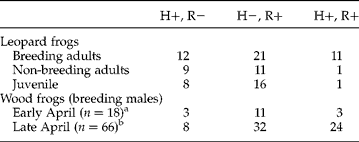
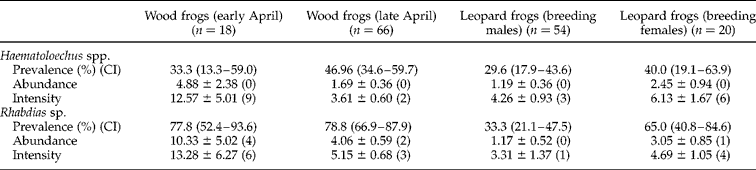
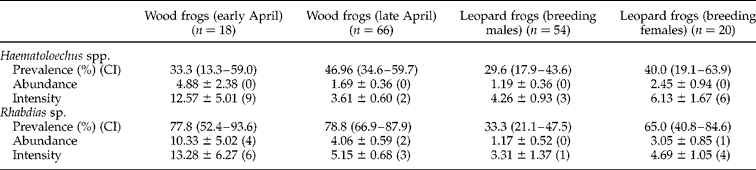
Tests for association between Haematoloechus spp. and Rhabdias sp. infections in northern leopard frogs revealed significant negative relationships between the two phyla of helminth in both breeding adults and juveniles, but not in non-breeding adults (breeding: χ2 = 4.30, P = 0.04; juveniles: χ2 = 5.13 P = 0.02; non-breeding: χ2 = 0.38, P = 0.54). Thirteen northern leopard frogs had co-occurring Haematoloechus spp. and Rhabdias sp. infections, while 77 frogs carried one or the other phylum of parasite (table 1). The prevalence, abundance and intensity of Haematoloechus spp. and Rhabdias sp. in breeding male and female northern leopard frogs are reported, along with data for breeding male wood frogs, in table 2. Non-breeding northern leopard frogs had lower measures of parasitism of both Rhabdias sp. (prevalence with Clopper–Pearson confidence intervals on binomial proportions (CI): 42.8 (24.4–62.8); abundance: 2.28 ± 1.17; intensity: 5.33 ± 2.52) and Haematoloechus spp. (prevalence (CI): 35.7 (18.6–55.9); abundance: 1.0 ± 0.40; intensity: 2.8 ± 0.89).
Numbers of host frogs carrying lungworm infections (Haematoloechus spp., Rhabdias sp. or both). Data presented are single and dual infections in breeding male wood frogs, and adult northern leopard frogs in breeding and non-breeding condition, and juvenile frogs. Plus (+) and minus (−) signs indicate, respectively, the presence or absence of Haematoloechus (H) or Rhabdias (R) infection. Tests for association between Haematoloechus spp. and Rhabdias sp. among frog cohorts are reported in the text.
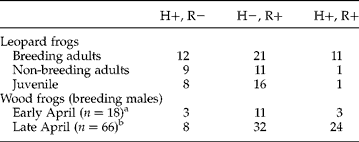
a One frog had no infection.
b Two frogs had no infection.
Haematoloechus spp. and Rhabdias sp. prevalence (%) with Clopper–Pearson confidence intervals on binomial proportions (CI), abundance and intensity of male wood frogs collected at the beginning (n=18) and end of April (n=66) 2007 and breeding male (n=54) and female (n=20) northern leopard frogs. Data reported are mean±SE; however, note that statistical analyses comparing parasitism between groups of male wood frogs were done using non-parametric tests (see text for details). We have therefore also indicated median abundance and intensity in parentheses.
No significant relationships were found between the two helminth phyla in intensity of infection in any of the breeding, non-breeding, or juvenile northern leopard frogs (breeding adults: r 2 = 0.03, P = 0.882, df = 21; non-breeding adults: r 2 = − 0.52, P = 0.12, df = 8; juveniles: r 2 = 0.21, P = 0.58, df = 7). However, we interpret our results with caution due to the low sample sizes.
A clear negative association between lungworms was also observed in wood frogs from both sample groups (early April collection (n = 18): χ2 = 9.14, P < 0.002; late April collection (n = 66): χ2 = 28.8, P < 0.0001) (table 1).
Of the 18 wood frogs sampled in early April, only 3 had dual infections, 14 had one or the other phylum of lungworm and 1 had no infection. Of the 66 wood frogs sampled on 23 April, 24 individuals carried dual infections, 40 carried one or the other phylum of lungworm and 2 carried no infection. No relationships between the phyla in intensity of infection was observed in either frogs sampled early (r 2 = − 0.18, P = 0.69, df = 16) or later in the spring (r 2 = − 0.338, P = 0.06, df = 64).
Haematoloechus spp. and Rhabdias sp. worms were segregated in lungs when they co-occurred in both northern leopard frogs and wood frogs. Rhabdias sp. was almost always found at the base of the lung, whereas Haematoloechus spp. was located near the entrance of the lung at the bronchi. In contrast, worms in single infections were found dispersed throughout the lung.
There was no difference among male hosts from the two wood frog sample groups in Haematoloechus spp. prevalence (Z = 1.03, P = 0.30) or abundance (Z = − 0.28, P = 0.77) (table 2). However, the intensity of flukes was significantly higher among male frogs collected on 23 April than in male frogs collected in the first week in April (χ2 = 5.89, P = 0.02). No significant differences between male frogs from the two sample groups were observed in any of the measures of Rhabdias sp. infection (prevalence: Z = 1.52, P = 0.13; abundance: Z = 1.17, P = 0.24; intensity: Z = 1.78, P = 0.07).
Discussion
In this study we report apparent competitive interactions between two phyla of lungworm commonly found in northern leopard frogs and wood frogs. We found that infections by one phylum of lung worm reduced the likelihood of infection by the other in both host species. We also discovered that on occasions in which we observed dual infections, there appeared to be spatial partitioning of the worms, with Rhabdias sp. occupying the basal volume of the lung and Haematoloechus spp. occupying the top portion of the lungs.
It is possible that the damage done to the lung tissue by Haematoloechus spp. worms inhibits the ability of Rhabdias sp. to feed, resulting in the observed spatial partitioning within the lung. Both lung helminths are blood feeders, however Rhabdias sp. infections do not result in the gross disintegration of the pleural lining and puncturing of the lungs by alveolar cysts that has been observed in some amphibians infected by Haematoloechus spp. (Shields, Reference Shields1987, pers. obs.). This is supported by our finding of far fewer dual infections than single infections in a lung. Although we did not observe significant relationships between intensity of infection by one or other lung helminth, few frogs harboured both lung helminths concurrently. Joly et al. (Reference Joly, Guesdon, Fromont, Plenet, Grolet, Guegan, Hurtrez-Bousses, Thomas and Renaud2008), in a study on nematode and trematode lung helminth infections in water frog populations, also found negative relationships in incidence of infection by one or the other lung helminth, and little evidence for the influence of intensity of one parasite on the other. Experimental studies on this partitioning are needed to identify any competitive interactions among these lung helminths that may result in smaller realized niches.
The establishment of one or the other lung helminth may also have important implications for fitness or survival of frog hosts. Rhabdias sp. lungworm infections are known to cause anorexia, and reduce growth and survival of toad hosts (Goater & Ward, Reference Goater and Ward1992). We expect Rhabdias sp. infections to affect northern leopard frogs and wood frogs in a similar manner. High infections may also impede adult male chorusing ability which, in turn, may result in reduced reproductive success. We also expect that Haematoloechus spp. infections will negatively affect fitness of host frogs, although it is uncertain whether the pathology caused by Haematoloechus spp. will result in mortality of hosts (see Hsu et al., Reference Hsu, Carter, Williams and Besh-Wiliford2004). Further study is needed to determine the effects of infection by Haematoloechus spp. on northern leopard frog and wood frog hosts. Nevertheless, competitive exclusion of one or other lung helminth may have varying consequences for fitness or survival of frog hosts.
Helminths in non-breeding adult northern leopard frogs did not show the same negative relationship that was observed in breeding adults and juveniles. One explanation may be that juvenile frogs may not have fully developed immune systems when they are infected, while breeding adults may trade off high energetic costs of reproduction against response to parasitic infection; a reduced host immune response may enable the worms to exhibit competitive interactions in the lung environment.
There are other hypotheses relating to seasonal cycles of parasite recruitment that may also explain the varying patterns of infection among the different cohorts of frogs. Annual patterns of recruitment and loss of Rhabdias involve the shedding of mature, senescent worms in the lungs in late spring, while new infections are acquired in the summer (Baker, Reference Baker1979). It is possible that in our study the breeding frogs still carried infections from the previous year, whereas the non-breeding frogs had shed worms and, at the time of collection, had not accumulated new infections. This may explain why we did not observe any interactions in the non-breeding frogs.
Alternatively, we may have observed no interactions in non-breeding frogs because of the seasonal dynamics of Haematoloechus infections. Northern leopard frogs lose Haematoloechus infections in the spring during the breeding season and recruit new infections over the rest of the year (Bolek & Coggins, 2000). This pattern may also explain why Haematoloechus infections in male wood frogs collected later in the spring were lower than in males collected earlier. Further studies should include experimental testing of these and other hypotheses.
Haematoloechus spp. infections are acquired by amphibian hosts when naiad dragonflies or damselflies, or semi-aquatic arthropods, are consumed by the frogs (Bolek & Janovy, Reference Bolek and Janovy2007). The higher prevalence of Haematoloechus spp. infection in male wood frogs collected later in April, relative to intensities of the frog samples collected earlier, may reflect the seasonal increase in numbers of available odonate prey as seasonal temperatures rise over the month of April, or changes in host behaviour (habitat selection) that could influence transmission rates (Yoder & Coggins, Reference Yoder and Coggins2007).
Interestingly, the prevalence, abundance and intensity of Haematoloechus spp. infections in male wood frogs were higher than those observed in breeding male northern leopard frogs, but were within the same range as those of breeding females. These differences may reflect different suites of species within the Haematoloechus taxon that infect the different host frog species, or lower defence of breeding female leopard frogs compared to male frogs. The variation observed may also reflect other factors, such as different feeding habits, that could result in variation in acquisition (Barton, Reference Barton1998).
Interspecific interactions between helminths are believed to play a primary role in structuring helminth component communities. Most studies of competitive interactions among helminths in vertebrates focus on helminths of the gastrointestinal tracts (see Poulin, Reference Poulin2001). Our study contributes new evidence for competitive interactions among helminths that warrants closer examination through experimental study.
Acknowledgements
We thank Frederick Scheuler for his assistance with the collection of frogs at Bishops Mills for this study. We are indebted to Janet and Kenneth Storey for sharing resources and samples that made this survey possible. We also thank an anonymous reviewer for many helpful suggestions that improved the quality of our manuscript. Funding for this research was provided by an NSERC PGS-D to O.D. and an NSERC discovery grant to M.R.F.