It is important to identify knowledge gaps in different areas of clinical medicine to stimulate the initiation of applied medical research. In 2010, The Swedish Agency for Health Technology Assessment and Assessment of Social Services (SBU) was assigned the task of identifying major knowledge gaps in health care. DUET (Database of Uncertainties about the Effects of Treatments) and SBU define a knowledge gap as present if systematic reviews reveal uncertainty about the medical effects of a health technology intervention, or if no systematic literature review is available (1;2).
Oral and maxillofacial surgery (OMS) comprises a wide range of treatments, from minor oral surgery undertaken in an outpatient setting to more complicated surgical interventions requiring hospital resources. Prevailing diagnoses include infections, trauma, congenital and acquired malformations, benign tumors, and systemic diseases with orofacial manifestations. Common treatment modalities are surgical removal of wisdom teeth, implant surgery with or without bone augmentation procedures, repair of fractures, orthognathic surgery, reconstructive surgery, and temporomandibular joint surgery.
A systematic review is intended to summarize research within a limited field. However, a poorly performed systematic review can be as misleading as a flawed primary study. Therefore, it is of crucial importance that systematic reviews are based on high-quality studies, use proper methodology, and an independent quality assessment (Reference Moher, Shamseer and Clarke3;Reference Shamseer, Moher and Clarke4). The review can then identify the best available evidence and reliably report scientific uncertainty and knowledge gaps to practitioners and healthcare authorities, and encourage clinical research. The first step in this process is to investigate the scientific literature and summarize it through a systematic mapping. The aim of this study was to identify knowledge and knowledge gaps in twelve selected domains of oral and maxillofacial surgery.
METHODS
To identify the most important domains in oral and maxillofacial surgery, eight major oral- and maxillofacial clinics in Sweden were requested to nominate five domains which they considered warranted priority in the systematic mapping. In addition, the four specialist members of the project group nominated the domains they considered to be the most important. There was good correlation between the proposals from the four specialists in the project group and from the OMS clinics
Inclusion Criteria
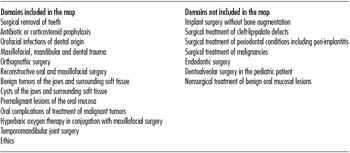
Systematic reviews published in peer-reviewed journals addressing questions on any of the selected domains listed in Table 1 were included. Intervention, control, and outcome parameters were recorded in accordance with the particular question: Population: Human subjects; Intervention: Oral and maxillofacial surgical interventions, precautions to prevent, reduce, and treat perioperative complications and adverse events; Control. Reference test, control (comparator); Outcome: Efficacy of surgical interventions, validity, safety, cost-effectiveness, ethical aspects.
List of Domains Included and Excluded in the Systematic Mapping

Exclusion Criteria
All of the excluded domains listed in Table 1 are areas related to oral and maxillofacial surgical interventions bridging other areas within odontology, such as paediatric dentistry, periodontology, oral medicine, and endodontics. Because these domains involve several specialties, the project group would require a more diverse mix of experts for adequate mapping. Furthermore, including these domains was regarded to increase the project to an unfeasible amplitude.
Literature Search Strategy
The latest literature search was undertaken during September 2014. Four databases were searched: PubMed, The Cochrane Library, Centre for Reviews and Dissemination (CRD), and EBSCO dentistry and oral science source. There were no language restrictions. The search algorithm was: (“Surgery, Oral” [Mesh] OR “maxillofacial surgery” [tiab] OR “craniofacial surgery” [tiab] OR “oral surgery” [tiab] OR “orthognathic surgery” [tiab] OR “Oral Surgical Procedures” [Mesh] OR (“Dental Implants” [Mesh] OR “dental implants” [tiab] OR “oral implants” [tiab] OR temporomandibular [tiab] AND surgery [tiab]) AND systematic [sb]).
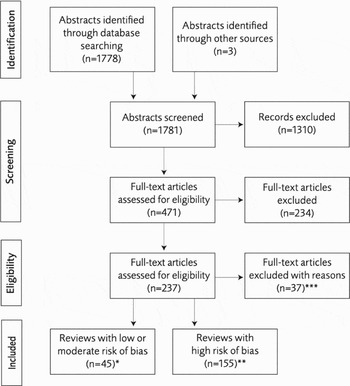
Figure 1 is a flow chart presenting the number of retrieved abstracts, included and excluded articles and stage of exclusion in each stage of the process. Abstracts identified according to the inclusion criteria were screened independently by two review authors. If at least one reviewer considered an abstract to be relevant, it was included and read in full text.
Flow chart presenting the number of retrieved abstracts, included and excluded articles, and stage of exclusion in each stage of the process. *The main objectives and results of the systematic reviews with low/medium risk of bias are summarized in Supplementary Table 3. **Systematic reviews excluded due to high risk of bias is presented in Supplementary Table 4. ***Systematic reviews that are excluded with reason in the eligibility step is presented in Supplementary Table 5.

Data Extraction and Quality Assessment
Data extraction, assessment of relevance, and quality of included reviews were undertaken independently by two review authors. Any differences were resolved by consensus discussion. When necessary, a third review author was consulted. In the case of a reviewer being the author, the quality was assessed by two other independent reviewers.
The quality (in terms of risk of bias) of all full text reviews was assessed using AMSTAR (Reference Shea, Grimshaw and Wells5). Items 1–3 and 5–8 were selected as being most important. The prespecified criteria for low, moderate, and high risk of bias are presented in Supplementary Table 1. A conservative approach was used; if a feature was not reported, it was assumed to be absent. If the answer to a particular item was unclear, it was discussed by the group and a decision was reached as to whether the review should be classified as having a low, moderate, or high risk of bias. As a general rule, the quality of the primary studies included in the reviews was not checked. An exception was when there was inconsistency or uncertainty about the results or the conclusions of a review. In these cases, random checks of individual articles were made.
Handling of Data
Existing knowledge for each domain was based only on data in reviews judged as having low or moderate risk of bias. However, with respect to knowledge gaps, reviews with low, moderate, and high risk of bias were included. In accordance with the working process described by Whitlock et al. (Reference Whitlock, Lin, Chou, Shekelle and Robinson6), no synthesis was made of the effect size of different interventions.
RESULTS
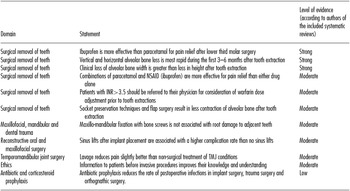
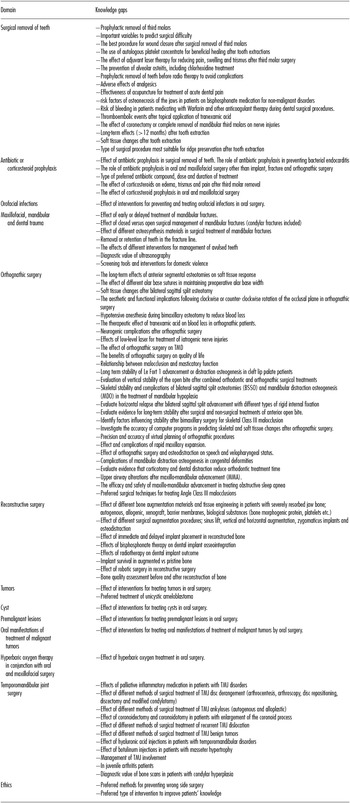
In total, 200 systematic reviews were included. Supplementary Table 2 presents the proportion of reviews with low/moderate or high risk of bias and the distribution of reviews in the different domains. In Supplementary Table 3, the main objectives and results of the systematic reviews with low/medium risk of bias are summarized. A table with the excluded systematic reviews with high risk of bias, and the reason for exclusion regarding to AMSTAR, is found in the Supplementary Table 4. Systematic reviews considered to be beyond the scope of the review are listed in Supplementary Table 5. No systematic reviews with low/moderate risk of bias were identified in the following domains: orofacial infections of dental origin, cysts, premalignant lesions, oral complications of treatment of malignant tumors, and hyperbaric oxygen treatment in oral and maxillofacial surgery. Existing knowledge and knowledge gaps are summarized in Tables 2 and 3, respectively.
Identified Knowledge and Level of Evidence According to Authors of the Systematic Review

Knowledge Gaps Identified from the Systematic Reviews

Surgical Removal of Teeth
Sixteen systematic reviews with low or moderate risk of bias were filed under this domain but they were highly diverse. Five addressed surgical techniques to minimize postsurgical complications (Reference Carrasco-Labra, Brignardello-Petersen, Yanine, Araya and Guyatt7;Reference Coulthard, Bailey, Esposito, Furness, Renton and Worthington8) and techniques to preserve the height and width of the alveolar process after tooth extraction (Reference Tan, Wong, Wong and Lang9–Reference Vignoletti, Matesanz, Rodrigo, Figuero, Martin and Sanz11). The reviews disclosed only low evidence in favor of triangular incisions for third molar removal. There was strong evidence that rapid vertical and (in particular) horizontal bone loss occurred during the first 1–3 months after extraction. There was supporting evidence that socket preservation therapies resulted in less contraction of the alveolar bone after extraction.
However, it was not possible to determine the best biomaterial supplement or surgical procedure to preserve the alveolar ridge. In one study comparing the effect of alveolar ridge preservation and unassisted socket healing, it was concluded that postextraction ridge preservation might limit but not eliminate alveolar ridge resorption. Neither cost-effectiveness nor case selection criteria were presented, and it was not possible to determine which material or method was most effective (Reference Horvath, Mardas, Mezzomo, Needleman and Donos12).
Two systematic reviews dealt with prophylactic removal of asymptomatic third molars (Reference Costa, Pazzini, Pantuzo, Jorge and Marques13;Reference Mettes, Ghaeminia, Nienhuijs, Perry, van der Sanden and Plasschaert14) and one compared damage to the inferior alveolar nerve after partial or total removal of third molars (Reference Long, Zhou, Liao, Pyakurel, Wang and Lai15). The first question could not be answered, while there was weak evidence to suggest that coronectomy was associated with fewer cases of nerve damage. Furthermore, because of the lack of high quality research, it was not possible to answer the question of whether the natural dentition should be extracted or retained before radiotherapy (Reference Eliyas, Al-Khayatt, Porter and Briggs16).
The search identified five systematic reviews covering various pharmacological approaches to reduce bleeding, pain, and swelling after tooth extraction. One review provided some evidence that topical applications of tranexamic acid could reduce postoperative bleeding (Reference Ker, Beecher and Roberts17) while the effects of autologous platelet concentrate (Reference Del Fabbro, Bortolin and Taschieri18) or chlorhexidine (Reference Yengopal and Mickenautsch19) were inconclusive. In two systematic reviews of postoperative pain relief (Reference Alexander, Hall, Eriksson and Rohlin20;Reference Bailey, Worthington, van Wijk, Yates, Coulthard and Afzal21), there was consensus that a combination of drugs (paracetamol, ibuprofen/NSAID) was more effective than each drug alone. The level of evidence was moderate and further research on the adverse effects seems to be warranted. One review presented strong evidence in support of referring patients on warfarin, who have an elevated international normalized ratio (>3.5), to a physician for consideration of dose adjustment before tooth extraction (Reference Aframian, Lalla and Peterson22).
Antibiotic and Corticosteroid Prophylaxis
In this domain, two systematic reviews of antibiotic prophylaxis were included: one for third molar surgery (Reference Oomens and Forouzanfar23) and the other for prevention of bacterial endocarditis (Reference Glenny, Oliver, Roberts, Hooper and Worthington24). Both provided evidence of low or very low quality; thus, the use of prophylactic antibiotics during invasive dental procedures remains a knowledge gap. No systematic reviews of corticosteroids were identified. One systematic review examined the evidence supporting the administration of prophylactic antibiotics in implant installation, orthognathic, and trauma-related surgery. Although a reduction in prevalence of postoperative infections was reported (25), there was no evidence to support prolonged administration of antibiotics, beyond the day of the surgical procedure, and insufficient evidence to determine which antibiotic drug or dose was most effective.
Orofacial Infections of Dental Origin
No systematic reviews with low or medium risk of bias were identified.
Maxillofacial, Mandibular, and Dental Trauma
Four systematic reviews with low or moderate risk of bias were identified. Two concerned mandibular fractures: whether open or closed management was preferable (Reference Nasser, Pandis, Fleming, Fedorowicz, Ellis and Ali26) and whether teeth involved in the fracture line should be retained or extracted (Reference Bobrowski, Sonego and Chagas Junior27). Both reviews found insufficient evidence to support the various clinical procedures and found no differences in postoperative infections. One systematic review presented evidence of moderate quality that the use of intermaxillary screws was very rarely associated with root damage (Reference M, Baratieri, Araújo, Souza and Maia28). The fourth review was unable to find intervention studies on prevention of domestic violence, leading to a decrease in the prevalence of dental trauma (Reference Coulthard, Yong and Adamson29).
Orthognathic Surgery
In this domain, nine systematic reviews were assessed (Reference Jayaratne, Zwahlen, Lo and Cheung30–Reference Paul, Ling, Lalonde and Thabane38). Two identified a knowledge gap concerning the effect of orthognathic surgery on soft tissue changes (Reference Jayaratne, Zwahlen, Lo and Cheung30;Reference Joss, Joss-Vassalli, Kiliaridis and Kuijpers-Jagtman36). Three reviews examined interventions to reduce blood loss during orthognathic surgery. Two disclosed lack of evidence for the effect of hypotension anesthesia (Reference Choi and Samman31;Reference Paul, Ling, Lalonde and Thabane38) whereas one showed lack of evidence on the effect of tranexamic acid (Reference Song, Yang, Hu, Zhu, Li and Wang32). There was also a lack of knowledge about the effect of orthognathic surgery on temporomandibular joint function (Reference Al-Riyami, Cunningham and Moles34). The question of the effect of different types of alar base sutures on postoperative alar base width could not be answered (Reference Liu, Zhu and Hu33). The evidence in support of the use of low effect lasers in the healing of iatrogenic nerve injuries was graded as very low (Reference Coulthard, Kushnerev and Yates35). Finally, a knowledge gap was identified as to the preferred surgical intervention to normalize an Angle Class III malocclusion (Reference Minami-Sugaya, Lentini-Oliveira and Carvalho37).
Reconstructive Oral and Maxillofacial Surgery
Four studies were included in the domain of reconstructive oral and maxillofacial surgery (Reference Esposito and Worthington Helen39–Reference Esposito, Felice and Worthington42). One study investigated whether zygomatic implants offered an advantage over other bone augmentation techniques in rehabilitation of the deficient edentulous maxilla. However, no evidence for a preferred method could be found (Reference Esposito and Worthington Helen39). The question of whether implant survival differed between placement in augmented and pristine bone could not be answered because of the limited scientific value of the included primary studies (Reference Donos, Mardas and Chadha40). Neither could the most beneficial bone augmentation method before implant installation be identified (Reference Esposito, Grusovin, Felice, Karatzopoulos, Worthington and Coulthard41). One systematic review compared different protocols for sinus lift but found that there was inadequate scientific evidence to indicate the preferred method. The systematic review also assess the beneficial or harmful effects of maxillary sinus lifts with or without bone augmentation. This showed that sinus lifts after implant placement was associated with a higher complication compared with treatment not involving sinus lift (Reference Esposito, Felice and Worthington42).
Benign Tumors of the Jaws and Surrounding Soft Tissue
One systematic review was included from this domain, evaluating which treatment of unicystic ameloblastoma gave the lowest recurrence rate. The formulated question could not be answered because the evidence of the included studies was estimated as low (Reference Lau and Samman43).
Cysts of the Jaws and Surrounding Soft Tissue
No systematic reviews with low or medium risk of bias were identified.
Premalignant Lesions of the Oral Mucosa
No systematic reviews with low or medium risk of bias were identified.
Oral Complications Associated with Treatment of Malignant Tumors
No systematic reviews with low or medium risk of bias were identified.
Hyperbaric Oxygen Therapy in Conjunction with Oral and Maxillofacial Surgery
No systematic reviews with low or medium risk of bias were identified.
Temporomandibular Joint Surgery
Six systematic reviews were included in the temporomandibular joint domain (Reference Januzzi, Nasri-Heir, Grossmann, Leite, Heir and Melnik44–Reference Fedorowicz, van Zuuren and Schoones49). There was no evidence to support the efficacy of combined palliative and anti-inflammatory medication for treatment of disc displacement without reduction (Reference Januzzi, Nasri-Heir, Grossmann, Leite, Heir and Melnik44). Because of insufficient scientific evidence, the focus question, as to which surgical intervention has the best effect on various temporomandibular joint disorders, could not be answered (Reference Guo, Shi and Revington45;46;Reference Al-Baghdadi, Durham, Araujo-Soares, Robalino, Errington and Sreele48). Comparing conservative treatment with temporomandibular lavage, a slightly better effect on pain relief was noted for the latter (Reference Vos, Huddleston Slater and Stegenga47). The efficacy of botulinum toxin injections on masseter hypertrophy was identified as a knowledge gap (Reference Fedorowicz, van Zuuren and Schoones49).
Ethics
One systematic review found strong evidence to support the effectiveness of various interventions to improve the knowledge and understanding of patients undergoing invasive dental procedures (Reference Kinnersley, Phillips and Savage50). Likewise, there was evidence of low quality to suggest that interventions to reduce wrong side surgery can be effective (Reference Mahar, Wasiak, Batty, Fowler, Cleland and Gruen51).
DISCUSSION
In the era of evidence-based medicine, systematic reviews are important contributions to the scientific literature, providing clinicians and researchers with a quality-assessed, condensed update on relevant clinical issues. In recent years, the number of published systematic reviews has grown significantly and this trend is likely to continue (Reference Straus and Moher52;Reference Booth, Clarke, Ghersi, Moher, Petticrew and Steward53). There is, however, a risk that a systematic review with suboptimal methodology may give rise to biased conclusions or promote less cost-effective methods. Therefore, it is crucial that the quality of systematic reviews is also assessed by independent referees, using validated tools (Reference Moher, Shamseer and Clarke3;Reference Shamseer, Moher and Clarke4), for example AMSTAR (Reference Moher, Shamseer and Clarke3;Reference Shea, Grimshaw and Wells5).
The most common shortcomings of the systematic reviews evaluated in this project were that the primary studies were not quality assessed and that primary studies with a high risk of bias were allowed to form the basis for conclusions. Another common bias was that the primary studies were not reviewed independently by two examiners.
This complex systematic review revealed considerable knowledge gaps in several domains within oral and maxillofacial surgery. Even many routine dentoalveolar surgical procedures seemed to be based on insufficient quality of evidence. Of particular note was the total lack of systematic reviews with low or moderate bias concerning cysts, premalignant lesions, and orofacial infections of dental origin. However, lack of evidence does not necessarily mean that an intervention or treatment has no effect rather that the effect is uncertain and that further high-quality clinical trials are warranted. The clinician must apply the evidence-based practice triad according to Sackett et al. (Reference Sackett, Rosenberg, Gray, Haynes and Richardson54), requiring judicious integration of systematic assessments of clinically relevant scientific evidence, consideration of the patient's oral and medical status and history, the oral and maxillofacial surgeon's clinical expertise, and the patient's treatment needs and preferences.
This underpins the need and responsibility of the profession to understand and remain updated on the best available evidence for oral and maxillofacial surgical care. In this context, complex systematic reviews constitute an important aid. Considering the large number of areas with lack of solid evidence-based practice, a rational sequential approach to this problem would be to prioritize future research into the identified knowledge gaps, according to priority. Although it was beyond the scope of this study to rank the identified knowledge gaps, this is strongly recommended, preferably according to the methodology of the James Lind Alliance to allocate initial efforts and financial means to the most urgent areas (55).
Sub-domains where no primary studies could be found, or where the identified studies did not meet the AMSTAR requirements, were listed as knowledge gaps. It has previously been suggested that systematic reviews with high risk of bias should be excluded from the synthesis of knowledge (Reference Whitlock, Lin, Chou, Shekelle and Robinson6). However, in the current study, these were regarded as knowledge gaps to circumvent a false impression of high evidence domains. Despite the large number of identified knowledge gaps within the field of oral and maxillofacial surgery, there were some domains in which evidence of high or moderate quality was noted, as summarized in Table 2.
However, in some such cases, despite evidence of high or moderate quality, a definite conclusion could not be reached. For example, there was evidence that thorough preoperative patient information consistently improved patients’ awareness and knowledge of the planned treatment. However, the type of knowledge most likely to promote informed consent for the intervention could not be identified (Reference Kinnersley, Phillips and Savage50). Another example is that, although socket preservation therapies and flap surgery are associated with less contraction of alveolar bone, neither the most effective surgical method nor the best socket preservation technique could be identified (Reference Vignoletti, Matesanz, Rodrigo, Figuero, Martin and Sanz11;Reference Horvath, Mardas, Mezzomo, Needleman and Donos12).
Although dental implants without prior/simultaneous reconstruction comprise a large proportion of oral and maxillofacial surgery procedures, it was decided to exclude these systematic reviews from the analyses: because this sub-domain is vast and complex, it should preferably be the subject of a separate evaluation. Furthermore, as uncomplicated implant surgery involves other areas of expertise such as periodontology, dental prosthodontics, and pediatric dentistry, such a separate evaluation should be undertaken in collaboration with representatives from these specialties.
Ethical Consideration
The fact that there is a pronounced gap in the scientific evidence on diagnosis and treatment in almost all of the selected sub-domains of OMS does not mean that in clinical practice there is no basis for selecting a particular method in preference to another. For example, methods that can expose patients to a high risk should be avoided. Methods involving particularly high costs should also be avoided, until their cost-effectiveness has been tested properly. Moreover, diagnosis and treatment based on established theoretical assumptions are preferred to methods which lack a theoretical basis. In the absence of scientific evidence in support of alternative methods, established treatments should be adhered to SBU (56). It was noteworthy that important, patient-oriented aspects, such as the acceptability of an intervention, were only occasionally mentioned in the systematic reviews.
In some serious conditions such as osteoradionecrosis or osteonecrosis associated with malignant disease, ethical considerations may complicate the application of an optimal study design. In these cases, treatment has to be based on experience of clinical practice. Furthermore, there is a risk of bias, as in many sub-domains of OMS, the research is funded by industry. This funding clearly enables research to be undertaken, but it may negatively affect study design by over-estimation of results.
CONCLUSIONS
This complex systematic review has disclosed a pressing need for high quality research in the selected subdomains of oral and maxillofacial surgery. Several aspects of surgical removal of teeth are, however, well documented, and there is also evidence that bone fixation screws are not associated with root damage, that sinus lifts are associated with a higher complication rate than implant placement without sinus lifts, that in treatment of temporomandibular joint conditions, lavage reduces pain compared with nonsurgical treatment, and that information provided before invasive procedures improves patients’ knowledge and understanding.
However, it is evident that substantial knowledge gaps remain in all domains, including many routine interventions. There is also a pronounced lack of studies which focus on health economics or ethical issues. The lack of data on health economic aspects is of concern because many of these procedures are expensive. Within all the selected sub-domains, there was a lack of systematic reviews of good quality. Until such evaluations are available, expensive treatments should be undertaken sparingly.
SUPPLEMENTARY MATERIAL
Supplementary Table 1: https://doi.org/10.1017/S026646231700023X
Supplementary Table 2: https://doi.org/10.1017/S026646231700023X
Supplementary Table 3: https://doi.org/10.1017/S026646231700023X
Supplementary Table 4: https://doi.org/10.1017/S026646231700023X
Supplementary Table 5: https://doi.org/10.1017/S026646231700023X
CONFLICTS OF INTEREST
The authors do not have any perceived or actual conflicts of interest to declare.