

The loss of work due to occupational injury can have a major impact on an individual's self-image, sense of personal worth and social status (Szymanski & Hershenson, Reference Szymanski, Hershenson, Parker and Szymanski1998). Individuals who are absent from work for a prolonged period have a heightened risk of economic and social deprivation, and encounter significant barriers in returning to work (Dekkers-Sanchez, Wind, Sluiter, & Frings-Dresen, Reference Dekkers-Sanchez, Wind, Sluiter and Frings-Dresen2010). In Australia, lost productivity and compensation claims amount to billions of dollars each year due to physical and psychological work-related injuries (Safework Australia, 2012; Zeiger et al., Reference Zieger, Luppa, Meisel, Gunther, Winkler, Toussaint and Riedel-Heller2011). The total cost of workplace injury and illness in the 2000–2001 financial year was $34.3 billion, or the equivalent of 5% of Australian Gross Domestic Product (GDP). The latest figures published by Safework Australia (2012) indicated that the total cost of workplace injury and illness remained at 4.8% of the GDP in the 2008–2009 financial year, though the total economic cost increased to approximately $60.6 billion. An escalation in the number of people affected by work-related injuries and receiving disability benefits highlights the need to identify factors that facilitate and maintain return to work (RTW) post occupational injury.
Much of the variability in RTW outcomes can be accounted for by what occurs in the workplace (Franche et al., Reference Franche, Cullen, Clarke, Irvin, Sinclair and Frank2005). Workplace factors may be more easily modified than medical factors. After the initial physical injury, psychosocial factors often contribute to the development and maintenance of disability (Waddell, Reference Waddell2006). Research has demonstrated the importance of support in the workplace in achieving positive RTW outcomes. Social support in the workplace may act to buffer stress and to promote organisational commitment (Gates, Reference Gates2000). Conversely, perceived lack of support in the workplace has been linked to poor RTW outcomes. Injured workers reporting support from supervisors and co-workers have been found to predict RTW outcomes and length of time to RTW post occupational injury (Gates, Reference Gates1993; Feuerstein, Berkowitz, Haufler, & Huang, Reference Feuerstein, Berkowitz, Haufler, Lopez and Huang2001; Post, Krol, & Groothoff, Reference Post, Krol and Groothoff2005; Young, Reference Young2010).
Post et al. (Reference Post, Krol and Groothoff2005), however, found that employees reporting low supervisor support at their pre-injury workplace demonstrated a significantly higher RTW rate than employees reporting high supervisor support. Post and colleagues hypothesised that low supervisor support may result in increased pressure and motivation to attend work, thereby increasing the rate of RTW. Given this was hypothesised to be somewhat of a coercive motivational process, it would have been interesting to ascertain whether RTW for these participants was durable. Post et al. suggested that employees with more supportive supervisors, on the other hand, may feel more secure in their employment and comfortable in remaining out of work for a longer period of time.
The job demands-resources model (JD-R model; Demerouti, Bakker, Nachreiner, & Schaufeli, Reference Demerouti, Bakker, Nachreiner and Schaufeli2001), an elaboration of the job demand-control model (Karasek, Reference Karasek1979), may explain the importance of social support in the workplace. The JD-R model classifies psychosocial risk factors into two general categories: job demands (JD) and job resources (JR). The model describes a health impairment process whereby high JD, such as high workload and physical, psychological or organisational pressures, exhaust employees’ physical and mental resources, leading to health problems and injury (Demerouti et al., Reference Demerouti, Bakker, Nachreiner and Schaufeli2001). The model also describes a motivational process whereby JR, such as autonomy and colleague and supervisor support, have the potential to increase employees’ motivation, growth, and development (Demerouti et al., Reference Demerouti, Bakker, Nachreiner and Schaufeli2001).
The JD-R model has been empirically supported with high JD related to burnout and the development of workplace-related health problems and JR related to increased motivation and work engagement (Bakker, Demerouti, De Boer, & Schaufeli, Reference Bakker, Demerouti, De Boer and Schaufeli2003). JR, such as colleague and supervisor support, have been found to buffer the impact of JD (Bakker, Demerouti, Taris, Schaufeli, & Schreurs, Reference Bakker, Demerouti, Taris, Schaufeli and Schreurs2003) and to maintain work engagement under conditions of high JD (Bakker, van Veldhoven, & Xanthopoulou, Reference Bakker, van Veldhoven and Xanthopoulou2010). These findings suggest that organisations can impact the health and wellbeing, and perhaps RTW status, of their employees by managing and altering organisational levels of JD and JR.
More generally, research has demonstrated that individuals without supportive relationships, whether professional or personal, experience greater stress than those with supportive relationships. Having people available for support and assistance can enhance coping and provide a buffer against stress (Baumeister & Leary, Reference Baumeister and Leary1995). Baumeister and Leary (Reference Baumeister and Leary1995) postulated that relationships and social interactions are fundamental to human beings, that people strive for belongingness, and that people have an innate drive to form and maintain social relationships.
The importance of social relationships can be seen in Baumeister's (Reference Baumeister1991) model of a meaningful life, which states that human experience is shaped by four factors of meaning: purpose, efficacy, value, and self-worth. Baumeister argued that the perception of a meaningful life depended upon satisfying these four factors. Stillman et al. (Reference Stillman, Baumeister, Lambert, Crescioni, DeWall and Fincham2009) examined how social exclusion impacted upon the four factors in Baumeister's model. Stillman et al. found that social exclusion significantly reduced participants’ reported sense of purpose, efficacy, value and self-worth. Based on these findings, Stillman et al. concluded that social exclusion, by decreasing a sense of meaningfulness, is likely to decrease goal-oriented behaviours, fulfilment seeking, motivation and sense of control over life. In applying these findings to the RTW context, it is possible that injured workers experiencing social support and a sense of belongingness in the workplace feel a greater sense of meaningfulness in their lives. With this additional meaning and purpose, injured workers may be more focused on future goals than on immediate needs, therefore increasing their capacity to withstand the pain and discomfort often associated with the RTW process. With increased social support and a greater sense of meaning, injured workers may feel more motivated to maintain RTW during difficult periods, and they may feel more in control of their environment.
Increasingly, the pivotal role of psychosocial factors in the RTW process has been acknowledged in the RTW literature (Burton, Kendall, Pearce, Birrell, & Bainbridge, Reference Burton, Kendall, Pearce, Birrell and Bainbridge2008; Shaw, Pransky, Patterson, & Winters, Reference Shaw, Pransky, Patterson and Winters2005). This perspective is reflected in the disability paradigm, which postulates that the causes of disability encompass more than the original injury/disease producing event (Loisel & Durand, Reference Loisel, Durand, Shultz and Gatchel2008). As a result, RTW does not depend on resolution of the condition but rather on diverse psychosocial and occupational factors that contribute to the disability. Work disability must therefore be seen as different from the original disorder that initiated the disability (Loisel et al., Reference Loisel, Durand, Berthelette, Vezina, Baril, Gagnon and Tremblay2001). The perspective that RTW may be hindered by a range of factors is also reflected in the flags model (Kendall, Linton, & Main, Reference Kendall, Linton and Main1997; Main, Sullivan, & Watson, Reference Main, Sullivan and Watson2008). The flags system was initially developed by Kendall and colleagues (Reference Kendall, Linton and Main1997) and further elaborated by Main et al. (Reference Main, Sullivan and Watson2008) as a means of identifying and managing psychosocial factors in low back pain. In this system, flags are viewed as obstacles that impede recovery and prolong the likelihood of disability (Main et al., Reference Main, Sullivan and Watson2008). For instance, orange flags are psychological in nature and include clinical depression and anxiety, while yellow flags are psychosocial and include beliefs and expectations about RTW and unhelpful coping strategies. Recognising the important role of workplace relationships, blue flags in this model include occupational factors, such as support from colleagues and management. Reflecting the importance of psychosocial and workplace factors for successful RTW, interventions such as the Sherbrooke Model and Therapeutic Return to Work, which focus on both clinical and occupational factors, have demonstrated effectiveness in improving RTW outcomes (Durand & Loisel, Reference Durand and Loisel2001; Loisel et al., Reference Loisel, Abenhaim, Durand, Esdaile, Suissa, Gosselin and Lemaire1997).
A return to the workplace does not always indicate the end of injury or the RTW process. Research has found that the majority of workers with upper extremity and lower back injuries reported the ongoing impact of the injury on work and activities of daily living one year post injury (Pransky et al., Reference Pransky, Benjamin, Hill-Fotougi, Himmelstein, Fletcher, Katz and Johnson2000). Consistent with the JD-R model, lack of support in the workplace may decrease the motivation of injured workers to persist during times of hardship, leading to poor RTW outcomes (Karasek, Triantis, & Chandhry, Reference Karasek, Triantis and Chaudhry1982). In Australia, a durable RTW outcome has been defined as an injured worker maintaining work post occupational injury for at least 6 months (Murphy & Jackson, Reference Murphy and Jackson2013). Minimal research, however, has explored the factors contributing to durable RTW outcomes (Young, Reference Young2010).
In a prospective study, Young (Reference Young2010) analysed whether a range of demographic, occupational and injury-related variables were able to differentiate between workers who maintained work post injury from those who did not. Of the variables explored, Young found that only self-reported relationship with one's supervisor was significantly related to employment status, with poor supervisor relationships associated with non-durable RTW outcomes. Similarly, in a qualitative study (n = 30), the most commonly provided reasons for non-durable RTW outcome, cited by half of the participants, pertained to the detrimental attitudes and behaviours of coworkers and supervisors (Murphy & Jackson, Reference Murphy and Jackson2013). The current study further explored this relationship between support in the workplace and durable RTW outcome.
Although the importance of social support in the workplace has been demonstrated, less is known about the relationship between social support external to the workplace and RTW outcome, such as support from family and friends. In a sample of 926 occupationally injured workers with periods of absence ranging from 6–12 weeks, Brouwer et al. (Reference Brouwer, Krol, Reneman, Bultmann, Franche, van der Klink and Groothoff2009) and Brouwer, Reneman, Bultmann, van der Klink, and Groothoff (Reference Brouwer, Reneman, Bultmann, van der Klink and Groothoff2010) found that perceived social support was significantly related to length of absence from work. Workers who reported higher levels of social support returned to work earlier compared to workers with less social support. However, this relationship was found for workers with physical conditions but not mental conditions, indicating that the importance of social support may differ according to injury. Brouwer et al. (Reference Brouwer, Reneman, Bultmann, van der Klink and Groothoff2010) utilised a self-constructed measure of social support with unknown psychometric qualities. The current study extended this research by using a well-validated measure of social support to further explore the relationship between social support external to the workplace and RTW outcome.
Based on previous research, it was hypothesised that participants with durable RTW outcomes, compared to participants with non-durable RTW outcomes, would report higher levels of support in the workplace, from both superior and colleagues. It was also hypothesised that participants with durable RTW outcomes would report higher levels of social support outside of the workplace than participants with non-durable RTW and no RTW (NRTW) outcomes.
Methodology
Study Location and Participants
Participants were previous clients of the Return to Work Assist (RTWA) program operated by Q-Comp, an independent statutory authority established under the Workers’ Compensation and Rehabilitation Act 2003 in Queensland, Australia. Q-Comp established RTWA to provide individualised support to workers with injuries that preclude them from returning to their previous employment. Injured workers can access RTWA services after their worker's compensation claim has ceased. Given these circumstances, clients of RTWA have often experienced long-term unemployment following their workplace injury and multiple barriers to successful RTW. RTWA is a voluntary service also working with clients seeking compensation from their employers due to workplace injury. Under Section 267 of the Workers’ Compensation and Rehabilitation Act 2003, injured workers with an open claim for compensation against their employer have been mandated to satisfactorily participate in the RTWA program to mitigate their loss.
RTWA utilised a two-pronged approach to help clients RTW after sustaining work-related injuries. The first is to prepare clients for re-employment through activities such as resume writing, job search, and interview training. Second, the program adopted a career development approach to harness the potential of clients for prospective career changes, as well as career advancement.
The current study was conducted in the context of an independent evaluation of the RTWA program by the authors. A total of 1,179 previous RTWA clients were randomly selected from the Q-Comp database to be included in this component of the evaluation. Potential participants were involved with the RTWA for various amounts of time from 2008–2012. Potential participants were contacted via post and provided with information regarding the evaluation. One hundred and forty-three (12.1%) letters were returned as the participants no longer resided at the postal address. In total, 113 (10.9%) surveys were received, either completed or partially completed.
Procedure and Measures
Prior to commencing this component of the evaluation, ethics approval was obtained from the authors’ university research and ethics committee. Introductory letters detailing the nature of the evaluation were posted to the randomly selected participants two weeks prior to posting the questionnaire booklet. A questionnaire booklet, along with an explanatory statement, was then posted to the participants. The questionnaires included in the booklet were intended to capture a range of information from the clients, including demographic information, information regarding the RTW process, mental and physical health, consumer satisfaction, and social support. Participants were asked to complete and return the questionnaires in a provided reply-paid envelope. Former RTWA clients were informed in the explanatory statement that participation was voluntary and that they would not be penalised if the questionnaires were not returned. Follow-up letters requesting completion of the questionnaires were posted 3 weeks later.
Of relevance to the current study, participants completed the Questionnaire on the Experience and Evaluation of Work (QEEW; van Veldhoven, Meijman, Broersen, & Fortuin, Reference Van Veldhoven, Meijman, Broersen and Fortuin2002) and the Multidimensional Scale of Perceived Social Support (MSPSS; Zimet, Dahlem, Zimet, & Farley, Reference Zimet, Dahlem, Zimet and Farley1988). The QEEW (van Veldhoven et al., Reference Van Veldhoven, Meijman, Broersen and Fortuin2002) is a measure that is widely used in the Dutch vocational health care services and in research (Bekker, Nijssen, & Hens, Reference Bekker, Nijssen and Hens2001; Hubert & van Veldhoven, Reference Hubert and van Veldhoven2001). Two subscales of the QEEW, the relationships with colleagues subscale and the relationship with superior subscale, were included in the battery of questionnaires. Participants are asked to indicate how frequently statements apply to them on a 4-point rating scale; always, often, sometimes, never. Items are the same on both subscales, with reference to either colleagues or superior; for example: ‘Can you count on your colleagues/superior when you encounter difficulties in your work?’, ‘Do you have conflicts with your colleagues/superior?’ Both subscales were transformed to a 0–100 range, as indicated in the QEEW manual.
Although the Dutch version of this instrument has been well validated in the European context, limited research has been conducted on the English version of the QEEW. The Dutch version of the QEEW has demonstrated acceptable internal consistency for all scales (α > .74; Cortina, Reference Cortina1993). In particular, the relationship with superior subscale (α = .88) and the relationships with colleagues subscale (α = .82) have demonstrated good internal consistency (van Veldhoven, Taris, de Jonge, & Broersen, Reference Van Veldhoven, Taris, de Jonge and Broersen2005). In the current study, Cronbach's alpha for the relationship with superior and relationships with colleagues subscales was .94 and .87, respectively. The factor structure of the QEEW has been supported with confirmatory factor analysis (van Veldhoven, Meijman, Broersen, & Fortuin, Reference Van Veldhoven, Meijman, Broersen and Fortuin2002).
The Multidimensional Scale of Perceived Social Support (MSPSS; Zimet, Dahlem, Zimet, & Farley, Reference Zimet, Dahlem, Zimet and Farley1988) is a 12-item measure that assesses the level of perceived support from family, friends and a significant other (Zimet et al., Reference Zimet, Dahlem, Zimet and Farley1988). Participants are asked to indicate their agreement with each statement on a 7-point scale, ranging from very strongly disagree to very strongly agree. Examples of items include: ‘My family really tries to help me’, ‘I can count on my friends when things go wrong’ and ‘There is a special person in my life who cares about my feelings’. In the current study, only the total score was utilised as an overall measure of social support. Reliability and validity has been established across multiple samples (Cecil, Stanley, Carrion, & Swann, Reference Cecil, Stanley, Carrion and Swann1995; Zimet, Powell, Farley, Werkman, & Berkoff, Reference Zimet, Powell, Farley, Werkman and Berkoff1990). The MSPSS has demonstrated high internal consistency, ranging from .84 to .92 for the total scale (Cecil et al., Reference Cecil, Stanley, Carrion and Swann1995; Zimet et al., Reference Zimet, Powell, Farley, Werkman and Berkoff1990). Cronbach's alpha in the current study was .86. Concurrent validity of the MSPSS was supported with significant correlations with the Social Support Behaviours Scale (SS-B; Kazarian & McCabe, Reference Kazarian and McCabe1991).
Results
Of the 1,179 surveys that were posted to potential participants, 113 were returned. Three surveys were excluded from the analysis as these participants reported zero contacts with RTWA. In total, 110 surveys were included in the analyses. Some surveys were only partially completed; the number of participants who completed each section is indicated below.
Descriptives
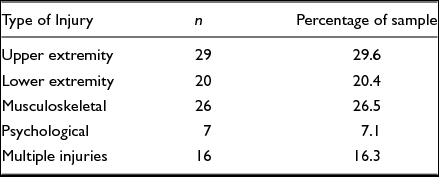
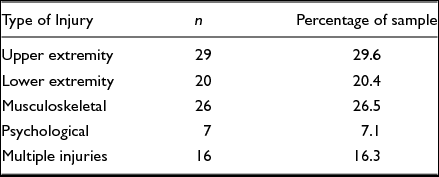
The sample was evenly split with 43 males and females, and 24 participants not specifying gender. The average age of participants at time of injury was 46.40 years (SD = 11.06) with ages ranging from 21 to 66 years. Participants were asked to report their injury. Utilising the categories from Queensland's Workers’ Compensation and Rehabilitation Act 2003, these injuries (n = 98) were classified, as indicated in Table 1.
Nature of the Reported Injuries Within the Sample
Of the 105 returned surveys where participants reported RTW status, 49.5% reported current employment or previous return to employment of greater than 12 months (durable RTW; n = 52), 25.7% reported previous return to work of less than 12 months but no current employment (non-durable RTW; n = 27), and 24.8% reported no return to work (n = 26). Of those in the durable RTW group, the average length of RTW was 15.23 months (SD = 10.60). These values ranged from 2 months to 60 months. For non-durable RTW participants, the average length of non-durable RTW was 3.56 months (SD = 3.30), ranging from less than a month to 11 months.
Due to the low response rate and concerns regarding the generalisability of the findings, demographic data for the current sample was compared to a separate database of 1,836 RTWA clients. Compared to the RTWA database, the current sample was more evenly distributed in terms of gender, with the database including 71% males, compared to 43% in the current sample. However, a high proportion of respondents in the current sample did not indicate their gender. In terms of age, the samples were comparable, with the current sample approximately 5 years older: M = 46.40 in the current sample and M = 41.91 in the RTWA database. Although the database did not indicate whether RTW was durable, similar rates of RTW were observed in both samples: 75% in the current sample and 76% in the database. The types of injuries in the samples were also comparable, with lower rates of musculoskeletal injuries and higher rates of multiple injuries in the current sample: upper extremity 26.4% versus 29.4%, lower extremity 18.2% versus 16.1%, musculoskeletal 23.6% versus 34.7%, psychiatric 6.4% versus 9.1%, and multiple injuries 14.5% versus 9.5%, respectively. Based on these comparisons, with the exception of gender, the current sample appeared similar to that of the larger RTWA population.
Relationships With Superior and Colleagues
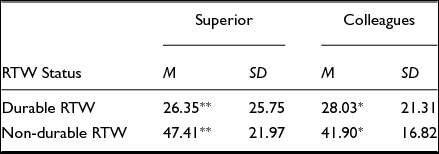
A multivariate analysis of variance (MANOVA) was utilised to ascertain whether the durable RTW (n = 44) and non-durable RTW (n = 15) groups reported significant differences in the quality of their relationships with their superiors and colleagues. Means and standard deviations are displayed in Table 2. Using Pillai's Trace, the between-group difference for the combined superior and colleague variables was statistically significant, V = 0.14, F(2,53) = 4.34, p = .018, η2 = .71. Separate univariate ANOVAs revealed statistically significant effects for both colleague support, F(1, 54) = 4.08, p = .048, η2 = .07, and support from a superior, F(1, 54) = 8.83, p = .004, η2 = .14. Participants who sustained RTW were significantly more likely to report positive support from colleagues and supervisor, compared to non-durable RTW participants.
Relationship With Superior and Colleagues for Durable RTW and Non-Durable RTW Groups
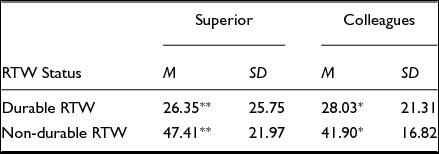
Note: RTW = Return to Work.
*p < .05; **p < .01.
Social Support Outside of the Workplace
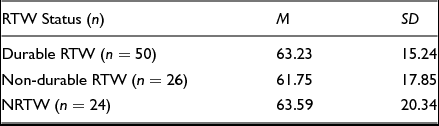
An ANOVA was utilised to ascertain whether social support differed according to injury, as was found in previous research; however, no significant differences were found, F(4,88) = 1.45, p = .225, η2 = .06. An ANOVA was also utilised to ascertain whether there were significant differences in reported social support between the durable RTW, non-durable RTW and NRTW groups. No significant differences were found between the groups, F(2,97) = .09, p = .917, η2 = .002, indicating that the RTW, non-durable RTW and NRTW groups reported similar levels of social support. These findings are displayed in Table 3.
Multidimensional Social Support for Durable RTW, Non-Durable RTW, and NRTW Groups
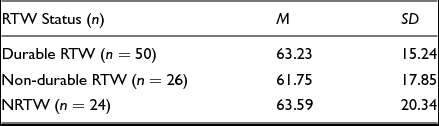
Note: RTW = Return to Work, NRTW = No Return to Work.
Discussion
This study examined the influence of social support, both in and out of the workplace, on RTW outcomes. Previous research has indicated that social support in the workplace is an important factor in facilitating and maintaining return to work post occupational injury (Feuerstein et al., Reference Feuerstein, Berkowitz, Haufler, Lopez and Huang2001; Young, Reference Young2010). The current study found that participants with durable RTW outcomes reported significantly better relationships with their superiors and colleagues than participants with non-durable RTW outcomes. These findings appear consistent with the JR-D model (Demerouti et al., Reference Demerouti, Bakker, Nachreiner and Schaufeli2001) and the findings of Bakker, Demerouti, De Boer et al. (Reference Bakker, Demerouti, De Boer and Schaufeli2003) and Bakker, Demerouti, Taris et al. (Reference Bakker, Demerouti, Taris, Schaufeli and Schreurs2003). Returning to work after injury is likely a challenging and stressful endeavour for the injured worker. Perhaps JR in the form of colleague and supervisor support served to buffer the challenges associated with maintaining RTW. Colleague and supervisor support may have provided the injured worker with increased motivation to maintain RTW, despite pain and discomfort. The findings of the current study also appear in line with Baumeister's model of a meaningful life (1991). Perhaps injured workers experiencing social support and a sense of belongingness in the workplace felt a greater sense of meaningfulness in their lives, enabling them to remain focused on future goals and increasing their capacity to withstand the pain and discomfort associated with RTW. With the support of colleagues and supervisor, injured workers may have felt more in control of their work environment and able to seek assistance or accommodations as needed.
The findings of the current study support the use of RTW interventions that include a focus on occupational factors, such as the Sherbrooke Model or Therapeutic Return to Work (Durand & Loisel, Reference Durand and Loisel2001; Loisel et al., Reference Loisel, Abenhaim, Durand, Esdaile, Suissa, Gosselin and Lemaire1997). The RTW process could be facilitated by a vocational rehabilitation case manager or RTW coordinator assessing the nature of workplace relationships and mediating conflict as appropriate. Although creating an initial increase in workload, such an intervention is likely to result in a more durable RTW outcome, thereby minimising the need to recommence the RTW process at a later date.
Returning to work post occupational injury is a complex process, involving financial and physical stressors. Individuals returning to work are likely to face barriers and limitations to employment and daily living not previously encountered. A supportive workplace environment is likely to increase an individual's willingness to persist through these difficult times, an outcome beneficial for the individual and the employer. Supportive relationships in the workplace are likely indicative of a flexible, understanding and accommodating approach to the RTW process.
Increasing the provision of support in the workplace post occupational injury can be facilitated by increasing the awareness of management and improving their ability to manage this process. For instance, McLellan, Pransky, and Shaw (Reference McLellan, Pransky and Shaw2001) developed a disability management training program for supervisors. The goal of this training was to take a supportive approach to workers with work-related injury, to facilitate communication, to encourage the reporting of injury among workers, and to implement accommodations when possible. The brief training (1.5 hours) significantly improved supervisor confidence in managing work-related injury concerns. Many supervisors also reported decreases in lost work time within their departments. Communication factors and enquiring about the worker's wellbeing were identified as most important in reducing worker disability. Communication and assertiveness training may also be beneficial for workers engaging in the RTW process as a means of ensuring that their workplace and injury-related needs are met.
Previous research has indicated that social support external to the workplace — support from family and friends — is an important factor in the RTW process (Brouwer et al., Reference Brouwer, Krol, Reneman, Bultmann, Franche, van der Klink and Groothoff2009). The results of the present study indicated that social support external to the workplace did not differ between the durable RTW, non-durable RTW and no RTW groups. These findings may be attributed to the sample utilised in the study. Many of the participants in the sample had experienced long-term unemployment due to occupational injury, negatively impacted upon by a range of adverse physical, emotional and social factors. It may also be anxiety provoking and distressing for family members and friends to see the person they care about in pain. Family and friends may lack an understanding of the RTW process and be unaware that RTW can actually aid recovery. Consequently, family members or friends may empathise with the injured worker and encourage him or her to delay their RTW until symptom improvement or resolution. External social support may encourage some injured workers to RTW; for others, the same support may encourage non-RTW. Future research could explore mechanisms by which family and friends may or may not contribute to the RTW process.
For the participants with a non-durable RTW outcome, the average length of time at work prior to cessation was approximately 5 months. This suggests that the vocational rehabilitation post RTW may be beneficial in maintaining employment. While this may not be possible for many services due to workload pressures, RTWA implemented a strategy whereby text messages were sent to previous clients after predetermined lengths of time to follow up on RTW status and to offer a recommencement of services, if required. Such an intervention may be an effective means of managing heavy vocational rehabilitation workloads, the need for client independence, and the ongoing provision of support for clients in RTW efforts.
A limitation of the current study was the low response rate. While 1,179 questionnaires were posted to participants, only 113 (10.9%) were returned. The low response rate may have resulted in a sampling bias, decreasing the representativeness of the sample. For instance, due to time pressures, potential participants who were employed may have been less likely to complete the battery of questionnaires. However, this does not appear to be the case, as the current sample's RTW rate was comparable to that of a larger RTWA sample. That stated, given the long-term unemployment due to occupational injury experienced by the majority of the sample, the generalisability of the results may be limited. Future research may wish to explore specific supervisor and coworker behaviours and attitudes that assist in facilitating and maintaining an individual in the workplace post injury. With scant studies considering the determinants of RTW for the long-term unemployed due to injury (Post et al., Reference Post, Krol and Groothoff2005), additional research is required to determine effective RTW practices with this complex client group. In interpreting the current study findings, it should also be considered that while the average length of RTW for the durable RTW group was approximately 15 months, some of the participants in this group may still stop working.
The current study was a correlational research design, limiting inferences that can be drawn regarding causality. Workplace relationships may contribute to the durability of RTW. Conversely, durability of RTW may shape retrospective accounts of workplace relationships, insofar as inability to sustain RTW may lead to negative appraisal of the former workplace. Future research employing a prospective design is necessary to appraise potential causal associations.
The findings from the current study contribute to the literature that social support in the workplace is a crucial component to the RTW process in both the facilitation and maintenance of positive RTW outcomes. Interventions aimed at improving support and relationships in the workplace are likely to result in beneficial outcomes for both the injured worker and the employer.
Acknowledgments
The authors would like to thank the Return to Work Assist and Data Management and Analytics personnel with Q-Comp for the assistance in establishing the research. The project was funded by Q-Comp, an independent statutory authority, established on July 1, 2003, under the Workers’ Compensation and Rehabilitation Act 2003, to oversee Queensland's workers’ compensation scheme.