Changing clothes
He then caused 1000 men of his kindred to wear the Marata fashioned robes and turbans instead of long caps & cloths, giving them stile of Ravoots.Footnote 1
Thus states a chronicle on the South Indian kingdom of Madurai about one of its rulers, Muttu Virappa Nayaka III (r. 1682–91 CE). Presumably, during his reign he ordered his men to abandon their old attire and adopt a new type of clothing, said to be of a specific style. But while this king sat on the throne in the late seventeenth century, the text in question was compiled only in the 1790s, when Madurai's Nayaka dynasty had long vanished. Although its author—a literary man called Terukerkadu Mootiah, who probably lived at Madras—declared that he had based his work on local written and oral accounts, its reliability has been questioned.Footnote 2 Nevertheless, the quoted passage suggests that over time the dress style at the Madurai court shifted from long tunics and high caps to garments and headwear as used by Marathas, apparently resembling what was termed ‘Ravoot’ (rāvuttaṉ) clothing. Thus, Mootiah's chronicle seems to point at several politico-cultural developments. First, the long tunics and caps originally worn in Madurai may call to mind the Islamic-style court dress of the Vijayanagara empire, Madurai's parental state. It has been suggested that Vijayanagara's rulers—even though they adhered to various strands of Hinduism—adopted such attire from Muslim-ruled courts in order to connect to the Indo-Islamic world.Footnote 3 Second, after Madurai's Nayakas had apparently initially continued this practice, later they allegedly came to look for another model: Maratha-style clothing. The Marathas were warriors from western India who played a dominant role in South Indian politics between the mid seventeenth and mid eighteenth centuries. Third, while the Marathas also professed Hinduism, Mootiah claims their type of dress was similar to that of a rāvuttaṉ (also irāvuttaṉ), or ‘rowter’ (from irauttar). This term, meaning horseman or trooper, was used as a (military) title by various Tamil-speaking Muslim groups and possibly some other communities too.Footnote 4
It therefore appears that here we read, in short, that clothing at the Madurai court was initially affected by Islamic dress practices which were subsequently changed for Maratha conventions, which in turn were probably of a certain ‘Muslim style’ themselves. Mootiah thus seems to have suggested that court attire could now be composed of elements from several backgrounds at the same time. Thereby he may have referred to a broader pattern among early modern South Indian dynasties, in which earlier politico-cultural borrowings from Islamic courts were replaced, supplemented, and affected by new influences, partly from a non-Islamic background. Looking at one aspect of these developments, this article aims at investigating the significance of royal clothing in Madurai and several other, interrelated South Indian kingdoms—all successors of the Vijayanagara empire—roughly from the mid seventeenth to mid eighteenth centuries. So far, the historiography on the adoption of Islamic notions of kingly attire in this area has concentrated on the mid fourteenth to mid seventeenth centuries, during most of which period Vijayanagara dominated the region. On the basis of both foreign accounts and indigenous art, it has been argued that in this stage ‘Muslim-style’ or ‘Persianate’ garments had specific connotations at a number of South Indian courts ruled by Hindu kings. Under the influence of conventions in the Islamic world, these rulers are thought to have appeared in such dress on occasions of a ‘public’ nature, whereas in situations of a more ‘domestic’ character they would wear traditional clothing associated with Hindus, also referred to as ‘Indic’.Footnote 5
The subsequent period has hitherto been neglected in this regard, despite the fact we have at our disposal several sets of sources that are lacking for earlier years. It seems that for this phase it is not always obvious which style of clothing kings were wearing in different situations. Former royal dress codes appear to have changed or actually blurred by this time, possibly indicating a wider shift in Islamic and other politico-cultural effects on South Indian courts. The focus of this article lies with royal attire worn at diplomatic audiences as portrayed in embassy reports of the Dutch East India Company (also known by its Dutch name Verenigde Oostindische Compagnie, or VOC) and in murals and sculptures at local palaces and temples. The main issues are: What do these sources suggest with respect to varying types of royal dress? How does that variation relate to existing theories on this subject? And how can the observed changes and diversity be connected to political developments?
We begin our investigation with a short overview of the dynasties under study and of scholarly ideas on the response by South Indian kingdoms to politico-cultural Islamic influences. Next, we examine several kinds of sources and note to what extent they match the present historiography. We first inventory what Company envoys reported on royal dress as they observed it at diplomatic meetings in four Vijayanagara successor states: Madurai, Ikkeri, Ramnad, and Tanjavur. These external sources show the diverse and changing nature of such events. We then turn to a pair of murals depicting audiences that are found in the royal reception hall of one of those successors, the kingdom of Ramnad. These paintings offer two strikingly different representations of kingly dress on such occasions. In an effort to explain this distinction, we discuss another Dutch embassy account, which sheds some light on the ruler who commissioned the murals. In addition, we briefly consider other portrayals of royal dress, painted and sculpted, in a number of temples in the region, although only some of these images clearly concern diplomatic meetings. Finally, based on the various explored sources on kingly attire, an attempt is made to draw some conclusions on the evidently shifting modes of dress at early modern South Indian courts over time and how this development may be linked to the changing political constellation in this region. It is argued that in the discussed kingdoms during the period under scrutiny, the dress categories of ‘Persianate’ and ‘Indic’ no longer suffice to do justice to the variety of royal clothing and influences thereon.
Dynasties and dress codes
We start with a brief survey of the relations between the dynasties of the Vijayanagara empire and the successor states dealt with in this study. Vijayanagara itself came into existence around the 1340s in the power vacuum resulting from the short-lived conquest of the peninsular Deccan plateau by the Delhi Sultanate. After a period of military service for one or several preceding dynasties—probably including Delhi's sultans themselves—some local chiefs of the Sangama house founded Vijayanagara. The new state soon acquired imperial dimensions and came to encompass large parts of South India. Disintegration always seemed to be looming, however. First, both the northerly adjacent Bahmani Sultanate and the five Deccan Sultanates that succeeded it were in a semi-permanent state of war with Vijayanagara. Second, regional governors appointed by the empire (for instance, in Madurai, Tanjavur, and Ikkeri) posed a constant threat to the imperial court as they strove for more autonomy. The destruction of the imperial capital by an alliance of the Deccan Sultanates in 1565 accelerated this process of fragmentation, and by the mid seventeenth century Vijayanagara had disappeared.Footnote 6
From the empire's decline arose new kingdoms, all ruled by adherents to one or another strand of Hinduism. To begin with Madurai, the founder of its dynasty belonged to a family of officers at the court of the Vijayanagara empire. In about 1529, he was installed by the imperial Tuluva house as a provincial governor of the peninsula's southernmost region. While his position grew into a hereditary monarchy—bearing the military title of nāyaka—the dynasty initially remained loyal to the empire, maintaining close links with Vijayanagara's rulers. During coronation ceremonies at the imperial court, for example, the Nayaka of Madurai was expected to serve the emperor as the bearer of his betel-leaf box.Footnote 7 But after a few generations, the Nayakas sought to break off from Vijayanagara. In particular following the aforementioned 1565 battle, when the empire's Tuluva rulers were replaced by the Aravidu dynasty, Madurai started asserting independence in every practical sense.Footnote 8
The dynasties of the other direct successor states of Vijayanagara also had their origins in politico-military appointments by and intimate ties to the imperial court. Like Madurai's Nayakas, the similarly named royal house of Ikkeri (also known as Keladi) came into existence when its founders were recognized by Vijayanagara's Tuluva emperors as chiefs, in this case of a part of India's southwest region. In contrast to Madurai's dynasty, however, the Nayakas of Ikkeri were of local origin and were incorporated into the empire rather than delegated from its court. Again, as Vijayanagara's power waned, Ikkeri gradually grew to be independent for all practical purposes.Footnote 9 Tanjavur, in the far southeast, was initially governed by a non-local Nayaka dynasty. Like their counterparts in Madurai, these Nayakas descended from a military officer from the Deccan plateau installed by Vijayanagara's rulers and became increasingly autonomous. The dynasty came to an end in the early 1670s when Tanjavur was temporarily occupied by Madurai, which eventually led to the foundation of a new royal house in Tanjavur, that of the Maratha Bhonsles, who traced their origins to the Maratha heartland in the west of India. Notably, this dynasty's founder served the Deccan Sultanate of Bijapur—itself both a recipient and source of Persianate court culture—as military commander when he expelled Madurai's troops from Tanjavur. He therefore had been in close contact with Bijapur's politico-cultural conventions.Footnote 10
Moving forward one more generation in South Indian state formation, the last kingdom under discussion here is Ramnad. Occupying Madurai's southeast region, it is generally thought to have been founded in about 1605. At around that time, the Nayaka of Madurai appointed a chief of the local, martial Maravar caste as his vassal to maintain order in this outlying area. Although under this chief's descendants his office turned into a dynasty, with the title of Setupati, the Ramnad court initially held close and loyal ties with Madurai's Nayakas. The Setupatis received royal titles, regalia, and other marks of honour from the Nayakas and were even accepted into Madurai's kumāravarkkam, the exclusive order of the ‘king's sons’, which included important chieftains ritually adopted into the Nayaka family. In return, Ramnad regularly offered military assistance to Madurai. But in the course of the seventeenth century, the Setupatis grew ever more assertive as the Nayakas’ power waned. Echoing Madurai's own secession from Vijayanagara, by the turn of the eighteenth century, Ramnad had become for all intents and purposes independent from Madurai.Footnote 11
Now let us consider the ideas put forward with regard to Islamic influences on South Indian courts, in particular that of Vijayanagara. From the very foundation of the empire onward, its rulers incorporated various cultural and political practices from Muslim-ruled courts. This behaviour, it has been proposed, was a strategy to participate and be understood in the Indo-Islamic and greater Persian and Arab worlds. In that area, which also encompassed the consecutive Delhi Sultanates (including the Mughal empire) as well as the Bahmani Sultanate and its successors in the Deccan, such customs belonged to a widely appreciated political idiom. Conformation to this idiom was an effort to increase the political status, legitimacy, and authority of one's dynasty. Absorbed by way of diplomacy, trade, warfare, and the like, these practices pertained to, for instance, political and social organization, judicial conventions, art and architecture, military recruitment and technology, royal titles, and courtly dress and etiquette. In order to differentiate such cultural and political facets of the Islamic world from its more religious aspects, the term ‘Islamicate’ (rather than ‘Islamic’) has been proposed. Vijayanagara's politico-cultural borrowings from its northern neighbours can thus be classified as Islamicate.Footnote 12 Another expression that has been used is ‘Persianate’, so as to denote politico-cultural practices at Indian Sultanate courts—largely absorbed from or via Persia—without referring to a particular religion.Footnote 13 The latter term is preferred in this article.
This process of ‘Persianization’ (or ‘Islamicization’) in South India did not necessarily wholly replace indigenous, traditional, or ‘Indic’ notions in the fields of politics and culture. Rather, it has been suggested, Persianate practices were chiefly employed at events with a ‘public’ character, whereas Indic customs remained in use on occasions of a ‘domestic’ nature. This division between ‘domestic’ and ‘public’ situations resembles the differentiation made in South India between ‘interior’ and ‘exterior’ spheres, for example in literature and architecture. Both classifications refer to distinct but complementary and at times partly overlapping social domains, each connected to certain types of action, company, representation, and so on. Related to the domestic or interior realm were, for instance, close family members, leisure, and residential sections of the palace. Linked to the public or exterior realm were, for example, one's extended family and caste, society at large, warfare, and diplomatic encounters.Footnote 14
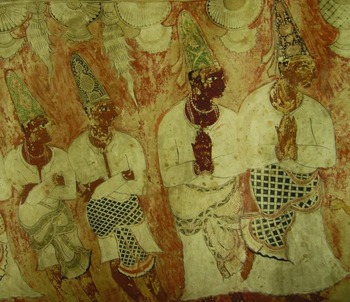
It has been argued that royal dress codes in Vijayanagara and the Nayaka-ruled states reflected the distinction between these two social categories, their respective associations, and Persianate influences in the public domain. The style of clothing at the courts in question has been recorded in various sources. For Vijayanagara, these sources include paintings, sculptures, and accounts of foreign travellers dating from the fifteenth and early sixteenth centuries. These sources often portray the emperors and their courtiers clothed in a long white tunic—known as a kabāyi—worked with gold (or other attire covering most of the body) and wearing a high conical cap called a kuḷḷāyi (see Figure 1). Those two types of garment are thought to have been of Arab and Persian origin respectively. When rulers and courtiers are referred to as wearing such dress in the sources, these men are usually involved in public duties like military processions, temple worship, and the reception of ambassadors. Likewise, among sources depicting royal dress in Tanjavur (or perhaps Madurai) is an indigenous painting on cloth, probably dating from the seventeenth century, which shows an unidentified Nayaka ruler in a kabāyi-like garment heading a military procession in a public courtyard. Notably, here the tunic is coloured rather than white, while the kuḷḷāyi is replaced with a turban.
Mural showing Vijayanagara courtiers, Virabhadra Temple, Lepakshi, sixteenth century. Source: the author.

In addition, another section of the same textile painting portrays the Nayaka being engaged in domestic activities, like enjoying musical entertainment and amorous pleasures. There we see him dressed in just a dhotī (cloth wrapped around the waist and legs) and a piece of cloth over his shoulders, while his bare chest and arms are exposed in a manner that can be considered traditional in South India. Hence, it has been concluded that this kind of dress was generally reserved for domestic situations, while Persianate attire was worn on public occasions. This finding should not surprise as it was precisely those public events that required rulers to demonstrate their familiarity with and connection to the wider Indo-Islamic world. Waging war, conducting diplomacy, touring the kingdom: these were all instances of political exposure to other rulers that required a broadly understood presentation.Footnote 15
The adoption of Persianate dress by South Indian Hindu kings, in Vijayanagara from around the mid fifteenth century, was closely linked to their use of Persianate royal titles. In addition to common South Indian imperial designations, the first Sangama rulers of Vijayanagara already included Indian transliterations of the Islamic term ‘sultan’ in their inscriptions. This practice continued until the seventeenth century under the empire's subsequent dynasties. Either used on its own or in the composite ‘Sultan among Hindu [or Indian] Kings’ (hindurāya suratrāṇa), the title was adopted for the same purposes as Muslim-style clothing. It signified the eagerness of these rulers to distinguish themselves from other kings and to be accepted and partake in the dominant Indo-Islamic political culture. The incorporation of these titles may even have led to the introduction of Persianate clothing. Manifesting oneself as a Sultan meant dressing like one and thus, on public occasions, forfeiting indigenous notions on royal attire. The traditional South Indian style of clothing, which revealed and accentuated the body, was viewed as inappropriate or even dishonourable in the Islamic world, where dress was supposed to fully cover one's body. Consequently, to be recognized as a sultan, a king had to present himself in clothing that resembled the Arab kabāyi. The use of such tunics at the Vijayanagara court was probably further encouraged by the influence of ceremonial practice widely carried out in the Islamic world that centred on dress gifting and was known as khilʿat. Garments like the kabāyi served as the principal gifts in an audience ritual that bound donor and recipient in a reciprocal relationship, the former acquiring legitimacy and the latter honour. At the Vijayanagara court, such clothing came to take prominence over traditional audience gifts.Footnote 16
In sum, Vijayanagara's rulers partially adapted their titles, dress, court etiquette, and other elements of court culture to Persianate conventions in order to enhance their status in the Indo-Islamic world. With regard to clothing, this concerned the use of white kabāyi tunics and high conical kuḷḷāyi caps. In the above-mentioned cloth painting depicting a Nayaka ruler, however, we observe a partial deviation from the imperial dress code, even though the dynasty was originally intimately linked to the Vijayanagara royal house. As noted above, the Nayaka had himself presented here at a public event in a long but coloured tunic and with a turban. We may wonder what caused this shift and whether the other successor states saw changes in this respect too.
Ambassadors on fashion
For our study of the development of royal dress at the successor courts, we first consider reports of diplomatic missions of the Dutch East India Company to various kingdoms in the region. These accounts appear to be rather useful because they regularly include notes about clothing worn by rulers at audiences, as observed by Company envoys. Although the Dutch first appeared in Indian waters at the turn of the seventeenth century, contact with most of the dynasties in question grew close only four to five decades later.Footnote 17 Surveying the known Company embassies to the four courts discussed in this study, counting only those involving Dutchmen rather than local brokers, we find the following minimum numbers and periods: Madurai, four (1645–89); Ikkeri, twelve (1657–1735); Ramnad, ten (1658–1759); and Tanjavur, seven (1645–1764). The meetings with the rulers of the latter kingdom almost all fell in the period of its Bhonsle dynasty. There were also several encounters between the Dutch and the monarchs during tours of the kingdom undertaken by the latter, as happened at least nine times in Madurai (1705–31),Footnote 18 once in Ikkeri (1738), and four times in Tanjavur (1725–41). In addition, we know of about five Company missions to Vijayanagara's Aravidu dynasts (1610–45) and two visits by the latter to a Dutch settlement (circa 1629, 1643). Finally, the successor states of Mysore and Senji (or Gingee) received respectively only one (1681) and about three (circa 1608–44) Company embassies.Footnote 19
Sadly, several of the extensive reports that were doubtless written about each and every meeting have not survived, which is the case with all embassies to Senji and Nayaka-ruled Tanjavur, and all but one to Vijayanagara. Furthermore, since there was really no need to do so, we are indeed lucky whenever Company envoys noted down anything concerning the clothes of the rulers they met—which unfortunately did not happen in the sole remaining report regarding Vijayanagara. Even more seldom are specific qualifications of dress styles, such as ‘Moorish’ or ‘heathen’. The term ‘heathen’ (heijden, jentief) was commonly used by the Dutch in India to denote Hindus (or more generally non-Muslim and non-Christian Indians) and things associated with them, as opposed to Muslims and Islamic matters, which were referred to as ‘Moorish’ (moors).Footnote 20 As can be seen below, Company envoys would occasionally use those two words to label types of clothing. We obviously cannot be sure of what exactly these terms meant to Dutchmen in each individual case, but given the fact that in our period the Company had been present in South India for more than half a century and many of its employees spent decades living and working in the region, the Dutch must have been rather familiar with the various local dress styles. What follows is a survey of all Dutch references to royal attire that are available to us. Together, they date from the period between the 1670s and the 1750s.
Madurai
We begin with the Nayakas of Madurai. Of the four royal houses under discussion, this dynasty appears to have been linked most closely to Vijayanagara because of its origin in a military position at the imperial court itself. The earliest Dutch report that refers to the clothing of these Nayakas concerns an embassy that took place from June to September 1689. To confirm the old treaties and friendship between Madurai and the Dutch East India Company, assistant and second-in-command Nicolaes Welter was delegated to Muttu Virappa III (r. 1682–91),Footnote 21 the ruler whom we encountered earlier in Mootiah's chronicle ordering his men to replace their long cloths and caps with Maratha-style attire. On 7 July, in the capital Tiruchirappalli, ambassador Welter was granted his first audience with the Nayaka.Footnote 22 As he reported:
I was brought with all our stuff and gift animals before His Highness. I found said ruler in a room open in front, sitting on a small alcatijff [al-katīf, carpet], wearing a white Moorish dress [wit Moors gewaedt] and pearl necklace (each one of them the size of a white pea) around the neck. The place where His Highness was seated was built 1½ feet above the front of the room. Its dome rested on several pillars, His Highness leaning against one of them. To the left and behind said ruler sat several court notables, while some servants were standing on both sides . . .Footnote 23
On what was clearly a well-attended, public occasion, the Dutch envoy apparently observed that dress he termed ‘Moorish’ was in use at the Madurai court under Muttu Virappa III. As it turned out during the same audience, however, not only the Nayaka was supposed to wear such clothing.
His Highness gifted me with a silver linen coat [rock] in the Moorish fashion [op zijn Moors gemaeckt] and a gold-wrought toock [headgear].Footnote 24 The ruler stated that, since I had come to his lands as envoy of the Hon[ourable] Company . . . to gift and greet him, he honoured me after their customs. In turn, Your Honours [Welter's superiors] could deal with and gift his visiting ambassadors in their [Your Honours’] manner. His Highness requested me to wear said coat and to put the toock on my head on the way to the residence, in which I obliged him . . . Thus, I returned outside, having paid my reverence, and departed, rigged out in Moorish fashion [op zijn Moors toegetaeckeld zijnde], to our lodging . . .Footnote 25
Welter, seemingly uncomfortable with what must have been a khilʿat ceremony, was spared this ritual when he secured a second meeting with the Nayaka on 18 July, during which only some courtesies were exchanged.
[I was] escorted before His Highness. He was three to four rooms deeper into the palace, where I found him the same way as the first time, though without any jewels or gold ware and without any of his councillors . . .Footnote 26
At this rather quieter and more intimate event in the palace's interior, Muttu Virappa III seems to have worn the same ‘Moorish’ attire as during the first meeting, although the jewellery was not now displayed. In any case, although Welter was granted a final audience in late August, he reported nothing else about the Nayaka's clothing during his embassy.Footnote 27
In fact, we have to wait until June 1711 before we find a Dutchman writing on the subject again. Around that time, Madurai's ruler Vijayaranga Chokkanatha (r. 1707–32) was touring his kingdom. On 2 June, the Nayaka and his retinue stayed in Melur on the outskirts of the port town Tuticorin, an important Dutch settlement, while on 5 June he encamped at Athur, some 20 kilometres south. On both days, the Company senior merchant (opperkoopman) and chief administrator Swen Anderson, delegated to renew the Dutch–Madurai treaties after conflicts with local regents, had an audience with the king. Each of the meetings was a well-attended, public occasion, with Vijayaranga Chokkanatha sitting on a platform under a canopy, surrounded by several courtiers and, at some distance, lots of commoners. Under both dates in the diary of his trip, envoy Anderson noted that the Nayaka was wearing ‘Moorish’ clothing—described respectively as red damask in a ‘Moorish’ manner and as ‘the Moorish garb’ (’t Moorsch habijt)—as well as jewellery, consisting of pearls and heavy golden chains.Footnote 28 Apparently, at the two encounters with the king during this Company mission, he appeared in more or less the same kind of dress, perceived by the Dutch as being ‘Moorish’ in style.
The third and last observation in the Company records of kingly attire at Madurai dates from June 1720, when the same Nayaka travelled to the coast once more. Upon Vijayaranga Chokkanatha's arrival in Melur on the first day of that month, the local Dutch chief (opperhoofd), Joannes Jenner, was requested to pay a visit to the king in his camp that same day. In the Company diary kept at Tuticorin, Jenner's appearance before the Nayaka was recorded as follows:
[T]he chief [Jenner], alighting his palanquin, walked through the crowd to the tent of His Highness, finding just inside the tent the great land regent Coemaren Swamie Modliaar [Kumara Svami Mudaliyar], who having welcomed the chief conducted him before His Highness, being dressed in a Moorish way [op zijn Moors gekleed], decked with costly jewels encrusted with gemstones, sitting on a poejaal [pial or poyal, raised platform] or small stage [theatertje], covered with an alcatijf [carpet], under a set of lights and torches . . .Footnote 29
The diary goes on to explain how various court nobles were seated at specific positions around Vijayaranga Chokkanatha. At the end of the meeting, consisting of little more than the presentation of gifts to the Nayaka, Jenner was presented with a few gifts too, including a so-called ‘Moorish’ turban with golden bands, which was tied around his head.Footnote 30 This was obviously another public audience, in the presence of several courtiers and with many people crowding around the Nayaka's tent. Once more, this Dutch account suggests that such an event required the king to wear both ‘Moorish’ clothing and expensive jewellery. Besides, chief Jenner underwent a khilʿat-like ritual, rather similar to the ceremony grudgingly endured by his fellow Dutchman, Welter, in 1689.
Considering the three cases described above, dating from a period of over 30 years, the many similarities between them indicate that what was called ‘Moorish’ clothing remained in use among Madurai's Nayakas at public audiences well into the eighteenth century, at least as various Company envoys interpreted it. We may therefore be inclined to assume that Persianate dress of some kind was in fashion at the Madurai court all this while. This supposition is further supported by the fact that both ambassador Welter and chief Jenner were made to wear similar attire at these meetings, reminding us of khilʿat etiquette. That this in at least one case included a turban wrapped in ‘Moorish’ fashion suggests that the high conical kuḷḷāyi caps worn at the Vijayanagara court had come to be replaced by Persianate-style turbans in Madurai.Footnote 31
In addition, jewellery appears to have been an important element of royal presentation whenever the Nayakas granted public audiences, but much less so (or even not at all) at the one audience that had a more intimate character, namely Welter's second meeting with Muttu Virappa III. In Madurai, but also elsewhere in India, jewels were associated with royalty, used by rulers to distinguish themselves from other dynasties, and expected to be worn whenever one appeared at court.Footnote 32 Welter's report seems to underline that the function of jewellery was generally similar to that of Persianate dress: to be seen at public rather than domestic occasions. Accounts of audiences with Madurai's Queen Mangammal (r. 1691–1707) in July 1705 and with Vijayaranga Chokkanatha in June 1717, both near Tuticorin during royal tours of the kingdom, further underscore the importance of jewellery at public events. While the Company reports in question are silent about the rulers’ dress, they specifically mention the large quantities of gold and jewels the monarchs were wearing.Footnote 33
Ikkeri
After the Nayakas of Madurai, we turn to those of Ikkeri. This dynasty was also a direct successor of the Vijayanagara court in the sense that its founder was installed by the empire's rulers. But since these Nayakas had local origins rather than a background at the imperial court, Vijayanagara's link with Ikkeri may have been less intimate than the one with Madurai. Besides, as it bordered on the Bijapur Sultanate during much of its existence, Ikkeri could have borrowed Persianate conventions directly from this neighbour in addition to being influenced indirectly through the Vijayanagara court. Unfortunately, we have rather few Dutch references to the clothing of these Nayakas at our disposal. The most substantial observation was written down by junior merchant (onderkoopman) Corijn Stevens in the report of his embassy to Somashekara Nayaka II (r. 1713–39) in February 1735.Footnote 34 Stevens had been sent to Ikkeri as an envoy of the Dutch East India Company with the aim of rebuilding relations after a violent clash about a year before.Footnote 35 In the course of his stay in the capital Bednur he secured two audiences at the court. The following excerpt from the report relates the Dutchman's appearance before the Nayaka during the first audience, when he presented gifts to Somashekara II and his courtiers:
. . . without shoes, I approached the king, who was sitting in a raised armchair of three steps, covered high with some Souratse [Surat] golden cloths, keeping between his legs a sword of which the sheath was gilded, being dressed in Souratse cloths, on his head a turban set with gold, wearing around his neck a few pearls and golden necklaces, and on his fingers some rings encrusted with diamonds, standing behind him a crowd of servants, and on both sides sat several state nobles and highly ranked people [rijxgrooten en staaten] . . .Footnote 36
As with the Dutch descriptions of Madurai's rulers above, Somashekara II's dress, headgear, and jewellery are all mentioned in detail. But ambassador Stevens apparently did not wish to further categorize this Nayaka's attire as ‘heathen’ or ‘Moorish’. And the word ‘Surat’ likely refers here to the kind of textiles produced and traded at the major Mughal port of that name in northwest India, rather than to a Mughal or Persianate style of dress. In any case, we notice that Somashekara II was wearing a turban worked with gold and several pieces of expensive jewellery, and was accompanied by a sword. All these elements of the Nayaka's presentation were apparently required at what was clearly a public audience, attended by many courtiers and servants.
The few other Dutch mentions we have of Ikkeri's royal dress, all also concerning Somashekara II, are even less specific. Two of them pertain to the same embassy of Corijn Stevens in January–March 1735. During his five-week sojourn at Bednur, the envoy met the Nayaka twice in front of his lodging, when the latter happened to pass by with his retinue of court nobles, soldiers, musicians, dancing girls (baljaer meiden), and various animals. On both occasions Stevens was obliged to stand outside and greet the king. Mounted first on an elephant and later on a black horse, Somashekara II was dressed in white garments (in het wit gekleed and uitgedost in witte kleederen), as the Company envoy recorded. No mention was made of jewellery, however.Footnote 37 In addition, a relevant reference is found in the report of a mission to the same ruler in October–December 1731, led by bookkeeper and resident Abraham Gosenson. This envoy wrote that at the first audience Somashekara II sat outside his residence in an armchair in ‘his entire garment and clothing’ (sijn gantsche gewaed en cleding), surrounded by courtiers and facing a crowd. At the final audience, about two weeks later, the king appeared dressed in the same manner.Footnote 38 Again, these were all public events, at which Somashekara II wore attire which at least twice was white and in most cases seems to have been elaborate rather than simple, considering the use of plural forms, repetition, and terms implying full clothing in the envoys’ descriptions.
In sum, the few Dutch references to kingly attire in Ikkeri are rather ambiguous. Yet, they suggest that on public occasions its rulers were usually dressed in long, white clothes, pointing to Persianate rather than traditional, ‘Indic’ garments. Further, these Nayakas usually seemed to wear turbans (rather than kuḷḷāyi caps) and jewellery, and keep a sword with them. The use of Persianate dress at Ikkeri appears to be confirmed—at least for an earlier period—by the Italian traveller Pietro Della Valle, who visited the kingdom in the 1620s and described several courtiers as being dressed in long, white, coloured, and even what he termed ‘Persian-style’ clothes.Footnote 39
Ramnad
The third dynasty we discuss here are the Setupatis of Ramnad. The bonds between the royal houses of Vijayanagara and Ramnad were much less direct than those between the imperial dynasties and the Nayakas of Madurai and Ikkeri. Installed by the Madurai kings, the Setupatis were only indirect successors of Vijayanagara's rulers. Fortunately, their clothing at audiences can be studied relatively well on the basis of Company records. We have three mission reports that contain relevant details, which we discuss in chronological order. The first of these embassies took place in November 1736, when Resident Wouter Trek was dispatched to the capital Ramanathapuram to greet the new Setupati, Sivakumara Muttu Vijaya Raghunatha (r. 1735–48).Footnote 40 On 4 November, Trek was invited for the opening audience, arrived at the first palace gate, and—after being nearly suffocated by a crowd of excited onlookers and rescued by the club-wielding captain of the palace guard—was brought inside. As the envoy wrote in his report:
[I] was guided before the young king, who sat, dressed in a Moorish way [op zijn Moors gekleed] and decked with some jewels, on a large outspread alcatijf [carpet], accompanied by his courtiers. As I approached, I greeted His Excellency in the Hollanders’ manner, who responded to me in the Moorish way [op de Moorse wijse] and signalled with the hand to sit down . . .Footnote 41
As with most opening audiences in South India, this meeting was meant only for the presentation of gifts to the king and his court nobles. Soon after this was done, Trek was asked to take his leave again, given some minor gifts, and covered with a finely woven cloak (?, ‘sadre’) of silk and gold. Although the envoy did not note down anything about the Setupati's dress at the second and last audience on 7 November, from his account it would seem that in this period both Persianate—or at least what was perceived as ‘Moorish’—clothing and court etiquette, as well as jewellery, were in use at Ramnad's public audiences.Footnote 42
A few years later, in June–July 1743, another embassy was sent to Sivakumara Muttu Vijaya Raghunatha, this time at the king's request to renew the Dutch–Ramnad treaties.Footnote 43 The Company envoys, Johannes Krijtsman and Francois Danens, secured their first audience on 26 June. After their reception at the palace gates by various courtiers, they were escorted inside the complex, where, according to the mission's diary:
. . . [we] were brought before the young king, who was dressed in a heathen way [op zijn heijdens gekleet], having a white turban on the head and further a white muslin [bethieljes] cloth with golden borders hanging over the shoulders, having a large sword [houwer] clasped with gold lying before him, being seated on an old outspread alcatijff [carpet], surrounded by some bodyguards [lijfftrawanten] of the royal caste [ragias kaste], furthermore on the right and left hand below him sitting some prominent princes and court nobles . . .Footnote 44
This passage may surprise us. Less than seven years after the embassy of Wouter Trek to the ‘Moorish’-dressed Sivakumara Muttu Vijaya Raghunatha, this very same Setupati was now said to present himself in ‘heathen’ clothes, even though this was a public audience. Although ‘heathen’ was a somewhat ambiguous term, it seems that the Dutch envoys meant to say the king was dressed in local, traditional style, and apparently not following Persianate conventions on royal attire. The reference to the piece of cloth that was put around the king's shoulders would further substantiate the conclusion that he was bare-chested. At the second and last public audience, on 29 June, the envoys’ observations of the Setupati were largely similar.
. . . the king, whom we found sitting in that same appearance [postuur] as the first time, having a large, round, and long white cushion lying behind his back, that was certainly grubby and dirty [morsig en vuijl] but not in the least regal . . .Footnote 45
While ambassadors Krijtsman and Danens may have thought the scene to be lacking dignity, to us this description indicates that the Setupati's allegedly local dress at the first meeting was not a one-time event. During both public audiences Sivakumara Muttu Vijaya Raghunatha chose to appear in what the Dutch considered ‘heathen’ attire. We should also note the repeated mention of a large and costly sword near the king.
The third and final mission to Ramnad we discuss was dispatched from June to July 1759. This time, junior merchant Joan Richard François and Lieutenant Johan Hendrik Medeler were delegated to the Setupati Sella Tevar (r. 1749–63), with the aim of making him ratify a new treaty.Footnote 46 Having arrived in the kingdom's capital on 26 June, the envoys were given their first public audience on 30 June. After a grand military reception at the various gates of the town and the palace, François and Medeler passed the court's innermost gate and entered a square where they were welcomed and hugged by two courtiers. In a pavilion on that square, the embassy's diary reports:
. . . sat the Theuver [Tevar, the Setupati], leaning with the back on a round thick cushion, the head covered with a turban in the Marruasse [Maravar] way, and hanging around the shoulders a fine muslin [neteldoek] with golden borders, his largest jewel being two costly pendants in the ears, and just flaunting a large golden betel box [?] and similar spittoons [quispidoors] . . .Footnote 47
Although the Dutch ambassadors did not use the term ‘heathen’ here, it seems that King Sella Tevar by and large appeared in the same kind of dress as his predecessor some 16 years before. Again, a piece of muslin was put around the Setupati's shoulders, probably leaving parts of his chest and arms exposed, while his turban was described as being in so-called Maravar fashion, referring to the Setupatis’ caste and apparently denoting an indigenous style. Jewellery and other golden objects as well as a large cushion also formed part of the king's presentation once more.
The next evening, the envoys François and Medeler met the Setupati again as they were invited to watch a display of fireworks with him on the occasion of the wedding of an important courtier. At this public event, attended by thousands of people, Sella Tevar's clothing style proved harder to define, as he was:
. . . graciously dressed up in a Pattanijs [Pathan] robe, the head covered with a beautiful turban of golden cloth, two singular pendants hung in the ears, being two pompous emeralds of reasonable size, and decorated around the neck and arms with broad, flat, and heavy golden chains. Beside lay a costly golden sword and belly-dagger [buiksteker (katāra?)], the latter encrusted with gemstones, which he, one after the other, took in his hand to show all the better a costly large ring on the little finger of his right hand, which he turned around several times . . .Footnote 48
Obviously, jewellery and weapons again played an important role in the king's appearance. It is uncertain what kind of turban Sella Tevar was thought to be wearing on this occasion, however, but his robe is described as Pathan, a term we would associate with Afghan or more generally Persianate dress.Footnote 49 In any case, there are no other mentions of the Setupati's clothes as the section of the diary dealing with the final audience of this mission is silent in this regard.Footnote 50
Based on this fair number of Dutch descriptions over a time span of almost 25 years, we may notice a certain development in royal dress at Ramnad. At the beginning of this period, what seem to have been Persianate attire and etiquette were reportedly still used by the Setupatis. This practice apparently changed in the following decades, however, as is suggested by the various public audiences granted by Ramnad's kings in what the Dutch labelled ‘heathen’ clothing and Maravar-style turbans. Nevertheless, it appears that Persianate dress was not entirely done away with, since the Setupatis would still occasionally present themselves in attire associated with the Indo-Islamic world, albeit wearing turbans instead of kuḷḷāyi caps. At the same time, other aspects of royal representation at audiences remained of great importance. As in Madurai and Ikkeri, items such as expensive jewellery and valuable weaponry were prominently displayed on public occasions.
Tanjavur
Having replaced the erstwhile Nayakas, Tanjavur's Maratha Bhonsles were not direct political heirs to the Vijayanagara court. Therefore, the empire's Persianate notions on royal dress would have influenced the Bhonsle house only indirectly.Footnote 51 Moreover, as explained, the founder of this dynasty was initially a high military commander under the Sultans of Bijapur. Therefore, Persianate conventions at Tanjavur in this period may also have derived from the Bijapur court.
The Dutch East India Company records contain just one reference to kingly attire in Tanjavur. This occasion concerned an embassy dispatched in November 1735. The envoys Arnoldus Oosterharen and Wouter de Jongh, both junior merchants, had been sent to Ekoji II (r. 1735–6) to congratulate him on his recent accession to the throne.Footnote 52 On 10 November, one day after their arrival in Tanjavur town, the ambassadors were received at the palace for their only audience. As the mission report goes, they were escorted through nine gates, reached a courtyard where they took their shoes off, and:
. . . proceeding in this way, [we] came into the hall and before the said King Ekogie Ragie, seated under a canopy on a bed hanging from four silver chains one foot above the ground, being continually and gently swung by eight fresh youngsters. The king, a well-formed man, 28 years old, was dressed in a long coat of white fine muslin [een lange rock van wit fijn neteldoek] and on his head also likewise a turban, on which stood a toeraaij [turra, turban jewel] wrought with gold, encrusted with many precious stones as a sign of his regal highness, with a staff [sceptre?] in the right hand, and a bunch of golden chains and coral strings around the neck, and rings around the arms . . .Footnote 53
In addition, the report of a much earlier embassy, although not mentioning anything about royal clothing, is also useful for its fairly detailed description of the khilʿat ceremony undergone by the Dutch envoys.Footnote 54 Dispatched to sign a new treaty with Ekoji I (r. circa 1676–84), merchant Thomas van Rhee and secretary Pieter Outshoorn Sonnevelt reached Tanjavur on 29 December 1676. Their sole audience took place the next day, with Ekoji being accompanied by his three sons and several courtiers. The meeting was concluded when the king:
. . . had the tasserijven [tashrīfs, marks of honour] installed, and let me [envoy Van Rhee] and the council's secretary Sonnevelt be dressed in a cottoned silken coat [rock] and tied with a turban around the head and commerbant [kamar-band, waist belt] around the body, and this way we were guided outside the court amid singing and as many as 20 musical instruments . . .Footnote 55
As in the case of Ikkeri, royal dress at Tanjavur was never called ‘Moorish’ or ‘heathen’ by Company envoys and is therefore especially hard to classify. Even so, the quoted passages suggest that, at least until the early decades of the eighteenth century, dress at the Tanjavur Bhonsle court was rather similar to kingly attire in Ikkeri: long tunics and turbans. Besides, several objects used in the khilʿat ritual were identified with Arabic and Persian terms: tashrīf and kamar-band.Footnote 56 Hence, it seems that Persianate notions on clothing and etiquette were followed to some degree during audiences at Tanjavur's Bhonsle court.
Considering all these Dutch observations of royal dress at audiences in the four Vijayanagara successor states between the 1670s and 1750s, we may note several points. At each court, rulers regularly appeared at public events in attire that was labelled ‘Moorish’ by Company envoys themselves or otherwise described by them in ways that may be associated with Persianate clothing styles. The Dutch records often speak of long, white garments, usually worked with gold, reminding us of the kabāyi worn in Vijayanagara. None of these sources, however, mention anything similar to the kuḷḷāyi cap, but unanimously point to turbans (of various types) as the sole royal headgear in use during audiences. Only for the court of Ramnad during the later period do Company accounts repeatedly characterize kingly attire in a manner that appears to denote a style largely devoid of Persianate elements. Employing the terms ‘heathen’ and Maravar, these reports seemingly suggest the use of traditional dress. Interestingly, all those cases concern public occasions, where one might expect Persianate rather than traditional clothing. Further, these references all date from the 1740s and 1750s, when Maratha forces from western India campaigned in the region around Ramnad while the kingdom maintained a level of autonomy from adjacent powers. We may thus notice a change in Ramnad that seems to set it apart from the other courts, as royal attire at public events appears to have grown more diverse, possibly connected to the political developments in the region at that time.
Additionally, we have seen one instance of an audience in Madurai that took place not at the main reception hall but in a more interior section of the palace, in the absence of courtiers and without the jewellery kings usually wore at diplomatic meetings. Apparently, audiences could be of different kinds—reflected in location, company, and royal display—which variation to some extent may remind us of the distinction made in South India between ‘domestic’ and ‘public’ spheres. After these tentative observations based on Company reports, we now turn to South Indian sources on kingly dress, beginning with two images in Ramnad that show royal audiences granted to European ambassadors.
Walking along battles and audiences
In Ramanathapuram, capital of the erstwhile Ramnad kingdom, the royal palace of the Setupati dynasty still stands. Constructed from the late seventeenth century onwards, the palace complex includes an imposing audience hall, which contains even more impressive murals. Known as the Ramalinga Vilasam, the hall was probably built in around 1700 by Kilavan Tevar (r. 1673–1710), one of the more powerful Setupatis. His successor Tiru Udaya Tevar—better known under his regnal name, Muttu Vijaya Raghunatha (r. 1710–25)—is credited with commissioning the extensive paintings that adorn the Ramalinga Vilasam's inner walls and ceilings. Arranged in various sections, they show military and political events, scenes with Hindu deities, court life, and amorous encounters.Footnote 57 Although such murals were executed in several southeast Indian palaces, those in Ramnad are thought to be the only surviving paintings at such a location that predate the nineteenth century.Footnote 58
As soon as we pass through the gate of the Ramalinga Vilasam and enter the building's first and largest hall, the murals come into view. On the left-hand (or south eastern and southern) side, we first see a group of paintings depicting scenes from a battle between Ramnad and Tanjavur, which reveal when the images were executed. A text below these murals, written in Tamil, declares that this battle was fought between King Muttu Vijaya Raghunatha and his Tanjavur counterpart Sarabhoji (r. 1711–29).Footnote 59 Therefore, the paintings probably represent a war that was waged between Ramnad and Tanjavur in 1715. Even though the latter kingdom was supported by the Danish East India Company, Muttu Vijaya Raghunatha claimed to be victorious, writing to the Dutch that he had slaughtered Tanjavur's commanders—a feat certainly worthy of commemoration on the palace walls.Footnote 60 If the murals do indeed show this conflict, they would date from any time between 1715 and 1725, the period between the war and Muttu Vijaya Raghunatha's death.Footnote 61
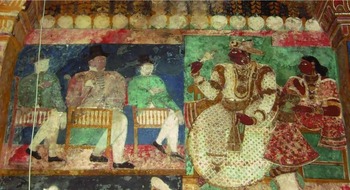
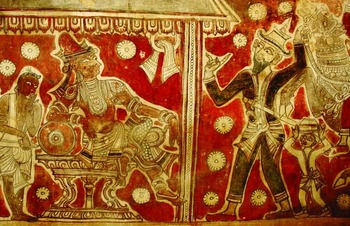
When we walk a few steps further along the south wall of the Ramalinga Vilasam, we arrive at another set of murals. These depict several royal audiences involving the Setupati, probably Muttu Vijaya Raghunatha again, as he meets with various courtiers and other dignitaries.Footnote 62 In one of these paintings we see the king, with a queen behind him, seated on a chair and conversing with three European officers, likely to be envoys of one of the European powers present in the region (see Figure 2). As in the other murals at this location showing audiences, the Setupati is dressed in a long, whitish garment that fully covers his body and seems to be worked with gold. In addition, he wears an elaborate turban, some sort of shawl, a vast amount of jewellery, and is barefooted. In his left hand, he holds what is likely to be a jewelled katāra (Indian dagger with the hilt attached crosswise to the blade). The object in the king's right hand appears to be a sceptre (ceṅkōl) in the form of a stylized bouquet.Footnote 63 The queen carries a miniature human figure (also clothed in a long garment and a turban) that probably represents an infant prince.Footnote 64 Seated to the Setupati's right (left on the image), the Europeans are dressed in European clothes: single-colour, hip-length buttoned coats with braiding, white trousers, black hats, and black closed shoes. The middle envoy holds an object in his right hand that is not clearly visible due to the mural's weathering. All adults sit on European-style chairs, with the royal couple's feet resting on cushions.Footnote 65
Mural depicting the Setupati receiving European envoys, Ramalinga Vilasam (main hall, south wall), Ramanathapuram, circa 1715–25.

Examining the Setupati's dress depicted in this mural, we may note two things. First, his clothing appears to be largely similar to the aforementioned Persianate attire of the Nayaka portrayed on the textile painting. Both monarchs are shown in long tunics and turbans, although the Setupati's clothes are white instead of coloured while his turban is tied in a different way, seemingly resembling a style associated with Marathas.Footnote 66 Second, the Setupati would thereby seem to adhere at least partially to Persianate royal dress codes.Footnote 67 According to the theory on such dress codes explained above, these observations should not surprise us. As mentioned, the Setupatis were installed by the Madurai Nayakas, both royal houses maintained close relations, and the conventions on clothing of the latter dynasty are likely to have influenced those of the former. That it was decided to display the Setupati in this particular mural with what seems to be Persianate rather than traditional clothing is logical too, if we follow the abovementioned hypothesis, which has it that a garment covering the full body was expected in situations of a public nature. The occasion here appears to have concerned a diplomatic encounter between the king and foreign ambassadors. Regarded as a public event, such an audience would require the Setupati to be dressed like a Sultan, or in any case as a ruler appropriately clothed to partake in the Indo-Islamic world, even when he was among Europeans.
Several explanations have been offered on how exactly Persianate conventions about clothing and other politico-cultural manifestations were transmitted to Ramnad. It has been put forward, for instance, that such notions reached the kingdom from the Deccan Sultanates and the Mughal empire, albeit in an indirect way.Footnote 68 In this view, these practices were initially incorporated by the courts of Madurai and Tanjavur, mostly through the immigration of painters and other artists in the sixteenth and seventeenth centuries. This was a consequence of the fact that these kingdoms were tributary to or received military assistance from the Deccan Sultans and the Mughals at some point. Subordinated to Madurai until the late seventeenth century and often dominated by Tanjavur in the subsequent decades,Footnote 69 Ramnad would in turn have borrowed these customs from its neighbours. Another theory proposes that the growing power of nearby Muslim-ruled Arcot—an offshoot of the Mughal empire—in the early eighteenth century was instrumental in the use of Persianate dress at the Ramnad court.Footnote 70 Though not specifically referring to clothing, yet another study points at Islamic influences that came from Ramnad itself, as it harboured a powerful community of Muslim merchants. It is suggested that their strong presence at the Setupati court helped it assume certain Persianate overtones (here referred to as ‘Sultanist’), particularly in the field of political and military organization.Footnote 71 Of course, these various explanations do not necessarily exclude one another. Neither do they contradict the more general theory that Vijayanagara adopted politico-cultural conventions from Sultanate courts and passed these on to its successors, including Ramnad.
A domestic reception
Having noticed certain similarities between Ramnad and other South Indian courts with regard to royal dress, we resume our walk in the Ramalinga Vilasam and pass various murals with scenes involving Hindu deities. Leaving the building's large main hall and ascending a few steps, we enter a much smaller second room, where more Hindu images are found.Footnote 72 Finally, we reach a middle-sized third space, again slightly raised, serving as the lower floor's back room, and containing a staircase to the one room on the upper floor. This ground-floor back room is filled with columns that are joined by arches. Looking up at the undersides of these arches, we see a group of paintings of the Setupati involved in various courtly duties and leisure activities. One of the images includes a text in Tamil that identifies the portrayed king as Muttu Vijaya Raghunatha again and another figure as Vijayaranga Chokkanatha Nayaka of Madurai (r. 1707–32). Apparently, even by this time some kind of bond between the dynasties of Ramnad and Madurai was still perceived to exist. Both the Setupati and the Nayaka are shown here in what looks like Persianate dress.Footnote 73
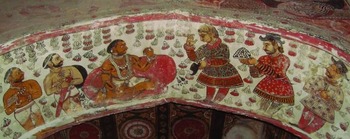
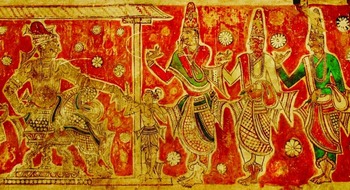
Another of these arch murals merits a second long break in our walk. Located right in front of the back wall of the Ramalinga Vilasam, and thus at the furthest possible distance from the building's entrance, the painting in question also depicts the Setupati as he receives three European envoys for an audience (see Figure 3). Compared with the mural showing the king's meeting with Europeans in the Ramalinga Vilasam's first room, however, this picture is strikingly different in several respects. Rather than sitting in a chair, the Setupati is seated cross-legged on a small platform that is raised a few inches above the ground and covered with cloth. Leaning against a large cushion, with his left hand he is probably greeting his visitors or signalling them to speak. In his right hand, the Setupati carries what in all probability is a jewelled katāra again. Standing behind the king are two courtiers, one of whom appears to hold a sword in its sheath, while the object kept by the other is difficult to identify, but might be some kind of medium used for writing, perhaps a book, tablet, or copper plate. To the Setupati's left (right on the image), the Europeans are now standing rather than sitting before him, the first two bowing slightly forward. The envoy in front has taken off his hat and salutes the king, while the second one seems to present him some gift.
Mural depicting the Setupati receiving European envoys, Ramalinga Vilasam (back room, arches), Ramanathapuram, circa 1720.

In terms of dress, the difference between the two murals may be even more remarkable. Instead of a long garment covering the full body, the Setupati, as well as his courtiers, wear just white dhotīs with ornamental bands or red borders, together with small black turbans and jewellery. Their chest, arms, shoulders, and lower legs are all exposed. Furthermore, a multi-stranded thread is loosely wrapped around the king's torso, probably representing the upavīta, or consecrated cord worn by adult male members of higher castes. Here the Europeans are also dressed in a style that differs considerably from their attire in the earlier image. They wear knee-length, multi-coloured tunics decorated with floral patterns, coloured trousers, and coloured open shoes. Only their black hats are similar to those depicted in the other mural. Besides, the two leftmost Europeans appear to be wearing short-sleeved clothes over long-sleeved ones. Finally, most men (both Indian and European) sport beards in various stages of growth, with the European envoy in the middle looking particularly ‘unshaven’. In contrast, although difficult to see, none of the men in the audience mural in the Ramalinga Vilasam's first room seem to show any trace of a beard.
Judging from the way the Setupati and his courtiers are portrayed, it seems this audience scene depicts an occasion that we might largely associate with the ‘domestic’ domain. This may surprise us, considering the aforementioned hypothesis that South Indian rulers would prefer Persianate clothing in situations deemed to be public, such as diplomatic events. While the first audience mural we encountered in the Ramalinga Vilasam fits neatly into this proposed pattern, we now find a painting in the same building showing the Setupati granting an audience in traditional dress. We wonder how this disparity can be explained. Were the murals executed in different periods? Do their separate locations in the building mean the images are wholly unrelated to one another and should not be compared in the first place? Were they created by artisans independently working with varying ideas about royal representation? Unfortunately, these questions will not get us very far.
With regard to the time of their execution, each mural belongs to a clearly demarcated and internally related section of images. Both these sections are linked to the reign of Muttu Vijaya Raghunatha (1710–25) based on textual evidence concerning one of the paintings within each section. It is therefore unlikely that the two murals we are looking at were created more than about a decade apart. Moreover, the various groups of paintings are thought to all be closely related to one another. They have been arranged in the Ramalinga Vilasam in a specific sequence so as to present a thematic progression, which suggests all murals were designed as part of a single programme. We may therefore assume that the dissimilarities between the two audience images have not been caused by a substantial difference in time—nor, for the same reason, by independently operating craftsmen.
The fact that the audience murals are found in separate locations does not yield an entirely satisfactory explanation either. As mentioned, the groups of paintings are thematically organized. They represent multiple facets of South Indian kingship, associated with various degrees of ‘interiority’ or ‘exteriority’. We encountered this classification earlier when we discussed the two complementary social realms in South India found, for example, in literature and architecture. Expressed by way of particular kinds of action, company, representation, and the like, this division is related to the distinction between domestic and public occasions. In the Ramalinga Vilasam, the groups of paintings depicting events considered ‘exterior’ or public—for instance battles and audiences—are situated in the large first room, near the entrance, obviously the structure's most exterior and public section. If one moves further into the building, climbing shorter or longer stairways, the spaces become progressively more interior and domestic as do the scenes in the murals. Eventually, one reaches the only room on the upper floor, where most paintings show the Setupati engaged in erotic pleasures, clearly the most ‘interior’ and domestic part of the Ramalinga Vilasam.Footnote 74
As noted above, the mural depicting the sole audience hosted by the king in traditional dress is placed on an arch near the back wall of the third room on the lower floor. This location may be considered a relatively interior, domestic section of the building or at least a kind of transitional zone between the two social spheres. Whereas images involving Hindu deities are found on this room's walls, several paintings on the two dozen arches depict domestic scenes. These include courtesans and other female figures engaged in various activities, amorous encounters, a meeting between the Setupati and his tutelary goddess, and the king listening to recitations from the Rāmāyaṇa epic. Several arch murals show the king dressed in traditional, ‘Indic’ style. Hence, considering this location, it makes sense that in the audience mural placed here the Setupati wears indigenous clothing too. But then other paintings on the arches present him in Persianate attire, which makes one wonder why the audience mural here does not portray him in such clothes.Footnote 75 All in all, the question remains why a supposedly public event like the reception of foreign envoys was depicted in a comparatively interior spot in the Ramalinga Vilasam, with the king foregoing the supposed Persianate dress code for diplomatic affairs—especially so because another mural showing a comparable situation was placed in a very public location, with the king appropriately dressed for the occasion. Perhaps a clue to the answer lies in the likely identity of the foreign envoys who were granted those audiences with this Setupati.
Dutchmen in the Setupati's backroom?
We will probably never know for sure whom exactly the artisans had in mind when they painted those European figures. The few texts accompanying the murals are silent on this matter, while other contemporary sources concerning the paintings appear to be non-existent. Nevertheless, it would seem logical that the painters modelled these foreigners on the nearest available examples. It has variously been suggested that the portrayed Europeans represent Portuguese Jesuits, or perhaps Frenchmen or Dutchmen.Footnote 76 However, during the rule of Muttu Vijaya Raghunatha, when the paintings were produced, only the Dutch East India Company maintained a permanent presence in Ramnad. By the time this Setupati ascended the throne in 1710, the Dutch had been more or less the only Europeans active in the kingdom for almost two decades.Footnote 77 In fact, since 1690 they had been living in Ramnad permanently, after Kilavan Tevar had allowed the Company to set up a trading factory at the port of Kilakkarai, only a few hours from the capital.Footnote 78 Therefore, when the murals in the Ramalinga Vilasam were created, unlike other Europeans, the Dutch had long been familiar faces, staying close to the Setupati court and, as we saw before, appearing there quite regularly on diplomatic missions to the king.
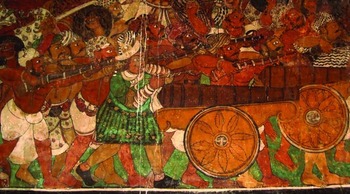
The court's close links with the Dutch are also demonstrated by another European figure depicted in the Ramalinga Vilasam paintings, this time in the aforementioned scene of the battle between Ramnad and Tanjavur (see Figure 4). Here, on the immediate left after the building's entrance, we see a European soldier—dressed in a green-blue suit, black footwear, and a white hat—fighting on the side of the Setupati and manning a cannon on wheels. It has already been suggested that this figure represents a Dutchman because the Setupatis often asked the Dutch East India Company for military assistance, although usually in vain.Footnote 79 Like Madurai's Nayakas, they were rather impressed by Dutch military skills, defence works, and weaponry.Footnote 80 In fact, during a Company mission to Muttu Vijaya Raghunatha himself in 1724, this very Setupati asked the envoys whether one of the accompanying Dutch soldiers was capable of manning cannons.Footnote 81 It is therefore probable that the European figure portrayed in the battle scene is a Dutchman.Footnote 82
Mural showing a battle, including a European soldier, Ramalinga Vilasam (main hall, southeast wall), Ramanathapuram, circa 1720.

Considering the long-lasting, strong, and unrivalled Dutch presence in Ramnad and the probable identity of the European soldier in the battle-scene mural, it appears rather likely that the Europeans shown in the Ramalinga Vilasam's audience murals represent envoys of the Company. With this assumption in mind, we may ask whether Dutch ambassadors themselves documented anything about audiences with the Setupati that had a private or ‘domestic’ rather than a ‘public’ character. We therefore again turn to reports of diplomatic missions dispatched by the Dutch to the Ramnad court. If we search the records of the Dutch East India Company, we come across only one report of an embassy to Muttu Vijaya Raghunatha, the Setupati responsible for the execution of the palace murals.Footnote 83 This mission took place from February to May 1724, when the king held court in the northern frontier town Arantangi instead of the capital, probably to defend himself against the imminent Tanjavur-backed invasion by his competitor, Bhavani Sankara. The following April, however, still residing at Arantangi, Muttu Vijaya Raghunatha died.Footnote 84 It is unlikely that he would have commissioned the Ramalinga Vilasam paintings in the short period of less than a year between the mentioned Dutch embassy and his death in 1725, during which time he seems to have been largely absent from the capital. The murals were most probably painted before this mission and therefore the report in question does not appear to be a relevant source in this context. Moreover, this document does not refer to any meeting with the Setupati of a private, intimate nature.
The previous Company embassy to Ramnad was dispatched from May to July 1709, when Kilavan Tevar was still king. This mission may thus also have been too early and hence insignificant for our research, but let us nevertheless examine the lengthy report of this trip to the Setupati court.Footnote 85 It states that on 28 May, merchant Cornelis Taaij and bookkeeper Barent Gast arrived in the kingdom's capital Ramanathapuram. As ambassadors of the Company, Taaij and Gast were instructed to secure an audience with Kilavan Tevar and complain about servants of the Setupati who had violated a treaty between the Dutch and Ramnad.Footnote 86 The following morning was spent with courtiers discussing an appropriate moment for their first audience with the king. In between these consultations, however, the Dutch envoys received news that the 70-year-old and apparently blind and demented Kilavan Tevar was more or less permanently drunk. Nevertheless, the next day Taaij and Gast were invited for an audience, and although they feared that a meeting with an intoxicated king would be entirely useless, they proceeded to the palace. On the way, six or seven messengers from the court, one after another, came to see the envoys, announcing the Setupati's desire and impatience to meet them. But upon arrival at the palace, they found Kilavan Tevar somewhere outside in the hot sun, blind drunk and causing a great commotion among the gathered people, while nothing had been prepared to receive the ambassadors in state. Exchanging courtesies and presenting gifts proved virtually impossible, leaving Taaij and Gast with no choice but to return to their lodging. The subsequent days also turned out to be fruitless as more reports about the Setupati's incessant drinking poured in and negotiations with Ramnad's courtiers, who actually controlled the court, led to nothing.Footnote 87
In the early morning of 2 June, however, the envoys received a message from Kilavan Tevar, requesting them to come see him at that very moment. Taaij and Gast knew it would be quiet in the palace at that hour, so this presented a rare opportunity to have a more or less private conversation with the king without courtiers intervening. As the diary of the mission goes, the ambassadors immediately hurried to the court, and:
. . . having arrived there, His Excellency [Kilavan Tevar] let us [envoys Taaij and Gast] know that we, without any retinue [gevolg] and only with the two of us, beside the interpreter, would stand inside, that from his side there would be nobody around either, which exceptionally good occasion we employed immediately and with just the both of us and the interpreter we went in front of His Excellency, who now sat inside a mandoetje [small ‘mandu’, pavilion?] and was accompanied by no one but two of his children beside two, three wives . . .Footnote 88
Sadly for Taaij and Gast, they had hardly sat down before the Setupati, who was now sober, when several court nobles rushed in and took over the discussion. The remainder of the audience, and of the envoys’ sojourn in the capital for that matter, was dominated by further cumbersome and unsatisfactory negotiations with Ramnad's courtiers. Another, final audience—an occasion during which kings usually formally dispatched foreign envoys back home—was endlessly postponed by the court. But amid all their disappointments, the Company ambassadors received help from an unexpected corner. The son of a court noble called ‘Oeria Theuver’ (as the Dutch spelled it) sent them some food gifts as well as advice on how to deal with the courtiers and speed up the negotiations. As Taaij and Gast wrote in their diary, this ‘Oeria Theuver’ was a close blood relative of Kilavan Tevar, and his son was considered to be the Setupati's likely successor.Footnote 89 Taking the recommendations of the son of ‘Oeria Theuver’ on board, the envoys finally secured a second audience on 17 June—albeit under the watchful eyes of dozens of court nobles—and departed from Ramnad's capital the same afternoon.Footnote 90
In the following year, Kilavan Tevar died and was succeeded by Muttu Vijaya Raghunatha, under whose rule the Ramalinga Vilasam murals were produced. It may be recalled that ‘Muttu Vijaya Raghunatha’ was this king's regnal designation, and so before his accession to the throne he must have been known under his personal name, Tiru Udaya Tevar. Considering this latter name, it seems that the local ally of the Dutch ambassadors during their mission in 1709 was actually none other than Tiru Udaya Tevar alias King Muttu Vijaya Raghunatha, who indeed succeeded Kilavan Tevar. As noted, the envoys wrote that the son of ‘Oeria Theuver’ was likely to be Kilavan Tevar's successor, as he and his father were close blood relatives of the Setupati. ‘Oeria Theuver’ is an obvious Dutch corruption of ‘Udaya Tevar’,Footnote 91 while tiru is a general honorific title in Tamil. Therefore, the son of ‘Oeria Theuver’—who may well have borne a similar name—was almost certainly the same person as Tiru Udaya Tevar, the future King Muttu Vijaya Raghunatha.Footnote 92 He was indeed closely related to Kilavan Tevar, being in all probability his nephew, and, as the Dutch reported, wedded to one of his daughters just moments before the old Setupati passed away.Footnote 93 Summing up, the perhaps somewhat confusing but most likely scenario appears to be as follows. The ‘Oeria Theuver’ mentioned by the Dutch was in fact named (Tiru) Udaya Tevar, and so was his son. This Udaya Tevar junior, who supported the Company envoys Taaij and Gast, was a nephew of Kilavan Tevar, as his father Udaya Tevar senior was Kilavan Tevar's brother-in-law. Upon Kilavan Tevar's death in 1710 and marriage to one of his daughters, Udaya Tevar junior became the new Setupati under his regnal name Muttu Vijaya Raghunatha.
If this identification is correct, we find that the king who commissioned the various murals portraying the Dutch—including the one located in the interior back room of his palace—had already favoured them during their embassy in the last regnal year of his predecessor. This assumption is further supported by the fact that during the Company mission to Muttu Vijaya Raghunatha in 1724, he complained about the present Dutch ambassadors and their limited powers, saying the previous envoys Taaij and Gast had been more qualified, which suggests he clearly recalled their visit 15 years earlier.Footnote 94 In any case, as an important courtier, Tiru Udaya Tevar alias Muttu Vijaya Raghunatha is very likely to have been present at the Ramnad court when envoys Taaij and Gast had their early morning impromptu private audience with Kilavan Tevar. He may well have been one of the Setupati's attending ‘children’ referred to in the Company report of 1709. Alternatively, he could have been one of the court nobles who soon came rushing in at this unusual event. In both instances, Muttu Vijaya Raghunatha—as a close relative of Kilavan Tevar and at the same time well-disposed toward the Dutch—would have clearly remembered this rare and intimate (not to say ‘domestic’) meeting between the Setupati family and the Company envoys, however brief. To commemorate this exceptional occasion, he may have wished to depict it in the small back room in the interior of the Ramalinga Vilasam. It would then seem only logical that he had the Setupati in that image (here perhaps an amalgam of Kilavan Tevar and Muttu Vijaya Raghunatha himself) represented in traditional attire. After all, this mural was probably not meant to show a public event or to be seen by people from outside the domestic domain of the king. To refer also to the common public audiences the Setupatis granted to the Dutch, and adhering to the convention of portraying kings in Persianate dress when receiving envoys, Muttu Vijaya Raghunatha may have had the other audience mural placed in a public, exterior location near the main entrance of the building. There, all could have a chance to see him as ‘Sultan among Dutchmen’.
Of course, in the end we can merely guess why Muttu Vijaya Raghunatha included an audience with traditional royal dress among the murals of the Ramalinga Vilasam. But it seems quite plausible there is a connection between that particular image, the small-scale, family-style audience granted by Kilavan Tevar to the Dutch, and the role of the future Muttu Vijaya Raghunatha during that mission. However, such a link would certainly not explain all there is to see in the audience paintings. Whether the mural in the back room depicts Dutchmen at a private audience or not, it may strike us as illogical that this painting, at this location, presents the Setupati in traditional clothing while being escorted by courtiers carrying a weapon and writing material. We would be inclined to associate these objects with warfare and administration rather than close family members, leisure, and residential sections of the palace. But perhaps this inclusion of both men of the sword and the pen in the mural signifies that even though this audience started off as a domestic occasion, political and mercantile matters would also be discussed. In the same vein, the audience mural situated in the most public area of the Ramalinga Vilasam puzzles us, as it portrays the Setupati in Persianate dress while he is accompanied by a spouse and a son. This aspect of the image appears to be a family affair par excellence, which then would belong to the interior parts of the building. But here, the depiction of a queen and a prince was maybe meant to convince the public of a secure continuation of the Setupati dynasty.
Finally, the difference between the clothing styles of the Europeans in the two murals might be explained in quite a mundane way. The garments shown in the second painting seem to underscore the account of the Dutch envoys Taaij and Gast stating that they immediately left their lodging when they were requested to appear without delay before the Setupati Kilavan for a private audience. The regulations of the Dutch East India Company stipulated that its employees were not to wear what was called ‘Moorish’ attire in public, but appear in European clothes.Footnote 95 Such a specific ban implies that in unofficial settings they actually regularly dressed in local or some sort of ‘Muslim-style’ clothing, suitable to the climate. Therefore, our Dutch envoys probably were wearing such dress when soon after dawn the Setupati's hurried call came in, and they had no time to change into European garments. The impromptu character of the audience and its early hour could also account for the bearded appearance of the portrayed attendees. In addition, this mural's depiction of the Dutchmen being apparently dressed in long-sleeved tunics covered with short-sleeved ones may refer to the aforementioned khilʿat ceremony, where the gifting of clothes during audiences was employed to bind king and envoy, who thereby attained legitimacy and honour respectively.
Speculative as these latter assumptions may be, together these palace murals and the Company embassy report of 1709 suggest that audiences in Ramnad could be associated with both public and more intimate situations. This distinction brings to mind the different types of meetings between kings and Dutchmen we have seen in Madurai. The second audience of ambassador Nicolaes Welter with Muttu Virappa Nayaka III in 1689 is described as taking place ‘without any of his councillors’ and ‘three to four rooms deeper into the palace’. The first of these quotes could also be applied to the small audience of the Dutch envoys Taaij and Gast with Kilavan Tevar, while the second passage might well apply to the second audience mural in Ramnad's Ramalinga Vilasam. Thus, the sources discussed in this section appear to underscore the observation made earlier that audiences were not always fully public events but could also be of a more private, or perhaps ‘domestic’, nature. Furthermore, both Welter's report on Madurai and the murals in Ramnad's palace seem to indicate that such intimate meetings could call for a kind of royal display that differed from what was presented at public audiences. On occasions of the former type, the Madurai Nayaka was reported to be wearing no jewellery, and the Setupati was portrayed in traditional clothing. At public events, the Nayaka was said to be dressed in ‘Moorish’ attire, and the Setupati was also depicted in garments we would mostly associate with a Persianate style (although both with various turbans instead of kuḷḷāyi caps). Consequently, the proposition that the latter type of dress was largely connected to the public sphere, whereas the more ‘domestic’ domain allowed a less impressive display, may hold true to some extent, at least in Madurai and Ramnad until the early eighteenth century.
Between deities and envoys
After this lengthy discussion of what are considered the sole surviving southeast Indian palace murals from the early modern period, we will look briefly at various portrayals of royal dress found in South Indian temples, in the shape of paintings and statues. It has been suggested that such temple images formed part of a ‘sacred’ environment, unlike the murals in Ramnad's audience hall, a location which would instead have constituted a strongly ‘political’ setting.Footnote 96 Representations of kingly attire in temples may therefore have had different connotations from those in palaces. Temple sculptures showing the Nayakas of Madurai, for instance, are thought to depict the relationship of these rulers with Hindu deities, which in turn was meant to be viewed by worshippers—rather than a royal display directly aimed at the general public, including the Indo-Islamic world.Footnote 97 Nonetheless, it may prove useful to examine some examples of royal dress present in temples and see how these relate to our observations in the previous sections.
To begin with, various depictions of courtly audiences are found among the large number of paintings and carvings in the Narumpunadasvami Temple at Tiruppudaimarudur, in Madurai's southernmost area. Scholars disagree on the age of these pictures but nearly everyone dates them to the sixteenth century at the earliest.Footnote 98 They may therefore have been produced under the Nayakas of Madurai, although this has not been firmly established by historians. In any case, several images show audiences granted by South Indian kings (perhaps Madurai's Nayakas) to Indian dignitaries and European representatives. In one mural, a king is seated on his throne and leaning on a cushion as he receives what are most probably Portuguese merchants or soldiers, accompanied by horses (see Figure 5). The monarch is bare-chested and wears some kind of medium-sized, rounded cap and profuse jewellery. A wood carving in this temple depicts a king in the same position while he watches two Europeans training a horse. Now the ruler is dressed in a garment that covers his body, together with jewels, and he sports a high conical cap.Footnote 99 It is not obvious exactly which kinds of occasions are represented here, but the first scene in particular would seem to be a public event. Therefore, one might expect not to see traditional royal dress in this picture, especially since the second image shows that long tunics and what looks like kuḷḷāyi caps—both considered Persianate dress—were apparently also in fashion at this court at this time.
Mural showing an audience granted by a South Indian king to European merchants or soldiers, Narumpunadasvami Temple, Tiruppudaimarudur, sixteenth century?

Another painting in the same temple portrays a royal audience given to a group of Indian officials (see Figure 6). Here the king is presented sitting on his throne with a bare chest and a medium-sized rounded cap again, whereas the standing officials are now clothed in colourful tunics reaching their ankles and kuḷḷāyi caps.Footnote 100 The temple paintings at Tiruppudaimarudur include many other examples of bare-chested kings and assorted courtiers with different types of caps (such as high and conical, curved and pointed, or shorter and rounded) as well as turbans, all appearing on various kinds of occasions at the court.Footnote 101 Thus, by and large, the associations of the public and domestic domains with respectively Persianate and traditional, ‘Indic’ clothing found earlier for Vijayanagara and one of the Nayaka courts do not seem to apply to these images. Indeed, it has even been concluded that in the scenes shown at this temple, kings generally wear kuḷḷāyi-like headgear at events of a religious nature, while they use lower caps with a rounded, curved top in situations where executive authority is exercised.Footnote 102 This combination of connotations would actually imply a dress code rather different from or even partly contradicting existing scholarly claims.
Mural showing some Indian officials being received by a South Indian king, Narumpunadasvami Temple, Tiruppudaimarudur, sixteenth century?

Such a specific and firm conclusion does not appear to be supported by other images of royal dress in South India, however. In fact, there are many temple paintings and sculptures depicting rulers of Vijayanagara successor states that demonstrate that specific garments and clothing styles were not always limited to particular occasions or social domains. For instance, temple statues of what are probably the Nayakas of Senji portray them with bare chests and kuḷḷāyi caps (and other tall headdress) at the same time, in addition to jewellery and weapons. A group of sculptures of their namesakes in Madurai up to King Tirumalai (r. circa 1623–59) in a religious festival hall presents some of these Nayakas with the same types of high headwear but others with small turbans, while all of them are fully or largely bare-chested, armed, and jewelled. Based on this set of statues, it has been suggested that the turn of the seventeenth century saw a change from the kuḷḷāyi cap to a rounded type of headdress, possibly signifying Madurai's striving for autonomy from the Vijayanagara court, where the former headgear remained in use.Footnote 103 A South Indian cloth painting, probably dating from the early seventeenth century but of unknown provenance, seems to underscore this assumption. It depicts receptions at several Asian courts, including what are thought to be those of Vijayanagara's Aravidus and Madurai's Nayakas. While the Vijayanagara ruler and courtiers have pointed caps and are clothed in attire covering their full bodies, those of Madurai all wear rather small turbans and some are bare-chested.Footnote 104 Further, a temple painting of Madurai's Vijayaranga Chokkanatha Nayaka (r. 1707–32)—who, as we have seen, in 1711 and 1720 was described by the Dutch as wearing ‘Moorish’ clothing—shows him in what has been interpreted as Mughal dress, consisting of a long, coloured tunic and a white turban.Footnote 105 Turbans, caps, bare chests, jewels, and arms are all found in temple sculptures of the Tanjavur Nayakas as well. For example, a statue of Raghunatha Nayaka (r. circa 1597–1630?) shows him bare-chested, with a sword, a dagger, jewellery, and a rounded, medium-sized cap. Temple statues of the Setupatis of Ramnad also include all these elements, with the exception of caps.Footnote 106
Things appear to be somewhat different in Tanjavur under the Bhonsles and in Ikkeri, although we do not have many relevant images for these houses. Temple statues of Ikkeri's second and last Nayakas—Sadashiva (r. circa 1530–65?) and Somashekara III, the latter ruling under the regency of Queen Virammaji (r. 1757–63)—portray them wearing long tunics and turbans (as well as jewels and, in the former case, what is thought to be a kamar-band). The clothing style of the latter sculpture is considered by some as ‘Mughal-Maratha’ fashion. One of the dynasty's most powerful rulers, Shivappa (r. circa 1644–60), is presented in much the same way in a temple mural. But then a temple statue of what in all probability is also one of Ikkeri's rulers shows him with a bare chest and a short, ribbed, conical cap, while his two attendants wear long coats.Footnote 107 Of Tanjavur's Bhonsles there seem to be few or no temple images that are known for certain to predate the nineteenth century. But in loose court paintings of a possibly early date portraying some of these Maratha rulers, for example the dynastic founder Ekoji (r. circa 1676–84) and Pratapasimha (r. 1739–63), they are always dressed in long clothes, jewels, and elaborate turbans (or in one case a tall hat).Footnote 108 For most houses discussed here, however, many other examples could be given, all of which would further illustrate that royal attire as depicted in temples comprises all sorts of styles, influences, and combinations (such as kuḷḷāyis worn over bare chests). Thus, in these settings, clothing types that might be considered Persianate or ‘Indic’ could apparently be mixed and would be shown in various kinds of scenes, both ‘public’ and ‘domestic’.
Hindu king among sultans?
Just as Tanjavur's Ekoji II was swung back and forth in his seat by no fewer than eight fresh youngsters, so was his clothing and that of the other rulers discussed above subject to certain swings too. The precise nature of these changes appears to be rather ambiguous, however. All the considered types of sources—reports of Dutch embassies, Ramnad's palace murals, temple images, and also Mootiah's chronicle of the Madurai Nayakas—give ambivalent impressions of royal dress in the Vijayanagara successor states. The Company records imply that kingly attire at the four courts under discussion developed in various ways, with Ramnad apparently differing from the other kingdoms. These sources also indicate that diplomatic meetings could be either wholly public or more private events, accompanied by different clothing styles. That distinction is also suggested by the two audience murals in the palace of Ramnad. However, both those paintings and the Dutch accounts also hint at a diversification or blurring of the dress codes and their associated social domains prevalent during the Vijayanagara period. Such modifications seem to be underscored by the variety of royal attire seen in temple images, as well as by the brief remark of the chronicler Mootiah.
Generally speaking, we might conclude that the four discussed courts stuck to a form of Persianate dress to at least some degree. Company reports refer to ‘Moorish’ attire until the mid eighteenth century; palace and temple images show long tunics; and Mootiah's text mentions a clothing style probably resembling that of Muslims. Elaborate jewellery and weaponry also remained an important element of royal display in all kingdoms throughout the considered period.Footnote 109 At the same time, however, certain elements of Persianate royal dress were clearly changing in comparison to such attire at the Vijayanagara court. Kuḷḷāyi caps appear to have fallen out of fashion, as is suggested by images of Madurai's Nayaka dynasty, whose later rulers seem to have been increasingly often portrayed with turbans. Besides, members of the relatively late Setupati house of Ramnad appear to have never been depicted with kuḷḷāyi caps. Neither do Dutch accounts ever mention such headgear for any of the courts. Instead we encounter a wide range of turban styles in both primary sources and modern historiography, including types referred to as Nayaka, Maravar, ‘Moorish’, Mughal, and Maratha.Footnote 110 Further, while the rulers under study continued to wear long tunics regularly,Footnote 111 the style of these garments evidently changed to a certain extent. Company records often speak of white cloths, usually worked with gold, reminding us of the kabāyi worn in Vijayanagara. But pictorial evidence produced at some of the successor courts—including temple murals in Madurai, textile paintings from Tanjavur or Madurai, and several murals in the Ramnad palace—shows that tunics were no longer invariably white. In fact, the coloured cloaks in those images remind us more of the Mughal jāmā (long coat) than of the Arab-inspired kabāyi.Footnote 112
Considering the apparent disappearance of the kuḷḷāyi, the decreasing presence of the kabāyi, and the emergence of Mughal-style tunics and turbans, we might surmise that the main source for Persianate dress in South India had shifted from Persia and Arabia in the earlier Vijayanagara period to the Mughal empire in the seventeenth and eighteenth centuries. That would not be surprising, since the Mughals and their local representatives (for example, in Arcot) had come to dominate the region from the late seventeenth century onward. If South Indian kings still wished to partake in the Indo-Islamic world and present themselves as some sort of ‘sultan’, it would therefore pay to follow the dress style of the most powerful Indo-Islamic court, that of the Mughal empire. But as all considered sources indicate, influences on South Indian court dress were not so unequivocal. While specific Mughal clothing may have replaced earlier Persian attire as an inspiration, we have seen several instances of royal garments associated with a Maratha style—which in turn often had Islamic connotations as well, however. In his Madurai chronicle, Mootiah stated that in the late seventeenth century the Nayakas changed from long tunics and tall caps to Maratha-fashioned robes and turbans, which was said to make them look like what probably were Tamil Muslims. Additionally, royal dress in late Ikkeri, as depicted in the temple statue of its last Nayaka, has been labelled as an amalgam of Maratha and Mughal clothing. Furthermore, the Setupati's turban in the Ramnad palace's first audience mural has much in common with Maratha-style turbans, although the overall appearance of the Setupati's attire might be regarded as Persianate. It thus seems that, first—by the turn of the eighteenth century at least—Maratha dress was making a strong impact on the dynasties under discussion, and second, that such clothing was itself influenced by Persianate or Mughal fashion. It may therefore be that what the Dutch envoys in Madurai and Ramnad called ‘Moorish’ garments were in fact modelled on Persianate clothes as worn by Marathas.
At any rate, just as the influences of Mughal dress probably reflected political dominance, so did the impact of Maratha clothing. The Marathas had initially served several Muslim rulers, such as the Sultans of Bijapur, and had also been in close contact with the Mughals. Having thus adopted politico-cultural conventions from these courts, between the mid seventeenth and mid eighteenth centuries Maratha chiefs campaigned in South India, subjugating or conquering kingdoms, including those considered here. Consequently, the same mechanism found in Vijayanagara's eagerness to partake in the Indo-Islamic world may be observed operating between the Vijayanagara successor states, the Marathas, the Deccan Sultanates, and the Mughals. This was not a simple, linear process. Several dynamics could be at work consecutively or simultaneously, as the four successors under discussion at one time or another bordered the Sultanates or Mughal provinces, became tributary to them, underwent Maratha invasions, and obviously also maintained legacies of the Vijayanagara empire. As a result, their court attire could include elements from all these polities, and these styles often blended and became blurred. Therefore, the designations ‘Persianate’ and ‘Indic’ appear too broad and strict to encompass the diversity of royal dress in the Vijayanagara successor states. Both categories comprised several nuances, were combined, and partly overlapped. Consequently, kingly attire cannot always be clearly associated with the ‘public’ and ‘domestic’ domains either, as we have seen in the various discussed sources.
Nevertheless, despite this overall variety and intermingling of styles, the four considered kingdoms seem to have differed from one another with regard to royal clothing. Temple sculpture and paintings as well as Dutch embassy reports suggest that the Nayakas of Ikkeri and the Bhonsles of Tanjavur generally continued to wear long tunics on public occasions, apparently following some sort of Persianate convention, albeit possibly in a Maratha form. The Company records indicate the same for the Nayakas of Madurai, although here temple images give another impression. In any case, it seems that the Setupatis of Ramnad in particular became less faithful to this dress code in the course of the eighteenth century. Unlike the other dynasties, the Setupatis came to grant public audiences dressed in traditional clothing and still appeared in some kind of Persianate attire at other public events. We thus observe that the Setupatis did not entirely forsake the use of Persianate dress (in whatever manifestation) but they abandoned the dress code that reserved this style for public occasions.
The discrepancy in this regard between Ramnad, on the one hand, and Bhonsle Tanjavur and Nayaka Ikkeri and Madurai, on the other, may be attributed to several factors, but the close and direct ties of the two latter kingdoms with Vijayanagara possibly played a role here. Both Nayaka dynasties were founded by men who had been installed by the ‘sultans among Hindu kings’ themselves and their courts must have been directly influenced by Vijayanagara's Persianate political culture. Ramnad's Setupatis, only indirectly linked to the erstwhile imperial rulers, were seemingly less affected by this legacy and at times apparently chose to present themselves as ‘Hindu king’ among the ‘sultans’ surrounding them. In this respect, Tanjavur's Bhonsles formed a special case too, of course, shaped as they were by their Maratha and Sultanate backgrounds and thus being even less connected to Vijayanagara. But the exceptional position of the Setupatis of Ramnad among the other royal houses was in all likelihood reinforced by very practical factors, such as the extent of political influence exercised by Muslim- and Maratha-ruled courts in the region. While the other kingdoms had become tributary to the Bijapur Sultanate and the Mughals in the seventeenth century, and some were later also subjugated by roaming Maratha forces, Ramnad appears to have remained relatively autonomous until far into the eighteenth century—in particular after Madurai's Nayaka dynasty had come to an end in the late 1730s.Footnote 113 Hence, political strategies aimed at the Indo-Islamic world (now including the Marathas) and the resultant adoption of Persianate practices were less relevant to Ramnad than to the other Vijayanagara successor states during most of the period under discussion. There was just no real need for the Setupatis to harbour ‘Sultanist’ ambitions anymore, be it among Hindu kings, Muslim rulers, or Dutch ambassadors.
Retracing our walk in Ramnad's Ramalinga Vilasam back to the entrance gate, we move again through the building's various sections, where we encountered the two murals depicting European envoys being received by the Setupati, one showing some form of Persianate clothing and the other traditional attire. We have seen, however, that in the period under consideration these two categories each comprised several styles with various backgrounds, which might all be combined and were not exclusively connected to specific situations. Therefore, we may wonder whether a wider range of terms than ‘Persianate’, ‘Indic’, ‘public’, and ‘domestic’ could be employed to cover this diversity of kingly attire and the types of occasions that were—or sometimes were not—associated with these different styles. For example, a systematic and exhaustive study of dress and headgear as depicted in temple paintings and statues may yield a clearer and more precise picture of the observed variety and also reveal developments over time and space in more detail.Footnote 114 However, such research and the pursuit of more accurate labels fall beyond the scope of this work and must wait for the future.
Nevertheless, on a more general level, the findings presented here imply that dualistic classifications like those mentioned above might obscure the diversity found among elements of dynastic self-fashioning, such as royal dress. The way in which any dynasty presented itself would likely be closely linked to particular political circumstances. Thus, just as politics were usually constantly evolving, with all sorts of developments influencing one another, so were royal clothing styles and other aspects of monarchical representation. Trying to make the resultant subtleties and ongoing modifications fit within the confinements of binary models could therefore lead to a simplification, obliterating the nuances of the political context. Indeed, this seems to have been the very mistake made by the several Dutch envoys who described South Indian kingly attire as ‘Moorish’ or ‘heathen’. Those VOC servants who chose to avoid such qualifications may have been just right in doing so, as royal dress codes were blurred, at least in some of the Vijayanagara successor states.