


Introduction
Why do some people go to the polls, wait in lines, and then invalidate their ballots? Some voters may use invalid voting as a tool of protest to signal their political discontent (e.g., Cohen Reference Cohen2018a, Reference Cohen2018b; Herron and Sekhon Reference Herron and Sekhon2005; Power and Garand Reference Power and Garand2007; Solvak and Vassil Reference Solvak and Vassil2015; Superti Reference Superti2020; Uggla Reference Uggla2008). Others, however, may cast invalid votes unintentionally due to the complexity of the electoral system and ballot design (Cantoni, Gazzè, and Schafer Reference Cantoni, Gazzè and Schafer2021; Hill and Young Reference Hill and Young2007; Kimball and Kropf Reference Kimball and Kropf2005; Pachón, Carroll and Barragán Reference Pachón, Carroll and Barragán2017; Power and Garand Reference Power and Garand2007; Reynolds and Steenbergen Reference Reynolds and Steenbergen2006; Singh Reference Singh2019).
Unintentional invalid voting can be particularly prevalent in countries where voting is compulsory (Hill and Young Reference Hill and Young2007; McAllister and Makkai Reference McAllister and Makkai1993; Singh Reference Singh2019), because even voters who are less knowledgeable and less interested in politics are forced to turn out to vote. Similarly, if multiple elections are held concurrently, some voters—especially those who are only interested in the top-ticket race—may not have enough information to cast valid votes for all races. In fact, previous studies have shown that concurrent elections can increase invalid votes (Cantoni, Gazzè and Schafer Reference Cantoni, Gazzè and Schafer2021; Kouba and Lysek Reference Kouba and Lysek2016; Lysek and Kouba Reference Lysek and Kouba2021). This paper examines how a combination of random ballot ordering and concurrent elections can increase invalid votes. In South Korea, elections for nonpartisan superintendent of education are held concurrently with other partisan races. We demonstrate that, when the ballot position of a progressive (conservative) candidate in a superintendent of education election is not aligned with that of a progressive (conservative) party in other partisan races, voters are more likely to become confused and cast invalid votes.
The paper's main contributions are two-fold. First, our results contribute to the literature on the effect that concurrent elections have on voters. Recent studies have shown that concurrent elections can increase voter turnout (Cantoni, Gazzè and Schafer Reference Cantoni, Gazzè and Schafer2021; Garmann Reference Garmann2016; Rudolph and Leininger Reference Rudolph and Leininger2021); however, this can also have other effects on voters. In particular, Rudolph and Leininger (Reference Rudolph and Leininger2021) suggest that when elections of two different systems are combined, the features of one election may affect the outcome of another. Similarly, we study the consequences of using two different ballot ordering schemes in concurrently held elections. Second, our findings are related to prior studies on ballot-order effects, which have tended to focus on the electoral advantages that first-listed candidates enjoy in elections (e.g., Brockington Reference Brockington2003; Chen et al. Reference Chen, Simonovits, Krosnick and Pasek2014; Faas and Schoen Reference Faas and Schoen2006; Grant Reference Grant2017; Jun and Min Reference Jun and Min2017; Koppell and Steen Reference Koppell and Steen2004; King and Leigh Reference King and Leigh2009; Marcinkiewicz Reference Marcinkiewicz2014; Meredith and Salant Reference Meredith and Salant2013; Miller and Krosnick Reference Miller and Krosnick1998; Pasek et al. Reference Pasek, Schneider, Krosnick, Tahk, Ophir and Milligan2014). However, two recent studies have examined the potentially harmful effects of random-ballot ordering on voters (Horiuchi and Lange Reference Horiuchi and Lange2019; Song Reference Song2019). Our paper is most closely related to Horiuchi and Lange's (Reference Horiuchi and Lange2019), which has also shown that ballot-order randomization can cause an increase in invalid voting. Nonetheless, whereas Horiuchi and Lange (Reference Horiuchi and Lange2019) compared actual and hypothetical ballot orders, we compare actual ballot orders in two different types of election that are held concurrently.
Institutional Background and Hypothesis
After South Korea's democratic transition in 1987, the first nationwide local election took place in 1995,Footnote 1 and these have been held once every four years since 1998, scheduled non-concurrently with two other national elections, namely the presidential and national legislative elections.
Superintendents of education are administrators responsible for provinces’ educational policies. They were appointed by the President until 1991 and were elected indirectly by school council members until 2006. But they have been elected in a nationwide local election since 2010. The provinces whose superintendents’ term expired between 2006 and 2010 elected a new superintendent by a popular vote. On a local election day, voters receive seven ballot papers: one for the superintendent of education, two for chief executive officers of upper- and lower-tier local governments, two for members of provincial and municipal legislatures, and two for the proportional representation tier of each local legislature.Footnote 2
Article 31 of the South Korean Constitution states that “independence, professionalism and political impartiality of education and the autonomy of institutions of higher learning shall be guaranteed under the conditions as prescribed by law.” To ensure impartiality, political parties cannot nominate candidates for the superintendent of education position and candidates running for this position are not allowed to be formally affiliated with any political party. Candidates’ partisanships are thus not printed on the ballot paper. However, these elections are not purely nonpartisan. Many candidates running in the nonpartisan superintendent of education elections seek to signal their partisan preferences to voters in various ways. They express their ideological positions during their campaigns and signal their ties to a political party by using specific colors that are associated with said party. For instance, Figure A.2 shows two election posters of candidates who ran in the 2018 local election, illustrating how the conservative candidate in the nonpartisan superintendent of education election (on the right) used the same red color as the Liberty Korea Party's candidate running in the gubernatorial election (on the left). Voters, in turn, would be able to use this information to infer the partisan affiliations of the candidates.
In this article, we show that a mismatch between candidates’ partisan preferences and their ballot positions can increase invalid votes by focusing on unique institutional features of the South Korean local elections. Whereas the superintendent of education elections are nonpartisan, all the other elections held concurrently with the superintendent of education elections are partisan. In addition, the ballot orders of two different types of election are determined under different schemes. Since 2014, the ballot order for the nonpartisan superintendent of education elections is determined by a randomization and rotation scheme. Based on this scheme, candidates’ ballot orders are randomly determined and rotated across sub-province localities (municipal legislative districts).Footnote 3 For example, consider a hypothetical three-candidate race. If the randomized ballot order in the first district is (C 1, C 2, C 3), where C i indicates a candidate, the order for the second and the third districts would be (C 2, C 3, C 1) and (C 3, C 1, C 2). This procedure is repeated until the ballot orders are fully determined.Footnote 4
As we mentioned previously, the nonpartisan superintendent of education elections are not purely nonpartisan in the sense that candidates often send signals about their partisan preferences to voters. However, because the ballot orders of the superintendent of education elections are determined differently from those of other races, the ballot order of a candidate who has ties with the conservative (or progressive) party may not match that of the conservative (or progressive) party in other races, causing some voters to become confused and cast an invalid vote. We formally test whether a match between candidates’ partisan preferences and their ballot orders decreases the number of invalid votes.
Method and Data
In order to test our hypothesis, we employed a regression in the following form:
 $$Y_{ist} = \alpha _{st} + \beta _1Match_{ist}^1 + \gamma {\rm ^{\prime}}X_{ijt} + \epsilon _{ist}, \;$$
where i, s, and t index district, province, and election year, respectively. Y ist is the outcome variable. Our primary outcome variable of interest is the percentage of invalid votes cast for the superintendent of education election.Footnote 5 The vector X ijt includes district-level control variables: the total population and the percentages of females, school-age population (population aged 6–21 years), population in their 30s–40s, and those over the age of 60.
The key independent variable,  $Match_{ist}^1 $, is a dummy variable indicating whether candidates who have ties to the first-listed party are listed first on the ballot for the superintendent of education election.Footnote 6 For instance, in the 2014 election, all candidates from the conservative-leaning Sanuri Party were listed first on the ballot for partisan races, because they held the most seats in the national legislature. Accordingly,
 $Match_{ist}^1 $ takes the value of one if a conservative candidate who signaled his/her ties to the conservative Sanuri Party was listed first on the ballot and zero otherwise. For the 2018 election,
 $Match_{ist}^1 $ is one if a progressive-party-leaning candidate is listed first on the ballot, because the progressive-leaning Democratic Party was listed first on the partisan ballot.
Given the abundant literature on the electoral advantages of the first-ballot position (e.g., Brockington Reference Brockington2003; Chen et al. Reference Chen, Simonovits, Krosnick and Pasek2014; Faas and Schoen Reference Faas and Schoen2006; Grant Reference Grant2017; Jun and Min Reference Jun and Min2017; Koppell and Steen Reference Koppell and Steen2004; King and Leigh Reference King and Leigh2009; Marcinkiewicz Reference Marcinkiewicz2014; Matsusaka Reference Matsusaka2016; Meredith and Salant Reference Meredith and Salant2013; Miller and Krosnick Reference Miller and Krosnick1998; Pasek et al. Reference Pasek, Schneider, Krosnick, Tahk, Ophir and Milligan2014), our baseline specification focuses on the first-ballot position. We also test whether the partisan match in the second-ballot position decreases invalid votes by including  $Match_{ist}^2 $, which is defined analogously to
 $Match_{ist}^1 $.
Our model includes province × year fixed effects, which control for all time-varying factors that may cause bias results at the province level. As noted previously, the election for superintendent of education employs a randomization and rotation scheme, implying that  $Match_{ist}^1 $ and
 $Match_{ist}^2 $ are randomly determined within each province-year. Accordingly, once we control for the province × year fixed effects, we can identify the causal effect of the match between candidates’ partisanship and their ballot orders on invalid votes. In Table A.1 we regress
 $Match_{ist}^1 $ and
 $Match_{ist}^2 $ on the district-level characteristics to assess their randomness. The results provide evidence that they are indeed randomly determined within province-years.
We collected the election data for this study from the online archive of the National Election Commission (NEC).Footnote 7 We also obtained town-levelFootnote 8 population data from the Korean Statistical Information Service (KOSIS),Footnote 9 which were then aggregated at the municipal legislative district level to be merged with the election data. The summary statistics of the variables we used in the analyses are provided in Table A. 2.
Results
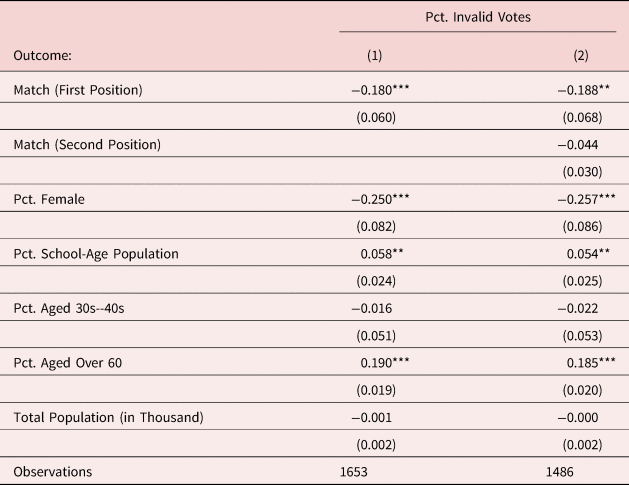
The estimation result of Equation (1) is reported in column (1) of Table 1, showing that the coefficient of  $Match_{ist}^1 $ is statistically significant. The estimate indicates that when candidates with ties to the first-listed party are listed first on the ballot, the number of invalid votes decreases by 0.18 percentage points. In column (2), we also include
 $Match_{ist}^2 $ to test whether the match between the second-listed candidate and the second-listed party decreases invalid votes. The estimated effect of
 $Match_{ist}^2 $ is not statistically significant and close to zero. Perhaps more importantly, the estimated coefficient of
 $Match_{ist}^1 $, -0.188, is unaffected by the inclusion of
 $Match_{ist}^2 $. According to the “satisficing” model of the ballot-order effect, the first-position advantage arises because some voters settle for the first acceptable alternative to reduce the cognitive costs of voting (e.g., Brockington Reference Brockington2003; Koppell and Steen Reference Koppell and Steen2004; Miller and Krosnick Reference Miller and Krosnick1998). Similarly, a satisficing voter, who would like to settle for the first acceptable candidate, may end up casting an invalid vote if the candidate they expect to be listed in the first ballot position is not listed there.
The Effect of Ballot Position Match on Invalid Votes

Note: Robust standard errors, clustered at the Province × Year level, are in parentheses.
Province × Year fixed effects are included in all columns
*p < 0.1, ** p < 0.05, *** p < 0.01
Although the estimated effect of  $Match_{ist}^1 $ is statistically significant in both columns of Table 1, its size is quite small. The mean and standard deviation of the percentage of invalid votes, our dependent variable, are 4.95 and 3.34, respectively. Accordingly, the effect of the match on invalid votes amounts to about 5.4 percent of the standard deviations in the dependent variable. It should be noted, however, that the superintendent of education election is a relatively high-profile local election, because the superintendent is the chief academic officer of a province. Therefore, it would be reasonable to assume that the effect of the match would be higher in other low-salience elections. Additionally, in elections for low-level offices, winners are often decided by a razor-thin margin. For instance, in the 1995, 1998, and 2002 South Korean municipal legislative elections, when candidates’ ballot orders were randomized, the winners of 616 out of 9,290 races were decided by less than a one-percent vote margin.Footnote 10 Because random ballot ordering is often used in elections for low-level offices (e.g., Meredith and Salant Reference Meredith and Salant2013; Song Reference Song2019), the effect of the (mis)match between candidates’ partisan preferences and their ballot order can be substantial and may alter the outcomes of very close races.
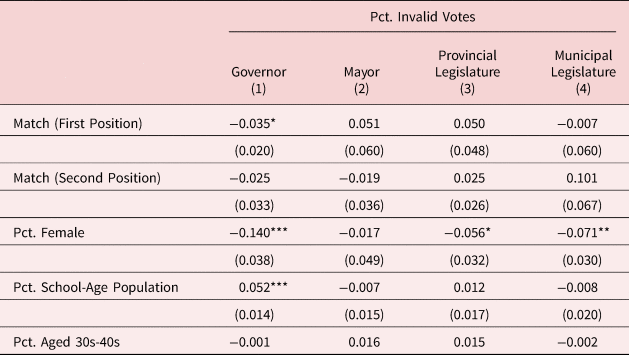
In Table 2, we test whether a match between a randomized ballot order and a partisan ballot order in the superintendent of education election decreases invalid votes for other offices. More specifically, we separately calculate the percent of the invalid votes for the gubernatorial, mayoral, and provincial and municipal legislative elections. We repeat the analysis of column (1) in Table 1 using these percentages as the dependent variables. Our interpretation of the results in Table 1 is that a mismatch between candidates’ partisan preferences and their ballot positions would increase invalid votes. Therefore, Match 1, which indicates whether the candidates who have ties to the first-listed party are listed first on the ballot in the superintendent of education election, should not be systematically related to the percents of invalid votes in other elections. The results in Table 2 confirm this: the estimates of the coefficient of Match 1 are all close to zero and only one of them is statistically significant. The coefficient of  $Match_{ist}^1 $ is marginally significant for the gubernatorial race. However, its size indicates that the match between the first-listed candidate and the first-listed party decreases invalid votes by only 0.035 percentage points.
The Effect of Ballot Position Match on Invalid Votes (Other Offices)

Conclusion
In South Korean local elections, two ballot-order rules are used for two types of election. Whereas ballot orders for partisan races are assigned according to the number of seats each party has in the national legislature, they are determined according to a randomization and rotation scheme for the nonpartisan superintendent of education elections. We have uncovered evidence suggesting that a mismatch between candidates’ partisan preferences and their ballot positions can increase invalid votes.
The results of our paper have implications for local politics of South Korea. In particular, they are most relevant to the scholarly debate on the desirability of nonpartisan elections for local offices, especially for the municipal legislative election, which became partisan in 2006, and the superintendent of education election, which is currently the only nonpartisan election in South Korea. Proponents of nonpartisan local elections claim that party nomination would lead to a nationalization of local politics (Hwang Reference Hwang2010a; Joo Reference Joo2007; Kim, Kim and Huh Reference Kim, Kim and Huh2019; Moon, Kim and Seo Reference Moon, Kim and Seo2017), increase corruption (An Reference An2014), and make regionalism worse (Ha Reference Ha2006; Shin Reference Shin2006). By contrast, some scholars argue that political parties can help voters hold local politicians accountable (Lee and Park Reference Lee and Park2010; Yu Reference Yu2014), increase candidate quality (Lee Reference Lee2015), provide voters with information (Hwang Reference Hwang2010b), and increase the representation of minorities (Hwang Reference Hwang2007).
Our findings contribute to this debate by showing that a nonpartisan election can increase invalid votes. Therefore, from an information perspective, a nonpartisan election can be detrimental to voters because it confuses them by suppressing information. Whereas holding a nonpartisan election can be beneficial to voters as some scholars claim, we also need to consider its potential costs.
In addition, our results suggest that we must consider elections’ potential spillover effect into other elections when multiple elections are held simultaneously. For instance, in the US, many types of election (e.g., legislative elections, ballot measures, judicial elections) are held at the same time. Our findings indicate that one election's features (e.g., ballot order) may affect the outcomes of other elections.
Conflicts of Interest
The authors declare none.
Supplementary Material
The supplementary material for this article can be found at https://doi.org/10.1017/jea.2022.38