Large-scale radiological disasters, such as Chernobyl, have affected the physical and psychological health of local populations.1-Reference Bromet, Havenaar and Guey4 In Fukushima, psychological issues such as anxiety continue to affect people even 9 years after the Fukushima Daiichi nuclear power plant accident (FDNPPA) that occurred in 2011. When the FDNPPA occurred, the local population did not know how to respond to it, or manage their daily lives,5-Reference Okazaki, Ohga, Yoko-O and Kohzaki7 and many people purchased a personal dosimeter to determine radiation levels and safety, in order to reduce anxiety. Due to the uncertainty of long-term health risks associated with low radiation exposure, it was difficult to decrease some people’s anxiety levels. However, some studies have reported that people who had fundamental knowledge of radioactivity and radiation protection and/or measured the terrestrial radiation themselves using dosimeters had a lower level of anxiety than other people.Reference Hirota and Terada8,Reference Hashimoto, Takada and Sakamaki9
Academic–community partnerships for community-based participatory research (CBPR) have been recognized as an effective approach for involving stakeholders in all processes and decision-making.Reference Israel, Schulz, Parker and Becker10 Academic researchers can assist in identifying social problems in communities and the CBPR by focusing more on active participation in community efforts to solve these problems rather than obtaining scientific research results. The CBPR team in Fukushima and Mongolia sought to introduce such a program in Mongolia to maintain good health through radiation emergency preparedness based on the experiences in Fukushima. The team selected the Zuunbayan (ZB) district in Dornogobi Province with a population of approximately 2000, as the program site in 2017. This district is located 40 kilometers from a uranium deposit, Dulaan Uul. Early in the year 2010, the central government and private companies assessed the nature of the deposit and estimated the amount of uranium using experimental mining, leaving the underground soil on the surface. Actual industrial mining had not yet started at Dulaan Uul. The researchers assumed that the radiation exposure in ZB might not be critical; however, they determined that the community should learn about, discuss, and determine how to prepare and protect themselves against radiation exposure. The Ethics Committee of Fukushima Medical University in Japan approved the research (No. 2840).
CONCEPTS AND APPROACHES
The framework consisted of the following core concepts and approaches:
-
Community participation
-
Involvement of stakeholders, including local governments
-
Motivation
-
Local personnel capacity building
-
Awareness through knowledge and information dissemination, and discussion
-
Resilience strengthening
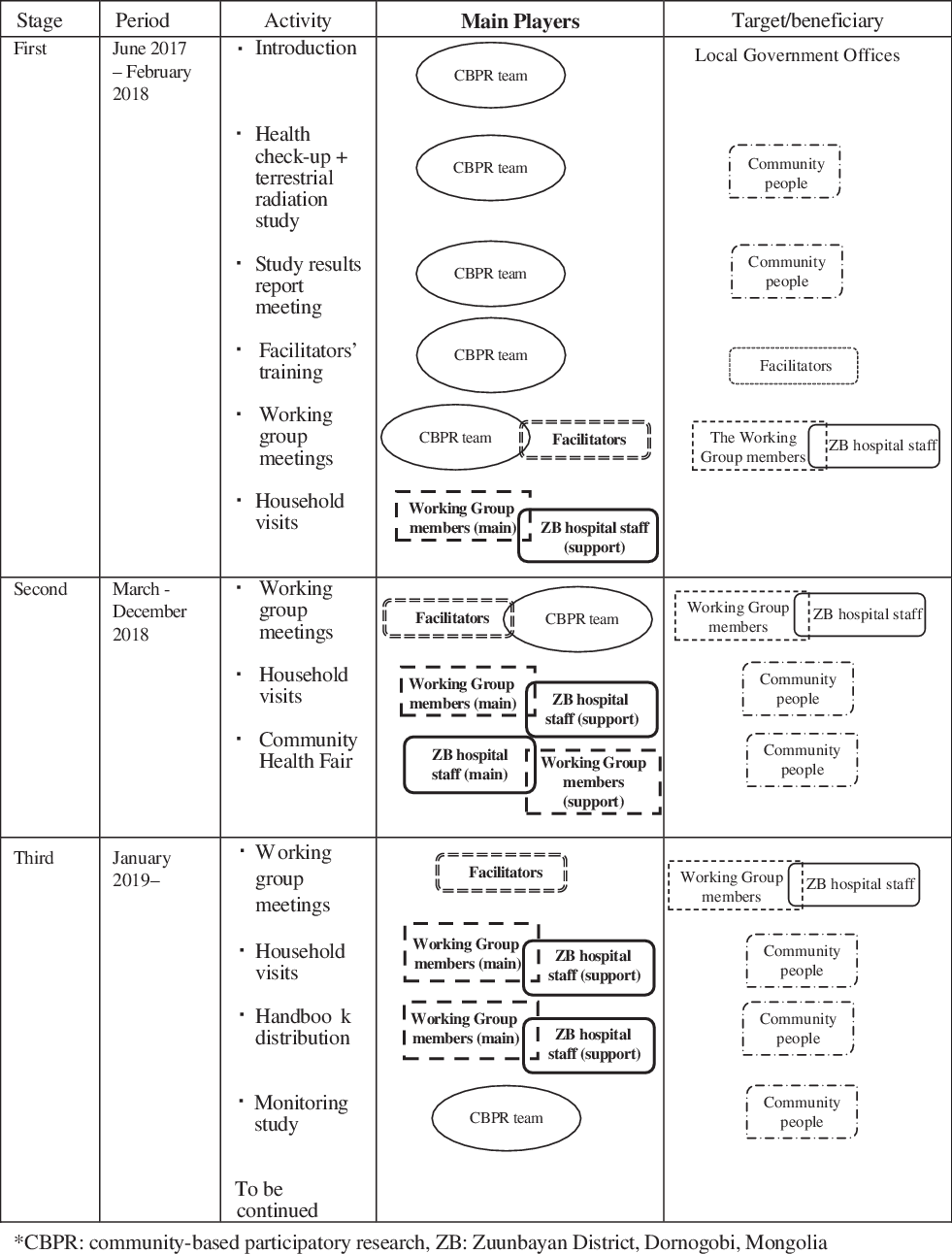
Community participation was the core concept, and Figure 1 depicts the project’s process showing activities and changes in the main players and their roles. In the first stage, the CBPR team approached the local population and some core persons who agreed to contribute to the project. The capacity building of these core persons, such as the ZB Hospital director and provincial engineer responsible for monitoring the environmental radiation level was implemented in Fukushima, Japan. In the second stage, the trained persons educated a working group (WG) as the facilitators of the CBPR program. The WG members visited households for which they were responsible after every WG group meeting, where they learned and discussed more information. The hospital and the WG planned and implemented their own activities. In the third stage, a handbook for disasters and emergencies was developed in the WG meetings which were distributed to all households along with the dissemination of the WG members’ information. The details about each activity and the results of the related outcomes are reported next in a time series.
Change of players and roles over activities.

Community Participation: First Stage
The team explained the program to the local governments, who accepted it. The CBPR program was the first intervention in the community as well as the first knowledge and information-disseminating approach used with the community population.
Involving Stakeholders, Including Local Offices
The officials’ involvement in radiation emergency preparedness was indispensable. The ZB Hospital, ZB Governor’s office, and Provincial Departments of Health and Environmental Monitoring joined the program. Health volunteers and supporters also joined the WG. There were no national or international non-profit organizations in ZB.
Awareness
The team conducted 4 interventions between July and September, 2017 to motivate people to learn about the effects of radiation on health.
Basic Health Check-up
The team invited adults and children in ZB for free health check-ups in collaboration with the Provincial Health Department and the ZB Hospital. The health check-up contents were basic blood and urine tests, blood pressure measurement, and medical consultation for adults as well as a urine test, weight and height measurements, and a medical consultation for children. Considering the funded budget, we asked 300 adults and 300 children in the community to participate voluntarily through the ZB Hospital. These numbers accounted for approximately 30% of the population. Ultimately, 127 girls (7.2 ± 4.3 years old), 145 boys (6.3 ± 4.0 years old), 190 women (32.3 ± 7.7 years old), and 110 men (32.6 ± 8.4 years old) received a health check-up in July, 2017. The adults were also asked to complete a questionnaire in the Mongolian language that the team developed to assess respondents’ knowledge of and attitude towards radiation exposure and good health.
Terrestrial Radiation Study
Japanese researchers and officers from the Mongolian Nuclear Energy Commission implemented a car-borne terrestrial radiation measurement in July 2019 using a 3 in x 3 in cylindrical Nal (Table 1) scintillation spectrometer.Reference Omori, Sorimachi and Gun-Aajav11
Monitoring Study Results in 2019 (1)

Community Reporting Meeting
The team conducted a community report meeting along with confidentially delivering individual health check-up results in September 2017. Aggregated results of the basic health data showed that (1) both children and adults had high percentages of bilirubin (+) in urine, ranging from 45% to 65%; (2) 40% of the women and 28.2% of the men had high blood glucose levels above the normal ranges of 4.11 to 5.89 mmol/L; (3) 66.4% of the women and 42.7% of the men had high low-density lipoprotein (LDL) cholesterol level while the normal range was < 3 mmol/L; and (4) 30% of the children were overweight based on the WHO Child Growth Standards and the ANTHOR software.12,13
The radiation measurement results revealed that the radiation level around ZB’s center ranged from 0.069 to 0.108 micro Sievert (µSv) per hour, or 0.6 to 0.95 milli Sievert (mSv) per year, and from 0.098 to 0.165 µSv per hour, or 0.86 to 1.44 mSv per year around the Dulaan Uul experimental mining site, which had been fenced off from the public.Reference Omori, Sorimachi and Gun-Aajav11 The International Commission on Radiation Protection stated that “the dose limit for exposures of the public from practices is expressed as aggregated (prolonged and transitory) additional annual doses from all relevant practices of 1 mSv”14; except for some parts around the fence surrounding the deposit, all areas showed safe levels.
Out of 300 adults, 180 women and 107 men responded to the questionnaire. Of these, 222 respondents (77.4%) knew about the uranium deposit in the vicinity, and 77 (26.8%) answered that they knew about the radiation. About half of the 77 who knew about the radiation wrote about their knowledge of the radiation in free format, and most responses were negative, such as radiation is poisonous, is dangerous to humans and livestock, induces stillbirths or fetus abnormalities, and causes cancers, allergies, or headaches.
Of the 180 women, 137 (76.1%) and 79 of the 107 men (73.8%) had never received a health check-up prior to the study although they had been examined and treated in medical facilities when they were ill or injured.
Personal Radiation Measurement Tool
At the time of the community report meeting, the team introduced the personal dosimeter measurement and showed respondents the radiation level at the site. They also provided 3 dosimeters (Radcounter DC-100, Nihon Seimitsu Sokki Co., Ltd., Japan, 181.95 USD per piece as of August 2017) to 2 nomad families and a family in the center so they could measure terrestrial radiation levels each month.
Local Personnel Capacity Building
In November 2017, 3 local persons were trained at Fukushima Medical University on community participation concepts, risk communication, risk management, basic radiology, the health management survey of Fukushima Province, health promotion, how to develop understandable educational materials for everyone, and environmental decontamination after FDNPPA. They visited and talked to the residents who had returned from evacuating the coastal area in Fukushima. After returning to Mongolia, they became the facilitators and selected people to participate in the WG. The WG included 25 people, including 3 family members who kept the dosimeters, school teachers, health volunteers, and hospital staff.
The WG members have been meeting quarterly since December 2017, offering different topics to learn and discuss. The researchers with academic and technical expertise have been assisting in the meetings. The members have not only learned about radioactivity, risk communication, health promotion, and health education but also collected information on the issues in the community that they discussed in the meetings. Every meeting, the radiation measurement results were reported, ranging from 0.07 to 0.09 µSv per hour to 0.61 to 0.79 mSv per year. Those values were within the safe level.
Utilizing an Existing Information Dissemination System
To disseminate information and knowledge to a population of nearly 2000 residents (approximately 650 households), the researchers found after the program initiation, that the ZB Hospital had been maintaining a home visit system that had been introduced early in the 1990s by the central government. Some areas had stopped using the system, whereas others like ZB, continued to utilize it. In ZB, hospital staff and health volunteers have been visiting responsible households on a quarterly or biannual basis. The facilitators developed educational materials, including colored handouts about health promotion, risk communication, and radiation. After the meetings, the members visited each household with those materials. The CBPR team provided the educational materials to the members; however, they were not supported financially by the team or the local government.
COMMUNITY PARTICIPATION: SECOND STAGE
At the beginning of the CBPR activity, the researchers took the lead to plan and implement a radiation emergency preparedness program. In 2018, they selected the facilitators and the WG members to discuss their plans for good health and to prepare for radiation emergencies.
Community Assessment
At the beginning of 2018, the researchers assessed the effect of disasters or crises on the community by utilizing a checklist from the International Federation of Red Cross and Red Crescent Society,15 and discussed the community’s vulnerability toward disaster with the WG members. After reviewing the effects of the events that had occurred in the last 10 years, the members predicted events for the coming 10 years, suggesting that no severe natural disaster would occur that would affect the entire community. Finally, they all agreed that droughts would affect mainly nomad families and that repeated outbreaks of zoonotic diseases would influence the entire community. In an emergency, such as a big fire, an army base located nearby worked effectively with the local government. Although there are some non-official organizations, such as “The Women’s Society,” their activities and power to reach the entire community are insufficient. Official organizations are generally the sole responsible entities to prepare and respond to emergencies.
It was also found that 20 nomad families, approximately 100 individuals, accounting for 5% of the total population, were disadvantaged in terms of water supply and electricity, compared to the other 95% who lived in the center. The nomad people lived scattered throughout a huge area between the center and the Dulaan Uul deposit. Their communication and mutual help connection seemed strong, however, they often could not receive official announcements, and some felt they were neglected.
Developing an Assistance Network for Vulnerable Persons
The WG members studied and drew maps of different locations for those who needed special assistance, such as small children. They identified 27 persons who would need special assistance in an emergency. The members discussed and officially assigned responsible persons and additional voluntary supporters to each vulnerable person.
Community Initiative Activities
As the health check-up revealed a high prevalence of high blood glucose levels, high LDL cholesterol levels as well as a higher prevalence of overweight women compared to the men, the ZB hospital and WG members planned and implemented a health fair in the community for September 28, 2018. The fair was held at the community sports center, with the support of the ZB Governor’s office and the research team. The health fair was open to the community for the entire day on Saturday. Several booths were set up to offer different services, including anthropometric measurements (height and weight) and body metrics indicator implications, blood pressure measurements, ‘Go Bag’ (emergency bag) presentations, first aid items presentations and demonstrations, the distribution of flyers with health information, presentation of the measured results of the radiation by Radcounter, and a demonstration of the tool. More than 300 adults visited. Among the 96 women and 61 men who completed anthropometric measurements, 37.5% of the women and 26.2% of the men were overweight or obese based on their body mass index values.
Based on a disaster preparation handbook distributed to households in Fukushima Province in 2018,16 the researchers recommended developing a handbook of ZB that would incorporate many illustrations to ensure that even children could understand how to prepare and what to do in emergencies such as natural disasters, radiation contamination and fires. In January 2019, the handbook was delivered to all households by the WG members who also provided an explanation of its contents.
Soil Radiation Study
The radiation levels in the soils were measured in July 2019, ranging from 0.048 to 0.082 µGy/h in ZB and 0.061 to 0.450 µGy/h around the fence surrounding the dump soil from the experimental mining in Dulaan Uul. We found that such levels are common worldwide.17 Further research revealed that the higher terrestrial radiation around the fence compared to other areas, came from natural radioactivity in the surface soil. Visiting that site was not recommended, although radiation was within safe levels. This information was disseminated to the WG members.
Community Radiation Alarm System
In March 2019, the researchers provided a pocket-size 24-hour survey-meter from DOSE e nano, Fuji Denki Ltd., Japan, to the community that had an early alarm system for excessive radiation. It was given to 1 household in the community center, and the family was responsible for calling the hospital and the governor’s office when radiation values exceeded the average of 0.12 µSv per hour, which was the value in that house, plus 1 mSv per year. The survey-meter cost 907.25 USD as of January, 2019.
Monitoring Study
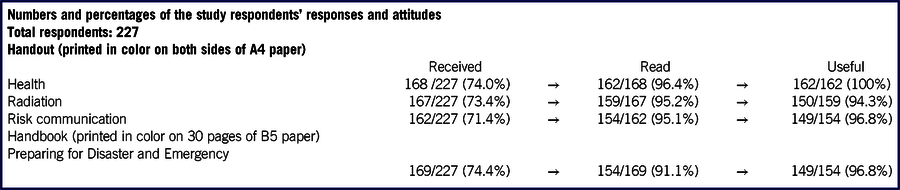
In March 2019, to monitor the progress of the activities, 1 person over 15 years old from each household who had been staying in ZB before June 2017 was asked to participate in the study. The team developed a questionnaire asking about people’s knowledge of and attitudes toward radiation exposure and good health promotion before 2017 and in 2019, and their experiences with respect to the health and radiation information disseminated through the CBPR activities. Overall, 227 people (138 women and 89 men) completed the questionnaire. Table 1 shows how household visits to deliver educational materials worked and the respondents’ response and evaluation regarding the contents. Approximately, three-fourths of the respondents received the educational materials, and almost of all of them read the materials and found them useful for understanding good health, radiation, risk communication, and how to prepare for disasters and emergencies at home.
Table 2 shows 227 respondents’ knowledge of, or attitude towards the radiation prior to and after the program started. The number of people who believed any level of the radiation were dangerous was statistically decreased while the number of people whose attitude towards radiation was indifferent decreased. In addition, 115 of 227 respondents (50.9%) answered that there were safe and unsafe levels of the radiation, which was written in the handouts.
Monitoring Study Results in 2019 (2)

* p < 0.05, ** p < 0.01, *** p < 0.001. Analyzed using SPSS (v26, IBM, NY, USA).18
It is noteworthy that 136 of 277 respondents (59.9%) knew that 3 families in the community had been regularly measuring radiation levels. Of those 136, 119 persons (87.5%) believed that the CBPR team’s efforts to measure radiation in their community in 2017, and subsequently similar efforts by some members of their community, were useful. However, 8 respondents (5.9%) doubted the accuracy of local measurements or disagreed with the need to measure because they felt it was of no use.
The ZB Governor stated that the program benefited the people and the office. For example, several community members joined the 2019 annual emergency drill that only officials had attended before 2018. The people’s interest in communicating with the office changed to become more proactive. The director of the Department of Health in Dornogobi Province told the researchers that the ZB program would be introduced at the national and international emergency preparation meeting in the province in 2019 as a successful case of community emergency preparation.
COMMUNITY PARTICIPATION: THIRD STAGE
In the next step of the program, the researchers collaborated with the community as consultants who visited annually; a decrease from the 3 to 4 times a year for the first 2 years. The facilitators and the WG members had been discussing several activities since confirming that the activities were changing people’s knowledge of and attitude towards health, radiation exposure and emergency preparedness.
The researchers recommended enhancing community resilience to emergencies as well as strengthening people’s resilience in the third stage. In terms of community resilience, several changes were already in practice. People began to recognize the governor’s responsibility and importance in assisting vulnerable persons in the neighborhood and to prepare alarm communication networks through cellphones.
DISCUSSION
Factors That Contributed to the Program’s Success
The participatory community program in ZB was successful for several reasons: (1) people accepted and actively participated in the program based on mutual trust between them and the researchers, including foreigners; (2) the local facilitators and officials took the lead to facilitate the program; (3) the high literacy rate in Mongolia made it possible to utilize the educational printing materials; and (4) the periodic home visit system by medical doctors, nurses, and health volunteers had existed for decades and functioned well. The team thought that was the most indispensable factor for starting CBPR, and we were lucky to be accepted and trusted by the local population. If the team could not obtain the trust of key persons, it would have been difficult to succeed. The program will be continued, and the team will support it.
As CBPR is a process to seek the community’s development or benefit through a community initiative, the researchers should not conduct the research first, but instead utilize research results for monitoring and changing the program’s development as such an approach would be more effective to the program’s achievement.
The Program Changed People’s Understanding of Radiation
In ZB, community members’ knowledge increased and their attitudes toward radiation changed. In the 2017 study, only a fourth of the respondents knew about the radiation, and they had limited knowledge of its health effects. In the 2019 study, half of the 227 respondents knew about safe and unsafe levels of radiation for health, they also knew that it was safe in ZB, as measured in the community at that point. Some results might have been biased in that those who had attended the health check-up and other activities might have attended actively in the 2019 study. This might have accounted for the increased number of people who understood radiation.
Health Check-up Revealed Issues and Motivated People’s Health Concerns
As there had not yet been any risk of radiation exposure like FDNPPA in ZB and a basic health check-up would not detect health issues caused by radiation, the team introduced the health check-up as an initial tool to inform people about good health and the program. It was the first time that three-fourths of the respondents received a health check-up, and the team thought the health check-up could motivate those respondents to join the program sustainably.
Many people who participated in the health check-up, both adults and children, had an extremely high prevalence of urinary bilirubin (+). The team found that Mongolia had a high prevalence of viral hepatitis B and C and the worst mortality rate due to liver cancer in the world.18,19 Therefore, we thought these facts might explain the ZB area’s high prevalence of urinary bilirubin (+) with almost all of the respondents being asymptomatic carriers. In light of this issue, the Ministry of Health launched a national program to provide viral hepatitis examinations and treatment in 2018.
Following this activity, the people’s main health issues seemed to be cases of being overweight or obese, especially among women. Excessive weight of led to non-communicable diseases, such as hypertension and diabetes. Therefore, in coming years the program will focus more on activities to reduce weight.
Community Assessment and the Next Step
Since the Japanese researchers did not know much about the research site except that it was near the Dulaan Uul deposit, they had to learn about ZB’s real situation during the process of program development. No life-threatening events had occurred, and because no severe disaster was predicted, the program shifted to empower the community by strengthening the community members’ preparedness for any emergencies. The first 2 years were spent on activities linked to awareness, education, and training as well as assessment of community vulnerability and capacity, and cooperation with the officials to strengthen community preparedness and resilience. The coming years will emphasize both the community and individual preparedness and resilience to produce a synergetic effect. The team will continue to support the community and believes that community participation will empower the community to deal with their good health and disaster/emergency preparedness.
CONCLUSION
This program was introduced to a small community in Mongolia by a Japanese research team who experienced a huge natural disaster and man-made nuclear disaster in Japan, with the belief that people could be equipped to prepare for potential radiation exposure in order to protect their health through active learning, discussing, and deciding. The program had been implemented by the community from the second year with the CBPR team’s assistance and empowered the community, not only for the radiation exposure but also for any emergencies. This global collaboration set forth the probability that a public health lesson learned from a disaster could be applied to other countries and changed people’s recognition and behavior towards good health and disaster/emergency preparedness.
Acknowledgments
This research was supported by the TOYOTA Foundation, Japan, from May 2017 through April 2019: D16-R-0238. We sincerely thank Dr. Enkhtsesteg, the Director of the Department of Health in Dornogobi, and her staff member, Ms. Suvdaa for their support for the project.
Conflict of Interest
The authors have no conflict of interest to declare.