Introduction
Attention deficit hyperactivity disorder (ADHD) is a highly heritable disorder (Faraone et al. Reference Faraone, Perlis, Doyle, Smoller, Goralnick, Holmgren and Sklar2005). Family studies consistently reveal an estimated sibling risk ratio of three- to sixfold (Faraone & Doyle, Reference Faraone and Doyle2000). However, underlying genetic factors are expected to be multiple, have small effect sizes when considered individually, and interact with each other and with environmental factors (Asherson, Reference Asherson2004). One approach to overcome these difficulties is the search for endophenotypes. The endophenotype concept represents a strategy to analyse the biological systems beyond the obvious disorder (de Geus, Reference de Geus2002; Gottesman & Gould, Reference Gottesman and Gould2003). Endophenotypes are assumed to be influenced by one or more of the same genes as the disorder but to be regulated more directly by these genes. They should thus be less genetically complex than the disorder they underlie. Endophenotypes should have good psychometric properties and be stable over time (be reliably measurable); be associated with the disorder in the general population and co-segregate with the disorder in families; and be heritable (or at least familial) and show increased expression in unaffected relatives of affected subjects.
Several studies have shown deficits in temporal information processing in children with ADHD in a wide variety of tasks, such as time reproduction, verbal time estimation, anticipation, finger tapping and duration discrimination tasks (for a review see Toplak et al. 2006). Although the results in time reproduction, duration discrimination and finger tapping tasks are fairly consistent in showing deficits in task performance for children and adolescents with ADHD, less consistent results have been obtained in verbal estimation and anticipation tasks. However, most results are available on time reproduction tasks. Most recently, Rommelse et al. (Reference Rommelse, Oosterlaan, Buitelaar, Faraone and Sergeant2007) showed that children with ADHD, and their non-affected siblings, performed less well in a time reproduction task with intervals between 4 and 20 s compared to normal controls. On the basis of these results, they proposed time reproduction as a candidate endophenotype for ADHD.
In the field of human temporal information processing, the classical single-clock models hypothesize a general timing mechanism underlying temporal information processing across a wide range of durations (Matell & Meck, Reference Matell and Meck2000). However, there are many results from psychophysical (Rammsayer & Lima, Reference Rammsayer and Lima1991; Karmarkar & Buonomano, Reference Karmarkar and Buonomano2007) and pharmacopsychological studies (Rammsayer, Reference Rammsayer1992a, Reference Rammsayer1993, Reference Rammsayer1997, Reference Rammsayer1999, Reference Rammsayer2006; Rammsayer et al. Reference Rammsayer, Hennig, Haag and Lange2001) that cannot be explained by a single timing mechanism for the whole range of time. These findings support the idea of two (or even more) different timing mechanisms. Thus, a two-process model with an automatic mechanism for timing in the range of milliseconds and a cognitively controlled mechanism for timing in the second range has been proposed, with transition from one timing mechanisms to the other somewhere between 200 and 800 ms (Rammsayer & Lima, Reference Rammsayer and Lima1991; Ivry, Reference Ivry1996; Lewis & Miall, Reference Lewis and Miall2003a, Reference Lewis and Miallb, Reference Lewis and Miall2006; Karmarkar & Buonomano, Reference Karmarkar and Buonomano2007). This notion is further supported by brain lesion and neuroimaging studies; brief intervals in the range of milliseconds seem to be processed in primary sensorimotor and premotor circuits whereas longer intervals tend to recruit right hemispheric prefrontal and parietal cortices (Mangels et al. Reference Mangels, Ivry and Shimizu1998; Rao et al. Reference Rao, Mayer and Harrington2001; Lewis & Miall, Reference Lewis and Miall2003a, Reference Lewis and Miallb).
In the present study, temporal information processing was analysed in children with ADHD and their unaffected siblings to search for candidate endophenotypes for ADHD. The study also focused on the differentiation between automatic and cognitively controlled timing by applying two versions of a duration discrimination task, one with base durations of 50 ms and one with base durations of 1000 ms.
Method
Subjects
Siblings were recruited from families participating in the Goettingen subsample of the International Multicenter ADHD Genes (IMAGE) study (Brookes et al. Reference Brookes, Xu, Chen, Zhou, Neale, Lowe, Anney, Franke, Gill, Ebstein, Buitelaar, Sham, Campbell, Knight, Andreou, Altink, Arnold, Boer, Buschgens, Butler, Christiansen, Feldman, Fleischman, Fliers, Howe-Forbes, Goldfarb, Heise, Gabriels, Korn-Lubetzki, Johansson, Marco, Medad, Minderaa, Mulas, Muller, Mulligan, Rabin, Rommelse, Sethna, Sorohan, Uebel, Psychogiou, Weeks, Barrett, Craig, Banaschewski, Sonuga-Barke, Eisenberg, Kuntsi, Manor, McGuffin, Miranda, Oades, Plomin, Roeyers, Rothenberger, Sergeant, Steinhausen, Taylor, Thompson, Faraone and Asherson2006). Families were included if at least one child suffered from ADHD and had at least one available sibling, regardless of whether the sibling was also affected or not. The complete study had medical/ethical approval from the National Institute of Mental Health (NIMH) confirmed by the local ethical review board.
Diagnosis of ADHD was made using the standard procedures of the IMAGE project as described in detail elsewhere (Brookes et al. Reference Brookes, Xu, Chen, Zhou, Neale, Lowe, Anney, Franke, Gill, Ebstein, Buitelaar, Sham, Campbell, Knight, Andreou, Altink, Arnold, Boer, Buschgens, Butler, Christiansen, Feldman, Fleischman, Fliers, Howe-Forbes, Goldfarb, Heise, Gabriels, Korn-Lubetzki, Johansson, Marco, Medad, Minderaa, Mulas, Muller, Mulligan, Rabin, Rommelse, Sethna, Sorohan, Uebel, Psychogiou, Weeks, Barrett, Craig, Banaschewski, Sonuga-Barke, Eisenberg, Kuntsi, Manor, McGuffin, Miranda, Oades, Plomin, Roeyers, Rothenberger, Sergeant, Steinhausen, Taylor, Thompson, Faraone and Asherson2006). In brief, children were screened for ADHD by applying Conners' rating scales (parent and teacher Conners' long-version rating scales) (Conners, Reference Conners1996) and Strengths and Difficulties Questionnaires (parent and teacher SDQ-D; Goodman, Reference Goodman1997; Woerner et al. Reference Woerner, Becker and Rothenberger2004). If ADHD was indicated by these rating scales, it was confirmed clinically by a semi-structured standardized clinical interview, the Parental Account of Children's Symptoms (PACS; Taylor, Reference Taylor, Sandberg, Thorley and Giles1991). PACS interviews were conducted for each child separately by well-trained medical clinicians. Children not being considered as suffering from ADHD by Conners' and SDQ scales were not interviewed with PACS. Each pair of siblings consisted of a child with ADHD and his/her available sibling with the smallest age difference.
A normal control group was selected from primary and high schools. Control children were included if they had non-clinical scores on Conners' N subscales of both parent and teacher Conners' long-version rating scales (T score ⩽62) and had no known psychiatric disorder.
All children were 6- to 18-year-old European Caucasians with normal hearing. Exclusion criteria for all groups were IQ<70 or a diagnosis of autism spectrum disorder, bipolar or schizophrenic psychosis, brain disorder, epilepsy, or known genetic disorders that might mimic ADHD.
By this procedure, 62 pairs of siblings were recruited with 10 pairs concordant for ADHD and 52 pairs discordant for ADHD. Thus, 72 children with ADHD and 52 unaffected siblings were recruited for the initial sample. In addition, 44 normal control children were included.
Intelligence
IQ was estimated by four subtests of the Wechsler Intelligence Scale for Children – Third Edition (WISC-III) or the Wechsler Adult Intelligence Scale – Third Edition (WAIS-III), depending on the child's age (Wechsler, Reference Wechsler2000, Reference Wechsler2002). The vocabulary, similarities, picture completion and block design subtests were used to obtain an estimate of the child's IQ (Sattler, Reference Sattler1992; Groth-Marnat, Reference Groth-Marnat1997).
Duration discrimination tasks
Duration discrimination tasks were carried out as described previously (Rammsayer et al. Reference Rammsayer, Hennig, Haag and Lange2001). In brief, the performances on duration discrimination were assessed by presenting pairs of auditory stimuli, a standard interval and a variable comparison interval, and asking the subjects to decide which of the two intervals was longer. The instructions to the participants emphasized accuracy; there was no requirement to respond quickly. After each response, visual feedback (‘+’=correct or ‘–’=false) was displayed on the monitor screen. An experimental session consisted of one block with a standard interval of 1000 ms and one block with a standard interval of 50 ms each. Each block consisted of 32 trails. The order of blocks and the presentation order of standard and comparison intervals within each block were counterbalanced across participants. For assessing performance on temporal discrimination, an adaptive psychophysical procedure was used to determine the 75% difference threshold for the 50-ms and 1000-ms standard intervals respectively (Kaernbach, Reference Kaernbach1991; Rammsayer, Reference Rammsayer1992b). The 75% difference threshold represents the difference in duration between the standard and comparison intervals required to produce 75% correct responses. As a measure of performance, threshold values were computed based on mid-run estimates for the last 20 trials within each block (Wetherill et al. Reference Wetherill, Chen and Vasudeva1966). The individual threshold represents a psychophysical measure of performance indicating the just noticeable difference between standard and comparison intervals. Thus, better performances are indicated by smaller thresholds.
Data analyses
Initially, data were checked for completeness and children with incomplete data and if available, from the corresponding sibling were excluded from further analysis. In addition, data were checked for outliers. Complete data sets were excluded if performance in one or more tasks differed from the mean of the respective group for more than two standard deviations.
Phenotypic analyses were conducted using SPSS version 15.0 (SPSS Inc., Chicago, IL, USA). All dependent variables were nearly normally distributed (Kolmogoroff–Smirnov Z=0.659–1.025, p=0.24–0.78). The level of statistical significance was set at 0.05 for all analyses. Univariate analysis of variance (ANOVA) was used to examine group effects on measured discrimination thresholds for each task separately. Group was set as a fixed factor and family as a random effect to account for family clustering. Age was used as a covariate because a significant effect on task performance was found for both conditions [F(1, 113)=11.24, p=0.001, η2=0.091, and F(1, 103)=31.29, p<0.001, η2=0.23 for time estimation and time perception respectively]. In addition, IQ and gender were initially introduced as covariates into the model, but because no significant effects on dependent variables were found, they were finally removed. Main effects were examined by means of pair-wise comparison with Sidak's correction for multiple comparisons. Effect sizes were estimated by calculating Cohen's d, with the difference of estimated means divided by pooled standard deviations (Cohen, Reference Cohen1998). Within-family correlations of task performance were examined by calculating the partial correlation coefficients of thresholds between siblings controlling for age of both siblings (sib-pair correlations). To investigate correlations between task performances and individual ADHD symptom levels, partial correlation coefficients between thresholds and Conners' scores of the L (DSM-IV inattentive), M (DSM-IV hyperactive/impulsive) and N (DSM-IV total) subscales (averaged across parent and teacher ratings), controlling for age, were calculated. Because of a high correlation between parent and teacher ratings (r=0.72–0.79, p<0.001), parent and teacher ratings of these Conners' subscales were averaged.
Results
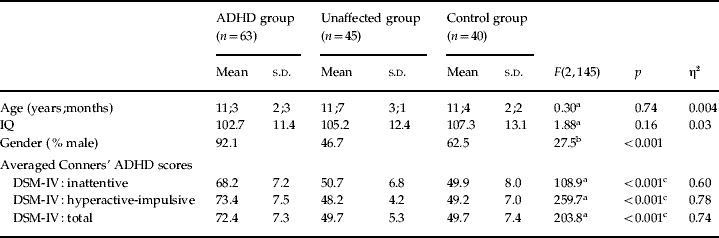
Eight pairs of siblings and four control children were excluded from the initial sample because of incomplete or outlying task performance. Thus, the final sample included 54 pairs of siblings with 63 affected and 45 unaffected children and 40 control children. Table 1 presents the main group characteristics. There was no significant group difference for age and IQ, but there was a significant group difference for gender ratio. Group had a significant influence on all three Conners' ADHD scores with the ADHD group differing significantly from the group of unaffected siblings and the group of control children. There was no significant difference between the groups of unaffected siblings and control children.
Sample characteristics
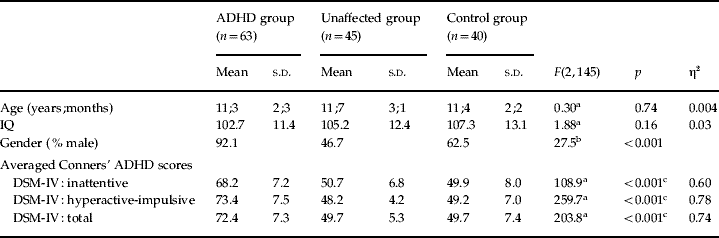
ADHD, Attention deficit hyperactivity disorder; s.d., standard deviation.
a One-way ANOVA.
b χ2 test.
c Post-hoc pair-wise Sidak-corrected t tests: ADHD group differs significantly from control group (p<0.05) and from unaffected group (p<0.05).
50-ms standard interval
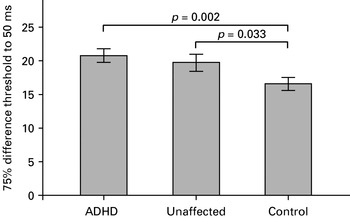
For the duration discrimination task with a base duration of 50 ms, the mean 75% difference threshold (±s.d.) was 20.8±8.0 ms for the ADHD group, 19.7±8.5 ms for the unaffected sibling group, and 16.6±6.3 ms for the control group. A significant effect of group was found [F(2, 108)=4.01, p=0.021, η2=0.07]. Pair-wise comparisons revealed that children with ADHD and their unaffected siblings performed significantly worse than controls (p=0.002, d=0.84 and p=0.033, d=0.61 respectively) (see Fig. 1). The difference between children with ADHD and their unaffected siblings was not significant (p=0.55, d=0.24).
Performance on discrimination of brief intervals as indicated by the 75% difference threshold in relation to a 50-ms standard interval for attention deficit hyperactivity disorder-affected children (ADHD), unaffected siblings (unaffected), and normal control children (control) (mean±s.e.m., p of Sidak-corrected pairwise comparisons).

The group effect remained significant after introducing gender as a covariate [F(2, 109)=3.84, p=0.024, η2=0.07]. In addition, there was no significant difference in task performance between boys and girls for all three groups according to Mann–Whitney U tests (Z=0.09, p=0.93; Z=0.33, p=0.74; and Z=0.66, p=0.51 for ADHD children, unaffected siblings, and control children respectively).
Furthermore, siblings within families resembled each other in their task performance as indicated by the sib-pair correlation (r=0.39, p=0.004). Similar results were obtained after excluding pairs of siblings with both being affected (r=0.37, p=0.015).
In the control group, phenotypic correlation analyses between individual 75% difference thresholds and corresponding DSM-IV Conners' M and N scores showed a significant correlation between performance and levels of hyperactivity/impulsivity (M scores) and total ADHD symptoms (N scores) (r=0.32, p=0.046 and r=0.32, p=0.047 respectively). The correlation between performance and individual levels of inattention (L scores) failed to reach the 5% level of statistical significance (r=0.27, p=0.092).
1000-ms standard interval
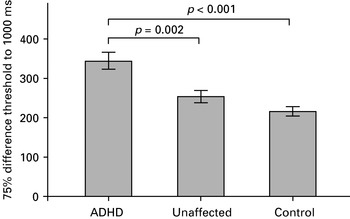
For the duration discrimination task with a base duration of 1000 ms, the mean 75% difference threshold (±s.d.) was 344.0±174.3 ms for the ADHD group, 252.5±102.5 ms for the unaffected sibling group, and 215.1±83.6 ms for the control group. A significant effect of group was found [F(2, 87)=11.73, p<0.001, η2=0.21]. Pair-wise comparisons revealed that children with ADHD performed significantly worse than their unaffected siblings (p=0.002, d=0.81) and significantly worse than controls (p<0.001, d=1.13) (see Fig. 2). The difference between unaffected siblings and controls did not reach significance (p=0.35, d=0.34).
Performance on discrimination of longer intervals as indicated by the 75% difference threshold in relation to a 1000-ms standard interval of attention deficit hyperactivity disorder-affected children (ADHD), unaffected siblings (unaffected), and normal control children (control) (mean±s.e.m., p of Sidak-corrected pairwise comparisons).

The group effect stayed significant after introducing gender as a covariate [F(2, 90)=9.24, p<0.001, η2=0.17]. In addition, there was no significant difference in task performance between boys and girls for all three groups according to Mann–Whitney U tests (Z=1.22, p=0.22; Z=1.12, p=0.27; and Z=0.13, p=0.9 for ADHD children, unaffected siblings, and control children respectively). For the comparison of task performance of siblings, the sib-pair correlation did not reach significance (r=0.25, p=0.069). For the control group, phenotypic correlations between individual 75% difference thresholds and corresponding DSM-IV Conners' scores (L, M and N) were r=0.24, r=–0.20 and r=0.08 respectively, and all failed to reach the 5% level of statistical significance. Thus, there was no indication for a functional relationship between performance and levels of ADHD symptom dimensions.
Discussion
The present study showed that performances on discrimination of extremely brief intervals in the range of several tens of milliseconds and of longer intervals in the 1-s range are clearly impaired in children with ADHD compared to normal controls, indicating deficits in automatic and also in cognitively controlled temporal information processing. By contrast, unaffected siblings of children with ADHD differ from normal controls in their performance to discriminate brief intervals in the range of milliseconds, but not to discriminate longer intervals. This indicates that these siblings are impaired in automatic timing mechanisms although they do not suffer from ADHD and their Conners' ADHD scores do not differ from those of normal control children. On the basis of these results, impaired duration discrimination in the second range can be seen as a ‘disease marker’ whereas duration discrimination in the range of several tens of milliseconds fits the pattern of a ‘vulnerability marker’ that distinguishes between normal families and families with an increased risk for ADHD.
Rommelse et al. (Reference Rommelse, Oosterlaan, Buitelaar, Faraone and Sergeant2007) found that children with ADHD, and their unaffected siblings, were less precise in time reproduction of intervals in the range of 4 to 20 s. Thus, time reproduction has been proposed as a candidate endophenotype for ADHD. At first glance, this is somewhat at variance with our findings of no endophenotypic pattern for duration discrimination of intervals in the 1-s range. In contrast to duration discrimination tasks, time reproduction tasks primarily involve aspects of time perception, time estimation and time production, and are also dependent on motor timing and coordination (Zakay, Reference Zakay and Block1990). Rommelse et al. Reference Rommelse, Altink, Oosterlaan, Beem, Buschgens, Buitelaar and Sergeant2008a, Reference Rommelse, Van der Stigchel, Witlox, Geldof, Deijen, Theeuwes, Oosterlaan and Sergeantb) also found endophenotypic patterns for motor timing and oculomotor control in families with ADHD. Thus, their findings of endophenotypic patterns in time reproduction might result from endophenotypic patterns in motor timing or oculomotor coordination. In general, temporal information processing is a complex neuropsychological function. Duration discrimination and time reproduction are thus not based on the same set of timing mechanisms and results cannot be compared directly.
The applied duration discrimination task with a 50-ms standard interval and its differentiation from the 1000-ms version have been validated by various timing studies with healthy humans (Rammsayer, Reference Rammsayer1992a, Reference Rammsayer1994; Rammsayer et al. Reference Rammsayer1993; Rammsayer & Ulrich, Reference Rammsayer and Ulrich2001; Rammsayer & Brandler, Reference Rammsayer and Brandler2004). Furthermore, pharmacopsychological and dual-task studies have frequently shown separability of the two task versions (Rammsayer, Reference Rammsayer1989, Reference Rammsayer1993, Reference Rammsayer1999, Reference Rammsayer2006; Rammsayer & Vogel, Reference Rammsayer and Vogel1992; Rammsayer et al. Reference Rammsayer, Hennig, Haag and Lange2001). Thus, duration discrimination in the range of milliseconds is reliably measurable, a necessary condition for candidate endophenotypes.
For duration discrimination of brief intervals, the values obtained were correlated significantly to levels of total ADHD symptoms in the normal control group, especially to the hyperactive/impulsive symptom level. This provides, on a dimensional level, further evidence for the association between worse performance in duration discrimination in the range of milliseconds and ADHD phenotypology. Furthermore, high resemblances between siblings within families were observed, as apparent from significant positive sib-pair correlations. This indicates further familiality of duration discrimination of brief intervals. Thus, overall, discrimination of intervals in the range of several tens of milliseconds represents a candidate endophenotype for ADHD.
Limitations
The present study was based on a sibling design. Whereas twin designs produce the three estimates of heritability, shared environmental influences and child-specific environmental influences, sibling designs cannot distinguish between genetic influences and shared environmental influences. They are accordingly only able to differentiate between familiality and child-specific influences, with familiality reflecting the combination of genetic and shared environmental effects. Thus, the observed familiality of performances in duration discrimination of brief intervals does not necessarily prove heritability.
The sample consisted mainly of boys and the groups were not matched for gender (Table 1). However, a potential influence of gender was not found for task performance of girls and boys within each group for both long and short intervals.
Acknowledgements
Sample recruitment was supported by NIMH Grant R01MH062873 to the IMAGE project.
Declaration of Interest
None.