1. Introduction
Language disabilities occur in monolingual and multilingual children and young people throughout the world. Language delay, difficulties and disorders can be due to biological impairments and/or social reasons such as deprivation of social and cultural engagement. Often the cause is unknown and other areas of development may not initially be affected. However, atypical development of comprehension and expression of form and function of language has implications for cognitive, social and emotional development, as well as learning literacy skills. In the UK, language disability is a highly prevalent category of special educational need (Bercow Review Reference Bercow2008).
Language disabilities are usually assessed through a range of generic procedures on different aspects of language performance: phonology, grammar, vocabulary and the processing of language information. Many are standardised on populations of typically developing children for measures of trustworthiness (validity), stability and replicability (reliability). Assessment profiles offer classification information about the type and severity of the speech/language/communication problem, contribute to the diagnosis of atypical speech and language development and often support a case for specialist support from education and health services.
There are several important criticisms of these generic procedures, which are sometimes referred to as ‘static assessment’ (SA). First, they privilege individual performance over joint performance, rule out mediation and maintain the distinction between assessment and intervention/teaching. Vygotsky argues that while two children may obtain similar scores on generic procedures, their different potential and capacities to learn and develop remain uncharted. In effect, we see the strengths and deficits of a child's language learning as if through a ‘rear-view mirror’. We are not offered a future-orientated view of a child's language learning potential that could inform teaching/learning in their educational context to improve their future development.
By contrast, a promising approach is Dynamic Assessment (DA), which incorporates diagnostic and predictive teaching/learning methods for identifying learners’ language-learning potential by appraising their responsiveness to specifically modified language interactions (Lantolf & Poehner Reference Lantolf and Poehner2011; Poehner & van Compernolle Reference Poehner and van Compernolle2011). Emerging research suggests that DA is particularly suited to identifying the language-learning capabilities of learners with language disabilities (e.g. Lidz & Peña Reference Lidz and Peña2009; Hasson & Botting Reference Hasson and Botting2010). As the DA method blurs the traditional divide between assessment of what has been learnt and future intervention, DA results can inform the manner and content of differentiated teaching/learning and inclusive schooling for those with language disabilities. In this paper the educational policy and practice discussed is that of the UK, but much of the discussion is likely to be applicable to other English-speaking countries with similar education provision, such as the USA, Canada and Australia.
Just to clarify: a social model of language disability focuses on the social practices of marginalising individuals with communication difficulties, ‘disablism’ (e.g. Clough & Barton Reference Clough and Barton1995). A sociocultural and historical approach to language development and language disability, as discussed here, is concerned to explain language learning through mediated interactions that indicate diagnostic and instructional pathways towards future development and language socialisation.
In the following sections I describe the participants and their context, the DA method of collecting and analysing the data for their language learning, and I draw some conclusions. First, I set out selected key concepts that inform the study.
2. Key concepts
Three key concepts shape the DA procedure used to explore the children's language learning in this study: mediation, transcendence and intentionality. They are informed by Vygotsky's writing (e.g. Rieber Reference Rieber1999: 55) and recent sociocultural approaches to language learning.
Mediation is concerned with bringing about development in the learner and, in the process, diagnosing and predicting lines of future intervention. When learners engage independently with an object or a task and encounter difficulty, the mediator introduces a mediating tool, such as support and guidance, into the learner's activity so that learning becomes a joint, co-constructed activity in mediation. Successful mediation involves judging the right moment to introduce the mediating artefact to enhance the learner's agency and responsiveness to the task. In this way, the mediator assesses both the learner's zone of actual (natural) development and how to engage their zone of proximal development in the mediation process.
The mediated learning method in DA is not just an additive process, ‘a simple building of a higher storey over the lower. . .the natural and the mediated’ (Vygotsky in Rieber Reference Rieber1999: 55). As language develops through the mediator's efforts in interaction,
. . .the operation itself of using an external sign is radically reconstructed. Being a decisive important operation for the young child, it is here replaced by a substantially different form; the internally mediated process begins to make use of completely new connections and new devices not similar to those that were characteristic for the external sign operation. (ibid.)
Mediation is transformative for the learner, bringing about the development of emerging abilities in the learner that she/he could not achieve independently. Vygotsky referred to this development as ‘[t]he process of revolution of cultural forms of behaviour’ (ibid.). Development accomplished through mediation in DA predicts approaches for future intervention.
These approaches draw on the notion of double stimulation. Double stimulation in mediation draws on the learner's memory as a tool to solve the current problem. The learner uses the remembered artefact or strategy, to self-mediate, to problem-solve, to achieve new learning, such as a colour sequence for learning grammatical word order. Double stimulation is evidenced in more advanced language learning when the learner's current language is used to mediate the learning of new aspects and uses of language. With the development of self-regulation of their language memory, the learner's double stimulation becomes increasingly internalised, and implicit in the mediation. Eventually, the remembered artefact or strategy in double stimulation is abandoned when new learning is achieved. Important progress is achieved when learners with language disabilities become increasingly able to learn language through language, that is, using double stimulation, rather than through visual or gestural support for language learning.
Transcendence is the conscious application of the newly learnt strategies and knowledge to real or imagined contexts. It can be realised in at least three ways for children with language learning difficulties: it can be (1) a form of generalisation of the learning strategy, rather than the generalisation of content (e.g. vocabulary) to a similar task, (2) the application of the target language form/content in new contexts, or (3) the application of the language function (e.g. genre) to new contexts.
A third key element in DA is intentionality to teach and learn in mediation. Mediation involves the mediator's intent to raise the learner's awareness of the purpose of the activity in framing the task and in particular moments of mediating interaction, while the learner's intent to learn is shown in their agency, engagement and responsiveness in mediation (Feurstein, Rand & Rynders Reference Feurstein, Rand and Rynders1988; Poehner & van Compernolle Reference Poehner and van Compernolle2011: 194). From the learner's perspective, consciousness of one's learning enhances not only language and cognitive development but also emotional and social development (Holzman Reference Holzman2009). Language becomes the tool with which children mediate their own social and emotional behaviour, something that is particularly challenging for children with language learning difficulties.
Awareness of and agency in one's learning through self-regulating are part of the learner's intramental process and are essential characteristics of development, that is, microgenesis (Wertsch Reference Wertsch1985: 54−55). Evidence of continuing formative activity in the microgenetic processes of mediation is the primary dynamic unit of analysis. In DA, modifiability of the child's learning is analysed through the reciprocal relationship of the assessor's efforts and the child's responsiveness in mediation, in order to bring about microgenesis in the children with language learning difficulties.
Alternatives to step formation hierarchies of mediation are being explored. One important development is the notion of mediator-initiated collaborative and cooperative interactional frames for mediation (Poehner & van Compernolle Reference Poehner and van Compernolle2011). Collaborative interactional framing is task-focused and is introduced into the mediation when the learner has difficulty completing a task or needs to work through a task to complete it. Mediation using cooperative interactional framing works beyond the confines of the immediate task to co-construct wider understanding. This innovative approach is particularly attractive for this study, since the DA procedure used has an underspecified hierarchy of mediation.
This study asks: what do we learn by careful observation of the language-learning behaviour shown in mediation sessions about language disabilities, language capabilities and language pedagogy/intervention?
3. The study
The study took place in the English Midlands in a specialist education unit attached to a mainstream state primary school with three monolingual English-speaking children with language disabilities. The speech and language therapist (SLT) who volunteered to participate in the study worked with and helped to recruit three participants, Esther, Mark and Ahmed (pseudonyms), aged 6–7 years, with identified language disabilities, and obtained the necessary permissionsFootnote 1. The children were completing their third school year, and were chosen for their different language disabilities and gender distribution.
The children's SA on entering the specialist language provision showed performances two years behind their statistical age band (chronological age 4y 2 m; test-language age 2y 8m) and in the first percentile. This level of discrepancy between chronological age and test-language age is often a local policy requirement for access to specialist support/provision in the UK. During their two years in specialist provision, Esther's and Mark's language test scores increased to within their statistical test-language age band, so they will be considered for transfer into mainstream provision in the next academic year. Ahmed's scores did not increase to the same extent.
Recent SA offered different diagnostic profiles of the children's learnt language knowledge (see the Appendix for the tests used). Esther's profile showed delay in developing verbal comprehension skills but she had acquired other conceptual knowledge, suggesting a specific developmental language difficulty. Mark's profile, by contrast, suggested that, apart from one concept subtest, he had ‘caught up’ with his peers. Ahmed's SA profile presented a two-year delay, which appeared to improve in the first year of provision, but then plateaued with a discrepancy of two years or more between his test-language age and his current chronological age. With this profile, he would probably continue in specialist provision. While bilingualism and English as an additional language (EAL) do not cause language disabilities, a further consideration is Ahmed's exposure to, and engagement with, English at home. His parents are first-language speakers of Yemeni Arabic and speakers of EAL. Case history information indicated that his parents speak English to the children, who are monolingual speakers of English. Ahmed's lack of sustained progress might therefore suggest that he had a more serious individual ‘problem’ with language learning, and/or that intervention practices in his school environment did not meet his needs.
3.1 Method
Vygotsky's experimental method of studying the ongoing activity that underlies cognitive learning has been described as ‘a purposeful distortion of ordinary reality’ (Valsiner Reference Valsiner1998: 317, also in Wagoner Reference Wagoner, Valsiner, Molenaar, Lyra and Chaudary2009: 99). In contrast to traditional experimental methods, where the experimenter aims to have full control over what happens in the experiment, Vygotsky makes clear that the main design of his experiment will not suffer if the child is allowed to spontaneously use other devices, signs or symbols to solve the problem (Vygotsky in Rieber Reference Rieber1999: 60). His method requires a tool, a process and outcomes (product). In this study the tool for language learning is narrative: telling and re-telling a story by the children. The process is a mediated intervention by a practitioner. Outcomes are measured by the child's responsiveness to modifiability through mediation for language learning. Change is also measured in the quantified difference between the child's structural language before and after the intervention.
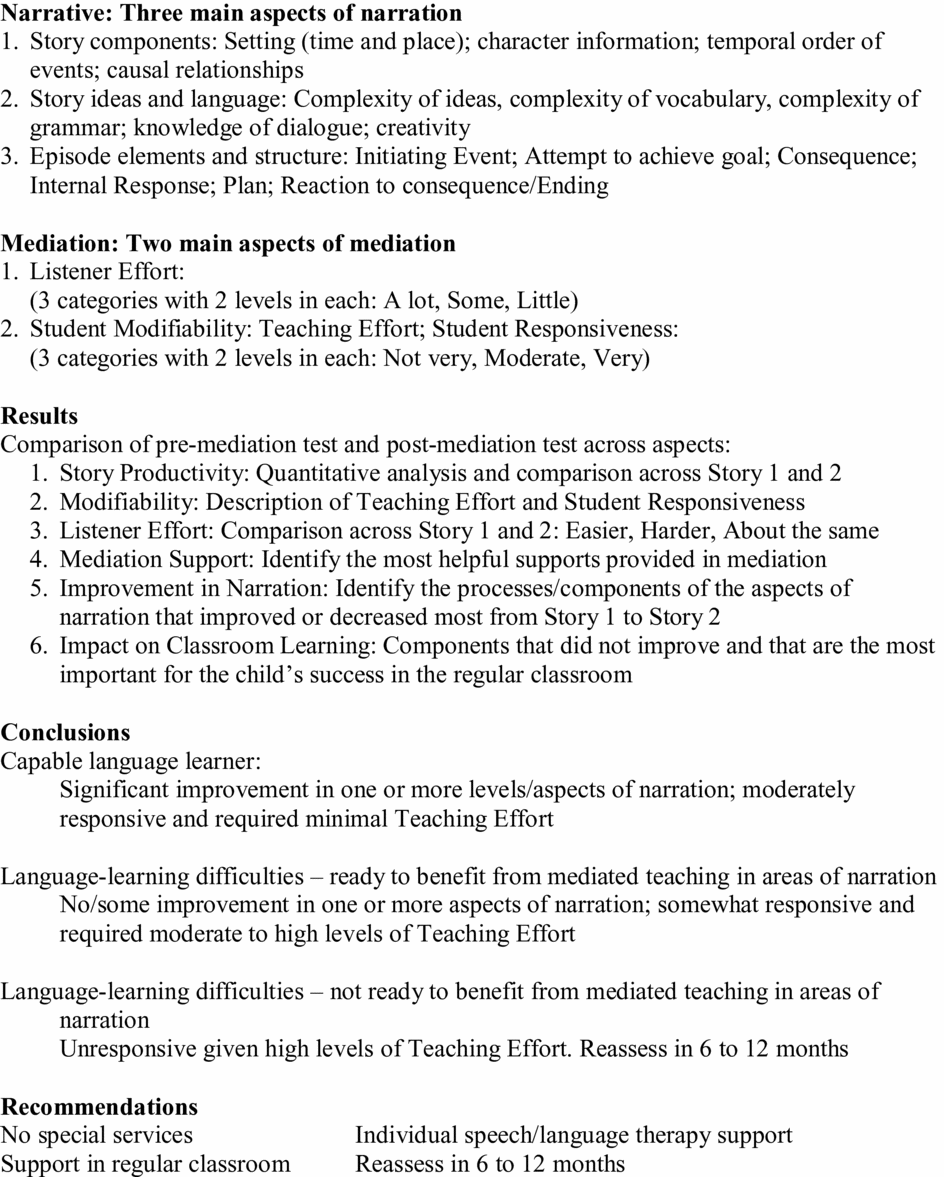
A published DA procedure, ‘Dynamic assessment and intervention: Improving children's narrative abilities’ (Miller, Peña & Gillam Reference Miller, Peña and Gillam2001), follows a three-stage DA format: ‘test – mediated interventions – retest’. Two stories from wordless picture books are used, interspersed with two 20-minute mediated interventions. The mediated interventions used the first story book and are based on Lidz's (Reference Lidz1991) principles of mediated learning, which use a simple hierarchy of mediation (see Figure 1) derived from Feuerstein's MLE approach (Feuerstein et al. Reference Feuerstein, Feuerstein, Falik and Rand2002). In this method the first story establishes the child's Zone of Actual Development (ZAD) and the mediated interventions extend the child's Zone of Proximal Development (ZPD) to develop new learning for aspects of story language identified in the ZAD assessment. The children's ZAD results showed potential to develop the ‘settings’ and circumstances of story grammar (location and temporal aspects). More recent use of DA (Fiestas & Peña Reference Fiestas and Peña2004) indicates that all areas of story grammar need to be mediated in the two mediation sessions. The fourth and final session was a second storytelling assessment with a different wordless story book, following the same protocol as the first session.
Miller, Peña & Gillam's (2001) Dynamic Assessment and Intervention method

Each child took part in four 20-minute sessions with the SLT over a period of four weeks, in a quiet work room attached to their classroom in the specialist provision. The protocol for the first and last assessment sessions began with the SLT explaining to each child what would happen in the session, then familiarising her/him with the wordless story book ‘The two friends’, and asking the child to tell the story on her/his own. The assessor talked each child through key vocabulary items.
The assessment tool (Miller et al. Reference Miller, Peña and Gillam2001) used in this study is a product of Peña's research over ten years with monolingual and bilingual children with and without developmental language difficulties. In Peña's studies, testers using the DA tool followed semi-scripted prompts to mediate the children through the picture story task in order to distinguish language differences from language disabilities in Spanish–English bilingual children in south-western USA. However, the exploratory study reported here worked in English only and did not use semi-scripted prompts.
Since the story books depicted scenes from south-western USA, we investigated the cultural accessibility of the first story material. A fourth child, a girl, with no apparent language or learning needs, from the same class group in the mainstream school as the other participants, was invited to participate, with the necessary permission obtained. Apart from one vocabulary item (‘armadillo’ rendered as ‘antelope’), her performance was satisfactory both in storytelling and in the quantitative expressive story grammar for the main basic elements (Score: 2). Some mediation supported her learning of unfamiliar vocabulary but there was no mediation for her ability to transcend the story. There were examples of unusual visual interpretations of story pictures (for example, in Story 2, Mark referred to one of the birds as a ‘robot’). It is possible that the materials could have made excessive interpretative demands on some children.
3.2 Recording, transcription and coding
All the children's sessions were video and audio recorded and independently transcribed verbatim by Julie Emms (JE) and Deirdre Martin (DM). The transcripts were scored quantitatively for word and clause totals, following the manual. An example of reliability in JE and DM's scoring of Story 1 for the three children is: Esther: 96.5%; Mark: 87%; Ahmed: 83%. One explanation for the differences could be the decreasing intelligibility between Esther, Mark and Ahmed. Additional non-verbal interaction communication (e.g. gestures, eye gaze, body orientation) was included in the transcriptions, which we found later to be important evidence for mediation. JE and DM interpreted the mediational measures of the transcripts independently and compared rating accuracy, and discussed and resolved differences with reference to the manual.
The primary unit of analysis discussed here is the modifiability and responsiveness in mediation for language learning in each child's ZPD, by the SLT tester. The DA tool also measures change in the children's talk quantitatively, by linguistic analysis and in story grammar. The following sections discuss analyses of the outcomes of mediated learning across aspects set out in the DA procedure (Miller et al. Reference Miller, Peña and Gillam2001) (see Figure 1), except for the final point concerning impact on classroom learning, which is not discussed here.
4. Discussion of the quantitative data analysis and narrative improvement
This discussion examines the data for what is revealed through mediation in DA about the language-learning capabilities of the three children with developmental language disabilities. In the following sections, the data are discussed across the analytic categories of the DA tool. Changes in amount of talk and improved narrative are discussed briefly with the main discussion of the primary unit of DA analysis, modifiability and responsiveness in mediation.
(1): Story productivity: quantitative analysis and comparison across Stories 1 and 2
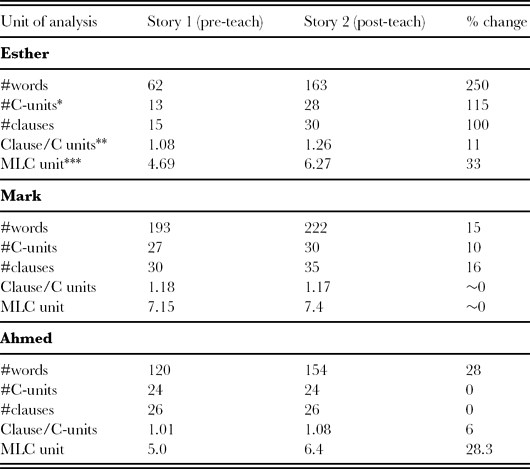
Quantitative increase in the children's storytelling data before and after mediations for language learning is taken as a measure of improvement. Structural linguistic features are counted: words, clauses, C-Units and Mean Length of Clauses are set out in the assessment protocol and also described in Fiestas & Peña (Reference Fiestas and Peña2004). The words counted in each story excluded repetitions. Number scores are presented in Table 1.
Pre-mediation test and post-mediation test dynamic assessment scores
C-Unit*: “the independent clause plus its modifier. In English, the main clauses were segmented with their conjoined simple coordinate conjunctions (e.g. and, but) unless an overt subject or pronoun was used in the clause.” (Fiestas & Peña Reference Fiestas and Peña2004: 159).
Clause/C-units**: the number of clauses divided by the number of C-Units
MLC ***: mean length of clause
The quantitative data shows before–after change, while the process of change itself is discussed in the next section. No normative comparison can be made, but the data enable us to compare differentiated change across the children. Typically, developing children become better storytellers when they engage in repeated storytelling activities (e.g. Morrow Reference Morrow1985; Cooper & Collins Reference Cooper and Collins1992). That is, they learn how to do storytelling. Esther's profile shows this point most clearly in the massive percentage change between her first and second stories. Ahmed also shows change across his stories but more at word level than at clause level. Mark shows only small quantitative changes across stories, although he says the most in his stories and is the most verbal, suggesting that he may already know how to tell stories. The quantitative analysis of structural language units, while differentiating an aspect of the children's storytelling, offers limited insight into their language learning, although it may suggest a growing confidence in storytelling.
5. Discussion of measures of improvement
The measures used in the DA tool to appraise change in the children's storytelling operationalise the concepts set out in section 2 above. Change is interpreted through qualities of improvement set out in the analytic frames of the children's language learning capacities (see Results 2–5 in Figure 1). Specific examples from the children's data are discussed in section 6.
(2) Modifiability: inverse relationship for Teaching Effort and Student Responsiveness: Teaching Effort: A lot, Moderate, Little; Student responsiveness: Not very, Moderate, Very
Modifiability is the measure of language learning that interprets and rates mediation. It aims to interpret the relationship between Listener Effort and Student Responsiveness, which is represented on three-point rating scales. The two intertwined aspects of mediation have an inverse relationship indicating the extent of work being done in the child's ZPD: low levels of mediator effort that engage high responsiveness from the child suggest language learning. High levels of mediator effort to support the child's language learning that draw little responsiveness from the child suggests that the focus of learning is not within the child's ZPD. It may also indicate that the learner is not engaging, perhaps because of related feelings of competence.
A critique of the categories in Miller et al.'s DA procedure that describe the relationship between mediational effort and learner responsiveness is that they are intuitive and underspecified with respect to the demands of the DA. Two options present themselves. A recent study of DA with language disabilities (Hasson & Botting Reference Hasson and Botting2010) used the prescribed rating scale from the Required Mediational Intervention (RMI) (Feuerstein et al. Reference Feuerstein, Feuerstein, Falik and Rand2002). Alternatively, measures of mediation effort could be more ecological and described in terms of pedagogic collaborative and cooperative strategies with students’ responsiveness (Poehner & van Compernolle Reference Poehner and van Compernolle2011).
(3) Listener Effort (understanding child's story): Comparison across Stories 1 and 2: Easier, Harder, About the same
The mediator found it difficult to make an ‘objective’ assessment of her own Listener Effort to measure improvement. A contributing factor was that, as their regular therapist, she was accustomed to the children's talk. The measure ‘About the same’ was marked for Esther and Mark. However, Ahmed's talk in Story 2 was ‘Easier’ to understand.
(4) Mediation Support: Identify the most helpful supports provided in mediation
As discussed in section 2, DA concerns the mediator's and learner's intentionality, modifiability-reciprocity and transcendence. The child's intentionality is appraised by consciousness and self-regulation of learning within the storytelling context. Strong support was provided by the existing relationship between the mediator and the children and the praise given by the mediator to the children during the DA. By contrast, in SA, personal supportive behaviour is minimised, with possible ethical implications.
Mediation in this study of DA draws heavily on the notion of double stimulation described in section 2: this occurs when mediation supports the child to use one ‘sign’ to bring another to mind. Competence in DA mediation is shown by interaction that is orientated by prompts that develop the child's problem-solving in both the story narrative and language form/content. An important strategy for the mediator is to draw on a sign that the child is already familiar with and use it in the new context.
A common confusion when performing mediation in DA is to focus on successful accomplishment of the task. The performance of modifiability-reciprocity is measured by graduated prompting (Lidz Reference Lidz1991; Feuerstein et al. Reference Feuerstein, Feuerstein, Falik and Rand2002) or a menu of mediating moves (Lantolf & Poehner Reference Lantolf and Poehner2011; Poehner & van Compernolle Reference Poehner and van Compernolle2011). The emphasis is on fine-grained description, analysis and classification of mediation and reciprocity.
Important mediating signs for the children were, first, drawing attention to a problematic answer by a pause, repeating the question, emphasising key words or re-phrasing the question. A second was asking open-ended questions, such as ‘what else?’ A final support drew explicitly on a previous experience: ‘Do you remember when. . .?’ This menu of mediating moves is similar to one described in a DA study of second language learning (Lantolf & Poehner Reference Lantolf and Poehner2011).
For one child, a successful prompt used a previous physical teaching aid. In the mediation session with Ahmed the practitioner drew on the ‘red card’ from a teaching approach used in classroom teaching about location settings, which she then used as a prompt to support mediating Ahmed to talk of different places in the story.
In this DA study, transcendence was evidenced in the development of the function of storytelling, the children's application of aspects of the story to other contexts, such as their own lives, as well as their application of an aspect of language form in narration to a new story, such as story settings or dialogue.
(5) Improvement in narration
A fifth measure of children's language learning from mediation sessions is rated through the processes/components of the aspects of narration that improved or decreased most between Story 1 and Story 2. In this aspect of the DA tool, the analytic frames of story grammar are drawn from three main elements of narrative developed by Merritt & Liles (Reference Merritt and Liles1987):
(i) Story components: Rated: None, Some, Well specified
Setting (time and place), Characters, Order of events, Causal relationships
(ii) Story ideas and language: Rated: Simple, Some
Complexity of ideas, Complexity of vocabulary, Grammatical complexity, Dialogue, Creativity
(iii) Episode elements and structure: Rated: Completeness and Complexity
Initiating event, Attempts to achieve Goal, Consequence, Internal response, Plan, Ending
The range of language aspects in the DA procedure indicates that mediators need to be trained in language and mediation analyses. The multi-level language afforded by storytelling in this DA tool may present challenges for selecting mediation sites in the case of some children with substantial language disabilities. In this study, ‘Setting (time and place)’ was chosen as a focus of mediation, since none of the children showed this knowledge in Story 1.
Discussion of the modifiability of each child is focused on the aspects of mediation (2), (3) and (4). A critique is offered of the mediation measurement scale used in this DA instrument in comparison with the measures used by Feuerstein et al. (Reference Feuerstein, Feuerstein, Falik and Rand2002) and Poehner & van Compernolle (Reference Poehner and van Compernolle2011).
6. Discussion of data about modifiability
The analysis and discussion of modifiability for language learning during the DA process serves at least two differentiation functions. First, the DA profiles show that mediation has a noticeable effect on each child's learning, reflected in different patterns of quantitative scoring, narrative and mediation/responsiveness. Second, the children's responsiveness to mediation in the narrative task brings to the surface information directly helpful for future instruction of the children.
In DA the primary unit of analysis is the process of mediation necessary for language learning. DA exceptionally affords analysis of language learning by assessing the reciprocity between the child's responsiveness and the mediator's teaching efforts with a story over two sessions. The children's data is discussed with reference to one story component: story settings.
Esther (6y 4m)
Esther's profile shows a positive response to mediation for story narratives when she learnt to use locative phrases appropriately and developed appropriate use of dialogue. For example:
Excerpt 1Footnote 2
Story 1 – Mediation 1
Mediator See if you can tell me the story remembering to tell me about where it is happening and when it is happening
Esther (takes book in both hands)
Mediator Off you go then
Esther A cat and a dog were talking together. (14 second pause) by a river
Mediator: Well done
This interaction follows discussion drawing on the understanding of location. The mediator offers Esther three mediated moves. She emphasises the word ‘where’, she allows Esther agency of the story book, and encourages her to begin. During the long pause, the video shows Esther moving her lips as if practising her response. The long pause and the subvocal practice indicate that Esther does not yet have full control of this grammatical item and is drawing on her cognitive resources. Similar evidence is noted by Lantolf & Poehner (Reference Poehner and van Compernolle2011). Esther was very pleased with her accomplishment, and aware of her achievement. In Esther's Story 2 this grammatical feature was established, suggesting that a single occurrence of development may be sufficient to establish learning. However, Esther has learnt to use locative phrases rather than ‘setting the story’ in a place. The mediator was keenly aware that she was waiting for Esther's response and considered interrupting the long pause with a further mediation. Instead she waited and gave Esther immediate praise, indicating for the second time her intention to help Esther improve, creating a ‘safe space’ for Esther to try out new language learning.
Later, in the same mediation session, ‘setting the story in time’ was broached. Three attempts by the mediator to mediate temporal phrases reveal that Esther does not seem to grasp the idea of using time words or other linguistic forms of time.
Excerpt 2
Story 1 – Mediation 1
Mediator The other thing we were going to talk about to make it more interesting was. erm. we were going to talk about was telling the time as well. not telling the time on a clock but some words like. one day
Esther (smiles)
Mediator that's a good start isn't it. . or.
Esther . . .(no response)
Mediator What else can we think. one day. or.
Esther two day
Mediator two days ye. once upon a time. .
Esther . . .(looks at mediator, no other response)
Storytelling typically invokes an existential use of time and place for story settings: ‘There was a. . .’; ‘One day. . .’. Here Esther shows an instrumental, quantitative understanding of the structure of time rather than the existential notion intended by the mediator. The mediator understands from Esther's response that this mediation for time settings is not in her ZPD and that further structured mediation for setting-the-story-time would be required. The mediator does not continue with this mediation, and changes topic.
Mark (6y 5m)
Mark's quantitative profile shows he is more verbal than his two peers. His clause structures indicate that developmentally he is more advanced in lexical and linguistic aspects. The following extract illustrates how he achieves this profile.
Excerpt 3
Story 1: Two Friends
Picture 1 What a lot of words (referring to speech bubbles). and the dog and the cat are sitting down. yeh and the stars are in the sky and there's some funny words there (referring to speech bubbles). and the cat's got red eyes and the dog's got blue eyes and the dog's got lots of colours, yellow and red and purple and white and the cat's got yellow, blue, red, yellow
Here Mark talks about the details of the picture and demonstrates his knowledge of print literacy (speech bubbles) and colours. However, his talk is not in a storytelling genre: it does not set the scene for the story to follow by identifying a relationship between the characters and the subsequent events that are shaped by their friendship.
One strand of Mark's development is narrative: that is, interpreting the inter-relationships between different characters and elements to create the story's meaning (episode structure). The mediator selects ‘story settings’ as Mark, like Esther, has shown this is an undeveloped narrative feature. In the first session, mediation aims to develop the notion of time in the story setting.
Excerpt 4
Mark's Mediation 1
1. Mediator: do you think it's day. or do you think it's night?
2. Mark: (yawns) it's day
3. Mediator: it's day. I think you're right (turns page).
4. do you think it's day here? (moves finger over top part of page 2)
5. Mark: No. night
6. Mediator: so we think it might be one morning?
7. Mark: yep
8. Mediator: d'you think?
9. Mark: yep
10. Mediator: so we think it might be one morning
11. Mark: (interrupts) No
12. Mediator: go on then
13. Mark: No. it'd be (slows pace and says slowly) two mornings and two nights
14: Mediator: why two mornings?
15. Mark: because I saw them on page . . . (goes to turn over to page 2)
16. Mediator: (turning over to page 2) oh right. but isn't this the same morning?
17. Mark:. (no response)
18. Mediator: we're just turning over
19. Mark: (looking at picture says slowly) yees
20. Mediator: there may be another morning. you're right. (flicks through pictures)
21. We might come to another morning. after the night. We'll see about that.
22. Mark:. . (looks at picture in silence)
This lengthy excerpt illustrates the mediator's collaborative and cooperative framing of mediated moves in response to the learner's agency. The context is a discussion of the time setting of the story. At the beginning of the excerpt (turns 1–11) the mediator draws on collaborative framing to establish the time of day. First, she ‘narrows the degrees of freedom’ for Mark by contrasting day vs. night, then morning vs. day, and she moves to explicitly establish ‘morning’ (turns 6 and 10). However, in response to Mark's contradiction (turn 11) she changes her mediation strategy to adopt a cooperative frame in a series of moves that explore Mark's meaning and build on his emergent agency. Mark moves from being minimally engaged in the activity (turn 2, yawning), to challenge the mediator's statement: one morning. The mediator follows Mark's agency as he flips forward a page, to justify his interpretation.
Engaging the learner's agency in this way, the mediator has temporarily shared responsibility for the interaction and as Mark becomes more agentive he reveals the extent of his understanding of time in the story. Had she not done this, ‘not only will a good deal of the learning process remain hidden from observation, but the process itself may well be impeded’ as the mediator takes increasing control (Lantolf & Poehner Reference Lantolf and Poehner2011: 33). The mediator shows here how she frames mediation by collaborative and cooperative interactions to meet both purposes of Mark's language learning and her purposes of assessing his ZPD for language learning. Task-focused (collaborative) and co-constructing (cooperative) interactions allow learner agency to develop which, as shown for Mark, can be a risky business. With appropriate mediation, it can become a ‘safe space’ for language learning.
The mediator moves to close down Mark's line of argument with a reassurance that his point may be supported later in the story. In this way the mediator has ensured that Mark has not lost face following his brave agentive move. Mark's slow, careful response (turn 19) suggests his original understanding has been disrupted and new learning may be taking place. It also suggests that Mark has emerging ideas of causal connections across the pictures. The mediation has also drawn from Mark a substantiated argument for ‘two mornings’, revealing that, like Esther, he has a quantitative understanding. Mediation has revealed diagnostic features of Mark's language learning and indicated lines for future intervention.
Ahmed (7y 2m)
Ahmed's quantitative profile shows a distinct improvement, with an increase in words, also reflected in his lexical and grammatical information (his rating for MLC-units improves 28%). Further scoring information indicates that he has learnt more about the story narrative genre. There is also evidence of more non-verbal communicative behaviour. In Story 2 he seeks and maintains more eye contact with the mediator, indicating both his own intention to learn and his awareness of the mediator's intention to help him learn. He has learnt to engage more in interpreting the pictures. His story has a narrative sense of ‘lost and found’ while relying heavily on the pictures for prompts. Ahmed's storytelling, like that of the other two children, has difficulties with setting the story in ‘place’.
Of the three children, it was Ahmed whose responsiveness required the most mediation effort in understanding and developing the notion of location/locative phrase, whether the location and physical settings of the action in the picture, or the location of the whole story. In the DA and the second mediation session, the mediator drew on three mediational prompts that were used in the classroom for learning locatives: saying the word ‘where’ while gesturing a specific sign and with a visual symbol (a red card representing the question word ‘where’). Ahmed engaged positively with this comprehensive level of mediation learning. In the mediation sessions with the story, Ahmed was able to respond with a relevant locative phrase (object + preposition) about a target picture.
Ahmed's talk in his DA and mediation displayed features typical of much younger children's developing language. There are several examples of language development across Story 1 and Story 2. In Story 1, Ahmed, like Mark, seemed to talk about each picture rather than telling a story, demonstrating the issue identified by Berman & Slobin (Reference Berman and Slobin1994). Yet by Story 2 his narrative indicated a sense of the ‘lost-found’ theme. Lack of clarity of meaning in Ahmed's clausal relations (because/coz/and) made understanding Story 1 difficult. The relationships (causal, co-ordination, consequence) between characters and events in the pictures did not make a coherent story sequence. Yet in Story 2 this feature was not in evidence and seemed to be largely resolved. Since this aspect of Ahmed's talk was not mediated, development cannot be attributed directly to mediation, but only generally to the DA method.
During the telling of Story 2, there was an illustration of mediating new word learning. Nest seems to have been a new word for Ahmed, introduced by the mediator when looking together through Story 2 storybook. In retelling Story 2 he spontaneously rendered nest as ‘tennis’. Nest and tennis contain similar phonemes but they are differently sequenced and the confusion can be explained by phonological processes found in early child speech development. This spontaneously occurring example within the story indicates that in a meaningful context, Ahmed learns new words, albeit with overt correction for the speech sound sequence. This example has implications both for further exploration of Ahmed's word learning capacities through DA, as well as for intervention and curriculum learning.
Ahmed's talk appears to be developing like that of a much younger child. Yet with mediation his talk evidenced continuous new learning underlying his language and cognitive development. The two examples above illustrate that while DA was focused on specific aspects of language development, Ahmed's language continued to develop across other fronts. An explanation may lie with the microgenesis that results from mediated interactions. As we have seen in Esther's and Mark's learning, during the intermental-intramental learning process of DA in the child's ZPD, even though the learning focus is on discrete features of language, such as locative phrases, the child and mediator also engage in developing self-regulation, self-awareness and agency. Thus, wider language development may occur as the child's ZPD is expanded to include cognitive, linguistic and social development. Further, the explicit use of multimodal mediation that linked classroom learning interactions with one-to-one learning interactions (in a different room) made explicit for the mediator, and probably for Ahmed, the ‘dialectical unity’ of language learning in his ZPD, for assessment and teaching. In fact, the discussion of the purpose for using the mediational tools either for assessment or for teaching seems unnecessary in this context and undermines their transformative potential (Poehner & van Compernolle Reference Poehner and van Compernolle2011: 195).
7. Conclusion
This study asks three questions about DA. First, what did we learn about the children's language disabilities? The diagnostic function of SA reveals current deficits through normative comparison. One diagnostic function of this DA identified differences in each child's natural (zone of actual) development in the narrative task. The children's difficulties were revealed in their performance and approach to the storytelling task and in structural aspects of language.
Second, what did we learn about their language learning capabilities? The most important diagnostic function of DA is the revealing of language learning capabilities in mediation with these children. Quantitative measures of structural language development and story grammar across the DA sessions evidenced differentiated language learning capacities across the three children, in learning new vocabulary, phonological organisation in words and grammatical forms. Furthermore, there was evidence of transcendence in language learning across other social contexts. That is, mediation had a transformative effect, working within the children's zones of proximal development and stimulating a wider systemic development of language, rather than being constrained to atomised development of specifically targeted structural features of language. Notably, Esther demonstrated enhanced social engagement in general classroom learning activity. Future studies of DA in the context of language disabilities could examine this phenomenon more closely, with particular reference to the development of ‘identity as a competent speaker’ (Holzman Reference Holzman2009).
Third, what did we learn about intervention? This DA procedure also revealed the relationship between the assessor's effort and the learner's responsiveness, and has shown that for DA with language disabilities mediation can draw on graduated artefacts as well as collaborative and cooperative interactional framing. Through different interactional frames, increased levels of mediation and a range of mediational artefacts, the mediator learnt to afford each child a transformative approach to the task.
Three final points: first, the significance of this exploratory study lies in its contribution to the growing knowledge of a DA process for children with language disabilities. It has added to the analysis of mediation in the published DA tool used in the study, by drawing on recent research in DA into foreign language learning that further analyses task-focused and learner-focused interactional framing (Poehner & van Compernolle Reference Poehner and van Compernolle2011).
Second, the study contributes to policy-practice debates on the relationship between assessment and inclusive/integrated curriculum teaching for special educational needs. As DA blurs the traditional divide between assessment and future intervention, its results can better inform the manner and content of differentiated teaching/learning for inclusive schooling for those with language disabilities. The example in the study of shared mediation practices and artefacts for language learning across classroom work and DA practice strengthens the case for DA as an effective tool to inform the integration of language learning into differentiated classroom pedagogy.
Third, the study contributes to the debate about the ethics of privileging individual learner performance in SA, which is particularly evident in diagnostic SA of language disabilities. This general ethical dilemma in SA procedures concerns the withholding of support for the child in the test on the grounds that it is outside test procedures. This ethical concern is illustrated in Ahmed's SA profile, where his development had ‘plateaued’ over a twelve-month period. Yet co-constructed language learning activity in DA over four 20-minute sessions evidenced measurable language development. That is, what he could not do on his own in SA, he could do jointly with the mediator in DA.
To conclude, this study contributes to growing evidence that DA can be an effective, ethical language learning assessment measure with the potential to inform inclusive/integrated pedagogy for learners with language disability. Important questions remain about language development in language disability that developing new DA procedures could effectively address.
Acknowledgements
I am hugely indebted to Julie Emms, specialist speech/language therapist, for collaborating with me on this paper, as well as to the co-operation of the three children, their parents, and the school for making this study possible.
Appendix
The Reynell developmental language scales III-RDLS (1999), published by GL Assessment. This is a standardised measure of language development for everyday clinical use. It uses comprehension scales to assess the structural aspects of language and how these are adopted to acquire and use language, and help in the identification of language disorders and language delay.
Test for the reception of grammar: TROG-2: Dorothy Bishop (2003), published by Pearson PsychCorp. TROG-2 assesses grammatical comprehension by measuring understanding of 20 constructions four times each, using different test stimuli.
Bracken basic concepts scale – 3rd edition: Receptive (BBCS-3: R): Bruce A. Bracken (2006), published by Pearson PsychCorp. This test aims to evaluate the child's acquisition of basic concepts, which is strongly related to cognitive and language development as well as to early childhood academic achievement.
Deirdre Martin is Senior Lecturer in the School of Education, University of Birmingham, UK. She has extensive experience as a speech/language pathologist, educator and researcher with children and families with language disabilities in multilingual societies. She has published widely in the field of language development, disability and bilingualism.