INTRODUCTION
The West Africa region has a diverse marine mammal fauna (e.g. Perrin & Van Waerebeek, Reference Perrin and Van Waerebeek2007; Weir, Reference Weir2010), however relatively little is known about cetacean ecology in the area extending from the Gulf of Guinea south towards Angola (Jefferson et al., Reference Jefferson, Curry, Leatherwood and Powell1997; Hoyt, Reference Hoyt2005; Weir, Reference Weir2010). The Gulf of Guinea and coastal waters of central Africa were a focus of commercial whaling activity (Townsend, Reference Townsend1935) with catches being made in Gabon until 1959 (Budker & Collignon, Reference Budker and Collignon1952). A humpback whale research project that began in 2000 has greatly increased the knowledge about cetaceans occurring in the inshore waters (Rosenbaum & Collins, Reference Rosenbaum and Collins2004). These surveys indicate that the coastal waters of Gabon represent an important breeding habitat for southern hemisphere humpback whales (Rosenbaum & Collins, Reference Rosenbaum and Collins2006; Collins et al., Reference Collins, Cerchio, Pomilla, Loo, Carvalho, Ngouessono and Rosenbaum2008). Published information on the distribution and abundance of other cetacean species occurring off Gabon is however limited, particularly in deep water areas. Findlay et al. (Reference Findlay, Collins and Rosenbaum2006) reported the potential occurrence of seven species of large whales (six mysticetes and the odontocete sperm whale) in Gabonese waters. The occurrence of six cetacean species was recently reported for São Tomé and Príncipe located in the Gulf of Guinea at the same latitude as the northern Gabonese coast (Picanço et al., Reference Picanço, Carvalho and Brito2009). In a recent review, Weir (Reference Weir2010) listed a total of 17 species recorded in Gabon with the majority of information compiled from stranded specimens, captures (deliberate and accidental by-catch in fisheries) and incidental sightings (Jefferson et al., Reference Jefferson, Curry, Leatherwood and Powell1997; Perrin & Van Waerebeek, Reference Perrin and Van Waerebeek2007).
The paucity of information on cetaceans in central West African waters suggests a need for research to study the distribution and abundance of cetaceans and also to study threats to them (Perrin & Van Waerebeek, Reference Perrin and Van Waerebeek2007). The main purpose of this paper is to contribute information on the distribution and relative abundance of cetaceans sighted during a geophysical survey in Gabonese waters and where possible to relate the occurrence of different species with oceanographic parameters such as sea surface temperature (SST) and depth.
MATERIALS AND METHODS
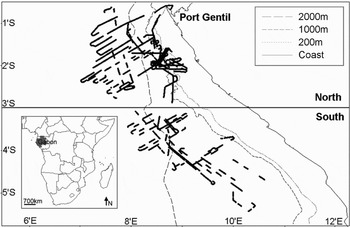
Cetacean surveys were carried out in Gabonese waters (0°33′S–05°26′S and 007°02′E–010°43′E) between 7 March and 7 August 2009. A geophysical seismic survey vessel, the CGG ‘Venturer’ was used to collect data on cetaceans, and as such acted as a platform of opportunity. The study area was situated to the south-west of Port Gentil, and consisted of a northern (north of 3°S) and southern sector (south of 3°S; Figure 1). The area extended between 25 and 130 nautical miles off the coast. There were a total of three different survey periods which differ in methodology.
Distribution of survey effort (thick black lines) during the main survey (7 May–12 July 2009).

Main survey
Dedicated cetacean observations were carried out between 5 May and 12 July 2009 (Table 1). An experienced observer searched for marine mammals from the flying bridge deck (12.5 m) or from the monkey island (14.5 m). Periods of dedicated watches for cetaceans were conducted during all daylight hours (12.5 hours) for the duration of the dedicated survey period. Cetacean data were collected in an opportunistic manner, with the distribution of the survey effort determined by the geophysical survey work and where the vessel did not deviate from the track-line when a sighting was made. The observer scanned predominately with the naked eye but used binoculars (7 × 50 and 8 × 43) for searching the horizon, aiding species identification and group size estimations. Searches included a 180° arc ahead of the vessel with occasional scans of 360°. Once a sighting was made the radial sighting distance to a sighted cetacean was determined using reticule binoculars or person-specific range-sticks. The bearing to the sighted animals and their heading were determined using an angle-board. Sightings data also included the time (GMT), GPS position, water depth, species identification, the presence of calves and/or juveniles, school size (maximum, minimum and best), travel mode (slow, moderate or fast), group composition and behaviour. Environmental data recorded included: wind speed and direction, visibility, swell height, sea surface temperature (SST) and Beaufort sea state (BSS). Ship's position, speed and course were continuously logged.
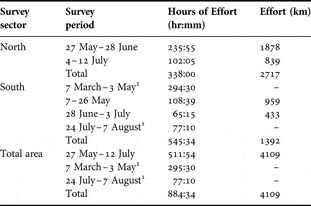
Extent of visual survey effort during the main and additional1 surveys in the northern and southern sectors between 7 March and 7 August 2009.

Additional surveys
Two additional cetacean surveys were carried out during which the author was not present (7 March–4 May 2009 and 24 July–7 August 2009) and watches were not maintained as rigorously as those described above. Observers involved during the additional surveys had previous experience of conducting cetacean surveys in tropical waters. The data regarding the ship's position, speed and course were not continuously logged, however, information was provided regarding the hours on watch. Cetacean sightings reported ‘off effort’ were regarded as incidental.
Data analysis
Cetacean sightings reported ‘off effort’ and with a BSS > 4 were regarded as incidental. Identifications included an associated ‘degree of certainty’ that ranged between definite (100%), probable (75%) and possible (50%). Where possible, animals were photographed to confirm identification using a Sony Single Lens Reflex (SLR) camera and 70–200 mm (f2.8) Sigma zoom lens. The species identification provided by observers was checked and verified using written descriptions and photographs. Animals too distant from the vessel to allow definite identification (>1 km for small dolphins such as Stenella/Delphinus) were classed as dolphin species.
RESULTS AND DISCUSSION
During the main survey, a total of 512 observation hours over 4109 km were carried out in good conditions (BSS 0–4 and visibility >5 km; Table 1). A total of 373 observation hours was carried out during the additional surveys. The water depth ranged between approximately 50 m and 4000 m with the vast majority (65%) of searches made in deep waters of ~2500 m. SSTs in the Eastern Gulf of Guinea generally vary between 27°C and 29°C, however they can drop to less than 22°C off the coast between July and September (Findlay et al., Reference Findlay, Collins and Rosenbaum2006). SSTs recorded during this survey were highest during early March (28.5°C) and lowest in July and early August (20.5°C). The vessel was in seismic operation for 61% of the main survey and data presented here are potentially influenced by unknown reactions of cetaceans to air gun operations.
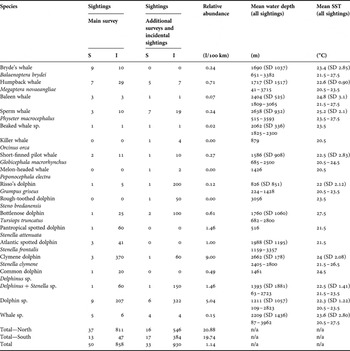
Definite (72%) and probable sightings (22%) comprised the majority of all sightings. A total of 50 sightings of 858 animals involving 13 different cetacean species were made during the dedicated main survey (Table 2). In addition, 29 sightings of 679 animals involving eight species were made during the additional surveys. A further four incidental sightings were made whilst off-effort. Many sightings remained unidentified during the surveys (N = 29, 36%) due to their distance from the vessel and confusion over species identifications, particularly those of Stenella sp. and Balaenoptera sp.
Overview of sightings (S) and total number of individuals (I) made during the main and additional surveys. The number of individuals 100 km−1 seen during the main survey is shown as the relative abundance for each species. In addition, the relative abundance for all species is shown for the different survey sectors. For all sightings (main + additional surveys) the mean water depth (m) and sea surface temperature (SST; °C) are presented together with the range.

n/a, not applicable.
Bryde's whale (Balaenoptera cf. brydei)
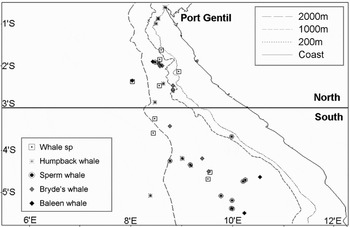
The Bryde's whale was the most frequently encountered baleen whale during the survey with a total of nine sightings at distances <2 km from the vessel. With the exception of one encounter involving two animals, Bryde's whales were encountered singly. The relative abundance (0.24 whales 100 km−1) was low compared to humpback whales (0.71; Table 2). Bryde's whales were sighted in deep water with a mean depth of 1690 m and mean SST 23.4°C (Table 2). For sightings with Bryde's whales encountered in deep oceanic waters (>2400 m) a higher SST was measured (>26.5°C). The majority of sightings were made in the northern sector along the 1000 m depth contour (Figure 2).
Distribution of all whale sightings (humpback whale, Bryde's whale, sperm whale and unidentified whale) made during the main and additional surveys. The 2000, 1000 and 200 m depth contours are also displayed.

Bryde's whales are notoriously difficult to identify to species level as they are very similar to Sei whales (B. borealis) in appearance and can also be confused with fin whales (B. physalus). For this reason an additional four possible Bryde's sightings were logged as ‘baleen whales’. Given current uncertainty regarding the taxonomic status of these whales, Best (Reference Best2007) adopts B. brydei for all Bryde's-like whales occurring in southern Africa. A divide in Bryde's whale distribution in distinctly separate habitats (shallow waters of <100 m or deep oceanic waters of >1600 m) was noted off Angola (Weir, Reference Weir2007) and may reflect distinct ‘offshore’ and ‘inshore’ forms of this species (Best, Reference Best2001). The Bryde's whales encountered during this study were most likely of the offshore form given that all sightings were in waters exceeding 650 m in depth. The ‘offshore’ form may make extensive migrations between South Africa (January–February) and Gabon (May–July; Best, Reference Best2001). Bryde's whale sightings during this study occurred in May and July and are consistent with this theory. The majority of Bryde's whales were seen travelling. In July, feeding activity was noted in an area where small fish (likely Sardinella sp.) were seen in huge shoals close to the surface.
Humpback whale (Megaptera novaeangliae)
Humpback whales were less frequently encountered than Bryde's whales but were however the most abundant whale encountered during the study. The first sighting occurred in the southern sector on 30 June after which they were seen more regularly with seven sightings recorded during the main survey and five sightings made during the additional surveys. The majority were seen in the northern sector (Figure 2) in water depths that ranged between 38 m and 3715 m with a mean temperature of 22.6°C (Table 2). The largest group of at least 20 whales was observed on 12 July. This surface-active group of whales was sighted whilst in transit in coastal waters (41 m) and comprised five mother–calf pairs (each pair >5 body lengths away from other pairs) and single whales in the vicinity of the pairs. All other encounters made during the present study consisted of single whales or pairs. The majority of sightings made during the main survey were encountered in deeper waters (>1000 m), although four sightings occurred in waters of <150 m. Humpback whales sighted in deep waters were typically travelling and those in shallow waters were surface active. The whales were sighted at distances ranging between 200 and 1200 m. During the additional surveys humpback whales were also sighted at greater distances (N = 2; 1500 and 2500 m).
The relative abundance was 0.71 whales 100 km−1 (Table 2) and was expected to be higher due to the reasons outlined below. The coastal waters of Gabon represent an important breeding habitat for humpback whales (Rosenbaum & Collins, Reference Rosenbaum and Collins2006). Humpback whales in Gabonese waters are for the majority observed during the months of June through to November and include animals from populations that feed in the waters of the Southern Ocean and the coastal waters of Antarctica (Findlay et al., Reference Findlay, Collins and Rosenbaum2006; Pomilla & Rosenbaum, Reference Pomilla and Rosenbaum2006; Rosenbaum et al., Reference Rosenbaum, Pomilla, Mendez, Leslie, Best, Findlay, Minton, Ersts, Collins, Engel, Bonatto, Kotze, Meÿer, Barendse, Thornton, Razafindrakoto, Nogouessono, Vely and Kiska2009).
Humpback whales in general show a preference for shallow water breeding habitats (<100 m; Clapham, Reference Clapham, Mann, Connor, Tyack and Whitehead2000) which has also been noted in the region (Weir, Reference Weir2007; Picanço et al., Reference Picanço, Carvalho and Brito2009). It is therefore likely that these whales were more abundant in shallow waters where less survey effort was carried out. On 1 July, two humpback whales were seen interacting with at least three sperm whales in water depths of 3593 m; both species were frequently breaching and tail slapping was also observed. No direct contact between the two species was observed.
Sperm whale (Physeter macrocephalus)
The majority of sperm whales were sighted during the additional survey in April (N = 7) with only three sightings made during the main survey in May, June and July. The whales were mainly seen in deep waters (>1600 m) with one encounter in 515 m water depth. All sightings were made seaward of the shelf break (Figure 2). The relative abundance of the whales was low during the main survey (0.24 whales 100 km−1; Table 2) compared to Angola waters where this species was the most abundant whale (Weir, Reference Weir2007). The mean group size of sperm whales was 2.9 and six sightings consisted of groups. The sperm whales were mainly encountered in the southern part of the study area (south of 3°S) with one record sighted in the northern sector at latitude of 1°55′S on 3 June.
Recent work suggests that the occurrence of sperm whales off Angola peaked between January and May (Weir, Reference Weir2007). Sperm whales were often sighted at long range from the survey vessel (ranging from 100 to 5000 m) and group composition could not be confirmed.
Unidentified beaked whales
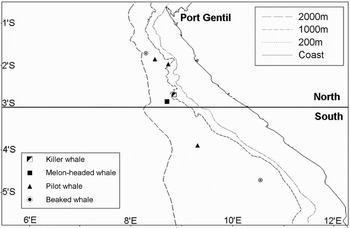
Two sightings of unidentified beaked whales (one in each sector) were recorded (Figure 3). Records of beaked whales off the west coast of Africa were summarized by Weir (Reference Weir2006c), with Cuvier's (Ziphius cavirostris), Blainville's (Mesoplodon densirostris) and Gervais' (M. europaeus) beaked whales considered the most likely species to occur off Angola.
Distribution of all sightings of short-finned pilot whale, killer whale, melon-headed whale and unidentified beaked whales made during the main and additional surveys. The 2000, 1000 and 200 m depth contours are also displayed.

Killer whale (Orcinus orca), short-finned pilot whale (Globicephala macrorhynchus) and melon-headed whale (Peponocephala electra)
Pilot whales were seen on three occasions throughout a range of depths (685, 1573 and 2500 m) at distances <750 m from the vessel. Only one sighting was made in the southern sector and the relative abundance during the main survey was low (Table 2; Figure 3). A group of eight pilot whales was seen in the northern sector in the vicinity of a solitary sperm whale. The pilot whales seen during the present study were most likely short-finned pilot whales due to their tropical location. However, distant views did not allow a positive identification but this species is believed to occur year-round in these waters (Jefferson et al., Reference Jefferson, Curry, Leatherwood and Powell1997; Weir, Reference Weir2010).
Killer whales were seen on one occasion in the northern sector at a distance of 180 m from the vessel (Figure 3). The group consisting of four animals was sighted in waters of 879 m and 20.5°C (Table 2). Killer whale presence has been reported off Gabon (Reeves & Mitchell, Reference Reeves and Mitchell1988; Weir et al., in press) and off northern Angola with both offshore (>2000 m depth) and inshore sightings (Weir, Reference Weir2007).
Two melon-headed whales were sighted in deep water in the northern sector (Figure 3). The whales frequently approached the vessel to bow-ride for a period of at least six hours. Melon-headed whales have been recorded off Gabon (Findlay et al., Reference Findlay, Collins and Rosenbaum2006) and Angola (Weir, Reference Weir2007).
Risso's dolphin (Grampus griseus)
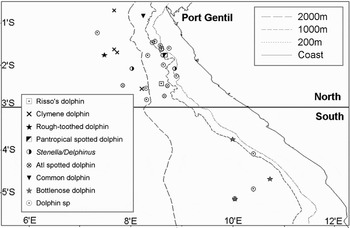
Risso's dolphins were seen on two occasions in the northern sector. During the main survey (in June) a group was seen in 224 m water depth. The group included one juvenile who briefly travelled at the bow of the vessel. The other sighting (28 July) was made during the additional survey and occurred in deep oceanic waters (Figure 4) at a distance of 1200 m.
Distribution of all dolphin sightings: bottlenose dolphin, rough-toothed dolphin, Clymene dolphin, Atlantic spotted dolphin, Pantropical spotted dolphin, common dolphin (Delphinus sp.), Stenella/Delphinus sp. mixed groups, Risso's dolphin and unidentified dolphin made during the main and additional surveys. The 2000, 1000 and 200 m depth contours are also displayed.

Risso's dolphins probably occur along the entire West African coast (Jefferson et al., Reference Jefferson, Curry, Leatherwood and Powell1997; Weir, Reference Weir2010) and have been sighted in both deep waters and in shallower habitats off Gabon and Angola (Findlay et al., Reference Findlay, Collins and Rosenbaum2006; Weir, Reference Weir2007).
Rough-toothed dolphin (Steno bredanensis)
One incidental sighting was made in June of a group of at least 50 animals including an all-white calf. The dolphins were sighted in the northern sector (depth >3000 m; Figure 4) and a detailed description of this encounter is described elsewhere (De Boer, in press).
A stranded dead rough-toothed dolphin was recorded at Gamba, Gabon during September 2002 (T. Collins, personal communication), providing the first verifiable record of the species in Gabonese waters (Rosenbaum & Collins, Reference Rosenbaum and Collins2004). At-sea sightings are rare but have been reported in the region, including three sightings off Angola, one off Gabon (Weir, Reference Weir2006a) and two off St Helena Island (MacLeod & Bennett, Reference MacLeod and Bennett2006).
Common bottlenose dolphin (Tursiops truncatus)
A sighting of bow-riding bottlenose dolphins was recorded during the main survey on 11 May in 682 m. Two other sightings were made during the additional surveys at sighting distances of <1750 m. Those sightings occurred in deep waters (1800 and 2800 m) and consisted of groups of travelling dolphins (up to 50 animals). All three sightings were made in the southern sector (Figure 4).
Bottlenose dolphins assumed to be T. truncatus are widespread in West Africa and probably inhabit near shore areas along the entire coast (Jefferson et al., Reference Jefferson, Curry, Leatherwood and Powell1997). The bottlenose dolphin is a coastal resident off Gabon (Collins et al., Reference Collins, Ngouessono and Rosenbaum2004; Rosenbaum & Collins, Reference Rosenbaum and Collins2004) and sightings off Angola suggest a year-round presence in both coastal and deep offshore waters (Weir, Reference Weir2010).
Pantropical spotted dolphin (Stenella attenuata) and Atlantic spotted dolphin (Stenella frontalis)
Some of the unidentified dolphins recorded during the surveys were strongly suspected to be either Pantropical or Atlantic spotted dolphin. Species identity could not however be firmly resolved and these were therefore recorded as Stenella sp. One sighting of Pantropical spotted dolphins was made during the main survey in the northern sector on 9 July, involving a surface active group seen at a range of 350 m (Figure 4). Some of the dolphins showed the distinct bipartite pigmentation on the flanks unlike the tripartite pigmentation pattern found on Atlantic spotted dolphins. Furthermore, the distinct cape blaze characteristic for Atlantic spotted dolphins was not observed. Some of the dolphins were rather spotted which obscured the pigmentation patterns. The sighting occurred in waters with a depth of 516 m and an average SST of 21.5°C (Table 2) and involved a group of at least 60 dolphins. Pantropical spotted dolphins have been reported in the Gulf of Guinea, off Gabon and off Angola (Perrin et al., Reference Perrin, Mitchell, Mead, Caldwell, Caldwell, van Bree and Dawbin1987; Perrin & Van Waerebeek, Reference Perrin and Van Waerebeek2007; Picanço et al., Reference Picanço, Carvalho and Brito2009; Weir, Reference Weir2010).
Three sightings of Atlantic spotted dolphins were made during the main survey towards the end of June whilst the vessel was in transit in the northern sector (Figure 4). The dolphins were sighted in deep waters with depths of 3357 m, 1447 m and 1159 m and an average SST of 21.5°C (Table 2). On two occasions small groups of dolphins (5 to 6 animals) came to bow-ride the survey vessel but a larger group of up to 30 dolphins was seen travelling away from the vessel at a distance of 500 m. Due to the small group size, the relative abundance was not very high (1.00; Table 2).
A Stenella sp. specimen record (of unknown origin) has been reported in Gabon (Perrin et al., Reference Perrin, Mitchell, Mead, Caldwell, Caldwell, van Bree and Dawbin1987; Weir, Reference Weir2010). Both Atlantic and Pantropical spotted dolphins have been sighted off Angola (Weir, Reference Weir2007) and are therefore assumed to also occur off Gabon. Moreover, the Atlantic spotted dolphin is considered to be one of the most numerous dolphin species inhabiting the primarily deep waters off West Africa (Weir, Reference Weir2010). The sightings of Atlantic spotted dolphin during the present study are the first confirmed at-sea sightings off Gabon.
Clymene dolphin (Stenella clymene)
During the main survey, three sightings of Clymene dolphins were made in May and June and one sighting was made during the additional survey in late July. All sightings occurred in the northern sector (Figure 4) and were sighted at distances of 70, 600, 750 and 800 m from the vessel. Clymene dolphins were encountered in relatively deep oceanic waters (>2400 m) with a mean SST of 24°C (Table 2). School sizes were large (best estimates of 150, 120, 100 and 60) making it the most abundant species seen during this study (Table 2).
The Clymene dolphin is especially poorly known in the eastern Atlantic off the African coast, although it is endemic to the tropical/subtropical Atlantic Ocean (Van Waerebeek, Reference Van Waerebeek2007). Only a very few reported sightings at sea have been made (Robineau et al., Reference Robineau, Vely and Maigret1994; Jefferson et al., Reference Jefferson, Curry, Leatherwood and Powell1997; Fertl et al., Reference Fertl, Jefferson, Moreno, Zerbini and Mullin2003). Recently, Clymene dolphins were reported off Angola (Weir, Reference Weir2006b) but no confirmed records for this species in Gabonese waters are presently known.
Fertl et al. (Reference Fertl, Jefferson, Moreno, Zerbini and Mullin2003) emphasize the importance of verifying the identification features of Clymene dolphins due to confusion with other pelagic dolphins of similar size, shape and coloration. The main identification features observed during sightings included: a small (<2 m), robust, streamlined body shape; prominent beak with a dark tip; tri-coloured flank pattern with a darker cape, grey flank and white ventral surface; dark cape with a rounded ‘dip’ below the dorsal fin almost reaching the white ventral surface; slightly enlarged tailstock; and dark slender pointed flippers. The dolphins did not approach the vessel to bow-ride and the distinctive ‘moustache’ marking situated one-third of the way down the dorsal surface of the beak was therefore not visible (Perrin & Mead, Reference Perrin, Mead, Ridgway and Harrison1994; Jefferson, Reference Jefferson1996; Fertl et al., Reference Fertl, Jefferson, Moreno, Zerbini and Mullin2003). The dolphins were travelling fast and some spinning behaviour was observed. A minimum of 5 juveniles were sighted amongst the group, but given the distance between the vessel and the group this should be regarded as a minimum.
Common dolphin (Delphinus sp.)
Common dolphins (Delphinus sp.) were sighted in the northern sector during the main survey in June (Figure 4; Table 2). Two mixed groups including both Delphinus and Stenella sp. were also encountered. These sightings were made at 300 and 1000 m from the vessel. One such sighting was made in shallow waters (63 m) whilst the other sighting was made during the additional survey in waters of 2723 m depth. A third group of 20 surface-active Delphinus sp. was sighted during the main survey in waters of 1461 m depth at a distance of 1000 m from the vessel.
Common dolphins are considered to be the most common offshore dolphin in West Africa (Jefferson et al., Reference Jefferson, Curry, Leatherwood and Powell1997). Delphinus sp. are regularly reported in the coastal waters of Gabon (Rosenbaum & Collins, Reference Rosenbaum and Collins2004) and Van Waerebeek (Reference Van Waerebeek1997) confirmed that both species of common dolphin (capensis and delphis) occur off Gabon. Sightings of common dolphins in the present study were not identified to species level as they are difficult to distinguish at sea. Furthermore, the morphology of Delphinus off Angola is not fully consistent with either D. delphis or D. capensis (Weir & Coles, Reference Weir and Coles2007).
CONCLUSIONS
Thirteen different cetacean species were identified during the surveys reflecting a broad cetacean diversity. These included two baleen whales, one sperm whale species and ten species of delphinid. The observations of this study should be taken cautiously due to low sample sizes, the limited temporal coverage of the 5 month-study (with the main study covering ten weeks) and unknown reactions of cetaceans to seismic operations.
In keeping with the distribution of survey effort the majority of sightings were made seaward of the shelf break at a distance of approximately 100 km from the coast. Risso's dolphins, mixed groups of Delphinus/Stenella sp. and humpback whales were sighted in shelf waters although they were also seen in deeper waters. The Bryde's whales sighted were probably all ‘offshore’ forms as these whales were encountered in waters exceeding 650 m in depth (whereas the inshore form is usually encountered in Angolan waters less than 100 m deep; Weir, Reference Weir2007). The majority of humpback whale sightings were made in deep waters (>1000 m), although three sightings occurred in shelf waters. All sperm whales were sighted in deep waters seaward of the shelf break. Bottlenose dolphins, Clymene dolphins, rough-toothed dolphins, Atlantic spotted dolphins and a mixed-group of Stenella/Delphinus sp. were seen in deep oceanic waters (>2400 m).
Bryde's whales, unidentified baleen whales, sperm whales, Clymene dolphins and bottlenose dolphins were sighted in waters with a SST > 25°C, although some of these species were also seen when temperatures were cooler (Table 2). Delphinid species such as Atlantic spotted dolphin, Pantropical spotted dolphin, rough-toothed dolphin, Risso's dolphin and Delphinus spp. were sighted in SST < 25°C. Sightings of pilot whale, killer whale, melon-headed whale and unidentified beaked whale were also made when waters were cooler (20.5°C).
The highest relative abundance for cetaceans (19.7 animals 100 km−1) was measured in the northern sector (Table 2) which also measured the highest species diversity with nine species identified during the main survey and three species identified during the additional surveys. In the southern sector, only five species were recorded, but survey effort, and thus the opportunity to see animals, was considerably lower here than in the northern sector (1392 km versus 2717 km). However bathymetric features (such as a relatively narrow neritic zone and shelf width) and oceanographic processes (such as upwelling; Roy, Reference Roy, Robinson and Brink2004), may have increased the productivity of the northern sector, providing improved conditions for a wider diversity of species. Bathymetric features and frontal zones may provide a means of predicting important foraging habitats for marine mammals (e.g. Yen et al., Reference Yen, Sydeman and Hyrenbach2004; Johnston et al., Reference Johnston, Westgate and Read2005; Panigada et al., Reference Panigada, Notarbartolo di Sciara, Zanardelli Panigada, Airoldi, Borsani and Jahoda2005; Bost et al., Reference Bost, Cotté, Bailleul, Cherel, Charrassin, Guinet, Ainley and Weimerskirch2009). During seasonal upwellings (July to September) the waters of the Gulf of Guinea cool and SSTs reach a minimum, with an average temperature of 22°C (Longhurst, Reference Longhurst1962). Such temperature changes appear to be related to an active oceanographic front (Odekunle & Eludoyin, Reference Odekunle and Eludoyin2008). This pattern was evident during the survey period with water temperatures ranging between 28.5°C (March) and 20.5°C (July/August). The foraging Bryde's whales sighted during this study were probably feeding on Sardinella sp. As small fish (likely Sardinella sp.) were seen in huge shoals close to the surface. These schooling fish occur year-round in West African waters and large schools of spawning Sardinella sp. have been linked with upwelling regimes (Whitehead, Reference Whitehead and Whitehead1985). Predation by Bryde's whales on schooling fish elsewhere in the Atlantic has been reported off South Africa (Best, Reference Best1977; Best & Rickett, Reference Best and Rickett1984) and off Brazil (Siciliano et al., Reference Siciliano, de Oliveira Santos, Vincente, Alvarenga, Zampirolli, Brito, Azevedo and Pizzorno2004).
It is important to note that the variations in oceanographic conditions (particularly SST) in Gabonese waters coincide with a temporal variation in species composition. This is apparent in the data set with the majority of sperm whales sighted in the southern sector in April (when SSTs are high), humpback whales arriving in the area in June and a higher diversity of delphinid species recorded in June and July (when SSTs are low).
Cetaceans in the region face various threats, particularly that of expanding offshore hydrocarbon extraction activity (Findlay et al., Reference Findlay, Collins and Rosenbaum2006; Weir, Reference Weir2007). Other threats include the impact of direct fisheries and fisheries by-catch, increased vessel activity and increased coastal development (Maigret, Reference Maigret1981, Reference Maigret1994; Jefferson et al., Reference Jefferson, Curry, Leatherwood and Powell1997; Rosenbaum & Collins, Reference Rosenbaum and Collins2006; Perrin & Van Waerebeek, Reference Perrin and Van Waerebeek2007; van Waerebeek, 2007).
The cetacean fauna in tropical West African waters is poorly known and the present survey adds to the limited data available from this region. Further cetacean surveys are clearly needed and the present study should be seen as part of an ongoing effort to both collect data when opportunities arise and to synthesize existing data in order to improve the current understanding of regional cetacean distribution, migration and critical habitat parameters.
ACKNOWLEDGEMENTS
I thank Ron Spicer and Phil Johnston who both helped with the observations. Of equal importance has been the support and goodwill of the bridge crew of the survey vessel. Thanks also to CGG ‘Veritas’ DL and the Ministry of Gabon and to all those who encouraged me to write up this interesting data set. The manuscript was reviewed and improved by comments from Tim Collins and Ron Spicer.