




No CrossRef data available.
Article contents
Is heart rate variability an objective parameter with which to manage treatment of infants with heart failure due to left-to-right shunting?
Published online by Cambridge University Press: 14 April 2005
Abstract
Treatment in heart failure could be guided by additional non-clinical measures, such as neurohumoral levels. Variability in heart rate is known to reflect neurohumoral stimulation. With this in mind, we sought to assess retrospectively the variability in heart rate to guide the treatment of infants in heart failure.
We analysed retrospectively the data from 20 infants with a significant left-to-right shunt. All were unsuitable for cardiac surgery or interventional therapy at the time the treatment had commenced. None of the infants improved while receiving diuretics, spironolactone, and digoxin alone, but improved after the addition of propanolol or metoprolol. None of the infants had problems during or after the subsequent operation. Parasympathetic activity reflected by parameters of variability in heart rate, such as the square root of adjacent RR-intervals, and the amount of adjacent RR-intervals greater than 50 milliseconds, improved in nearly all infants during beta blockade. On the other hand, parameters of variability in heart rate reflecting sympathetic activity did not change. Parasympathetic activity reflected the clinical state of nearly all the infants. These parameters, therefore, seem to be a good non-clinical parameter, showing the optimal treatment for heart failure in an ambulatory setting.
Information
- Type
- Original Article
- Information
- Copyright
- 2005 Cambridge University Press
The conceptual model of cardiac failure has changed over the past decades. Heart failure is now seen as a complex clinical syndrome under the influence of neurohormones, and release of cytokines, leading to cardiac remodelling,1, 2 a model also believed to apply to infants and children.3–6 On the basis of this modified concept, it has proved possible successfully to develop new therapeutic options. In addition to digoxin and diuretics, drugs such as inhibitors of angiotensin-converting enzyme, and beta-blockers, have now been introduced in the armamentarium of anticongestive therapy in childhood.7–10 Therapy, nonetheless, needs to be adjusted to individual needs. Several studies in adults have demonstrated that treatment is best guided by levels of neurohormones, rather than by a clinical approach.11–13 Monitoring of norepinephrine and other neurohormones, however, would be expensive in infants, and could be distorted simply by the sampling of blood. We have looked, therefore, for a surrogate marker, one that is easily accessible and non-invasive. The variability of heart rate is known to reflect well neurohumoral activation, and to correlate with the severity of heart failure.14, 15 An additional advantageous aspect of the variability of heart rate is its probable stability over months and years when measured over a 24-hour period.16 We hypothesized that such variability in heart rate could be used as a surrogate marker for the neurohormonal stimulation found in infants with heart failure due to left-to-right shunting. This concept was supported by our experience from 6 infants with a significant left-to-right shunt, in whom the variability of the heart rate correlated with improved clinical signs of heart failure.17
Methods
We included 20 infants seen consecutively, aged from 3.2 plus or minus 2.5 month, with a range from 10 days to 9.2 months, and weighing 4.0 plus or minus 1.31 kilograms, with a range from 2 to 6.3 kilograms, in our retrospective analysis. All infants were suffering from severe heart failure, with a Ross score18 of 6 or greater (mean 7.8 plus or minus 1.4) due to a significant left-to-right shunt. None of the infants had responded to our standard therapy, consisting of diuretics such as frusemide, or hydrochlorothiacide, spironolactone, and digoxin (Fig. 1). Because of the lack of response, we added propanolol or metoprolol. Metoprolol was used only in two in infants with coexisting bronchopulmonary dysplasia.

Figure 1. Flow sheet for treatment of severe cardiac failure in infants with a left-to-right shunting and pulmonary hyper perfusion. rr: respiratory rate; weight gain < 5 gr/kg BW/d: weight gain less than 5 grams per kilogram bodyweight per day; hr: heart rate. Ross score – see literature.18
We had discussed all the infants with our cardiosurgical colleagues prior to beginning the intensive medical therapy (Fig. 1). Only those infants were treated medically, and included in our study, when it was agreed that immediate surgery would have meant an increased risk due to prematurity, because the babies were small for their gestational dates, weighing less than 2 kilograms, or when further surgery was deemed impossible, as for example with those awaiting the second stage of the Norwood procedure. One of these infants had already been accepted for cardiac transplantation. The origins of the heart failure were large ventricular septal defects, aorto-pulmonary shunts after the first stage of the Norwood procedure, or simple or complex atrioventricular septal defects with left-to-right shunts.
Following our standardized protocol (see also Fig. 1) for infants with heart failure, we recorded daily the weight, respiratory rate, heart rate, blood pressure, drinking behaviour described by nursing staff, fluid intake, and additionally recorded one electrocardiogram each week, along with echocardiography, and a 24-hour electrocardiographic monitoring. The change of mean daily weight gain, heart rate and respiratory rate were used as parameters for improvement of heart failure. The data were collected from the daily charts for a period of 72 hours starting with the Holter electrocardiogram. The first recording was made prior to starting beta blockade, and repeated after at least 10 days of beta blockade, with a mean of 20.6 plus or minus 15 days, and a range from 10 to 54 days. The dosage of beta blockade should have reached at least 1.5 milligrams per kilogram per day.
The 24-hour recordings were analysed with a pathfinder 710 (Reynolds, Hertford, UK), software version 7,520. The acquired data had to be of high quality in leads I and II. The parameters analysed included ones relevant to the sympathetic system, such as the standard deviation of all RR-intervals over 24 hours, and the standard deviation of the means of all RR-intervals for all 5 minute segments of the analysis, and parasympathetic ones, such as the square root of the mean of the sum of squares of differences between adjacent RR-intervals over the length of the analysis, and the amount of adjacent RR-intervals that are greater than 50 milliseconds for the whole analysis.16 The parameters were analysed in a multivariant analysis, taking a p value of less than 0.05 as significant, using the commercially available program SPSS 9.0 (SPSS, Inc., Chicago, IL, USA). We used the Mann–Whitney test to compare the different parameters, as well as weight gain, respiratory rate and heart rate before and during beta blockade (Prizm 4.0; GraphPad Software, San Diego, CA, USA).
Results
Clinical parameters
All infants improved clinically after a period of at least 10 days on beta blockade, and were then able once more to be breastfed or bottle-fed. This clinical improvement could be shown by a mean weight gain of about 37.5 grams each day, a reduction in the heart rate of 24.2 each minute, and a similar reduction in the respiratory rate from about 11.6 per minute (Table 1).
Table 1. Heart rate variability, weight gain, heart rate and respiratory rate before and after at least 10 days of beta receptor blockade.

Variability in heart rate
The standard deviation of the means of RR-intervals, and the standard deviation of the intervals themselves, showed no correlation with any of the clinical parameters (Tables 1 and 2). Neither showed any change during beta blockade. On the other hand, there was an increase in the square root of adjacent RR-intervals, and in the amount of adjacent RR-intervals greater than 50 milliseconds (Tables 1 and 2). The square root of adjacent RR-intervals showed a mean increase of 5.6 milliseconds, reaching values of greater than 13 milliseconds in 13 infants, but did not change significantly, or not at all, in 5 infants. The value even decreased in one infant although the clinical parameters improved (Fig. 2). The number of adjacent RR-intervals greater than 50 milliseconds increased by an average of 3743, and doubled in 13 patients during treatment, but did not show an increase despite improved clinical parameters in 5 infants. Nevertheless, there was a good correlation between the increase in the square root of adjacent RR-intervals and the amount of adjacent RR-intervals greater than 50 milliseconds and the gain in weight and decreasing respiratory rate (Table 2, Fig. 3). The introductions of beta blockade to our standard treatment of heart failure led to an improved weight gain, as seen in Figure 3.

Figure 2. The change of the square root of adjacent RR-intervals and the gain in weight in all infants studied, with the individual values connected before ([bull ]) and after at least 10 days (○) of beta blockade.
Table 2. Correlation between the different parameters and respiratory rate, weight gain, and heart rate of all infants before and during beta receptor blockade.


Figure 3. Comparison of gain in weight and the square root of adjacent RR-intervals for all infants before and during beta receptor blockade. All values are shown before ([bull ]) and after at least 10 days (○) of beta blockade.
No infant suffered any serious side effects, became severely bradycardic, or needed any other additional intervention. The initial planned increase of the dose of beta-receptor blockade had often to be delayed due to age-corrected borderline arterial blood pressure. One infant was subsequently removed from the transplant list, and was thriving and drinking on her own. No infant had any problems during or after subsequent cardiac surgery.
Discussion
Congestive heart failure in infants is often due to pulmonary hyper circulation and a reduced systemic circulation. The aim of treatment is to provide cardiac compensation and to both improve and prolong the quality of life. This aim is best achieved in infants with left-to-right shunting by either catheter intervention or cardiac surgery. Medical treatment is often used, nonetheless, to stabilize such infants until cardiac surgery or catheter intervention becomes possible, or until the shunt diminishes with age. All the infants included in our study were not initially suitable for cardiac surgery or catheter intervention, so medical therapy was started as described previously.19 The positive influence of such medical therapy on clinical signs of heart failure has previously been shown in large trials conducted in adults.20–23 In adults, the severity of congestive heart failure has shown a good correlation with neurohumoral stimulation, variability in heart rate, and outcome.20, 21 In infants the variability in heart rates is also known to have a good correlation to the grades of the classification system devised by the New York Heart Association.15 Our aim was to show that medical intervention could translate into an improved clinical picture, as judged by the variability in heart rate, a sign of reduced neurohumoral stimulation, which is known to be associated with a better outcome.11–13 We opted against possible treatment with an inhibitor of angiotensin-converting enzyme as some evidence points against their use in the setting of left-to-right shunting and no controlled trial exists to support their use.7, 24 None of the infants had improved whilst being treated with our basic schedule, but did so after we added the beta blocker. In most infants, the parasympathetic variability of heart rate also improved during beta blockade, as described previously.25, 26 The standard deviation of all RR-intervals, and the standard deviation of the means of the RR-intervals, the sympathetic parameters, did not change. This finding has been described previously; though no explanation was given.25, 27 We speculate that initial sympathetic over stimulation, and later the effective beta blockade, might prevent any change in the sympathetically controlled variability of heart rate.
The increased square root of adjacent RR-intervals, and the amount of adjacent RR-intervals greater than 50 milliseconds, correlated with an improved clinical condition. A few infants, nonetheless, improved clinically without a significant increase in these parameters. This could be due to continuing insufficient suppression of the sympathetic or the neurohumoral system. Increasing the dosage of beta blockade above that used in our protocol might have led to greater suppression. In a prospective study, defining the improvement in the variability in heart rate, and correlating this with the clinical improvement, might address this. During such a study, it might also be possible to prove that the changes of the variability in heart rate in infants would stay stable over time, as suggested by studies in adults in congestive heart failure or after myocardial infarction.28, 29 Buchhorn et al.19 also showed an improvement in variability of heart rate comparing digoxin and diuretic therapy with additional beta blockade.
Our retrospective study was able to show that parasympathetic variability in heart rate with reduced neurohumoral stimulation correlated with improved clinical condition, and a good overall outcome, in our infants with significant left-to-right shunting. Hence, the parameters are useful to support clinical impressions in the ambulatory setting, since they reflect the neurohumoral status.
References
Packer M. The neurohormonal hypothesis: a theory to explain the mechanism of disease progression in heart failure. J Am Coll Cardiol 1992; 20: 248–254.Google Scholar
Cohn JN, Ferrari R, Sharpe N. Cardiac remodelling – concepts and clinical implication: A consensus paper from an international forum on cardiac remodelling. J Am Coll Cardiol 2000; 35: 569–582.Google Scholar
Buchhorn R, Ross RD, Wessel A, Hulpke-Wette M, Bürsch J. Acitivity of the renin-angiotensin-aldosterone and sympathetic nervous system and their relation to hemodynamic and clinical abnormalities in infants with left-to-right shunts. Int J Cardiol 2001; 78: 225–230.Google Scholar
Buchhorn R, Wessel A, Bartmus D, Bürsch J. The pathogenesis of heart failure in infants with congenital heart disease. Cardiol Young 2001; 11: 498–504.Google Scholar
Giardini A, Formigari R, Bronzetti G, et al. Modulation of neurohumoral activity after treatment of children in heart failure with carvedilol. Cardiol Young 2003; 13: 333–336.Google Scholar
Ross RD, Danniels SR, Schwartz DC, Hannon DW, Kaplan S. Return of plasma norepinephrine to normal after resolution of congestive heart failure in congenital heart disease. Am J Cardiol 1987; 60: 1411–1413.Google Scholar
Buchhorn R, Ross RD, Hulpke-Wette M, et al. Effectiveness of low dose captopril versus propranolol therapy in infants with severe congestive heart failure due to left-to-right shunts. Int J Cardiol 2000; 76: 227–233.Google Scholar
Kimball TR, Daniels SR, Meyer RA, et al. Effect of digoxin on contractility and symptoms in infants with a large ventricular septal defect. Am J Cardiol 1991; 68: 1377–1382.Google Scholar
Leversha ML, Wilson NJ, Clarkson PM, et al. Efficacy and dosage of enalapril in congenital and acquired heart disease. Arch Dis Child 1994; 70: 35–39.Google Scholar
Buchhorn R, Hulpke-Wette M, Ruschewski W, et al. Effects of therapeutic beta blockade on myocardial function and cardiac remodelling in congenital cardiac disease. Cardiol Young 2003; 13: 36–43.Google Scholar
Cohn JN, Levine TB, Olivari MT, et al. Plasma norepinephrine as a guide to prognosis in patients with chronic congestive heart failure. N Engl J Med 1984; 311: 819–823.Google Scholar
Denver R, Tzandiis A, Martin P, Krum H. Salivary endothelin concentrations in the assessment of chronic heart failure. Lancet 2000; 355: 468.Google Scholar
Troughton RW, Frampton CM, Yandle TG, et al. Treatment of heart failure guided by plasma aminoterminal brain natriuretic peptide (N-BNP) concentrations. Lancet 2000; 355: 1126–1130.Google Scholar
Woo MA, Stevenson WG, Moser DK, Middlekauf HR. Complex heart rate variability and serum norepinephrine levels in patients with advanced heart failure. J Am Coll Cardiol 1994; 23: 565–569.Google Scholar
Massin M, von Bernuth G. Clinical and haemodynamic correlates of heart rate variability in children with congenital heart disease. Eur J Pediatr 1998; 157: 967–971.Google Scholar
Task force of The European Society of Cardiology and The North American Society of Pacing and Electrophysiology. Heart rate variability – standards of measurement, physiological interpretation, and clinical use. Eur Heart J 1996; 17: 354–381.
Motz R, Luze K, Harding P, Seidenberg J, Buchhorn R. Neue Therapieansätze in der Behandlung der Herzinsuffizienz: Die Bedeutung der Beta-Blocker-Therapie für die kardiale Rekompensation von Kindern mit Links-Rechts-Shuntvitien. Kinder- und Jugendmedizin 2001; 1: 36–39.Google Scholar
Ross RD, Bollinger RO, Pinsky WW. Grading the severity of congestive heart failure in infants. Pediatr Cardiol 1992; 13: 72–75.Google Scholar
Buchhorn R, Hulpke-Wette M, Hilgers R, et al. Propanolol treatment of congestive heart failure in infants with congenital heart disease: The CHF-PRO-INFANT Trial. Int J Cardiol 2001; 79: 167–173.Google Scholar
Nolan J, Batin PD, Andrews R, et al. Prospective study of heart rate variability and mortality in chronic heart failure: results of the United Kingdom heart failure evaluation and assessment of risk trial (UK-heart). Circulation 1998; 98: 1510–1516.Google Scholar
Ponikowski P, Chua TP, Piepoli M, et al. Ventilatory response to exercise correlates with impaired heart rate variability in patients with chronic congestive heart failure. Am J Cardiol 1998; 82: 338–344.Google Scholar
CIBIS-II Investigators. The cardiac insufficiency bisoprolol study II (CIBIS-II): a randomised trial. Lancet 1999; 37: 1022–1036.
MERIT-HF study group. Effect of metoprolol CR/XL in chronic heart failure: Metoprolol CR/XL randomised intervention trial in congestive heart failure (MERIT-HF). Lancet 1999; 353: 2001–2007.
Wessel A, Buchhorn R, Bürsch J. Kreislaufinsuffizienz bei Kindern mit Links-Rechts-Shunt im Rahmen angeborener Herzfehler – Pathophysiologie und therapeutische Konsequenzen. Klin Pädiatr 2000; 212: 53–59.Google Scholar
Lin LY, Hwang JJ, Lai LP, et al. Restoration of heart rate turbulence by titrated beta-blocker therapy in patients with congestive heart failure. J Cardiovasc Electrophysiol 2004; 15: 752–756.Google Scholar
Després G, Veissier I, Boissy A. Effect of autonomic blockers on heart period variability in calves: Evaluation of the sympatho-vagal balance. Physiol Res 2002; 51: 347–353.Google Scholar
Buchhorn R, Hulpke-Wette M, Nothroff J, Paul T. Heart rate variability in infants with heart failure due to congenital heart disease: reversal of depressed heart rate variability by propanolol. Med Sci Monit 2002; 8: CR661–CR666.Google Scholar
Malfatto G, Facchini M, Sala L, et al. Effects of cardiac rehabilitation and beta-blocker therapy on heart rate variability after first acute myocardial infarction. Am J Cardiol 1998; 81: 834–840.Google Scholar
Lin JL, Chan HL, Du CC, et al. Long-term beta-blocker therapy improves autonomic nervous regulation in advanced congestive heart failure: a longitudinal heart rate variability study. Am Heart J 1999; 137: 658–665.Google Scholar

Flow sheet for treatment of severe cardiac failure in infants with a left-to-right shunting and pulmonary hyper perfusion. rr: respiratory rate; weight gain < 5 gr/kg BW/d: weight gain less than 5 grams per kilogram bodyweight per day; hr: heart rate. Ross score – see literature.18
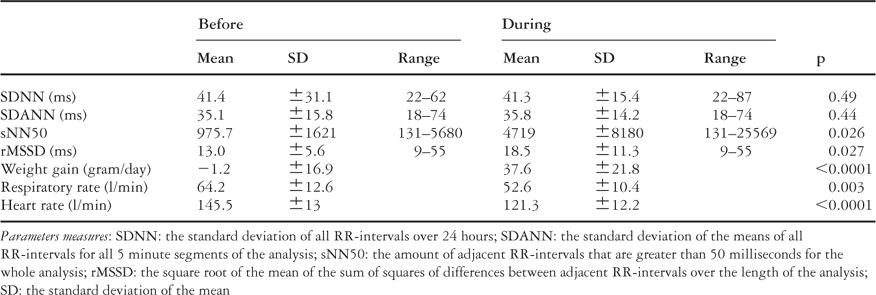
Table 1.

The change of the square root of adjacent RR-intervals and the gain in weight in all infants studied, with the individual values connected before ([bull ]) and after at least 10 days (○) of beta blockade.
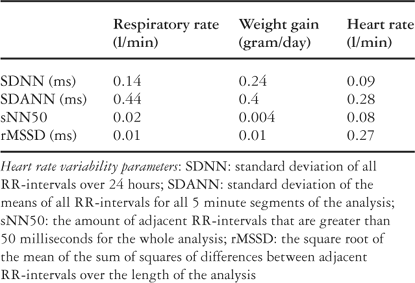
Table 2.

Comparison of gain in weight and the square root of adjacent RR-intervals for all infants before and during beta receptor blockade. All values are shown before ([bull ]) and after at least 10 days (○) of beta blockade.
 You have
Access