Interparental aggression, as defined by parental physical and verbal assaults directed toward the adult partner, is a major public health concern in the lives of preschool children in the United States (Margolin & Gordis, Reference Margolin and Gordis2000; McDonald, Jouriles, Briggs-Gowan, Rosenfield, & Carter, Reference McDonald, Jouriles, Briggs-Gowan, Rosenfield and Carter2007). Young children are substantially more likely to witness interparental aggression than older children (e.g., Fantuzzo, Boruch, Beriama, Atkins, & Marcus, Reference Fantuzzo, Boruch, Beriama, Atkins and Marcus1997). Illustrating the significance of early childhood as a vulnerable period, interparental aggression has been shown to be more strongly associated with psychological problems in preschool children than older children (Kitzmann, Gaylord, Holt, & Kenny, Reference Kitzmann, Gaylord, Holt and Kenny2003; see also McDonald et al., Reference McDonald, Jouriles, Briggs-Gowan, Rosenfield and Carter2007). In advancing the empirical documentation of risk for psychopathology among children who witness interpartner aggression, a pressing objective of current research is to better understand how and why interpartner hostility and violence increases child vulnerability to psychological problems within the broader family and ecological contexts. Parent antisocial personality, which is characterized by a stable pattern of intentionally violating the basic rights of others in a callous, impulsive, manipulative, and aggressive manner, has been conceptualized as a critical risk factor in informing the link between interparental aggression and child problems (Emery, Waldron, Kitzmann, & Aaron, Reference Emery, Waldron, Kitzmann and Aaron1999; Frick & Jackson, Reference Frick and Jackson1993). Adult history of antisocial difficulties is not only a predictor of violence in the interpartner relationship (Fergusson, Boden, & Horwood, Reference Fergusson, Boden and Horwood2008; Magdol, Moffitt, Caspi, & Silva, Reference Magdol, Moffitt, Caspi and Silva1998), but it is also a documented risk factor for disruptive problems in offspring (Lahey et al., Reference Lahey, Loeber, Hart, Frick, Applegate and Zhang1995; Pfiffner et al., Reference Pfiffner, McBurnett, Lahey, Loeber, Green and Frick1999).
Accordingly, the objective of this paper is to identify the pathways and processes underlying the joint roles of interparental aggression and maternal antisocial personality disorder as predictors of preschooler disruptive problems in the form of oppositional behaviors, defiance, hyperactivity, and inattention. Consistent with the theme of this Special Issue, we take a multiple levels of analysis approach to addressing the intergenerational transmission of antisocial and disruptive behaviors. As a first step, Study 1 aims to delineate the nature of the interplay between interparental aggression and maternal antisocial personality as risk factors for concurrent and prospective levels of child disruptive problems within a broader constellation of risk factors comprising multiple forms of maternal psychopathology and family socioeconomic status (SES) background. Study 2 is designed to identify the downstream mechanisms that account for the intergenerational transmission of disruptive problems. Within our specific multiple levels of analysis model, we distinguish among risk factors, risk mechanisms, and psychopathology. Our target family characteristics of maternal antisocial personality difficulties and interparental aggression are conceptualized as risk factors that probabilistically increase the likelihood of broad, traitlike forms of child psychopathology through their association with risk mechanisms at several levels of analysis, including at the family level (i.e., maternal parenting), child relational level (i.e., child negative emotional reactivity to interparental conflict), and child dispositional trait level (i.e., undercontrolled temperamental dispositions). In further highlighting the value of multiple levels of analysis, we also explore whether these risk factors and mechanisms may operate to increase children's vulnerability by altering their neurobiological reactivity (i.e., cortisol) to challenging family conditions.
Study 1
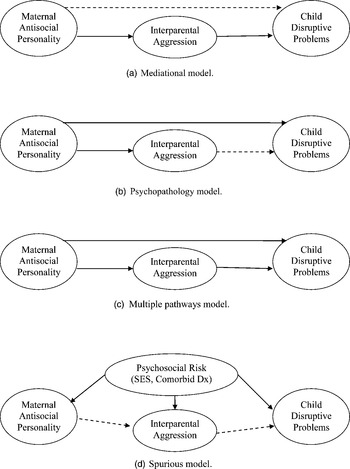
Researchers have outlined four primary models for characterizing the nature of the interplay between adult antisocial personality disorder and interpartner discord as predictors of children's disruptive problems (Emery et al., Reference Emery, Waldron, Kitzmann and Aaron1999; Frick & Jackson, Reference Frick and Jackson1993). First, in the model illustrated in Figure 1a, which we refer to as the “mediational” model, interparental aggression is regarded as a central mediator of the risk posed by maternal antisocial personality symptoms in the development of children's disruptive problems. Thus, maternal antisocial personality is associated with child problems indirectly through its covariation with the more proximal role of interparental aggression as a predictor. Second, in the next pathway, which we designate as the “psychopathology” model, the history of maternal antisocial personality is proposed to predict interparental aggression but also supersedes it as a more powerful risk factor for children. Accordingly, any association between interparental aggression and child disruptive problems is largely explained by the primacy of maternal antisocial personality disorder as a precursor of child maladjustment. Third, even in the context of a documented covariation between interpartner aggression and maternal antisocial personality, the primary assumption of the “multiple pathways” model illustrated in Figure 1c is that both interparental aggression and parent antisocial personality disorder uniquely predict child disruptive problems. Likewise, interparental aggression is proposed to partially mediate the link between maternal antisocial personality and children's psychological problems. Fourth and finally, as depicted in Figure 1d, the main premise of the “spurious” model is that maternal antisocial personality and interparental discord do not offer unique leverage in understanding child disruptive problems after taking into account the comorbid psychopathology and the prevalence of socioeconomic disadvantage in these high-risk homes. The goal of the present study is to examine the relative viability of these models in a sample of young children
Four conceptual models characterizing the different forms of interplay between maternal antisocial personality and interpartner discord in the prediction of children's disruptive problems. Solid lines denote substantive relationships among constructs, whereas dotted lines reflect relationships among constructs that are no longer significant after consideration of other pathways in the broader model.

Although empirical attempts to examine the nature of the interplay between interparental discord and maternal antisocial personality are limited, the results have yielded relatively consistent support for the psychopathology model (Emery et al., Reference Emery, Waldron, Kitzmann and Aaron1999; Frick, Lahey, Hartdagen, & Hynd, Reference Frick, Lahey, Hartdagen and Hynd1989; Lahey et al., Reference Lahey, Hartdagen, Frick, McBurnett, Connor and Hynd1988). For example, the findings of a seminal, cross-sectional study by Frick and colleagues (1989) indicated that low levels of marital satisfaction failed to predict child disruptive problems in a model that simultaneously estimated the significant paths among maternal antisocial personality, SES, and child disruptive problems. Similarly, in a prospective study, a history of maternal antisocial behaviors was a significant predictor of indices of maternal marital status (i.e., divorce or single parenthood status) and their children's externalizing behavior assessed 14 years later. In this analysis, the concurrent association between marital status and child externalizing problems was initially significant; however, this relationship was attenuated with the inclusion of maternal antisocial history as a predictor and controlling for indices of socioeconomic disadvantage (Emery et al., Reference Emery, Waldron, Kitzmann and Aaron1999).
Despite some progress in elucidating the joint roles of interparental discord and maternal antisocial personality in understanding child disruptive problems, substantive gaps remain in testing the relative utility of the four conceptual models. From a methodological standpoint, the predominant use of relatively brief measures assessing marital status and dissatisfaction may substantially underestimate the potency of interparental discord as a risk factor for children. Research has shown that aggression between parents is a stronger predictor of child adjustment problems than marital status or marital satisfaction (Grych & Fincham, Reference Grych and Fincham2001). Thus, in support of the mediational and multiple pathways models, it is still plausible that interparental discord may mediate maternal antisocial personality with the inclusion of more rigorous, targeted assessments of destructive interparental conflict. Consistent with this observation, Fergusson and Horwood (Reference Fergusson and Horwood1998) reported that a retrospective measure of interparental aggression significantly predicted late adolescent conduct problems even after controlling for family SES and indices of parental criminal and risky behaviors. Therefore, as a way of offering new insight into the joint role of interparental discord and maternal antisocial personality as predictors of child disruptive behavior problems, our study focuses on interpartner aggression as a more robust index of interparental discord.
Models addressing pathways among antisocial personality disorder, family discord, and child problems are also rooted in the assumption that antisocial tendencies pose a unique developmental risk to children when considered in relation to the constellation of other comorbid disorders. Thus, relative to other profiles of psychopathology, hallmark antisocial symptoms reflecting callous, coercive, and violent tendencies are particularly likely to be manifested in aggression, turmoil, and impairment in interparental and family relationships (Humbad, Donnellan, Iacono, & Burt, Reference Humbad, Donnellan, Iacono and Burt2010; Jaffee, Belsky, Harrington, Caspi, & Moffitt, Reference Jaffee, Belsky, Harrington, Caspi and Moffitt2006; Magdol et al., Reference Magdol, Moffitt, Caspi and Silva1998). In the context of other parental (e.g., psychopathology, substance use, interparental violence) and ecological (e.g., poverty) characteristics, conceptual models have also proposed that a history of antisocial problems experienced by parents plays a distinct role in the emergence of early, protracted trajectories of child disruptive behavior problems (Frick, Reference Frick1994; Jaffe, 2005). Consistent with this hypothesis, Rutter and Quinton (Reference Rutter and Quinton1984) suggested that the greater stability of personality disorders in relation to Axis I disorders (e.g., mood, anxiety) may pose an incremental risk for family and child problems.
Supporting the primacy of maternal antisocial personality problems in the prediction of family and child problems, prior research has shown that parental antisocial personality problems are associated with higher levels of interpartner violence and child disruptive problems even in models that also estimate sociodemographic disadvantage and other forms of maternal psychopathology as risk factors (e.g., Emery et al., Reference Emery, Waldron, Kitzmann and Aaron1999; Frick et al., Reference Frick, Lahey, Hartdagen and Hynd1989; Jaffee et al., Reference Jaffee, Belsky, Harrington, Caspi and Moffitt2006). However, studies have yet to examine the magnitude and nature of pathways among antisocial personality disorder, interparental aggression, and child problems in the context of comorbid forms of parental psychopathology. Maternal antisocial personality symptoms are associated with a wide array of mood and anxiety symptoms (Goodwin & Hamilton, Reference Goodwin and Hamilton2003; Grant et al., Reference Grant, Hasin, Stinson, Dawson, Chou and Ruan2005). Given that these forms of internalizing psychopathology are also documented precursors of both interparental problems and child disruptive problems (Goodman & Gotlib, Reference Goodman and Gotlib1999), it is possible that antisocial personality symptoms or interparental aggression are simply markers of these more proximal risk factors. Accordingly, a more comprehensive test of the relative utility of the spurious pathways hypothesis necessitates the inclusion of a broader network of risk factors in the form of socioeconomic disadvantage and comorbid maternal psychopathology.
Addressing existing substantive gaps also requires testing the developmental applicability of prior findings. Although existing research has focused solely on characterizing the adjustment of school-aged children and adolescents in multivariate models of the interplay between interparental discord and maternal antisocial personality, developmentally oriented models support the contention that the preschool years may be a sensitive period of heightened vulnerability to family aggression. Compared to older children, preschool children appear to be more easily overwhelmed by exposure to aggressive adult displays during the preschool period (McDonald et al., Reference McDonald, Jouriles, Briggs-Gowan, Rosenfield and Carter2007). For example, preschool children exhibit a greater disposition to experience a wide array of forms of distress, aggression, and limited, ineffective coping strategies than older children (Cummings, Iannotti, & Zahn-Waxler, Reference Cummings, Iannotti and Zahn-Waxler1989; Grych, Reference Grych1998; Jouriles, Spiller, Stephens, McDonald, & Swank, Reference Jouriles, Spiller, Stephens, McDonald and Swank2000). Other developmental conceptualizations further postulate that the disruptive problems in parents are likely to increase child vulnerability for stable behavior problems during early childhood through the transmission of constitutional vulnerabilities (e.g., difficult temperament) and exposure to disrupted caregiving environments (Jaffee, Reference Jaffee, Tremblay, van Aken and Koops2009; Keenan & Shaw, Reference Keenan, Shaw, Lahey, Moffitt and Caspi2003; Moffitt, Reference Moffitt1993).
To address the gaps in the literature, our study builds on earlier research by examining pathways among maternal antisocial personality, interparental aggression, and child disruptive problems over the course of a year during the preschool period. Past research examining the interplay between interparental discord and maternal antisocial personality problems has relied on cross-sectional data or longitudinal designs using measures of child outcomes limited to a single occasion. Because these static designs only provide a single snapshot of the child, they do not address a primary aim in developmental psychopathology of identifying the family precursors of successive and changing patterns of child maladaptation (Sroufe, Reference Sroufe1997). Without a stronger analysis of the genesis and course of child behavior problems within a broader complex of other putative risk factors (e.g., socioeconomic disadvantage, comorbid maternal psychopathology), a number of other plausible third variable and child effects accounts remain plausible as alternative explanations for associations between child disruptive problems and the personality and interparental parameters of aggressive home contexts (Davies & Cummings, Reference Davies, Cummings, Cicchetti and Cohen2006). Thus, our study examines the operation of interparental aggression and maternal antisocial personality as predictors of both concurrent levels of and prospective changes in child disruptive problems within a wider network of risk factors indexing other forms of maternal psychopathology and socioeconomic impoverishment. To address prior methodological limitations associated with reliance on questionnaire assessments of maternal symptomatology and interparental discord, we utilized standardized, clinical diagnostic interviews to assess maternal psychopathology and multimethod assessments (i.e., questionnaires, ratings of maternal interviews) to measure interparental aggression.
Because of substantive and methodological differences between our study and earlier research, we do not offer a precise set of hypotheses. Whereas the sparse body of previous research did generate some support for the psychopathology model, the predominant use of marital status and dissatisfaction may underestimate the power of interparental discord as a predictor in pathways between maternal antisocial problems and children's disruptive behaviors. Given our focus on interparental aggression and its demonstrated strength as a risk factor, a plausible alternative hypothesis is that either the mediational or multiple pathways models may provide a better representation of the data. By the same token, our broader consideration of other risk factors in the analyses (i.e., comorbid forms of maternal psychopathology, SES) may reduce the effect sizes of maternal antisocial personality and interparental aggression as predictors and in turn increase the viability of the spurious pathway as an explanatory model. Developmental frameworks add to the complexity of predictions by raising the possibility that the multivariate interplay between maternal antisocial personality and interparental aggression may vary during the preschool years. For example, some models suggest that other processes (e.g., genetic and constitutional dispositions) underlie the transmission of highly stable disruptive problems as early as the first 2 years of life (Keenan & Shaw, Reference Keenan, Shaw, Lahey, Moffitt and Caspi2003), whereas other developmental proposals suggest that exposure to family adversity continues to increase child difficulties above and beyond earlier risk experiences and difficulties (Maikovich, Jaffee, Odgers, & Gallop, Reference Maikovich, Jaffee, Odgers and Gallop2008).
To test the viability of these models, we specifically use a multimethod approach to develop continuous latent assessments of the family predictors in models of child disruptive problems over a 1-year period. Interparental aggression was assessed by standard questionnaire assessments from mothers and coder ratings of maternal narrative descriptions of the origins, course, and endings of conflicts with their partners derived from a semistructured interview. Owing to the loss of information and power associated with categorical classification schemes for clinical diagnosis, our administration of a standard structured psychiatric interview with the mother afforded the opportunity to develop more powerful, continuous latent constructs of multiple forms of maternal psychopathology (i.e., maternal antisocial, mood, anxiety, and substance use difficulties) from several key indicators (e.g., symptom counts, degree of impairment). Finally, our developmental perspective is instantiated in our analysis of the role of family aggression, parent psychopathology, and socioeconomic characteristics as predictors of both concurrent levels of and prospective changes in children's disruptive behavior problems using a relatively new developmental quantitative approach of latent difference score (LDS) modeling (Ferrer, Ballluerka, & Widaman, 2008; McArdle, Reference McArdle2009).
Method
Participants
The participants included 201 2-year-old children and their mothers in a moderately sized metropolitan area in the Northeast. A two-step recruitment process was implemented to insure that the enrollment of a high-risk sample exhibited disproportionate levels of interparental aggression, sociodemographic adversity, and maternal psychopathology. In the first step, we recruited participants through agencies serving disadvantaged children and families, including Women, Infants, and Children; Temporary Assistance to Needy Families rosters from the Department of Human and Health Services; and the county family court system. In the second step, we administered the abbreviated version of the physical assault subscale of the Conflict Tactics Scale 2 (CTS2; Straus, Hambby, Boney-McCoy, & Sugarman, Reference Straus, Hambby, Boney-McCoy and Sugarman1996) to insure that roughly equal proportions of participating mothers experienced (a) no violence (i.e., 40%), (b) mild/moderate physical violence (i.e., 24%), and (c) severe physical violence (i.e., 36%) in the interpartner relationship. Additional inclusionary criteria were implemented to insure that (a) the female caregiver was the biological mother, (b) the child participant was 27 months old (±5 months) and had no serious developmental disabilities, and (c) the male partner had regular contact with the mother and toddler over the past year.
Median annual income for the family household was $18,300 (US) per year, and a substantial minority of mothers (30%) and their partners (24%) did not complete high school. Most families received public assistance (95%) and were impoverished according to the US Federal Poverty Guidelines (99.5%). The mean age of the children was 26 months (SD = 1.69), and 44% of the sample consisted of girls (n = 92). The majority of mothers and children were Black (56%), followed by smaller proportions of family members who identified as White (23%), Latino (11%), multiracial (7%), and other (3%).
The retention rate across the two annual measurement occasions was 83%. No differences were found between the mother–child dyads who participated in both measurement occasions and dyads who only participated in the first measurement occasion along the 18 family and child measures at Wave 1 (e.g., SES, interpartner aggression, maternal psychopathology, child behavior problems) and eight additional demographic (e.g., maternal age, race, and marital status; child age and gender) variables. Therefore, we utilized full-information maximum likelihood in Amos 17.0 to estimate missing data and retain the full sample for analyses. Full-information maximum likelihood is a well-established data imputation technique that effectively preserves the original structure of the relationships among the primary variables (Enders, Reference Enders2001). Missing data ranged from 0% to 17% across variables (median = 1%).
Procedures
The data for this study were collected at two measurement occasions spaced 1 year apart. At each wave, mothers and children visited our research center three times within a period of approximately 2 weeks. Mothers completed questionnaires and interviews to assess the main variables in the study. The research procedures were approved by the Institutional Review Board at the research site prior to conducting the study.
Measures
Interpartner aggression
Four measures collected at Wave 1 were used as indicators of interpartner violence. The first two indices of aggression were derived from maternal reports on two questionnaires: the physical assault subscale of the revised CTS2 (Straus et al., Reference Straus, Hambby, Boney-McCoy and Sugarman1996) and the physical aggression subscale of the Conflict and Problem-Solving Scales (CPS; Kerig, Reference Kerig1996). The CTS2 physical assault subscale contains 24 items designed to assess maternal and partner acts of physical attacks toward each other in the interpartner relationship, ranging from relatively mild (e.g., “I pushed or shoved my partner.”) to severe (e.g., “I used a knife or gun on my partner.”) forms of assault. Following scoring guidelines, prevalence scores were calculated for each of the two scales based on the sum of the occurrences of specific aggressive acts (1 = act occurred one or more times, 0 = specific act did not occur).
As a complementary measure, the CPS physical aggression subscale assessed maternal reports of children's direct exposure to violent interpartner conflicts. Mothers completed 14 items indexing the frequency with which they and their partner's engage in physically aggressive conflict tactics within the interparental relationship (e.g., “beat up,” “slap”) using a Likert scale of response alternatives ranging from never (0) to often (3). Reliability was satisfactory for both the CTS2 and CPS scales in this sample (αs = 0.92 for each measure), and prior research supports the validity of the measures (El-Sheikh, Cummings, Kouros, Elmore-Staton, & Buckhalt, Reference El-Sheikh, Cummings, Kouros, Elmore-Staton and Buckhalt2008; Kerig, Reference Kerig1996).
The remaining two indicators of interparental aggression were derived from the Interparental Conflict Characteristics (ICC) module of the Interparental Disagreement Interview (IDI). Based on a prior interview developed in previous research (Crockenberg & Langrock, Reference Crockenberg, Langrock, Grych and Fincham2001a, Reference Crockenberg and Langrock2001b), the ICC module of the IDI is a semistructured, narrative interview with the mother that is designed to assess the frequency, nature, course, and aftermath of interpartner conflicts witnessed by child participants. Video records of the interview were subsequently coded for interparental aggression. Coders specifically rated the level of maternal and partner aggression during the conflicts along 7-point scales. Aggression was operationally defined as the level of hostility and aggression directed toward the partner in the interparental relationship. At one extreme, no aggression (0 = none) was characterized by no evidence of any overt form of aggression or hostility direct toward the partner. At the other extreme, high (6 = high) aggression reflects high levels of aggression that reflect considerable dysregulation, disorganization, and/or loss of control on the part of the parent that reflects a clear risk to the psychological or physical welfare of the child.
Narratives regarding the emotional and interpersonal aftermath of the conflict were also rated by coders with 7-point scales to assess mother and father postconflict hostility. The hostility codes, which indexed expressions or displays of parental anger, hostility, frustration, fury, and aggression following the interparental disagreement, ranged from 0 (none) to 6 (intense forms of parental anger, tension, or frustration that assume a dysregulated or mismanaged form). Intraclass correlation coefficients reflecting interrater agreement indices for ratings aggression and hostility ranged from 0.78 to 0.92. To obtain a more parsimonious set of assessments, the ratings of mother and partner scores of aggression and postconflict hostility were summed together to form an interpartner aggression composite and a postconflict hostility composite. Support for the validity of the IDI codes is reflected in their associations with established measures of interparental discord and child psychological functioning (Davies, Sturge-Apple, Cicchetti, Manning, & Zale, Reference Davies, Sturge-Apple, Cicchetti, Manning and Zale2009).
Maternal psychopathology
At Wave 1, trained experimenters administered the Computerized Diagnostic Interview Schedule IV (C-DIS-IV; Robins et al., Reference Robins, Cottler, Bucholz, Compton, North and Rourke2000) to mothers to obtain assessments of maternal diagnostic, impairment, and symptom patterns. The DIS is a structured psychiatric interview originally designed for lay interviewers in the epidemiological catchment area studies. The interview consists of a computer-generated series of structured interviewed questions with “yes” or “no” response alternatives. The DIS-IV, which incorporates diagnostic criteria specified in the DSM-IV (American Psychiatric Association, 1994), allows for the determination of diagnostic, symptom, and impairment measures through computer algorithms for the spectrum of Axis I adult mental disorders and antisocial personality disorder. Accordingly, the C-DIS-IV was explicitly designed to be conducted by trained nonprofessionals. Consistent with established procedures (Toth, Rogosch, Sturge-Apple, & Cicchetti, Reference Toth, Rogosch, Sturge-Apple and Cicchetti2009), all interviewers were trained to criterion reliability in administering the DIS.
C-DIS-IV modules were utilized to obtain multiple-indicator assessments of (a) antisocial personality, (b) anxiety, (c) mood, and (d) substance use difficulties. For the first three forms of psychopathology, the three specific indicators included (a) a continuous index of the presence and absence of DISM-IV symptoms; (b) the level of impairment measure, ranging from 0 (no impairment) to 3 (severe impairment); and (c) a continuous developmental diagnostic assessment, ordered along a 4-point scale (0 = no current or prior history of the disorder; 1 = prior disorder, but recovery, with no disorder in the past year; 2 = prior disorder, but only partial recovery, with some subclinical difficulties; and 3 = active disorder in the past year). Thus, for the antisocial personality disorder module, these three measures were used to capture a latent construct of maternal antisocial psychopathology. Likewise, to obtain a more comprehensive measure of maternal mood difficulties, the three indicators for mood disorder were derived from sums of symptom counts, impairment, and the continuous developmental diagnostic index for both the major depressive disorder and dysthymia modules from the C-DIS-IV. For the latent composite of the overarching construct of maternal anxiety, difficulties consisted of sums of the three main indicators across both the posttraumatic stress and generalized anxiety disorder modules of the C-DIS-IV.
For the fourth form of psychopathology, substance use disorders were defined by symptoms of abuse and dependence across 10 classes of substances including alcohol, amphetamines, cocaine, opiates, sedatives, PCP, hallucinogens, inhalants, marijuana, and other illicit drugs. Consistent with three other psychopathology measures, the first two indicators of the latent construct of substance use difficulties consisted of the (a) sum of symptoms across all 10 drug classes and (b) continuous developmental diagnostic assessments ranging from 0 (no current or prior history of the disorder) to 3 (active disorder in the past year) summed across the 10 drug classes. Because the substance use modules of the C-DIS-IV do not contain continuous impairment scales that are comparable to the other disorders, the third indicator of substance use difficulties consisted of the duration of abuse and dependence symptoms in years. Years of abuse and dependence across the 10 classes of drugs were summed together to obtain a single duration measure for analyses. Prior research provided well-documented support for the reliability and validity of the C-DIS-IV (e.g., Compton & Cottler, Reference Compton, Cottler, Hersen, Hilsenroth and Segal2004; Hofstra, Van Der Ende, & Verhulst, Reference Hofstra, Van Der Ende and Verhulst2001; Melchior et al., Reference Melchior, Caspi, Milne, Danese, Poulton and Moffitt2007; Toth et al., Reference Toth, Rogosch, Sturge-Apple and Cicchetti2009).
SES
Mothers completed a demographic interview to obtain three measures of SES. First, mother and partner educational level and occupational status were used to derive the social strata score on the Hollingshead Four Factor Index of Social Status. Second, mothers reported on the earned annual income of the family unit without consideration of public assistance supplements. Third, a measure of household income per capita was calculated as the quotient resulting from dividing the total annual income of the family unit by the number of individuals living in the home.
Child disruptive behavior problems
Mothers completed the oppositional defiant disorder (ODD) and attention-deficit/hyperactivity disorder (ADHD) problems subscales of the Child Behavior Checklist (CBCL) at Waves 1 and 2 to obtain multiple measures of child disruptive disorders over the previous 2 months (ages 1.5–5; Achenbach & Rescorla, Reference Achenbach, Rescorla and Archer2006). The ODD subscale contains six items indexing high levels of negativistic and hostile behaviors (e.g., “disobedient,” “stubborn, sullen, or irritable”), whereas the six items on the ADHD subscale assess hyperactive (e.g, “can't sit still, restless, or hyperactive”) and inattention (e.g., “can't concentrate, can't pay attention for long”) symptoms. The CBCL is a widely used, well-validated measure of child adjustment problems (Achenbach, Dumenci, & Rescorla, Reference Achenbach, Dumenci and Rescorla2003). Internal consistency estimates of the CBCL scales in this sample were 0.82 and 0.85 for the ODD subscale at Waves 1 and 2, respectively, and 0.77 and 0.74 for the ADHD subscale at Waves 1 and 2, respectively.
Results and discussion
Descriptive analyses
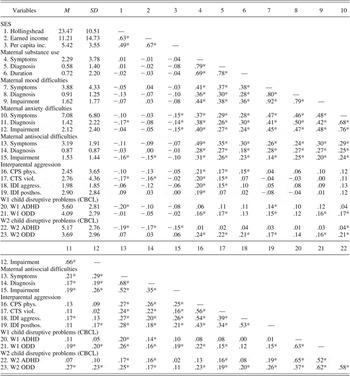
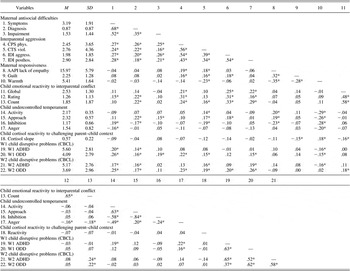
Table 1 provides the raw means and standard deviations for the primary analyses. Because of the presence of several outliers for the three indicators of maternal substance use difficulties, we followed conventional winsorizing procedures by adjusting extreme values so that they were no more than 3 SD beyond the mean (Tabachnick & Fidell, Reference Tabachnick and Fidell2007). Four of the variables in Table 1 evidenced skewed and/or kurtotic distributions. Therefore, these variables were transformed using a logarithmic calculation to normalize the distributions. Transformed variables were utilized in the calculation of the correlations in Table 1 and the primary analyses.
Means, standard deviations, and intercorrelations of the main variables in Study 1

Note: Earned income is reported in thousands of dollars in the past year. SES, socioeconomic status; CPS, Conflict and Problem-Solving Scales; CTS, Conflict Tactics Scale; IDI, Interparental Disagreement Interview; W1, Wave 1; CBCL, Child Behavior Checklist; ADHD, attention-deficit/hyperactivity disorder; ODD, oppositional defiant disorder; W2, Wave 2.
*p ≤ .05.
To assess changes in children's disruptive behavior problems, we utilized a second-order LDS model across the two measurement occasions (Ferrer et al., Reference Ferrer, Balluerka and Widaman2008; McArdle, Reference McArdle2009). As a relatively new integration of latent growth curve (LGC) and cross-lagged panel analyses, the versatility of LDS is reflected in its ability to determine whether children (a) in the sample as a whole exhibit a significant increase or decrease in disruptive problems, (b) differ significantly from each other in their initial level of disruptive problems, and (c) exhibit significant individual differences in their changes in disruptive problems over time (King, King, McArdle, Shalev, & Doron-LaMarca, Reference King, King, McArdle, Shalev and Doron-LaMarca2009; McArdle, Reference McArdle2009; Sbarra & Allen, Reference Sbarra and Allen2009). Of further relevance to our main research questions, the flexibility of LDS allows for an analysis of the predictors of individual differences in the initial level of and subsequent changes in children's disruptive behavior problems (e.g., Geiser, Eid, Nussbeck, Courvoisier, & Cole, Reference Geiser, Eid, Nussbeck, Courvoisier and Cole2010; Maikovich, Jaffee, Odgers, & Gallop, Reference Maikovich, Jaffee, Odgers and Gallop2008).
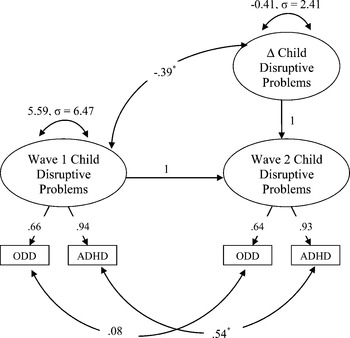
Figure 2 depicts the results of the unconditional second-order LDS analysis prior to the inclusion of the covariates and predictors. The model fit the data well, χ2 (3, N = 201) = 5.91, p = .12, root mean square error of approximation (RMSEA) = 0.07, comparative fit index (CFI) = 0.99, Tucker–Lewis index (TLI) = 0.97, and χ2/df ratio = 1.97. For the first-order component of the model, the manifest indicators loaded significantly onto the latent constructs of child disruptive behavior problems at each time point (all ps < .001). Consistent with prior associations between the initial level and change in psychopathology (e.g., King et al., Reference King, King, McArdle, Shalev and Doron-LaMarca2009), the Wave 1 level of child disruptive problems was negatively correlated with change in problems over time (r = –.39, p < .01). The mean level of initial status for disruptive behavior problems was significantly different from 0 (5.59, z = 28.06), and levels of disruptive problems in the sample decreased significantly over time (–0.41, z = 2.39) from 5.59 to 5.18. In addition, the latent intercept and mean difference factors had statistically significant variances of 6.47 (z = 7.40) and 2.41 (z = 5.16) respectively, indicating that there were significant individual differences in children's initial levels of problems and the mean change in problems from Time 1 to Time 2. Therefore, given our aim of examining why children differ in their disruptive problems over time, the primary analyses were designed to examine the family and contextual predictors of the significant variation in the initial levels of and changes in children's disruptive problems.
Study 1: An unconditional second-order latent difference score analysis of the intercept and mean difference of preschooler disruptive problems prior to the inclusion of the covariates and predictors. *p < .05.

Paths among maternal antisocial personality, interparental aggression, and child problems
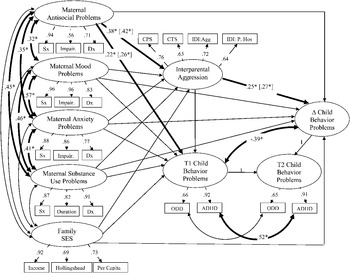
In the first step of testing our model, we sought to determine whether maternal antisocial personality disorder and interparental aggression were actually significant predictors of child disruptive problems prior to estimating the effects of covariates. Thus, in addition to specifying the path between maternal antisocial personality disorder and interparental aggression at Time 1, the first model conducted only estimated paths from the two main predictors (i.e., maternal antisocial personality disorder, interparental aggression) to the latent constructs reflecting the initial level of child problems and change in child problems. All other paths depicted in Figure 3, which constitute paths between the covariates (e.g., SES, other forms of maternal psychopathology), and the two main dimensions of child problems were constrained to 0. The model provided a good representation of the data, χ2 (216, N = 201) = 328.83, p < .001, RMSEA = 0.05, CFI = 0.95, TLI = 0.94, and χ2/df ratio = 1.52. The results, which are denoted by the bracketed standardized path coefficients in Figure 3, supported a multiple pathways model. Maternal antisocial personality disorder was significantly associated with greater interparental aggression (β = 0.42, p < .01) and higher initial levels of disruptive child problems (β = 0.26, p < .01); however, it was negligibly associated with subsequent changes in child disruptive problems. Conversely, despite its nonsignificant associations with initial levels of child problems, interparental aggression significantly predicted subsequent changes in child disruptive problems (β = 0.27, p < .05). The variance explained (R 2) in the three endogenous constructs was .18 for interparental aggression, .07 for initial level of child disruptive problems, and .07 for change in child disruptive problems.
Study 1: A latent difference score for the joint role of maternal antisocial personality disorder and interparental aggression as predictors of preschooler disruptive problems in the context of other psychosocial risk factors. *p < .05. Sx, symptoms; Impair., level of impairment; Dx, diagnosis; CPS, physical aggression subscale from the Conflict and Problem-Solving Scales; CTS, physical assault subscale of the Conflict Tactics Scale 2; IDI-Agg, Aggression Scale from the Interparental Disagreement Interview; IDI P. Hos, posthostility rating from the IDI; per capita, household income per capita.

Accordingly, the second step of our primary analyses tested the stability of the significant pathways in relation to the alternative spurious hypothesis that the findings are simply an artifact of the operation of more proximal predictors of SES and other forms of maternal psychopathology. Thus, in addition to estimating the pathways between our primary predictors and child problems, the pathways between the covariates and children's exposure to marital aggression and their problems were also freely estimated. The model, which is depicted in Figure 3, fit the data well, χ2 (204, N = 201) = 317.24, p < .001, RMSEA = 0.05, CFI = 0.95, TLI = 0.94, and χ2/df ratio = 1.56. All specified indicators in the measurement model loaded significantly (all ps < .001) onto their respective latent constructs. For clarity of presentation, only significant path coefficients are included in Figure 3. Supporting its robustness as a predictor, maternal antisocial personality continued to be significantly associated with interparental aggression (β = 0.38, p < .01) and initial levels of child disruptive problems (β = 0.22, p < .05), even after estimating the effects of SES and other forms of maternal psychopathology. Likewise, after controlling for these covariates, interparental aggression was still a significant predictor of subsequent changes in child disruptive problems (β = 0.25, p < .05). The total variance explained in the endogenous variables did not change substantially from the prior model with the addition of the covariates in the model (R 2): .22 for interparental aggression, .08 for initial levels of child problems, and .09 for change in child disruptive problems.
To more authoritatively examine the role of interparental aggression as an explanatory mechanism linking maternal antisocial personality problems with subsequent changes in children's disruptive problems, we conducted three additional sets of analyses. First, bootstrapping tests utilizing the PRODCLIN software program indicated that the indirect path involving maternal antisocial personality, interparental aggression, and changes in child disruptive problems was significantly different from 0 (95% confidence interval [CI] = 0.01–0.22; MacKinnon, Lockwood, Hoffman, West, & Sheets, Reference MacKinnon, Lockwood, Hoffman, West and Sheets2002; Preacher & Hayes, Reference Preacher and Hayes2008).
Second, we conducted pairwise parameter comparison analyses to determine whether the magnitude of the indirect pathway was stronger than alternative pathways in the model. In the first link in the indirect pathway, we specifically examined whether the association between maternal antisocial personality and interparental aggression was significantly stronger than comparable associations between the covariates after reverse scoring SES so that the directionality of the scale (i.e., higher values reflect greater adversity) was equivalent to the other predictors. In support of the pathway, maternal antisocial personality was a significantly stronger predictor of interparental aggression than maternal anxiety problems (z = 3.05, p < .01), maternal mood difficulties (z = 4.03, p < .01), and SES (z = 3.83, p < .01), but not substance use (z = 0.80). Corresponding pairwise parameter tests examining whether the link between interparental aggression and changes in child disruptive problems were significantly stronger than structural paths running from the other exogenous variables to changes in child disruptive problems indicated that interparental aggression was a significantly stronger predictor of changes in child disruptive problems than mood difficulties (z = 2.23, p < .05) and SES (z = 2.07, p < .05). A comparison of the magnitude of paths running from interparental aggression and maternal antisocial problems to changes in child disruptive problems approached significance (z = 1.90, p < .10). Finally, interparental aggression was not a significantly stronger predictor of changes in child problems than maternal substance use (z = 0.88, ns) or antisocial (z = 1.33, ns) problems.
Third, as a final analysis of the stability of the pathways identified in the primary analyses, we tested whether child gender altered the associations among maternal antisocial personality, interparental conflict, and child disruptive problems as a covariate. Specifying paths between child gender and each of the endogenous variables in the primary analyses (i.e., Figure 3) did not change the pattern of findings, thereby supporting the stability of our results.
In conclusion, although the delineation of child disruptive problems associated with exposure to interparental aggression and maternal antisocial personality disorder have developed in relative isolation, efforts to conceptually integrate these literatures has yielded four primary models that vary in the nature of the interplay between the two forms of family adversity and child difficulties (see Figure 1). Therefore, the primary objective of the current study was to test the comparative efficacy of the four models in delineating the pathways among maternal antisocial personality difficulties, interparental aggression, and child disruptive problems (Emery et al., Reference Emery, Waldron, Kitzmann and Aaron1999; Frick & Jackson, Reference Frick and Jackson1993). Consistent with the multiple pathways model, the pattern of findings broadly supported two primary pathways of risk: (a) a direct link between maternal antisocial personality and initial levels of child disruptive problems and (b) an indirect link in which maternal antisocial personality is associated with less marked decreases and, in some cases, increases in child disruptive problems over the subsequent year through its association with the more proximal role of interparental aggression as a predictor.
Study 2
In building on the documented significance of maternal antisocial personality and interpartner aggression in understanding individual differences in child disruptive problems in Study 1, a critical next step is to address the question of why children exhibit vulnerability in the face of these two types of family hostility. Therefore, Study 2 sought to identify the underlying mechanisms that mediate the disruptive problems of children exposed to maternal antisocial personality and interparental aggression. In highlighting the significance of this objective, conceptualizations of interparental conflict and maternal antisocial personality have independently called for multivariate, process-oriented studies designed to address the knowledge gap on how and why aggression runs in families (Davies, Winter, & Cicchetti, Reference Davies, Winter and Cicchetti2006; Jaffee, Reference Jaffee, Tremblay, van Aken and Koops2009). Guided by these models, we specifically explored four processes that have been proffered to serve as carriers of the risk associated with these two types of hostility in the family: parental unresponsiveness, children's emotional reactivity to interparental conflict, children's undercontrolled temperament, and children's neurobiological reactivity to parent–child challenges.
Parental unresponsiveness
Models of the developmental sequelae of parental antisocial personality and interparental aggression bear remarkable similarities in conceptualizing parental unresponsiveness and insensitivity as key mediators of children's disproportionate vulnerability to behavior problems.
Predictions regarding the mediating role of parenting in models of interparental conflict have commonly been rooted in the integration of the spillover hypothesis (e.g., Erel & Burman, Reference Erel and Burman1995; Floyd, Gilliom, & Costigan, Reference Floyd, Gilliom and Costigan1998) and socialization models of parenting (Baumrind, Reference Baumrind1971; Maccoby & Martin, Reference Maccoby, Martin and Mussen1983). In addressing the first link in the indirect path model of parenting, the spillover hypothesis specifically posits that parental anguish, indifference, and antipathy originally stemming from the unresolved partner disputes is carried over into the parental interactions with children, resulting in diminished responsiveness, sensitivity, and warmth. These specific types of parenting difficulties in turn are theorized to increase children's risk for psychopathology in socialization models of parenting. Consistent with this indirect path model, experimental and longitudinal analyses have shown that disruptions in parenting increase following interparental conflicts (e.g., Jouriles & Farris, Reference Jouriles and Farris1992; Kitzmann, Reference Kitzmann2000; Sturge-Apple, Davies, & Cummings, Reference Sturge-Apple, Davies and Cummings2006a). Likewise, parental unresponsiveness has been found to at least partially mediate the association between interparental hostility and child adjustment (e.g., Levendosky, Huth-Bocks, Shapiro, & Semel, Reference Levendosky, Huth-Bocks, Shapiro and Semel2003; Sturge-Apple, Davies, & Cummings, Reference Sturge-Apple, Davies and Cummings2006b; Webster-Stratton & Hammond, Reference Webster-Stratton and Hammond1999). In light of the consistency of these findings, a plausible hypothesis is that parental unresponsiveness may maintain its robustness as a mediator even in the context of a broader constellation of family risk factors (i.e., maternal antisocial personality) and mechanisms (e.g., child temperament and conflict reactivity).
Within the frameworks of parental antisocial personality (e.g., Frick & Jackson, Reference Frick and Jackson1993; Jaffee, Reference Jaffee, Tremblay, van Aken and Koops2009), the callous, deceitful, and egocentric characteristics of parents with antisocial personality difficulties are postulated to be manifested in high levels of unresponsive parenting characterized by diminished warmth and insensitivity to the children's needs. Children's experiences with these parenting difficulties in turn are proposed to increase their risk for psychological problems. Studies examining specific links in the proposed mediational chain provide some support for this hypothesis. For example, antisocial personality has been associated with diminished maternal warmth, acceptance, and sensitivity (Bosquet & Egeland, Reference Bosquet and Egeland2000; Jaffee et al., Reference Jaffee, Belsky, Harrington, Caspi and Moffitt2006). Likewise, other research has reported that these same parenting difficulties are predictors of child disruptive problems (e.g., Goldstein et al., Reference Goldstein, Harvey, Friedman-Weieneth, Pierce, Tellert and Sippel2007). However, direct tests of the role of parenting difficulties as mediators of maternal antisocial personality have yielded inconsistent results (for a review, see Jaffee, Reference Jaffee, Tremblay, van Aken and Koops2009). Thus, although some studies have identified child-rearing impairments as explanatory mechanisms in the intergenerational transmission of antisocial problems (e.g., Smith & Farrington, Reference Smith and Farrington2004; Thornberry, Freeman-Gallant, Lizotte, Krohn, & Smith, Reference Thornberry, Freeman-Gallant, Lizotte, Krohn and Smith2003), other research has failed to replicate these results (e.g., Capaldi, Pears, Paterson, & Owen, Reference Capaldi, Pears, Patterson and Owen2003). Given that prior research has focused predominantly on testing the role of parenting as a mediator in isolation from other potential risk factors and mechanisms, further questions can be raised about the power of parenting as a mediator of maternal antisocial personality in the context of the broader multivariate process model tested in this paper.
Children's emotional reactivity to interparental conflict
Although little is known about the processes that interparental violence directly sets in motion within children that increase their vulnerability to psychopathology, a common assumption of interparental conflict theories is that children's emotional reactivity to interparental conflict is a key mediating mechanism (Davies et al., Reference Davies, Winter and Cicchetti2006; Grych & Fincham, Reference Grych and Fincham1990). In these theories, the stressfulness of witnessing aggression between parents engenders progressively higher levels of emotional distress and fear in subsequent conflicts. Through this sensitization process, the level of distress and arousal experienced by children in the context of conflicts is proposed to intensify and proliferate into broader patterns of behavior dysregulation and oppositional behavior. Although prior research has consistently documented that indices of children's fear and emotional distress responses to interparental conflict mediate the link between interparental conflict and child psychological problems (Davies, Harold, Goeke-Morey, & Cummings, Reference Davies, Harold, Goeke-Morey and Cummings2002; Grych, Harold, & Miles, Reference Grych, Harold and Miles2003), the applicability of these models to understanding why exposure to violence between parents is a risk factor for children has rarely been examined empirically (Davies et al., Reference Davies, Winter and Cicchetti2006). As a single exception, El-Sheikh et al. (Reference El-Sheikh, Cummings, Kouros, Elmore-Staton and Buckhalt2008) reported that children's emotional reactivity to conflict served as a mediator of concurrent associations between interparental aggression and school-age children's adjustment problems. A next important step is to examine the robustness of this mediational pathway within a prospective analysis that simultaneously tests the strength of this pathway in relation to other viable forms of risk (e.g., temperament, parenting).
Contextualizing models of interparental conflict and child reactivity also raise the possibility that maternal antisocial personality may ultimately increase children's vulnerability to disruptive problems through its association with their emotional reactivity to conflict. The callous, short-tempered, and hostile expressions of mothers exhibiting antisocial personality symptoms may, by themselves, engender distress and fear in young children (Davies & Sturge-Apple, Reference Davies and Sturge-Apple2007). Because conflict between partners disproportionately increases oppressive, coercive displays of parents with preexisting personality vulnerabilities (Finkel, DeWall, Slotter, Oaten, & Foshee, Reference Finkel, DeWall, Slotter, Oaten and Foshee2009; White & Widom, Reference White and Widom2003), children of mothers with histories of antisocial personality may exhibit particularly pronounced levels of distress and fear in response to interparental conflicts. Thus, in this study, we examine the role of children's distress responses as an explanatory mechanism for children's vulnerability to behavior problems in the contexts of interparental aggression and maternal antisocial personality problems.
Children's undercontrolled temperament
In neurobiological conceptualizations, children's early emerging temperamental characteristics are postulated to partially account for the intergenerational transmission of aggression in the family (Jaffee, Reference Jaffee, Tremblay, van Aken and Koops2009; Moffitt, Reference Moffitt, Cicchetti and Cohen2006). According to the genetic components of these models, an undercontrolled genetic profile is theorized to be phenotypically manifested in adult antisocial personality traits and heightened strife and discord between partners. By virtue of the shared genetic substrates, the children are also likely to exhibit a set of personality traits and symptoms that are similar to their parents. This genetic risk may specifically predispose children from these hostile homes to exhibit undercontrolled behavioral traits characterized by proneness to anger, high activity levels, and impulsivity (e.g., heightened sensitivity to reward, diminished inhibition to potential risk). Reflecting a complementary component of these models, maternal antisocial behavior is also likely to amplify young children's neuropsychological problems by increasing their exposure to prenatal (e.g., maternal substance use, poor obstetric care) and postnatal (e.g., inadequate nutrition) pathogens.
Studies have provided some partial, indirect support for the role of temperament as a mediator. For example, Harden, Lynch, et al. (Reference Harden, Lynch, Turkheimer, Emery, D'Onofrio and Slutske2007) and Harden, Turkheimer, et al. (Reference Harden, Turkheimer, Emery, D'Onofrio, Slutske and Heath2007) reported that the inheritance of a genetic liability mediated the association between the frequency of marital conflict and children's externalizing symptoms. Likewise, a meta-analysis of twin and adoption studies yielded a heritability coefficient for antisocial behavior that is moderate in magnitude (Rhee & Waldman, Reference Rhee and Waldman2002). Documentation of the specific role of undercontrolled dimensions of temperament predictors of early disruptive problems is also relatively consistent across studies (Campbell, Shaw, & Gilliom, Reference Campbell, Shaw and Gilliom2000; Campbell & von Stauufenberg, Reference Campbell and von Stauffenberg2009). Although this research bolsters the plausibility of temperament as an explanatory mechanism in the intergenerational transmission of disruptive problems, studies have not systematically examined the mediational role of children's temperament in associations between hostile parents and child disruptive problems.
Children's cortisol reactivity to stress
Reflecting another level of analysis in identifying physiological risk mechanisms, the hypothalamic–pituitary–adrenal (HPA) axis is regarded as a central biological process in understanding children's adaptation in aggressive homes (Repetti, Robles, & Reynolds, Reference Repetti, Robles and Reynolds2011; Saltzman, Holden, & Holahan, Reference Saltzman, Holden and Holahan2005). Through the process of allostasis, the biological “set points” of the HPA axis are altered to meet the stressful dynamics in the environment in order to preserve the internal integrity of the organism. In response to threatening events (i.e., Gunnar & Vazquez, Reference Gunnar, Vazquez, Cicchetti and Cohen2006), the HPA axis and its end product of cortisol specifically prime biological defenses through the mobilization of energy (e.g., glucose, oxygen) and modulating the processing, encoding, and memory consolidation of emotionally significant events (for details, see Gunnar & Vazquez, Reference Gunnar, Vazquez, Cicchetti and Cohen2006; Lupien et al., Reference Lupien, Ouellet-Morin, Hupbach, Tu, Buss, Walker, Cicchetti and Cohen2006). Optimal physiological adaptation involves efficient activation of the HPA axis that affords sufficient access to biological resources and effective downregulation of the system to conserve psychobiological resources and return to homeostatic functioning. However, in highlighting the operation of allostatic load, successive cycles of allostasis engendered by repeated exposure to environmental adversity are theorized to progressively alter adrenocortical reactivity to stress outside the boundaries of efficient functioning, resulting in wear and tear on the body that undermines the integrity of multiple domains of functioning (McEwen & Sapolsky, Reference McEwen and Sapolsky1995; Taylor, Way, & Seeman, Reference Taylor, Way and Seeman2011).
Biopsychological conceptualizations of family risk posit that children's exposure to high levels of aggression in the home are associated with a cascade of psychosocial processes that increase children's psychological problems by altering how physiological stress systems defend against family difficulties (Repetti et al., Reference Repetti, Robles and Reynolds2011; Repetti, Taylor, & Seeman, Reference Repetti, Taylor and Seeman2002; Taylor et al., Reference Taylor, Way and Seeman2011). In integrating this pathway into the study of the intergenerational transmission of aggressive and antisocial behavior, a primary thesis is that children's cortisol reactivity to stressful family events may help to explain part of the risk of growing up in a hostile home environment. Thus, in our study, the greater vulnerability of children exposed to interparental aggression, maternal antisocial behavior, and the underlying constellation of psychosocial explanatory mechanisms (i.e., diminished parental responsiveness, emotional reactivity to interparental aggression, undercontrolled temperament) may be mediated by children's cortisol reactivity to threatening family conditions (Repetti et al., Reference Repetti, Taylor and Seeman2002; Taylor et al., Reference Taylor, Way and Seeman2011).
Hypotheses differ widely on the nature of the relationship among exposure to family adversity, cortisol reactivity, and children's psychological problems (McEwen & Wingfield, Reference McEwen and Wingfield2003; Repetti et al., Reference Repetti, Robles and Reynolds2011). According to the hypercortisolism hypothesis (e.g., Pine & Charney, Reference Pine and Charney2002), exposure to family adversity increasingly sensitizes the HPA axis, resulting in progressively greater cortisol reactivity and ultimately psychological difficulties. In contrast, the hypocortisolism hypothesis proposes that hostile family environments increase children's mental health problems by blunting children's cortisol reactivity to stressful family events (e.g., Susman, Reference Susman2006). Although the findings from studies are not entirely consistent (e.g., Alink et al., Reference Alink, van IJzendoorn, Bakermans-Kranenburg, Mesman, Juffer and Koot2008; Dougherty, Klein, Rose, & Laptook, Reference Dougherty, Klein, Rose and Laptook2011), a growing corpus of research supports the hypocortisolism hypothesis under conditions of repeated exposure to stress in developmental periods following infancy (see Repetti et al., Reference Repetti, Robles and Reynolds2011). For example, children's dampened cortisol reactivity to stressors has been associated with parental unresponsiveness (Blair et al., Reference Blair, Granger, Kivlighan, Mills-Koonce, Willoughby and Greenberg2008); interparental conflict (Davies, Sturge-Apple, Cicchetti, & Cummings, Reference Davies, Sturge-Apple, Cicchetti and Cummings2007); bold, undercontrolled temperamental traits (Bruce, Davis, & Gunnar, Reference Bruce, Davis and Gunnar2002); and parental psychopathology (Hardie, Moss, Vanyukov, Yao, & Kirollovac, Reference Hardie, Moss, Vanyukov, Yao and Kirollovac2002). In turn, children who evince blunted cortisol responses to social stressors have been shown to exhibit greater disruptive behavior problems in both cross-sectional and longitudinal research (Davies et al., Reference Davies, Sturge-Apple, Cicchetti and Cummings2007; Davies, Sturge-Apple, & Cicchetti, Reference Davies, Sturge-Apple and Cicchetti2011; van Goozen, Fairchild, Snoek, & Harold, Reference van Goozen, Fairchild, Snoek and Harold2007).
Current study
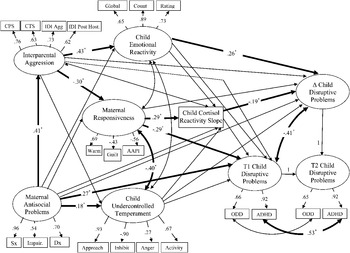
In the current study, we examine diminished parental responsiveness, children's emotional reactivity to interparental conflict, and children's undercontrolled temperament as explanatory mechanisms that account for the intergenerational transmission of disruptive behavioral difficulties. Specifically, each of these mechanisms are examined as mediators of the two modes of transmission identified in Study 1: (a) the direct path between maternal antisocial personality and concurrent levels of preschooler disruptive problems and (b) the indirect path in which maternal antisocial personality is ultimately associated with increases in preschool problems through its association with children's exposure to interparental violence. Furthermore, consistent with multilevel, allostatic load conceptualizations of family risk (Repetti et al., Reference Repetti, Robles and Reynolds2011; Taylor et al., Reference Taylor, Way and Seeman2011), we explore whether these pathogenic pathways are further mediated by individual differences in children's cortisol reactivity to a challenging parent–child relationship task (i.e., Strange Situation [SS]). To advance a process-oriented model of the direct and indirect associations documented in Study 1, we supplement the data from the longitudinal project reported in Study 1 with a multimethod (i.e., questionnaire, interview, observational) and multilevel (i.e., cortisol reactivity) measurement battery of the four putative mediating mechanisms.
Methods
Participants
Participants included the 201 2-year-old children and mothers enrolled in Study 1.
Procedures
For the sake of comparability, the same questionnaire and interview data from the two measurement occasions of Study 1 were utilized to assess interparental aggression, maternal antisocial personality, and child disruptive problems. Children and mothers also participated in four additional procedures from the Wave 1 measurement occasions to assess the putative mechanisms in the pathways among the two family risk factors and child disruptive problems.
IDI: Child reactivity module
Mothers also completed the child reactivity module from the IDI to assess children's emotional reactivity to interparental conflict. This part of the interview is designed to supplement the assessment of the nature, course, and aftermath of conflict in the interparental conflict properties module used in Study 1. The child reactivity module follows a similar semistructured, narrative format, but it is specifically geared toward obtaining rich descriptions of children's behavioral signs of reactivity to the interparental conflict and its aftermath. For example, maternal responses of child reactivity to one of the questions, “During these disagreements that [child] sees or hears, how does s/he respond?” is followed up with a further probe inquiry “What does [child] do or say during these disagreements?” If the mother indicates that the child does nothing, additional probes (e.g., “When you say that [child] does nothing, what do you mean specifically?”) are also utilized to further capture the child's response. Videotaped records were later coded for child reactivity to interparental conflict.
Unfamiliar episodes
Following a similar procedure to previous temperament batteries (e.g., Fox, Henderson, Rubin, Calkins, & Schmidt, Reference Fox, Henderson, Rubin, Calkins and Schmidt2001; Kagan, Reznick, & Snidman, Reference Kagan, Reznick and Snidman1987; Putnam & Stifter, Reference Putnam and Stifter2005), children were exposed to a series of novel objects and events while mothers, who were in the same room, were instructed to complete questionnaires and only intervene with their children if they were concerned about their well-being. In the first episode, the experimenter escorted the child into the room containing a number of unusual objects (e.g., funnel, goggles, windshield cover). After the experimenter departed, the child was free to explore the room and play with the objects for 3 min. In the second task, the experimenter returned and instructed the child to manipulate the objects in different ways (e.g., windshield cover: “Poke it!”; funnel: “Put it on your head!”). In the next episode, an unfamiliar female experimenter dressed as a clown invited the child to play with a sack of toys for 2 min after introducing herself. In the final task, the primary female experimenter instructed the children to imitate the following events after first enacting them herself: (a) reaching behind a black curtain to pull out a doll, (b) placing a finger in glasses of water and prune juice, and (c) picking up a rubber snake and letting it slide back on to the table. All episodes were videorecorded for subsequent behavioral coding.
Parent–child interaction task
Mother participation with their children in a free-play and cleanup episodes during Wave 1 was used to assess indices of maternal parenting. In the first 7-min period, mothers were instructed to play as they normally would at home with their children in a room full of toys. Following the 7-min period, the experimenter knocked on the wall as a prearranged signal for the parent to have the child clean up the toys. Videotaped records were subsequently coded for parenting behavior in each of the tasks.
Salivary cortisol collection during the SS
Saliva samples were collected from the children at three points during the SS procedure to obtain cortisol reactivity measures (Ainsworth, Blehar, Bell, & Waters, Reference Ainsworth, Blehar, Waters and Wall1978). The well-established procedure is a stressful task for the children, consisting of a series of separations and reunions with the mother interspersed with visits from an unfamiliar female adult. To limit the effects of daily routines and afternoon naps on child cortisol levels, all visits were conducted within a 2-hr window during the morning hours. The average sampling time for pretask cortisol occurred at 9:47 a.m. (SD = 0 hr, 28 min). All toddlers had been awake at least 1 hr prior to providing the first saliva sample, thus avoiding the period of the dynamic cortisol awakening response (Susman et al., Reference Susman, Dockray, Schiefelbein, Herwehe, Heaton and Dorn2007). During the visit, toddlers were monitored to insure they did not eat or drink for 30 min before the posttask sample collection was taken in order to limit saliva contamination. Following guidelines established in previous research (e.g., Dickerson & Kemeny, Reference Dickerson and Kemeny2004), the two posttask saliva samples were obtained approximately 25 and 50 min after the end of the 5h episode in the SS paradigm in which the mother leaves the child alone in the room. The episode is designed to be the most stressful period of the procedure for the child.
Because of the age of the participants, a sorbette was held under the child's tongue by a research assistant for 1 min to ensure a sufficient quantity of saliva was obtained. Each sorbette was placed in a 2- ml cryovial and immediately stored at –80°C until shipped on dry ice to Salimetrics, LLC (State College, PA). All samples are assayed for salivary cortisol in duplicate using a highly sensitive enzyme immunoassay (Salimetrics, PA). The test uses 25 µl of saliva per determination and has a lower limit of sensitivity of 0.003 µg/dl, a standard curve range from 0.012 to 3.0 µg/dl, and average intra- and interassay coefficients of variation 3.5% and 5.1%, respectively. Method accuracy, determined by spike and recovery, and linearity, determined by serial dilution, are 100.8% and 91.7%, respectively. The values from matched serum and saliva samples show the expected strong linear relationship, r (63) = .89, p < .0001 (Salimetrics, Reference Salimetrics2005).
Measures
Interparental aggression
The same four measures from Study 1 were used as measures of interparental aggression at Wave 1.
Maternal antisocial psychopathology
The three C-DIS-IV measures of maternal antisocial personality assessed in Study 1 at Wave 1 were utilized in this study.
Child emotional reactivity to conflict
A pair of coders, who were different from the raters for the ICC component of the IDI, coded the maternal narratives from the child reactivity component of the IDI to obtain three indicators of children's emotional reactivity to conflict (e.g., Davies et al., Reference Davies, Sturge-Apple, Cicchetti, Manning and Zale2009). First, based on the narrative descriptions of children's reactivity to conflict, judges coded for the presence (1) and absence (0) of the following three expressions of emotional distress both during and after the interparental conflict: fearful distress (i.e., forms of distress characterized by high levels of anxiety, tension, fear, distress, or worrying), crying (i.e., crying through display of visible tears and/or sobbing), and active flight (i.e., actively shutting out or avoiding the disagreement, e.g., walking or running away, leaving the room, plugging ears). Behavioral tallies of the three behaviors were summed across the conflict and postconflict periods to obtain a single behavioral count of distress.
Second, coders utilized a rating scale to assess children's fearful distress during the conflicts as manifested through descriptions of distressing facial expressions, postures, gestures (e.g., freeing, postural slumping, fidgeting), and verbalizations (e.g., whimpering, verbal concern). The fearful distress rating ranged from 0 (none = no indications of fear worry, anxiety, distress, concern, or vigilance) to 6 (high = description suggests substantial problems controlling and regulating their distress and fear).
Third, coders provided a broader, global rating of children's blatant, unvarnished, and dysregulated expressions of arousing forms of emotional reactivity (e.g., crying, overt fear expressions, calls to mom during conflict, proximity seeking, running away, involvement) based on the overall quality and organization of the child's behavior both during and after the conflict. Ratings ranged from not at all characteristic (1 = none or minimal signs of mobilizing or arousing distress) to highly characteristic (5 = exhibits telltale signs of mobilizing or arousing distress). Intraclass correlation coefficients, reflecting agreement between the two raters on 25% of the interviews, were 0.95 for the behavioral count of distress, 0.90 for the fearful distress rating, and 0.85 for the global rating of emotional reactivity. Evidence of the validity of the emotional reactivity codes derived from the IDI is reflected in its significant associations with indices of family discord and children's functioning in substantively meaningful ways (Davies, Cicchetti, & Martin, in press; Davies et al., Reference Davies, Sturge-Apple, Cicchetti, Manning and Zale2009).
Undercontrolled temperament
Children's patterns of behavior in response to each of the four unfamiliar episodes were coded by another set of coders along four 5-point scales designed to index temperamental activity, approach, inhibition, and negative affect in the context of novel and risky events. Adapted from previous coding systems (e.g., Fox et al., Reference Fox, Henderson, Rubin, Calkins and Schmidt2001; Putnam & Stifter, Reference Putnam and Stifter2005), the activity level was coded in each episode using a scale ranging from 0 (none = child is completely or nearly still) to 4 (intense = child engages in multiple, intense gross motor activities throughout the segment). Our assessment of approach and inhibition was also guided by a previous behavioral system for coding temperament (Hane, Fox, Henderson, & Marshall, Reference Hane, Fox, Henderson and Marshall2008). The approach code ranged from none (0 = negligible or minimal curiosity with no stimulus approach) to intense (4 = approaches all stimuli immediately with excitement and marked confidence). Similarly, the inhibition scale varied from none (0 = no apprehension toward any of the stimuli in the episode) to intense (4 = intense inhibition characterized by freezing, hypervigilance, and/or anxious displays throughout the episode). Finally, following a comparable set of scale anchors, the anger scale ranged from none (0 = no signs of frustration, anger, hostility, and aggression) to intense (4 = multiple signs of intense displays of anger and hostility such as shouting, screaming, loud demands, and throwing toys). To obtain assessments of the individual differences in temperament that are consistent across contexts, ratings across the four unfamiliar episodes were aggregated into composites of approach (α = 0.60), inhibition (α = 0.60), anger (α = 0.72), and activity level (α = 0.62). Two coders, who were extensively trained to reliability, were randomly assigned to code approximately 60% of the children in the unfamiliar episodes, overlapping on approximately 24% of the video records for purposes of calculating reliability. Intraclass correlation coefficients, which examined interrater reliabilities, ranged from 0.89 to 0.96.
Cortisol reactivity
To create a manifest indicator of children's cortisol reactivity to the SS task, we first ran an unconditional LGC model for children's cortisol reactivity using MPlus 6.0 statistical software. Because children were assessed in the morning to limit the effects of daily routines and napping on cortisol levels, average cortisol values decreased across the tasks. Cortisol evidences a strong diurnal pattern whereby highest values are typically occur upon wake-up in the morning followed by a steep decline over the morning hours. Thus, average cortisol values in the present study include both the steep decline in the morning juxtaposed against the stress response to the laboratory paradigms.
To disentangle the diurnal pattern from children's reactivity to laboratory assessments, we followed previous recommendations for controlling for the impact of time in the growth curve analyses (Davies et al., Reference Davies, Sturge-Apple, Cicchetti and Cummings2007; Sturge-Apple, Davies, Cicchetti, & Manning, Reference Sturge-Apple, Davies, Cicchetti and Manning2012). Children's wake-up hour as reported by mothers (M = 7:50 a.m., range = 4:00 a.m. to 9:50 a.m.) was specifically regressed onto the manifest cortisol indicators of the LGC to separate variability due to reactivity to the SS paradigm from variation resulting from the length between child wake-up time and assessment time. Parameterization of the growth curve was defined by a linear slope that weighted each manifest cortisol measurement to correspond to the number of minutes elapsed from the collection of the baseline sample. Factor loadings on the growth curve were centered on the initial cortisol assessment, identifying the intercept value of the growth function to reflect mean cortisol levels at baseline. To create a manifest variable of children's cortisol reactivity, we utilized an option available in MPlus that calculates and saves the actual factor score for each individual. Thus, a score for each child on the slope factor in the latent growth model is calculated for the SS. Examination of the slope factor scores revealed that every child but one evidenced a positive slope score in the SS (range = –0.11 to 1.14), thereby indicating that children generally evidenced mild to moderate positive cortisol reactivity in our latent growth model. The presence of significant variability in the slope factors allowed for the examination of family context predictors of children's differences in cortisol reactivity (e.g., Davies et al., Reference Davies, Sturge-Apple, Cicchetti and Cummings2007).
Diminished maternal responsiveness
Indices of diminished maternal responsiveness were assessed by questionnaire and behavioral observation. As the first indicator, mothers completed the Lack of Empathy Scale from the Adult–Adolescent Parenting Inventory (Bavolek, Reference Bavolek1984). The Lack of Empathy Scale consists of eight items designed to assess maternal insensitivity to the child's needs (e.g., “Parents will spoil their children by picking them up and comforting them when they cry.”). The internal consistency for the scale was satisfactory (α = 0.82), and the validity of the measure is supported by its associations with related parenting constructs (Bavolek, Reference Bavolek1984; Fischer & Corcoran, Reference Fischer and Corcoran2007).
The final two indicators were assessed by coder ratings of parenting in the free play and cleanup tasks using the Warmth/Support Scale and Guilt Scale from the Iowa Family Interaction Rating Scales (IFIRS; Melby & Conger, Reference Melby, Conger, Kerig and Lindahl2001). The IFIRS is a global, macrolevel rating scale that assesses the frequency, intensity, and proportion of parental caregiving behaviors on a 9-point scale, ranging from not at all characteristic (1) to mainly characteristic (9). In support of its validity, the IFIRS scales have been associated with indices of family relationship quality and child functioning in theoretically meaningful ways (Ge, Best, Conger, & Simons, Reference Ge, Best, Conger and Simons1996; Melby & Conger, Reference Melby, Conger, Kerig and Lindahl2001). The warmth code is specifically designed to assess parental support and affection toward the child; the guilt code indexes the parental efforts to control child behavior through emotional forms of manipulation including blaming, threats, punitive statements, and guilt induction. Separate ratings of maternal parenting across the play and cleanup components of each parent–child interaction task were averaged together to form warmth and guilt measures of parenting. Three coders, who were extensively trained to reliability, were randomly assigned to code subsamples of the parent–child interactions. To evaluate interrater reliabilities, the coders on the team were responsible for rating the same subsample (21%) of tapes. Intraclass correlation coefficients, which examined the interrater reliabilities of the team of judges, were 0.76 for guilt and 0.89 for warmth.
Children's disruptive problems
In accord with Study 1, mother reports on the CBCL ODD and ADHD subscales served as indicators of child disruptive problems at Waves 1 and 2.
Results and discussion
Descriptive and preliminary analyses
The raw means and standard deviations of the variables used in the primary analyses are listed in Table 2. Three variables evidencing substantial skewness were transformed using the same methods in Study 1 prior to the calculation of correlations in Table 2 and the primary analyses. Following the same analytic procedures used in Study 1, preliminary analyses were also conducted to examine whether children's gender altered any of the associations identified in the primary analyses as either a covariate. Because the findings did not change with the inclusion of gender, gender was dropped from the analyses to increase analytic parsimony.
Means, standard deviations, and intercorrelations of the main variables in Study 2
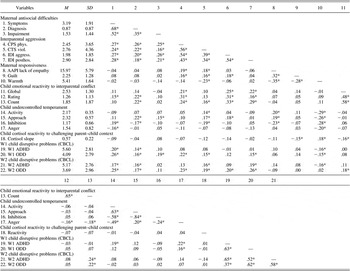
Note: CPS, Conflict and Problem-Solving Scales; CTS, Conflict Tactics Scale; IDI, Interparental Disagreement Interview; AAPI, Adult–Adolescent Parenting Inventory; W1, Wave 1; CBCL, Child Behavior Checklist; ADHD, attention-deficit/hyperactivity disorder; ODD, oppositional defiant disorder; W2, Wave 2.
*p ≤ .05.
Primary analyses
Consistent with Study 1 analyses, we used LDS analyses to examine the role of children's distress reactivity to interparental conflict, undercontrolled temperament, diminished maternal responsiveness, and cortisol reactivity as explanatory mechanisms in the documented associations among maternal antisocial personality, interparental aggression, and children's disruptive problems. For the primary analyses depicted in Figure 4, all direct and indirect paths among the risk factors (i.e., interparental aggression, maternal antisocial personality), the three risk mechanisms of maternal responsiveness, child emotional reactivity to conflict, and child undercontrolled temperament, and the two indices of child disruptive problems were estimated. Consistent with the biopsychological models of family risk, children's cortisol reactivity to the parent–child challenge was further specified as a potential mediator in links among the two risk factors and three risk mechanisms and children's disruptive problems. Correlations among the residuals for maternal responsiveness, child emotional reactivity, and child undercontrolled temperament were estimated. For clarity, only significant pathways in Figure 4 are bold and denoted with standardized path coefficient values. The model provided a good representation of the data, χ2 (184, N = 201) = 278.60, p < .005, RMSEA = 0.05, CFI = 0.93, TLI = 0.91, and χ2/df ratio = 1.51. In support of the measurement model, the manifest indicators all evidenced significant loadings onto their respective latent constructs (ps < .001). The total variance explained in the endogenous variables by the predictors in the overall model, as indexed by R 2, were as follows: .17 for interparental aggression, .08 for parental responsiveness, .05 for child undercontrolled temperament, .18 for child emotional reactivity, .13 for initial level of child problems, and .18 for change in child disruptive problems.
Study 2: A latent difference score analysis of children's undercontrolled temperament, emotional reactivity to conflict, experiences with diminished maternal responsiveness, and cortisol reactivity as explanatory mechanisms in pathways among interparental aggression and maternal antisocial personality and child disruptive problems. *p < .05. Sx, symptoms; Impair., level of impairment; Dx, diagnosis; CPS, physical aggression subscale from the Conflict and Problem-Solving Scales; CTS, physical assault subscale of the CTS2; IDI-Agg, Aggression Scale from the Interparental Disagreement Interview; IDI P. Hos, posthostility rating from the IDI; AAPI, Lack of Empathy Scale from the Adult–Adolescent Parenting Inventory.

Initial levels of child disruptive problems
An analysis of the predictors of children's initial levels of disruptive problems reveals both direct and indirect pathways involving maternal antisocial personality and interparental aggression. First, in reflecting a direct pathway, maternal antisocial personality continued to be concurrently associated with the initial level of child disruptive problems even after the inclusion of the three intervening mechanisms in Figure 4 (β = 0.27, p < .01). The magnitude of this direct path was comparable after running a model that constrained the structural paths among the mediators and child disruptive problems to 0 (β = 0.25, p < .01), thereby suggesting that the risk mechanisms did not account for the association between maternal antisocial personality disorder and concurrent levels of child disruptive problems. Maternal antisocial personality was also significantly associated with higher levels of undercontrolled child temperament (β = 0.18, p < .05). However, because of the negligible association between undercontrolled temperament and children's disruptive problems, the results did not support an indirect pathway whereby maternal antisocial behavior was also related to child disruptive problems through its association with children's temperament.
Second, although interparental aggression did not predict initial levels of child disruptive problems at Wave 1, it was indirectly associated with these problems through its relationship with diminished maternal responsiveness. As shown in Figure 4, interparental aggression predicted lower levels of maternal responsiveness (β = –0.30, p < .05) and lower maternal responsiveness in turn was concurrently associated with higher initial levels of child disruptive problems (β = –0.29, p < .05). Follow-up mediation tests using the PRODCLIN software program indicated that this indirect pathway was significantly different from 0 (95% CI = 0.01–0.83; MacKinnon et al., Reference MacKinnon, Lockwood, Hoffman, West and Sheets2002; Preacher & Hayes, Reference Preacher and Hayes2008). Furthermore, by virtue of its role as a predictor of interparental aggression (β = 0.41, p < .01), maternal antisocial personality was linked in a more complex, indirect way with initial levels of child disruptive problems. Specifically, the results supported a pathway whereby parent antisocial personality disorder may incur additional risk to children by increasing interparental aggression that in turn indirectly increases the likelihood of initial levels of child problems through its association with diminished maternal responsiveness.
Prospective changes in child disruptive problems
Changes in child disruptive problems were largely predicted by risk mechanisms that were more proximally associated with interparental aggression than maternal antisocial personality difficulties. More specifically, inclusion of the intervening mechanisms in Figure 4 substantially altered the associations between interparental aggression and subsequent changes in child disruptive problems. Whereas the direct path between interparental aggression and changes in child disruptive problems was significant prior to the inclusion of the structural paths between the intermediary mechanisms and change in disruptive problems (β = 0.29, p = .01), the magnitude of this association dropped substantially following the estimation of all of the indirect paths in the full model (β = 0.15, p = .28). An inspection of the pathways in Figure 4 supports the hypothesis that children's emotional reactivity to interparental conflict mediated interparental aggression. Interparental aggression was significantly associated with greater child emotional reactivity to interparental conflict (β = 0.43, p < .01). Child emotional reactivity to conflict in turn significantly predicted smaller decreases and, in some cases, increases in child disruptive problems over the subsequent year (β = 0.26, p < .05). Furthermore, follow-up tests for testing mediation using PRODCLIN indicated that children's fearful reactivity was a significant explanatory mechanism in the path between interparental aggression and changes in children's disruptive problems (95% CI = 0.04–0.67; Preacher & Hayes, Reference Preacher and Hayes2008).
Interparental aggression was also associated in complex ways with changes in children's disruptive problems. Specifically, interparental aggression was associated with lower levels of parental responsiveness that in turn predicted dampened cortisol reactivity in the SS paradigm (β = 0.29, p < .05). Lower levels of cortisol reactivity in turn was associated with smaller reductions and, in some cases, rises in children's disruptive behavior problems over the 1-year period (β = –0.19, p < .05). PRODCLIN tests of mediation showed that this indirect pathway was significantly different from 0 (95% CI = 0.01–0.09; Preacher & Hayes, Reference Preacher and Hayes2008).
Although maternal antisocial personality was not a proximal predictor of the risk mechanisms that accounted for changes in child disruptive problems, the findings support its role as a distal predictor in a more complicated chain of processes. The results in Figure 4 are consistent with a pathway whereby maternal antisocial personality was indirectly related to children's emotional reactivity to interparental conflict through its association with interparental aggression. As noted previously, emotional reactivity in turn was a significant predictor of children's disruptive problems over the subsequent year.
General Discussion
This multistudy paper was designed to identify the pathways and processes underlying the associations among maternal antisocial personality, interparental aggression, and child disruptive problems. In the initial stage of our multiple levels of analysis approach to understanding the intergenerational transmission of antisocial and disruptive problems, the first study was designed to trace the developmental implications of maternal psychological attributes (i.e., antisocial personality difficulties) and relationship processes in the interparental relationship (i.e., aggression). To rigorously test the joint interplay between interparental aggression and maternal antisocial problems, we examined these pathways within a broader constellation of maternal psychological (i.e., substance use, anxiety, posttraumatic stress disorder, mood) difficulties and broader family socioeconomic factors. In moving to the level of searching for mechanisms, our goal in Study 2 was to identify the processes that accounted for how and why interparental aggression and maternal antisocial difficulties increased children's vulnerability to disruptive problems. In accord with the theme of this Special Issue, we examined the putative role of mediating mechanisms at different levels of analysis, including family (i.e., parental responsiveness), stable child psychological attributes (i.e., undercontrolled temperament), and children's behavioral (i.e., emotional reactivity to interparental conflict) and neuroendocrine reactivity (i.e., cortisol reactivity to maternal separations and reunions) to stressful family events.
As first step, the findings of Study 1 supported the multiple pathways model through the documentation of two main pathways (Emery et al., Reference Emery, Waldron, Kitzmann and Aaron1999). Maternal antisocial personality was specifically associated with greater disruptive problems both directly and indirectly through its link with interparental aggression. However, examining the results through a closer developmental lens revealed that the robustness of the two pathways varied, depending on the ontogenetic characteristics of the child disruptive problems. In support of the psychopathology model (see Figure 1), maternal antisocial personality difficulties predicted initial levels of child disruptive problems, even after estimating the negligible role of interparental aggression as a predictor. Conversely, in accordance with the mediational model, LDS analyses revealed that interparental aggression mediated the associations between maternal antisocial personality and changes in preschool children's behavior problems over 1 year. In the context of a significant normative decline in behavior problems during the preschool years (e.g., Campbell, Reference Campbell1994; Keller, Spieker, & Gilchrist, Reference Keller, Spieker and Gilchrist2005; Owens & Shaw, Reference Owens and Shaw2003), the mediational pathways indicated that maternal antisocial behavior was associated with greater interparental aggression that in turn predicted less marked declines and, in some cases, rises in child behavior problems.
Extending research on the transmission of disruptive problems during middle childhood and adolescence (Emery et al., Reference Emery, Waldron, Kitzmann and Aaron1999; Frick et al., Reference Frick, Lahey, Hartdagen and Hynd1989), our findings underscore that the parent psychopathology and mediational pathways emerge as early as the preschool years. Developmental psychopathology frameworks have long regarded the early childhood years as a sensitive period for the impact of family risk factors on the development of child externalizing problems (Campbell et al., Reference Campbell, Shaw and Gilliom2000; Cicchetti, Cummings, Greenberg, & Marvin, Reference Cicchetti, Cummings, Greenberg, Marvin, Greenberg, Cicchetti and Cummings1990; Moffitt, Reference Moffitt1993). The results further supported the notion that these two pathways were not simply spurious artifacts of co-occurring stressors. Sociodemographic disadvantage and maternal mood, substance use, and anxiety psychopathology are regarded as potential confounding factors in light of their significant associations with maternal antisocial personality, family violence, and child externalizing symptoms (Emery et al., Reference Emery, Waldron, Kitzmann and Aaron1999; Jaffee et al., Reference Jaffee, Belsky, Harrington, Caspi and Moffitt2006). However, including sociodemographic disadvantage and comorbid forms of maternal psychopathology as predictors of interparental aggression and child disruptive problems did not alter the direct association between maternal antisocial personality and child disruptive problems or the mediational role of interparental aggression in the link between maternal antisocial personality and changes in child problems. Thus, the specificity of the pathways supports the notion that maternal antisocial personality and interparental violence hold primacy over other common risk factors in accounting for preschooler disruptive behavior problems.
A next important step in this research was to understand why preschoolers are specifically vulnerable to these two forms of hostility in the family. To address this question, Study 2 examined children's undercontrolled temperament, emotional reactivity to interparental conflict, cortisol reactivity to maternal separation, and exposure to unresponsive parenting as mediators of the interplay between interparental violence and maternal antisocial behavior in the prediction of child disruptive problems. Although children's undercontrolled temperament did not mediate the intergenerational transmission of problems in any of the analyses, the findings did provide support for the role of children's emotional reactivity to conflict and unresponsive parenting as intermediary mechanisms of family risk, particularly for pathways involving interparental aggression. In addition, children's cortisol reactivity further mediated the associations between parental unresponsiveness and child disruptive problems.
Reflecting one of the primary mediational paths, the results indicated that children's emotional reactivity to interparental conflict partially explained the link between interparental violence and children's disruptive problems. Interparental violence was specifically associated with higher levels of children's emotional reactivity, characterized by prolonged, dysregulated fear and distress in the context of interparental conflicts. Children's emotional reactivity in turn prospectively predicted smaller reductions and, for some children, increases in their disruptive behavior problems over 1 year. Thus, these findings are consistent with proposals that witnessing interparental violence is a destructive environmental pathogen for young children that not only signifies potential reductions in support from caregivers but also poses a direct threat to their security and safety (Davies et al., Reference Davies, Winter and Cicchetti2006; Johnston & Roseby, Reference Johnston and Roseby1997; Margolin, Reference Margolin2005). Given young children's rudimentary representational and social–cognitive capacities, a central premise of this proposal is that children's increasing concerns about their security are reflected in preverbal, sensorimotor patterns of distress that evolved from exposure to destructive conflict in the family and in turn set the stage for later maladaptation (Davies et al., Reference Davies, Winter and Cicchetti2006).
An important question, however, is why children's fear and distress would predict a morphologically different outcome characterized by hostility, defiance, hyperactivity, and inattention (Jenkins, Reference Jenkins2002). Running counter to our conceptualization, one rival explanation may be that children's emotional reactivity serves as an inert proxy for more active mediating mechanisms. The tenets of some temperament and personality models may be specifically translated into the proposal that emotional reactivity is simply a context-specific manifestation of the more potent effects of children's difficult or undercontrolled temperament (Harold & Conger, Reference Harold and Conger1997; Watson & Pennebaker, Reference Watson and Pennebaker1989). Alternatively, based on family models that consider parenting as the primary socialization agent in the family (Buehler, Benson, & Gerard, Reference Buehler, Benson and Gerard2006), it is also possible that parenting difficulties associated with interparental aggression may be the common etiological source of high levels of emotional reactivity to conflict and disruptive child problems. However, the plausibility of these interpretations are diminished by the analyses indicating that children's emotional reactivity to interparental aggression was a significant mediator of interparental aggression, even after considering the effects of diminished parenting and undercontrolled temperament. Drawing from emotional security theory (Davies et al., Reference Davies, Winter and Cicchetti2006), a more plausible explanation is that the hypervigilance and arousal accompanying children's emotional reactivity to interparental conflict is postulated to increase behavior dysregulation (e.g., attention difficulties, oppositionality, hyperactivity) by amplifying children's tendencies to scan, process, and respond to potential dangers in other interpersonal settings (Bascoe, Davies, Sturge-Apple, & Cummings, Reference Bascoe, Davies, Sturge-Apple and Cummings2009; Margolin & Vickerman, Reference Margolin and Vickerman2007). Likewise, as outgrowths of high levels of emotional reactivity and arousal (Scheeringa & Zeenah, Reference Scheeringa and Zeanah1995), displays of aggression and antagonism may intensify and crystallize when it serves a “detouring” function that distracts parents from engagement in destructive conflicts (Buchanan & Waizenhofer, Reference Buchanan, Waizenhofer, Booth, Crouter and Clements2001; Kerig, Reference Kerig1995).
Our identification of indirect pathways suggests that interparental aggression may produce a “double whammy” of risk for children by virtue of its association with parenting difficulties (Margolin, Reference Margolin2005). The findings specifically revealed that children's exposure to interparental aggression was also indirectly related to concurrent levels of child disruptive problems through its association with maternal unresponsiveness. Thus, the stressful processes accompanying interparental aggression are not only implicated in the subsequent changes in children's behavior problems over time, but they also indirectly account for differences between children in their initial levels of problems. Although our concurrent findings do not rule out alternative conceptualizations of directionality (i.e., child disruptive problems strain the family system, parenting may undermine interparental relations), they are broadly consistent with the main tenet of spillover formulations and its interpretation that mothers' distress, preoccupation, and frustration in the wake of interparental aggression undermine their ability to sensitively and empathetically respond to their children (Davies, Sturge-Apple, Woitach, & Cummings, Reference Davies, Sturge-Apple, Woitach and Cummings2009; Margolin, Reference Margolin2005; Schofield et al., Reference Schofield, Conger, Martin, Stockdale, Conger and Widaman2009). Moreover, the specificity of the association between interparental aggression and parenting difficulties was evident after consideration of the effects of maternal antisocial personality as a predictor. Thus, the results do not support the notion that the “spillover” pathway is simply a spurious vestige of the effects of antisocial personality on interparental and parenting difficulties (Levendosky et al., Reference Levendosky, Huth-Bocks, Shapiro and Semel2003). Rather, consistent with family systems theory, the findings lend credibility to the family systems principle that the interparental relationship is a cornerstone of the family that has significant implications for how adults approach the developmental challenge of raising children (Cowan & Cowan, Reference Cowan and Cowan2002).
The documented pathway between lack of maternal responsiveness associated with interparental aggression and child disruptive problems is more broadly consistent with the identification of maternal parenting difficulties as intervening mechanisms in the prediction of child externalizing symptoms (Levendosky et al., Reference Levendosky, Huth-Bocks, Shapiro and Semel2003; Levendosky, Leahy, Bogat, Davidson, & von Eye, Reference Levendosky, Leahy, Bogat, Davidson and von Eye2006). Testifying to the strength of this pathway, our findings further extend this early knowledge base by demonstrating that the indirect pathway is stable and independent of the potential confounding role of children's undercontrolled temperament and emotional reactivity to interparental discord. Consistent with developmental psychopathology models of family discord during the toddler and preschool years (Cicchetti & Toth, Reference Cicchetti and Toth1995; Dodge & Pettit, Reference Dodge and Pettit2003; Margolin, Reference Margolin2005), maternal emotional availability may assume particular prominence during the first few years of life as at-risk children approach the formidable stage-salient task of developing a secure attachment relationship. By undermining children's success in utilizing caregivers as a source of protection and safety, diminished parental responsiveness may ultimately increase children's disruptive problems by impeding their ability to regulate emotions, impulses, and attention (Cicchetti et al., Reference Cicchetti, Cummings, Greenberg, Marvin, Greenberg, Cicchetti and Cummings1990; Margolin & Vickerman, Reference Margolin and Vickerman2007).
As a further testament to the value of maternal responsiveness in models of family aggression and child psychopathology, the multiple levels of analysis design in Study 2 indicated that diminished maternal responsiveness was also indirectly linked with changes in disruptive problems through its association with children's blunted cortisol reactivity to maternal separation. Consistent with the hypocortisolim hypothesis, the findings support a complex pathway in which diminished parental responsiveness in the wake of interparental aggression ultimately increases children's disruptive problems by altering adrenocortical reactivity to challenges in the parent–child relationship. Although replication with longitudinal designs that can more decisively disentangle directionality is necessary before drawing definitive conclusions, the results are broadly consistent with biopsychological models of family aggression (Cicchetti & Rogosch, Reference Cicchetti and Rogosch2007; Repetti et al., Reference Repetti, Taylor and Seeman2002, Reference Repetti, Robles and Reynolds2011; Taylor et al., Reference Taylor, Way and Seeman2011). According to these models, preserving the integrity of physiological systems in the face of protracted family adversity requires significant changes in how the HPA system responds to subsequent family stressors.
In examining the specific nature of HPA reactivity, questions still remain as to why dampened, rather than heightened, cortisol reactivity served as the allostatic mediator. One possible explanation is that diminished cortisol reactivity is the end product of the downregulation of the HPA axis following progressive sensitization of the system in the face of repeated threats (Repetti et al., Reference Repetti, Robles and Reynolds2011; Susman, Reference Susman2006). Thus, although the initial period of experiencing stressful events may be accompanied by progressively greater reactivity, blunting of HPA axis components may serve a protective function designed to prevent the toxic effects of chronic overarousal of the stress system in response to danger (Fries, Hesse, Hellhammer, & Hellhammer, Reference Fries, Hesse, Hellhammer and Hellhammer2005; Susman, Reference Susman2006). From a multiple levels of analysis perspective, the diminished reactivity may be a physiological manifestation of a broader, analgesic strategy characterized by both biological and psychological detachment from threat (Davies & Sturge-Apple, Reference Davies and Sturge-Apple2007). Proclivities toward detachment from threat may be further amplified by general impairments in identifying and comprehending the meaning and consequences of emotional events in the family. Interpreted within the attenuation model (Susman, Reference Susman2006), unsupportive, unresponsive parenting may specifically expose children to high levels of interpersonal volatility and unpredictability that disrupt the capacity of the limbic system to process emotions. The resulting difficulties in neurobiological processing of emotional parameters of events may be manifested in processes underlying the development of disruptive behavior problems, including diminished sensitivity to punishment and negative stimuli, impairments in the development of empathy, and sensation seeking.
In contrast to the mediational findings for interparental aggression, none of the three putative mechanisms accounted for the associations between maternal antisocial personality and initial levels of child disruptive problems. Although maternal antisocial personality was a significant predictor of observer ratings of children's undercontrolled temperament as hypothesized, undercontrolled temperament was unrelated to their disruptive problems. Therefore, in support of multifinality in developmental pathways, children of mothers with high levels of antisocial personality characteristics appear to be vulnerable to two distinct developmental outcomes: undercontrolled temperamental attributes and disruptive behavior problems (Cicchetti & Rogosch, Reference Cicchetti and Rogosch1996). However, these findings should not be misinterpreted as evidence against the role of temperament as a mediator in the intergenerational transmission of externalizing symptoms. For example, the pattern of bivariate correlations in Table 2 do provide evidence that observer ratings of specific dimensions of the undercontrolled temperament (i.e., high activity, anger proneness) are associated with maternal reports of children's disruptive problems. Thus, future empirical attempts to dissect this undercontrolled composite may yield stronger support for the mediational role of more specific dimensions of temperament. Likewise, even our broad composite of temperament does not capture all of the early child constitutional dispositions that may mediate maternal antisocial personality. The finding that maternal antisocial personality remained a moderate predictor of child disruptive problems after controlling for a whole host of possible environmental pathogens in Study 1 and Study 2 underscores the need to explore other types of early emerging child characteristics as mediators. Guided by neuropsychological and temperament work on early emerging disruptive problems (Dodge & Pettit, Reference Dodge and Pettit2003; Lynam & Henry, Reference Lynam, Henry, Hill and Maughan2001; Raine et al., Reference Raine, Moffitt, Caspi, Loeber, Stouthamer-Loeber and Lynam2005), specific neurocognitive impairments (e.g., spatial, memory, and verbal abilities) and temperament attributes (e.g., resistance to control) may yield stronger evidence for mediation.
The lack of support for the other two mediational pathways tested was largely attributable to the negligible associations among maternal antisocial personality and children's experiences of maternal unresponsiveness and emotional reactivity to interparental conflict. Although it is difficult to provide any definitive interpretation of null results, some potential explanations and qualifications can be offered as a guide for future work. In accord with earlier research on predictors of parenting (Jaffee et al., Reference Jaffee, Belsky, Harrington, Caspi and Moffitt2006), maternal antisocial personality may not confer incremental risk for exhibiting diminished maternal responsiveness beyond other psychosocial vulnerabilities. However, this interpretation does not rule out the possibility that antisocial personality is a distinct predictor of other forms of parenting (Jaffee, Reference Jaffee, Tremblay, van Aken and Koops2009). For example, preliminary evidence provides some (albeit inconclusive) support for the hypothesis that maternal antisocial personality may be a specific precursor of harsh, hostile patterns of parenting (Jaffee, Reference Jaffee, Goldstein and Brooks2005). Furthermore, the pathways identified suggest that antisocial personality characteristics of mothers may play a more insidious role in the prediction of behavior problems in young children. Despite its nonsignificant associations with maternal unresponsiveness and children's emotional reactivity to conflict, maternal antisocial personality was indirectly associated with these pathogenic processes through its role as a moderate predictor of children's exposure to interparental violence. Although the complexity of these pathways requires replication before making any definitive conclusions, the findings raise the possibility that maternal antisocial personality ultimately increases child disruptive problems by first setting the stage for children's exposure to violence between parents. Interparental aggression in turn may increase child disruptive problems through its role as a more proximal precursor of greater child emotional reactivity to interparental conflict, diminished parental responsiveness, and, ultimately, alterations in neurobiological functioning.
Fully interpreting the results of the studies also requires consideration of some additional limitations. First, our sample contained higher proportions of families who were characterized as racial minorities and experienced interparental aggression, violence, and poor socioeconomic backgrounds. Thus, caution should be exercised in generalizing these results, especially in light of the higher prevalence of adult antisocial personality in poor, violent homes. Second, although our prospective analysis of change in child disruptive problems is relatively rare in the family violence literature, the two-wave design precluded similar analyses of whether interparental aggression and maternal antisocial personality were precursors of change in the proposed mediating mechanisms. Third, although the multimethod measurement in this study has advantages in reducing the influence of monomethod bias in the findings, common method variance may still be operating in some of the pathways. Fourth and finally, our analysis of mediational pathways does not rule out the plausibility of other multivariate models.
In summary, this multistudy paper breaks new ground by systematically exploring (a) the nature of the interplay between maternal antisocial personality and interparental aggression in predicting child disruptive problems and (b) the underlying mechanisms involved in the pathways among these two family risk factors and child disruptive problems. Consistent with the psychopathology model, the Study 1 findings indicated that maternal antisocial personality was a predictor of initial levels of preschool disruptive problems independent of the effects of interparental violence, comorbid forms of maternal psychopathology, and socioeconomic factors. Conversely, support for the mediational model was reflected in the finding that maternal antisocial personality was associated with prospective changes in child disruptive problems through its relationship with elevated interparental aggression. In addressing the question of why these pathways exist, Study 2 further revealed that the documented role of interparental aggression as a predictor was further mediated by children's emotional reactivity to interparental conflict, experiences with diminished maternal responsiveness, and, in a multichain process, dampened cortisol reactivity to maternal separation.
In revisiting the theme of this Special Issue, our examination of risk factors and mechanisms at ecological, psychological, familial, and biological levels across the studies attests to the utility of a multiple levels of analysis paradigm to understanding antisocial and disruptive behavior. Toward fully realizing the potential of a multilevel approach, we selectively offer three broad recommendations for future research on the intergenerational transmission of antisocial behavior. First, future advances may be facilitated by considering the organization of multiple physiological systems in adapting to aggression and hostility in the family. For example, the HPA, the sympathetic nervous system, and the parasympathetic nervous system are regarded as part of a broader stress–response system, with the evolved biological function of coordinating physiological responses to environmental challenges that had fitness-relevant consequences in ancestral environments (e.g., Del Giudice, Ellis, & Shirtcliff, Reference Del Giudice, Ellis and Shirtcliff2011; Repetti et al., Reference Repetti, Robles and Reynolds2011). Thus, understanding how the HPA axis operates within the broader network of physiological systems may lead to the identification of new processes in the transmission of antisocial behavior.
Second, the modest nature of many of the mediational pathways underscores the fruitfulness of identifying sources of heterogeneity in the sequelae of children exposed to hostile home environments. Developmental psychopathology models of family aggression have proposed that ecological and family variables may serve to potentiate or protect children from the risk of developing psychopathology (e.g., Cicchetti & Lynch, Reference Cicchetti and Lynch1993; Margolin, Reference Margolin2005). Reflecting additional layers of analysis, several organism–environment models have further underscored how children's attributes at genetic, biological, and temperamental levels may act as moderators of hostile family environments (Cicchetti, Reference Cicchetti, Beauchaine and Hinshaw2008; Cicchetti & Rogosch, Reference Cicchetti and Rogosch2007; Jaffee, Reference Jaffee, Tremblay, van Aken and Koops2009). Toward greater precision in identifying the nature of moderating effects, a significant challenge is to determine whether the specific child attributes act as (a) diatheses or vulnerabilities that increase child psychopathology in adverse contexts but have no adaptive advantage in other contexts (e.g., El-Sheikh, Hinnant, & Erath, Reference El-Sheikh, Hinnant and Erath2011; Jaffee, Reference Jaffee, Tremblay, van Aken and Koops2009) or (b) individual differences in sensitivity that confer heightened vulnerability in the face of heightened family adversity but significant benefits in supportive socialization settings (Belsky & Pluess, Reference Belsky and Pluess2009; Ellis & Boyce, Reference Ellis and Boyce2008).
Third, a prevailing approach in conducting multilevel research is to rely on a single level of analysis in assessing each conceptual construct in multivariate models. For example, measurement of children's reactivity to maternal separation in our study was indexed by cortisol functioning rather than a broader profile of both psychological and biological assessments. Accordingly, fully integrating different levels of analysis into research designs on the development of antisocial behavior will require systematic examination of how indices of biological functioning correspond concurrently with their psychological functioning (Fox, Hane, & Perez-Edgar, Reference Fox, Hane, Perez-Edgar, Cicchetti and Cohen2006; Katz, Reference Katz, Grych and Fincham2001). Applied to our study, the analysis of children's behaviors in response to maternal separation and reunion would afford a test of the hypothesis that dampened neurobiological reactivity is part of a broader strategy of dissociating from threat. Likewise, the identification of moderators of antisocial behavior at a single level of analysis (e.g., genes) could be followed up with an analysis of the mechanisms (e.g., phenotypical manifestations in the form of temperament) that account for the multiplicative effects.