According to the World Health Organization (WHO; 2006), child maltreatment (CM) is a pervasive public health problem that presently affects approximately one in four children worldwide with the potential for profound developmental sequelae. In addition to the call for effective prevention, the WHO (2006) outlines the growing need to gain clearer insight into the developmental processes that characterize individuals exposed to CM and that provide the infrastructure for its emergence in different ecological settings. Child maltreatment researchers have also highlighted the urgent need to enhance knowledge of the factors that lead parents to expose their offspring to maltreatment (Freisthler, Merritt, & Lascala, Reference Freisthler, Merritt and LaScala2006; Stith et al., Reference Stith, Liu, Davies, Boykin, Alder, Harris and Dees2009). Such descriptions would provide a clearer path to more meaningful intervention work for individuals exposed to CM, as well as help target factors that lead to the emergence of CM in different families (Cicchetti & Toth, Reference Cicchetti and Toth2016). The purpose of this meta-analysis is to systematically examine studies that have addressed the relation between CM exposure and later quality of parenting behavior. The CM–parenting association is perceived as being one of the core paths linking the potential transmission of maltreatment across generations (Plant, Jones, Pariante, & Pawlby, Reference Plant, Jones, Pariante and Pawlby2017).
A growing body of literature has demonstrated that CM, defined as the experience of sexual, emotional, or physical abuse or neglect before the age of 18 years, may have short-term and long-term consequences on an individual's physical, behavioral, emotional, and psychological health and well-being (Alink, Cicchetti, Kim, & Rogosch, Reference Alink, Cicchetti, Kim and Rogosch2012; Norman et al., Reference Norman, Byambaa, De, Butchart, Scott and Vos2012). Many researchers have suggested that CM may not only have lifelong consequences on the individuals who are exposed to it, but it may also have deleterious effects on their offspring (Plant et al., Reference Plant, Jones, Pariante and Pawlby2017; Roberts, O'Connor, Dunn, & Golding, Reference Roberts, O'Connor, Dunn and Golding2004). Children of mothers who experienced CM are at greater risk of being engaged on developmental paths that are characterized by more frequent manifestations of impulsivity, aggressiveness, depression, and anxiety, and to develop disorganized attachment with their caregiver (Madigan, Wade, Plamondon, & Jenkins, Reference Madigan, Wade, Plamondon and Jenkins2015; Plant et al., Reference Plant, Jones, Pariante and Pawlby2017). Moreover, parents with a maltreatment history are twice as likely to maltreat their own children (Madigan et al., Reference Madigan, Cyr, Eirich, Fearon, Ly, Rash and Alink2019). In light of the observation that approximately one in four children experience CM (Stoltenborgh, Bakermans-Kranenburg, Alink, & van Ijzendoorn, Reference Stoltenborgh, Bakermans-Kranenburg, Alink and van Ijzendoorn2015; WHO, 2016), and that one in three parents with a history of maltreatment will go on to maltreat his or her own children (Kaufman & Zigler, Reference Kaufman and Zigler1987), it is critical to elucidate the developmental processes involved in the intergenerational transmission of maltreatment.
Theoretical Overview of Child Maltreatment and Subsequent Parenting
Many researchers have suggested that individuals who experienced maltreatment as children are at risk for experiencing difficulties in their parenting behavior (Freisthler et al., Reference Freisthler, Merritt and LaScala2006). This may be due, in part to the duel burden of experiencing CM, as well as its negative psychosocial circumstances (Madigan, Wade, Tarabulsy, Jenkins, & Shouldice, Reference Madigan, Wade, Tarabulsy, Jenkins and Shouldice2014). Research from different conceptual perspectives has shown that when CM victims become parents, there is a greater likelihood of experiencing difficulties in their daily interactions with their child (Fraiberg, Adelson, & Shapiro, Reference Fraiberg, Adelson and Shapiro1975; Goldberg, Benoit, & Blokland, Reference Goldberg, Benoit and Blokland2003; Madigan et al., Reference Madigan, Bakermans-Kranenburg, van Ijzendoorn, Moran, Pederson and Benoit2007; Pasalich, Cyr, Zheng, McMahon, & Spieker, Reference Pasalich, Cyr, Zheng, McMahon and Spieker2016; Rijlaarsdam et al., Reference Rijlaarsdam, Stevens, Jansen, Ringoot, Jaddoe, Hofman and Tiemeier2014). In this view, one of the paths by which exposure to CM may be linked to later child outcome is through problematic parenting and parent–child interaction (Cicchetti & Toth, Reference Cicchetti and Toth2016).
Attachment theory provides a helpful conceptual framework for understanding the effects of CM on later parenting. Attachment theory postulates that the quality of interactions and relationship experienced with primary caregivers during childhood form a “blueprint” for later, meaningful relationships (Sroufe & Fleeson, Reference Sroufe and Fleeson1986), including parent–child relationships (Feeney & Woodhouse, Reference Feeney, Woodhouse, Cassidy and Shaver2016). Much of the research in support of this hypothesis has been conducted in longitudinal studies that show that early attachment is linked to later socioemotional outcome in children and adolescents and the way they form relationships (e.g., Fearon, Bakermans-Kranenburg, van IJzendoorn, Lapsley, & Roisman, Reference Fearon, Bakermans-Kranenburg, van IJzendoorn, Lapsley and Roisman2010; Troy & Sroufe, Reference Troy and Sroufe1987). In light of such findings, it is noteworthy that most studies on the topic have underlined that childhood exposure to maltreatment is frequently linked to insecure and disorganized attachment, both of which are linked to developmental risk and relationship difficulties (Cyr, Euser, Bakermans-Kranenburg, & van Ijzendoorn, Reference Cyr, Euser, Bakermans-Kranenburg and van Ijzendoorn2010). Such attachments mark the presence of a potentially problematic socioemotional trajectory (Fearon et al., Reference Fearon, Bakermans-Kranenburg, van IJzendoorn, Lapsley and Roisman2010).
At least two aspects of attachment theory have been relied upon to address the association between CM and parenting behavior. The first concerns the possibility that exposure to CM may create conflict between the parent's attachment and caregiving behavioral systems. Bowlby (Reference Bowlby1969), Lyons-Ruth and Block (Reference Lyons-Ruth and Block1996), and George and Solomon (Reference George, Solomon, Cassidy and Shaver2008) have suggested that, while caregiving is a goal-corrected behavioral system that is deployed to provide protection and care for offspring within the context of interactions, signals, and child emotions, CM experiences may increase parental need to maintain their own vigilance and self-protection, which may create problems in how parents interpret and respond to child signals. The competing behavioral systems make the parent less able to appropriately interpret and respond to child needs in a predictable fashion, as parents may be overly concerned with their own preservation and well-being. Several studies have provided indirect support for this hypothesis. For example, Lyons-Ruth and Block (Reference Lyons-Ruth and Block1996) have obtained data showing that mothers with histories of sexual abuse are less involved and more withdrawn during interactions with their infant than their nonabused counterparts. Relatedly, Bailey, Tarabulsy, Moran, Pederson, and Bento (Reference Bailey, Tarabulsy, Moran, Pederson and Bento2017) have shown how exposure to maltreatment moderated the transmission of maternal to infant attachment. Mothers exposed to maltreatment appeared to experience disrupted attachment transmission in comparison to those who were not exposed. Thus, the notion that CM may create a kind of systemic obstacle to parenting is a viable hypothesis.
Second, attachment theory casts CM as a potentially traumatic event that has ramifications for the manner in which parents will interact with their child. Addressing CM in this light may help to gain insight into the interactive experiences of children and the developmental processes that are involved. For example, Main and Hesse (Reference Main, Hesse, Greenberg, Cicchetti and Cummings1990) have suggested that unresolved trauma resulting from CM may be activated by child emotional signals and behaviors, whereby the fear, distress, and confusion associated with trauma are triggered by events occurring in the context of interaction and negatively influence a parent's ability to respond sensitively to the child. In support of these specific theoretical postulates, different studies have shown that exposure to CM leads to more frightened, frightening, or otherwise negative, atypical parental behavior that may alarm the child (e.g., Madigan et al., Reference Madigan, Bakermans-Kranenburg, van Ijzendoorn, Moran, Pederson and Benoit2007). When these behaviors become recurrent patterns of interaction, they have the potential to be associated with different aspects of infant and child development, including attachment security and organization (Moran, Forbes, Evans, Tarabulsy, & Madigan, Reference Moran, Forbes, Evans, Tarabulsy and Madigan2008).
Empirical Overview of Child Maltreatment History and Parenting Behaviors
In view of the strong theoretical underpinnings linking CM to parenting behavior, it is surprising to note that although the CM–parenting association has been examined in a number of reports, results have varied considerably. While some studies support the basic CM–parenting link, others have not. For example, in the German Longitudinal Study, Fuchs, Moehler, Resch, and Kaess (Reference Fuchs, Moehler, Resch and Kaess2015) examined the potential association between maternal history of abuse and parenting behaviors by observing mother–infant interactions at infant age 12 months. In this study, mothers who did not report abuse experiences showed greater levels of interactive sensitivity than those who had, during a 20-min free-play interaction segment. Similar results emerged from a study by Zvara, Mills-Koonce, Appleyard Carmody, and Cox (Reference Zvara, Mills-Koonce, Appleyard Carmody and Cox2015), who found an association between childhood sexual abuse and the observed parenting behavior of mothers of 5-year-old children in a low-income group of participants. Results revealed that mothers who experienced sexual abuse scored significantly lower on parenting sensitivity, and significantly higher on harsh intrusiveness and boundary dissolution dimensions, compared to mothers with no experiences of sexual abuse. Such findings have been used to support the hypothesis that maternal experiences of abuse may impact future parenting behavior.
However, in contrast, some studies have obtained results that do not support the CM–parenting association. For example, in a study focusing on the effects of maternal CM on mother–child interactions at 6 months postpartum, Sexton, Davis, Menke, Raggio, and Muzik (Reference Sexton, Davis, Menke, Raggio and Muzik2017) found no evidence of any association between CM and either observed hostile, controlling, or positive parenting behaviors. Similarly, in a study that examined the association between exposure to neglect during childhood and the quality of parental interactive behavior, Lounds, Borkowski, and Whitman (Reference Lounds, Borkowski and Whitman2006) found no association when mothers were observed with their child at 3 and 5 years of age.
One method for resolving discrepancies in the literature is to conduct a meta-analytic synthesis. Thus, the primary aim of the current meta-analysis is to quantify the association between maternal exposure to CM and subsequent parenting in children aged 0–6. The specific focus on the parenting behavior of children under the age of 6 is due to the greater homogeneity of parenting measures during early childhood, compared to middle or later childhood (Koehn & Kerns, Reference Koehn and Kerns2018). The mixed findings that emerge from studies on the CM–parenting association may be linked to a number of conceptual and methodological issues that vary across studies. Thus, a secondary aim of the current study will be to examine whether four categories of variables, that vary across studies, systematically moderated the proposed association: the type of parenting measure, the type of maltreatment parents were exposed to as children, the method used to assess parenting outcome (i.e., self-reported vs. observed), and whether characteristics of the sample (i.e., level of risk, child gender, and child and maternal age) moderated the proposed association. Each of these potential moderators is discussed in further detail below.
Moderators
Type of parenting measure
The type of parenting measure used in different studies is usually chosen by researchers as a function of the specific hypotheses that are addressed in a given study. Some have focused on broad, normative, positive aspects of parenting behaviors. These involve assessments of parental warmth and sensitivity during parent–child interactions (e.g., Bernstein, Laurent, Musser, Measelle, & Ablow, Reference Bernstein, Laurent, Musser, Measelle and Ablow2013; Dayton, Huth-Bocks, & Busuito, Reference Dayton, Huth-Bocks and Busuito2016; Gonzalez, Jenkins, Steiner, & Fleming, Reference Gonzalez, Jenkins, Steiner and Fleming2012; Madigan et al., Reference Madigan, Wade, Plamondon and Jenkins2015; Nuttall, Valentino, Wang, Lefever, & Borkowski, Reference Nuttall, Valentino, Wang, Lefever and Borkowski2015). Other researchers have addressed specific characteristics of the parent–child relationship, where the units of analysis included consideration of both parental and child dimensions to infer relationship quality. Studies where relationship variables were considered focused on measures of bonding or the quality of mother–child interaction. Many of these studies examined the hypothesis that the effects of CM on parental behavior emerged in the dynamics of the mother–child relationship (e.g., Lounds et al., Reference Lounds, Borkowski and Whitman2006; Milan, Lewis, Ethier, Kershaw, & Ickovics, Reference Milan, Lewis, Ethier, Kershaw and Ickovics2004). Finally, other researchers have examined the link between CM and more negative aspects of parenting linked to possible abuse and the potential for maltreatment, such as punitive behaviors, hostility, coerciveness and intrusiveness, or physical or psychological aggression (e.g., Kim, Pears, Fisher, Connelly, & Landsverk, Reference Kim, Pears, Fisher, Connelly and Landsverk2010). In the current study we examine all three categories of parenting variables, and compare and contrast their effect sizes in terms of their association with CM.
Although they assess different aspects of parenting, there is no reason to believe that these different categories are mutually exclusive. It is conceivable that more positive parenting behaviors are linked to higher quality interactions and relationships and lower levels of negative behaviors, and in this regard, considering all assessments of parenting behaviors together in the current meta-analysis is warranted. However, given that different types of measures are called on to address different sets of hypotheses, it is possible that such conceptual and methodological variations may account for some of the mixed findings from research on the CM–parenting association. Moreover, given the theoretical postulate that CM predisposes parents to behave in atypical ways that may distress their child, it is possible that by isolating more negative parenting behaviors, a greater effect size between CM and parenting may be documented than if the distinction in parenting behaviors is not made.
Parenting measures also differ as a function of the informant. Some studies have examined parenting behavior through parental self-reports (e.g., Beckerman, van Berkel, Mesman, & Alink, Reference Beckerman, van Berkel, Mesman and Alink2017; Bert, Guner, & Lanzi, Reference Bert, Guner and Lanzi2009; Renner, Whitney, & Easton, Reference Renner, Whitney and Easton2015; Rijlaarsdam et al., Reference Rijlaarsdam, Stevens, Jansen, Ringoot, Jaddoe, Hofman and Tiemeier2014; Roberts et al., Reference Roberts, O'Connor, Dunn and Golding2004; Schuetze & Eiden, Reference Schuetze and Eiden2005). Others have used observational strategies such as the Maternal Behavior Q-Sort (Pederson & Moran, Reference Pederson and Moran1995; e.g., Dayton et al., Reference Dayton, Huth-Bocks and Busuito2016; Gonzalez et al., Reference Gonzalez, Jenkins, Steiner and Fleming2012; Pereira et al., Reference Pereira, Vickers, Atkinson, Gonzalez, Wekerle and Levitan2012) or the Atypical Maternal Behavior Instrument for Assessment and Classification (Bronfman, Madigan, & Lyons-Ruth, Reference Bronfman, Madigan and Lyons-Ruth1992–2009; e.g., Ensink, Normandin, Plamondon, Berthelot, & Fonagy, Reference Ensink, Normandin, Plamondon, Berthelot and Fonagy2016). Such variations in research methodology may account for some of the divergence in results between studies. It may be expected that self-reports could lead to more favorable portrayals of parenting behavior than observational assessments and, as such, yield lower associations to CM exposure. The possibility that the source of parenting measures moderates the CM–parenting link will presently be examined.
Type of maltreatment exposure
Several studies have indicated that there might be differential associations between different kinds of maltreatment exposure and parenting outcome. For example, Bailey, DeOliviera, Wolfe, Evans, and Hartiwck (Reference Bailey, DeOliveira, Wolfe, Evans and Hartwick2012) found an association between parental hostility and exposure to childhood emotional abuse, but not to sexual and physical abuse. Lyons-Ruth and Block (Reference Lyons-Ruth and Block1996) found an association between exposure to childhood sexual abuse (but not physical abuse or neglect) and high levels of parental withdrawal during interactions with the child. Pereira et al. (Reference Pereira, Vickers, Atkinson, Gonzalez, Wekerle and Levitan2012) reported that lower maternal sensitivity was associated to maternal childhood physical abuse as well as emotional neglect, but not to childhood sexual abuse. In view of the different aspects of CM that have been considered in this body of research, it is important to address the possibility that the CM–parenting association varies as a function of the type of maltreatment the parent experienced as a child. In the present study, three CM subgroups were devised to examine the potential moderating role of maltreatment exposure: (a) childhood sexual abuse; (b) physical and emotional abuse; and (c) physical and emotional neglect. Conceptually, the major distinctions that are made concern that between physical and sexual abuse (categories a and b) and between maltreatment that involves specific acts (categories a and b) or acts of omission (category c). Similar distinctions have been made elsewhere in the literature, where groups of CM exposure were created (Ethier, Couture, & Lacharite, Reference Ethier, Couture and Lacharite2004).
Exposure to risk
Problems in parenting are more likely to arise in contexts where a diversity of risk factors characterizes the family's developmental ecology and it is possible that such differences may affect the link between CM and later parenting behaviors (Stack et al., Reference Stack, Serbin, Girouard, Enns, Bentley, Ledingham and Schwartzman2012). For example, it is well established that socioeconomic risk factors such as teen or single parenting and low income are linked to difficulties in parenting, including positive and relationship-based assessments (Appleyard, Egeland, van Dulmen, & Sroufe, Reference Appleyard, Egeland, van Dulmen and Sroufe2005; Spieker & Bensley, Reference Spieker and Bensley1994) and both single parents and adolescent mothers are at greater risk of using more negative, coercive parenting behaviors (Berger, Paxson, & Waldfogel, Reference Berger, Paxson and Waldfogel2009; Spieker, Larson, Lewis, Keller, & Gilchrist, Reference Spieker, Larson, Lewis, Keller and Gilchrist1999). Moreover, such risk factors have been linked to the likelihood of being exposed to CM (Abajobir, Kisely, Williams, Strathearn, & Najman, Reference Abajobir, Kisely, Williams, Strathearn and Najman2018; Bailey et al., Reference Bailey, Tarabulsy, Moran, Pederson and Bento2017; Font & Maguire-Jack, Reference Font and Maguire-Jack2016; Madigan et al., Reference Madigan, Wade, Tarabulsy, Jenkins and Shouldice2014). Presently, studies will be coded for socioeconomic risk, defined as adolescent or single motherhood, and low income to examine the potential moderating effect of this important aspect of the developmental ecology on the CM–parenting association.
Maternal age
Relatedly, the association between CM and parenting may be linked to maternal age across its continuum. The age when mothers have their child may be linked to the manner in which CM exposure may manifest itself in parenting. For example, it is well established that adolescent mothers, who are more likely to have been exposed to sexual abuse (Madigan et al., Reference Madigan, Wade, Tarabulsy, Jenkins and Shouldice2014), tend to display less sensitive behaviors, are more likely to ignore or neglect the infants needs, and use more coercive and punitive parenting practices than their adult counterparts (Spieker et al., Reference Spieker, Larson, Lewis, Keller and Gilchrist1999). Thus, we hypothesized that the association between CM and parenting would be stronger for younger compared to older mothers.
Child age
The association between maternal CM and parenting may vary as a function of child age. Parenting demands vary greatly as a function of the developmental challenges that children of different ages present. Studies have shown that whereas positive interactive behaviors remain largely unchanged in their frequency during early childhood, as the child gains both motor and cognitive competence, parents engage in more frequent limit setting and negative, coercive behaviors with their children (Anderson et al., Reference Anderson, Campos, Witherington, Dahl, Rivera, He and Barbu-Roth2013; Smith, Calkins, Keane, Anastopoulos, & Shelton, Reference Smith, Calkins, Keane, Anastopoulos and Shelton2004). It is possible that such challenges may draw out CM effects on parenting behavior because they overextend parenting competence or revive past trauma and feelings of loss of control and helplessness, as has been suggested by Moehler, Resch, Cierpka, and Cierpka (Reference Moehler, Resch, Cierpka and Cierpka2001). We thus hypothesized that the association between CM and parenting would be greater in studies involving older children.
Child gender
The association between CM and parenting may also be moderated by child gender. Some studies have shown that parenting behavior differs as a function of child gender (Leaper, Anderson, & Sanders, Reference Leaper, Anderson and Sanders1998; Shanahan, McHale, Crouter, & Osgood, Reference Shanahan, McHale, Crouter and Osgood2007), and in light of the frequently documented association between child gender and externalizing behavior (King et al., Reference King, Luk, Witkiewitz, Racz, McMahon and Wu2018), it is possible that boys would more often elicit more controlling or otherwise negative parental behaviors from their parents, possibly increasing the CM–parental behavior association (Cross et al., Reference Cross, Kim, Vance, Robinson, Jovanovic and Bradley2016). Indirect support of this possibility comes from the observation that boys are more often exposed to emotional and physical abuse than girls (Government of Canada, 2012). Thus, we hypothesize that the association between CM and parenting behaviors is greater for samples that contained a higher percentage of boys.
Method
Study selection
Pertinent studies were collected using three search strategies. First, a computerized literature search within PsycINFO, MEDLINE, EMBASE, and Francis was performed on the topic of CM and parenting. Database-specific subject headings were selected for the concepts of « childhood relational traumatic experiences » and « parenting » (see Appendix A). All terms relating to relational trauma were combined first using the Boolean « OR ». All terms related to parenting were also combined using a Boolean « OR ». These two sets of terms were then combined with the Boolean « AND ». When appropriate, truncation symbols were used in word searches to capture variant endings or spellings of a word. Date and language restrictions were applied, confining the search to only French and English papers that were published prior to December 31, 2017.
Inclusion and exclusion criteria
Two authors reviewed the titles and abstracts identified in the search strategy. To be included, a study had to: (a) include an assessment of maternal CM; (b) include an assessment of maternal parenting between child ages of 0 and 6; and (c) report on the association between the previous two criteria. Authors of studies reporting on both CM and parenting without reporting a statistical relation between the two variables were contacted and asked to retrieve the necessary information. Studies that had not been subjected to peer review were also excluded (e.g., theses, dissertations, and book chapters). The second study selection strategy consisted of searching reference lists of relevant studies and reviews that were gleaned in the first step. As a third and final search strategy method, we contacted authors considered to be specialists in this area and asked them for pertinent references on the subject. Any pertinent reference was investigated and added if it met selection criteria.
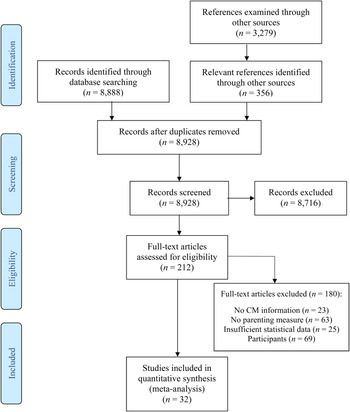
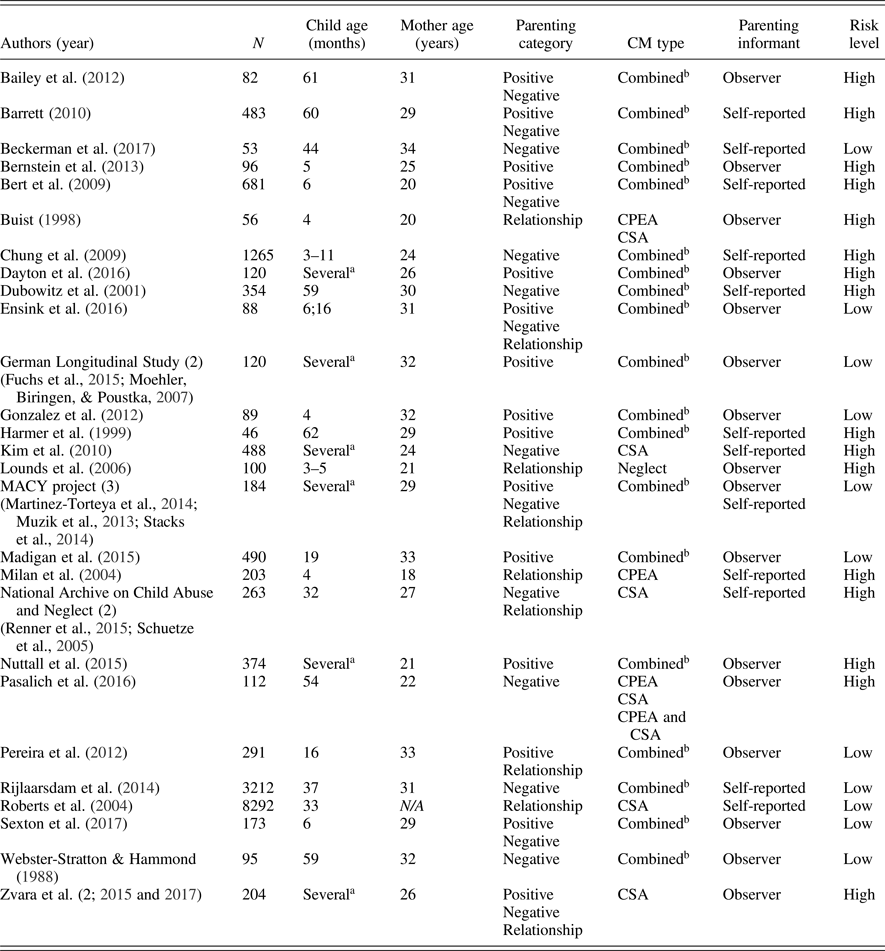
The literature review and reasons for exclusion are summarized in Figure 1. A total of 8,928 independent titles/abstracts were examined. Articles were excluded for the following reasons: no CM (including cases where mothers reported on a trauma that did not fit the present description), no parenting measure, different participant characteristics (i.e., took part in an intervention that focused on past trauma or on their parenting, were not parents, were represented in two different studies, or child age >6) or missing effect size index. In total, 32 articles describing 27 samples and presenting 41 different effect sizes were retained for analyses. These studies involved 17,932 participants, with sample sizes varying from 35 to 8,292 participants. Study characteristics are presented in Table 1.
Flow diagram for selection of articles

Studies included in meta-analysis

Note: CPEA, child physical or emotional abuse. CSA, child sexual abuse. aData gathered at more than one time.
bDifferent or general exposure to maltreatment.
Coding of studies and data extraction
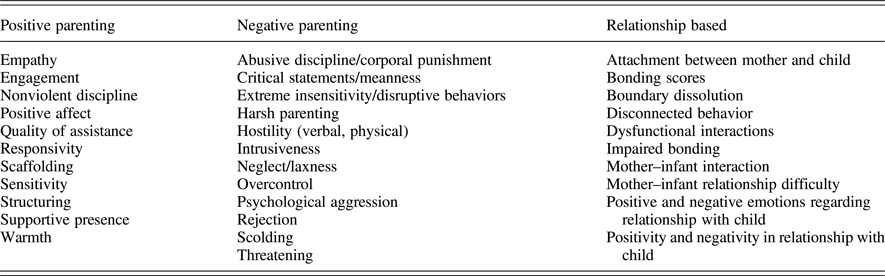
Studies meeting inclusion criteria were coded as a function of the characteristics of four items: (a) type of parenting behavior; (b) parenting measure informant; (c) type of CM; and (d) study characteristics, including sample size, psychosocial risk (absent or present), child and mother age at the time of the study, child gender, and publication year. A standard data extraction form was developed to extract all relevant information. Two aspects of parenting were coded. First, parenting measures were classified in three different categories, derived from the constructs assessed within studies: (a) positive parenting; (b) negative or potentially abusive parenting; or (c) relationship-based measures. The different constructs included in each category are summarized in Table 2. Second, parenting measures were coded as being either observational or maternal self-report. In addition, studies were coded for whether mothers reported being exposed to neglect, physical, emotional, and/or sexual abuse. When studies reported associations between different types of CM and parenting for the same individuals, an average effect size was calculated to avoid overrepresentation of participants in moderation analyses. In such cases, as well as in cases where global scores were used (e.g., a composite score for all types of CM exposure), CM was identified as “combined” (see Table 1).
Parenting aspects/behaviors in function of their category of belonging

A second coder reviewed 9 studies for interrater reliability (29%). There was 100% interrater agreement on the following variables: type of CM, parenting measure informant, psychosocial risk, child and mother age, and gender. Coders agreed on type of parenting 8 times out of 9, the resulting disagreement being resolved through consensus coding.
Statistical analyses
The meta-analysis was conducted using Comprehensive Meta-Analysis Version 3.0 (CMA; Borenstein, Hedges, Higgins, & Rothstein, Reference Borenstein, Hedges, Higgins and Rothstein2009). Studies reported on the association between CM and parenting through different indices. It was thus necessary to convert all of the effect sizes to a common index before comparing them with each other. An effect size (Pearson's r) was calculated for each sample. Pearson's r statistic was chosen due to the nature of the present research question as we are looking to document the association between two variables, rather than, for example, differences between groups or intervention effects. The conversion from different indices of effect size to Pearson's r is conducted with CMA.
Each sample was represented by a single mean effect size. If a sample was presented in more than one study, the most comprehensive presentation of that sample was kept for analysis. In an effort to report as much of the information as possible, when a sample presented data concerning more than one moderator, different effect sizes were calculated for use in moderator analyses. This was especially important when considering differences in parenting informant and type of parenting behavior, where several studies provided multiple effect sizes. In the two cases where samples were divided as a function of CM type (i.e., Buist, Reference Buist1998; Pasalich et al., Reference Pasalich, Cyr, Zheng, McMahon and Spieker2016), each subsample was considered independently for moderation analysis involving type of CM. In all other cases, a mean effect size was calculated. When running analyses, CMA transforms the correlation to Fisher's z scale and uses Fisher's z variance to yield summary effect and confidence intervals. Effect sizes are then weighted by the inverse of their variance, allowing for studies with larger sample sizes to be given greater weight, thus leading to more precise estimates. Finally, Fisher's z is reverted back to correlations for presentation and interpretation.
Specific attention had to be given to determine the valence of effect sizes linking CM to parenting category. With respect to positive parenting and relationship-based assessments of parenting, a negative valence indicated that greater levels of CM were inversely linked to indices of parenting quality. The same kind of association linking CM with negative, potentially abusive parenting would lead to a positive effect size, where exposure to CM is linked to more problematic parenting. To ensure that the direction of all effect sizes was coherently considered within the meta-analysis, CM-negative parenting effect sizes were inversed.
Tests of significance and analyses to assess the effects of various moderators were conducted using a random-effects model. The random-effects approach is more conservative than the fixed-effects approach and should be used when there is variability in study characteristics. Moreover, random effects provide for greater control for differences in sample sizes when estimating effect sizes (Borenstein, Hedges, Higgins, & Rothstein, Reference Borenstein, Hedges, Higgins and Rothstein2010).
Publication bias, outliers, and heterogeneity
The presence of a publication bias was assessed by employing the trim-and-fill procedure (Duval & Tweedie, Reference Duval and Tweedie2000). This procedure allows researchers to detect publication bias by using the mean effect estimate as a fixed point to test which studies with positive effect sizes have no mirror image counterparts with negative effect sizes and vice versa. When such asymmetry is observed, the procedure computes a corrected effect size obtained through an iterative process of imputation of the studies and their lacking counterparts. To test for the presence of outlier data, a Fisher's Z score was calculated for each study and then compared to the normal distribution (Z has to be less than –3.29 or greater than 3.29 to be considered an outlier; Tabachnik & Fidell, Reference Tabachnik and Fidell2007).
Two procedures were used to provide information about between-study heterogeneity. First, the Q statistic was used to test for the heterogeneity of effect sizes across studies. Heterogeneity of results was assumed if Q was significant at the p < .05 level. Second, the I 2 statistic was used to document the percentage estimate of the amount of total variability in effect size estimates that can be attributed to heterogeneity among the true effects (Huedo-Medina, Sánchez-Meca, Marín-Martínez, & Botella, Reference Huedo-Medina, Sánchez-Meca, Marín-Martínez and Botella2006).
Results
Main effect
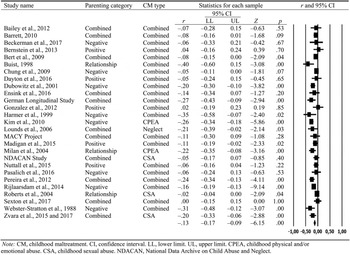
A small but significant association between CM and parenting emerged, r = –.13 (k = 27, p < .001, 95% confidence interval [CI] [–.17, –.09]). Effect size estimates for each study, confidence intervals, and forest plot are presented in Figure 2. The trim-and-fill procedure (Duval & Tweedie, Reference Duval and Tweedie2000) revealed a publication bias where two studies required adjustment, yielding a bias-adjusted effect size of r = –.12 (Q’ = 117.26, 95% CI [–0.16, –0.08]). No outliers were found. High heterogeneity in effect sizes was found between studies (Q’ = 111.67, p < .001. I 2 = 76.72%), and potential moderators were explored.
Forest plot of included studies

Moderator analyses
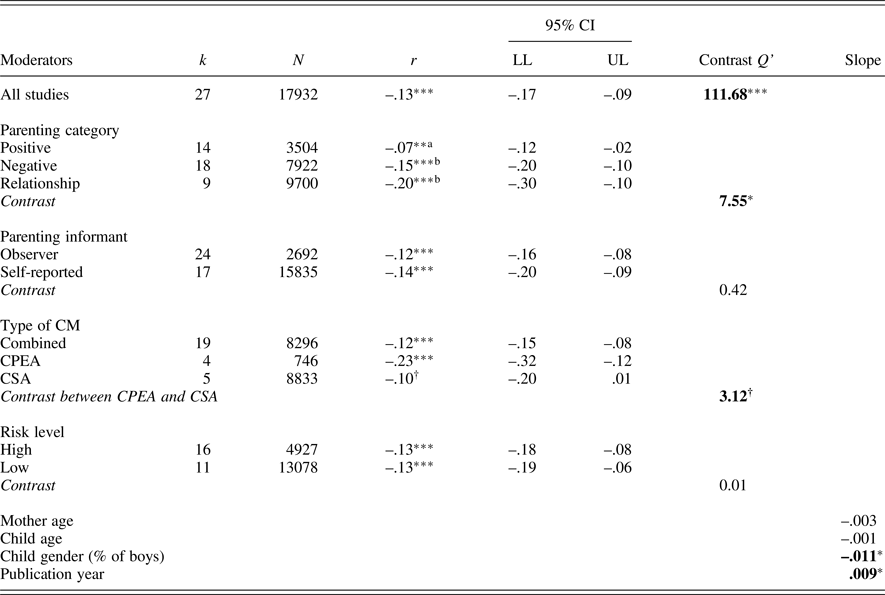
Moderator analyses are presented in Table 3.
Association between CM and parenting for all studies and as a function of moderators

Note: CI, confidence interval. LL, lower limit. UL, upper limit. CM, childhood maltreatment. CPEA, childhood physical and/or emotional abuse. CSA, childhood sexual abuse. aSignificantly different from. bAs a result of paired comparison. †p < .10. *p < .05. **p < .01. ***p < .001.
Parenting category
A significant difference emerged in the association between CM and parenting as a function of different parenting categories (Q’ = 7.55, p < .05). Although all three types of measures were significantly linked to CM, associations with positive measures (r = –.07, p < .01, k = 14) were weaker than with negative (r = –.15, p < .001, k =18; Q’ = 4.97, p < .05) and relationship-based measures (r = –.20, p < .001, k = 9; Q’ = 4.64, p < .05). Effect sizes for the link between CM and negative parenting and CM and relationship quality were not significantly different from each other (Q’ = 0.71, p = .40).
Type of maltreatment exposure
Only 10 studies reported on specific forms of CM with enough accuracy to allow for a moderator analysis to be performed, as many studies used generic measures of maltreatment that did not permit specific coding. Among these 10, only 1 reported on the association between child neglect and parenting, making it impossible to include this subgroup in the analysis. Table 3 reports on the CM–parenting association for general, combined measures of CM. As well, Table 3 reports effect sizes for studies that reported on specific experiences of emotional and/or physical abuse, as well as exposure to sexual abuse. Parenting was not statistically different as a function of the type of CM experiences, though a marginally significant tendency emerged (Q’ = 3.12, p < .10). The effect size for the experiences of emotional and/or physical abuse (r = –.23, p < .001, k = 4) was marginally greater than for exposure to sexual abuse (r = –.10, p < .10, k = 5).
Child gender
A meta-regression revealed that the CM–parenting association was greater for samples that had a higher percentage of boys (slope = –.01, p = .02). The greater the number of boys in a sample, the greater the effect size linking CM and parenting.
Publication year
The association between CM and parenting was also moderated by publication year, as shown by a meta-regression (slope = .009, p = .02), meaning that older studies reported stronger effect sizes than more recent ones.
Nonsignificant moderators
Parenting behavior informant, exposure to psychosocial risk, as well as maternal and child age did not significantly moderate the CM–parenting link.
Discussion
One of the major hypotheses linking parental antecedents of maltreatment and offspring development is that adults who experienced CM have more difficulty with their parenting behaviors and the quality of their interactions with their child. The purpose of this study was to synthesize research amassed to date that have examined the strength of this association when offspring were under the age of 6. Results reveal a weak but significant association (r = –.13) between CM and parenting behavior, suggesting partial support for the proposed hypothesis. Thus, exposure to maltreatment may be considered as a potential risk factor for parenting behavior. However, moderator analyses revealed that the strength of the CM to parenting behavior hypothesis is also influenced by sample and study characteristics.
It is critical to note that CM is one factor, among many, that predicts parenting behaviors and that our understanding of the role of CM depends on our ability to place it within a more global perspective of the developmental ecology. Other variables are involved that may directly or indirectly be linked to CM. For example, CM has been shown to be a risk factor for teenage motherhood (Madigan et al., Reference Madigan, Wade, Tarabulsy, Jenkins and Shouldice2014), and it is well documented that early motherhood is linked to problems in parenting (Tarabulsy et al., Reference Tarabulsy, Bernier, Provost, Maranda, Larose, Moss and Tessier2005). Likewise, it is possible that CM exposed parents experience relationship instability with their partner and that this may affect their ability to provide a stable home environment for their child (Nguyen, Karney, & Bradbury, Reference Nguyen, Karney and Bradbury2017). CM must be viewed as only one of the numerous characteristics that have a bearing on the quality of parenting behaviors, but its importance varies as a function of the degree to which it is embedded within the more global developmental ecology of the parent–child dyad. Among the more likely moderators and mediators of the impact of CM on parenting are problems in adjustment and mental health that may emerge as a result of such experiences (Berthelot et al., Reference Berthelot, Ensink, Bernazzani, Normandin, Luyten and Fonagy2015; Gallo, Munhoz, de Mola, & Murray, Reference Gallo, Munhoz, de Mola and Murray2018; Guyon-Harris, Ahlfs-Dunn, & Huth-Bocks, Reference Guyon-Harris, Ahlfs-Dunn and Huth-Bocks2017; Madigan et al., Reference Madigan, Bakermans-Kranenburg, van Ijzendoorn, Moran, Pederson and Benoit2007; Narang & Contreras, Reference Narang and Contreras2000). These and others should be the subject of further study in teasing out the role of CM on parenting.
Although CM significantly affects all three types of parenting outcomes, effect sizes are greater when parenting measures are relationship based or focus on more negative, potentially abusive behaviors. The idea that CM may be differentially linked to these categories of parenting behaviors has been suggested by attachment researchers who have shown that past experiences linked to abuse and trauma are associated with later manifestations of atypical or frightening parenting behaviors, observable in the context of play interactions or interactions that focus on emotional regulation (Madigan et al., Reference Madigan, Bakermans-Kranenburg, van Ijzendoorn, Moran, Pederson and Benoit2007; Main & Hesse, Reference Main, Hesse, Greenberg, Cicchetti and Cummings1990). It is also coherent with CM experiences being a manifestation of an important breakdown in secure-base, relationship experiences that are so crucial to emotion regulation and development in early childhood (Tarabulsy et al., Reference Tarabulsy, Pascuzzo, Moss, St.-Laurent, Bernier and Cyr2008). In this view, CM is considered as both a marker of potential difficulties and a relationship experience that modifies cognitions regarding different aspects of relationships, including those that involve parenting. The present results are viewed as providing support for basic postulates of attachment theory as to the disruptive influence of CM experiences as they are manifested in parenting behavior.
The CM–parenting behavior association was also moderated by child gender, with effect sizes being greater in samples with a higher proportion of males. There are two possible explanations for these findings. The first is that boys tend to show more externalized behavior early in their development, as early as the preschool years (Broidy et al., Reference Broidy, Nagin, Tremblay, Bates, Brame, Dodge and Vitaro2003; King et al., Reference King, Luk, Witkiewitz, Racz, McMahon and Wu2018), and this may test parents’ abilities more so than for girls. Support for this hypothesis comes from studies that have examined foster placement stability. Bernedo, Salas, García-Martín, & Fuentes (Reference Bernedo, Salas, Garcia-Martin and Fuentes2012) showed that boys had greater levels of externalized behavioral symptoms and more frequent foster placement instability compared to girls. It is also possible that mothers struggle with male offspring due to the greater likelihood of child maltreatment perpetrators being male. This dynamic creates an additional parenting challenge. The vast majority of parents in the current meta-analysis were mothers, and in the specific case of sexual abuse, mothers are more often abused by male adults and parental figures (US Department of Health and Human Services, 2012). It is possible that having to care for a male child may create more conflict for CM-exposed mothers. This hypothesis merits further investigation.
The association between CM and parenting was also moderated by publication year in that the effect size for the CM–parenting association has decreased over time. It is possible that methodological rigor in terms of CM assessment has improved over time. For example, among the six studies published before 2005, only one (Harmer, Sanderson, & Mertin, Reference Harmer, Sanderson and Mertin1999) used a validated questionnaire assessment of CM, whereas after 2005, the vast majority of studies used validated questionnaires or interviews. Moreover, in light of changes in popular notions regarding maltreatment, parents may not have considered that they had been exposed to maltreatment. It is possible that present definitions of maltreatment are more sensitive in asking about CM, and that the decreased stigmatization around discussing CM experiences has led to an increase in rates of disclosure. Finally, it is also possible that the enormous efforts made over the last half century have led to a better understanding of the deleterious impacts of child maltreatment and, accordingly, to the development and widespread implementation of policies and programs that help support its victims. This systemic change may have reduced the potential impact of CM on parenting and other life history outcomes.
Future directions
Meta-analytic procedures are helpful in drawing general conclusions regarding the validity of research hypotheses. However, several questions remain as a result of the current study. First, while developmentally appropriate, the present focus on the parenting of 0- to 6-year-olds excludes the possibility that CM experiences may affect parental behavior with older children. It is possible that as children gain greater competence and autonomy, they may elicit different kinds of parenting behaviors that are not presently considered.
Second, the high heterogeneity in results presently documented suggests that there are important variations across studies that may not be captured by the moderating analyses that were conducted. Although studies were categorized as a function of numerous factors that were included in moderating analyses, the heterogeneity remains present, suggesting important variations across studies in measures, populations studied, and designs used. Scholarly work in this area, critical for the elaboration of appropriate clinical intervention, will benefit from greater similarity in methods across studies.
Future research will also benefit by addressing a number of other issues that emerged within the present meta-analysis related to the description of maltreatment. There is much speculation in different studies as to how the type of maltreatment, duration, frequency, and intensity of CM experiences relate to development and later parenting (Ethier et al., Reference Ethier, Couture and Lacharite2004; Nolin & Ethier, Reference Nolin and Ethier2007; Putnam, Harris, & Putnam, Reference Putnam, Harris and Putnam2013). Certainly, in the present study, it was not possible to give this question as much attention as it was hoped. More scholarly work on the characteristics of maltreatment will help in understanding both the developmental response to adversity and the elaboration of appropriate clinical intervention (Buist, Reference Buist1998; Pasalich et al., Reference Pasalich, Cyr, Zheng, McMahon and Spieker2016).
Conclusion
In summary, the present meta-analytic results support the hypothesis that CM may affect parenting. The meta-analysis points to type of parenting behavior as a potential moderator, with effects being stronger for negative or potentially abusive behaviors and relationship-based assessments, in comparison to positive parenting behaviors. Moreover, a moderating effect for child gender was noted, also in line with findings suggesting that male offspring may test the limits of parenting resources more than females. Future research should focus on the characteristics of CM, such as severity, duration, and intensity, in order to clarify the role of adversity in developmental processes, enhancing our capacity to identify important targets for intervention.
Funding Statement
This research was supported by a scholarship from the Social Sciences and Humanities Research Council of Canada to the first author and a team grant from the Quebec Fund for Social and Cultural Research to the second author. The authors report no conflict of interest.
Appendix A
Search Terms
((maternal or mother or history or past)) AND (((((((((child or childhood)) AND (trauma or neglect or abuse or maltreatment or loss or incest)) AND (parenting or sensitiv* or emotional availability))))))