INTRODUCTION
There is growing interest in older individuals whose cognitive impairments, and cognitively driven functional impairments, appear to place them on the border between normal aging and dementia. In specialized memory disorders clinics, the majority of individuals with mild impairments are highly likely to progress over time to frank dementia and to have underlying neurodegenerative disorders such as Alzheimer’s disease (Morris, Reference Morris2006; Petersen, Roberts, Knopman, Boeve, Geda, & Ivnik, Reference Petersen, Roberts, Knopman, Boeve, Geda and Ivnik2009; Petersen, Reference Petersen2004; Winblad et al., Reference Winblad, Palmer, Kivipelto, Jelic, Fratiglioni and Wahlund2004). In contrast, all studies conducted in population-based community cohorts show that while mildly impaired individuals are indeed at elevated risk of progressing to dementia, substantial proportions remain mildly impaired or revert to normal (Busse, Hensel, Guhne, Angermeyer, & Riedel-Heller, Reference Busse, Hensel, Guhne, Angermeyer and Riedel-Heller2006; Ganguli, Dodge, Shen, & DeKosky, Reference Ganguli, Dodge, Shen and DeKosky2004; Larrieu et al., Reference Larrieu, Letenneur, Orgogozo, Fabrigoule, Amieva and Le Carret2002; Manly, Tang, Schupf, Stern, Vonsattel, & Mayeux, Reference Manly, Tang, Schupf, Stern, Vonsattel and Mayeux2008; Palmer, Wang, Backman, Winblad, & Fratiglioni, Reference Palmer, Wang, Backman, Winblad and Fratiglioni2002; Ritchie, Artero, & Touchon, Reference Ritchie, Artero and Touchon2001). This phenomenon is typically attributed to selection factors that result in different groups of individuals participating in different types of studies (Bruscoli & Lovestone, Reference Bruscoli and Lovestone2004). Those who seek services or volunteer for research in memory clinics are a relatively homogeneous group. Typically, they or their families are subjectively conscious of their cognitive changes, and they are relatively free of other health problems, compared with others within their own base population with the same objective level of impairment. In contrast, individuals whose cognitive and functional impairments are detected as part of community surveys are a larger, more heterogeneous group. In these persons, mild impairments may be attributable to a wider range of underlying factors and conditions, not limited to progressive brain disorders leading to dementia; some of these other conditions may be reversible or self-limiting. Thus, while extremely valuable information is obtained from samples of patients and study participants in clinical research settings, their inherent referral bias limits the generalizability of their data to the community at large.
A range of objective neuropsychological tests are used to measure global and domain-specific cognition in clinical and clinical research settings, and increasingly also in epidemiological, population-based studies. Cognitively driven functional impairments are frequently measured on the Clinical Dementia Rating Scale (CDR) (Hughes, Berg, Danziger, Coben, & Martin, Reference Hughes, Berg, Danziger, Coben and Martin1982; Morris, Reference Morris1993). The CDR is used primarily to rate patients presenting to clinical or clinical research programs. In these settings, the individuals being rated have typically referred themselves, or been referred by a family member, because of concerns about their cognitive functioning. In some studies, a CDR rating of 0.5, defined variously as questionable dementia or very mild dementia, is considered equivalent to the entity known as mild cognitive impairment (MCI) (Marquis et al., Reference Marquis, Moore, Howieson, Sexton, Payami and Kaye2002; Morris, Reference Morris2006; Petersen et al., Reference Petersen, Smith, Waring, Ivnik, Tangalos and Kokmen1999). The CDR has also been used in population-based epidemiologic studies, where study participants are not patients seeking help, may not express their concerns spontaneously. Rather, their subjective reports are solicited by researchers using standardized assessment protocols and performing CDR ratings based on these data. Validated in these settings, the CDR has been used to identify and estimate incidence and prevalence of not only dementia but also lesser degrees of cognitive impairment that affect everyday functioning (Ganguli, Dodge, Chen, Belle, & DeKosky, Reference Ganguli, Dodge, Chen, Belle and DeKosky2000; Ott et al., Reference Ott, Breteler, van Harskamp, Claus, van der Cammen and Grobbee1995; Saxton et al., Reference Saxton, Snitz, Lopez, Ives, Dunn and Fitzpatrick2009).
A further potential application of the CDR in both clinical and non-clinical settings is to determine change over time. There is considerable public health value in determining changes, and identifying predictors of these changes, at the population level. We have previously reported (Ganguli, Chang, Snitz, Saxton, Vaander Bilt, & Lee, Reference Ganguli, Chang, Snitz, Saxton, Vander Bilt and Lee2010) the prevalence of mild cognitive impairment in a cohort representative of the local population, using several criterion/ classification systems including the CDR. From the same cohort, we now report on changes over 1 year in CDR, and neuropsychological tests that predicted these changes. Because the CDR is rated independently of the neuropsychological tests, and the CDR scoring algorithm is weighted toward memory difficulties, we hypothesized that lower initial performance on objective measures of memory would predict changes in observed functional level as measured by the CDR. Neuropsychological measures that predict decline from mild impairment to dementia have been widely investigated (DeCarli et al., Reference DeCarli, Mungas, Harvey, Reed, Weiner and Chui2004; Fleisher et al., Reference Fleisher, Sowell, Taylor, Gamst, Petersen and Thal2007; Loewenstein, Acevedo, Agron, & Duara, Reference Loewenstein, Acevedo, Agron and Duara2007; Loewenstein, Acevedo, Small, Agron, Crocco, & Duara, Reference Loewenstein, Acevedo, Small, Agron, Crocco and Duara2009; Tabert et al., Reference Tabert, Manly, Liu, Pelton, Rosenblum and Jacobs2006) and a few studies have identified predictors of new onset mild impairment (Marquis et al., Reference Marquis, Moore, Howieson, Sexton, Payami and Kaye2002) or dementia (Grober, Hall, Lipton, Zonderman, Resnick, & Kawas, Reference Grober, Hall, Lipton, Zonderman, Resnick and Kawas2008; Howieson et al., Reference Howieson, Carlson, Moore, Wasserman, Abendroth and Payne-Murphy2008; Iwasa et al., Reference Iwasa, Gondo, Yoshida, Kwon, Inagaki and Kawaai2008; Kluger, Ferris, Golomb, Mittelman, & Reisberg, Reference Kluger, Ferris, Golomb, Mittelman and Reisberg1999) in previously normal individuals. Only a few previous studies have examined cognitive variables that predict future improvement, measured by reversion to normal from MCI as classified using neuropsychological, subjective, and functional criteria (Loewenstein et al., Reference Loewenstein, Acevedo, Agron and Duara2007, Reference Loewenstein, Acevedo, Small, Agron, Crocco and Duara2009; Manly et al., Reference Manly, Tang, Schupf, Stern, Vonsattel and Mayeux2008).
METHOD
Study Area, Sampling, and Recruitment
The study cohort named the Monongahela-Youghiogheny Healthy Aging Team (MYHAT) was an age-stratified random sample of the population aged 65+ years, drawn from the publicly available voter registration list in a small-town region of southwestern Pennsylvania, in the United States. Community outreach, recruitment, and assessment procedures were approved by the University of Pittsburgh Institutional Review Board for protection of human subjects. Additional details have been reported previously (Ganguli, Chang, et al., Reference Ganguli, Chang, Snitz, Saxton, Vander Bilt and Lee2010; Ganguli, Snitz, Lee, Vander Bilt, Saxton, & Chang, Reference Ganguli, Snitz, Lee, Vander Bilt, Saxton and Chang2010; Ganguli, Snitz, Vander Bilt, Chang, & Reference Ganguli, Snitz, Vander Bilt and Chang2009). Recruitment criteria were (a) age 65 years or older, (b) living within the selected area, (c) not already in long-term care institutions. Individuals were considered ineligible if they (d) were too ill to participate, (e) had severe vision impairment, (f) had severe hearing impairment, or (g) were decisionally incapacitated. Over the approximately 2-year recruitment period, a total of 2036 individuals were recruited.
Assessment (Overview)
A single-stage assessment (Prince, Reference Prince2000) was used to avoid delays and potentially non-random attrition between screening and definitive assessment stages (Ganguli et al., Reference Ganguli, Snitz, Vander Bilt and Chang2009). The Mini-Mental State Examination (MMSE) (Folstein, Folstein, & McHugh, Reference Folstein, Folstein and McHugh1975) was administered and scored on the spot, applying a standard correction for age and education (Mungas, Marshall, Weldon, Haan, & Reed, Reference Mungas, Marshall, Weldon, Haan and Reed1996). Fifty-four individuals (2.7%) scoring <21 /30 (age-education corrected) were classified as having moderate to severe cognitive impairment and therefore unsuited to a study of mild impairment; those individuals were not assessed further. The remaining 1982 participants, who scored ≥21 on the age-education corrected MMSE, were classified as having normal or mildly impaired cognition. They proceeded to the full assessment, which included the neuropsychological assessment briefly described below. Following the full in-home assessment, individuals were contacted by telephone every 3 months to minimize loss to follow-up, and invited to undergo a repeat assessment at home 1 year later.
Neuropsychological Assessment
Cognitive functioning was assessed by the following test battery, categorized here according to the principal cognitive domain tapped by the tests.
Attention/Processing Speed: Trail Making Test A (Reitan, Reference Reitan1955), Digit Span Forward (Wechsler, Reference Wechsler1997)
Executive Function: Trail Making Test B (Reitan, Reference Reitan1955), clock drawing (Freedman, Leach, Kaplan, Winocur, Shulman, & Delis, Reference Freedman, Leach, Kaplan, Winocur, Shulman and Delis1994), verbal fluency for initial letters P&S (Benton & Hamsher, Reference Benton and Hamsher1989)
Language: Boston Naming Test (Kaplan, Goodglass, & Weintraub, Reference Kaplan, Goodglass and Weintraub1978), verbal fluency for categories (animals) (Benton & Hamsher, Reference Benton and Hamsher1989), Indiana University (IU) Token Test (Snitz et al., Reference Snitz, Unverzagt, Chang, Vander Bilt, Gao and Saxton2009; Unverzagt, Farlow, & Hendrie, Reference Unverzagt, Farlow and Hendrie1999)
Memory: WMS-R Logical Memory (immediate and delayed recall) (Wechsler, Reference Wechsler1987), WMS-R Visual Reproduction (immediate and delayed recall) (Wechsler, Reference Wechsler1987), 3-trial Fuld Object Memory Evaluation (OME) with Semantic Interference (Fuld, Reference Fuld1981; Loewenstein et al., Reference Loewenstein, Acevedo, Schram, Ownby, White and Mogosky2003; Loewenstein, Acevedo, Luis, Crum, Barker, & Duara, Reference Loewenstein, Acevedo, Luis, Crum, Barker and Duara2004; Snitz et al., Reference Snitz, Loewenstein, Chang, Lee, Vander Bilt and Saxton2010)
Visuospatial Function: WAIS-III-Block Design (Wechsler, Reference Wechsler1997)
Population-based norms on these tests from the MYHAT cohort free of dementia have been previously published (Ganguli, Snitz, et al., Reference Snitz, Loewenstein, Chang, Lee, Vander Bilt and Saxton2010) and are also available on our study Web site (http://www.wpic.pitt.edu/research/dementia_epidemiology/MYHAT/MYHATHomePage.htm).
In addition, the Wide Range Achievement Test (WRAT-3) (Wilkinson, Reference Wilkinson1993; Manly, Jacobs, Touradji, Small, & Stern, Reference Manly, Jacobs, Touradji, Small and Stern2002) was also administered to participants at baseline as a measure of premorbid reading level.
Clinical Dementia Rating
Trained interviewers rated participants on the CDR scale (Morris, Reference Morris1993) after obtaining online CDR training and certification via the Washington University Alzheimer’s Disease Research Center Web site (Washington University in St. Louis, 2006). The rating was based on an assessment protocol composed of standardized questions, as well as raters’ observation, regarding the participant’s daily functioning in the six areas of memory, orientation, judgment, home and hobbies, community affairs, and personal care. In this population-based sample, the majority of normal or only mildly impaired older adults provided their own self-report information, that is, did not have surrogate informants. The CDR assessment is not based on neuropsychological test performance, although the same interviewer performed the neuropsychological testing and later the CDR rating on each participant. The CDR rating for each participant was finalized by consensus after discussion between two or more interviewers of the functional assessment, ignoring the neuropsychological data, but determining that the reported or observed functional impairments were attributable to cognitive difficulties, as opposed to, for example, sensory or motor impairments. Each of the six areas is rated on a scale of 0 through 0.5, 1, 2, and 3, and a standard algorithm is used to generate a summary CDR rating of 0 (no dementia), 0.5 (variously designated as mild cognitive impairment, possible/questionable dementia, or very mild dementia), 1.0 (mild dementia), 2.0 (moderate dementia), and 3.0 (severe dementia) (Hughes et al., Reference Hughes, Berg, Danziger, Coben and Martin1982; Morris, Reference Morris1993). As the scoring algorithm for the CDR global summary score is weighted in favor of memory, the summary score does not capture the full range of dysfunction represented by the “box scores” that represent the six areas of functioning. The CDR Sum of Boxes (CDR-SoB) metric, which is the aggregate of all six box scores, is thus a better indicator of the spread of difficulties experienced by the participant than the summary CDR.
Statistical Analyses
Baseline cognitive test scores and demographic characteristics were examined in pairwise comparisons between (a) participants with baseline CDR = 0.5 who remained at CDR = 0.5 at 1-year follow-up, versus those who improved to CDR = 0 at follow-up; and (b) participants with baseline CDR = 0 who remained at CDR = 0 during follow up, versus those who worsened to CDR = 0.5 at follow-up. Given the skewness of the neuropsychological data in this population, the non-parametric Wilcoxon Rank Sum Test was used to identify statistically significant differences in test scores between groups; the χ2 test was used for categorical demographic characteristics; the effect of age was also tested by the Cochran-Armitage test for trend. In post hoc analyses, baseline CDR-SoB was also examined in relation to CDR change, using the Cochran-Armitage trend test.
Univariable logistic regression models were fit for each neuropsychological test, first unadjusted and then adjusting for age, sex, and education, to examine the odds of CDR improvement from CDR = 0.5, and the odds of CDR worsening from CDR = 0, with stable CDR as the reference group in each case. Finally, we explored the independent contributions that each individual neuropsychological measure makes to predicting CDR change, in the presence of the other measures. Stepwise multiple logistic regression models were fit for CDR improvement and CDR worsening, potentially including as independent variables all neuropsychological tests that were significant in the univariable analyses. Age, sex, and education were included as covariates. The entering and removing probabilities in the stepwise regression were 0.15 and 0.2, respectively. After fitting the stepwise model, we examined the selected neuropsychological measures for multicollinearity, using the Variance Inflation Factor (VIF) for each test. All statistical analyses were performed using SAS v. 9.2 (SAS Institute, 2002).
RESULTS
Sample Size and Demographics
At study entry (baseline), we recruited 2036 individuals, of whom 54 (2.7%) had moderate to severe cognitive impairment (age-education corrected MMSE <21), leaving 1982 with normal or mildly impaired cognition to undergo the full assessment. These 1982 participants had mean (SD) baseline age of 77.6 (7.4) years with a range of 65 to 99 years. With regard to education, 13.8%, 45.1%, and 41.1% had completed less than high school, high school, and more than high school. Women comprised 61.1%, while 94.8% of the cohort was Caucasian.
Attrition between baseline recruitment and 1-year follow-up was 13.0%. Those not assessed at this follow-up included 59 who died, 26 who relocated outside the study area 33 who were too ill to continue participating, 107 who chose to drop out of the study, 31 who were untraceable (e.g., telephone disconnected, no forwarding information, no information obtainable from contact person), and 2 in other situations. A further 27 who skipped the first annual follow-up have remained in the study for future assessments. Thus, of the original 1982 individuals, 1697 (85.6%) underwent the repeat assessment a year later; of these, 15 individuals who had CDR ≥ 1 at baseline are excluded from these analyses. Among the remaining 1682 participants, the mean baseline age of 77.4 (7.3) years, proportion of women (62.3%), Caucasians (95.0%), and those at the three educational levels (13.1%, 45.0%, and 41.9%) were not different to those of the original cohort of 1982 as detailed above. Because this report is focused on neuropsychological test performance at baseline, these analyses are restricted to the 1432 participants with complete data on all tests and CDR 0 or 0.5 at baseline. These individuals had mean (SD) age 76.9 (7.1) years, 62.3% were women, 96.4% were Caucasians, and 11.4%, 45.7%, and 42.9% of them had less than high school, high school, and more than high school education, respectively.
Baseline CDR and CDR Sum-of-Boxes
At baseline, among the 1432 participants included in these analyses, 1096 obtained CDR summary scores of 0 (no dementia), with 336 being rated as CDR = 0.5 (very mild impairment). Of those with CDR = 0, 1046 (95.4%) had CDR_SoB of 0; 48 (4.4%) had CDR_SoB of 0.5; and 2 (0.2%) had CDR_SoB = 1. Among those with CDR = 0.5 at baseline, 203 (60.4%), 94 (28.0%), 25 (7.4%), and 14 (4.2%) had CDR_SoB of 0.5, 1, 1.5, and ≥2.
CDR Improvement
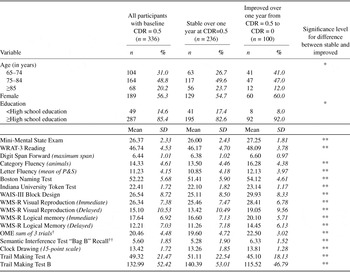
Of the 336 individuals with baseline summary CDR = 0.5 at baseline, 236 (70.2%) remained stable at CDR = 0.5, while 100 (29.8%) improved to CDR = 0 (Table 1). In the subgroup with baseline CDR_SoB of 0.5, 1, 1.5, and ≥2, the n(%) with improving CDR were 75 (36.9%), 19 (20.2%), 5 (20.0%), and 1 (7.1%), that is, lower baseline CDR_SoB was associated with greater probability of improvement, a significant trend (Cochrane-Armitage p < .05).
Demographic characteristics and mean (SD) baseline neuropsychological test scores among participants with Clinical Dementia Rating (CDR) = 0.5 at baseline

* p < .05 based on the chi-square test for education, gender, and age; age was also tested by the Cochran-Armitage test for trend (p < .05).
** p < .05 based on the Wilcoxon Rank Sum test.
† Fuld Object Memory Evaluation (OME), sum of 3 learning trials.
†† OME with Semantic Interference recall of second list after pro-active interference.
CDR Worsening
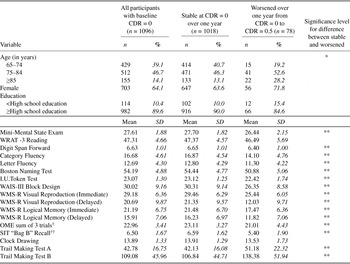
Of the 1096 with baseline summary CDR = 0, 1018 (92.9%) remained at CDR = 0 at 1-year follow-up, while 78 (7.1%) worsened to CDR = 0.5 (Table 2). In the subgroup with baseline CDR_SoB of 0, 64 (6.1%) had CDR worsening; of the 48 with CDR_SoB of 0.5; 14 (29.2%) had CDR worsening, while neither of the 2 participants with CDR_SoB of 1 showed CDR worsening. As only 3 individuals with summary CDR = 0.5 worsened to CDR ≥ 1, they are excluded from these analyses.
Demographic characteristics and mean (SD) baseline neuropsychological test scores among participants with CDR = 0 at baseline

* p < .05 based on the chi-square test for education, gender, and age; age was also tested by the Cochran-Armitage test for trend (p < .05).
** p < .05 based on the Wilcoxon Rank Sum test.
† Fuld Object Memory Evaluation (OME), sum of 3 learning trials.
†† OME with Semantic Interference recall of second list after pro-active interference.
Neuropsychological Tests Associated With Improvement Versus Stability at CDR = 0.5
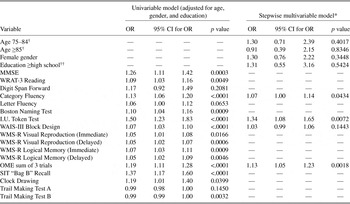
Pairwise comparisons of mean (SD) baseline cognitive test scores (Table 1) showed significant differences between those who remained at CDR = 0.5 and those who improved from CDR = 0.5 to CDR = 0. Among those who improved, higher baseline scores were seen on all tests except Digit Span. Demographic characteristics of the stable and improved groups (Table 1) indicate that younger age and higher education were associated with global CDR improvement. In unadjusted logistic regression models examining each test individually, all tests except Digit Span were significantly associated with CDR improvement (data not shown); adjusting for age, sex, and education, all tests except Digit Span, Letter Fluency, and Trailmaking Test A were significantly associated with CDR improvement (Table 3). In the stepwise multiple logistic regression combining all tests and adjusting for demographics, only Category Fluency (Animals), the IU Token Test, and the sum of three learning trials on Object Memory Evaluation test, remained significantly associated with subsequent CDR improvement from 0.5 to 0. Model fit was good, with area under the ROC curve (AUC) of 0.76.
Baseline measures associated with improvement from CDR = 0.5 at baseline to CDR = 0 at follow-up

Note
Logistic regression models based on participants with CDR = 0.5 at baseline.
* During the stepwise procedure, age, gender, and education were always included. Area under the ROC curve = 0.76 in final stepwise multivariable model.
† The two older groups each compared to the 65–74 group (the reference group).
†† ≥ High school education compared to < high school education (the reference group).
Neuropsychological Tests Associated With Worsening Versus Stability at CDR = 0
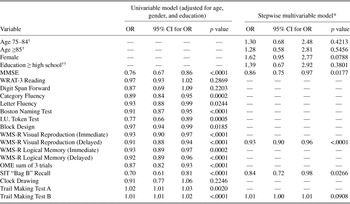
Pairwise comparisons of mean (SD) baseline neuropsychological test scores (Table 2) also showed significant differences between those who remained at CDR = 0 and those who progressed to CDR = 0.5; among those who worsened, lower baseline scores were seen on all tests except the WRAT-3 and Clock Drawing. Demographic characteristics of the stable and worsened groups (Table 2) showed that older age was associated with CDR worsening. In unadjusted logistic regression models examining each test individually, all tests except the WRAT-3 were significantly associated with CDR worsening (data not shown). Logistic regression models (Table 4) examining each test individually, and adjusting for age, sex, and education, showed CDR worsening to be significantly associated with lower baseline scores on all tests except WRAT-3, Digit Span, and Clock Drawing. In the stepwise multiple logistic regression combining all tests and adjusting for demographics, only baseline MMSE, Visual Reproduction (Delayed), and recall susceptible to proactive interference (“Bag B” recall on the Semantic Interference Test) (Loewenstein et al., Reference Loewenstein, Acevedo, Schram, Ownby, White and Mogosky2003; Snitz et al., Reference Snitz, Loewenstein, Chang, Lee, Vander Bilt and Saxton2010) at baseline remained significantly and independently associated with subsequent CDR worsening from 0 to 0.5. The model had good fit (AUC = 0.78).
Baseline measures associated with worsening from CDR = 0 at baseline to CDR = 0.5 at follow-up

Note
Logistic Regression Models based on participants with CDR = 0 at baseline.
* During the stepwise procedure, age, gender, and education were always included. Area under the ROC curve = 0.78 in final stepwise multivariable model.
† The two older groups each compared to the 65–74 group (the reference group).
†† ≥ High school education compared to < high school education (the reference group).
Collinearity
For both CDR improvement (Table 3) and CDR worsening (Table 4), the multivariable model identified the neuropsychological measures that independently predicted the outcomes after adjustment for the other measures. None of the variables in the final stepwise models had VIF values above 2.5, that is, there was no multicollinearity within these models.
DISCUSSION
The clinical and prognostic significance of minimal cognitive and functional difficulties can be difficult to ascertain in older adults. In specialty health care and research settings, the state represented by a Clinical Dementia Rating of 0.5, when assessed by trained clinicians exercising clinical judgment, has been considered equivalent to an entity referred to as mild cognitive impairment (MCI), and even to early Alzheimer’s disease (Morris, Reference Morris2006). It is also a widely used measure of functional status in longitudinal studies of cognitive decline among elderly subjects in clinical and epidemiological studies, and is rated without reference to objective cognitive deficits. For these reasons, we chose CDR as the outcome measure for our current study examining neuropsychological predictors of functional change, although we recognize it was never intended as a fine-grained measure of everyday functioning. Note that, as used here, the CDR does not represent a disease severity rating or any specific etiological entity. MCI is characterized by both subjective complaints and objectively measured deficits in the presence of minimal functional impairment, and typically described as a state intermediate or transitional between normal aging and dementia (Petersen, Reference Petersen2004; Winblad et al., Reference Winblad, Palmer, Kivipelto, Jelic, Fratiglioni and Wahlund2004). However, the terms “intermediate” and “transitional” are not synonymous or interchangeable, that is, not everyone with mild impairment is on the road to dementia. In specialty clinical research settings, individuals with MCI (especially of the amnestic variety) or CDR = 0.5 do have an overwhelming probability of progressing to dementia of the Alzheimer’s type (Morris, Reference Morris2006; Petersen et al., Reference Petersen, Roberts, Knopman, Boeve, Geda and Ivnik2009). Yet, in every population study that has been reported worldwide, substantial proportions of older adults in the community meet the same criteria but remain stable at the mildly impaired level, or even improve and revert to normal. A recent meta-analysis of 41 cohort studies concluded that only 5–10% of individuals with MCI will progress to dementia even after 10 years of follow-up (Mitchell & Shiri-Feshki, Reference Mitchell and Shiri-Feshki2009). The reasons for the discrepancy between results of clinical and population studies may be myriad but must surely include referral/selection factors (Bruscoli & Lovestone, Reference Bruscoli and Lovestone2004). A study comparing individuals with MCI recruited from clinic and community settings in the same area found that they progressed to dementia at annual rates of 13% and 2%, respectively, with recruitment source itself carrying an over three-fold risk elevation of incident dementia. Baseline functional level was the only variable that accounted for this difference (Farias, Mungas, Reed, Harvey, & DeCarli, Reference Farias, Mungas, Reed, Harvey and DeCarli2009). Older adults who seek services for cognitive difficulties, and particularly those who volunteer for clinical research programs, are presumably those who feel more distressed or functionally impaired by these difficulties than those who do not present themselves at these facilities. Furthermore, participation in many clinical studies of cognitive impairment requires the absence of substantial medical comorbidity and the availability of a reliable surrogate (informant). In contrast, individuals are included in population studies regardless of whether they have spontaneous complaints, comorbidity, or informants. By definition, they are more representative of the community from which they are drawn than are participants in typical clinical studies. Memory clinics have the advantage of applying in-depth clinical and laboratory assessments and expert individualized clinical judgment to every case. Population studies have the advantages of standardized assessments by trained but not expert examiners, large numbers, and enhanced generalizability. Thus, the two broad genres of studies provide essential complements to each other.
In a large, population-based cohort of older adults, drawn randomly from the local communities, we performed detailed neuropsychological assessments as well as clinical dementia ratings at study entry and a year later. The CDR assesses cognitively driven everyday functioning. The majority of study participants remained stable at either CDR = 0 or CDR = 0.5 over 1 year. Of those with no functional impairment (CDR = 0) at baseline, 7% had developed mild impairment a year later. In epidemiological terms, this might be considered analogous to “incidence” of mild impairment, although we emphasize that we do not consider CDR = 0.5 in this setting to be equivalent to the clinical concept of MCI. Nearly all the neuropsychological test measures at the initial assessment were lower in those participants whose everyday functioning subsequently worsened, compared with the stable group. However, only tests of global cognitive function, of delayed visual memory, and of recall susceptible to proactive semantic interference, were significantly and independently associated with worsening, after adjusting for demographics and all other tests. This finding was as hypothesized given that the CDR is weighted toward memory. Some tests were univariably associated with change but lost statistical significance in the final model because they were collinear with other tests; however, they still robustly predicted CDR worsening on their own.
On the other hand, nearly 30% of individuals with mild impairment at baseline appeared normal a year later, a figure consistent with earlier population studies (Ganguli et al., Reference Ganguli, Dodge, Shen and DeKosky2004; Larrieu et al., Reference Larrieu, Letenneur, Orgogozo, Fabrigoule, Amieva and Le Carret2002; Manly et al., Reference Manly, Tang, Schupf, Stern, Vonsattel and Mayeux2008; Palmer et al., Reference Palmer, Wang, Backman, Winblad and Fratiglioni2002; Ritchie et al., Reference Ritchie, Artero and Touchon2001). This phenomenon of reversion to normal is broadly attributed to the heterogeneity of mild impairment outside treatment settings but its mechanism remains a matter for speculation. It might represent true improvement in the condition underlying the original impairment, if the condition was transient and self-limiting, or reversed by treatment. Alternatively, it might represent random fluctuation or instability of measurement, which should rectify itself with longer follow-up. To our knowledge, there have been few previous reports of cognitive or other factors which might distinguish between those who will remain mildly impaired and those who will demonstrate the apparent improvement. In one earlier population study, individuals with impairment in only a single cognitive domain at baseline were the most likely to revert to normal at follow-up (Manly et al., Reference Manly, Tang, Schupf, Stern, Vonsattel and Mayeux2008). In a study of volunteers in a memory research program, individuals who were classified as MCI on the basis of only one test in a given domain, and had higher test scores at baseline, were those most likely to be normal at follow-up (Loewenstein et al., Reference Loewenstein, Acevedo, Small, Agron, Crocco and Duara2009). In our cohort, better initial performance on a list learning measure and two language tests independently predicted subsequent improvement.
Our findings help to reinforce and consolidate several points. We have previously shown in this population that, at baseline, cognitive test scores were significantly lower in individuals with concomitant CDR = 0.5 than in those with CDR = 0 (Ganguli, Snitz, Lee, Vander Bilt, Saxton, & Chang, Reference Ganguli, Chang, Snitz, Saxton, Vander Bilt and Lee2010). We now show that lower test performance at baseline also independently predicts subsequent change in CDR, in the expected direction. Because the CDR rates impairments in everyday functioning without reference to neuropsychological test data, the two measures are independent and their associations provide some cross-validation of each other, while also suggesting that objective tests have demonstrable predictive value with regard to functional change.
Furthermore, by demonstrating these findings in a population-based cohort, using trained interviewers who are not expert clinicians but use a standardized assessment protocol, we have shown that these associations are potentially generalizable from the clinical research setting to the community at large. Our findings also show these standard measurement tools and ratings to be robust in well-trained non-expert hands. This is not a trivial issue given the prohibitive costs of providing participants in population studies with the type of assessments conducted by highly qualified and experienced clinicians in tertiary care and research settings.
An unbiased population-based sample can at best be representative of the population from which it was drawn. Consequently, its results are at best generalizable to other similar populations. Our sample is representative of the region’s older population, but over 10% had completed less than high school education, and only 5% were from ethnic U.S. minorities. Thus, our results are likely not completely generalizable to populations with substantially lesser education or substantially greater racial/ethnic diversity, even within the United States. For example, literacy or reading level (as measured by the WRAT-3) might be more informative in such a cohort than it was in ours (Manly et al., Reference Manly, Jacobs, Touradji, Small and Stern2002). Hence, replication is needed in a variety of population samples.
Some limitations are inherent in the population study design. The large cohort, its accrual by random sampling from the voter registration list, and the conduct of most of the assessments in participants’ homes, are all assets that enhance the generalizability of its results. The same characteristics limit the depth of the assessments that can be conducted and render it impractical to have expert clinicians perform them. Most cognitively intact or very mildly impaired older adults in the community, who are not seeking help for cognitive concerns, do not have their everyday functioning closely monitored by others who can serve as reliable informants. Thus, in our study, assessments were based on participants’ self-reports, objective measurements, and the observations of trained raters. Our interviewers were trained to complete the CDR ratings based on these data, and after review and discussion of these with other interviewers, ignoring the neuropsychological data. Because the entire assessment of each participant was done by the same interviewer, the possibility remains that, at some level, the CDR could not be entirely independent of the neuropsychological data. We would point out, however, that the current analyses examined the relationship between individual tests at baseline and change in CDR over 1 year. It is unlikely that an interviewer rating the CDR at follow-up could remember and be influenced by the participant’s neuropsychological test performance or CDR rating in the previous year, in a cohort this large. Finally, this report is focused on neuropsychological predictors, and does not examine other variables such as depression (Teng, Lu, & Cummings, Reference Teng, Lu and Cummings2007), anxiety (Palmer, Berger, Monastero, Winblad, Backman, & Fratiglioni, Reference Palmer, Berger, Monastero, Winblad, Backman and Fratiglioni2007), vascular risk factors (Solfrizzi et al., Reference Solfrizzi, Panza, Colacicco, D’Introno, Capurso and Torres2004), or brain atrophy (Jack et al., Reference Jack, Shiung, Weigand, O’Brien, Gunter and Boeve2005), all of which have previously been reported as predictors of progression from mild impairment to dementia. Over a single year of follow-up, most normal or very mildly impaired individuals do not show substantial changes in functioning, and some improvements and decrements in the short term might represent random fluctuations. Continued follow-up with repeated assessments will be necessary to tease out these patterns and to determine their clinical significance.
ACKNOWLEDGMENTS
The authors gratefully acknowledge the valuable input of Frederick Unverzagt, PhD, the valiant efforts of the MYHAT research team, and the cooperation of the entire MYHAT cohort of senior citizens.