

1. Introduction
Actuaries are often criticised for creating confusion and over-complicating the issue of defined benefit pension valuation (Carne, Reference Carne2004; Hatchett et al., Reference Hatchett, Bowie and Forrester2010). Such criticism is understandable, given the numerous types of valuation and the lack of consensus within the actuarial profession as to the “correct” method of valuing pension scheme obligations.
At the same time, however, actuaries have a difficult challenge. For every combination of stakeholder and required decision, the actuary needs to convey all salient information in a convenient and accessible manner. Stakeholders often have different expectations and different requirements. Indeed, the concept that there could be a “correct” number applied to something which is inherently uncertain is a barrier to understanding. The debate here often focuses on a single ‘number’ at a single point in time, not on what the number is trying to represent, which is the valuation of a series of future cash flows.
The debate can also polarise views, for instance, on whether or not a certain portfolio of assets will be sufficient to meet a series of future benefit cash flows. The reality is that actuaries do not know for certain the answer to this question; typically there is a chance the assets will be sufficient and a chance they will not. Assessing that chance, considering the consequences of failure, and considering alternative options are valuable risk management inputs that actuaries and others can provide.
The numerous types of valuation reflect the various purposes for which they are being prepared. For example, different valuations often exist for company accounting, corporate valuation, funding valuation, technical provisions, buyout valuation, and the Pensions Protection Fund valuation to name a few. Actuaries, sponsors of defined benefit schemes, trustees of these schemes and other users of actuarial information are not always clear about the purpose or the limitations of these different actuarial measurements.
1.1 Purpose and perspectives of valuation
Pension liabilities (i.e. the obligation to pay a group of pension scheme members and their dependents benefits under a scheme) should be properly managed. There is little doubt that it is hard to measure these liabilities due to: the long timescale over which such obligations arise; the range of uncertain variables to which the payments are co-dependent; and, perhaps most importantly, the different perspectives of the stakeholders who might be interested in the measurement.
Different stakeholders require different information and their needs are not always consistent or compatible. For example, while a best estimate of future mortality is required for company accounting, prudent principles must be used in setting an estimate for funding (The Occupational Pension Schemes (Scheme Funding) Regulations, 2005, 5(4)(c)). And, as the recent debate on the Pensions Technical Actuarial Standard showed, it is not even clear that “best estimate” has a common meaning to actuaries. Furthermore, the desire to concoct a single estimate, of whatever hue, can distract from the fact that future mortality is uncertain. Stakeholders need to understand the impact of that uncertainty on their objectives, whether that be delivering the benefits, maximising shareholder value, or something else.
The authors argue that considerable advantages can be gained by stakeholders agreeing common management strategies for the scheme. These strategies should be focussed on real world actions that stakeholders can take, not the calculation methodology underlying the measurement estimate. Whilst each stakeholder may have a different perspective, there are often sufficient areas of agreement, such that an overall strategy can be formed around a common goal. From the basis of agreed objectives, the genuine differences between stakeholders’ perspectives and measurement techniques may be more easily understood.
1.2 Measurement
Once a common management strategy is agreed between stakeholders, the purpose of measurement is clearer. The purpose of measurement is often to help the stakeholders meet the agreed management objective. So whether a particular measurement approach gives a higher or lower number is in one sense academic; a better question is whether a measurement approach helps the scheme managers make better informed decisions.
Whilst a common management strategy can help all stakeholders reach agreement, areas of difference will still exist. A sensible framework should allow for these differences, and enable those differences to be articulated clearly. In particular, the authors’ proposed framework focuses on the key areas of distinction, namely:
• the scheme's sponsor contributions;
• other funding support that strengthens the sponsor's covenant;
• the benefit promise;
• investment strategy;
• risk appetite; and
• the time horizon over which the above evolve.
In a recent alternative framework, the recent paper by the Discount Rate Steering Committee (Cowling et al., Reference Cowling, Frankland, Hails, Kemp, Loseby, Orr and Smith2011) proposed that discount rate calculations could be broadly split between matching calculations and budgeting calculations, although in their final update (2011) they noted that “in limited circumstances, a blend of matching and budgeting can be relevant.” In addition, the Discount Rate Steering Committee (Cowling et al., Reference Cowling, Frankland, Hails, Kemp, Loseby, Orr and Smith2011) also published in appendix 2, a table setting out how their recommendations, including the budgeting/matching framework, corresponded to the Technical Actuarial Standards published by the Board for Actuarial Standards. This paper develops the existing research beyond discount rates.
1.3 Flight paths
As defined benefit pension schemes close to new members and to future accrual (The Pension Regulator's Purple Book, 2010), the focus of sponsors and trustees tends to change. Many traditional valuation methods focused on the ongoing nature of schemes, whereas the recent trend has been towards an end game. The change in employer debt regulations on June 11th 2003, together with the mass extinction of discretionary increases, has also hardened the obligations reinforcing this trend. This focus on an end game is likely to give greater commonality of objectives.
Once a common goal is agreed, then stakeholders can focus on the critical stage of the process, which is how they intend to get to their target, also known as a flight path. Any measurement information should support this decision making, rather than being an end in itself.
One particular area of debate, which this paper addresses, is how to reconcile the views held by financial economists and those of other market analysts. This paper proposes a robust framework for allowing for investment returns above “risk free” rates.
The authors note that the recent crisis has highlighted, once again, that nothing in life is risk free. However, “risk free” rates form a common building block and useful short-hand for much actuarial and financial economic analysis. We have chosen to side-step this debate in this paper. The reader may choose to interpret “risk free” in a UK context as a low credit risk instrument such as gilts or a suitably well collateralised swap with a sufficiently reliable counterparty. An interesting area of future study would be an analysis of pension scheme funding that tackled the approximations inherent in using a “risk free” building block.
In the authors view, it is not unreasonable for some stakeholders to believe that: there is no risk free way to deliver a long term pension obligation; some assets might be expected to deliver returns higher than gilts, say; and, therefore, any particular investment strategy and asset level has a chance of meeting a set of pension obligations. Assessing the level of that chance is difficult because it will rely on a subjective model of the future. However, it is not unreasonable to set a strategy based on those beliefs, if the consequences of adopting that strategy are accepted, and it appears to be better at meeting the stakeholders’ objectives than other possible strategies. That said, it is important that any strategy is communicated clearly, including the potential downside consequences of adopting it, and what it relies on to deliver the pensions obligations i.e. investment returns and contributions.
Within this context, it is worth noting that some measurement information is forced on the stakeholders that could be considered irrelevant for flight paths e.g. a Section 179 valuation. The flight path, although it may be considered independent of statutory requirements in the first order, does need to interact with them. For instance, regulatory views, Pension Protection Fund levies, and the downside risk mitigation offered by the Pensions Protection Fund, are all relevant contextual information for decision making.
1.4 Risk and uncertainty
All defined benefit pension scheme management strategies pose certain risks to stakeholders and the understanding of these risks is critical. The agreement of a common management strategy greatly improves the assessment and management of risks within the scheme. In particular, risks can be expressed in terms of the impact on the agreed target.
In addition, the authors suggest that many of the current debates surrounding defined benefit pension scheme value or actuarial assumptions are a result of industry practitioners placing too much emphasis on a single number. Consequently, the objective of measurement is often confounded, and this confounding of measurement issues may ultimately undermine the overall objective of the actuarial profession, namely “making financial sense of the future”.
Whilst the notion of a single number that can convey all the information that one could wish to know about a scheme in relation to funding, accounting, risk and cost is entrancing, it is simply not possible. Even sensitivities to particular risks are scheme specific. For example, a scheme with LPI pension increases will be more sensitive to inflation than a scheme with fixed increases. Further, the way sensitivity analysis is carried out to demonstrate those risks is subjective and often arbitrary, for example the impact of a 0.1% change in assumed inflation.
The final part of this problem is the level of acceptable risk. This is dependent on the stakeholder. For example, a sponsor might view it as reasonable if, say, there is a 1 in 5 chance in the long-run of benefits not being paid in full. Moreover, given the failure rate for BB rated companies is around 1% a year, this level of risk is not necessarily unrealistic for many sponsors. However, from the perspective of a scheme member, this level of risk is unlikely to be clear to them. If such risks were apparent, this would, in all likelihood, change their perception of the security of their benefits. It is worth noting that the systemic level of risk can be observed by the 350 defined benefit schemes which are already in the PPF, the 146 schemes which had completed assessment outside the PPF, and the hundreds of schemes in assessment at the time of writing.
Any proposed framework must allow sufficient flexibility for stakeholders to debate the key interrelated decisions on: contribution strategy; covenant support; investment strategy; benefit promise; risk appetite; and time horizon; all of which must occur with reference to the key risk metrics that stakeholders are interested in. Most importantly, actuaries should communicate these considerations to stakeholders.
1.5 Communication
Confusion amongst users of actuarial information is also commonplace. For instance, the vast majority of scheme members (and no doubt some trustees) do not understand the risks implicit in the statement that their scheme is 100% funded on an ‘ongoing’ basis (Cowling et al., Reference Cowling, Gordon and Speed2005). Many scheme members may be surprised to learn that in the event of sponsor insolvency, the level of benefits received may be considerably lower than those promised. Scheme members may also be surprised at the markedly different outcomes apparently similar members can experience on wind-up due to the interaction of the wind-up priority order and the way shares of pension funds are calculated under current legislation.
As such, considerable focus is given in this paper to the communication of the risks and uncertainty posed by the agreed flight path.
2. Competing purposes and perspectives of valuation
In order to understand the myriad valuation techniques, it is worth reflecting upon the purposes and perspectives of defined benefit pension scheme valuation. In particular, understanding the different approaches to managing pension schemes, and the different perspectives of stakeholders, can help to explain how existing approaches have emerged and therefore help us propose a common framework.
2.1 Different management strategies
There are numerous approaches to funding and financing defined benefit pension schemes. Whilst there are few absolutes in pension scheme management, it aids clarity to generalise these strategies into six broad categories. The strategies are listed in order of increasing required asset base.
It is worth noting that most UK occupational schemes are currently in the second of these categories (sponsor reliant funding). However, the future management of defined pension scheme provision is likely to head towards the latter strategies as final salary defined benefit pension obligations are wound up. The focus of this paper is therefore largely around how schemes can plan and execute the transition from their current position to the more secure strategies outlined below, which require increasing asset bases.
2.1.1 Pay As You Go (PAYG)
Under this arrangement, payments to beneficiaries are made directly by the sponsor at the time they are required. There is no separate invested asset base except for a small fund to smooth the payments to beneficiaries. Future asset returns are largely irrelevant to the risks in the scheme, but future benefit payments critically rely on the ability of the sponsor to make those payments when they fall due, and the continued existence of a solvent sponsor. This type of arrangement is most clearly seen in government schemes such as the UK state pension. PAYG pensions are not common in the UK private sector (except in a few unapproved unfunded arrangements). However, PAYG arrangements are more common in private sector firms in other countries, one example of this being Germany.
2.1.2 Sponsor-reliant financing approach
This is the most common approach used in the United Kingdom. An invested asset base is built up over time which, typically, has significantly different economic sensitivities to the benefit payments. In other words, the scheme assets are deliberately mismatched to the scheme liabilities.
The deliberate mismatch is designed to generate a higher expected asset return than a more closely matched portfolio would. The higher expected return on assets has been used to justify lower immediate levels of cash contributions from the sponsor. In addition, it reduces the expected level of future cash contributions from the sponsor and/or increases the level of benefits provided to pension scheme members for a given sponsor spend. In other words, new benefits are accounted for in scheme funding by a combination of contributions today and anticipated investment outperformance over the lifetime of the scheme.
If the assets grow more slowly than the budgeted rate, then the sponsor will be required to make up the difference via additional contributions (or member's benefits will be cut back if the sponsor cannot do so). If assets grow faster than the budgeted rate, any surplus can be used to pay for additional benefits (such as the discretionary benefits awarded regularly in the 1990s) or to further reduce the cost of past or future pension provision to the sponsor.
2.1.3 “Sustainable” approach
The “sustainable” strategy is the position of holding sufficient assets such that the scheme is unlikely to require material additional funding from the scheme sponsor. What is material for a particular scheme will depend on the relative sizes of the scheme and sponsor. It will also depend on stakeholders’ risk appetites and the time-horizon and approach for making good any deficits (e.g. re-risking or sponsor contributions). Here, the scheme is likely to be well funded and invest in broadly matching assets, but with a relatively small element of return seeking asset allocation.
We define broadly matching assets in this situation as an asset portfolio that has similar economic and demographic sensitivities to the benefit cash flows that the sponsor is trying to meet. This could include a combination of relatively low credit-risk assets such as index-linked gilts, insurance contracts and swaps. The extent to which these matching assets exist, and are deemed good value investments, will be dependent upon the liability profile of the scheme, prevailing market conditions, and the stakeholder's perspective.
2.1.4 Hedging approach
Under a hedging approach, the scheme's assets are invested in a portfolio that is expected to closely match the benefit payments under most foreseeable scenarios. In other words, the assets should have similar sensitivities (to both economic and demographic factors) as the benefit payments. Consequently, a change in economic or demographic factors should not unduly impact the risks within the scheme.
The extreme example of hedging is buy-in. In this situation the scheme holds an insurance contract which pays the scheme's future liabilities. It is worth noting that even with the buy-in, the hedge is still not perfect due to such factors as, the default risk of the insurer, operational risk around the data, and contract or legislative change.
2.1.5 Solvency II or “self-sufficiency” type approach
The Solvency II type approach is similar to the hedging approach, but requires the scheme to hold additional assets to mitigate those risks which cannot be, or are chosen not to be, hedged. In other words, a scheme would hold capital to increase the likelihood of being able to pay the benefits without recourse to the sponsor, which is akin to Pillar 1 Solvency II calculations. In the authors view, this is the only way for a scheme to be “self-sufficient” in a pensions funding context. Given the importance of clear communication, we suggest it would be helpful for all stakeholders if “self-sufficiency” did not mean something other than its normal English language meaning in a pensions funding context.
A “self-sufficiency” approach could involve a buy-in or else will involve holding more assets than are expected to be required to meet the liabilities to mitigate unhedged risks. In non-insurance terms “self-sufficiency” could be viewed as requiring a scheme to be able, with a high level of confidence, to demonstrate it is solvent based on a hedging approach at any moment in time in the future. For example, a scheme might hold a portfolio of conventional and index-linked gilts that produced cash flows that were expected to match the benefit payments. If the benefits were subject to inflation caps and floors, the scheme would be subject to a variety of risks including asset-liability mismatch. Even without caps and floors any scheme will be subject to various basis risks including demographic risks in the modelled cash flows and the cash flow modelling approximations themselves. These additional risks would be mitigated by holding an additional reserve within the scheme to protect against adverse future experience. This is in contrast to relying on the sponsor to finance any adverse experience, since if the scheme is relying on the sponsor; it is clearly not ‘self-sufficient’.
2.1.6 Buy-out
The strategy of buying out the scheme's liabilities in full with an insurance company is a one-off irreversible termination of the scheme, rather than an ongoing management strategy. Under this approach, the scheme passes its liabilities to a third party, who assumes responsibility for the liabilities in exchange for a premium which covers the insurer's estimate of the cost of meeting the benefits (including administration expenses), the insurer's profit margin, and the cost of the insurer's capital required to write the business. For most UK pension schemes buy-out would require significant extra capital contributions from the sponsor given the existing asset base of most schemes. Buy-out is often perceived as an intended future strategy when the level of capital contribution would be lower.
2.2 Different stakeholder perspectives
As well as different management approaches, we can also consider different perspectives. The scheme will, in all likelihood, be viewed quite differently by different stakeholders.
2.2.1 Trustees (and scheme members)
Due to their primary duty to pay the promised benefits, scheme trustees are likely to desire strategies with higher levels of asset base and lower levels of funding volatility in order to provide security for members’ benefits. In order to adopt these lower risk strategies, however, the asset base of the scheme must often be increased from the current position. The sources of those additional assets are likely to be sources of debate and disagreement.
Scheme trustees seek to represent all classes of members and so have multiple perspectives to manage themselves. In addition, they will also seek to be prudent, although how prudence is interpreted, how it is allowed for in management planning, and the levels of prudence sought, are also matters of debate.
Scheme members’ interests are represented by the trustees. Individual member views may differ depending on their particular category of membership and time-horizon for risk exposure to the scheme. For example, active members may also have an interest in the ability of the sponsor to provide ongoing employment, whereas pensioner members are likely to focus on the security of their current pension.
A scheme member may view their own risk exposure as the risk that the benefits that they have been promised are not paid in full. In previous decades, and for a few schemes today, they might also take a view on the risk that discretionary benefits are not paid. The members’ risk, therefore, depends on the management approach of the scheme managers in implementing a given approach. In setting a management approach on behalf of the members, scheme managers will need to set a risk appetite on behalf of the membership as a whole.
For the scheme to fail to pay the pension obligation in full, the sponsor would have failed through insolvency, or some other event that would have triggered a wind-up of the scheme when it was insufficiently funded (after any Section 75 debt) to purchase benefits in full. The trustees’ main concern, therefore, is about the risk of having to undertake deficit recovery at some point in the future when they are unable to compel the sponsor to eliminate the shortfall.
2.2.2 Sponsors (and shareholders)
The sponsors of the scheme are likely to have different objectives according to their individual corporate preferences on behalf of their shareholders. Many sponsors will be focussed on the impact of the scheme on their income statement, balance sheet, cash flow or other key financial metrics. Their main concern is likely to be that the scheme liabilities have a detrimental impact on future shareholder returns or impede key business objectives.
Where relevant, the shareholders’ primary concern is likely to be the returns achieved on their investment. This is often measured by the profitability of the sponsor. The consistency of profits over time and their correlation to the earnings of other companies are relevant metrics in addition to the absolute level of profits. The way the pension scheme invests its assets will affect the correlation between cash calls from the pension scheme and broader equity market returns. This means that investment decisions made by the scheme trustees ought to impact on the way sponsor profits are valued.
Sponsors will typically be concerned about paying “excessive” additional contributions to the scheme or the impact of the scheme on the sponsor's cost and availability of capital (internally generated or otherwise).
2.2.3 Regulators
The UK Pensions Regulator has four statutory objectives set out in the Pensions Act 2004 and 2008:
• To protect the benefits of members of work-based pension schemes;
• To promote good administration and improve understanding of work-based pension schemes;
• To reduce the risk of situations arising which may lead to compensation being payable from the Pension Protection Fund (PPF); and
• To maximise employer compliance with employer duties (including the requirement to automatically enrol eligible employees into a qualifying pension provision with a minimum contribution) and with certain employment safeguards.
2.3 Sponsor covenant and funding
There are only two fundamental sources of additional assets available to frozen defined benefit pension schemes. The first is from contributions made by the sponsor, and the second is from the investment returns achieved on the scheme's existing assets, although the latter can be negative.
One of the more interesting facets of how pension plans are funded is the negotiations that take place between trustees and sponsor over the financing of the scheme. Typically, these conversations relate more to contributions than they do to investment strategy or other levers that influence risk and funding outcomes. The authors argue that this may lead to sub-optimal decision making, and this is more likely to be the case where a corporate sponsor does not influence investment risk, but will ultimately have to meet the cost of poor investment outcomes.
2.3.1 Relevance of sponsor covenant
All other things being equal, trustees will seek higher cash contributions as this is perceived to make a scheme more secure. It is essentially the bird in the hand argument: some element of cash paid into the scheme today is better than the promise of a higher contribution at some point in the future because that future time may never materialise.
Additional contributions paid by the scheme sponsor are a hedge against future insolvency. Moreover, the sponsor covenant is typically the largest undiversified risk that schemes are exposed to. In theory, this risk could be partially mitigated for the largest schemes by purchasing credit default swaps on the sponsor, albeit with a variety of basis risks to contend with. In practice this rarely happens. Further, in contrast to most other credit exposures in financial services, sponsor covenant risk is rarely included in valuing alternative funding promises or recovery plans.
The benefits of such a hedge are vividly illustrated by the case of the Lehman Bros. insolvency. Few people could have envisaged circumstances where the Lehman Bros. would have become insolvent. The authors do not have access to the details of the funding advice, negotiations or discussion. However, it would not have been unreasonable (or based on our experience uncommon) for the scheme trustees to have felt relatively comfortable that the sponsor covenant was strong. Indeed, the credit rating agencies who are the professional experts in this field felt the same. In the aftermath of the collapse the scheme has entered Pensions Protection Fund assessment, the Pensions Regulator has issued a Financial Support Directive against Lehman Bros, and while the scheme benefits may have been affordable to the sponsor at some point, they are no longer.
There is a second issue raised by trustees negotiating for more money. Where a firm is slowly declining it can be very apparent to both trustees and the market that the firm is riskier. From the perspective of the trustees, this implies that the sponsor covenant is weakening over time. Consequently, trustees may well negotiate hard to get larger sums of cash contributions into the scheme, all other things being equal.
Simply requesting more cash, however, is over-simplistic and may not result in high payments in any case (if the covenant is weakening then affordability is likely to be decreasing). Trustees should assess the source of any additional payments into the scheme. If a contribution is at the expense of a dividend, then it is likely this will improve scheme security at the cost of shareholders. If instead it is at the expense of paying company debt holders or reinvesting in the business, while the scheme may be better funded, the covenant is weakened by a comparable amount. As we have argued above, there are multiple levers that affect funding outcomes and risk, trustees should therefore not focus solely on cash contributions.
The question of how much to take, and when to take the contribution, is clearly a complex and finely balanced issue for trustees. This would be true even in scenarios where trustees have a free hand in decision making. If trustees operate on a ‘too big to fail’ basis this can leave the scheme without sufficient funds. Conversely, if trustees try to increase funding to secure member benefits as a sponsor tends towards bankruptcy; this can be a self-fulfilling prophecy as it pushes the firm closer to insolvency.
2.3.2 Relevance of the Investment Decision
Whilst considerable focus is placed on the contribution debate, the greatest determinant of ongoing funding risk for most mature schemes in the UK is the scheme's investment strategy. It is the funding volatility in the scheme's investment strategy that generates much of the uncertainty over whether the trustees will achieve their ultimate goal, and, whether the sponsor will be required to provide more support than it can afford.
It is unfortunate, that, despite its importance, the regulatory regime does not give more attention to scheme investment strategy. The authors strongly argue that any sensible flight path should focus as much on the scheme investment strategy, as the sponsor contributions, and this should be undertaken in a holistic way, alongside the other levers the authors have described above.
2.4 Purpose of pension scheme valuation
Ultimately, the goal of measuring pension obligations must be to support the pension management strategy, and inform actual stakeholder decision making (even if the decision is to “do nothing”), as otherwise the measurement is futile. Since any measurement will come from a model, the output should be overlaid with pragmatism, experience and common sense before driving decision making. For instance, while some measurement metrics are volatile, a volatile management approach for a long term vehicle like a pension scheme seems unlikely to be optimal in most cases.
As well as having differing objectives, stakeholders will have different options available to them. That is a further reason why different stakeholders might want different information (including different measurement approaches and metrics).
Trustees require management information, including measurement information and advice, which aids their choices over decisions on contributions, asset allocation etc. Better management information should, therefore, help them to make better decisions. Their decisions will be influenced by many factors, such as the approach they are taking to manage the scheme e.g. funding or hedging; as well as the strength and circumstances of the sponsor and the nuances of the scheme.
Given that many different stakeholders have different management strategies, different objectives, different risk appetites and different views; it is not inconceivable that different measurement information would be appropriate to each. As commented on previously, one problem for actuaries is when they communicate one sort of measure but another party believes they are referring to a different one (Carne, Reference Carne2004).
By establishing each measure in the context of a management strategy and stakeholder perspective, greater clarity can be achieved. From this base, it is easier for stakeholders to appreciate where their objectives are aligned, focus on management decisions rather than measurement assumptions, and obtain clarity on where they agree and disagree. This improves debate and leads to better communication and decision making.
3. An overview of flight paths
This paper proposes a framework to enable stakeholders to agree common management objectives and highlight areas of disagreement. Negotiations can then focus on agreeing a well defined flight path, rather than measurement assumptions that do not influence actual funding outcomes.
3.1 Target
The first area where agreement should be sought is the target. This target will reflect the management strategy that stakeholders would adopt if sufficient assets were available. An agreed target can assist scheme governance as it helps decision making. Moreover, both upside and downside implications can be measured relative to the impact they have on achieving the target.
Most sponsors and trustees would agree that the ultimate aim of scheme funding is to achieve a situation whereby the scheme is no longer heavily dependent on the future success of the sponsor. In other words, the sponsor is no longer expected to have to provide material financial support to the scheme.
For many schemes, the target will be full insurance company buy-out. However, this requires a relatively large asset base to pay the required premium. For other schemes, the agreed target will be less than full insurance company buy-out and maybe reflect a desired sustainable strategy, hedging strategy or self-sufficiency strategy (although for a small scheme self-sufficiency might well require more assets than buy-out, due to individual demographic risks which will be hard to hedge).
The ultimate agreed target will depend on the long term preferences of the stakeholders concerned, and can be aided by modelling expected future funding volatility once the target has been reached. Asset liability modelling can provide this analysis. Stakeholders will, therefore, be able to determine whether or not such a level of volatility is acceptable at the desired target state, in the context of potential future sponsor affordability.
Historically, there may have been a further objective of setting an appropriate balance between the financial risk within the scheme and the strength of the sponsor covenant. This situation is an arrangement that would most suit an open scheme, and could include a stable sponsor contribution rate as part of the balance. In one sense this can be viewed as a going concern/risk-sharing arrangement between the corporate sponsor and the scheme members. However, the decline of the defined benefit pension in the private sector, and changes in pension legislation, means that this is a situation, which in almost all instances, is no longer popular.
3.2 Variables
Having agreed a target, a number of other variables remain. Whilst variations in flight paths may occur, the key variables are the timeframe, contribution strategy, covenant support, benefit strategy, current asset allocation and future investment strategy. These six levers have interrelated effects on funding and risk, and so a holistic analysis is required. It is worth noting that numerous reasonable flight paths may exist, but the key challenge is to find a flight path that is agreeable to all stakeholders. The desired outcome for a particular scheme will depend upon the particular constraints faced, such as affordability, as well as stakeholders’ risk appetites.
Overall, this framework highlights the stakeholders’ focus on the key real world decisions, which are the contribution and investment strategies, subject to an acceptable timeframe and risk. The timeframe matters since extending it increases the exposure to sponsor default. However, a longer timeframe may correspond to lower contributions, which will in most cases decrease the likelihood of sponsor default if the cash is used effectively within the sponsor's business. Striking the right balance of risks to run is, therefore, a complex balancing act, but focussing on the risks, rather than measurement methodology, appears to be the right place to start.
Ultimately, there are a range of possible outcomes for any given flight path. What is important when selecting the key variables is that, as far as possible, scheme managers:
• Understand the likely distribution of the range of outcomes and the value that stakeholders place on those outcomes. For instance, shareholders may place less weight on good outcomes and more weight on bad outcomes, if the bad outcomes are co-dependent with wider market performance;
• Consider how alternative choices of variables that meet stakeholders’ constraints would affect those outcomes; and,
• Choose a strategy based on the most acceptable range of outcomes, both in terms of upside chance of outperformance and downside risk.
3.2.1 Contribution strategy
The contributions payable by the sponsor into the scheme are regularly the focus of debate during the actuarial valuation process. In addition to this, there is often a shadow debate on actuarial assumptions rather than directly on contributions. In our view, this does not help the transparency of the valuation process as a risk management exercise. Under the current regulatory guidance (Pensions Act, 2004; Occupational Pension Schemes (Scheme Funding) Regulations, 2005; The Pensions Regulators Code of Practice 3, Scheme Funding) contributions are made on the basis of the calculated deficit (on a regulatory basis) and affordability to the sponsor. Once agreed, this contribution schedule forms one of the flight path parameters.
For instance, the impact of higher contributions would be to allow greater flexibility in the other parameters, for example, to reduce the expected timeframe or to reduce the required investment return (and downside investment risk) through either the initial asset allocation or future intended investment allocation.
3.2.2 Covenant support
While cash contributions are the most common form of covenant support, there are a variety of other measures that companies can take to reduce the covenant risk faced by schemes. These include contingent funding (e.g. rises in contributions if profits exceed an agreed level); negative pledges; security over assets; asset backed funding through Scottish Limited Partnerships; letters of credit; and group/parent company guarantees.
Many of these forms of support have no impact if the scheme and sponsor remain ongoing, so to that extent they are ancillary to the flight path. However, if they materially reduce the exposure of the scheme to sponsor default, they ought to influence the degree of downside risk trustees are willing to expose the scheme to over the flight path.
3.2.4 Initial asset allocation
The possible returns on the scheme assets are a key component in the derivation of the flight path, both in terms of outperformance and downside risk. In the first instance, this is shaped by the initial asset allocation, and, in particular, the allocation and structure of return seeking assets.
A more risk averse initial asset allocation (lower potential outperformance), will either increase the potential timeframe to reach the target in normal scenarios, increase the returns required from the future investment strategy (i.e. require higher risk taking later in the flight path), or require higher sponsor contributions. That is to say, an initial strategy that appears lower risk due to lower volatility, may, in the longer term, be higher risk as it relies on the sponsor for a longer period. Striking a good balance between these different types of risk is not straightforward.
It should be noted that out of all of the parameters considered, it is the initial investment allocation that primarily influences the immediate level of funding volatility being borne by the scheme.
3.2.4 Future asset allocation
To help communicating a well defined flight path, the scheme's intended future asset allocation must be defined. In reality, this can only be done at a fairly high level since actual decisions will depend on pricing and markets at the time of trading. A multitude of options are available and these can be conditional. For example, de-risking triggers based on funding levels will reduce particular asset-liability mismatches at points in the future if the scheme funding level, or market pricing, reach certain trigger points. Other strategies may be to reduce the risk-return profile of the scheme as it matures, and the volatility drag related to being a forced seller of assets increases.
By volatility drag we mean the reduction in money-weighted returns experienced by a scheme that is a net disinvestor relative to time-weighted returns, due to volatility in asset prices. For example, a scheme is disinvesting £5 p.a. from an asset base of £100. If the markets drop 15% the scheme assets will drop to £85, then £5 is paid out leaving £80. Returns of 25% would then be required to return back up to £100 (or 18.75% to get back to £95). With a few bad years’ performance this effect is compounded. Similarly, upside experience can also be magnified. However, the median money-weighted return is typically lower than the median time weighed return in this scenario. For pension schemes it is money-weighted returns that matter.
The future investment strategy is critical to the flight path, even if it does not affect short-term risk. Without a future asset allocation assumption, you cannot assess potential future outcomes.
The derivation of the future asset allocation is, however, an extremely beneficial process and one that the trustees and sponsor are most likely to reach agreement on, given that it does not affect short-term actions. The discussion around future asset allocation is likely to help the trustees and sponsor reach common agreement regarding the future of the scheme.
3.2.5 Timeframe
For many schemes, the potential timeframe to reach the target is of less importance than the other parameters. Pension schemes are very long term investment vehicles. Whilst all parties concerned are likely to wish to reach the target in as short a time period as possible, there are likely to be greater constraints regarding contributions, investment strategy and downside funding risk over shorter time horizons.
The timeframe is important, however, as most stakeholders would prefer to have a realistic timeframe to reach the target. As schemes mature they become increasingly cash flow negative, i.e. they are forced to sell increasing proportions of their portfolio each year. As forced sellers, funding volatility acts as an increasing drag on money weighted returns.
At the same time, it is preferable to have a genuine target with an extended timeframe and tolerable level of downside risk, rather than an easy target with a shorter timeframe. The latter may be misleading and lead to a situation whereby a scheme reaches its target, but few of the stakeholders are satisfied with the outcome.
3.2.6 Benefit strategy
Many schemes are now closed to new entrants, and an increasing proportion to future accrual. This means that the proportion of the benefits that are set explicitly by the scheme rules is relatively high, or equivalently, benefit strategy will only have a modest effect on future scheme funding.
However, there are a range of activities that sponsors might undertake that are intended to reduce the cost of benefit provision. These typically include scheme closure, controlling pensionable salary, enhanced transfer value exercises, flexible income drawdown, pension increase exchanges, and cash commutation. To the extent that such activities are being undertaken, they will impact the profile of the obligations and, therefore, the range of outcomes under a given flight path. Trustees faced with a challenging deficit are in a difficult position and ought to think carefully about the benefit strategy within the scheme.
3.3 Disclosure
The combination of agreed target along with potential timeframe, covenant support, contribution, benefit and investment strategy, defines the scheme's flight path. From this framework, the sponsors and trustees have agreement over the major issues relating to the pension scheme. Whilst this debate will need to be flexible to accommodate future changes in circumstance, the common platform should facilitate future decision making.
It should also be noted that an agreed framework assists delegation of investment decisions and should reduce the frictional cost of decision making, because any opportunities can be assessed within the agreed framework. In addition, the framework also provides a common language for discussing scheme funding and aids understanding.
Disclosure should also reflect the risk and uncertainty of the current position and the likelihood of adverse (or beneficial) outcomes. Thus, disclosure can then reflect on the likelihood of the flight path being achieved and the consequences of it not being achieved.
4. Capturing risk and uncertainty
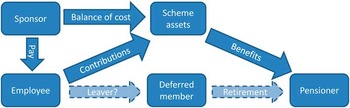
Consider the following stylised model of a funded pension scheme:
Model of a funded pension scheme

It shows contributions being paid into a scheme, being invested, and then providing benefits to beneficiaries. The financial management of such schemes is complex. At a high level, this complexity arises because:
• There is uncertainty as to what the future benefit payments will be (depending on financial and demographic outcomes as well as operational and regulatory risk);
• There is uncertainty as to what future asset returns will be (depending on markets and counterparties); and
• There is uncertainty as to the sponsor's ability to meet the future balance of cost.
For a more detailed exposition of pension scheme risks see Kemp & Patel (Reference Kemp and Patel2011). It is clear that not all the sources of uncertainty emanate from the pension scheme. This highlights the need for a broad perspective that will give an integrated view on the uncertainty and associated risks in a defined benefit pension scheme.
The complexity of pension scheme measurement also means that very few measurements of the liabilities are absolutes, they are often estimates of unknowns and, therefore, uncertain. From this, it can be concluded that an understanding of risk is key. Expectations are relevant, but it is important to inform stakeholders about what could happen, not provide false confidence by focusing on what is likely to happen (even with a ‘prudent’ likelihood).
The agreement of a flight path between all relevant stakeholders provides a consistent framework from which to analyse the risks posed by the pension scheme. Further, by agreeing the target, those risks and uncertainties can be considered by reflecting on the potential impact against the agreed target.
Indeed, the agreed flight path should provide a mechanism for establishing the risk-reward trade-off, for articulating future risks, and for conveying the potential consequences of adverse outcomes and uncertainty.
4.1 Risk and uncertainty
The distinction between risk and uncertainty is crucial when using an estimate of the likelihood of a particular outcome in decision making. This can be done in rather simplistic terms. If a given situation, or particular outcome, can be attributed well-specified probabilities, then the situation is classified as risky. However, where a situation cannot be attributed probabilistic outcomes, then the situation is one of uncertainty.
The notion of distinguishing between risk and uncertainty is a long standing debate in economics. Frank H. Knight introduced this distinction in his seminal work “Uncertainty and Profit” (Reference Knight1921). Knight put forward the case that, markets where insurance can be purchased are markets in which there is risk, and markets in which no insurance can be purchased are those where there is uncertainty (LeRoy & Signell, Reference LeRoy and Singell1987). Lo & Mueller (Reference Lo and Mueller2010) when considering the use of models in finance provided a more stratified taxonomy of uncertainty with five levels.
The crucial thing for stakeholders is to understand the limitations of their decisions and how they might change were subjective parameters to differ. For instance, stakeholders would adopt a materially different strategy were the ‘true’ equity risk premium to be 3.5% rather than 3%, then the decision is unlikely to be robust to their underlying uncertainty about the future.
At an individual level, from the perspective of scheme members, this gets more complicated. Personal probabilities (Savage, Reference Savage1967) are applied and individuals attribute probabilities on all outcomes. Implicit in this is the assumption that all individuals can choose between lotteries consistently and therefore rationally, an assumption disproved by studies in behavioural finance (Kahneman & Tversky, Reference Kahneman and Tversky1979).
For Knight, risk and uncertainty were distinguished by three specific cases. First, was a situation where ‘a priori’ probabilities could be deduced e.g. rolling a dice or tossing a coin. Second, were situations where probability distributions could be estimated and examined from an analysis of historical information e.g. in the life insurance industry. Third, were situations where “…no valid basis of any kind exists for classifying instances”. These classifications suggest that the first and second scenarios are those where risk exists and the final scenario is one of uncertainty. In a pensions context, the change of statutory indexation from RPI to CPI would demonstrate uncertainty, whereas the basis risk between RPI and CPI would be part risk (historic data) and part uncertainty (policy on the construction of the CPI index).
As Knight notes “Business decisions … deal with situations which are far too unique, generally speaking, for any sort of statistical tabulation to have any value for guidance”. However, the idea of uniqueness is in itself complex. Uniqueness depends on perspective, and the pooling of similar but different risks is essentially the basis of insurance. It is an open question, to the authors’ minds, as to how much reliance we ought to put on the statistics of past capital market movements or other theories in modelling how markets, or indeed individual scheme sponsors, ‘ought’ to behave.
4.2 Sources of risk in a pension scheme
There are many uncertainties associated with such a long term financial undertaking as a defined benefit pension scheme. For a fairly extensive list see Kemp & Patel (Reference Kemp and Patel2011). As emphasised in a pension context by, for example, Hatchett et al., Reference Hatchett, Bowie and Forrester2010 and Kemp & Patel, Reference Kemp and Patel2011; for risk management purposes an integrated approach that takes a broad perspective is important. However, it is the identification and management of risks that matters, not the categorisation (which is solely a means to an end).
If we start with the pension obligation, the key sources of uncertainty are around operational risks (for example, data), member options, member experience and indexation. A discount rate will impact on the present value placed on a set of obligations, but it is not a source of uncertainty in the obligations themselves. The scheme managers may want to also include the costs of providing the obligations to be funded, and then we will have expense risk e.g. levies and asset management costs that must also be managed.
The asset risks can then be measured relative to the obligations. Uncertainty over the capability of a portfolio of assets to meet a set of obligations will depend on changes in asset prices and prospective yield, relative to the obligations. Finally, the sponsor covenant risk, that when required by the trustees, the sponsor is not willing or able to make good any shortfall in the desired level of assets.
The sponsor covenant risk can be seen in two lights. On the one hand, the funding level (measured in an appropriate way) describes the asset backing held within the trust to provide members’ benefits. This is one form of security. On the other hand, the deficit in monetary terms, relative to the sponsor, is a description of the degree of reliance the scheme places on the sponsor. In the authors’ experience, trustees tend to focus on the former measure, at the expense of the latter, notwithstanding the fact that it is difficult to place a value on the sponsor.
An alternative way of describing things is from the perspective of different stakeholders:
• Trustees might be categorised as primarily focussing on the risks that members fail to receive their promised benefits in full (although active members might well place a higher priority on job security and pay).
• Sponsors might be categorised as primarily focussing on the risks that could give rise to higher contributions or increased cost of capital.
4.3 Trustees’ viewpoint
The ways that members might receive benefits in full can be categorised broadly into three different routes:
• Insurance buy-out – The benefits are bought out with a Financial Services Authority regulated insurer (accepting that nothing in life is risk free, but the risk profile and history of such institutions suggests that they offer far greater security than a typical pension scheme). Any benefits reside with the member rather than the scheme or sponsor.
• Self-sufficiency – The scheme achieves a self-sufficient position, whereby there is very limited expected requirement for recourse to the sponsor, and sufficient sponsor covenant to meet any future demands should they arise. As noted above, this might require more assets than buy-out to cover individual or idiosyncratic risks, particularly for a smaller scheme, depending on the risk appetite applied in calculating the self-sufficiency measure.
• Run-off – The scheme continues to run risk and pays benefits until the last member leaves the scheme.
The first two situations can be flight path targets. While the third depends on the sponsor continuing to trade for the duration that members receive benefits (which is likely to be many decades). It also requires the sponsor mitigating any downside investment performance or increase to obligations relative to current expectations, through additional contributions. In the third scenario there is much greater uncertainty over potential outcomes, and hence risk for scheme members.
Moreover, the third scenario is challenging to analyse as it requires a holistic view of the sponsor covenant, the assets, the liabilities and the management strategies that would be employed to manage all three. Indeed, some would argue that modelling the sponsor in any great detail is first impossible, since it is a unique entity; and second irrelevant, since its failure is a binary outcome. To the authors, this seems overly pessimistic. Sponsor affordability is a key constraint on any flight path and just because a risk is unquantifiable does not mean it cannot be managed. For example, this could be done via agreeing contingent support with the sponsor, asset backed funding, negative pledges etc or more indirectly by setting an investment strategy that has lower co-dependency with the sponsor's business outcomes. For instance, if your sponsor is a mining company, you might exclude mining stocks and bonds from your scheme asset portfolio.
Consider one scenario which shows how the analysis of run-off is complex. Assume a given level of regulatory technical provisions and associated regulatory recovery plan, for a scheme which is expected to continue for several decades. If the scheme has relatively prudent technical provisions (in the regulatory sense) and a moderate amount of mismatch risk between the assets and liabilities, under some possible future scenarios a large (technical provisions) deficit could emerge. However, given the flexibility inherent in setting both technical provisions and recovery plan:
• The contributions could just rise in proportion to the deficit.
• This deficit amount could be lowered by changing assumptions if the scheme managers believed in mean reversion of markets.
• The amortisation of the deficit could be extended, which would manage the level of sponsor contributions.
This flexibility in future strategies is hard to model in advance. It will depend in part on the biases and beliefs of those negotiating the situation in future.
By considering boundary conditions we can gain some insights to modelling risks from a trustee's perspective:
• If the scheme develops an unaffordable deficit, then members will not receive their full benefits. The likelihood of an unaffordable deficit emerging based on current contribution schedules, asset allocations, and sponsor free cash flow and assets can be estimated. The amount of the unaffordable deficit itself is likely to be subjective, and more likely is a range than a particular number. It is the level of deficit where the trustees would believe that they would be forced to crystallize the deficit in the scheme, rather than run-on and realistically expect the situation will improve. The level of the unaffordable deficit will depend on a variety of complex factors, and will be based on a decision by the trustees about the relative merits of possible improvement in a scheme's position against a possible worsening, all the while paying pensioners one hundred pence in the pound.
• If the sponsor becomes insolvent for business reasons while the scheme is not self-sufficient or solvency funded, then there is a significant risk that members will not receive their benefits in full. Whilst estimating the probability of sponsor insolvency is challenging, credit rating agencies calculate statistics for rated entities. For instance, for a BB-rated company default rates are in the order of 1% a year. If the funding strategy requires the sponsor to continue trading for the next seven, eight or nine decades, clearly the chance of the benefits being paid in full is not very high. This is confirmed empirically by the hundreds of schemes that have undergone Pensions Protection Fund assessment during the Fund's first few years of existence.
A particularly challenging situation for trustees is where a scheme has only a modest chance of paying all benefits in full. Except in wind-up, trustees cannot unilaterally lower pension payments to current pensioners. So while a scheme may only be funded to 50 pence in the pound on an economic basis, pensioners will receive 100 pence in the pound. This is a challenging intergenerational issue. Future investment returns may ‘solve’ the problem for schemes in this situation, but there is also a non-negligible chance that funding could worsen leaving non-pensioners even worse off. Where a scheme is still open to accrual, and current active members are contributing towards paying current pensioners’ pensions (rather than building an asset base to fund their own), this could uncharitably be called a ponzi scheme.
4.4 Sponsors’ viewpoint
A sponsor's main risks could be classified between:
• Human resource (HR) risks, such as employee engagement and retention risks if the scheme reduces benefits or is materially underfunded; and
• Financial risks, such as the risk of higher contributions being required, company assets being required as security, or the sponsor cost of capital rising due to the pension scheme obligations.
These factors are inter-related, for example HR risks are likely to emerge as a consequence of financial risks, and HR actions have financial implications.
One area of focus for many companies is the cash contributions they have to pay into the scheme. The cash contribution profile will depend on how the scheme is managed and scheme experience.
The dependency of the future cash payments on the future approach to managing the scheme is challenging to model and measure. There are other measurements that could be made, for example the possible future funding position or the estimated change in shareholder value associated with different actions.
The latter is an interesting case, because altering the asset strategy in a scheme in and of itself does not create any value (Exley et al., Reference Exley, Mehta and Smith1997). This however, ignores second order effects, relating to tax, member views, trustee actions, and the value of the (shareholders) limited liability (the right of the shareholders to default on the pensions promise) (Sutcliffe, Reference Sutcliffe2004, Reference Sutcliffe2005).
Some analysts argue that riskier pension schemes increase the sponsor's cost of capital, but the increase is not simply proportionate to the additional risk. This could be an indication that the real world of shareholder value is more complex than simple models would predict, or that shareholders themselves do not measure the world in terms of long run economic value (but, for example, discount at a higher rate and only focus on short to medium term returns). “The markets can remain irrational longer than you can remain solvent” [J. M. Keynes cited in R. F. Harrod (Reference Harrod1951)]. The question remains however, of whether companies should make decisions based on how shareholders ought to behave, or how they do behave. Some companies, and in particular private firms or those with a concentrated ownership base, might wish to ask their shareholders directly for their preference. In other cases, companies appear to take a steer from the fact that their shareholders have invested in equity as to their inclination.
For the purposes of establishing an appropriate flight path, however, it is clear that for many sponsors risks can be managed by agreeing with the trustees an adequate flight path. Such that it takes account of these risks, and ultimately targets a position, whereby, these risks are considerably more manageable at some point in the future than in the current position.
4.5 Pensions Protection Fund
The existence of the Pensions Protection Fund changes expected payoffs to members. Under regulatory guidance (Henderson, Reference Henderson2009 in ITS vs. Hope), however, the trustees and sponsor of a scheme are not permitted to make allowance for the existence of the Pensions Protection Fund to avoid public interest risk.
At the same time, Pension Protection Fund levies increase the cost to the sponsor. Stakeholders would appear to create ‘value’ if they maximise risk to the Pension Protection Fund relative to the Pension Protection Fund levy (i.e. if stakeholders maximise the value of insurance).
This subject would be a useful area of future research.
5. Current valuation methods: implied flight paths
The authors argue that all schemes already have an implied flight path, but that many do not recognise it as such. In particular, many schemes have flight paths that are inconsistent with stakeholder preferences, and their intended future investment strategy. For the purposes of clarity, a number of valuation approaches are discussed here with comments regarding their implicit flight path.
5.1 Discount rates
Some of the key problems in measurement are driven by an undue focus on balance sheet measurements in general, and discount rates in particular. Within a general budgeting framework, a discount rate is merely a parameter that is used in a simplified, deterministic model of investment markets.
The power of the discount rate to ‘simplify’ decision making means that it generates undue attention. In reality, investment returns are not steady over time, and so any deterministic discount rate is essentially an assumption that tries to encapsulate long-run expectations. A broader view would include management information about what could happen to pension scheme financing, not what is likely to happen according to our long-run expectations.
Large amounts of time and money are spent by numerous stakeholders debating this single model parameter. In many instances this debate is at the expense of more important considerations such as the level of benefits that the company wishes to pay employees, asset allocation and the most appropriate way to fund the scheme given uncertainty around future outcomes.
Moreover, a deterministic present value budgeting approach for liabilities is not the most useful information for understanding or managing the risks facing a scheme. Indeed, actuarial valuations of pension obligations often start at the measurement stage, skipping considerations of stakeholder objectives and constraints. In reality the decision is about the level of contributions that will be made to the scheme by the sponsor over the next 3–5 years. The relevant context here is the consequences of this action and these consequences should be at the forefront of any decision making.
However, discount rates are very popular tools within scheme funding and are required for setting technical provisions by legislation (Occupational Pension Schemes (Scheme Funding) Regulations, 2005). We therefore consider some of the practicalities and limitations of using different discount rate approaches to set flight paths.
5.2 Traditional funding bases
One common approach used to set technical provisions is to discount the scheme liabilities by reference to a fixed margin above the yield available on government bonds. This is often referred to as a “gilts+x%” approach. The rationale for this approach is to reflect the additional investment return expected on the scheme's assets above gilt yields as a proxy to “risk free” rates (although gilts are clearly not default risk free).
The addition to reflect the expected return on the scheme assets can be derived with respect to three main approaches:
• Current expected return;
• Split pre- and post-retirement discount rates; and,
• Target expected return.
Notwithstanding the limitations of the discount rates set out above, the relative merits of these three approaches are considered in turn.
5.2.1 Current expected return
By deriving the technical provisions with reference to the scheme's current expected return, the decision maker is determining the level of assets required now to meet the scheme liabilities as they fall due, assuming that the scheme will continue to be invested in line with its current asset allocation, and that these assets deliver the expected (money weighted) return.
Any future change to the scheme's asset allocation will change the value of assets required and cause the scheme to be off the original flight path. This approach is inconsistent with de-risking strategies, as it makes no allowance for the scheme having lower expected returns in the future.
For instance, a scheme reaching a 100% technical provisions funding level would not be 100% funded if they decided to reduce their exposure to high yielding asset classes, or if the expected return on those asset classes were to fall.
This approach can easily lead to poor decisions if the scheme's current expected return and asset allocation is expected to change over future periods. This is likely to be the case for most UK pension schemes, as few closed schemes are likely to maintain their existing investment strategy indefinitely.
This can be simply demonstrated by considering the present value of a payment of 100 due in ten years time (assuming gilt yields are 4% per annum).
• Based on gilts funding (i.e. 4% p.a.) is 100 e(−4% × 10) = 67.0
• Current expected return of gilts+1.5% (5.5%) is 100 e(−5.5% × 10) = 57.7
• Lower expected return of gilts+1.0% (5.0%) is 100 e(−5.0% × 10) = 60.7
The scheme might be underfunded and developing a strategy to achieve assets of 57.7. Once the target is reached, if the exposure to growth assets is reduced, so is the expected asset return and technical provisions discount rate. The net effect is to immediately increase the technical provisions from 57.7 to 60.7 and create a new deficit. Note that at no point did the obligation change, it is always to pay £100 in ten years time. What changes is our implied plan to meet that obligation, and the balance between cash contributions and anticipated investment returns in that plan.
Whilst this strategy of reducing investment risk as funding improves may be a sensible outcome, it is clearly preferably if it is articulated in such terms. In other words, technical provisions should often be acknowledged as an interim target towards the true long-term target, which should also be specified.
A more worrying example of this risk is where the decision makers increase the scheme's exposure to growth assets solely in order to reduce the technical provisions. Stakeholders could change the asset allocation to “hide” the deficit. It is not necessarily a poor technique to move an interim target by changing asset allocation (a debate which the authors avoid for the purposes of this paper). However, it is only a good management decision if it is made based on a full understanding of the potential implications both good and bad, of undertaking such an action. In particular, the action taken is one of a funding strategy, rather than changing the nature of the scheme's obligations in any way.
5.2.2 Split pre- and post-retirement discount rates
The most common approach to setting scheme funding bases in the UK is the use of split pre- and post-retirement discount rates. This approach uses a different discount rate for benefits in payment to those not yet in payment. The rationale behind this approach is to assume that the scheme will switch from one type of asset to another type as scheme members retire. A variant of this approach would be to have a discount rate that depended on the time horizon, again assuming that the scheme's asset allocation will switch over this given time horizon. In different scheme circumstances, some trustees might find one approach more intuitive than the other.
In other words, as each member retires, the equivalent value of their asset reserve should be switched from one asset class to another. The net effect is that, as the scheme matures, the scheme's investment portfolio will gradually move from high expected return assets to lower expected return assets with a higher degree of security.
This approach has two main drawbacks. First, the implied de-risking is gradual and made regardless of market conditions or other considerations; and second, it is rarely implemented in practice.
On the first point, this transition based on retirement would take many years to implement and considerably longer than most scheme sponsors or trustees intend to take to reach their investment target. In other words, the implied flight path is inconsistent with the scheme's actual intentions.
On the second point of practicality, it is the authors’ experience that most schemes do not implement an automatic pre- and post-retirement switching policy in practice. In the past some schemes will have had reference to this measure, but many will have “ignored” the scheme actuary's advice in favour of a more appropriate investment strategy. In other words, the scheme's technical provisions basis is out of line with the scheme's likely investment strategy.
The consequence of assuming an intended future investment strategy that de-risks more slowly than is likely to occur in practice, is that too much credit is available for future investment returns relating to growth assets that are unlikely to be held in practice. This can create a distorted position and lead to poor decisions being made in the short-term by allowing for future events, which are not expected to occur.
In other words, for the reasons outlined above, the use of split discount rates generates an implied flight path that is unsatisfactory to most stakeholders because the expected timeframe is too long, and does not reflect reality because the intended future investment strategy is misguided. It is unfortunate that most UK pension schemes have adopted implicit flight paths that are inconsistent with actual intentions and this may lead to poor decision making.
5.2.3 Target expected return
Under the target expected return approach, the discount rate used to value the technical provisions is set with reference to the expected return on the scheme's assets once the scheme reaches its target.
For example, if the scheme's target is to be fully invested in gilts, then the appropriate discount rate would be the gilt yield. As such, when the scheme reaches its target funding position, then it can afford to invest in its target asset allocation.
Note that the valuation of the scheme's liabilities on the target expected return basis does not necessarily affect the scheme's short-term investment or contributions strategy. Indeed, it is expected that most schemes would not have already reached their target investment strategy and will still be working towards achieving their target.
By clearly identifying the funding gap between the current level of assets, and the scheme's required level of assets to support the target investment strategy, the scheme's stakeholders can identify how far away they are from their target and make decisions based on the reality of that position.
A funding position on this basis may be expressed as follows, using the 100 in 10 years time example, as previously:
• Scheme target is 100 in 10 years time.
• Scheme wishes to be invested fully in gilts to match this target in 5 years time.
• Value of gilts required is 100 e(−4% × 10) = 67.0.
• Market value of scheme assets is 57.0.
• Shortfall is 10.0.
If the scheme expects to achieve 5.5% for the next five years and 4% thereafter, then the required level of assets now would be 100e(−4% × 5–5.5% × 5) = 62.2.
In other words, if growth assets are budgeted to yield gilts+3% and the scheme intends to have a 50% growth asset strategy for 5 years, then the scheme intends to meet its shortfall of 10.0 through a combination of 4.8 investment return and 5.2 contributions. This can be described as:
• Valuation of scheme liability is 67.0, based on scheme being fully invested in gilts.
• Market value of scheme assets is 57.0.
• Shortfall is 10.0
• This is budgeted to be met from:
○ Contributions of 5.2
○ Investment return of 4.8 through an expected 5 year investment of 50% growth assets and 50% gilts.
This approach clearly highlights the target and the approach to meet the target including a clear explanation of how the scheme's investment decision is anticipated to help meet the target. Given its clarity, this is the authors’ preferred approach.
5.3 Financial Economics and the Law of One Price
Given the prominence of financial economics in pensions finance, it is worth briefly discussing the relevance of financial economics and its application to the subject of flight paths.
Financial economics is a broad subject, which drives much of modern finance (Hull, Reference Hull1996; Baxter & Rennie, Reference Baxter and Rennie1996; Miller, Reference Miller1997). It is built up axiomatically from a few simple presuppositions to form strong conclusions. There have recently been critiques of applying the approach unthinkingly from some leading economists such as Joseph Stiglitz and George Soros, due in part to the financial crisis. Often, if not always, the presuppositions hold only approximately, but second order effects can build up to materially change the conclusions.
Issues such as liquidity, bias, agency, irrationality and other behavioural factors, all of which have strong evidence of existing in markets, are not always consistent with the traditional financial economics approach. However, despite its limitations, financial economics is very instructive in assessing how to price and hedge financial obligations, including those in a pension scheme.
5.3.1 Economic Value of Pension Obligations
A helpful starting point for measuring pension obligations is the law of one price, or to put it another way ‘there is no such thing as a free lunch’. If there is an asset which pays £100 at a known point in the future, with certainty, then the value of a liability to pay £100 at that same point in the future (which is just an asset to someone else) has the same value. This has symmetry about it, and a contradictory position would seem untenable in a deep and liquid market: if someone promised to pay £100 to you in the future, which you paid immediately on to someone else, there would seem to be little value or cost to you in the process. It is worth noting that the law of one price is independent of whether markets are efficient or not.
To value a set of pension obligations, we could start with a model for them. This could be a projection of benefit cash flows which will depend on future levels of inflation. A scheme could attempt to purchase low risk fixed interest assets, which are expected to provide similar cash flows to a set of pension scheme obligations, irrespective of what future inflation turns out to be. We then have a set of obligations which are ‘matched’ by a set of assets which have a market price. The law of one price would suggest that the value of the obligations is then just the market price of the assets.
Such a valuation is likely to be consistent with many of the long-term targets established by sponsors and trustees when setting flight paths. This portfolio is likely to be relevant to the stakeholders’ when considering their target investment strategy.
If the scheme managers are interested in minimising the volatility in the scheme funding level within the scheme itself, without using bulk annuities, this seems like a sensible approach. Stating the obvious, given a management decision to minimise scheme volatility, we obtain both a potential investment strategy and a corresponding target value of assets which is the cost of that investment strategy.
Many would suggest stakeholders go one step further, and say that irrespective of what you choose to do with the assets, the obligations are unchanged and so their value is the same. The concept of flight paths can be consistent with this view, given that changes to investment strategy do not affect the required level of assets to finance the long-term target.
However, a number of real world complexities arise:
• Tradable assets do not currently exist that have the same payoffs as pension liabilities in all future economic outcomes;
• There is no single market of broadly matching assets (particularly in light of the UK's recent adoption of quantitative easing) which is sufficiently deep, liquid and transparent to provide assets to match the private sector defined benefit pension promises in the UK;
• Financial uncertainty arises inter alia through future salary linkage, changing nature of cash flows (e.g. from real to fixed at the uncertain point of retirement and commutation), the long duration of some scheme liabilities, various flavours of LPI that schemes pay (particularly those linked to CPI);
• Demographic uncertainty arises from all assumptions made, with longevity being a key uncertainty;
• Whatever assets we hold there is some level of uncertainty about the capability of the asset portfolio meeting the liabilities;
• The issues of benefit uncertainty and sponsor credit risk remain. The further a scheme strays from the hedging approach, the greater these uncertainties become;
• Some benefit uncertainty arises whatever you do, witness the recent change in indexation from the RPI to the CPI imposed by the Government on some schemes; and,
• No assets are default risk free.
When using this approach to measurement, any actual management decision needs to be viewed within the context of the market conditions in which it is being pursued. At the time of writing, the Eurozone crisis has left the UK as one of the few markets where investors are willing to invest heavily in government debt. One view of the UK is that of ‘the least ugly duckling’ and so prevailing yields may increase as uncertainty in the Eurozone is removed, for better or worse. Consequently, while a target strategy may involve gilts or swaps, a scheme might decide that now is not the right time to purchase them from a value perspective. However, schemes should beware the fact that just because yields are viewed as being low today, it does not mean they cannot go even lower and stay lower for a long time. On the other hand, in setting their flight path, schemes might well allow for the fact that they expect the price of gilts to decrease in the coming years and budget for that accordingly.
Despite these limitations, with appropriate approximations, in normal market conditions the asset value of a hedging portfolio for scheme obligations can be established, and may be informative when deriving the scheme's long-term target. Certainly, an appreciation of these limitations will help the sponsor and trustees establish their long-term target and, ultimately, help decision making.
5.3.2 Economic valuation in practice
In order to demonstrate the practicalities of constructing a flight path and associated disclosure, it is worth considering an example, such as the example of funding for a single payment of 100 due in 10 years time. The strategy for meeting a payment of 100 in 10 years time can be established in a number of different ways.
An ‘economic value’ perspective might be viewed as the cost of buying a low default risk matching asset. It was shown earlier that the value of 100 in 10 years time on a gilts basis is 67.0.
This is not to say that all schemes should or should not be invested solely in gilts. Although not covered in this paper, the implications of pension schemes investing solely in gilts would have a variety of macroeconomic and other consequences.
Another form of low risk solution might be to enter into a 10 year bullet swap. The sponsor could invest the funds into cash generating instruments and enter into a 10 year pay floating swap. By time 10, the 67.0 plus fixed payments would have accrued to 100 (assuming 4% per annum yields). Compared to the gilt, there are several new risks:
• The cash instruments would need to generate LIBOR (this has upside and downside, although experience in the financial crisis was that risks were skewed to the downside).
• The swap counterparty (rather than the UK Government) could default. This risk is reduced if the swap is collateralised.
• If the swap is collateralised then the sponsor may need to pay collateral. This introduces additional operational issues, such as whether or not the sponsor has eligible collateral, how is the collateral invested and what return it earns.
For practical purposes, we might be willing to say that the value was 67.0. There are clearly other management issues to be addressed if this strategy is adopted, other than calculating the value of 67.0.
5.3.3 Benefits of Financial Economics for setting targets
The benefits of such a valuation when establishing the scheme target, is apparent in a number of different areas.
First, it provides a value of the liabilities in an economic sense based on the target portfolio of assets that would broadly recreate the promised benefits. This is closely related to the hedging management strategy referred to earlier.
Second, knowing the best hedging portfolio is helpful, even if you do not want to hedge today. Many pension scheme sponsors and trustees are scarred by their experiences of managing pension schemes through the early part of this millennium and would seek to de-risk when they can afford to do so (even if that is not today). It is helpful to know how far away a scheme is from being able to afford to largely de-risk.
Third, the gap between the current level of assets and the hedging level reflects the reliance placed on the sponsor. Clearly that gap can grow or shrink depending on contributions, investment returns and the obligations evolving over time. From this base, we can establish risk metrics to assess the sponsor covenant. For instance, we could simply compare the net assets of the sponsor to the deficit, or alternatively the free cash flow of the company to the deficit contributions. In either case, the trustees could ask themselves how a bank or other lender might measure and manage the credit risk of the sponsor.
Fourth, as well as indicating the hedging value, it is generally a good start point for a low cost self-sufficiency portfolio. As set out earlier, there are a range of self-sufficient approaches, but the ones that require least risk capital will generally be the ones with the closest hedging approach.
Fifth, it provides a more objective measure of the benefit promise. In the abstract, where a perfectly matching portfolio can be found, the value of the benefit promise is the cost of that portfolio. If the sponsor decides to take a different approach to investment, they will skew risk-return trade-offs, although this does not in itself create or destroy value (except due to second order effects as described above, which could be significant).
Last, it helps clarify changes in short-term and intended future investment strategy (particularly those related to risk management). A financial economics approach is ‘market consistent’ in that it is consistent with the market price of matching assets. By using ‘off-market’ assumptions when setting the target, we make it hard to manage decisions that will transact at market prices. However, risk premia may be incorporated explicitly when determining the flight path.
5.4 Allowing for risk premia
One of the main criticisms of financial economics is its inability to incorporate market distortions or strong views on relative value. In other words, if an investor believes a market is over- or under-priced, then this view is not reflected in the economic value. This is particularly relevant to pension scheme investors, who have different time horizons and needs to most investors.
The authors are unashamedly avoiding the debate regarding the ability of investors to identify risk premia in pricing or generating superior risk-adjusted returns. What the authors will say is, that where this view is held, then stakeholders should incorporate this opinion to optimise decision making including asset allocation. However, there are few certainties about how markets will behave in future. That is not to say that markets are efficient, but just the size of the position investors take should be proportionate to their ability to underwrite being wrong in their view, as well as their strength of conviction.
This question is how risk premia or market “distortions” should be allowed for in our measurement approach, such that better management decisions can be taken in light of this information.
It would be inconsistent to adjust the value placed on the target asset allocation to allow for “off-market” pricing. This could be misleading and lead to poor decisions from focusing on a false target. Instead the authors advocate that, where this view is held, then the distortion adjustment should be made directly and explicitly in the flight path. This adjustment should be adequately disclosed, and the risks of the “off-market” pricing not being realised in practice should be understood fully.
For instance, if the sponsor and scheme trustees uphold that they wish to be fully invested in a portfolio of gilts (their target), but that they believe the current gilt yield is significantly more likely to rise than fall over the timeframe of their flight path, then they may allow for rising gilt yields in their flight path.
In this example, if stakeholders view the gilts market as distorted due to a supply-demand imbalance pushing up prices, the current cost of hedging liabilities using gilts is higher than it would otherwise be. But as a single player in the market, there is little they can do about this.
The stakeholders may choose to refrain from buying gilts today in the expectation that prices will fall in future. In doing so, they should be aware of the risks of this chosen strategy relative to alternative strategies. Key risks being that something triggers the need to purchase gilts before prices fall, or that simply prices do not fall, for instance due to demand continuing to exceed supply for an extended period.
The pension obligation itself has not changed, so it would make little sense to directly change the target. Furthermore, to completely ignore the view that gilt yields are more likely to rise than fall would also be inconsistent if that is the stakeholders view.
For avoidance of doubt, while the actual characteristics of future gilt yields are ultimately unknown, that does not preclude modelling or measurement providing useful insights. The view should be built into the flight path and adequately disclosed.
Using the simplified deterministic example from earlier, the revised disclosure might now be revised to incorporate the stakeholders’ view that gilt yields will rise by 0.5% to 4.5% by the end of the five year period.
• Scheme asset target is 67.0 based on scheme being fully invested in gilts.
• Market value of scheme assets is 57.0.
• Shortfall is 10.0.
• This is expected to be met from:
○ Contributions of 5.2
○ Investment returns of 3.2 through an expected 5 year investment of 33% growth assets with expected return on 5.0%.
○ Reduction in cost of investing in target assets of 1.6 through gilt yield rising by 0.5% by the end of year 5.
This example is particularly revealing, because the revised flight path includes an allocation of 33% growth assets for five years rather than an allocation of 50% growth assets. In other words, the more accurate portrayal of the stakeholders’ views of the market has caused them to significantly reduce short-term risk.
In contrast, if the stakeholders had ignored their views of gilt yields, then they would have taken more growth asset risk to compensate. It would seem inconsistent to allow for future investment performance, but not future improvements in market conditions.
In the above example, the stakeholders require gilt yields to rise by 0.5% and if they do not, then they will not achieve their target. Similarly, however, if investment performance is not achieved in line with expectations, they will not achieve their target. The risks of any strategy should be understood, in the context of the sponsor's ability to underwrite them.
6. Communicating risk and uncertainty
The derivation of a suitable flight path does not require asset liability modelling. However, the authors argue that such modelling can greatly enhance the flight path by more clearly highlighting some of the risks inherent in the available strategies. Communicating risks is of upmost importance and asset liability modelling enables this communication in an efficient manner.
Asset returns do not evolve in a straight line, although discount rate models typically assume that they do. It is widely accepted that asset liability models are useful for setting pension scheme strategy. Too often, however, these models are used solely for setting investment strategy, neglecting the inter-relationship between the investment and contribution strategy (and other flight path parameters) highlighted earlier.
Discount rate models are very powerful because of their simplicity, generality, and the way in which they reflect how pension obligations unwind over time. For an excellent description of their history and uses see Patel & Daykin (Reference Patel and Daykin2010). Like all models, however, they have their limitations, especially when used in isolation, including:
• In a pension context, they draw attention as assumptions to be negotiated over, distracting from direct discussion of the funding constraints.
• They can confuse where the funding risks lie. For example, the assets could earn more (or less) than the discount rate but the funding level and deficit could worsen (or improve).
In many situations a more holistic view of the scheme and risk would be beneficial. In different scenarios, and for different stakeholders, with different objectives, different measures will be more or less appropriate. A simple metric would be the likelihood that the flight path delivers the obligations in full. This probability will be subjective, but no less so than the selection of a “gilts +” discount rate. It seems at least as transparent and helpful in management decision making as a simpler discounted value calculation.
A pension scheme is more than just an asset portfolio. As described earlier, there are no tradable assets that perfectly match pension liabilities and so there is asset-liability funding volatility, as well as asset price volatility. For materially underfunded schemes, fluctuations in the funding shortfall might emanate more from variations in prospective asset returns than from actual asset prices.
6.1 Funding valuation
One of the inevitable consequences of pension schemes funding at less than full insurance company buy-out levels, is that pension scheme members are exposed to the risk that the sponsor defaults on the pension fund. This poses a substantial challenge.
Many of the flight paths endorsed by the UK Pensions Regulator suggest that contributions from the sponsor can cease when there is a “prudent” chance of the scheme assets being sufficient to ensure that members receive their benefits in full in the long-run. For sponsors with a weaker covenant, higher reserves are required. Prudent typically this means better than 50:50 according to some model of the future, but the meaning is in the mind of the beholder.
If a scheme remains fully funded on its technical provisions basis, there still exists a significant sponsor default risk for many decades. For technical provisions levels that rely on earning future investment returns above low risk rates, there will be some asset liability risk. This means that there is a chance of schemes having a lower value of assets than their technical provisions. In addition, due to the co-dependency of asset returns and corporate defaults, it is likely that the assets are liable to be relatively depressed when the asset backing of the pension obligation is needed most.
From the trustees’ perspective, the following metrics would be useful for comparing alternative flight paths:
• The probability of members receiving their benefits in full;
• If the sponsor defaulted today, the benefits members would receive; and,
• The lowest level of benefits members are likely to receive (with, say, a 1 in 20 chance, although this is fairly arbitrary).
The first and third point requires a model of the sponsor, the assets and the obligations. The second is a simpler question as it only depends on insurers’ pricing today. Some scheme members might want to understand the joint distribution of bad outcomes in the scheme, and their other non-pension assets, if they actually wanted to manage these risks. For instance, the risk of becoming unemployed (or receiving lower wage increases), and how that changes in line with scheme funding outcomes, would be relevant.
From a sponsor's perspective, useful considerations include:
• The chance that the current level of scheme assets, plus any deficit contributions, will be sufficient to pay the obligations in full without any further contributions;
• How large required deficit contributions could become;
• How good (or bad) the accounting position could reasonably get, in terms of both balance sheet and income statement, and the consequences of this;
• How the risks in the pension scheme manifest themselves relative to other business risks of the sponsor;
• How employees react to pension scheme funding issues;
• Operational and regulatory risks arising from the pension scheme; and,
• Actions that can be taken to influence the above.
It is hard to see what discount rate model in isolation usefully answers these questions. Consider the sponsor Finance Director reporting an IAS19 surplus but paying deficit contributions. The significant pensions accounting disclosure notes and scheme funding valuation reports that are required suggest that the answer is not simple.
If asked the question of whether or not the scheme is sufficiently well funded, an unhelpful answer would be it depends on what discount rate you use. A more accurate answer would be it depends on what happens in future. Actions taken today can influence how pension scheme funding evolves in future, but a sophisticated model is not required to reveal this fact. Sophisticated models can help demonstrate the implications of better matching, benefit changes, and the implications of paying different levels of sponsor contribution today.
With this modelling output, stakeholders can make better informed strategic decisions today, based on estimates of relevant future outcomes.
6.2 Hedging and self-sufficiency valuation
Many of the issues raised above also hold true for a hedging valuation, given the limitation of any hedge approach. The quantum of volatility, however, is likely to be much reduced. Although, even with a very closely matched portfolio, volatility in the funding position will not be zero unless an insured solution is used. For example, any matching portfolio using swaps generates the additional risk in terms of generating LIBOR (upside and downside risk), counterparty risk and requirements to provide collateral.
Useful management information might include:
• The level of residual volatility;
• The sources of the volatility, for example longevity, inflation caps and floors, long dated liabilities, and other demographic risks;
• Ways in which the residual volatility can be reduced and, if so, at what cost; and,
• Non-investment solutions available to manage the volatility, for example secure funding solutions that can be drawn upon if required.
A clear view of the objectives of the stakeholders is important here. Management issues with ‘low risk’ solutions can be more nuanced and more complicated than for typical ‘high risk’ solutions. In the latter, market risk dominates all others in terms of volatility, and sponsor covenant risk dominates in terms of impact.
6.3 Disclosure
Risk is a key element of the valuation measurement and so it should be disclosed appropriately. A number of areas have already been covered that demonstrate where the area of risk is important, but are repeated here for completeness.
First, some stakeholders believe that the funding position will improve by being overweight scheme assets that involve a risk premium (such as equities). The allowance for gains in the measurement method is clearly risky. Some quantum of this risk should be established and disclosed.
Second, gains or losses may be expected on the valuation of the target asset portfolio, if stakeholders have a strong view that the price of those assets will rise or fall over the timeframe of the flight path. Anticipating these gains or losses, or even simply assuming you can transact at today's prices in future, also gives rise to some degree of risk, which should be quantified and disclosed.
Third, market values themselves are driven by market sentiment and will vary from time to time. The risks inherent in these market values should be reflected in both the current and target asset side. To the extent that these risks are “matched” in the sense that the scheme assets will move in line with target asset portfolio, these risks are reduced. The net effect of these influences is important.
Fourth, any risk relating to the sponsor should be allowed for in decision making. These risks will relate to the value of the contingent underwriting of scheme funding. Allowance for the nature of the sponsor agreement should be incorporated, including additional guarantees above the statutory minimum, and any existing legal contribution commitments through the statutory “schedule of contributions”.
Some risks such as sponsor covenant, political risk and wider market risk are less easily (or not at all) quantifiable. However, these risks are just as important in decision making as models of financial risk. Moreover, the way risks evolve over time and how that is communicated is important. For example, trends in longevity expectations appear to have momentum type effects (i.e. if you knew that improvements in longevity had increased over the past few years, you might expect them to continue increasing for at least the next few years after that), while interest rates and inflation are typically expected to mean revert. Thus the way a risk evolves and grows over time depends on the nature of the risk.
6.3.1 Recommendations
Above all, however, the purpose of the measurement is the critical factor. The measurement approach should be selected to aid the decision being made. Disclosure should clearly define the objective, the target asset allocation and highlight the inherent risks. Other purposes may also be relevant. The key part of the measurement in those circumstances is to provide the relevant financial information to aid the decisions under consideration.
At the same time, however, it is expected that those decisions will also be mindful of the funding and investment decisions for which this paper has presented a form of disclosure and basis for consideration. Valuing scheme liabilities can be a complex and often misleading exercise. The authors are particularly concerned that poor decisions may be made out of misunderstood valuation measures.
By way of a solution, the authors put forward a potential solution that combines the three commonly used approaches of discounted cash flow, financial economics, and technical provisions.
1. The authors assert that the scheme's assets will ultimately be valued at market value on the date of settlement, whether this be by the payment of a benefit to a scheme member, or through exchanging the liability with a third party such as an insurer. The role of market values is, therefore, relevant, even if the scheme decision makers believe that particular asset markets are distorted by supply-demand issues and subject to risk premia or risk discounts.
2. The authors further assert that the anticipated sources of funding improvement should be quantified. In other words, if the decision makers believe that the scheme's assets are likely to outperform, then this should be quantified and highlighted, so the reliance of the flight path on this belief can be understood. Similarly, if the decision makers believe that the target asset portfolio is likely to underperform, then this should also be quantified and explained, so the flight path reliance on this belief can also be understood.
Decision makers could reach these views based on any model whatsoever. In particular, for those who believe that discounted cash flow models are insightful, they can be used to inform these decisions.
3. For schemes with a current investment strategy differing from the long-term objective, the expected reward and risks of this approach should be quantified and explained.
4. The authors assert that the investment strategy prior to reaching the target investment strategy should be ignored from the target valuation if at all possible, but rather explicitly included in the scheme's flight path.
6.3.2 Disclosure
The authors’ preferred approach, therefore, is for a valuation of the scheme's assets and liabilities to look similar to the example provided earlier with explicit allowance for stakeholders’ views with respect to future relative changes in the prices of both the current asset portfolio and the target asset portfolio.
In addition, adequate disclosure of the risks inherent in such a strategy is required, including the risk that “off-market” views are not realised in the future. The ‘within scheme’ risks can be demonstrated through asset liability modelling (including models of demographic risk in the liabilities where appropriate).
In addition, a scheme deficit can only be understood relative to the strength of the sponsor. However, the strength of the sponsor covenant does not affect the relative size of the deficit, but rather the risk that contributions to fund the deficit become unaffordable.
There are a number of approaches to define the relevance of the scheme sponsor, but most are effectively measuring the contingent claim of the scheme on the underlying sponsor. It should be noted that UK legislation already requires that the sponsor provides a contingent guarantee to the scheme. Any further covenant support is merely increasing the security of the contingent guarantee relative to other sponsor creditors.
We argue that the sponsor covenant should not affect the level of the quoted scheme financial position from a trustee perspective. However, based on a holistic view on risk, it ought to strongly affect other management decisions. In particular, the sponsor covenant is directly linked to the risk profile of the scheme and, hence, short term investment strategy.
It is worth noting that sponsor covenant is unlikely to affect long-term investment strategy. Few scheme stakeholders would be comfortable relying on any sponsor covenant for the many decades until the last member of the scheme leaves the scheme.
The valuation of the credit-risky claim on the sponsor is often considered as a put option on scheme assets. This is covered further in Black & Scholes (Reference Black and Scholes1973) and Clacher et al. (Reference Clacher, Hillier and Hurd2011).
6.4 Solvency II
The issues relating to self-sufficiency valuations are likely to be similar to the above, but based on a position of the scheme holding risk capital directly, rather than via a promise from the sponsor. Insurers and banks have a well-developed framework for managing risk using economic capital (McNeil et al. Reference McNeil, Frey and Embrechts2005) that is fairly easily translated to managing pension schemes which are targeting this approach.
Note that the risk capital need not be held directly within the scheme, but may be held outside of the scheme as part of the wider sponsor's assets. However, in this case the scheme is still reliant on sponsor assets, and so is not expecting to be self-sufficient.
The translation is that rather than trying to earn a higher return on the capital, from a trustee perspective (in delivering the benefits in full without relying on the sponsor) they would want to minimise the chance of having inadequate capital. It could be that trustees believe having a modest amount of return seeking assets helps them minimise this chance.
Most UK defined benefit schemes are not funded to this level. Most schemes choose to invest in assets which they believe will help eliminate any shortfall.
By way of an example, it is illuminating to consider the risk capital required under two investment strategies.
6.4.1 BBB corporate bond investment
A moderate risk solution might be to buy a BBB corporate bond with a single payment of 100 in 10 years time. The (historic) default risk on similarly rated bonds over that period is circa 2% and for simplicity we assume a recovery rate of 50 (rolled up to 10 years time). If it is assumed that the Gross Redemption Yield on such a bond is 5% per annum, then the required expected investment to receive £100 in 10 years would be 100 e(−5% × 10) = 60.7 to purchase the bond. In such a scenario:
• There is a 98% chance that the bond pays 100 and the member receives benefits in full.
• There is a 2% chance that the bonds pay out 50. In this case, either:
○ The sponsor contributes an additional 50 at that time and the benefit is paid, or
○ The sponsor is unable to make the 50 payment in full and can only contribute between 0 and 50, resulting in reduced benefits.
Note that even if the sponsor had contributed 60.7 at the outset, and the funds are invested in the BBB bond, there would still be a 2% chance of a shortfall (but the shortfall would be reduced). Indeed, the scheme would have to invest 122.8 at time zero to guarantee having 100 if the bond defaulted (assuming the 50% recovery rate is guaranteed).
It might be convenient shorthand to discount these payments to time zero to get to a present value, but care should be taken to avoid losing information that might be valuable.
6.4.2 Equity investment
Assume for simplicity of exposition (rather than as a realistic market model) that total equity returns follow a lognormal process with median returns of 7% per annum and volatility 20% per annum. The initial contribution required for a 50% probability of paying the benefit is 100 e(−7% × 10) = 49.7.
Figure 2 shows the common sense result that if the stakeholders would like more confidence in meeting the £100, they would need to have more assets available. Conversely, if the stakeholders are satisfied with a 10% probability of not requiring a future top-up, then only 22.6 is required. A 90% chance would require 114.3 and a 99.5% chance (as defined as the standard measure by Solvency II, albeit over a one year time horizon) would require almost £260.
The Cost of Meeting £100 in 10 Years Time Using Equities

While the parameters and the model are simplistic, the conclusion is stark. The equity risk premium may well be around 3% or 4%, but in order to be very confident that a portfolio of equities will meet a fixed liability over a 10 year time horizon you need to invest in a lot of equities. Using a discount rate of 1% or 2% above gilt yields as a prudent approach, because it is below an assumed equity risk premium does not highlight this investment risk.
In fact, in the absence of arbitrage, the investment that requires the least available assets to pay the 100 with near certainty is the fixed income investment.
An alternative is to show the distribution of the likely top up that would be required to make at time 10 to get back to 100 if the sponsor starts by contributing 49.7 (the best estimate).
In addition, Figure 3 shows that the risk-reward payoff for different stakeholders is asymmetric.
The Cost of Topping-Up to £100

7. Conclusions
The issue of defined benefit pension scheme valuation and management is complex. The authors believe, however, that a commonly agreed management strategy between all stakeholders greatly enhances the chances of the scheme reaching its target.
By agreeing a well defined target, stakeholders have a common benchmark from which to assess their progress against the scheme's long-term objective. This target can be measured using market value techniques and expressed in terms of the cost of achieving that objective at the time of measurement.
By making an explicit allowance for risk premia and risk discounts, stakeholders are able to incorporate their views of financial markets. In particular, the authors argue that where these views are held, then they should be allowed for to avoid taking undue risk in the short term.
Furthermore, stakeholders should avoid the potential pitfall of “reckless prudence”, where they take undue short-term investment risk to compensate for an inappropriate target, timeframe or other flight path parameter.
A well defined flight path should incorporate the stakeholders’ agreed contribution and investment strategy and provide a platform for achieving the agreed objective. It should be based upon an understanding of benefit strategy, covenant support and risk appetite. In other words, the analysis of the flight path should be holistic.
From this platform, the risks and uncertainties of the scheme can be more clearly understood and communicated. In particular, the risks and uncertainty can be expressed in terms of the impact on the agreed target. Furthermore, a common platform provides a framework for stakeholders to debate which levels of risk are acceptable.
Ultimately, the management of defined benefit pension schemes is more successful if the sponsors and trustees of the scheme work together towards a common objective. This framework avoids discussion over more irrelevant issues and focuses decision making on the key issues, such as contribution, investment and risk management strategy. From this platform, the stakeholders can seek to reach a mutually agreed target.