Implications
Bovine semen cryopreservation allows the widespread dissemination of valuable genetic material. However, the overproduction of reactive oxygen species (ROS) causes sperm membrane structural damage and results in the loss of 40% to 50% of viable sperm during freeze-thaw. As the primary component of the sperm antioxidant system, vitamin E is the major membrane protectant against ROS. No data seem to be available regarding the effects of vitamin E on frozen- thawed semen of the Chinese Holstein Cattle. This study was set up to determine the effects of vitamin E on standard semen parameters and antioxidant activities following the freeze–thawing of bovine semen.
Introduction
All aerobic organisms require oxygen for life, and thus the production of reactive oxygen species (ROS) is a normal physiological event in various organs. However, overproduction of ROS can be detrimental to sperm. It has been shown that ROS can damage sperm function and viability (Saleh and Agarwall, Reference Saleh and Agarwall2002), particularly attack sperm DNA, and cause strand breaks and base damage (Baumber et al., Reference Baumber, Ball, Linfor and Meyers2003). Under the natural system of mating, sperm cells are exposed primarily to anaerobic conditions, thus reducing potential damage by ROS. During the procedures of frozen semen production, sperm cells are exposed to oxygen and visible light radiation. These can lead to the formation of ROS, which damage sperm motility and genomic integrity (Foote and Hare, Reference Foote and Hare2000; Bilodeau et al., Reference Bilodeau, Blanchette, Gagnon and Sirard2001). Under these conditions, additional antioxidants can protect against the damaging effect of ROS on sperm movement, and help to maintain sperm motility (Beconi et al., Reference Beconi, Francia, Mora and Affranchino1993). Additions of various antioxidants to spermatozoa have been investigated in the frozen-thawed semen of bulls (Beconi et al., Reference Beconi, Francia, Mora and Affranchino1993), humans (Askari et al., Reference Askari, Check, Peymer and Bollendorf1994) and boars (Pena et al., Reference Pena, Johannisson, Wallgren and Rodriguez Martinez2003).
Vitamin E is a hydrophobic antioxidant that can stop the chain reaction of peroxidation by scavenging peroxyl radicals in lipids in the plasma membrane (Niki, Reference Niki1987) and maintain human sperm DNA integrity (Hughes et al., Reference Hughes, Lewis, McKelvey-Martin and Thompson1998). Beorlegui et al. (Reference Beorlegui, Cetica, Trinchero, Cordoba and Beconi1997), Pena et al. (Reference Pena, Johannisson, Wallgren and Rodriguez Martinez2003) and Breininger et al. (Reference Breininger, Beorlegui, O’Flaherty and Beconi2005) reported that vitamin E supplementation in the extender could reduce ROS generation and improved bovine and boar semen quality. Therefore, vitamin E is the primary component of the antioxidant system of the sperm and is one of the major membrane protectants against ROS and lipid peroxidation. Nevertheless, little is known about the effects of the addition of vitamin E on frozen bovine semen quality and sperm antioxidant activities of superoxide dismutase (SOD), catalase (CAT), reduced glutathione (GSH) and glutathione peroxidase (GSH-Px). No data appear to be available regarding the effects of vitamin E on frozen-thawed semen of the Chinese Holstein Cattle. Therefore, the objective of this study was to determine the effects of vitamin E supplementation in the extender on standard semen parameters and antioxidant activities following the freeze–thawing of bovine semen.
Material and methods
Chemical agents
Unless otherwise stated, all chemicals used were purchased from Sigma Chemical Co. (St. Louis, MO, USA) and stored in desiccators at 5°C.
Semen collection
This investigation was carried out on a total of 12 optimal quality ejaculates from six Chinese Holstein bulls at the Domestic Animal Improving Station in Shaanxi Province (China). The bulls (aged 4 to 5 years) were maintained under identical feeding and managerial regimes. Two semen samples were collected by artificial vagina from each bull. The semen was held in a water bath at 35°C while the sperm concentration and initial percentage of motile sperm were being estimated. Sperm concentration was estimated by optical density using a calibrated spectrophotometer. Motility and morphology were subjectively evaluated by microscope at 37°C, and only ejaculates with motility >75% and normal sperm morphology >85% were used.
Extender preparation
The extender for the treatment groups used in this study was composed as follows: 2.42 g Tris, 1.48 g citric acid, 1.00 g fructose, 6.6 ml glycerol, 20 ml egg yolk, 25 mg gentamicine, 50 000 IU penicillin for 100 ml deionized water, and supplemented with vitamin E at 0.5, 1.0, 1.5 and 2.0 mg/ml. The extender for the control samples was not supplemented with vitamin E, which was the only difference with the extender for the treatments. The purity of vitamin E is 400 mg/g.
Semen processing
After the evaluation of quality, pooled semen was divided into five equal fractions, one fraction was diluted with the control extender, and others with the treatments extender to obtain 120 × 106 sperm/ml. Semen was cooled from 37°C to 4°C for 1.5 h. Subsequently, polyvinyl chloride (PVC) straws (0.25 ml; IMV, L’Aigle, France) were filled and maintained at 4°C for 2.5 h. The straws were then placed 3 cm above the liquid nitrogen surface and cooled at approximately −15°C/min from +4°C to −120°C. Then these straws were transferred to a liquid nitrogen tank (−196°C) and stored at least 2 weeks before thawing.
Analysis of standard semen quality parameters
Automated analysis of sperm motility
The characteristics of sperm motion were assessed with the WLJY-9000, a computer-aided sperm analysis (CASA) system (WeiLi Software Co. Ltd, Beijing, China). For each extender, three straws were thawed separately by immersion in a water bath at 37°C for 45 s. The thawed semen samples were immediately transferred into 1 ml plastic tubes and incubated at 37°C for 10 min. Five microliters of each straw were examined and six fields were randomly chosen. The calibration settings had been optimized and a video digitizing rate of 24 frames s−1 was used for determining sperm motility. The designation of the motility status was based on the level of the average path velocity (VAP). Sperm with average path velocity <5 μm/s was considered immotile, with average path velocity >25 μm/s being defined as motile, and 5 to 25 μm/s as locally motile. The median values of sperm motion characteristics were obtained from the video recording as follows: sperm motility (% of motile spermatozoa), the straight line velocity (VSL, μm/s), the curvilinear velocity (VCL, μm/s), amplitude of the lateral head displacement (ALH, μm), velocity of the average path (VAP, μm/s) and frequency of head displacement (BCF, Hz). The linearity index (LIN= (VSL/VCL) ×100), mean coefficient (STR= (VSL/VAP) ×100) and wobble coefficient (WOB= (VAP/VCL) ×100) were calculated.
Assessment of acrosome integrity and membrane integrity
Acrosome integrity was determined using the fluorescein isothiocyanate-conjugated peanut agglutinin (FITC-PNA, 100 μg/ml) according to the method described by Aboagla and Terada (Reference Aboagla and Terada2003). The acrosome status of the sperm was examined by an epifluorescence microscope (LEIKA DM-IRB linked up to a Nikon digital camera DXM (Nikon Ltd, Tokyo, Japan)). The whole acrosome was visualized with strong green fluorescence under a fluorescence microscope and scored as acrosome-intact sperm. The plasma membrane integrity was evaluated using the hypo-osmotic swelling test (HOST) described by Osinowo et al. (Reference Osinowo, Bale, Oyedipe and Eduvie1982). Viable spermatozoa had coiled tails after HOST. At least 300 sperm cells per slide were observed at 400× magnification. The percentages of fluorescent acrosome-intact sperm and coiled tail sperm were counted in at least 300 sperm cells per slide.
Biochemical assays
The biochemical assays of antioxidant enzyme activity of SOD, CAT, GSH-Px and GSH were detected by means of commercially available assay kits purchased from Nanjing Jiancheng Bioengineering Institute (Nanjing, China). The SOD activity was measured using the method of Flohe and Otting (Reference Flohe and Otting1984) at 560 nm on the spectrophotometer (Shanghai Spectrophotometer Co. Ltd, Shanghai, China) and expressed as U/ml. The CAT activity was measured according to the method of Goth (Reference Goth1991). Hydrogen peroxide was measured at 405 nm on a spectrophotometer and the value of CAT activity was expressed as U/ml. The GSH-Px activity was determined using the method described by Lawrence and Burk (Reference Lawrence and Burk1976). The absorbance at 412 nm was recorded on the spectrophotometer and the GSH-Px activity was expressed as U/l. The GSH content of sperm was measured using the method of Sedlak and Lindsay (Reference Sedlak and Lindsay1968) and read at 412 nm on a spectrophotometer. The values of GSH were expressed as U/l.
Statistical analysis
All experiments were performed for at least 10 replicates for the control and treatment groups. All results were expressed as mean ± s.e.m. The mean values of the percentages of motile sperm, acrosome-intact sperm, plasma membrane-intact sperm and enzyme activity were compared using Duncan’s multiple range test by ANOVA procedure, when the F-value was significant (P < 0.05). All statistical analyses were performed using Statistical Product and Service Solutions (SPSS 11.5 for Windows; SPSS, Chicago, IL, USA).
Results
Sperm motility and movement characteristics
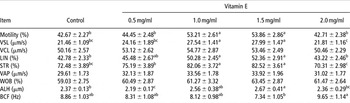
The effects of vitamin E supplementation in the extender on frozen-thawed bovine sperm motion characteristics are shown in Table 1. The motility and main motion characteristics of sperm were improved in the presence of vitamin E at the concentration of 1.0 and 1.5 mg/ml, as compared with the control group (P < 0.05). The sperm motility and VSL, STR values in the extender supplemented with 1.0 and 1.5 mg/ml of vitamin E, were significantly higher than that of other concentrations (P < 0.05). However, there were no significant differences in the LIN and BCF values in the extender supplemented with 1.0 and 1.5 mg/ml of vitamin E compared with 0.5 mg/ml in the vitamin E group. The extender supplemented with vitamin E did not affect sperm motion characteristics of VCL, VAP and WOB, compared with the control (P > 0.05).
CASA-obtained mean values of motility parameters from frozen-thawed bovine semen samples in the presence and the absence of vitamin E

CASA = computer-aided sperm analysis; VSL = straight line velocity; VCL = curvilinear velocity; LIN = linearity index; STR = mean coefficient ((VSL/VAP)×100); VAP = velocity of the average path; WOB = wobble coefficient; ALH = amplitude of the lateral head; BCF = frequency of head displacement.
Values are mean ± s.e.m. of motility parameters from the CASA data set of thawing bovine sperm in different treatments.
Values within a row with different superscript letters are significantly different at P < 0.05.
Acrosome and membrane integrity
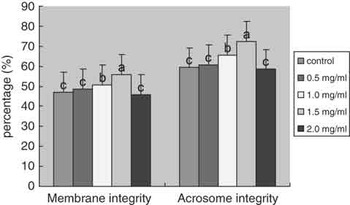
The effects of vitamin E supplementation in the extender on frozen-thawed bovine sperm acrosome and membrane integrity are shown in Figure 1. The percentages of acrosome-intact and membrane-intact spermatozoa were significantly improved (P < 0.05) by supplementing with 1.5 mg/ml of vitamin E. However, there were no significant differences of acrosome integrity and membrane integrity in the extender supplemented with 0.5 and 2.0 mg/ml of vitamin E compared with the control, respectively.
Microscope observation obtained mean values of the acrosome integrity and membrane integrity from frozen-thawed bovine semen in the presence and absence of vitamin E. In each set of bars, different letters imply significant difference (P < 0.05).

Analysis of antioxidant activities
The effects of vitamin E supplementation in the extender on antioxidant activities of thawed bovine sperm are shown in Table 2. The extender supplemented with vitamin E did not exhibit significant improvement in SOD levels, compared with the control (P > 0.05). CAT levels were higher in the groups supplemented with 1.0 and 1.5 mg/ml of vitamin E, when compared with other treatment groups and control (P < 0.05). The extender supplemented with 1.5 mg/ml of vitamin E caused the highest levels of GSH-Px, compared with other groups (P < 0.05). The GSH activity was significantly higher with the supplementation of 0.5, 1.0 and 1.5 mg/ml of vitamin E, compared with 2.0 mg/ml in the vitamin E group and control (P < 0.05). The increasing doses of vitamin E decreased sperm antioxidant activities, and the extender supplemented with 2.0 mg/ml vitamin E caused the lowest level of GSH-Px and GSH activities, compared with other treatment groups (P < 0.05). Moreover, CAT level did not differ from the control and 2.0 mg/ml in the vitamin E group.
Total SOD, CAT, GSH-Px and GSH levels in frozen-thawed bovine semen in the presence and the absence of vitamin E

SOD = superoxide dismutase; CAT = catalase; GSH-Px = glutathione peroxidase; GSH = Glutathione reductase.
Values are mean ± s.e.m. of thawed bovine spermatozoa in all the concentration of vitamin E.
Values within a row with different superscript letters are significantly different at P < 0.05.
Discussion
Mammalian sperm cells have a high content of unsaturated fatty acids in membranes and lack a significant cytoplasmic component containing antioxidants. This has led to increased interest in the oxidative damage occurring during the freezing-thawing process of bovine semen. In this study, our results showed that the supplementation of vitamin E in the extender significantly improved post-thaw bovine sperm motility, movement characteristics, acrosome and membrane integrity, and antioxidant activities of CAT, GSH-Px and GSH. The supplementation of 1.5 mg/ml of vitamin E into the extender inhibited deleterious effects of ROS on bovine sperm. Similar results were reported by Beorlegui et al. (Reference Beorlegui, Cetica, Trinchero, Cordoba and Beconi1997), Pena et al. (Reference Pena, Johannisson, Wallgren and Rodriguez Martinez2003) and Breininger et al. (Reference Breininger, Beorlegui, O’Flaherty and Beconi2005) who reported that vitamin E addition reduced ROS generation and improved frozen semen quality.
Cryopreservation decreases viability and the number of motile cells (Hammerstedt et al., Reference Hammerstedt, Graham and Nolan1990). The main deleterious effect of freezing-thawing process on sperm cells is ROS generation (Chatterjee and Gagnon, Reference Chatterjee and Gagnon2001). ROS can initiate lipid peroxidation, which is a major cause of sperm dysfunction, especially the loss of membrane fluidity or sperm membrane structural alterations, which can decrease sperm motility and viability (Storey, Reference Storey1997; Devi et al., Reference Devi, Prasad, Saraswathi, Raghu, Rao and Reddy2000). Sharma and Agarwal (Reference Sharma and Agarwal1996) reported that human sperm exhibit a capacity to generate ROS and initiate peroxidation of the unsaturated fatty acids in the sperm plasma membrane. The two main sites of ROS production in sperm are the mitochondria through the electron transport chain, particularly when it suffered from freezing-thawing damage (Brouwers and Gadella, Reference Brouwers and Gadella2003), and the sperm plasma membrane through the NADPH-dependent oxidase system (Agarwal et al., Reference Agarwal, Prabakaran and Said2005). However, mammalian sperm may not possess significant NADPH oxidase activity, as indicated by some biochemical studies (Richer and Ford, Reference Richer and Ford2001), and also the occurrence of peroxidation in the mitochondria of sperm mid-piece instead of where NADPH is produced, and therefore it is not possible that ROS production is contributed by NADPH oxidase (Brouwers and Gadella, Reference Brouwers and Gadella2003). Vitamin E is known as an efficient antioxidant and the most potent scavenger of lipid peroxyl radicals, which are toxic by-products of many metabolic processes (Takanami et al., Reference Takanami, Iwane, Kawai and Shimomitsu2000). The protective effect of vitamin E on sperm quality has been previously reported in domestic animals or humans. Beconi et al. (Reference Beconi, Affranchino, Schang and Beorlegui1991) confirmed that the presence of α-tocopherol in the extender used to freeze bovine semen decreased the level of lipid peroxidation. Adding vitamin E to the freezing extender enhanced post-thaw boar sperm motility (Pena et al., Reference Pena, Johannisson, Wallgren and Rodriguez Martinez2003) and improved membrane integrity (Verma and Kanwar, Reference Verma and Kanwar1999) of human sperm. These results were in agreement with the findings of Massaeli et al. (Reference Massaeli, Sobrattee and Pierce1999) who reported that vitamin E was effective in inhibiting lipid peroxidation reaction in the cell membrane. Vitamin E has a beneficial effect on sperm characteristics by protecting the cells against ROS accumulation when they are exposed in aerobic conditions (Foote et al., Reference Foote, Brockett and Kaproth2002). This study indicated that the supplementation with vitamin E in the extender significantly improved bovine frozen semen quality parameters, particularly the inclusion of 1.5 mg/ml vitamin E, compared with the control group. The sperm motility improvement in semen samples frozen with the extender containing vitamin E could be explained by the lower effect of ROS on sperm membranes due to the antioxidant capacity of vitamin E.
The sperm cell has a high proportion of polyunsaturated fatty acids, and is therefore particularly susceptible to peroxidative damage, especially following cryopreservation. Antioxidants including superoxide dismutase, glutathione peroxidase and catalase play an important defensive role in neutralizing the ROS (Aitken, Reference Aitken1994). SOD is an important component of the enzymatic antioxidant system. The potential role of the CAT enzyme was demonstrated to be the aging processes and control of oxidative stress in mammalian sperm, mainly resulting from H2O2 production (Upreti et al., Reference Upreti, Jensen, Munday, Duganzich, Vishwanath and Smith1998; Bilodeau et al., Reference Bilodeau, Blanchette, Gagnon and Sirard2001). GSH plays an important role in the intracellular protective mechanism against oxidative stress as it can react both with many ROS and as a cofactor for glutathione peroxidase, which catalyses the reduction of toxic H2O2 and hydroperoxides (Bilodeau et al., Reference Bilodeau, Blanchette, Gagnon and Sirard2001). GSH-Px plays a role in the elimination of hydrogen peroxide (Meister and Anderson, Reference Meister and Anderson1983). In this study, Table 2 showed that the antioxidant activities of CAT, GSH-Px and GSH were significantly (P < 0.05) increased by the supplementation of vitamin E in the extender. Similar results were found by Brzezinska-Slebodzinska et al. (Reference Brzezinska-Slebodzinska, Slebodzinski, Pietras and Wieczorek1995) and Geva et al. (Reference Geva, Bartoov, Zabludovsky, Lessing, Lerner-Geva and Amit1996) who reported that vitamin E supplementation reduced ROS generation and improved semen quality. These results were in agreement with the findings of Cerolini et al. (Reference Cerolini, Maldjian, Surai and Noble2000) who reported that the vitamin E enrichment of boar semen diluents increased cell viability, through its prevention of an oxidative reduction in the levels of the major polyunsaturated fatty acids. Vitamin E gave satisfactory results in ROS inhibition by having values of CAT, GSH-Px and GSH activities higher than that of the control group in this study. The semen frozen with the extender containing vitamin E prevented oxidative damage and thus improved bovine frozen semen quality.
In this study, vitamin E showed significant dose-dependence. Instead of improving sperm quality, vitamin E supplementation at concentrations of 2.0 mg/ml negatively influenced certain sperm quality parameters. Our findings are in agreement with those of Aitken and Clarkson (Reference Aitken and Clarkson1988). Vitamin E is a collective term for eight naturally occurring compounds, four tocopherols (α, β, γ and δ) and four tocotrienols (α, β, γ and δ), which qualitatively exhibit the biological activities of α-tocopherol (Liu et al., Reference Liu, Wallin, Wallmon and Saldeen2002). Beconi et al. (Reference Beconi, Affranchino, Schang and Beorlegui1991) confirmed that α-tocopherol in the extender used to freeze bovine semen decreased the level of lipid peroxidation. Cao and Cutler (Reference Cao and Cutler1993) reported that the effect of α-tocopherol may vary with the concentration and act as an oxidation stimulator rather than as an antioxidant at high concentration. It was demonstrated that the net hydroxyl radical-absorbing capacity of α-tocopherol (Trolox) increased with increasing concentrations and its advisable concentration was 0.1 to 20 mM. At higher concentrations (20 to 400 mM), the hydroxyl radical-absorbing capacity actually decreased, Trolox acted as an oxidation stimulator rather than as an antioxidant. Therefore, the sperm quality decreased when the concentration of vitamin E was 2.0 mg/ml in this study. In addition, Dalvit et al. (Reference Dalvit, Cetica and Beconi1998) confirmed that low vitamin E levels would allow for physiological production of reactive oxygen species that were essential for the membrane changes required for capacitation, acrosomal reaction and in vitro fertilization processes. Whereas the increase in vitamin E concentration could alter plasma membrane features, thus affecting its fluidity or the production of the required ROS for such processes. It might be supposed that the new lipid environment caused by the high concentration of vitamin E in sperm might be associated with an increase in specific phospholipid classes that are not fully protected by the antioxidant activity of α-tocopherol, and lipid peroxidation might still represent a cause of sperm damages and decreased sperm quality (Cerolini et al., Reference Cerolini, Zaniboni, Maldjian and Gliozzi2006). These results suggested that the mechanism of vitamin E reduced ROS damage on sperm was very complex and that further research should be carried out.
Conclusion
The vitamin E supplementation in the extender resulted in positive effects on bovine sperm motility and movement characteristics, acrosome and membrane integrity, and antioxidant activities of CAT, GSH-Px and GSH after thawing in this study. The beneficial effects of vitamin E can be attributed to the antioxidant characteristics. Vitamin E supplementation in the extender reduced the lipid peroxidation potential and improved semen quality during the freezing-thawing. More research is needed to evaluate and understand the precise physiological role of vitamin E in reproduction.
Acknowledgment
This research was supported by the 11th 5-year Plan State Science and Technology Support Project (2006BAD04A11), the National High Technology Research and Development Program (2008AA101004), Scientific and Technological Project of Shaanxi Province (2007K02-03-02), 13115 Project of Shaanxi Province (2009ZDKG-17), the Fund of Science and Research of Northwest A & F University (Z111020727), the Foundation for the Author of Excellent Doctoral Dissertation of Shaanxi Province (A213020901) and Youth Extra Fund of Northwest A & F University (Z111020905 and Z111020711) and the Basic Scientific Research Expense of Major Project of Northwest A & F University (Z109021011).