

Management policies concerning sample collection for DNA forensic databases, profile entry criteria, profile removal criteria and elimination of reference samples imply diverse ethical challenges which have been the subject of intense debate (for a detailed overview, see for example the report by the Nuffield Council on Bioethics, 2007, and also the commentaries drafted in response to the publication of that report in BioSocieties 3(1)). In this article we aim to expand the traditional ethical issues related to the use and storage of genetic information in forensic DNA databases by exploring the emerging Portuguese practices of informed consent in the context of DNA sample collection for forensic processing. We will focus on three interrelated issues: the practice of volunteering; the communication of information and ways of obtaining consent; and the implications of requesting donors’ ethnic group in the set of personal data obtained for the DNA database. This discussion re-focuses the ethical debate on the consent process undergone during DNA sample donation and collection for forensic purposes, elucidating how this activity both transforms and reproduces interpersonal relations and social hierarchization of individuals, the power of legal medicine and criminal justice, and the cultural and social constraints in the framing of the concepts of personal autonomy, privacy and individual rights.
The Portuguese forensic DNA database is expected to be operational in 2010 and its regulation appears to be more restrictive in terms of data inclusion and information preservation than for other European countries. These restrictions comprise: profile entry criteria (DNA profiles are included only for those convicted of serious crimes; sentenced to three or more years in prison), the obligation for authorities to remove profiles at the time of the definitive cancellation of criminal records, and the requirement to destroy the actual DNA sample after the DNA profile has been obtained. If a convicted person commits no further crime, their DNA profile is removed from the database five, seven or ten years after their sentence has been served, for sentences of less than five years, between five and eight years, or more than eight years, respectively (Article 15 of Law 5/2008). Thus a criminal's DNA profile is not permanently retained in the DNA database and DNA samples can only be collected if this is ordered by a judge. Samples from criminal suspects and convicted offenders can be collected by force (if they have not consented), but the law states that the individual has the right to be informed, specifying the content and possible uses of his or her genetic information. Legal regulations governing the Portuguese forensic DNA database seem to be oriented towards protecting citizens’ rights. In fact, in 2005 the Portuguese government had the intention of creating a universal DNA database for civil and forensic identification purposes, and this purpose was justified on humanitarian grounds that have characterized the Portuguese legal system since the nineteenth century (Santos and Gomes, Reference Santos and Gomes2003). Thus the initial intention had been to collect data from the entire Portuguese population to avoid discrimination, but this idea was abandoned in favour of a database restricted to the ‘criminal’ population, as in many other countries in Europe and around the world. Nevertheless, there is a widespread belief among politicians and law and science experts that the Portuguese forensic DNA database will ‘inevitably’ increase in breadth and scope in the next few years (Machado and Silva, Reference Machado, Silva and Frois2008a). This combination of protective legislation and possible future pressure for expansion provides a particularly interesting context in which to discuss the ethical implications of emerging informed consent practices in the Portuguese forensic DNA database.
DNA samples can either be collected from crime scenes or from persons’ bodies, which can be regarded as a violation of physical integrity or spatial privacy (Camp and Dierickx, Reference Camp and Dierickx2007). In medical and clinical research, the principle of informed consent (Kaye, Reference Kaye2006), which frequently means that tissue samples can only be taken with the donor's approval, seeks to respect an individual's bodily integrity. However, informed consent is not typically considered an issue in the context of forensic processing.
When national jurisdictions claim that informed consent is needed for samples collected during criminal proceedings (Belgium, Cyprus, Germany, Luxembourg, Portugal, Republic of Ireland and Spain), there are as yet ‘unresolved questions about just how “informed” or “voluntary” the proffered consent could be’ (Parry, Reference Parry2008: 219) and, according to Camp and Dierickx, ‘coercive sampling is allowed in all Member States’ in the European Union (2007: 89). Furthermore, many jurisdictions in Europe (Austria, Denmark, Estonia, Finland, Latvia, Lithuania, Scotland, Slovakia, The Netherlands, England and Wales) have stipulated that consent is not required when taking a sample from individuals who have committed a crime or who are criminal suspects, as these persons are considered to hold diminished rights taking into consideration the broader rights of society. Three main reasons are invoked to justify why the principle of informed consent need not be applied during criminal investigations: the collection of DNA samples can possibly help solve a case or avoid serious harm; the procedure (in most cases, by a mouth swab) is only minimally intrusive; and the act of taking a DNA sample is performed in accordance with standard medical practices (Camp and Dierickx, Reference Camp and Dierickx2007: 14–15). Although samples collected from convicted offenders are consensual (e.g. Dundes, Reference Dundes2001; for a discussion see Guillén et al., 2000), the same cannot be said about the collection of biological material from criminal suspects. As suspects are supposed to be treated as innocent until proven guilty, in some countries a court order is needed before collecting biological samples from criminal suspects (such as Cyprus, France, Germany, Luxembourg, Portugal, the Republic of Ireland and Spain).
It is our view that informed consent practices in forensic contexts should be an important area of inquiry, which is still clearly under-addressed and requires further investigation. In this article we seek to contribute to the debate on the ‘imagined and actual rights of those constituents targeted by databases’ (Parry, Reference Parry2008: 218) by covering three interrelated issues in the domain of informed consent practices in the context of the Portuguese DNA forensic database: the practice of ‘volunteering’ for the development of the national DNA database (Silva and Machado, Reference Silva and Machado2009); the portfolio of risks (Lentzos, Reference Lentzos2006) presented in the information and informed consent forms supplied to DNA donors; and the social and ethical implications of requesting donors’ ethnic group (Rose, Reference Rose2008; Smart et al., Reference Smart, Tutton, Martin, Ellison and Ashcroft2008) in the set of personal data obtained for the DNA database. Our empirical approach will be to analyse three different documents which are included in the legislation for the Portuguese forensic DNA database: the mandatory written request provided by volunteers or relatives of missing persons to request that his/her DNA profile be included in the Portuguese forensic DNA database; the information sheet to be shown to individuals before they sign the informed consent form; and the personal data for identification of donors included in the consent form.
DNA sample collection for the Portuguese forensic DNA database
The Portuguese forensic DNA database was established under Law 5/2008 on 12 February 2008. On 3 December 2008 regulations for the operation of the database were approved by the Medical-Legal Council of the National Institute of Legal Medicine under Deliberation no. 3191/2008. The latter document sets out legal provisions governing the operation of the database and includes rules for carrying out the collection and analysis of samples; DNA profiling and the inclusion of DNA profiles in the forensic genetic database. Some implications of these legal provisions will be explored in this article, with the aim of raising a number of ethical issues regarding practices of informed consent in the context of the Portuguese forensic DNA database.
The Portuguese forensic DNA database can include the following types of profiles: those of volunteers and relatives of missing persons; those of professionals who collect and analyse DNA samples; those derived from unidentified human remains, for the purposes of civil identification; those of convicted individuals with sentences of three or more years (no. 1, 2 and 3 of Article 18 of Law 5/2008). According to Law 5/2008, the DNA profiles obtained from the analysis of samples, and the corresponding personal data, are only integrated into the database with the free, written and informed consent of volunteers, relatives of missing persons or forensic technicians who collect and analyse DNA samples (no. 1a and 1b of Article 18 of Law 5/2008). Collecting samples from accused and convicted individuals can be done by force (in the absence of their consent). This demarcation between criminals and law-abiding citizens means that the protection of individual rights to privacy and equality, as they relate to the collection and analysis of DNA, is differentiated, and that modes of categorization and hierarchization of citizens are constructed (Rose, Reference Rose2008). As Cole suggests, issues of race, class and gender inequalities might ‘serve as a convenient prism through which to ask broader questions about the impact of new criminal justice technologies on inequality … in criminal justice systems’ (2007: 95).
In this article we will critically examine some ethical issues related to informed consent in the context of collecting biological samples and DNA profiling in the Portuguese national forensic DNA database. The practices of informed consent create a moral duty for citizens to comply with technical interventions for the sake of crime detection and prevention, while attention has not been focused so much on the duties of the custodians of forensic DNA databases and on the institutions that fund them (Williams and Schroeder, Reference Williams and Johnson2004). The right to information, aiming to support informed consent, may in this fashion act as a moral landscape based on claims for individual responsibility for the future collective well-being of society. It might be a way of constituting a molecular biopolitics (Rose, Reference Rose2008), that is, a way of governing human beings, individually and collectively, through new forms of genetic information and new ways of thinking about risks and responsibilities.
The risks of DNA sample collection and genetic profiling are mitigated by narratives of science and technology as social progress and providers of public good, by which a political community makes binding collective choices and produces and validates collective knowledge and public trust (Jasanoff, Reference Jasanoff2005). This deletion or naturalization of risks (Lentzos, Reference Lentzos2006) comes blended with the fact that the Portuguese law governing the forensic DNA database implies a representation of DNA data as something which does not provide more information than the mere identification of individuals, described by Williams and Johnson (2004: 215) as ‘genomic minimalism’, which reduces the information capacity of a DNA profile to an empty signifier. Describing DNA in these terms might contribute to both legitimizing the use of DNA in criminal investigations and to taking it from individuals without their consent. We argue that this group of practices needs to incorporate information on the risks and uncertainties posed by DNA sample collection and DNA profiling, as well as practices of inclusion of DNA profiles in forensic genetic databases in order to guarantee citizens’ trust in the transparency and safety of the procedure and in the intentions and practices of those who hold the power to collect and use genetic information in the context of forensic applications (Williams et al., Reference Williams, Johnson and Martin2004).
Consent forms for DNA sample collection
There are some central differences between the debates surrounding the use of DNA by the criminal justice system and those that arise in discussions of DNA databasing for medical purposes. The different circumstances in which DNA samples are obtained in medical contexts versus criminal investigations have influenced the ways in which the debates about consent, privacy and autonomy, are presented in the two contexts (Williams and Johnson, Reference Williams and Johnson2004: 211). However, the Portuguese forensic DNA database case might be explored as a sort of combination of issues raised in forensic DNA databasing and medical DNA databasing. The Portuguese forensic DNA database contains profiles from volunteers (i.e. non-criminals who want to give samples on their own initiative) which can be cross-referenced with profiles from criminal suspects and convicted individuals. This means that DNA samples are ‘given’ by volunteers to the Portuguese forensic DNA database (as is the case in the context of medical DNA databases), but ‘taken’ from criminal suspects or convicted offenders. The Portuguese law clearly stipulates that procedures for obtaining DNA samples for forensic purposes must be based on written and informed consent. But this combination of practices—‘volunteering’ versus taking DNA samples from criminal suspects and convicted individuals—raises unresolved questions about just how ‘free’, ‘informed’ or ‘voluntary’ the proffered consent could be (Parry, Reference Parry2008).
The Portuguese National Institute of Legal Medicine has approved four consent forms: the first for the collection of samples and identification in the case of volunteers; second for the collection of samples for the purposes of civil identification; third for the collection of samples and identification in the case of convicted offenders; and the fourth for the collection of samples and identification in the case of criminal suspects (Appendix II of Deliberation no. 3191/2008). There is no specific informed consent form to be signed by forensic technicians who collect and analyse DNA samples, although the law mentions the need for free, written and informed consent in such cases. In addition, there is no reference to, or special safeguard concerning, the rights of minors or individuals incapable of giving informed consent, which is contrary to the recommendations of the Portuguese National Council of Ethics for the Life Sciences (Henriques and Sequeiros, Reference Henriques and Sequeiros2007), and other ethics committees that have advised that special attention should be given to the treatment of children by legal systems (Nuffield Council on Bioethics, 2007). In the case of volunteers and relatives of missing persons, the consent forms include the following statement: ‘I declare that I give my free and informed consent to collection of biological samples and to obtaining my DNA profile, as well as to insertion, communication and interconnection, according to the Law no. 5/2008 of 12 February.’ The consent forms to be signed by convicted offenders and criminal suspects do not include this statement and there are no guidelines regarding how to proceed if this person refuses to collaborate. Thus, in such cases the human rights to liberty, autonomy and privacy can be transformed into a duty to consent to profile entry (Machado and Silva, Reference Machado and Silva2008b).
The four consent forms approved by the National Institute of Legal Medicine for the Portuguese forensic DNA database are very similar in terms of their structure and content. All of them request information on the following: (1) circumstances of the collection, e.g. location, date of collection, hour of collection, identification number of the case; (2) identification of the sample that was collected, e.g. mouth swab, blood or other; (3) authentication of the donor's identity by forensic experts, by way of registering an identity card, a personal photograph taken during the collection of samplesFootnote 1 and fingerprint evidence; and (4) name and signature of the professionals involved in the collection of biological material and in the collection of personal data.
All four consent forms also request the following personal data from donors: name; personal address; telephone; identification card number; date of birth; civil status; profession; ethnic group and place of birth; father's ethnic group and place of birth; and mother's ethnic group and place of birth. The ‘examined’ citizen must declare that he or she authorizes the registration of their personal data to be considered relevant by experts and also state that he or she has not received blood transfusions and/or organ transplants.
It has been argued that the inclusion of information about an individual's ethnic group in DNA databasing can enable discrimination (Williams et al., Reference Williams, Johnson and Martin2004) and transform the social-political construct of race and ethnicity into innate and natural categories (Rose, Reference Rose2008). Moreover, the inclusion of information about an individual's ethnic group will be based on subjective and generalized categories, as such information will either be based on visual judgements by the forensic technician or the donor's self-classification, which may not correspond with the types of classification used in population genetics research. Also, the use of such classifications is not consensual; these labels may vary greatly over space and time and are rarely applied to some groups, even by the individuals themselves, with any consistency (Nuffield Council on Bioethics, 2007: 80). Besides, information about an individual's ethnic group in forensic DNA databases might allow researchers to explore the intersection between race and genotype, leading to misguided theories about genetics and criminal behaviour (Nuffield Council on Bioethics, 2007: 77–88; Smart et al., Reference Smart, Tutton, Martin, Ellison and Ashcroft2008) and to new ways of thinking about individuals, race and populations (Rose, Reference Rose2008).
Volunteers for DNA profile inclusion in the forensic database
An important feature of the legislative framework of the Portuguese forensic DNA database is the concept of volunteers, i.e. anyone who wishes to donate a biological sample (no. 1 of Article 6 of Law 5/2008). In this section we discuss some ethical and political issues concerning the concept of ‘volunteers’ in the Portuguese forensic DNA database. In particular, we examine some specific concerns regarding informed consent which are raised by the written request provided by volunteers to apply for his/her DNA profile to be included in the database.
Regarding profile entry criteria, Law 5/2008 establishes that DNA profiles obtained from the analysis of samples, and the corresponding personal data, are only integrated into the database with the free, written and informed consent of volunteers, relatives of missing persons and forensic technicians who collect and analyse DNA samples (no. 1a and 1b of Article 18 of Law 5/2008). Forensic technicians are required to provide their DNA profile in order to be admitted to work in the national forensic DNA database, but volunteers and relatives of missing persons, on their own initiative, must send a written sample collection request to the Laboratory of the Scientific Police and the National Institute of Legal Medicine (no. 2 of Article 6 of Law 5/2008). There are clear benefits to relatives of missing persons being included in the national forensic DNA database, as it can help them find and identify their loved one. However, there is no clarification in the law as to why people would volunteer to have their profile in the database. As such, in the case of volunteers, the mandatory written request for his/her DNA profile to be included in the database may symbolically stand for the maximization of choice and a sense of individual responsibility in the maintenance of social order (Silva and Machado, Reference Silva and Machado2009). This mandatory written request is also a way of constituting spatial and social state–citizens' relationships (Svendsen and Koch, Reference Svendsen and Koch2008). The sample is received by the state as a voluntary gift, transformable through forensic DNA fingerprinting into the genetic identity of the volunteer in question, whose profile can then be cross-referenced with other profiles mentioned in Law 5/2008, including those of suspects; convicts; forensic DNA researchers; unidentified human remains or evidence found on crime scenes or civil identification sites (no. 3 of Article 20 of Law no. 5/2008). These profiles are then held indefinitely, except in the case of explicit revocation of the previously given consent or in the case of victim identification.
The Portuguese DNA database is promoted by the government as a universalistic and humanitarian entity, which will help protect against discrimination in criminal investigations, for it enables the inclusion of any—and every—citizen, whose biological material seems to be a public good (Busby, Reference Busby2006). Take the standard model of the Portuguese mandatory written request provided by volunteers as an example: does any—and every—citizen really have the opportunity to be included in this collective project? Why, and under which conditions, would people volunteer?
According to Appendix I of the Deliberation no. 3191/2008, the mandatory written request must include two types of information: the first page is concerned with the identity of the potential donor; and the second (blank) page is concerned with information related to the donor's request. Page one requests the following personal data: name; civil status; place of birth; date of birth; identification card; profession; personal address; and telephone number. The potential donor should also state why he or she is creating a DNA profile, i.e. whether they are volunteers or relatives of missing persons. One might argue that the mandatory written request could be, at least in the case of volunteers, a form of ‘recruitmentology’ (Epstein, Reference Epstein2008), that is, a way of ‘scientifically’ evaluating the social, cultural and economic profile of people who want to become donors of biological material.
Regarding the information about the potential donor's request, the Portuguese law does not provide any clarification as to why, and under what conditions, people would volunteer. The potential donors must simply write on a blank page (page two) the information that they consider relevant regarding why they are providing samples for inclusion in the Portuguese forensic DNA database.
What are the criteria—if any—for establishing the relevance, utility and legitimacy of a sample donation? Moreover, for what purpose and by whom will the information about the potential donor's motivation be used?
In any case, the mandatory written request provided by volunteers might illustrate a ‘new’ form of moralizing biological citizenship, in the sense that the frontiers of biocitizenship are traced back to the moral and ethical principles which guide the behaviours and values of the small group who choose to become donors. At the same time, the emergence of a new morality, which rests on the solicitation of the gift of biological material from ‘good’ citizens as an instrument for the common good, can be observed (Rose and Novas, Reference Rose, Novas, Ong and Collier2005); however, the citizen is not summoned at any other moment to participate in this socio-genetic project. In this case, the political exercise of allocation of responsibilities, promises and risks is grounded on the principle of ‘benefit sharing’ materializing in the future. The political construction of this principle has implications for the constitution of the publics of the biosciences and those who participate in the biosciences: deserving and/or undeserving citizens in relation to the production of (bio)security (Hayden, Reference Hayden2007). It reinforces the importance of a ‘public sociology’ (Haimes and Williams, Reference Haimes and Williams2007) critically engaged with recent political-moral debates and ethical discourses, and public policies concerning the governance of the challenges of the new genetic technologies.
The information sheet
The aforementioned Law 5/2008 of 12 February clearly states that individuals from whom DNA samples will be collected have the right to information (Article 9 of Law 5/2008), in accordance with the Portuguese Act on the Protection of Personal DataFootnote 2 (Article 10 of Act 67/98). It was considered necessary to produce an information sheet that would protect and respect fundamental ethical values and citizens’ individual rights. Thus the information sheet approved by the National Institute of Legal Medicine provides information on the following (Appendices III of Deliberation no. 3191/2008): a note that personal data and the DNA profile will be integrated into the database (excluding the case of a defendant undergoing a criminal investigation); an explanation of how a DNA profile will be derived from a sample; a disclaimer that a person's DNA profile can be cross-referenced with other types of files according to the terms and conditions mentioned in Law 5/2008; a note that the collected sample might be preserved in the Portuguese forensic DNA biobank (Article 9 of Law 5/2008).
But there are some aspects of the law that might affect fundamental ethical values and human rights in subtle ways. Take the Portuguese information sheet, for example: first, although individuals from whom DNA samples are collected might have different needs, values and expectations, the provision of information is based on general principles; second, there is an underlying assumption that the provision of information is an essential way of legitimizing the collection of human biological material.
How do we make the provision of information compatible with individual requirements, values and expectations? How should the forensic technicians who collect and analyse DNA samples respond to questions posed by individuals from whom samples are collected? How do we provide information that takes into account, in the foreseeable future, uncertain and potential uses of personal data and individual genetic profiles incorporated into the forensic DNA database? In the document on the regulation of the forensic DNA database, in the section titled ‘final provisions’, there is an indication that a handbook of guidelines will be prepared during the first year of operation of the database. But apparently these guidelines will be technical in nature and ethical considerations will be absent, since the prospective handbook is referred to as ‘a manual of procedures for the technical operation of the database, to ensure the quality, safety and confidentiality’ (Article 16 of Deliberation no. 3191/2008).
As we have shown elsewhere (Machado and Silva, Reference Machado and Silva2008b), the evaluation of citizens’ understandings and interpretations of information is crucial to ensure that the information sheet is satisfactory for most donors and sufficient to legitimize the construction of the Portuguese forensic DNA database (Barr, Reference Barr2006; O’Neill, Reference O’Neill2002; Williams and Schroeder, Reference Williams and Schroeder2004), in order to guarantee that informed consent is not merely a formal discursive practice, but something that ought to humanize and to democratize social relationships. This is especially important because genetic information may have far-reaching repercussions, not only for the individual but also for the individual's immediate and extended family, and because uncertainties about DNA profiling and the uses and applications of this information still exist (Nuffield Council on Bioethics, 2007). It is also essential to take into account the constructive nature of risk and its implications for the mobilizations and courses of action taken by different political groups and distinct social groups (Lentzos, Reference Lentzos2006; Rowe and Frewer, Reference Rowe and Frewer2000), in order to develop more accountable technology decision-making (Scott and Du Plessis, Reference Scott and Du Plessis2008) to enhance decision-making based on the assessment of expectations, limitations, risks and uncertainties of technologies carried out either by experts or lay persons.
General principles of information and communication of uncertainties
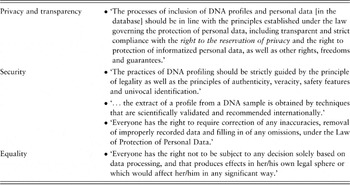
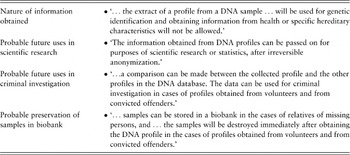
The Portuguese forensic DNA database information sheet does not give equal weight to all ethical, social and political issues. The protection of individual rights associated with ethical values of privacy and equality, and the assurance of the quality and safety of procedures are clearly identified (see Table 1), as well as some probable future uses of the genetic profile in scientific research and criminal investigations (see Table 2). However, some probable risks related to possible laboratory errors and to the specific nature of genetic information are omitted or at least clearly reduced.
General principles guiding the Portuguese information sheet in the context of the DNA forensic database

Communication of uncertainties in the Portuguese information sheet shown to individuals before they sign the informed consent form

Security
The international certification of the quality and safety of technical procedures is clearly identified, while the potential for laboratory and technical errors is described as ‘eventual absences’ and ‘eventual inaccuracies’. Implicitly this means that errors and omissions from the laboratory in the recording of data are unlikely to occur. If there are errors and inaccuracies it should be the responsibility of the citizens themselves to correct them. The principle of security is reported in different ways: first, by the exaltation of international certification procedures; and, second, through the minimization of possible errors. If we take into account the minimization or softening of probable errors for which forensic scientists could have responsibility, these different ways of describing the principle of security can perhaps be associated with assumptions of justice and science's aura of infallibility and competency.
Nature of information obtained
The Portuguese forensic DNA database information sheet does not contain any safeguard against the fact that a DNA genetic profile could also be used to establish biological kinship relations. The individual whose DNA is extracted could very well be unaware of such relationships, i.e. ‘ownership’ of genetic information can perhaps be said to extend to the donor's relatives, which raises ethical issues that are usually not debated. For example, genetic testing and screening may affect the lives and decisions of all family members, including those who otherwise might not want to submit themselves to genetic testing (Heyd, Reference Heyd1992) and who have the right to remain in ignorance (Bennett, Reference Bennett2001).
Probable future uses of genetic information
Some uncertainties about the DNA profile entry and the uses and applications of the information obtained through the collection of biological samples still exist and, in the future, genetic information could be used not only to identify people, but also to prevent some kind of ‘danger’ (Aas, Reference Aas2006: 148). The inherently complex relationships and concerns that emerge in the context of forensic genetic testing and profiling, including those regarding privacy and discrimination, suggest a need for extra requirements in the informed consent process, that should exceed the requirements of informed consent to undergo traditional medical tests (Nisker and Daar, Reference Nisker and Daar2006). Some examples of the extra-requirements that we argue should be incorporated in the information sheet for informed consent are: clarification of who is the owner of the information; the individual should be able to indicate whether or not he/she wants to have access to certain information (for example, the right to decide whether he/she wants information about his/her biological parents if there is any discrepancy with the parents listed on the information sheet) or to allow public disclosure of his/her ethnic group. We argue that this is especially important if we take into account that one of the principal criticisms of genetic database consent forms is that they do not adequately account for what will become of DNA samples in the future (Ducournau, Reference Ducournau2007).
Conclusion
The consent form used by the Portuguese forensic DNA database symbolically maintains social ties between the donor and their biological material and, at the same time, it can be seen as an instrument that reinforces: (1) the importance of individual choice and autonomy; (2) the donor's responsibility as a citizen in the fight against crime and in the promotion of future human well-being; and (3) the transformation of the biological material into objects of knowledge and intervention (Hoeyer, Reference Hoeyer2003; Silva and Machado, Reference Silva and Machado2009).
In this article we have focused on three interrelated issues associated to informed consent in forensic processing: the practice of volunteering; ways of communicating information to and obtaining consent from DNA sample donors; and the ethical challenges and potential inequalities created by the inclusion of ethnic group in the personal data provided by individuals whose profiles will enter the DNA database. We have tried to show how the law which underpins the Portuguese forensic DNA database feeds on the idea that ordinary citizens’ participation in the construction of the forensic DNA database is needed and should be valued (Evans and Plows, Reference Evans and Plows2007). However, this sort of public participation fosters an increase in mandatory volunteerism as good citizenship (Marx, Reference Marx and Monahan2006) and creates modes of categorization and hierarchization of citizens, from criminals to law-abiding citizens, on the basis of willingness versus unwillingness to voluntarily donate a DNA sample. Along with the socio-political concern with the identity of populations, the inclusion of the ethnic group category in the personal data obtained from individuals in the context of the Portuguese forensic DNA database forms an alignment of science and state bureaucracy that could have significant consequences (Smart et al., Reference Smart, Tutton, Martin, Ellison and Ashcroft2008) for the management, labelling and surveillance of citizens by the state. The temptation to explain population differences in molecular rather than in socio-political terms (Kahn, Reference Kahn2006) might expand.
One of the objectives of the information sheet is to protect and respect fundamental ethical values and citizens’ individual rights, such as privacy, transparency, security and equality. However, it provides information based on general principles and uncertainties, and not all probable risks are the subject of equal concern, or of equal relevance. Some risks are clearly identified, namely those located in the legal realm—the threat to individual rights—and on the forensic science level—the certification of the quality and safety of procedures and harmonization of the techniques according to international standards. But, at the same time, the occurrence of possible laboratory errors is minimized, the potential emergence of future discrimination and inequality is softened, and the specific nature of genetic information is not discussed.
The practice of informed consent in the context of the Portuguese forensic DNA database might thus be an interesting case study to re-focus the ethical debate on the implications of collecting genetic information, elucidating how this activity reconfigures interpersonal relations and the social hierarchization of individuals, as well as the power of legal medicine and criminal justice, and the cultural and social constraints in the framing of personal autonomy, privacy and individual rights. Before obtaining a DNA profile, ‘identity’ is about identification and status markers (Hauskeller, Reference Hauskeller2004). The classification of individuals that might emerge from the use of genetic information in forensic processing illustrates a clear example of an increasing geneticization of social relationships (Kahn, Reference Kahn2006). The differentiation between criminals and law-abiding citizens stemming from the use of forensic DNA databases implies a redefinition of individuals in terms of genetic codes (Have, Reference Have2001) by which volunteerism, ethnicity and race occupy an unstable space between identity politics and a molecular vision of the genome (Rose, Reference Rose2007).
Acknowledgements
We would like to thank the Foundation for Science and Technology (Portuguese Ministry of Science, Technology and Higher Education) for financing this research through a post-doc fellowship SFRH/BPD/34143/2006 (2007–10) and the project ‘Forensic DNA databasing in Portugal: contemporary issues in ethics, practices and policy’ (PTDC/CS-ECS/098148/2008).