Introduction
In cases of head trauma, a coup injury occurs under the site of impact with an object, while a contrecoup injury occurs at the side opposite the impacted area. Coup and contrecoup injuries can occur individually or together.Reference Poirier1 When a moving object impacts upon a stationary head, coup injuries are typical, while contrecoup injuries are produced when a moving head strikes a stationary object.Reference Poirier1, Reference Morrison, King, Korell, Smialek and Troncoso2 Coup and contrecoup injuries are considered focal brain injuries, i.e. they occur in a particular area of the brain, in contrast to diffuse injuries, which occur over a more widespread area.Reference Hardman and Manoukian3
Temporal bone fracture is frequently associated with a coup intracranial injury. The incidence of contrecoup injury in this setting is relatively unknown; such injuries have been reported only as case reports.Reference Mitsuyama, Ide and Kawamura4–Reference Ulug and Ulubil8 However, studies have shown that the brain appears to be more susceptible to injury from a lateral impact than a posterior or frontal impact; therefore, contrecoup injuries may be more prevalent in temporal bone fracture cases than has previously been reported.Reference Hardman and Manoukian3, Reference Ryan, McLean, Vilenius, Kloeden, Simpson and Blumbergs9 Contrecoup injuries are also frequently missed, as clinicians tend to focus on the fracture site.
To our knowledge, there has been no previously reported, full study of the prevalence and association of contrecoup injury in cases of temporal bone fracture. We believe that data from the present study will be a useful additional reference in head trauma cases, and will increase clinicians' awareness of contrecoup injuries during computed tomography (CT) and magnetic resonance imaging (MRI) review. Earlier detection of contrecoup injuries can minimise the complications of head trauma.
Materials and methods
This study was conducted in Hospital Tengku Ampuan Afzan, a tertiary referral hospital in Eastern Peninsular Malaysia, which caters for a local population of over one million. The study period was 18 months beginning in January 2007.
All head injury patients admitted to the accident and emergency ward were seen and assessed on the day of admission.
Head injury was defined as a definite history of a blow to the head, with or without a laceration of the scalp or altered consciousness (no matter how brief).
A high resolution CT scan of the brain and skull base was ordered when indicated (thin slice, 2 mm coronal and axial cut; GE 9800 Advantage machine, General Electric Medical Systems, Milwaukee, Wisconsin, USA). The main indication for CT scanning was a drop in consciousness level, taken as a Glasgow coma score of 14 and lower. A CT scan was also ordered in cases with bleeding from the ear or nose, scalp haematoma, scalp laceration, watery otorrhoea or rhinorrhoea, or periorbital haematoma.
Patients whose CT scan showed a one-sided temporal bone fracture were included in the study. The appearance of other types of ipsilateral skull fracture, together with temporal bone fracture, was also considered an inclusion criterion.
A gadolinium-enhanced MRI brain scan was ordered in all cases of unilateral temporal bone fracture in which the patient or immediate family members gave informed consent for inclusion in the study, and in which transport to the scanning facility and processing of the scan would not compromise other aspects of the patient's care. Magnetic resonance imaging was conducted using a 1.5 Tesla proton imaging system (T1- and T2-weighted images, 3–5 mm cut). The time lapse from CT to MRI scanning ranged from three days to four weeks.
Exclusion criteria comprised any CT evidence of contralateral skull fracture, and non-performance of MRI scanning.
The CT and (particularly) MRI films were reviewed thoroughly with a radiologist to look for evidence of intracranial injury, including contusions and haemorrhages.
Findings were recorded and assessed using the Statistical Package for the Social Sciences version 13 software program (SPSS Inc, Chicago, Illinois, USA). The chi-square test was used for statistical evaluation; a p value of less than 0.05 was considered significant.
Results and analysis
The total number of head injury cases admitted to the casualty unit within the study period was 1579. There were 1251 males (79.2 per cent) and 328 females (20.8 per cent), with a male–female ratio of 3.8:1. The mean patient age was 21.3 years, with an age range of 14 to 72 years. Motor vehicle accidents were the commonest cause of head injury, contributing to 1356 cases (85.9 per cent).
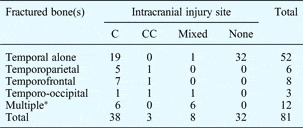
Five hundred and fifty-nine patients underwent CT scanning. Of these, 88 patients were diagnosed with a single-sided temporal bone fracture. In seven of these cases, MRI could not be performed. Therefore, 81 cases (5.1 per cent of total head injury cases) were included in this study. Of the 81 temporal bone fracture cases, 52 had a temporal bone fracture only. The remaining 29 cases had other associated skull fractures, namely of the frontal bone (eight patients), parietal bone (six), occipital bone (three) or mixed fractures (12 cases) (Table I).
Sites of fracture and intracranial injury

Data represent patient numbers. *More than 2 bones fractured. C = coup; CC = contrecoup
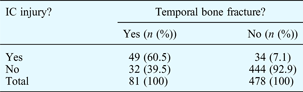
The incidence of intracranial injury was 60.5 per cent (49/81) in patients with temporal bone fracture and 7.1 per cent (34/478) in patients without temporal bone fracture (Table II; This information compares the incidence of intracranial injury in patients with temporal bone fracture and those without the fracture). There was a statistically significant relationship between the presence of temporal bone fractures and intracranial injuries in our patients (chi-square test; p < 0.001). The incidence of contrecoup injury in unilateral temporal bone fracture cases was 13.6 per cent (11/81 cases). Three cases had a contrecoup injury alone, without injury at the side of impact. These three patients sustained a temporal bone fracture associated with other ipsilateral skull bone fractures (Table I). Eight cases had mixed intracranial injury on both the ipsilateral and contralateral sides. All patients with temporal bone fracture associated with other ipsilateral skull fractures also had intracranial injury (Table I).
CT-Scanned cases: temporal bone fractures and intracranial injuries
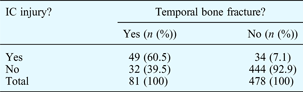
χ2 = 156.1; one degree of freedom; p < 0.001. CT = computed tomography; IC = intracranial
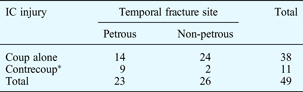
Of the 49 cases of temporal bone fracture with intracranial injury, 23 (46.9 per cent) had petrous temporal bone fracture. Contrecoup injury was significantly associated with petrous temporal bone fracture (p < 0.01) (Table III; this information compares the incidence of contrecoup injury in patients with petrous temporal bone fracture and those non-petrous temporal bone fracture).
Temporal bone fracture + intracranial injury cases: data
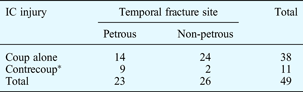
Data represent patient numbers. χ2 = 6.928; one degree of freedom; p = 0.008. *With or without coup injury. IC = intracranial
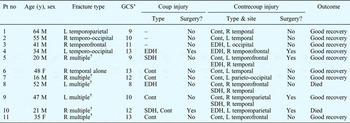
Demographic data for the 11 contrecoup injury patients are shown in Table IV.
Temporal bone fracture + contrecoup injury cases: demographic data

*On admission, out of 15. †More than 2 bones. Pt no = patient number; y = years; GCS = Glasgow Coma Score; M = male; F = female; L = left; R = right; EDH = extradural haematoma; SDH = subdural haematoma; cont = contusion
Discussion
We studied 1579 cases of traumatic head injury, and found unilateral temporal bone fractures in 5.6 per cent. This is a slightly higher figure than that quoted in other studies.Reference Ryan, McLean, Vilenius, Kloeden, Simpson and Blumbergs9–Reference Saraiya and Aygun11 The majority of our temporal bone fracture cases were caused by traffic accidents; the high prevalence of this causation reflects the severity of motor vehicle collision impact in our country. The average age of our patients was also much younger than that reported for other temporal bone fracture series.Reference Brodie and Thompson12, Reference Yavuz, Asirdizer, Cetin, Balci and Altinkok13 In Malaysia, it is legal to drive from the age of sixteen years, and this may have contributed to the younger average age observed in our series.
Of the 81 temporal fracture cases identified, 49 (60.5 per cent) had an associated intracranial injury (Table II; this information compares the incidence of intracranial injury in patients with temporal bone fracture and those without the fracture). A Turkish study on the relationship between skull fractures (not confined to the temporal bone) and intracranial lesions, following head injury due to traffic accidents, found an intracranial injury incidence of only 38.9 per cent.Reference Yavuz, Asirdizer, Cetin, Balci and Altinkok13 The disparity between these two results may reflect a difference in the severity of traffic accident trauma between the two countries. It may also indicate that temporal bone fractures are associated with a higher risk of intracranial damage, compared with other skull bone fractures. This latter effect is probably due to the temporal bone's irregular architecture, which results in more injury when brain tissue glides against it.
In their study of 13 temporal bone fracture cases, Jones et al. reported ipsilateral temporal lobe injury in 46 per cent and contralateral injury in 16 per cent.Reference Jones, Rothman, Gray, Zoarski and Mattox7 We observed a slightly higher incidence of coup injury, at 56.8 per cent, but a comparable incidence of contrecoup injury, at 13.6 per cent. To our knowledge, the incidence of contrecoup injury in temporal bone fracture cases has not been determined in a larger series. Judging from both our own and Jones and colleagues' results, contrecoup injuries are not uncommon in patients with temporal bone fracture.
We found that contrecoup injury was significantly associated with petrous temporal bone fracture (Table III). Petrous bone fracture is defined as a fracture extending into the petrous apex and/or the otic capsule.Reference Ishman and Friedland14 Since the temporal bone, and in particular its petrous part, is considered one of the toughest bones in the body, a considerable amount of force is required to fracture it. This considerable force may be sufficient to cause associated skull and/or intracranial injury, either directly (coup) or indirectly (contrecoup).
In our 11 temporal bone fracture patients with contrecoup injury, the average age was 39.4 years and only two were female (Table IV). This average age was twice that of all head injury cases in our study. We speculate that the incidence of contrecoup injury may be greater in an older age group. This could be explained by atherosclerotic blood vessel changes in elderly patients acting as a risk factor for intracranial injury; a contralateral impact could have an indirect shearing effect on such vessels, leading to a contrecoup injury. We observed only one case of contrecoup injury due to temporal bone fracture alone; the rest occurred in association with other skull bone fractures ipsilateral to the temporal bone fracture. This further indicates that a contrecoup injury is associated with a significant amount of collision force transmitted across the skull to the other side.
In head trauma cases, the severity and type of resulting intracranial injuries depend on the site and direction of impact, the severity of the traumatising force, and the tissue resistance of the brain. Cortical contusion was the most prevalent type of contrecoup injury in our series (Table IV). This is in concordance with previous findings that linear translation of the traumatic force in the latero-lateral direction usually leads to coup or contrecoup contusions.Reference Besenski15 Contusions are considerably less frequent following head injury delivered in a centro-axial direction (i.e. either fronto-occipital or the reverse), as such injuries produce a different pattern of lesions mostly involving deep structures (e.g. diffuse axonal damage).Reference Besenski15 In our four cases in which contusion occurred both on the coup and contrecoup sides, the contrecoup lesions were found to be larger than the coup lesions (Table IV).
In our cases of contrecoup contusion, we observed a predilection for damage to the lateral surfaces and bases of the temporal lobes, and the tip and bases of the frontal lobes. These areas are at risk as the brain moves against the uneven surface of the skull and skull base.
The second commonest type of contrecoup injury in our patients was extradural haematoma. We observed four cases of contrecoup extradural haematoma (Table IV), one of which occurred without a coup injury. This latter patient had sustained a fractured right temporoparietal bone from an assault with a wooden stick. He developed a minimal, non-expanding, contrecoup extradural haematoma in the left occipital region, which was treated conservatively and responded well. Our other three cases of contrecoup extradural haematoma required surgical intervention. In these patients, surgical exploration on the contrecoup side revealed no damage to large arteries but ‘oozing’ from small periosteal capillaries. This may indicate that contrecoup extradural haematoma is due to tearing of these small interposed periosteal capillaries, rather than to damage of bigger arteries in the area.
The first three patients shown in Table IV sustained a contrecoup injury alone, without any coup injury. These patients had Glasgow Coma Scores on admission of 9/15, 10/15 and 11/15, variously. The mean Glasgow Coma Score for the other, mixed injury cases was better, at 11.3. This conforms to observations, obtained from experimental models and autopsy reports of head injury victims, that contrecoup injuries are generally more severe than coup injuries.Reference Drew and Drew16, Reference Gurdjian and Gurdjian17 The overall mortality rate amongst our contrecoup injury cases was 18 per cent (i.e. two deaths out of 11 cases). These two deaths occurred in cases with multiple trauma; in one case, the patient died before surgical intervention was possible.
Our study had several limitations. Regarding study methodology, we performed CT scans on head trauma patients immediately upon presentation to the accident and emergency ward, mostly within 12 hours of injury. Dahiya et al. reported in 1999 that up to one-third of temporal bone fractures are not evident on the initial CT scan.Reference Dahiya, Keller, Litofsky, Bankey, Bonassar and Megerian18 However, the high resolution CT scanning used in our study has excellent sensitivity for temporal bone fractures, and most of our intracranial findings were obtained from MRI. Although the majority of patients with vascular injury can satisfactorily be evaluated with MRI, the MRI signs of traumatic vascular injury may be extremely subtle. The ‘gold standard’ for vascular injury diagnosis is catheter angiography, which was not performed in our cases.
Another limiting factor was the fact that CT scans were ordered based on certain patient criteria. Therefore, it is possible that some temporal bone fractures were missed.
• Temporal bone fractures are frequently associated with coup intracranial injuries, but their relationship with contrecoup injuries is rarely reported
• The brain is more susceptible to injury from lateral than posterior or frontal impacts
• Contrecoup injuries are frequently missed in temporal fracture cases, as clinicians focus on the fracture side, and hence may be under-reported
• This prospective, cohort study assessed patterns of contrecoup injury in traumatic temporal bone fracture cases
• Contrecoup injury occurred in 13.6 per cent of unilateral temporal bone fracture cases, and was significantly associated with petrous temporal bone fracture
• Clinicians should be aware of these results when viewing imaging scans in such cases
In addition, this study involved only a relatively small number of cases (11 contrecoup cases). Thus, our results should be applied with certain reservations. However, since research on this particular area is scarce, our findings could act as an impetus for future studies involving larger sample sizes.
Conclusion
Contrecoup injury is not uncommon following traumatic temporal bone fracture; however, research in this area is scarce. In our temporal bone fracture patients, a contrecoup injury was significantly associated with petrous temporal bone fracture. The commonest contrecoup injury was brain contusion, followed by extradural haematoma.
Acknowledgement
We thank the Director of Hospital Tengku Ampuan Afzan for permission to conduct this study, and Drs Rosnida Azura, Ayesha Zain, Halimaton Mohamad and Katyatee Kassim for their help with data collection.