Introduction
The presence of slate-backed iron-ore mirrors in Costa Rica (Figure 1) has been reported as a result of the looting of pre-Columbian cemeteries and, to a lesser extent, archaeological excavation carried out within the country. A review of collections held at the National Museum (Museo Nacional), the Jade Museum (Museo del Jade), and the pre-Columbian Costa Rican collection in the Denver Art Museum, as well as published research, has enabled us to identify nearly 60 slate-backed iron-ore mirrors, in addition to some reworked fragments used as small pendants and necklaces (Fonseca and Richardson Reference Fonseca and Richardson1978:Figure 10; Stone and Balser Reference Stone and Balser1965:Figure 2). To date, the majority of compete or fragmentary mirrors have been recovered from funerary contexts ranging between 300 b.c. and a.d. 500–600, yet a single example from later contexts, around a.d.. 800–1550, has also been recovered. While representing a broad time range, the majority of examples occur between a.d. 300 and 500–600. Notably, in all cases, only a single mirror has been deposited with the funerary offerings in individual burials.
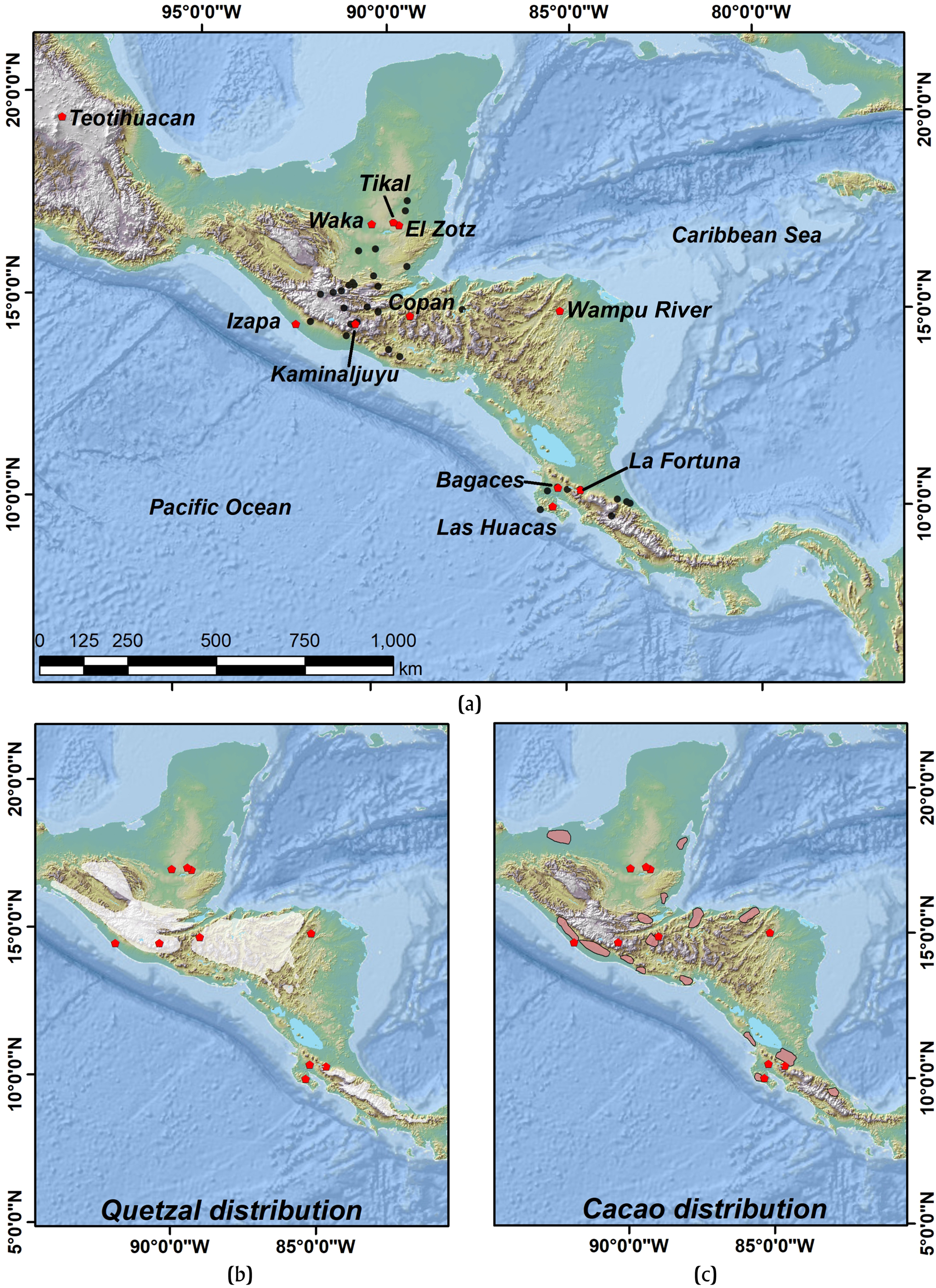
(a) Mirror distribution in Mesoamerica and Central America; (b) Quetzal distribution mark by white areas; (c) cacao distribution mark by pink areas. Maps by Sebastián Granados; cartography elaborated in ArcMap 10.8 using a 12.5 m resolution Advanced Land Observing Satellite-1 (ALOS) elevation model of Central America, obtained from Japan Aerospace Exploration Agency (JAXA).

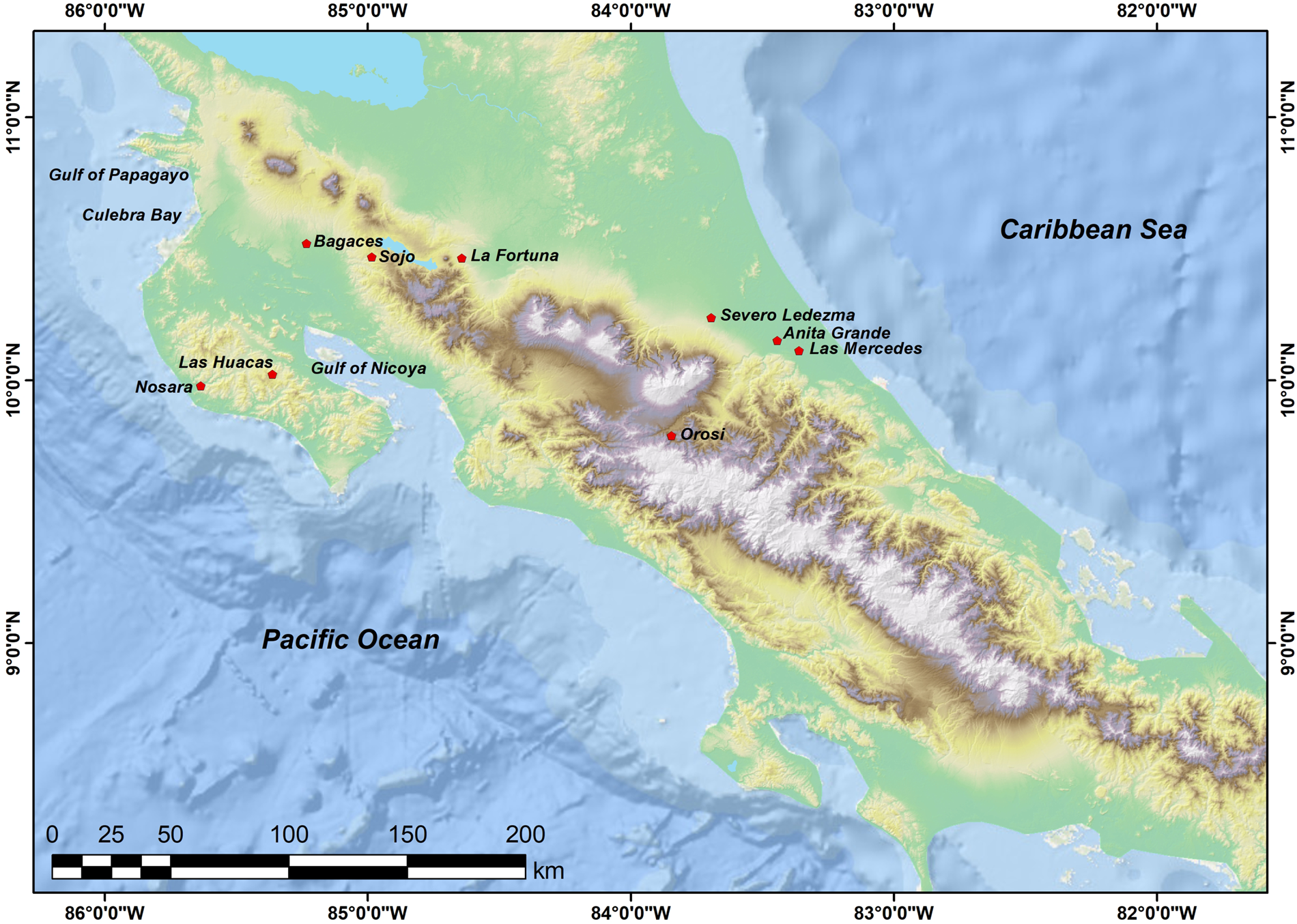
A recent geochemical analysis of mirrors from the Sojo site, located in the northwestern Pacific region (Figure 2), has demonstrated that materials and techniques used in their manufacture differ from those known to local artisans who inhabited the region (Ménager et al. Reference Ménager, Tísoc, Cavallini, Conejo, Barboza and Salgado2021). Two mirror-backs bear Maya hieroglyphic inscriptions—one recovered from the site of La Fortuna in the central highlands, and another from the Bagaces area in the Pacific piedmont (Figure 1)—indicating that these artifacts were probably manufactured in the Maya area, as various researchers have previously suggested (Dennett and Blainey Reference Dennett, Blainey, Gallaga and Blainey2016:239; Snarskis Reference Snarskis, Quilter and Hoopes2003; Stone and Balser Reference Stone and Balser1965). Mirrors, however, are not the only evidence of interaction with the Mesoamerican regions, particularly the Maya. Also recovered from Costa Rican contexts are jade artifacts of Olmec style from the Middle Preclassic, Epi-Olmec style from the Late Preclassic, and objects executed in Maya styles from the Late Preclassic and, to a greater extent, the Early Classic period (Mora-Marín Reference Mora-Marín2002; Mora-Marín et al. Reference Mora-Marín, Reents-Budet, Fields, Patton and Manion2017). Unfortunately, to date, there has only been a single well-documented archaeological context for these types of artifacts (Snarskis Reference Snarskis, Lange and Stone1984), while the remainder have been described through direct observation during active looting processes in the recent past (Stone Reference Stone1977:60, 194).
Map with Chibchan sites in Costa Rica mentioned in the text. Map by Sebastián Granados; cartography elaborated in ArcMap 10.8 using a 12.5 m resolution Advanced Land Observing Satellite-1 (ALOS) elevation model of Central America, obtained from Japan Aerospace Exploration Agency (JAXA).

While we focus primarily on the presence of nonlocal stone artifacts, it is important to note that local artisans across Costa Rica also mastered the skills to transform hard stone into shiny objects and accoutrements, mainly pendants, beginning around 500 b.c. and declining after a.d. 600–700 (Guerrero Reference Guerrero and Jones1998). Most artifacts were crafted from locally sourced greenstones, such as serpentine and quartz, but jadeite from Motagua was also used, as demonstrated by instrumental neutron activation (INAA) and X-ray diffraction (XRD) analyses (Bishop et al. Reference Bishop, Sayre, Mishara and Lange1993; Jones Reference Jones1998), as well as petrographic studies (Soto Reference Soto and Lange1993). These nonlocal jadeites are primarily associated with high-status or elite funerary contexts (Guerrero Reference Guerrero and Jones1998:29). Lastly, it is important to note that jade artifacts fabricated by local artisans in Costa Rica have been found in the Maya region and surrounding areas (e.g., Chalchuapa, El Salvador; Playa de los Muertos and Copan, Honduras; Altun Ha and Pomona, Belize; Chaksinkin, Yucatan; Cerro de las Mesas, Veracruz), indicating bidirectional or reciprocal exchange of finished goods (Easby Reference Easby1963, Reference Easby1968; Mora-Marín Reference Mora-Marín2002).
Distribution and contexts of iron-ore mirrors in Costa Rica
As noted above, the distribution of iron-ore mirrors in Costa Rica is heavily concentrated in the northern highlands and Pacific coastal regions, although a single example has been recovered in the more easterly Central Valley, at the site of Orosi (Hartman Reference Hartman1907:184, Plate 63; see also Figure 2). Interestingly, this spatial outlier is also the same temporal outlier discussed above (the only example recovered from contexts postdating a.d. 800). The following discussion focuses on those mirrors whose specific provenance and context are known, excepting the Bagaces mirror with Maya hieroglyphs, for which we only know that it was recovered from burial contexts around the town of Bagaces in the northwest Pacific, Costa Rica (Stone Reference Stone1977:64; see Figure 2). The mirrors described below vary in aspects such as their time frame, size, and decoration, as well as the use of different materials in the fabrication of the mirror-backs. The sites where they have been found also display various characteristics, some of which reflect social inequality, while in others this is not evident.
Preclassic mirrors in the northeastern region
In the northeastern region, mirrors dating between 300 b.c. and a.d. 300 have been found at the sites Las Huacas (initially called Las Guacas; Hartmann Reference Hartman1907:12; see Figure 2) and Nosara on the Pacific Coast (Figure 2). The contexts from which they were recovered are described below.
Las Huacas
This cemetery was looted in the nineteenth and early twentieth centuries. On behalf of the Carnegie Museum, Hartman (Reference Hartman1907) conducted excavations in the region and purchased a pre-Columbian collection of 2,178 artifacts, primarily derived from funerary contexts at Las Huacas, which was shortly thereafter bolstered by the purchase of an additional 2,500 artifacts. These included ceramics and carved stone objects, with metates, mace heads, and pendants, among other artifact types. Evidence of exchange with Mesoamerican regions, particularly from the Maya area, are demonstrated through worked pebbles and a block of nonlocal jadeite (Hartmann Reference Hartman1907:Plate XXXII), an Early Classic Maya pendant, crafted in a style associated with Nebaj or El Quiche (Easby Reference Easby1963:97; Hartman Reference Hartman1907:Plate XLV.10), an Itzamna-style pendant identified by Michael Coe (Fonseca and Ricardson Reference Fonseca and Richardson1978:315, Figure 13c), and two slate mirror-back fragments and seven fragments of slate from mirror-backings (Fonseca and Richardson Reference Fonseca and Richardson1978:313, Figures 8, 9, 10). Importantly, Las Huacas has yielded the greatest number of greenstone pendants recovered to date in Costa Rica.
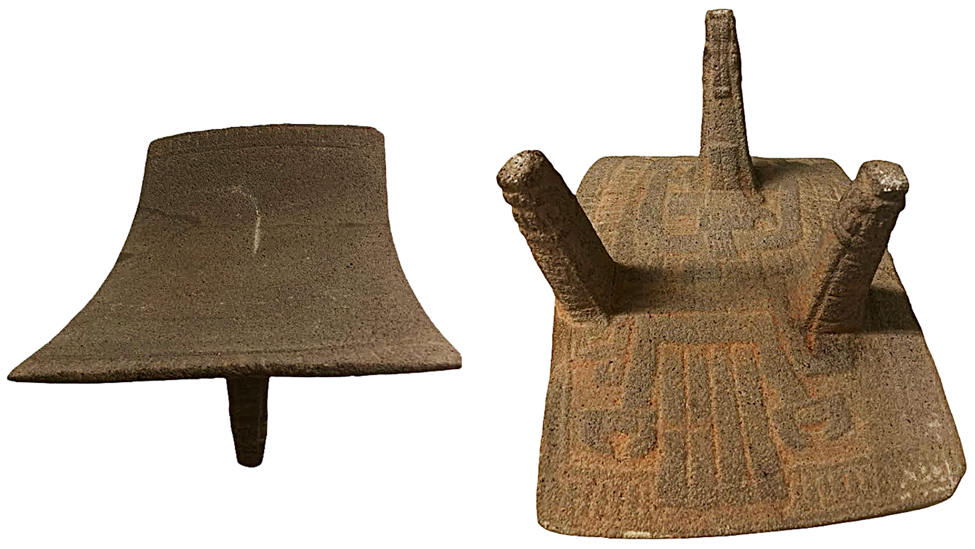
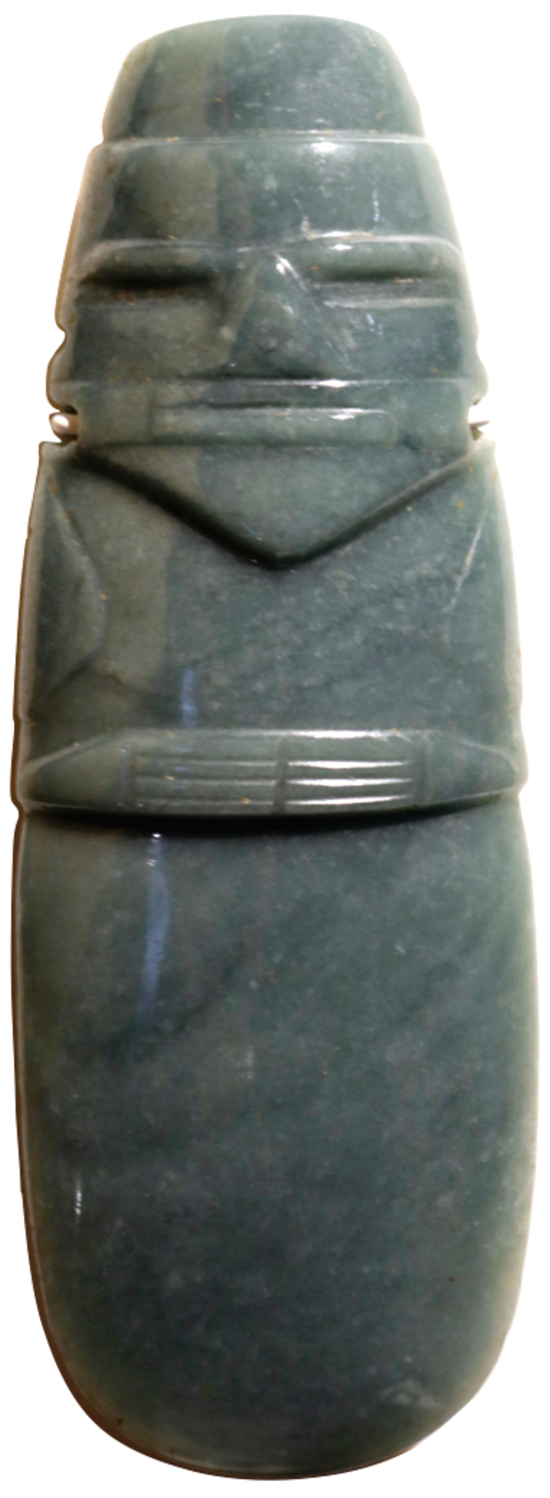
In a small, undisturbed area at Las Huacas, Hartman (Reference Hartman1907:16–38) excavated 16 burials, of which 12 contained funerary offerings. Burials VIII and IX each contained carved tripod metates (Figure 3), which have been interpreted as ceremonial stools (Lange Reference Lange and Lange1992:119), and greenstone celt pendants of the anthropomorphic axe-god style (Figure 4), more recently defined by Mora-Marín (Reference Mora-Marín2016). The presence of these types of offering is considered indicative of emerging status differentiation at the site and, importantly, is not considered typical or found consistently in contemporaneous cemeteries across the region.
Upper and underside plate of a carved metate in the style of those found in Las Huacas. Images courtesy of the collection of the National Museum of Costa Rica.

Jade pendant in the style of the anthropomorphic axe god. Image courtesy of the collection of the Jade Museum of Costa Rica.

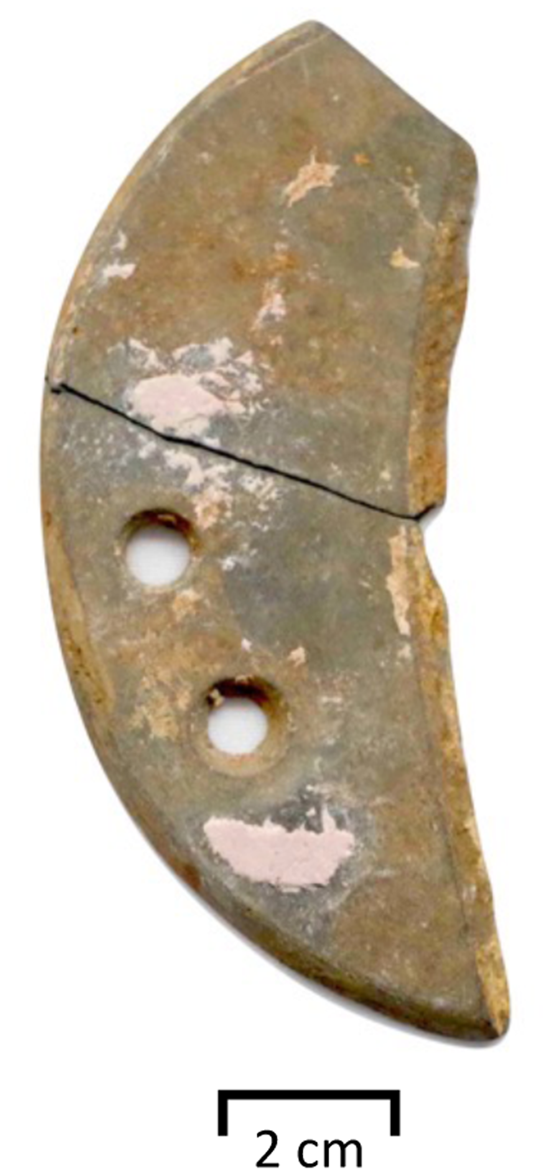
Baudez (Reference Baudez1967:196–197) has since provided identifications for some of the associated ceramic artifacts at Las Huacas, including a Marbella Incised ocarina (Catalina phase, 300 b.c. to a.d. 300) and an Early Classic-style ceramic figurine (Ciruelas phase, a.d. 300–500) from Burial IX. Associated Burial XV contained objects from the earlier Catalina phase (300 b.c. to a.d. 300), as demonstrated by a small olla of the Guinea Incised type, together with five greenstone beads, while Burial XIII represents additional Ciruelas phase (a.d. 300–500) contexts, as demonstrated by a ceramic olla of the Uruela Red type, along with a greenstone anthropomorphic axe god and two burnishing stones. Lastly, Burial VII contained ceramics which have not been described in sufficient detail to provide typological attributions; it also contained a broken metate leg/support and a crescent-shaped “cutting tool” of black slate (Figure 5) that was likely reworked from a mirror-back with an original diameter of 15 cm (Hartman Reference Hartman1907:18, 52, Figure 66). Considered collectively, these funerary contexts provide an approximate understanding of the time in which this ceremony was in use.
Crescent-shaped “cutting tool” from the Sojo site, similar to the one found in Las Huacas Burial VII. Photograph by Ménager.

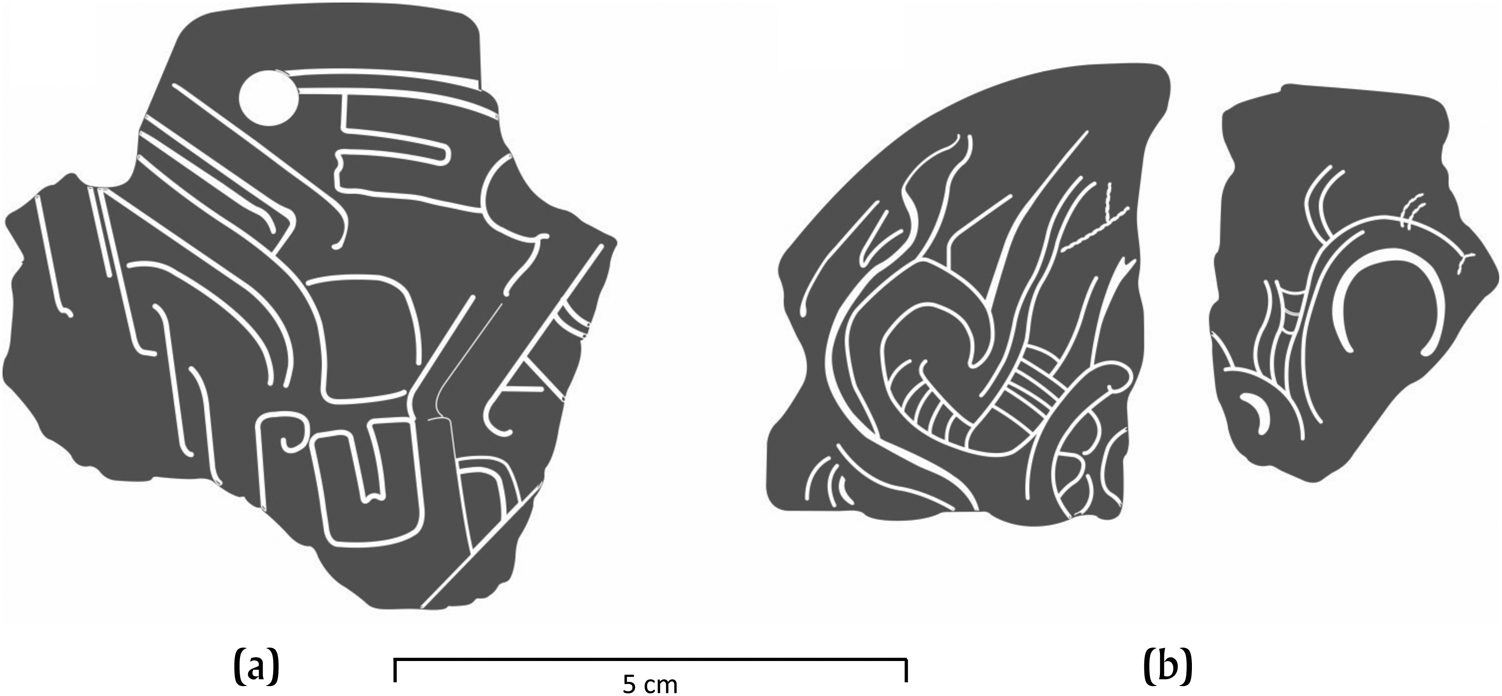
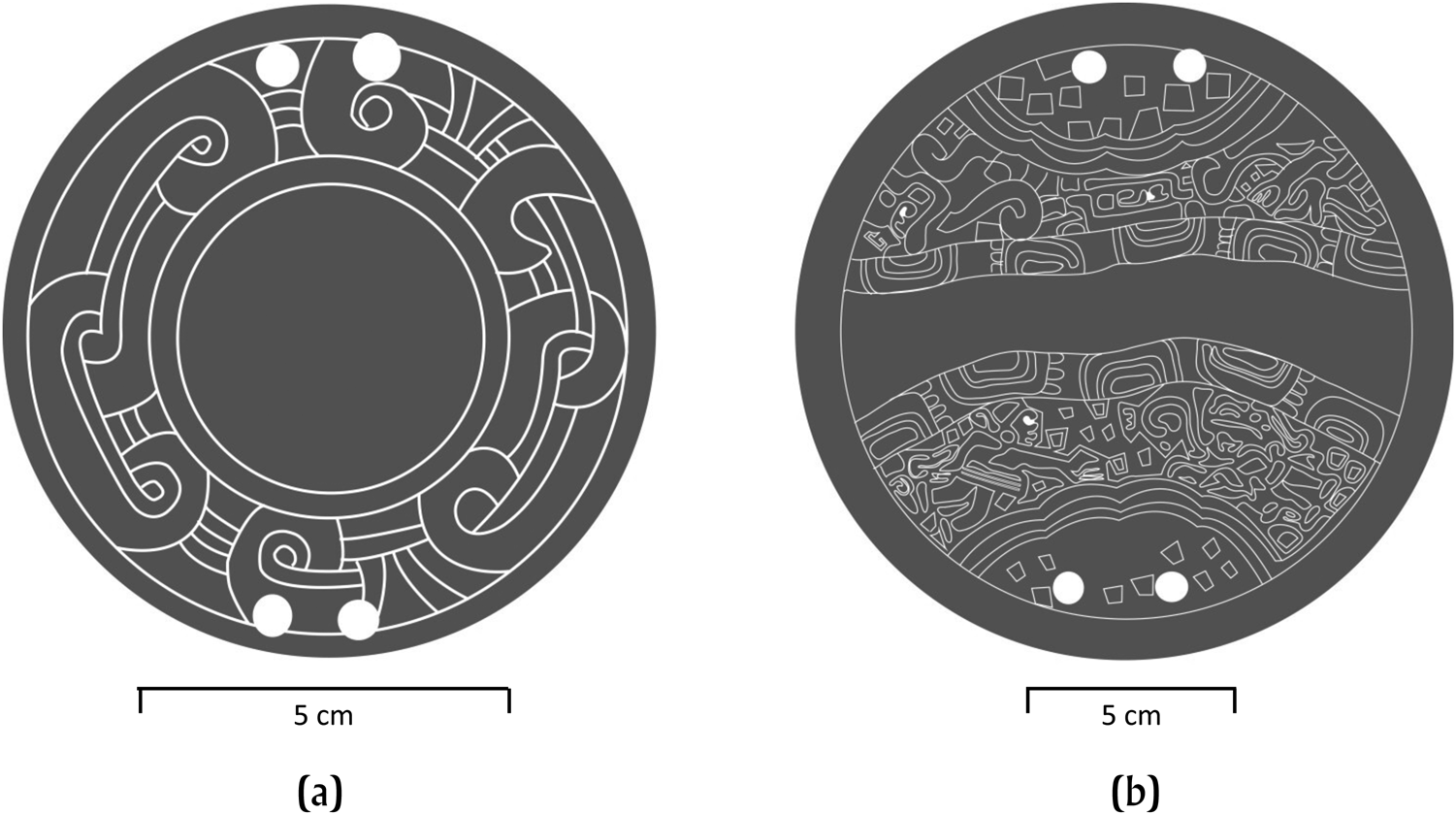
The two slate mirror-back fragments previously mentioned were decorated with Preclassic Olmec stylistic traits. The first of these (Mirror Back 1, Figure 6a), originally interpreted as being executed in “Izapan style” (Quirarte Reference Quirarte1973), presents a recurring Preclassic trait: the incised “U.” Frequently referred to as a U-shaped motif, this symbol is represented on jade celts, ceramic objects, and sculptures recovered from sites in the Olmec area and southeastern Mesoamerica. In Mesoamerica, the U-shaped motif has been interpreted by some scholars as representing the earth (Marcus Reference Marcus, Sharer and Grove1989), while others have proposed that it represents the leaves covering the maize ear (Taube Reference Taube2004). Linking this U-shaped motif with maize also refers to fertility, vegetation, and growth. Many examples of this shape appear on jade celts, strengthening the link and relevance of wealth and fertility, while the material jade itself is related to rulership and authority, wealth, water, maize, and centrality (Taube Reference Taube2005:23). This motif is also seen incorporated into costume details and glyphic notations in the Maya and Zapotec areas (Quirarte Reference Quirarte1973:33). When encountered in archaeological contexts, as described in this Special Section (Arroyo Reference Arroyo2023), mirrors are sometimes found alongside jade artifacts. Beyond the Olmec area, the U-shaped motif occurs frequently on the Late Preclassic sculptures of Kaminaljuyu and other sites along the Pacific Coast, including Izapa, which is located in Chiapas, Mexico.
Drawing of fragments of mirror-back from Las Huacas: (a) Mirror Back 1; (b) Mirror Back 2. Drawings by María López.

The second example from the Las Huacas collection (Mirror Back 2, Figure 6b) presents a pattern that combines the U-shaped motif with diagonal lines, recalling Late Preclassic monuments such as Chiapa de Corzo Stela 3 (Julia Guernsey, personal communication 2021; Lee Reference Lee1969), which itself is related to other examples from Izapa. Research in the Maya Lowlands of Peten notes the abundant use of the U-shaped motif, including depictions rendered in the San Bartolo murals (Taube et al. Reference Taube, Saturno, Stuart and Hurst2010). In pre-Columbian Mesoamerica, the U-shaped motif held potent symbolic meaning that crossed borders, which may contribute to an explanation for the presence of Mirror Back 1 (Figure 6a) in Costa Rica. This artifact held great value and power, and its appearance in a distant region connects Mesoamerica and southern Central America through symbolic language. The power of mirrors as reflective objects included not just their shiny surfaces, but also the emblematic meaning of the symbols carved onto their backings, a tradition which, while not common, lasted through time, as exemplified in the Maya Classic examples (Freidel et al. Reference Freidel, Navarro-Farr, Rich, Meléndez, Pérez, Robles and Kelly2023).
Mirror Back 2 (Figure 6b) has scrolls and a curly design that suggests a Late Preclassic date of origin. As with Mirror Back 1, it seems to fit well within the Izapan stylistic tradition. Examples of Preclassic scrolls are common on Pacific Coast monuments at Izapa, Tak'alik Ab'aj, El Baul, and the Maya highland site of Kaminaljuyu. Other examples can be seen in frescoes from Structure 5D-Sub.10-1st at Tikal (Coe Reference Coe1965) and the San Bartolo murals (Taube et al. Reference Taube, Saturno, Stuart and Hurst2010), reflecting a broad sphere of interaction during the Preclassic. While Costa Rica is a long way from the Maya heartland, certain powerful objects made their way this far south because of the strong symbolic message transmitted by such unique objects.
Nosara
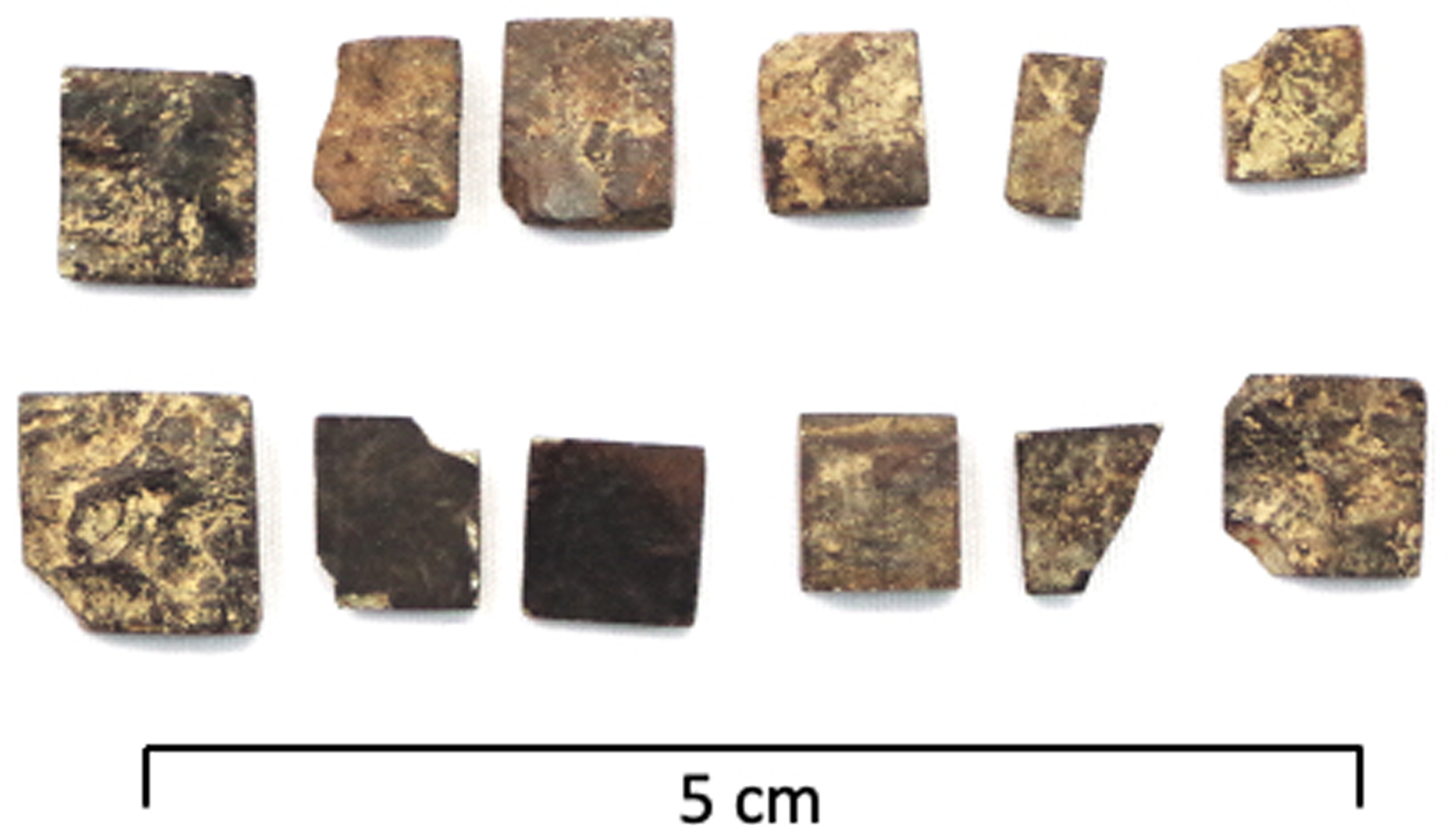
This burial ground is located in hilly terrain between 50 and 150 m asl and less than 1 km from the Pacific Coast (Figure 2), in a region believed to have been a cacao-producing area due to its climatic conditions (Lange at al. Reference Lange, Bernstein, Siegel and Tase1974). At the site, some partially disturbed burials were excavated, one of which yielded 21 square or rectangular pyrite tesserae, measuring 1 cm2, together with three flat ceramic fragments (Figure 7) that appear to be from the back of the mirror (Guerrero Reference Guerrero1986:177, Figure 12.10). In form, they are similar to those used on pyrite mirrors at the site of Chiapas de Corzo (Gallaga et al. Reference Gallaga, Melgar and Lowe2023) and Tak'alik Ab'aj (Schieber de Lavarreda et al. Reference Schieber de Lavarreda, Melgar Tísoc, Solís Ciriaco, Corzo and Claudio2023). Guerrero (Reference Guerrero1986) has proposed that the destruction of funerary sites in this area is due to the quantity of jade artifacts that were deposited as funeral offerings, together with ceremonial metates and mace heads, a funerary pattern that resembles that found at Las Huacas.
Rectangular and square pyrite tesserae found in the cemetery at Nosara. Image courtesy of the collection of the National Museum of Costa Rica.

Classic mirrors in the northwestern region
As discussed above, most of the mirrors found in Costa Rica pertain to the Early Classic period (Mora-Marín et al. Reference Mora-Marín, Reents-Budet, Fields, Patton and Manion2017:182). In the Guanacaste region of northeastern Costa Rica, differences among examples are reflected not only in their physical characteristics, but also in characteristics unique to the site contexts or areas where they have been recovered. Herein we discuss examples from the Sojo site, which was excavated by the archaeologist Carlos Aguilar, and from looted contexts in the Bagaces area, to better understand and provide perspective on those differences.
Sojo
Located on the Pacific slope of the Tilaran range (Figure 2), the site is situated in an area where there are natural intermontane passes that facilitate interaction between the northwestern and northeastern regions. The site is a funerary mound, 30 m long and 20 m wide, covered with layers of stone totaling 830 m3, and under which 49 groups of funerary offerings have been identified to date (Bonilla et al. Reference Bonilla, Calvo and Sánchez1977). Among these were chronologically and culturally distinctive ceramic types, including Charco Black-on-Red and Hermanos Beige. Their presence indicates an approximate chronological range of a.d. 300–500/600 (Baudez Reference Baudez1967:188; Hoopes and Chenault Reference Hoopes, Chenault, Sheets and McKee1994:95), which corresponds roughly to the local Late Arenal phase (a.d. 300–600), a time when funerary mounds were numerous in the area (Hoopes and Chenault Reference Hoopes, Chenault, Sheets and McKee1994:100). Of the 49 interments identified at the Sojo site, the majority contained funerary offerings that comprised ceramic vessels and rare traces of human remains (likely due to environment-induced decomposition). While many of these contexts also included plain metates, celts, and other lithic artifacts, a few “exceptional” tombs were also encountered where greenstone pendants, with or without other offerings, were deposited.
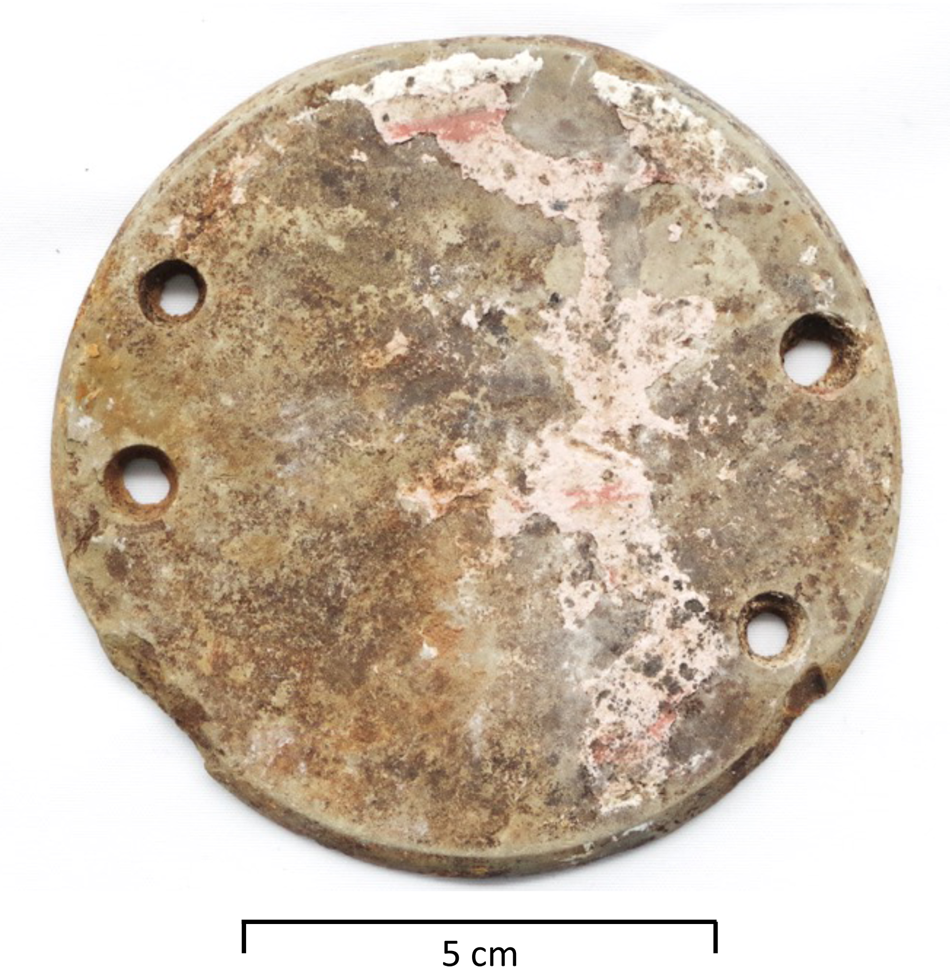
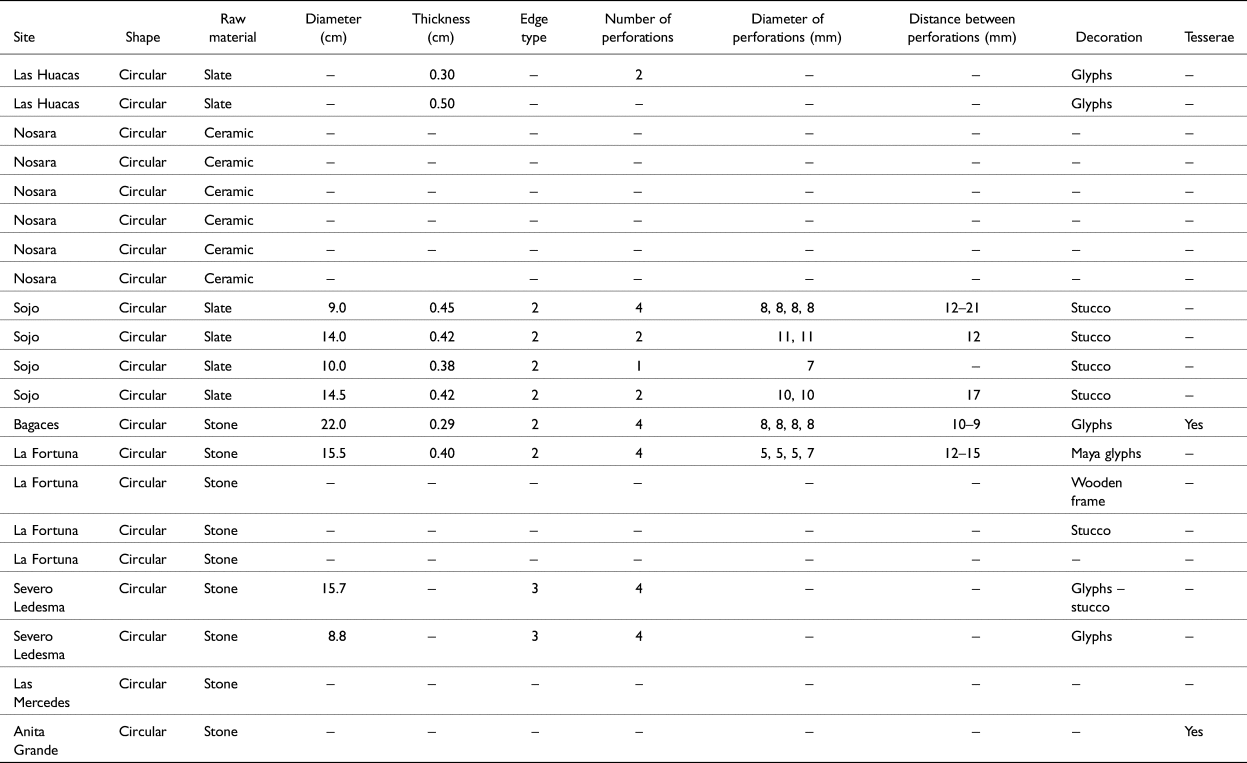
Of particular interest here, four tombs were shown to contain funerary offerings that included circular slate-back iron-ore mirrors. On the front (facing) side of these mirrors, traces of an adhesive were found, and on the back, traces of stucco with painted decoration in white, red, and pink (Figure 8). In each instance, the edges of the back are beveled inside (Gallaga Reference Gallaga, Gallaga and Blainey2016:12), with holes or perforations that run right through the mirror, from front to back, in order to attach or suspend the mirror (Gallaga Reference Gallaga, Gallaga and Blainey2016:16). Examining the examples individually, we note that one burial contained a complete slate mirror-back (Figure 8), measuring 9.0 cm in diameter and 4.5 cm thick, with a set of 0.8 cm drill holes on opposite sides (Table 1), along with an ear flare made of greenstone with red ochre. Another context revealed a mirror fragment, 14.00 cm in diameter and 0.42 cm thick (Table 1), with a 0.9 cm drill hole visible on the remaining edge, found together with a small ceramic vessel and a groundstone pestle. Another burial contained six medium-sized ceramic vessels and a mirror fragment measuring 10.00 cm in diameter and 0.38 cm thick (Table 1), from which one side with two drill holes had been cut off and reworked into a crescent-shaped tool (Figure 5). Finally, the fourth example found as a funerary offering was a slate-back cut down to an eighth of its original size, which measured 14.50 cm in diameter and 0.42 cm thick, and exhibited a set of 1 cm drill holes on one of its edges (Table 1). Alongside this was another reworked mirror-back in the form of a crescent-shaped tool, with the same dimensions as the accompanying fragment. Two tesserae were also discovered in this deposit (both oxidized, lightly polished on one side, and very well-preserved on the other), along with two polished stone celts. These tesserae fragments raise the possibility that the mirror was originally a composite one, like those described by Nelson et al. (Reference Nelson, Scheetz, Mata and Prado2009).
Mirror-back from Sojo, with traces of stucco decoration. Photograph by Ménager.

Mirror attributes.

A physicochemical and traceological (use-wear) analysis of the iron-ore mirrors and mirror fragments showed them all to have the same slate clay mixed with an organic material or adhesive, and that chert and obsidian tools were used to cut and polish the edges of the backs and the drill holes (Ménager et al. Reference Ménager, Tísoc, Cavallini, Conejo, Barboza and Salgado2021), which suggests that they were likely manufactured at the same location. In contrast, a variety of limestone, basalt, and granite tools were used to abrade the different mirror-backs, perhaps indicating the local recycling of mirrors manufactured in the Maya area. There is no evidence that local artisans used stucco as a construction material and, perhaps more relevant is that slate of this type is not found in Costa Rica, nor obsidian with the necessary characteristics for the fabrication of tools/cultural objects. On the other hand, the features of these mirrors are like those described by Arroyo (Reference Arroyo2023), which were recovered from intrusive pits associated with Ballcourt B at Kaminaljuyu. It is probable that these objects were manufactured in the same area as the Kaminaljuyu mirrors, but additional archaeometric analyses are required to determine the precise area of manufacture.
A more recent survey in the Tilaran area has located 45 additional sites (Aguilar Reference Aguilar1984:63; Mueller Reference Mueller, Sheets and McKee1994:51). Of these, only the Bolivar site (G-164) has yielded evidence for iron-ore mirrors. There, a single fragment from a slate mirror-back was recovered from within a funerary feature (Hoopes and Chenault Reference Hoopes, Chenault, Sheets and McKee1994:99). This lack of evidence is interesting and requires more investigation, but for now suggests localized, limited access to mirrors (or objects made of jade) in that area.
Bagaces
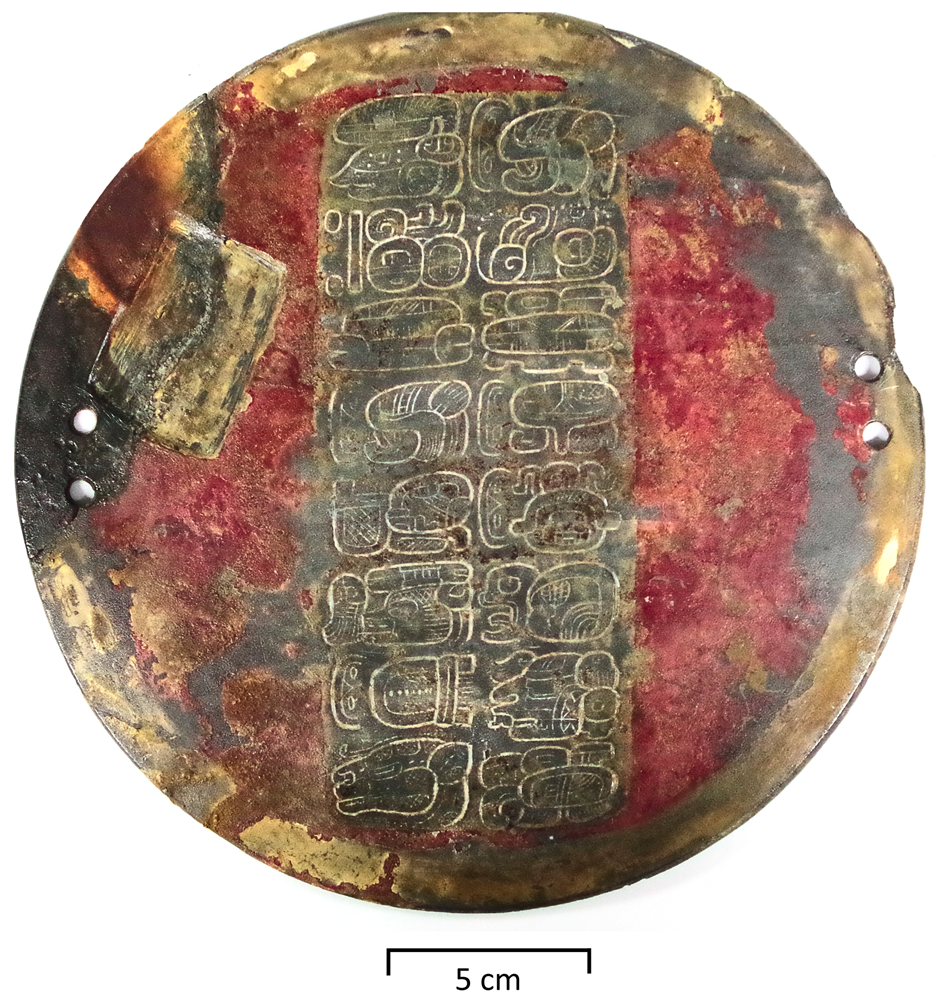
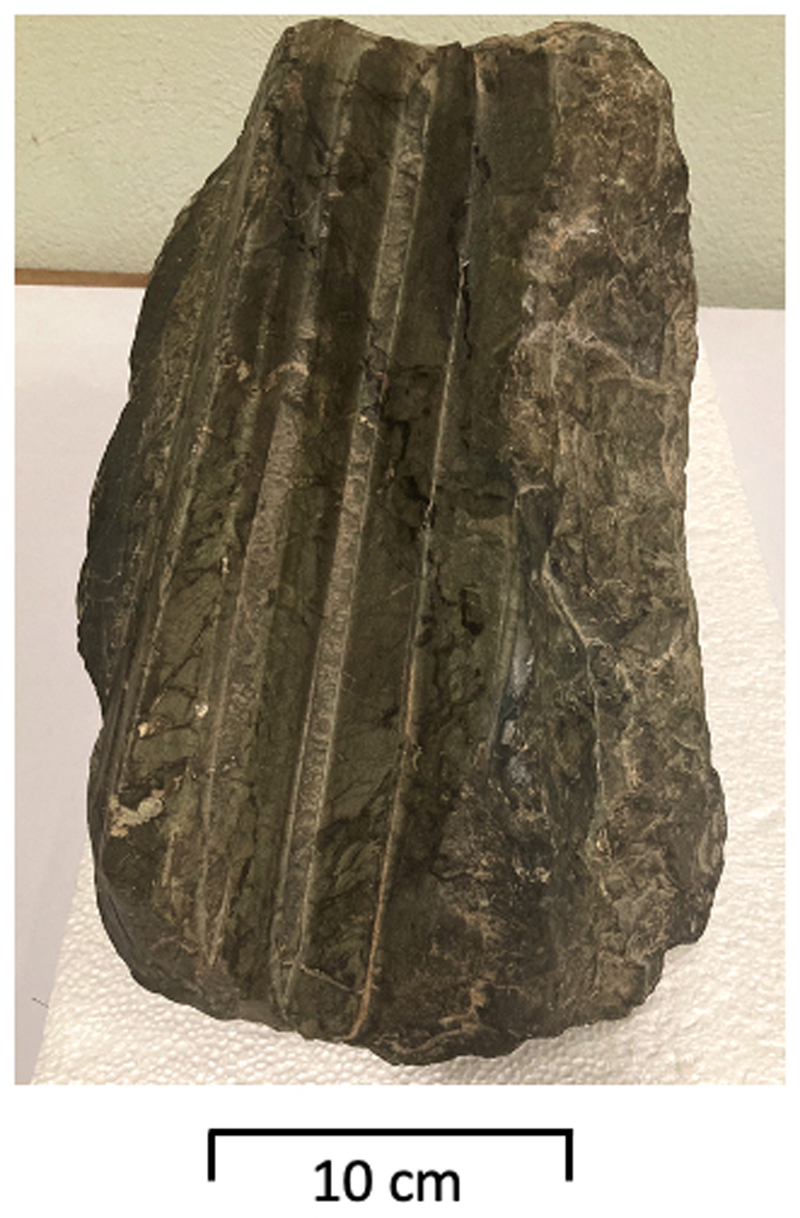
A mirror with Maya-style glyphs (Figure 9) was found by pot-hunters near the modern-day town of Bagaces, Guanacaste, along with a worked block of jadeite (Figure 10), Olmec- and Zapotec-style jade artifacts, and Classic Maya incised jade objects, including belt plaques that, according to Stone (Reference Stone1977:56, 60), were brought by Mesoamerican traders through the Gulf of Nicoya (Figure 2), and inland via the Bebedero River and its tributaries, the latter of which flow through the Bagaces area. Almost all incised belt plaques have been found in this area.
Bagaces mirror. Photo by Matthieu Ménager. Image courtesy of the collection of the Museo del Jade.

Jadeite block found in Bagaces, 35 cm long and 25 cm in height. Image courtesy of the collection of the National Museum of Costa Rica.

The Bagaces mirror is an Early Classic artifact on the scale of Teotihuacan-related mirrors in the Maya world (Helmke Reference Helmke2006), some of which were certainly mirrors worn by warriors on their backs (Taube Reference Taube and Berlo1992). It is unique in that it provides a textually attested relationship between two Maya rulers of related polities in the late fourth-century Entrada era. The text, as read by Mary Kate Kelly (personal communication October 2, 2020), Alexandre Tokovinine (personal communication May 11, 2021), and Stephen Houston (in Garrison and Houston Reference Garrison and Houston2019:24–26), broadly declares “his image” King Sihyaj Chan Ahk of El Zotz (including the adjacent outlying palace complex at Bejucal), his conjuring (darkness-creation) of/for his god, his gift (from) King K'inich Bahlam of Waka'. As Garrison and Houston (Reference Garrison and Houston2019) state in their monograph on El Zotz, this is a very important clue of the Entrada era alliance between El Peru-Waka', El Zotz, and Tikal in the fourth century, on the route linking these kingdoms to the west and Teotihuacan. This route was identified by Stuart (Reference Stuart, Carrasco, Jones and Sessions2000) and later affirmed by the El Peru-Waka' project (Freidel et al. Reference Freidel, Escobedo, Guenter, Sabloff and Fash2007).
A detailed epigraphic analysis of the text by Mary Kate Kelly, summarizing discussions with Marc Zender, reading from Houston, and with alternative readings of glyph A1 and reading of A2 by Alexandre Tokovinine, is shown below:
ta?/pu?-ji[bi] u-BAAH 7-CHIT-K'AN-NAL SIH [CHAN]AHK PA'[CHAN]-na-AJAW
? ubaah wuk chiit k'an nal sih[yaj] chan ahk pa'chan ajaw
“it is the … image in the place of the rising sun (of) Sihyaj Chan Ahk, the king of El Zotz”
u-BAAH u-CH'AB[AHK'AB]-li tu-K'UH-li u-MIJIIN CHAK-? a-ku
ubaah uch'ab yahk'baal tu k'uhuul umijiin chak ? ahk
“it is his image in engendering of/for his gods, the son of Chak ‘Fish Dog/Otter’ Ahk”
u-si K'INICH BAHLAM wa-ka-AJAW
usi[h] k'inich bahlam wak ajaw
“it is a gift(?) (from) K'inich Bahlam, the king of Waka'”
Through personal communications with Tokovinine, Kelly, and Zender, Tokovinine suggests a value of ta for the first syllable of the opening glyph and gives the following possibilities for its reading: ta-ji[bi], tajib, “shiner,” or ta-ji[bi] taj-ib[il], “illuminated,” or ta-[bi]ji, taabij, “smoking.” Alternatively, Kelly (based on discussion with Marc Zender) suggests the first syllable may read pu, though a reading based on this is not yet evident. This term is somehow qualifying the following glyph block and is possibly related to a name for the mirror itself. K'inich Bahlam I was vassal to Kaloomte' Sihyaj K'ahk', put into power in a.d. 378. The incising of the text is in an excellent hand and represents a tradition of writing found on leather-hard ceramic before firing, fresh soft stucco, and on hard stucco “graffiti.”
The central action of the mirror wielder is in the uch'aab yahk'baal “darkness-creation” phrase. This act of conjuring supernatural or divine beings, such as Wahy spirits, is the most powerful of Maya rulers (Stuart Reference Stuart, Coltman and Pohl2021). That is the main function of the Bagaces mirror. The depiction of mirrors provides clues as to the being conjured. For the Early Classic Maya (and the Preclassic Maya in some cases), the back position of Teotihuacan-style battle mirrors is occupied by a head mask. This back position for masks might represent an ancestor or the name/status of the wearer (Velázquez Reference Velázquez García2005). On the mid-fifth century Tikal Stela 31 depiction of Sihyaj Chan K'awiil II, the back mask is a jaguar head denoted as Unen Bahlam. She was queen and 12th successor in the Tikal dynasty (Freidel et al. Reference Freidel, Escobedo, Guenter, Sabloff and Fash2007; Martin Reference Martin and Sabloff2003). On the flanking portraits on Tikal Stela 31, King Yax Nuun Ahiin wears a Teotihuacan-style mirror-back (Taube Reference Taube and Berlo1992). In our view, the Bagaces mirror conflates this idea of identity/ancestor with the Teotihuacan battle god conjuring mirror. The Bagaces mirror was a portal, in this reasoning, for the conjuring of a battle god of Sihyaj Ahk, either worn or carried on a staff like the Tikal Marcador mirror effigy, empowered with Teotihuacan magic through Kaloomte' Sihyaj K'ahk', vassal of King K'inich Bahlam I (Freidel et al. Reference Freidel, Escobedo, Guenter, Sabloff and Fash2007). As such, the Bagaces mirror was a personal conjuring device for King Sihyaj Chan Ahk of El Zotz. The god that he would conjure would likely be a dangerous spirit companion, called Wahy in ancient Mayan. Houston (Garrison and Houston Reference Garrison and Houston2019) argues that the Wahy spirit belief was especially well-developed at El Zotz. Mirrors in this era could be important instruments of the kingdom. Tikal Stela 1 depicts King Sihyaj Chan K'awiil standing on a locality marked by a sun mirror (Taube Reference Taube and Berlo1992:Figure 19a), out of which is flowing the embodiment of Tikal as a latch-lipped bird framing the dawning sun.
Here we explore two plausible ways that the mirror found its way out of El Zotz and to Costa Rica: by capture in war or by looting of the king's tomb. Modern looting of Early Classic tombs at El Zotz is now documented, but whether any of those were entered in antiquity is not documented to our knowledge. The era of King Sihyaj Ahk was one of ongoing war between the allies of Teotihuacan and kings of the Kaan regime to the north. His capture would have included the capture of his power mirror. While it is possible that power objects could have been physically destroyed, such an act, in our view of Classic Maya beliefs, would have released its power, and perhaps a dangerous war god, into the realm of the victor. That made its exile to Costa Rica a viable alternative.
Classic mirrors in the northeastern region
As detailed above, Preclassic mirrors have been recovered in the northeastern region (ca. 300 b.c. to a.d. 300) at sites including Las Huacas and Nosara. Into the Classic period, the presence of Mesoamerican-related mirrors continues, but associated with different sites, including La Fortuna, Severo Ledesma, Las Mercedes, and Anita Grande, all of which are discussed below.
La Fortuna
This site is located on the tributary system of the San Carlos River, flowing into the San Juan River, which connects with the Caribbean Sea (Figure 2). Architecture at La Fortuna indicates it was a center of regional ceremonial and political relevance, and even though many features have been impacted or destroyed by both historic and modern activities (e.g., looting, agricultural development, and urban expansion) some earthen mounds, sunken roads, and burial grounds are still visible (Guerrero and Sanchez Reference Guerrero and Sánchez2006). Forty kilometers to the southeast is a similar site known as Cutris, covering an area of 50 ha, with mounds, platforms, terraces, and sunken roads, with the largest extending outward from the site for 9.4 km (Vázquez et al. Reference Vázquez, Guerrero and Sánchez2003).
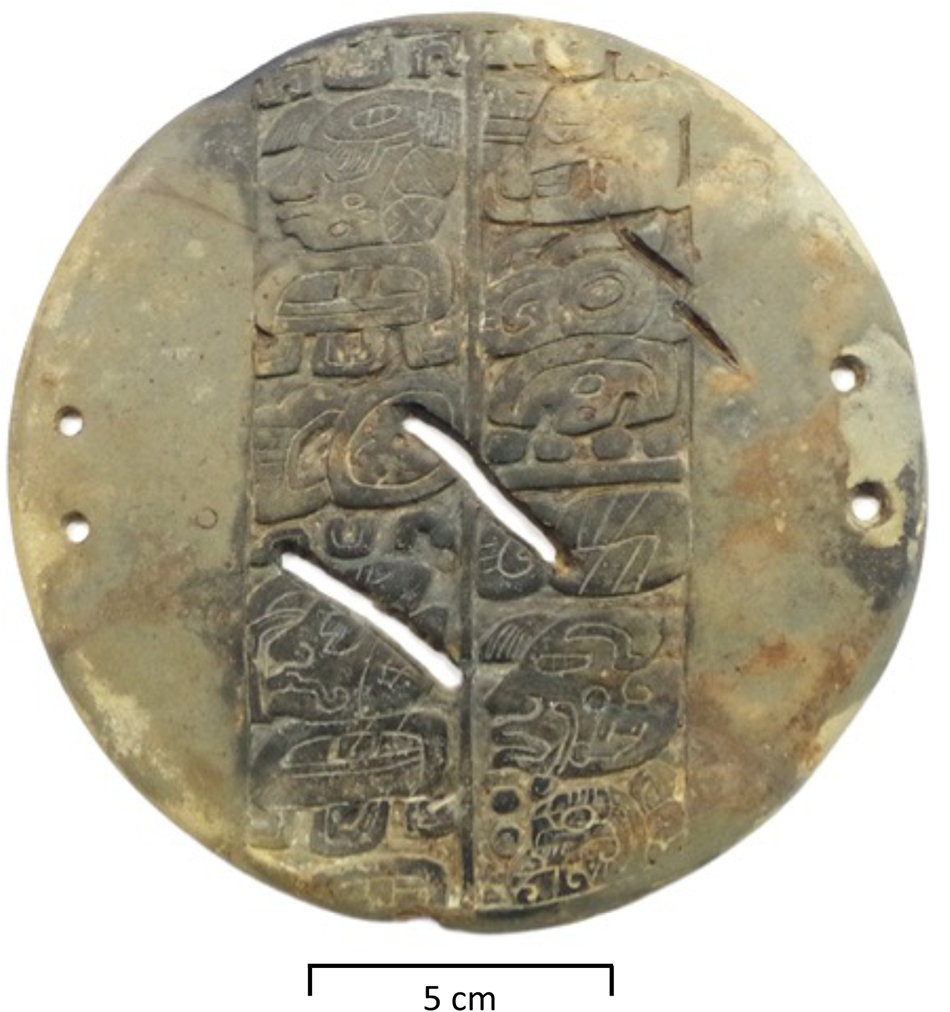
Stone and Balser (Reference Stone and Balser1965:312–313) traveled to La Fortuna after a looter showed them a mirror with two columns of carved Maya glyphs (Figure 11) and five jade pendants recovered from a cemetery at the site. In a summary report, they mentioned the burial ground had four burial groupings, each with 25 to 40 individual graves. In the group where the looter originally located the grave with the mirror with two columns of glyphs and a reworked jade axe-pendant, it was noted that a total of 20 graves had been ransacked (Stone and Balser Reference Stone and Balser1965:317, Figure 15). There, Stone and Balser excavated five graves that remained “unexplored.” One of the graves contained fragments of a round disk and remnants of a wooden frame, three grinding stones, and a polychrome vessel. The second grave also contained fragments of a slate disk, with traces of red and white stucco on the back, and four ceramic vessels. The third grave contained a slate disk, a jade axe-pendant, two grinding stones, and fragments of two ceramic vessels. The fourth burial yielded three ceramic vessels, and the fifth held a single fragment from two vessels, as well as a metate. Preliminary analysis by Baudez of the ceramics recovered from these contexts suggests an a.d. 300–500 date range, based on the presence of types such as Guinea Incised and Charco Black-on-Red (Baudez and Coe Reference Baudez and Coe1966:441–442). Importantly, Stone and Balser (Reference Stone and Balser1965:313–315) also noted artifacts recovered from 19 looted graves, including 19 jade objects (4 long, tubular beads and 15 pendants), 18 groundstone metates, and 8 additional mirror fragments or complete slate backs, each from a different grave.
La Fortuna mirror. Photo by Matthieu Ménager. Image courtesy of the collection of the National Museum of Costa Rica.

The mirror with the two columns of Maya glyphs measured 15.5 cm in diameter, and was 0.4 cm thick (Table 1), with a pair of drill holes on opposite edges, each measuring 0.5 cm in diameter (Figure 11). In the 1960s, Stone asked Eric S. Thompson to interpret the mirror, and he argued that 90 percent of the glyphs were decorative, and that the mirror was manufactured around a.d. 435 in the Central Peten area near Tikal (Thompson, cited by Stone and Balser Reference Stone and Balser1965:316). Another recent interpretation proposes a manufacturing range of a.d. 379–455, based on the similarity of designs in the text to those on the ballgame marker at Tikal, which was dedicated in a.d. 416, as well as the graphic design of various symbols (e.g., T16 and T124) that are consistent with these dates (Mora-Marín et al. Reference Mora-Marín, Reents-Budet, Fields, Arroyo, Salinas and Álvarez2018:146).
Severo Ledesma
Stone and Balser (Reference Stone and Balser1965) visited another looted cemetery known as El Tres, located in a sector of the larger Severo Ledesma site (Salgado Reference Salgado González, Araya Jiménez and González2015:100). Snarskis (Reference Snarskis, Lange and Stone1984) conducted research at Severo Ledesma, which is located on a fertile plain, roughly 2 km from a tributary of the Parismina River that flows into the Caribbean Sea (Figure 2). In the local El Bosque phase (100 b.c. to a.d. 500), Snarskis encountered differences among domestic units in terms of design and artifact assemblages, as well as in funerary offerings encountered in an associated cemetery. Beneath the largest identified house structure, seated atop an earthen mound, he encountered a grave containing 27 artifacts, including ceramic vessels and musical instruments, as well as “an incomplete flying-panel metate, a necklace of jade disk beads with sporadic larger pendants, and a central jade avian pendant of about five centimeters in length” (Snarskis Reference Snarskis, Quilter and Hoopes2003:170). Apparent differences in access to goods and certain spaces across the site have been interpreted as evidence for the existence of social hierarchy (Snarskis Reference Snarskis, Lange and Stone1984:209).
The cemetery of El Tres had 125 graves, three of which were excavated by Doris Stone (Stone and Balser Reference Stone and Balser1965:317–321). One contained three ceramic vessels and seven carved metates, with small human heads crafted around the metate plate. The second yielded ceramic vessels and a flying panel metate, while the third contained just a few ceramic sherds. In the course of these excavations, Stone also recorded offerings from two other graves that contained iron-ore mirrors (Stone and Balser Reference Stone and Balser1965). Of these two, Grave 1 contained a slate mirror-back with engraved designs (Figure 12a), stone ceremonial mace heads, a jade pendant in the form of a curly-tailed animal, several ceramic vessels, and eight ornaments made of tumbaga, an alloy combining copper and gold. The second, Grave 2, contained a small effigy vessel with a human face, a rectangular metate, five tumbaga pendants, two stone ceremonial mace heads (one of green slate with pyrite inlays), and an engraved slate disk (Figure 12b).
Drawings of engraved mirror-backs from Severo Ledesma: (a) Maya-style mirror; (b) Teotihuacan-style mirror. Drawings by María López.

The mirror found in Grave 1 (Figure 12a), had a diameter of 8.8 cm and two drill holes (Table 1) on opposite edges, with an “engraved scroll motif consisting of alternating large and small units. Each unit appears twice, and the design encircles the plaque, suggesting the tail and body of a serpent.” This decoration was initially attributed to the Classic period Veracruz stylistic tradition (Stone and Balser Reference Stone and Balser1965:319; see Figure 7a), but has since been identified as a style from the Maya area during the Early Classic period (Baudez and Coe Reference Baudez and Coe1966:442; Mora-Marín et al. Reference Mora-Marín, Reents-Budet, Fields, Patton and Manion2017:182). The mirror found in Grave 2 (Figure 12b) has a diameter of 15.7 cm, with the same perforation features as the previous example (Table 1). Adhesive residue was found on it, with polygonal pyrite tesserae and, on its back, engraved scenes with traces of white and red stucco. The interpretations of these scenes have varied. While Stone and Balser (Reference Stone and Balser1965) proposed several interpretations of the symbols and related them to Classic period Veracruz culture, John Hoopes (Reference Hoopes, Pillsbury, Potts and Ritcher2017:59) considers this artifact to be of Teotihuacan style and points out that one of the scenes shows a Spondylus diver conversing with a merchant from Teotihuacan. Lastly, Dennett and Blainey (Reference Dennett, Blainey, Gallaga and Blainey2016:236) suggest that both mirrors were manufactured in the Guatemalan highlands, where similar styles have been found at sites such as Kaminaljuyu and Zacaleu.
The graves reported by Stone and Balser (Reference Stone and Balser1965) display marked differences in their contents. Graves 1 and 2 stand out because of their offerings, which show that access to certain goods of foreign origin or local manufacture was limited to a segment of individuals buried there. It appears that of the 125 graves, 25 located in the middle of the cemetery had rich offerings, including five additional iron-ore mirrors with traces of stucco decoration, as well as a significant portion of at least 60 ceremonial metates and 150 jade pendants.
The artifacts of gold or gold and copper alloy found at El Tres are stylistically related to the initial metal group, a style that extended from northern Colombia to Costa Rica from roughly a.d. 200–600 (Bray Reference Bray1997:39). Recent archaeometric research has provided evidence of the local production of an initial metal group ring with high copper content, found at Cerro Juan Díaz in Central Panama (Fernández Esquivel Reference Fernández Esquivel2011:228), dating to around a.d. 130–370, according to analysis of the dentin collagen from an individual found in the same funerary context where the ring was deposited (Cooke et al. Reference Cooke, Isaza, Griggs, Desjardins, Sánchez, Quilter and Hoopes2003:95). Therefore, it is uncertain whether the gold pendants from El Tres were manufactured in Colombia, Panama, locally, or a combination of these places.
Las Mercedes and Anita Grande
Both sites are located in the Caribbean lowlands (Figure 2), alongside navigable rivers flowing into the Caribbean Sea. The distance between the two sites is approximately 13 km and both were inhabited from 1500 b.c. until the sixteenth century, with an increase in population from a.d. 300 onward. The process of development into socially complex political and ceremonial centers likely began around a.d. 600 and became unmistakably evident in subsequent centuries, with the architectural development of mounds as platforms for houses, plazas, and paved roads, as well as the production of sculptures as symbolic elements in public spaces (Vázquez and Rosenswig Reference Vázquez and Rosenswig2016).
At Las Mercedes, Skinner (Reference Skinner and Lothrop1926) excavated four burial grounds, of which Cemetery 2 was composed of 32 stone-walled tombs with stone floors. In Grave 2, funeral offerings included a circular mirror-back, two greenstone earrings, an artifact Skinner (Reference Skinner and Lothrop1926:451) described as a “beautiful jade idol” along with eight ceramic vessels, two censers, and three flint blades. In the remaining 31 graves the funerary offerings were varied. In one there were pottery vessels and two jade ornaments; in another, a vessel and a copper bell. Six tombs contained pottery, stone celts, and some sort of small stone sculpture, in four other tombs, vessels and stone celts were found, while 19 graves contained only ceramic vessels, and two contained no funerary offerings at all. Unfortunately, there are no identifications for the recovered ceramics, which makes establishing a precise date for the burials difficult, although it is probable that the grave with a circular mirror-back dates to no later than a.d. 600, when jade production declined in the region. The presence of small sculptures among the offerings and on the surface of the burial ground suggests that the area was used for burials starting sometime between a.d. 300 and 400.
At Anita Grande, Skinner also excavated a looted mound where he found some undisturbed graves. In written notes, he describes Grave 2, where he found a circular disk with iron-ore tesserae, two stone celts, and a ceramic plate (or salver) that was broken into four pieces and intentionally deposited (Skinner Reference Skinner and Lothrop1926:464) in each of the four corners of the rectangular tomb. Currently, no time frame can be established for these offerings or their surrounding contexts.
Conclusions
The notable presence of iron-ore mirrors in northern Costa Rica fundamentally demonstrates a degree of interaction with the Maya area. So far, a review of select funerary contexts shows the consistent presence of single mirrors in individual graves. In most cases, jade artifacts occur in context with these mirrors (or reworked mirror fragments), an association also noted at contemporaneous sites in the Maya area, such as Kaminaljuyu.
Temporally, mirrors in Costa Rica occur in contexts ranging from approximately 300 b.c. to a.d. 300. In the northwest region near the Pacific Coast, we encounter the presence of the U-shaped motif at Las Huacas, which suggests connections with Izapa, the Pacific Coast or the southern highlands. Early Classic mirrors were distributed in both the northwestern and northeastern regions of Costa Rica, indicating connectivity that expanded to include both the Maya Highlands and Lowlands. Dennett and Blainey (Reference Dennett, Blainey, Gallaga and Blainey2016) have recently explored several hypotheses to explain the presence of Mesoamerican iron-ore mirrors in southern Central America. Of those explored, it seems that the peer elite hypothesis is perhaps the most convincing and applicable to this current analysis. They propose that “many of these mirrors have arrived at their destination as a result of symbolic sociopolitical exchange, or ‘gifting,’ between ‘peer elites’” (Dennett and Blainey Reference Dennett, Blainey, Gallaga and Blainey2016).
Most mirrors have been found in sites where cumulative evidence suggests emerging status differentiation, such as that seen at Las Huacas and Nosara from around 300 b.c. to a.d. 300, or at larger regional centers like those discussed for the northeastern region around a.d. 300–600. The Sojo site stands out as a possible exception, with its simpler funerary offerings, its location in a region where jade artifacts are scarce (Mueller and Chenault Reference Mueller, Sheets and McKee1994), and the overall lack of identifiable regional center. Certainly, those who brought the Maya royal mirrors to La Fortuna and Severo Ledesma were cognizant of the political geography of the region. These sites were inhabited from at least 300 b.c. through to a.d. 1200, emerging as regional centers between a.d. 300 and 600. This may be explained, in part, by their strategic geospatial location, which provided both access to the Caribbean Sea and proximity to the mountain range connecting the highlands to the Pacific lowlands, all of which facilitated control over valuable foreign goods for people seeking distinction and power. Although we lack knowledge about the context of the Bagaces royal mirror, it may be assumed (and we expect) that such a powerful conjuring device would have been placed into an elite context, like those discussed for the Caribbean lowlands.
It has been assumed that because Costa Rican artisans sometimes reworked both mirrors and objects of jade, such as belt plaques and celts, among others, that they were unaware of the symbolic charge these types of objects contained (Lange Reference Lange and Lange1992:118). Graham (Reference Graham and Graham1993:23, Reference Graham and Jones1998), however, opposes this idea, suggesting, instead, that “it was all understood: the cutting of the belt celts may have been a kind of symbolic appropriation of the power and sanctity of the Maya lords that were embodied in the celt.” We argue here, based on the evidence presented, that the Costa Rican peoples fully understood, and that this knowledge also applied to mirrors, regarding their value, purpose, and use.
The distribution of mirrors dating from the Late Preclassic and Early Classic periods has an uneven distribution in Central America. Beyond Mesoamerica, and the Maya area particularly, mirrors or fragments thereof have been reported from northeast Honduras (Dennett and Blainey Reference Dennett, Blainey, Gallaga and Blainey2016) and northern Costa Rica (see Figure 1). This geographic distribution suggests that sea navigation was the primary means of transport in their exchange, something that Coe (Reference Coe1962) had proposed much earlier for contacts and exchange occurring between Mesoamerica and Costa Rica. Indeed, there is clear evidence of travel by water among the Maya, since the Late Preclassic, along both the Pacific Ocean (Favila-Vázquez Reference Favila-Vázquez2020) and the Caribbean Sea (McKillop Reference McKillop2010), as well as by Chibcha peoples in the same time frame (Ibarra Rojas Reference Ibarra Rojas2011, Reference Ibarra Rojas2020).
Mora-Marín and colleagues (Reference Mora-Marín, Reents-Budet, Fields, Patton and Manion2017, Reference Mora-Marín, Reents-Budet, Fields, Arroyo, Salinas and Álvarez2018; see also Reents-Budet et al. Reference Reents-Budet, Mora-Marin, Fields, Arroyo, Salinas and Ajú Álvarez2018) have argued that the interaction between the Maya and Chibcha peoples was systematic and institutionalized, the result of a longstanding exchange that occurred over at least 1,000 years. This, they suggest, was interaction that was based not only on goods, but also on ideas. As we have argued here, such ideas were present beginning in Preclassic times, as demonstrated by the appearance of the U-shaped motif found on the Las Huacas mirror, for example. Jadeite was clearly a valuable material for the Chibcha, but a variety of bird feathers, cacao, Spondylus shells, and pearls, among other materials, could have been attractive resources that were available in Costa Rica and desired by the Maya for use in their ritual economy.
Taube (Reference Taube, Gallaga and Blainey2016:287) also offers a viable reason for the presence of mirrors in Costa Rica, stating that the Classic Maya were keen to obtain the tail feathers of the quetzal bird, which may have been overhunted in the Maya region, thus forcing them to seek an alternative source to the south. Indeed, the niches where quetzal birds are found are abundant in the mountain range that runs through Costa Rica from north to south (Figure 1b), while in Nicaragua, with its lower mountains, there are only a few places where quetzals are present. At Las Huacas, 42% of the jade avian pendants represent the quetzal bird (Fonseca and Scaglion Reference Fonseca and Scaglion1978), even though the site is located roughly 75 km away from the bird's natural habitat.
Chibcha divers retrieved Spondylus shells and pearls (Pinctata margaritifera mazatlanica) from the Gulf of Nicoya and the Gulf of Papagayo (Figure 2), both treasured materials for the Maya. Spondylus jewelry (crafted from S. crassisquama [princeps]) has been recovered from sites along the Bay of Culebra, in contexts dating from at least 300 b.c. to a.d. 1350 (Snarskis Reference Snarskis and Young-Sánchez2013; Solís and Herrera Reference Solís and Herrera2012), where pearls have also been found in a funerary context dating to a.d. 900–1350, at the site of Jivaro (Cleria Ruiz, personal communication 2021). Due to the high quality of these pearls, indigenous divers were forced by the Spaniards to continue to extract Pinctata mazatlanica pearls well into the eighteenth century (Payne Reference Payne2008).
Cacao was a significant material in the Maya ritual economy (Wells and David-Salazar Reference Wells, David-Salazar, Wells and David-Salazar2007:1), as well as among some Chibcha groups. Cacao orchards were located along the Pacific lowlands in Nicoya and to the south in Quepos, as well as in the northern Caribbean lowlands and to the south in the Valley of Sixaola (Figure 1c; see Bergmann Reference Bergmann1969:95–96).
Finally, it is relevant to bear in mind that in the Caribbean lowlands around a.d. 300, exchanges with northwest Colombia and Panama led to the import of gold, copper, and alloy ornaments, along with local production in the area where Severo Ledesma, Anita Grande, and Las Mercedes are located (Fernández Esquivel Reference Fernández Esquivel2011). In this regard, Chibcha traders may have served as intermediaries, helping to facilitate the early exchange of these goods between more southerly groups and the Maya.
All of these examples provide tantalizing clues that require further exploration, but what we do know is that if we want to better understand the relationship between Costa Rican peoples and the Maya in the distant past, we need not only to augment our archaeological knowledge, but also to grow our understanding of indigenous world views.
Acknowledgements
We would like to thank the Museo Nacional de Costa Rica and the Museo de Jade for facilitating access to their collections of iron-ore mirrors, and the Centro de Investigaciones Antropológícas (CIAN) of the Universidad de Costa Rica for their support with project registration and development. Finally, we would like to acknowledge and thank our coresearcher, Carolina Cavallini, and research assistant, Nataly Barboza, for their participation in the initial research and materials analysis carried out at the Universidad de Costa Rica.
Funding
This project was supported by a grant from the Vicerrectoría de Investigación of the Universidad de Costa Rica, awarded under the project title “Reflejos que enlazan: Producción, distribución e intercambio de los espejos de pirita en Mesoamérica y el Sur de Centroamérica”: (839-B9-771).